<?xml version="1.0" encoding="UTF-8"?>
<feed xmlns="http://www.w3.org/2005/Atom">
  <title type="text">Cleveland Historical</title>
  <updated>2026-08-21T21:05:42+00:00</updated>
  <generator uri="http://framework.zend.com" version="1.12.20">Zend_Feed_Writer</generator>
  <link rel="alternate" type="text/html" href="https://mail.clevelandhistorical.org/"/>
  <link rel="self" type="application/atom+xml" href="https://mail.clevelandhistorical.org/items/browse?output=rss2"/>
  <id>https://mail.clevelandhistorical.org/</id>
  <author>
    <name>Cleveland Historical</name>
    <uri>https://mail.clevelandhistorical.org</uri>
  </author>
  <link rel="hub" href="http://pubsubhubbub.appspot.com/"/>
  <entry>
    <title type="html"><![CDATA[Lake View Park: The Rise and Fall of  Cleveland&#039;s Forgotten First Park]]></title>
    <summary type="html"><![CDATA[<p><strong><em>“Lake View Park! How many can remember the view from there, north, east, west far to the horizon of Lake Erie. Sailing vessels would stand along the sky line, jibs and mainsails immovable as in a picture. Down below passenger engines would move on the Lake Shore tracks, with stately shining stacks, deer horns behind the head lights, and flashing flag rods. From your seat under trees along Summit Street you would look again. Those vessels had moved. You could see it. Slowly creeping ahead until past or off Cleveland’s harbor.” —S. J. Kelly, <em>Plain Dealer</em> columnist (1936)</em></strong></p><img src="https://mail.clevelandhistorical.org/files/fullsize/45bdb96df37dff9953bca297c45eb4e0.jpg" alt="An Artistic Rendition of Lake View Park" /><br/><p>In 1936, Cleveland newspaper columnist S. J. Kelly reminded Clevelanders of the loss of what was once the pride of the Forest City—Lake View Park. The origins of Lake View Park can be traced back to 1867, when a group of citizens visited Mayor Stephen Buhrer to request a lakeside park, leading the city council to recommend acquiring land. In 1869, the Ohio legislature passed a bill that enabled the city council to condemn and purchase land for Cleveland’s first park. Council approved buying property between the lakefront railroad tracks and Summit Street (a street that once ran a block to the north of today’s Lakeside Avenue) from Seneca (W. 3th) to Erie (E. 9th) Streets. In 1871 the mayor appointed the first Board of Park Commissioners, empowering them to levy taxes for park purposes. It took two more years before the land was fully appraised and purchases were completed to assemble ten acres.</p><p>In 1874 the park commissioners authorized issuing $50,000 in bonds for park development. The city then removed the shanties along Summit Street and graded and terraced the bluff. Landscape gardener C. T. Shueren devised a plan of improvements. City workers planted trees, sculpted ponds, and created decorative features. Instead of allowing the entirety of Cleveland’s downtown lakefront to be given over to shipping and industrial interests, the city had used its natural resources to its advantage, opening up the first city park as a showcase for the natural beauty of the lakefront. For the 1876 U.S. Centennial, the park offered a favored vantage point for Clevelanders and out-of-towners to watch a “sham” reenactment Commodore Perry’s battle on Lake Erie. Through ongoing beautification work, by 1885, Lake View Park was reportedly a showplace that must have impressed railroad passengers on the Lake Shore & Michigan Southern line that ran past the lower level of the park.</p><p>Lake View Park included many pathways which visitors could walk through to observe the gorgeous flower fields, rock grottos, manmade lakes, and unique features such as the large fountain—fashioned in the likeness of what observers variously described as a dinosaur, dragon, or lizard—which stood in the middle of the park grounds. The public reception to Lake View Park was overwhelmingly positive, with many praising the naturalistic environment that was in stark contrast to the dominant industrial and commercial sections of the central city.</p><p>Despite the attractiveness of Lake View Park, it was not without its problems. Periodic news reports make clear that by the 1880s, the park already had “acquired a tough reputation.” It was a “rendezvous” for “improper purposes,” “infested by mashers” (a Victorian-era reference to men who sexually harassed women), lined with saloons, and often “virtually deserted.” Given the park’s prime location alongside downtown, existing railroad rights-of-way, and the lake, not to mention the problems the park faced, the city entertained various proposals from business interests to redevelop the area. One proposal in 1889-90 was for a 10,000-seat exposition hall in the park, which it was held would rival similar venues in Detroit and Pittsburgh as a tourist attraction.<span> </span>However, iron and steel interests hoped eventually to expand the industrial usage of the lakefront, and some city officials decried the loss of Cleveland’s only central park on the lake. Ultimately the plan was dropped.</p><p>External pressure from rising industrial powers to replace Lake View Park would be enough for most local governments to consider the offers, especially with the promise of a future economic boom. However, Cleveland officials and citizens regularly pushed back against threats to close the park. Citizens formed committees and brought petitions to court to protect Lake View Park, and the local government regularly hosted events on park grounds to show that interest was still high. However, industrialists’ interest in the lakefront was unmoved by citizen interest in public access to the waterfront. Therefore, it came as little surprise that, in 1907, a new union railroad depot was approved for the Lake View Park site as part of the <a href="https://clevelandhistorical.org/items/show/56">Group Plan</a>. The station plan, however, met with severe backlash in 1910 from park supporters, who argued that the establishment of a railroad depot was antithetical to the very reason that Lake View Park was established and offered a less-people-friendly experience to visitors. Despite grievances from the public, city officials viewed the union depot as far too important to reject. Only the federal government’s concern during World War I about local rail traffic impeding cross-country traffic along the lakefront lines prevented the lakefront union station from reaching fruition.</p><p>Nevertheless, even as the debate over building a union depot raged, the decline of Lake View Park became apparent and too rapid to stop. The worsening pollution caused by the aforementioned railroad, as well as the numerous factories established through the city, suffocated the natural life in the park. The park’s trees and flowers began to wilt and die and its manmade lakes, which were once a beautiful highlight, became toxic and polluted. Despite preventing industrial society from directly destroying Lake View Park, the city was unable to stop the negative effects that industrialism had on the environment, which destroyed the park all the same.</p><p>The effect that pollution had on Lake View Park led to a further drop in attendance, but the park’s end did not come right away. Instead, as is usually the case with redevelopment, it awaited a firm plan that could make it off the drawing board. That firm plan came in early in the 1930s, soon after construction of the multipurpose <a href="https://clevelandhistorical.org/items/show/149">Cleveland Municipal Stadium</a>, when the city built an underground garage for nearby City Hall. By that time, “made land” (or fill) had shifted the water's edge some 1,000 feet to the north, making the “lake view” a more distant one. Ever an astute observer of Cleveland’s changing cityscape, <em>Plain Dealer</em> columnist S. J. Kelly noted that the dragon fountain, once the park’s conversation piece, was headless by that time and carried off by a junk dealer.</p><p>Despite efforts from citizens and local city planners, this beautiful and unique landmark which afforded a place to marvel at the majesty of one of the Great Lakes was allowed to waste away until its final demise went unmourned. Clevelanders today have no memory of Lake View Park, which has been buried beneath parking garages for nearly a century. Lake View Park was a final bastion of naturalist beauty and appreciation along a Cleveland downtown lakefront dominated by capital interests. With its demise, officials, planners, and citizens would struggle for the next century to give Clevelanders a people-friendly lakefront.</p><p><em><strong><a href="https://mail.clevelandhistorical.org/items/show/996">For more (including 9 images) view the original article</a></strong></em></p>]]></summary>
    <published>2022-12-02T03:42:46+00:00</published>
    <updated>2026-04-17T19:17:42+00:00</updated>
    <link rel="alternate" type="text/html" href="https://mail.clevelandhistorical.org/items/show/996"/>
    <id>https://mail.clevelandhistorical.org/items/show/996</id>
    <author>
      <name>Will Bailie</name>
    </author>
  </entry>
  <entry>
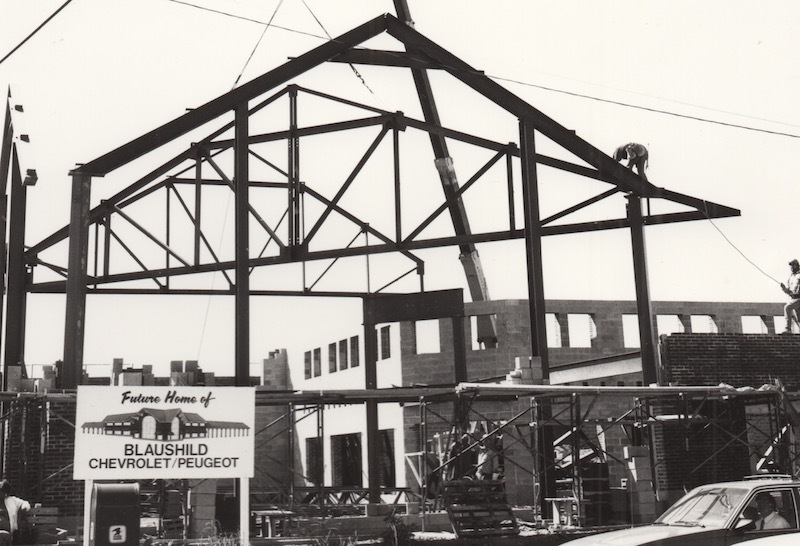
    <title type="html"><![CDATA[A Public Service Message from David Blaushild Chevrolet: &quot;Let’s Stop Killing Lake Erie!&quot;]]></title>
    <summary type="html"><![CDATA[<p><strong><em>In July of 1964, motorists were greeted by the newest billboard from Shaker Heights auto dealer David L. Blaushild.  Bold letters declared: “Let’s Stop Killing Lake Erie, have your council vote Anti-Pollution!"  Learn how one car salesman  helped initiate an environmental movement in Cleveland that pushed lawmakers to publicly recognize and respond to the lax enforcement of antipollution laws.  </em></strong></p><img src="https://mail.clevelandhistorical.org/files/fullsize/b52b771ceac298f1e9f52ffb08a7719e.jpg" alt="Future Home Of Blaushild Chevrolet / Peugeot" /><br/><p>In July of 1964, motorists traveling along the Inner Belt Freeway south of Memorial Shoreway were greeted by the newest billboard from Shaker Heights auto dealer David L. Blaushild. Bold letters spanning a giant 80- by 20-foot sign declared: “Let’s Stop Killing Lake Erie, have your council vote Anti-Pollution! write…David Blaushild 16003 Chagrin.” The environmentally conscious car salesman acquired free use of 15 billboards in the Cleveland area, and was using them to draw attention to the issue of lake pollution. A series of advertisements in Cleveland’s newspapers complemented the imposing signage, and called on the citizenry to join the crusade. Blaushild asked Clevelanders to express their support for the cause by filling out and mailing in a coupon to his dealership, which would be forwarded to public officials. An overflow of public response prompted the salesman to expand his efforts. He began sending both petitions and an antipollution resolution to those that replied to his ads. The respondents could then circulate the petitions within their communities throughout the greater Cleveland area, and submit with the proposed statement of position to local governing bodies for adoption. By some accounts, over half a million signatures were gathered between June and August. Twenty-six towns along Lake Erie passed Blaushild’s resolution calling on the Ohio Governor to take steps towards preventing industrial and sanitary pollution from reaching public waters. </p><p>David Blaushild’s Moreland-based Chevrolet dealership served as headquarters for the petition drive. Both his surname and automobile promotions had long been known in the Cleveland and Shaker Heights area. Just one year prior, he had caused a minor stir with another billboard located near Fairhill (Stokes Boulevard) and Petrarca Roads. As described by Cleveland Plain Dealer, “Tired businessmen driving home…have been met by the sight of two scantily clad young women cavorting on the catwalk of a billboard.” Police intervened after receiving complaints, which Blaushild chalked up to the doings of rival auto dealers. Beyond enlisting bikini-models to sell cars, he was also known for imaginative radio and print advertisements. In 1963, Blaushild employed the Cleveland Orchestra to record a minute-long jingle promoting a “classically, classical deal at David Blaushild Chevrolet.” </p><p>Beyond his sometimes-questionable promotional tactics, Blaushild’s name carried weight in the auto sales industry. Lester Blaushild, David’s father, opened a franchise of the Star-Durant car line around 1921 at 12100 Kinsman Road. Keeping up with the rapidly changing automobile industry, Lester switched to the Hudson-Essex line before finally settling with a Chrysler dealership in 1931. The Latvian immigrant brought members of his family to Cleveland during this time, including his brother Bennie. Bennie started working for Lester in 1924, and soon after opened B.W Blaushild Motors, Inc. at 15215 Kinsman Road. The Dodge-Plymouth dealership relocated within Mount Pleasant at 14307 Kinsman Road in 1932, and eventually opened a showroom at the Kinsman-Lee intersection in Shaker Heights at 16333 Kinsman Road by 1948. All the while, Lester’s dealership grew by bounds. Regularly touted as the largest Chrysler dealership in the region, at one time it was the third largest in the country. In 1949, Lester opened a new Chrysler-Plymouth showroom at 16005 Kinsman Road. </p><p>David Blaushild worked for his father’s auto dealership beginning in 1938. With the advent of World War II, David enlisted in the U.S Army Air Forces. Joining in 1942, he served as a photo intelligence officer in Europe for nearly the duration of the war. Upon his discharge, Lester offered David the choice to work in the mechanic shop or frontroom. David chose the latter, at which point his father removed himself from the business’ daily operations. Following the relocation of both the Dodge-Plymouth and Chrysler-Plymouth auto dealerships to Shaker Heights at midcentury, the Blaushild name became a fixture in the emerging Kinsman-Lee auto row. A year after Lester’s death in 1958, David transitioned the business into a Chevrolet dealership. The Chevrolet dealership expanded to include a showroom across the street at 16222 Chagrin Boulevard in 1963.</p><p>A trip to Shaker Lakes in the summer of 1963 drastically altered the trajectory of David Blaushild’s life for the next decade. Hoping to share fond childhood memories of visiting the recreation grounds with his young daughter, David Blaushild arrived to find the body of water emitting a rancid odor and littered with garbage. Similar to most cities situated along Lake Erie, both Shaker Heights’ and Cleveland’s sewage infrastructure was outdated and ineffective. With excessive rain, the sewer systems regularly failed and raw waste flowed into the surrounding rivers and lakes. He quickly discovered that Lake Erie was in just as bad of shape. In addition to being a final destination for much of the region’s sewage overflow, the lake was used as a dumping ground for untreated chemical waste by local industries. </p><p>Blaushild immediately began working to raise public awareness about the sad state of the region’s water supply. He was not alone in advocating for the modernization of sewage systems or holding industries accountable for breaking antipollution laws. Increasingly since the early 1960s, scientists and environmental activists voiced their concerns over the alarming levels of pollution in Lake Erie. Blaushild, however, effectively used his skills as an advertiser, salesperson and showman to bring this crisis to light and build a base of support that could influence policymakers. In addition to his billboard and print campaign, Blaushild booked television appearances, radio interviews and a speaking tour to spread his message. Local newspapers similarly began to call on lawmakers to take action on water pollution issues. </p><p> As support for Blaushild’s cause grew, governing bodies of communities along Lake Erie were quick to adopt his resolution. Cleveland Mayor Ralph Locher initially rejected the non-binding proposal, however, citing the potential negative economic impact on local industry if antipollution laws were strictly enforced. Following public outcry, the resolution passed in the fall of 1964. The following year, Ohio’s Governor requested a federal government conference be held concerning Lake Erie pollution. Blaushild used the opportunity to present state officials over 200,000 signed petitions and letters that had been collected over the course of his campaign. </p><p>The Woods and Water Club of Cleveland named Blaushild their Man of the Year in 1964, noting that he had “single-handedly…done more than any other person to fight pollution of our lake and waterways.” The highly visible media campaign, however, only marked the beginnings of a nearly decade-long battle waged by Blaushild to raise public awareness about the region’s water pollution crisis. In 1965, Blaushild sued the City of Cleveland for failing to enforce water pollution laws. He asserted that the local government turned a blind eye to local industries that dumped untreated chemical waste into the Cuyahoga River. </p><p> The case was drawn out over seven years, eventually making it to the Supreme Court. In the end, Blaushild lost. It was determined that the City was not the appropriate regulatory authority for enforcement of the antipollution laws. Despite its outcome, the lawsuit had served its purpose. The harmful and illegal dumping practices employed by a number of Cleveland industries were brought out into the open. Coinciding with the national media coverage of the 1969 Cuyahoga River fire, the work of environmental activists such as Blaushild attracted attention to the dire state of Lake Erie and set the stage for future regulatory protections of the region’s water supply. </p><p>Blaushild stepped away from his public role in the fight against water pollution during the early 1970s. Since the eye-opening visit to Shaker Lake in 1963, the crusade to save Lake Erie had taken over much of his life. Reflecting a tenacity and flare for salesmanship that is often disparagingly associated with used car dealers, Blaushild instigated lawmakers to publicly recognize and respond to the lax enforcement of antipollution laws. His campaign mobilized residents living near Lake Erie into action by offering a platform from which they could express their concerns.</p><p><em><strong><a href="https://mail.clevelandhistorical.org/items/show/845">For more (including 16 images) view the original article</a></strong></em></p>]]></summary>
    <published>2018-07-20T06:04:10+00:00</published>
    <updated>2026-04-17T19:17:39+00:00</updated>
    <link rel="alternate" type="text/html" href="https://mail.clevelandhistorical.org/items/show/845"/>
    <id>https://mail.clevelandhistorical.org/items/show/845</id>
    <author>
      <name>Richard Raponi</name>
    </author>
  </entry>
  <entry>
    <title type="html"><![CDATA[Geauga Lake: An Environmental History]]></title>
    <summary type="html"><![CDATA[<img src="https://mail.clevelandhistorical.org/files/fullsize/3683da36546c8e1c6b6675425a0b3414.jpg" alt="Geauga Lake in the 1930s" /><br/><p>Many think of Geauga Lake as a popular amusement park for much of the 20th century, but it has a little-known environmental history. The lake has existed for millennia and human activity has impacted it for a very small portion of its existence. The lake formed in a time before humans, saw the tenure of Native Americans, pioneers and settlers, and eventually urbanites seeking short excursions for leisure and recreation. Throughout these phases, Geauga Lake influenced local residents, and they, in turn, influenced the lake.</p><p>Geauga Lake is a "kettle" that was left behind during the retreat of the Wisconsin glaciation, which occurred about 12,000 years ago. As the glaciers retreated north, they scoured the land and left behind Geauga Lake, as well as other natural lakes. The land surrounding the lake was eventually inhabited by beech forests, the result of ecological succession, which would cover this area of Ohio for years. The land also consisted of silt loam soils, which are rich with nutrients. The fruit bearing vegetation and water brought animals like the now extirpated elk, panther, wolf, bear, wild cat, and beaver.</p><p>From 9500 B.C. to nearly the 18th century, different groups of Native Americans inhabited in northeastern Ohio. These groups from earliest to latest are the Paleo-Indians, Archaic Indians, the Woodland period, the Whittlesey Focus, and the Proto-historic period. There is some uncertainty about Native American boundaries, but it was once thought that perhaps the Erie people, a Proto-historic Iroquoian tribe, inhabited the lands including Geauga Lake. The current consensus is that these lands were instead inhabited by the Whittlesey Focus people and varying tribes until the pioneer era. Regardless, Erie and Whittlesey Focus cultures may give some insight into the interplay between human cultures and the environment around Geauga Lake. The Erie people were called “nation du Chat,” or the Cat Nation, by the French in the Jesuit Revelations of 1641. No Europeans ever officially met a member of the Erie people, but the Erie are said to have built palisaded towns on rivers such as the Chagrin and used these lands for hunting grounds. Similarly, the Whittlesey Focus people had towns with earthen walls topped with wooden stockades. Both groups grew corn, squash, and beans on a small scale. Geauga Lake may have been part of the hunting grounds of either of these groups, but it is unclear how the lake was used and viewed by native people. Compared to today, the lake was still relatively untouched and pristine, but the cultural importance of the lake to native people may never be discovered.</p><p>By the mid-18th century, Northeast Ohio was uninhabited by native people and by the end of the 18th century, white settlers began to arrive in the area. Joel S. Giles was not the first settler in the area, but he bought 100 acres of farmland near the lake for $4.00 an acre in 1817. The lake was named Giles Pond and eventually the Geauga Lake rail depot was constructed as part of the Erie Railroad. Eventually known as Picnic Lake, the lake brought people and groups for fishing, as well as for picnics and other group recreational excursions on the land around it. Soon it was known by its present name, Geauga Lake, and the 75-room Kent House was built in 1888 to accommodate recreation seekers. The lake fell under increasing pressure from human use, which gradually diminished the natural qualities that first brought people there. This paradox presents itself throughout much of the rest of the lake’s history.</p><p>Geauga Lake and the surrounding land was slowly transformed into an amusement park, beginning with a “primitive merry-go-round,” as stated by the Plain Dealer in a 1981 article on the park’s history, and growing to encompass a multitude of rides and roller coasters. Large swaths of trees were removed and massive amounts of concrete infrastructure, including parking lots, were installed to accommodate increasing numbers of patrons. As people left Cleveland to find amusement, the lake was being polluted and the land, contaminated. By 1970, the lake was almost fully surrounded by Geauga Lake Park and the newly opened Sea World of Ohio, which later became rebranded under the ownership of Six Flags and Cedar Fair. The lake and wetlands that make up the Geauga Lake site became less effective at filtering and slowing down the waters the flow into the Tinker’s Creek and Chagrin River watersheds. Installation of concrete infrastructure and asphalt parking lots replaced hydric soils, which are important for wetland and riparian function. On September 21, 2007, Cedar Fair, the current owners of the lake, closed down Geauga Lake Park and eventually Wildwater Kingdom, formerly Sea World, on the east side of the lake a few years later. </p><p>The land now sits, amusement park torn down, a shadow of its former self in the eyes of local residents. Parking lots, concrete pilings, and abandoned buildings dot the landscape. The lake has storm water runoff issues, leading to algae problems. The soils under the impervious surface may be contaminated with various chemicals including solvents and herbicides. Nonetheless, the potential for the lake to return to a more natural state, possibly bringing balance to the natural needs and human wants to the lake, presents itself. Plans are being developed to repurpose the site, but the outcome remains uncertain. Strong leadership backed by a small fortune can bring harmony between humans and nature back to Geauga Lake.</p><p><em><strong><a href="https://mail.clevelandhistorical.org/items/show/795">For more (including 12 images) view the original article</a></strong></em></p>]]></summary>
    <published>2017-05-13T21:53:49+00:00</published>
    <updated>2026-04-17T19:17:41+00:00</updated>
    <link rel="alternate" type="text/html" href="https://mail.clevelandhistorical.org/items/show/795"/>
    <id>https://mail.clevelandhistorical.org/items/show/795</id>
    <author>
      <name>John Micklewright</name>
    </author>
  </entry>
  <entry>
    <title type="html"><![CDATA[The 1916 Waterworks Tunnel Disaster: Twenty Clevelanders Die Four Miles Out in Lake Erie]]></title>
    <summary type="html"><![CDATA[<p><strong><em>This wasn't John Patton's first trip to America.  The Irish immigrant, who was born and raised in the village of Derreens on Achill Island in County Mayo, had come to America in 1907, staying on the west side of Cleveland with his sister Mary and her husband.  But for whatever the reason--possibly to tend to a wife who was ill at home, he soon returned to Ireland.  There, he resumed farming, helped to raise the couple's five children, and perhaps held hope that he could make a life for himself and his family there.  By 1914, however, those hopes had likely evaporated.  His wife had died.  He had remarried.  And now he was making plans for a second voyage to America and to Cleveland, this time to stay with his younger sister Celia.  She was engaged to be married to James Masterson, a work crew foreman for a massive waterworks tunnel project just underway in Cleveland.  It wouldn't be a stretch to believe that it was the promise of a job on this project which prompted Patton's second trip to America.  Regrettably, it was a job that two years later would cost him his life.</em></strong></p><img src="https://mail.clevelandhistorical.org/files/fullsize/dcc3f046429bb857edabf78b1f5e6cb8.jpg" alt="Rescuers Gasping for Air" /><br/><p>Long before John Patton, one of the victims in the 1916 waterworks tunnel disaster, had ever thought about coming to Cleveland, the city had been digging water intake tunnels under Lake Erie.  In the post-Civil War era, pollution of the Cuyahoga River and the lake into which it flowed had increased so rapidly as a result of an expanding industrial sector and urban population that, by the late 1860s, residents were already complaining of tainted water from the lake, which had been the city's primary source for drinking water since 1856, the year construction of the Kentucky Street Reservoir project had been completed.  Responding to these complaints, the city, in 1874, constructed its first waterworks tunnel.  Five-feet in diameter and located 40 feet below the lake bed, it extended from the shore near the old River Bed to a water intake crib in the lake a little over a mile away where, presumably, the water was untainted.  </p><p>By the mid-1890s, however, this tunnel, and a second, larger one later built to the same crib, became inadequate, as pollution of the river and lake had worsened considerably.  Therefore, in 1898, the city undertook to construct a new tunnel leading to a new water intake crib three miles out in the lake.  (Still visible from Cleveland's shoreline today, this crib eventually became known as the 5-mile crib, because, while located three miles from the shore, its tunnel stretches a distance of five miles to the east side Kirtland pumping station.)  The project was completed in 1904, but by 1910, with questions raised regarding the new tunnel's integrity and a rising typhoid fever rate in the city, plans were soon made to construct a fourth tunnel, larger in diameter and extending further out into the lake than any of the previous ones. The new tunnel would be constructed from the old west side crib, which was abandoned when construction of the new tunnel to the Kirtland station had been completed, to a new water intake crib nearly four miles out into the lake.  </p><p>Construction of this newest lake tunnel began in March 1914.  It was initially lauded for its safety record, especially when compared to that of the last tunnel's construction, which had taken the lives of a total of 33 workers in four separate accidents occurring between 1898-1901.  But the praise quickly ended on July 25, 1916, when Clevelanders woke up to learn that there had been a terrible accident the night before in the tunnel.  In the evening hours of July 24, Harry Vokes, a 27-year-old Case Institute graduate, who was serving as acting foreman, led a work crew of eight men, including John Patton, down into the tunnel from the new crib known as Crib No. 5.  Shortly thereafter, when natural gas vented up from the lake bed and somehow ignited, an explosion occurred, which buried Vokes and his entire work crew under hundreds of feet of mud and tunnel debris.</p><p>As often happens in the midst of tragedy, a number of men, including African American Garrett Morgan, inventor of a new type of gas mask, and later of other patented products including the first three-position traffic signal light, exhibited extreme courage and bravery in descending into the tunnel to search for survivors that night and the following morning.  The first two rescue attempts led by Crib superintendent John Johnston and Construction superintendent Gus Van Duzen rescued none of the work crew and resulted only in the deaths of ten of the rescuers who were overcome by the gas in the tunnel.  Several additional efforts in the early morning hours of September 25 by Van Duzen's stepson Tom Clancy resulted in the successful rescue of one or two members of the second rescue team lying unconscious on the tunnel floor, but it was not until Morgan, and his brother Frank, arrived with their gas masks that they, tunnel workers, firefighters and others at Crib No. 5, were able to descend into the tunnel relatively safely and bring out the remaining surviving rescuers, including Van Duzen, as well as the bodies of the rescuers who had not survived.</p><p>Once all of the rescuers, alive or dead, were removed from the tunnel, sandhogs began to dig through the mud, and sometimes patiently wait for gas in the tunnel to dissipate, in a renewed effort to reach and retrieve the bodies of the work crew.  As this was slowly progressing, Cleveland City Hall launched a probe to determine who was at fault for this disaster.  Fingers were initially pointed at Van Duzen, Johnston and Vokes, as well as at a city chemist who had failed to timely test an air sample from the tunnel. But, when witnesses began to fault city officials for safety shortcomings at Crib No. 5, including lack of resuscitation equipment, a telephone, and an attending physician, Mayor Harry L. Davis quickly ended the probe, concluding that no one was at fault and that "every man did what he thought best."  Meanwhile, digging for the work crew continued.  By August 21, all nine bodies were recovered, including that of John Patton.  His body was identified by his brother-in-law James Masterson.  During the recovery effort, another sandhog, Italian immigrant Luigi Bucciarelli, fell from Crib No. 5 into the lake and drowned, becoming the twentieth victim of the tragedy.</p><p>Work soon resumed on construction of the tunnel, which was finally completed in 1918.  Afterwards, the two west side cribs were submerged under Lake Erie's waters, leaving only the 5-Mile Crib still visible to Clevelanders today.  The west side tunnel was destined to be the last waterworks tunnel ever constructed under the lake bed.  When the city initiated its next water intake project in 1948, the project was constructed by digging a trench in the lake bed from a crane mounted on a barge, and then laying prefabricated pipe into the trench.  Certainly, this was a better and safer method of constructing a water intake system in Lake Erie, but it unfortunately was developed three decades too late for Irish immigrant John Patton and the other 19 men who died with him four miles out in Lake Erie.</p><p><em><strong><a href="https://mail.clevelandhistorical.org/items/show/736">For more (including 12 images) view the original article</a></strong></em></p>]]></summary>
    <published>2015-09-22T08:42:04+00:00</published>
    <updated>2026-04-17T19:17:41+00:00</updated>
    <link rel="alternate" type="text/html" href="https://mail.clevelandhistorical.org/items/show/736"/>
    <id>https://mail.clevelandhistorical.org/items/show/736</id>
    <author>
      <name>Jim Dubelko</name>
    </author>
  </entry>
  <entry>
    <title type="html"><![CDATA[Highland View Hospital: Cooley Farms and the Legacy of the &quot;Fresh Air&quot; Movement]]></title>
    <summary type="html"><![CDATA[<img src="https://mail.clevelandhistorical.org/files/fullsize/7b6ff93860ddfa4fab45f66b582d5914.jpg" alt="Aerial View of Highland View Hospital" /><br/><p>Highland View Hospital was a Warrensville Township gem. Originally known as the Cuyahoga County Hospital, the name was changed to make the hospital sound private. Opening in 1953 as part of the Cuyahoga County Hospital System, with the goal of treating chronically ill patients, Highland View was known for treating and rehabilitating victims of strokes, those suffering from neuromuscular diseases, and the chronically crippled. The hospital continued a long history of rehabilitative institutional use of the Cooley Farms, named for minister and reformer Rev. Harris Cooley, in Warrensville Township. This land was outside of the Cleveland's corporation limit but was owned by the City of Cleveland. It was believed the "fresh air" of the pastoral area was good for the patients of the various institutions. By the mid-1910s, the land included the Cleveland Workhouse, Warrensville Sanatorium (later Sunny Acres Tuberculosis Hospital) and an Infirmary. Highland View Hospital was a county hospital on city property, making use of part of the former infirmary. </p><p>Highland View was a leading facility of its type in the country whose programs were innovative and proven to work. The hospital always had vacant beds, especially in the 1950s, because of a shortage of staff.  Patients were not accepted for permanent placement, but the average stay of a patient was 67 days. The challenge the staff at Highland View faced was helping those under their care and getting them back into society and back to their regular lives. The hospital was excellent at helping people with spinal cord injuries. People who were expected to only live for another year at most were able to get the help they needed to return to an almost regular life.  A unique service the hospital offered was the mobile dentist's office, which allowed patients with little mobility to get the dental care they needed in their own homes. Highland View staff helped their patients relearn not just simple things such as walking or how to maneuver around in the kitchen, but also complex things such as relearning to drive. The hospital had a mock kitchen to help patients relearn how to get around and do things in the kitchen with their new found disabilities. Dr. Charles Long II headed a program that helped handicapped patients relearn how to drive.  The "automobility clinic" became a way to evaluate how patients reacted to driving situations and retrain them accordingly. "In all cases, those who (had) taken the driver's licensing examination (had) passed with above-average scores." The program gave hope to those with disabilities that they could get around by themselves when they left the hospital.</p><p>Not only were patients at Highland View Hospital prepared for their departure, but they were also mentally stimulated while at the hospital. Many patients needed some kind of activity to prevent boredom and possible depression. The two most popular programs were the Studio Greenhouse and the Art Studio. In the greenhouse patients could "work in soil, plant bulbs, root cuttings, clip faded flowers, arrange bouquets and do other small chores that are fun, and also good for muscles that need mild exercising." The plants and flowers provided a fun activity that surely added some joy to the patients' day. When discharged patients could take plants with them if they wished. In the Art Studio they could paint, draw, write, read or people watch. The staff members in the room were not there to supervise. All they did was provide advice or criticism if someone requested it. Those in the studio could express themselves in any manner they wished. Some of the art was even placed into the art sale held by the hospital or placed on display at the public library.</p><p>Despite all the good Highland View Hospital was doing, Beachwood Councilman Ralph S. Bing fought the hospital for years over the pollution pouring out of the hospital's two smokestacks. The hospital was confronted by the Ohio Environmental Protection Agency, which said it would deny air pollution variance applications made by the hospital because of unsatisfactory schedules for complying with state air pollution regulations. Ironically, patients came to Highland View for its pastoral setting and fresh air, yet the hospital was polluting the same air. In 1970 a proposal was put forth to the board to consolidate Highland View Hospital. The plan was to merge Highland View Hospital into Metropolitan General, a plan that took about six years to accomplish. In the last two years of the plan, people began speaking out against it. They wanted to polish Highland View into the gem it once was. People claimed a misuse of money from a levy occurred because the hospital board decided the money was better spent else where and that Highland View was beyond saving. The court ruled in favor of the hospital board and Highland View Hospital was closed and split between Sunny Acres and Metropolitan General.</p><p><em><strong><a href="https://mail.clevelandhistorical.org/items/show/682">For more (including 7 images) view the original article</a></strong></em></p>]]></summary>
    <published>2014-12-05T07:57:34+00:00</published>
    <updated>2026-04-17T19:17:40+00:00</updated>
    <link rel="alternate" type="text/html" href="https://mail.clevelandhistorical.org/items/show/682"/>
    <id>https://mail.clevelandhistorical.org/items/show/682</id>
    <author>
      <name>Kristine Kroll</name>
    </author>
  </entry>
  <entry>
    <title type="html"><![CDATA[Brecksville VA Hospital]]></title>
    <summary type="html"><![CDATA[<img src="https://mail.clevelandhistorical.org/files/fullsize/318d7c206379f07b3924e55deee19ff7.jpg" alt="Aerial, 1964" /><br/><p>The Brecksville Veterans Administration Hospital had a tumultuous history that raised the question of whether the hospital was actually unhealthy for the environment. Although initially embraced by the community, the hospital soon became a lightning rod for concerns that would last many years. </p><p>The Brecksville Veterans Administration Hospital was a massive 999-bed facility built as a replacement for an <a href="https://clevelandhistorical.org/items/show/595">earlier facility</a> of the same name built in 1938 in the village of Broadview Heights, which at the time carried a Brecksville address. When construction was completed on an 87-acre site in Brecksville in 1961, the hospital was one of the largest veterans' hospitals in the U.S. After World War II the growth rate of long-term care patients in the Veterans Administration was over 1,000 a month. In late 1945 the federal government earmarked a generous sum of one billion dollars for the construction of hospitals to serve the large number of veterans needing care. </p><p>When the Brecksville facility was built, its designers chose to embrace nature, going so far as to incorporate a natural lake on the premises for use by the patients. However, concerns mounted over pollution generated by the hospital. In 1970 the hospital faced accusations of polluting the air in Brecksville due to the large amounts of coal it burned around the clock in order to heat the dozens of buildings and miles of hospital corridors. In 1971 the hospital administration admitted the Brecksville VA Hospital was severely polluting the air, prompting a switchover to cleaner-burning oil and gas. </p><p>The problems the hospital presented to the local community were greater than just pollution in the air and water. The 1970s saw a shift in the attitudes of many local residents toward the hospital. Some of this ill will can be linked to attitudes toward returning Vietnam veterans. At that time there was a prevailing shift in the nation's collective consciousness towards veterans, for never had the U.S. been embroiled in a war that was so controversial or, with the exception of the Korean conflict, with an end result that did not produce victory. In addition, much of the Brecksville communal backlash was due to the problems the Brecksville hospital presented to the community. The local press reported that mental patients from the hospital were escaping and wandering the town, which frightened some residents. In the late 1970s the hospital was also rocked by several scandals, including the theft and sale of prescription drugs. These crimes had led to several dozen convictions by the early 1980s.</p><p><em><strong><a href="https://mail.clevelandhistorical.org/items/show/594">For more (including 8 images) view the original article</a></strong></em></p>]]></summary>
    <published>2013-02-26T23:54:46+00:00</published>
    <updated>2026-04-17T19:17:40+00:00</updated>
    <link rel="alternate" type="text/html" href="https://mail.clevelandhistorical.org/items/show/594"/>
    <id>https://mail.clevelandhistorical.org/items/show/594</id>
    <author>
      <name>Daniel Zamborsky</name>
    </author>
  </entry>
  <entry>
    <title type="html"><![CDATA[Dugway Brook: Cleveland Heights&#039; Bluestone Stream]]></title>
    <summary type="html"><![CDATA[<img src="https://mail.clevelandhistorical.org/files/fullsize/2ff7b6caf9dc9bf6971d2dc66faf0b7d.jpg" alt="Waterfall in Lake View Cemetery, 2011" /><br/><p>Dugway Brook, one of several bluestone streams that flow into Lake Erie, is largely invisible today. Generations ago, Dugway's serpentine branches were covered up by streets, parking lots, and parks. Almost 50 percent of the watershed flows through Cleveland Heights, but all that is visible within the community are a 300-yard stretch bordering Euclid Heights Boulevard just east of Coventry School, a deep ravine in Forest Hill Park, and a secluded spit inside Lake View Cemetery. Altogether, nearly 95 percent of Dugway is culverted. </p><p>Dugway’s two branches begin in University Heights and South Euclid and cut through Cleveland Heights and East Cleveland before they merge in Cleveland's Glenville neighborhood and run north to a single outlet into Lake Erie in Bratenahl. The west branch begins near John Carroll University. Much of this branch runs through a giant culvert under Meadowbrook Boulevard to its intersection with Cedar Road east of St. Ann's Church. Two small segments of the brook can be seen between Coventry and Washington on Berkshire and East Overlook Roads. The west branch flows underground through the Coventry Village district before reappearing briefly in Lake View Cemetery. </p><p>The east branch begins in South Euclid running parallel to and north of Cedar Road. A small portion of this branch flows above ground to the north of Washington Boulevard east of South Taylor Road before disappearing beneath Cain Park. It reappears along the western edge of Cumberland Park to the north of Euclid Heights Boulevard and emerges briefly once again in Forest Hill Park. </p><p>Bluestone brooks were so named for the presence of bluish sandstone deposits along their banks. To the east of Dugway, the most visible example is Euclid Creek, the site of a large quarry whose sandstone was used to build everything from building faces and sidewalks to cemetery markers and mausoleums. In the 1930s, legions of Civilian Conservation Corps (CCC) employees extracted untold tons of Euclid Creek sandstone.</p><p>Along Dugway Brook's scenic courses, visionaries chased dreams. In the 19th century John Peter Preyer carved orchards, vineyards, and cider and grist mills from the Dugway valley in the vicinity of what is now Cumberland Park. Although Preyer's Lake View Wine Farm gave way to early suburban residential development soon after the turn of the 20th century, Preyer's homestead on Superior Road, made of one-and-a-half-foot-thick, locally quarried stone walls, survives as the oldest house in Cleveland Heights and among the oldest in the former Western Reserve of Connecticut (as Northeast Ohio was known into the early 19th century).</p><p>Others who developed the Dugway Brook watershed included Orville A. Dean, who built a successful dairy business just northeast of the Preyer farm; John D. Rockefeller, whose Forest Hill summer estate straddled the east branch of the brook; architect Eric Mendelsohn, who designed the domed Park Synagogue on a site straddling a small tributary of the east branch; and Frank Cain, Cleveland Heights mayor who, in the 1930s, used WPA funding to culvert Dugway through Cain Park and spearhead development of an amphitheater. </p><p>East siders mostly forgot about the brook amid relentless suburban expansion. Cleveland Heights, 60,000 strong by 1960, was a mosaic of suburban neighborhoods and business districts. Heights High teens joined many others in the humming Cedar-Lee and Coventry areas. In both places the only evidence of Dugway Brook's branches was often the sound of rushing water heard through covered manholes in the streets. A two-mile greenbelt of parks (Cain, Cumberland, and Forest Hill) transformed Dugway’s east branch into ball fields, playgrounds, and other recreational facilities.</p><p>By the 1960s and 1970s, devastating floods in low-lying University Circle prompted new concerns about Dugway (and its neighbor to the south and west, Doan Brook). This led to the construction in Lake View Cemetery of what was the largest poured-concrete dam east of the Mississippi River up to its time. Completed in 1978 as the first project of the newly created Northeast Ohio Regional Sewer District, the dam stands 90 feet high and spans some 500 feet. Today Dugway Brook suffers from years of neglect and pollution during storms. Many have begun to seek ways to resurrect this fragile yet important natural resource.</p><p><em><strong><a href="https://mail.clevelandhistorical.org/items/show/546">For more (including 8 images) view the original article</a></strong></em></p>]]></summary>
    <published>2012-08-30T18:26:47+00:00</published>
    <updated>2026-04-17T19:17:39+00:00</updated>
    <link rel="alternate" type="text/html" href="https://mail.clevelandhistorical.org/items/show/546"/>
    <id>https://mail.clevelandhistorical.org/items/show/546</id>
    <author>
      <name>J. Mark Souther&amp;#32;&amp;amp;&amp;#32;Chris Roy</name>
    </author>
  </entry>
  <entry>
    <title type="html"><![CDATA[Gordon Park]]></title>
    <summary type="html"><![CDATA[<img src="https://mail.clevelandhistorical.org/files/fullsize/cmp-gordonparkca1900_562c0bc300.jpg" alt="Gordon Park, Circa 1900" /><br/><p>When William J. Gordon died in 1892, he donated the land that became known as Gordon Park to the City of Cleveland under the condition that it would forever remain a free, public park.  By the time of his death, Gordon, who made his fortune in the wholesale grocery and iron ore businesses, had accumulated some 122 acres of land along the shoreline near the spot where the Doan Brook enters Lake Erie.  Gordon Park opened to the public in 1893 and quickly became a recreational destination for Clevelanders living on the east side.  A grand bathhouse catered to the multitudes who crowded onto the park's beach, and the city also provided facilities for boaters, fishermen, and picnickers.  Meanwhile, further inland, south of the beach, wooded areas and formal gardens provided quiet retreats for those seeking a more relaxed atmosphere.    </p><p>In the decades after World War II, however, Gordon Park began to decline. Water pollution affected all of the city's lakefront parks and Gordon Park was no exception. Swimming in particular became increasingly unsafe. Moreover, the late-1960s construction of a straighter route for I-90 (an upgrade of the Memorial Shoreway that the Works Progress Administration had built from East 9th Street to Gordon Park in the late 1930s) literally split the park in two, separating its lakefront areas from those further inland.  Meanwhile, Doan Brook was culverted, and the area directly to the east of the park (Dike 14) became a dredge disposal site.  </p><p>Lake Erie may not have gone anywhere, but it is hard to imagine that William J. Gordon would recognize his 122-acre gift to Cleveland if he could see it today. </p><p><em><strong><a href="https://mail.clevelandhistorical.org/items/show/143">For more (including 9 images&#32;&amp;&#32;1 audio file) view the original article</a></strong></em></p>]]></summary>
    <published>2011-02-07T11:18:04+00:00</published>
    <updated>2026-04-17T19:17:37+00:00</updated>
    <link rel="alternate" type="text/html" href="https://mail.clevelandhistorical.org/items/show/143"/>
    <id>https://mail.clevelandhistorical.org/items/show/143</id>
    <author>
      <name>Michael Rotman</name>
    </author>
  </entry>
  <entry>
    <title type="html"><![CDATA[Cuyahoga River Fire: The Blaze That Started a National Discussion]]></title>
    <summary type="html"><![CDATA[<img src="https://mail.clevelandhistorical.org/files/fullsize/riverfire-press-oilslick65_a14ac5ba8c.jpg" alt="Oil Slick, 1965" /><br/><p>The story of the Cuyahoga River fire of 1969 - the event that sparked pop songs, lit the imagination of an entire nation, and badly tarnished a city's reputation - is built more on myths than reality. Yes, an oil slick on the Cuyahoga River - polluted from decades of industrial waste - caught fire on a Sunday morning in June 1969 near the Republic Steel mill, causing about $100,000 worth of damage to two railroad bridges. Initially the fire drew little attention, either locally or nationally. The '69 fire was not even the first time that the river burned. Dating back to the beginning of the twentieth century, the river had caught fire on several other occasions.</p><p>The picture of the Cuyahoga River on fire that ended up in Time Magazine a month later - a truly arresting image showing flames leaping up from the water, completely engulfing a ship - was actually from a much more serious fire in November 1952. No picture of the '69 river fire is known to exist. </p><p>Throughout much of Cleveland's history, water pollution did not trouble the city's residents very much. Instead, water pollution was viewed as a necessary consequence of the industry that had brought prosperity to the city. This attitude began to change in the 1960s as ideas associated with what would become known as environmentalism took shape. In 1968, Cleveland residents overwhelmingly passed a $100 million bond initiative to fund the Cuyahoga's cleanup. Also, by this time deindustrialization was somewhat alleviating the pollution problem, as factories closed or cut back operations. Ironically, the city and its residents were beginning to take responsibility for the cleanliness of the river in the years before the infamous fire of 1969.</p><p>The '69 fire, then, was not really the terrifying climax of decades of pollution, but rather the last gasp of an industrial river whose role was beginning to change. Nevertheless, Cleveland became a symbol of environmental degradation. The Time article contributed to this, as did the notoriety of Cleveland Mayor Carl Stokes. Stokes, who was the first black mayor of a major city when elected in 1967, became deeply involved with the issue, holding a press conference at the site of the fire the following day and testifying before Congress - including his brother US Representative Louis Stokes - to urge greater federal involvement in pollution control. The Stokes brothers' advocacy played a part in the passage of the federal Clean Water Act of 1972. In Cleveland, a number of Cleveland State University students celebrated the inaugural Earth Day in 1970 by marching from campus to the river to protest pollution.  </p><p>Even though it has been misunderstood, the 1969 Cuyahoga River fire did help bring about positive change. The river's water quality improved during the following decades, and business investors capitalized on this by converting parts of the Flats' abandoned industrial landscape into an entertainment district featuring restaurants, nightclubs, and music venues.  </p><p>Much of the industry that both made Cleveland rich and caused its river to burn may never be coming back, but Clevelanders are meeting this challenge by reshaping their city to reflect its current realities.</p><p><em><strong><a href="https://mail.clevelandhistorical.org/items/show/63">For more (including 8 images&#32;&amp;&#32;2 videos) view the original article</a></strong></em></p>]]></summary>
    <published>2010-09-22T13:36:07+00:00</published>
    <updated>2026-04-17T19:17:37+00:00</updated>
    <link rel="alternate" type="text/html" href="https://mail.clevelandhistorical.org/items/show/63"/>
    <id>https://mail.clevelandhistorical.org/items/show/63</id>
    <author>
      <name>Michael Rotman</name>
    </author>
  </entry>
  <entry>
    <title type="html"><![CDATA[Lake Erie : &quot;Lake Erie is Dead&quot;]]></title>
    <summary type="html"><![CDATA[<img src="https://mail.clevelandhistorical.org/files/fullsize/press-66aerial_43e3dfce85.jpg" alt="River Enters Lake, 1966" /><br/><p>By the 1960s, Lake Erie had become extremely polluted, in part due to the heavy industry that lined its shores in Cleveland and other cities. Factories dumped pollutants into the lake and the waterways that flowed into it (like the Cuyahoga River) without much government oversight. Waste from city sewers made its way into the lake too, as did fertilizer and pesticides from agricultural runoff. </p><p>As a result of these pollutants, Lake Erie contained increased levels of phosphorus and nitrogen, which contributed to eutrophication - a process that encourages the development of algal blooms. Dead fish littered the shoreline as a lack of oxygen in the water led to massive fish kills. Episodes like this led to the coining of the phrase - more sensational than factual - "Lake Erie is dead," which started to appear in national publications in the late 1960s. </p><p>In 1969, the Cuyahoga River caught fire, bringing more negative national publicity to Cleveland and its polluted waterways. Even though pollution in Lake Erie was a regional problem, Cleveland bore the brunt of the negative publicity. </p><p>The burning river and the "dead" lake were major impetuses for the Federal government to step in and deal with water pollution in Cleveland and across the nation. In 1972, Congress passed the Clean Water Act, a measure that tightened regulations on industrial dumping. That same year, the United States and Canada signed the Great Lakes Water Quality Agreement in an attempt to lower the amount of pollutants entering the Great Lakes. </p><p>Locally, the city took steps to improve its sewer system and better monitor water quality. Mayor Carl Stokes led the way, pledging to clean up Cleveland's waterways.  He appeared before Congress (and his brother, United States Representative Louis Stokes) in 1970 to discuss the issue and seek federal aid.  Carl's involvement brought significant media attention to the problem and contributed to the national movement against water pollution.</p><p><em><strong><a href="https://mail.clevelandhistorical.org/items/show/58">For more (including 7 images&#32;&amp;&#32;1 video) view the original article</a></strong></em></p>]]></summary>
    <published>2010-09-22T11:05:49+00:00</published>
    <updated>2026-04-17T19:17:37+00:00</updated>
    <link rel="alternate" type="text/html" href="https://mail.clevelandhistorical.org/items/show/58"/>
    <id>https://mail.clevelandhistorical.org/items/show/58</id>
    <author>
      <name>Michael Rotman</name>
    </author>
  </entry>
</feed>