<?xml version="1.0" encoding="UTF-8"?>
<feed xmlns="http://www.w3.org/2005/Atom">
  <title type="text">Cleveland Historical</title>
  <updated>2026-04-18T02:28:17+00:00</updated>
  <generator uri="http://framework.zend.com" version="1.12.20">Zend_Feed_Writer</generator>
  <link rel="alternate" type="text/html" href="https://mail.clevelandhistorical.org/"/>
  <link rel="self" type="application/atom+xml" href="https://mail.clevelandhistorical.org/items/browse?output=rss2"/>
  <id>https://mail.clevelandhistorical.org/</id>
  <author>
    <name>Cleveland Historical</name>
    <uri>https://mail.clevelandhistorical.org</uri>
  </author>
  <link rel="hub" href="http://pubsubhubbub.appspot.com/"/>
  <entry>
    <title type="html"><![CDATA[Fairhill Road Village: A Unique Planned Community ]]></title>
    <summary type="html"><![CDATA[<p><strong><em>"It is seldom that an entire neighborhood packs its trunks and moves in a body," wrote <em>The Architectural Exhibitor</em> in April of 1929 about a group of neighbors living around Hessler Road. The enclave of creative professionals planned to move into a community of their design, giving way to a historic development that bridges Cleveland and Cleveland Heights and urban and suburban living.</em></strong></p><img src="https://mail.clevelandhistorical.org/files/fullsize/9caad50fe9b6e3d9b87b5fbdb316811b.jpg" alt="Fairhill Road Village" /><br/><p>Locally known as Belgian Village, Fairhill Road Village was listed on the National Register of Historic Places in 1990. Originally called Fairmount Place before the change of the development’s frontage road's name from Fairmount Road to Fairhill Road, the single-family homes combine detached and semi-detached dwellings. Today, thirteen homes comprise the Fairhill Road Village Historic District; five two-family semi-detached units built over the winter between 1929 and 1930 and three detached homes built intermittently in 1930, 1933, and 1971.
Fairhill recalls other planned communities built around the same time, notably Mayfair Lane in Buffalo, Sessions Village in Columbus, and the French Village in Philadelphia. All share the use of uniform architecture in a historic-revival style and semi-detached layout. Fairhill’s use of an unusually natural setting so close to an urban center allows it to be an exemplary model of this mode of building.</p><p>Standing on the abandoned debris created in the 1915 construction of the Fairmount Reservoir, Fairhill literally straddles the divide between urban and suburban by being built over the municipal boundary between Cleveland and Cleveland Heights. Architecturally Fairhill blends into its neighboring communities through historical revival architecture that evokes a common European heritage, a facet of suburban living. The development utilizes a style reflective of the Cotswold Hills District of England. The homes favor white varied stone and stucco with multiple gables and various recesses in the façade, creating the overall effect of an English hamlet appearing out of the forest.</p><p>The combination of shared and private space is central to Fairhill’s makeup. Originally planned as seventeen semi-detached homes by architect Antonio DiNardo, the eleven houses share a single drive with the dwellings facing a private park directly off Fairhill Road for shared use of the residents. The semi-detached units connect via their respective garages while service rooms above allow a more insular living space that looks onto private terraced gardens built at the edge of a ravine running through Ambler Park.</p><p>Landscape architect A. Donald Gray drove Fairhill’s development from conception to completion. Before moving to Cleveland, in 1920, Gray worked for The Olmsted Brothers landscape architecture firm under Frederick Law Olmsted Jr. Gray’s profession and his connections to the lauded firm show throughout Fairhill’s design.</p><p>The use of gardening to accentuate a site’s beauty and create natural boundaries was a key principle in Olmsted’s work and reflects in Fairhill’s balanced relationship between architecture and landscape. Each private terrace uses flower beds sparingly in order not to distract attention from the natural landscape. Decorative pools mirror the Doan Brook at the bottom of the ravine while simultaneously attracting birds into the garden. The additional planting of trees and shrubs at the front of the development creates a natural boundary between the homes and the roadway leading to the city.</p><p>The construction of Fairhill Road Village coincided with a culmination of development in suburban Cleveland before the Great Depression. By the end of the 1920s, Cleveland’s population had reached 900,000. The completion of the Union Terminal complex would mark Cleveland as a great American industrial center, with one of the tallest buildings in the country serving as a grand focal point for commuters going to and from their rapidly expanding suburban neighborhoods. Between 1919 and 1929 an average of 300 new homes were built annually in Shaker Heights. Literature and pamphlets were used like propaganda championing the single-family house on a large site and demonizing living close to vestiges of the city like factories, apartments, and minorities.</p><p>Nearby, John D. Rockefeller Jr. was developing the site of his family’s former country estate, <a href="https://clevelandhistorical.org/items/show/83">Forest Hill</a>, into another residential community. To promote his development, he mounted a large-scale advertising campaign in local papers that played on his bucolic childhood and promised to “revolutionize American standards of home construction” and ensure that “your neighbors are inevitably people of tastes in common with yours.”</p><p>In contrast to these commercial enterprises, Fairhill Road Village echoes the communal aspects of the Garden City Movement. Spearheaded by urban theorist Ebenezer Howard’s <em>Garden Cities of To-Morrow</em>, the Garden City attempted to alleviate the congestion of urban life by creating small, self-contained, and interconnected communities that would give residents access to the benefits of both urban and rural living while also making them stakeholders through communal ownership. Unlike Shaker Heights and Forest Hill, profit was not Fairhill’s concern. It started as a collaboration between creative professionals living on <a href="https://clevelandhistorical.org/items/show/829">Hessler Road</a> who wanted to move away from the frenzy of Cleveland towards the tranquility of Cleveland Heights while maintaining the cultural sophistication of urban life. Fairhill incorporated many of the ideas championed by the Garden City Movement through shared ownership, green space, and limited size.</p><p>The Fairmount Development Group, comprised of future residents of Fairhill, was formed to purchase and subdivide the property into individual lots. The company’s mission statement clearly outlined its objective “to get a group of interesting people to build semi-detached houses in the same style of architecture, to build these houses on small areas of land…” Through a co-op model, the residents of Fairhill pooled resources to procure the land on which to build their homes. This communal approach was unusual as shown by A. Donald Gray’s letter to architect H. O. Fullerton that showed the committee in charge of securing the loan at Cleveland Trust for the development of Fairhill was “skeptical” because the proposition “was a new idea to them.”</p><p>Inadequate finances and a lack of interested parties created an obstacle to the construction of Fairhill. To fill the appropriate number of building plots, the Fairmount Development Group members were enlisted to find interested people within their network. One Fairhill planner, J. T. Seavers, told Gray, “I’m putting it up to every family to get one more pronto, and we will not only be done but have a waiting list.”</p><p>A sense of urgency pervaded the building of Fairhill that correlated with the beginning of the Great Depression. <em>Cleveland Plain Dealer </em>business columnist, and original resident, John W. Love wrote on October 24, 1929, about his unease in Cleveland’s labor conditions amid a large building project. Love cited labor’s stable relationship with “the Vans” (<a href="https://clevelandhistorical.org/items/show/66">Van Sweringen brothers</a>) during the five-year construction of the Terminal complex as long as they didn’t “rock the canoe,” but that those agreements would end in the spring, and he urged the building to be completed before March 31 to avoid a potential strike. A week later, on Black Tuesday, he used the urgency of the telegram to communicate what must have been a growing sense of dread, writing, “Financial conditions [are] so extremely ominous that I doubt we ought to proceed with construction except with best possible guarantees of money and stability of contractor.” By April 1930, ten of the seventeen planned homes were completed in the spirit of DiNardo’s original plans if not in size.</p><p>The Great Depression crippled neighboring developments like Shaker Heights and Forest Hill. Donald Gray saw Fairhill’s innovative collaboration amongst its residents as a potential benefit in residential development during the Depression. In a letter to <em>The Ladies Home Journal, </em>Gray wrote of how the residents were able to lower the cost of building by sharing building materials because of Fairhill’s uniform style as well as sharing the expense of an architect. In a letter to <em>House Beautiful Magazine, </em>Gray stressed Fairhill’s merits, writing, “It seems to me that in these days of economy that the scheme has a great deal of interest to the general reader.” The letters show Gray’s belief in Fairhill’s social and economic benefits while demonstrating its adaptability to changing times.</p><p>The planned community allowed refuge for Cleveland’s white population to create enclaves amongst themselves. Fairhill’s co-op model and design reflected the intention to innovate in habitation, but not immune to the self-selective nativist sentiments prevalent in the 1920s. Fairhill’s formation of The Fairmount Road Association allowed members of the community to retain the social control that <em>The Architectural Exhibitor </em>alluded to in writing, “In every community, there are certain sections and sometimes individual streets to which people of kindred tastes and habits naturally gravitate.” To live, build, or sell in the development required the approval of three-fourths of the Association's trustees—a trustee was either the owner of a home or their spouse—allowing the residents to foster a social homogeneity in line with its times. Fairhill never fulfilled its objective as outlined in <em>The Architectural Exhibitor </em>of moving the original group of Hessler Road residents into a community of their design. Nevertheless, Fairhill proved to be the cross-section of creative, cultured, and professional people reflective of its origination on Hessler Road including Russell and Rowena Jelliffe, founders of Karamu House, retired movie star May Alison, and aforementioned John Love and A. Donald Gray.</p><p><em><strong><a href="https://mail.clevelandhistorical.org/items/show/987">For more (including 10 images) view the original article</a></strong></em></p>]]></summary>
    <published>2022-11-28T20:14:38+00:00</published>
    <updated>2026-04-17T19:17:42+00:00</updated>
    <link rel="alternate" type="text/html" href="https://mail.clevelandhistorical.org/items/show/987"/>
    <id>https://mail.clevelandhistorical.org/items/show/987</id>
    <author>
      <name>Robert Vroman</name>
    </author>
  </entry>
  <entry>
    <title type="html"><![CDATA[Painter Estate: A Globetrotting Banker&#039;s Menagerie]]></title>
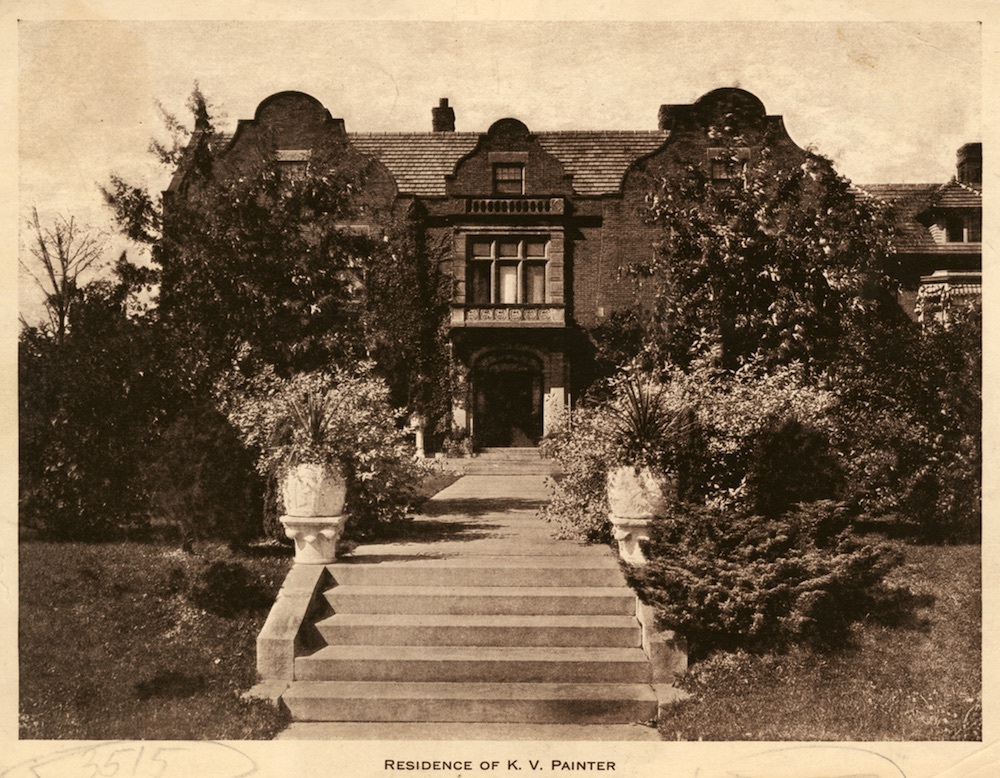
    <summary type="html"><![CDATA[<p><strong><em>The ornithology collections of the Cleveland Zoo and the Cleveland Museum of Natural History trace their origins partly to the backyard zoo and aviary that banker and investor Kenyon V. Painter cobbled together on his Cleveland Heights estate from his far-flung travels around the world.</em></strong></p><img src="https://mail.clevelandhistorical.org/files/fullsize/c7cbbf59c14e2c23996cae29b6353712.jpg" alt="The Residence of Kenyon V. Painter" /><br/><p>Kenyon V. Painter (1867 - 1940) grew up on the 25th block of Euclid Avenue. His father, John Vickers Painter, a wealthy banker, railroad man and associate of John D. Rockefeller, purchased 8.5 acres in Cleveland Heights and hired Frank Skeel to design a summer home for his family. After the elder Painter’s untimely death in 1903, his wife and son Kenyon continued construction. The 65-room Jacobean-style house, completed in 1905, was situated on a property covering more than 50 acres. After serving as a summer refuge for more than a decade, the estate became the family's permanent home in 1915. Mr. Painter followed his father into a successful banking career with Cleveland’s Union Trust Company. </p><p>Painter was a product of the Gilded Age. His wealth and stature afforded him many luxuries and hobbies, including expensive automobiles, big game hunting in Africa, and flirtations as an inventor (Painter sought a patent for a novel golf ball design in 1903). As an automobile enthusiast, Kenyon received one of Cleveland’s earliest speeding tickets for traveling along Rockefeller Parkway in 1901 at twice the 10 mph limit. In 1903, he “ran over” a young boy at a downtown intersection, breaking the boy’s collarbone and shoulder. Painter’s chauffeur took the boy to Lakeside hospital. The police arrested Kenyon, who posted bond, claiming the boy ran out in front of his car. It is plausible that Painter's social status helped his case. Among his well-connected friends was former President of the United States Theodore Roosevelt, with whom he shared safari resources during his frequent hunting trips to the African continent.</p><p>Despite his seemingly freewheeling nature, Kenyon Painter also sought to establish familial roots. He married Mary Chisholm in 1889. They had one daughter who died in 1894.  Mary died in 1901, and soon after, Painter married Maud Wyeth. They would have four children but again suffer the loss of a daughter in 1921 – somewhat ironically, in an automobile accident. </p><p>Painter's globetrotting safaris often mixed leisure with business. Kenyon and Maud honeymooned for three months on a safari in German East Africa, one of 31 extended hunting trips between 1907 and the 1930s. During these trips, Painter established investments near Arusha, Tanganyika, where he developed an 11,000-acre coffee estate, and built Arusha’s first post office, church, hospital, hotel, and coffee research facility with an $11 million investment. </p><p>Kenyon Painter's passion for wild animal trophies and specimens manifested itself on his Cleveland Heights estate grounds. In 1928, Tudor details were added to the mansion in addition to a garage, a stable, zoo and aviary, playhouse, and a small house for Painter's secretary. His trophy room surpassed any other and his two aviary facilities were filled with specimens personally secured when visiting foreign countries. The New York Zoological Society documented his bird collection in its September 1913 bulletin. The writer lauded “Painter’s aviaries as excellent examples of what can be done in private enterprise… Everything possible was done for the comfort of the birds…” He went on to document the birds in the collection, noting it “is cared for by a very intelligent Italian woman, and the uniformly perfect condition of her charges attests her skill in handling them.” In time, Painter would donate birds to the Cleveland Natural History Museum and to Cleveland Brookside Zoo to support the ornithology collections.</p><p>Like many fortunate sons, Painter may have taken for granted the privilege that his father's fortune afforded him. In 1935, he was involved in a notable financial fiasco. As the director and major stockholder of the Union Trust Bank, Painter borrowed nearly $3 million and was unable to pay it back, causing the bank to fail. He was sued and sentenced to prison in Columbus but fell ill and was hospitalized. Ohio Governor Davey pardoned the conviction and Painter returned to the estate where he lived quietly until his death in 1940. </p><p>Painter's life was marked by adventure and intrigue, loss and disgrace, excessive wealth and financial disaster. Philanthropy is perhaps his most lasting legacy. Painter's donations to the Natural History Museum and Cleveland Zoo helped both organizations start their ornithology collections with contributions following his early safaris. The Natural History Museum documents letters of thanks for the donation of a Turaco and parrot in 1930 and cites catalogs of his earlier donations. The zoo indicated Painter's donations included a Japanese robin, two black-headed parrots, two Indian geese, an Australian parakeet, two cranes, four Singapore doves, a silver pheasant, a South African golden oriole, and a South African black-breasted dove. Upon the sale of his estate in 1942, Painter's widow, Maud, donated his remaining aviary of 500 birds to the Cleveland Zoo. </p><p>Likewise, the sprawling Painter Estate found a new life. Shortly after Kenyon Painter's death, the Ursuline Academy (a school for girls at East 55th Street and Scovill Avenue in Cleveland since 1893) was in need of more space. On February 21, 1942, Maud Painter agreed to sell her Cleveland Heights mansion and property to the Ursuline Sisters for use as an educational facility. The sisters modified the house for classrooms and a library and used auxiliary buildings for related school facilities, including a gymnasium in the main trophy room where Kenyon had once kept his prized specimens. In 1943, they renovated the Aviary building. By 1964, the sisters built a new school building on the property with classroom space for 540 students, a new gymnasium, dining room, chapel, and administrative offices. The Aviary and Trophy Rooms were converted to house the Fine Arts Department. As the school progressed through the 20th century, additional facilities were added on the grounds and the mansion was used to house the nuns and for administrative offices and functions. </p><p>In 1979, the Painter Estate was declared a Cleveland Heights Landmark. It also has been featured on the Heights Community Congress’s “Heights Heritage Tour.” Despite its historic significance, the future of the Painter Estate is unclear. By the turn of the 21st century, studies were commissioned to explore options to renovate and utilize the mansion for schooling functions once again. Cost estimates to maintain or convert the mansion space were prohibitive for the nuns. They sold the property and building to Beaumont School in July 2009 and some administrative functions remained in Painter’s house. By 2017-18, Beaumont School administrators and directors removed staff from the building for safety and maintenance concerns and subsequently adopted a plan to demolish the mansion and use the land for athletic facilities. The City of Cleveland Heights has resisted action on the plan, and the ‘mothballed’ building stands today.</p><p><em><strong><a href="https://mail.clevelandhistorical.org/items/show/915">For more (including 10 images) view the original article</a></strong></em></p>]]></summary>
    <published>2020-08-25T14:50:21+00:00</published>
    <updated>2026-04-17T19:17:42+00:00</updated>
    <link rel="alternate" type="text/html" href="https://mail.clevelandhistorical.org/items/show/915"/>
    <id>https://mail.clevelandhistorical.org/items/show/915</id>
    <author>
      <name>Jim Lanese</name>
    </author>
  </entry>
  <entry>
    <title type="html"><![CDATA[B&#039;nai Jeshurun Congregation: The Temple on the Heights]]></title>
    <summary type="html"><![CDATA[<img src="https://mail.clevelandhistorical.org/files/fullsize/12283ff747d75d931758363aa2b4dafb.jpg" alt="Temple on the Heights today" /><br/><p>By the 1920s, Cleveland's growing Jewish community approached 10% of the city's population. As with Jewish enclaves in other major American cities of the era, the Jewish-American community of Cleveland began spreading into the suburbs. B'nai Jeshurun, became the first to make the move when in 1919 the congregation decided to relocate out of the city proper and into the nearby suburb of Cleveland Heights. The new building on Mayfield Road held over 3,000 worshipers and included a gymnasium, a banquet hall, and an entertainment hall, as well as a library. The congregation also retained its old building on East 55th Street for other social events before the existing structure became Shiloh Baptist Church.</p><p>Cleveland's Jewish population went back decades. Fleeing religious persecution in Europe and seeking greater job opportunities, Hungarian Jewish immigrants to the United States flocked to large cities. The western side of Cleveland attracted to pre-existing Jewish settlements and manufacturing jobs. The old German synagogues of earlier settlers simply would not do, necessitating buildings for  distinctly Hungarian congregations. In 1866, Hungarian Jewish immigrants began meeting in their own homes, and then in Gallagher’s Hall on Erie and Superior to pray, partially because they simply could not afford the fees the German synagogues required. In 1906, the Hungarian Jewish community of B'nai Jeshurun constructed their first permanent synagogue on East 55th Street and called it home for two decades.</p><p>B’nai Jeshurun’s congregation moved into the new temple in March of 1926, and Rabbi Abraham Nowak consecrated the structure in August of the same year: by now, over a thousand Jews called B’nai Jeshurun home. It was also at this time that B’nai Jeshurun gained its famous moniker— the Temple on the Heights, or more simply, Heights Temple. In comparison, the second Jewish congregation to move to the suburbs came nearly 20 years later when Anshe Chesed Fairmount Temple, Cleveland's oldest Jewish congregation, moved to Beachwood in 1947.</p><p>The congregation elected its first Cleveland-born Head Rabbi in 1934, Rudolph Rosenthal.  At the time of Rosenthal’s election, the Temple on the Heights served more than 1,000 families, had more than 600 youths in its education program, and was home to one of the largest Conservative congregations in the entire United States and would continue to grow over the next three decades. By the late 1960s, further suburbanization of the Jewish-American community moved congregants farther east. It was obvious the still-vibrant synagogue would need to move once again.</p><p>In 1978, only a few years after the 110th anniversary of B’nai Jeshurun’s founding, some 400 members of the congregation participated in a ceremonial groundbreaking of the temple’s new location on Fairmount Boulevard, in Pepper Pike, further east than Cleveland Heights and truly suburban. In late 1979 Rabbi Herbert Schwartz consecrated the new temple on the first night of Hanukkah.</p><p>On October 30, 2016, B’nai Jeshurun, Cleveland's third-oldest continuously operated Jewish congregation, capped off its 150th anniversary with a gala. The success of the Temple on the Heights in smoothing its congregants' transition to suburban life and the congregation's continued vitality over the past century and a half cements B'nai Jeshurun as a mainstay of the Cleveland metropolitan area. </p><p><em><strong><a href="https://mail.clevelandhistorical.org/items/show/821">For more (including 5 images) view the original article</a></strong></em></p>]]></summary>
    <published>2017-11-27T19:12:37+00:00</published>
    <updated>2026-04-17T19:17:41+00:00</updated>
    <link rel="alternate" type="text/html" href="https://mail.clevelandhistorical.org/items/show/821"/>
    <id>https://mail.clevelandhistorical.org/items/show/821</id>
    <author>
      <name>Anthony J. Kleem</name>
    </author>
  </entry>
  <entry>
    <title type="html"><![CDATA[Oheb Zedek-Taylor Road Synagogue: A Model of Resilience in Jewish Cleveland]]></title>
    <summary type="html"><![CDATA[<img src="https://mail.clevelandhistorical.org/files/fullsize/d031afb9bfbae4b8beb8b8809916cc9b.jpg" alt="Taylor Road Synagogue, 2015" /><br/><p>Oheb Zedek is one of the most venerable Orthodox Jewish congregations in the greater Cleveland area. It was founded in 1904 by a group of former members of the congregation B’nai Jeshurun. The disgruntled ex-congregants vehemently disagreed with B’nai Jeshurun’s ongoing transition from Orthodox to Conservative Judaism. Accordingly, they sought to establish a more firmly Orthodox synagogue of their own. The next year, the group built and moved into a synagogue on East 38th Street and Scovill Avenue in Cleveland’s predominantly Jewish Woodland neighborhood. From there, Oheb Zedek followed the general migratory pattern of Cleveland’s Jewish population, slowly but steadily moving further eastward. By 1922, the congregation had fully relocated to the Glenville neighborhood, northeast of Woodland; by 1955, the group had moved again, this time to the inner-ring suburb of Cleveland Heights.</p><p>In Cleveland Heights, Oheb Zedek established itself in the building it occupies to this day: the Taylor Road Synagogue. In the 1950s and early 1960s, Taylor Road was in the process of becoming a hub of Jewish life and worship, reminiscent of similar streets in the Woodland and Glenville neighborhoods back when they had been among the primary Jewish enclaves in the Cleveland area. Notable institutions like the Jewish Education Center of Cleveland and the Hebrew Academy were also located on Taylor Road, and in 1961, the Jewish Community Center was built just down the street. In addition, a panoply of Jewish shops, restaurants, and other establishments spread up and down the street. Oheb Zedek was far from alone. By 1955, when its building had been completed and dedicated, the newly renamed Taylor Road Synagogue had absorbed several other Orthodox congregations: Agudath Achim, Agudath B’nai Israel Anshe Sfard, Chibas Jerusalem, Knesseth Israel, and Shaaray Torah. Together, these congregations would maintain a thriving Jewish community … for a while.</p><p>After about a decade, the Taylor Road Synagogue was under pressure to relocate once again. Faced with familiar motivators — an influx of African Americans into the area and the gradual departure of the Jewish population — it would have been relatively unsurprising to see Oheb Zedek and the other Taylor Road congregations move eastward once more. Many other Cleveland Heights congregations had already moved, or would do so within the next several decades: for instance, B’nai Jeshurun, Oheb Zedek’s forebear and occupant of the grand Temple on the Heights, voted to leave for Pepper Pike in 1969, although it did not officially relocate there until 1980. Surprisingly, however, Oheb Zedek and its brethren, along with a number of other Cleveland Heights Jewish congregations, refused to leave. With the help of the Heights Area Project, a nonprofit organization run by the Jewish Community Federation, Cleveland Heights’ Jewish residents rallied together, embracing integration and investing in institutions in a way that previous Cleveland Jewish communities had not. In this way, Cleveland Heights’s Jews managed to preserve their Heights presence, and prevent the departure of some (although far from all) local synagogues. Taylor Road in particular retained a significant portion of its Orthodox population, ensuring the survival of the Taylor Road Synagogue.</p><p>The aforementioned happy ending comes with a strange recent twist. In 2012, Oheb Zedek reportedly merged with the Cedar-Sinai Synagogue in Lyndhurst. What did not become apparent until later that year was that the proposed merger had engendered heated opposition. In November of 2012, furious members of Oheb Zedek on Taylor Road filed a lawsuit aimed at stopping the merger. This lawsuit was aimed not just at Cedar-Sinai, but at three leading members of Taylor Road Synagogue as well! The members who filed the suit mainly argued that the merger had been somehow illegitimate, and therefore invalid. After over a year of legal wrangling, involving both the Common Pleas Court of Cuyahoga County and a prominent Jewish religious court based in New York, the plaintiffs and the defendants reached an out-of-court settlement. While most of the details were not disclosed, it was made clear that the two synagogues would not be making a full merger. Once again, Oheb Zedek managed to pull through and survive. </p><p><em><strong><a href="https://mail.clevelandhistorical.org/items/show/709">For more (including 6 images) view the original article</a></strong></em></p>]]></summary>
    <published>2015-05-16T11:50:01+00:00</published>
    <updated>2026-04-17T19:17:40+00:00</updated>
    <link rel="alternate" type="text/html" href="https://mail.clevelandhistorical.org/items/show/709"/>
    <id>https://mail.clevelandhistorical.org/items/show/709</id>
    <author>
      <name>Carter Hastings</name>
    </author>
  </entry>
  <entry>
    <title type="html"><![CDATA[Doctors&#039; Hospital: Forerunner of Hillcrest Hospital]]></title>
    <summary type="html"><![CDATA[<img src="https://mail.clevelandhistorical.org/files/fullsize/5c8aa35c8d19df1d85d38703d7173bd8.jpg" alt="Doctors&#039; Hospital" /><br/><p>Graced with a particularly rhythmic and memorable address – 12345 Cedar Road – Doctors' Hospital was actually a converted eight-story apartment building: the former Edgehill Apartments. The structure stood slightly south and east of what are now the Buckingham Condominiums at the crest of Cedar Hill. </p><p>Transformed from a residence to a medical facility, Doctors' Hospital opened its doors in August 1946, following nearly ten years of fundraising by physicians associated with the Academy of Medicine of Cleveland. The hospital was governed by a new non-profit entity: The Cleveland Memorial Foundation, Inc. By the mid 1950s, Doctors' Hospital had more than 200 beds and a variety of medical specialties, including pediatrics, osteopathy and oncology. </p><p>Despite its value to patients and the community, Doctors' Hospital survived little more than 20 years, with myriad growth plans thwarted by space and zoning constraints. In 1953, a proposal to double the facility's size (including a proposed school of nursing and a basement bomb shelter) was rejected by the Cleveland Heights building commissioner and the City's Board of Zoning Appeals. According to The Sun Press, the reason (painfully familiar to many Cleveland Heights residents and visitors) was a lack of parking. Three years later, hospital officials unsuccessfully sought to build a second Doctors' Hospital in South Euclid at the corner of Belvoir and Monticello – property the city had originally purchased to use as a dump. By 1960, hospital officials also were eyeing building sites in Solon and Twinsburg, neither of which panned out. </p><p>The beginning of the end came in 1964, when the US Public Health Service announced that $1.7 million in grants would be made available to relocate Doctors' Hospital to 15 acres of donated land in Mayfield Heights east of SOM Center Road. In 1966, the City of Cleveland Heights announced plans to replace Doctors' Hospital with a fire station, as well as a new city hall (to replace the outdated building where Honda of Cleveland Heights now stands on Mayfield Road). The next year, the City bought the Doctors' Hospital building and land for $675,000. Shortly after, construction began on the Mayfield Heights facility, tentatively named Doctors' Hospital. The complex, eventually christened Hillcrest Hospital, opened in November 1968, with 31 patients transferred by ambulance from the doomed Doctors' Hospital in Cleveland Heights.</p><p>Doctors' Hospital was demolished in February 1969 and the new fire station and city hall were built elsewhere. Most of the Doctors' Hospital site, somewhat ironically, is now a municipal parking lot.</p><p><em><strong><a href="https://mail.clevelandhistorical.org/items/show/694">For more (including 5 images) view the original article</a></strong></em></p>]]></summary>
    <published>2015-02-16T13:58:17+00:00</published>
    <updated>2026-04-17T19:17:40+00:00</updated>
    <link rel="alternate" type="text/html" href="https://mail.clevelandhistorical.org/items/show/694"/>
    <id>https://mail.clevelandhistorical.org/items/show/694</id>
    <author>
      <name>Chris Roy</name>
    </author>
  </entry>
  <entry>
    <title type="html"><![CDATA[Sears Catalog Homes]]></title>
    <summary type="html"><![CDATA[<img src="https://mail.clevelandhistorical.org/files/fullsize/8daed1dd52098cdee0965deb9b0a8018.jpg" alt="The Argyle" /><br/><p>Sears Roebuck and Company built many a marketing campaign around its ability to supply "everything for the home." However, between 1908 and 1940, Sears also supplied the home itself. Through its mail-order catalog, Sears offered more than 400 different house styles: from the elaborate "Ivanhoe," with French doors and art glass windows, to the Spartan "Goldenrod": three rooms and no bath.</p><p>According to Sears-house authority Rosemary Thornton, Sears kit homes contained about 30,000 pieces, including 750 pounds of nails, 27 gallons of paint and a 75-page instruction book with the homeowner's name embossed in gold on the cover. Masonry (block, brick, cement) and plaster were not included as part of the package deal, but the bill of materials list advised that 1,300 cement blocks would be needed for the basement walls and foundation. The average carpenter would charge $450 to assemble a Sears house. Painter's fees averaged about $35. Other skilled labor generally priced out at about $1 an hour. Total home prices ranged from less than $600 to about $6,000.</p><p>In some cases, Sears houses were more modern than the communities in which they were built. Electricity and municipal water systems were not available in every locale where Sears homes were sold. To meet this need, Sears advertised houses without bathrooms well into the 1920s. And for $23, you could always purchase an outhouse. This also explains, in part, why Sears sold heating, electrical and plumbing equipment separately, and not as part of the kit. </p><p>From 1908 to 1940, between 75,000 and 100,000 houses-all components manufactured by Sears-were made available through the company's catalog. Authorities believe that less than 5,000 of those have been conclusively identified as Sears homes, which means that at least 70,000 remain "undiscovered." Take Cleveland Heights, where only five homes have definitively been labeled "Sears": The Argyle on Marlindale, The Crescent and Ardara on Ormond, The Columbine on Clarendon and The Wayne on Randolph.</p><p>Across the Cleveland area, myriad Sears homes have been positively identified, although they likely represent only a small percentage of all those that were built. These structures include The Princeville in Bay Village, The Elsmore in Westlake and The Rodessa in University Heights. According to Rosemary Thornton, Ohio had more sales offices than any other state and most likely the greatest number of Sears homes.  </p><p>Although no examples have been cited in northeast Ohio, there was even a Sears home model called "The Cleveland"-a two-story building with an apartment comprising four rooms and a bathroom on each floor. According to researcher Bill Latrany, Sears would often name houses after cities where there was a Sears Homes Catalog office. In addition to The Cleveland, Sears also created The Wellington, The Mansfield, The Lorain and The Norwood.   </p><p>Mail order homes from other companies-Montgomery Ward, Aladdin, Gordon-VanTine-also have been identified across Cleveland. However, it is Sears that had, and continues to have, the enduring name recognition: the "cachet." </p><p><em><strong><a href="https://mail.clevelandhistorical.org/items/show/693">For more (including 7 images) view the original article</a></strong></em></p>]]></summary>
    <published>2015-02-10T20:58:44+00:00</published>
    <updated>2026-04-17T19:17:40+00:00</updated>
    <link rel="alternate" type="text/html" href="https://mail.clevelandhistorical.org/items/show/693"/>
    <id>https://mail.clevelandhistorical.org/items/show/693</id>
    <author>
      <name>Chris Roy</name>
    </author>
  </entry>
  <entry>
    <title type="html"><![CDATA[Brith Emeth Temple/Ratner School]]></title>
    <summary type="html"><![CDATA[<img src="https://mail.clevelandhistorical.org/files/fullsize/055190be2d074795553c31f77a091024.jpg" alt="Detail of Circular Portico" /><br/><p>In 2013 the Lillian and Betty Ratner Montessori School celebrated the semicentennial of its founding in 1963. Melding its Jewish roots with the educational philosophy of Maria Montessori, the Ratner School is both a story of innovative education and of suburbanization. Ratner developed at Park Synagogue in Cleveland Heights, where it was housed for most of its first two decades before moving to Lyndhurst and, later, Pepper Pike.  </p><p>For a generation, Cleveland Heights represented upward mobility for Cleveland Jews, just as the Glenville neighborhood had for the previous generation. The Temple on the Heights (B'nai Jeshurun), which opened on Mayfield Road in 1926, signaled that decades of eastward movement of the city's Jewish population might continue into the suburbs, but in the meantime East 105th Street in Glenville was still on the build as a hub of Jewish life. Another congregation, Anshe Emeth, had recently moved from the Central neighborhood to a new facility on East 105th. Known as the Cleveland Jewish Center, the synagogue housed a religious school and recreational facilities that included the Council Educational Alliance, a forerunner of the Jewish Community Center of Cleveland.</p><p>Meanwhile, a group of Vassar-educated women founded the Park School in 1918 to provide a setting for "learning by living." Originally holding classes in the Heights Masonic Temple at Mayfield and Lee roads, the Park School grew to serve preschool through high school. The school leased a tract between Euclid Heights Boulevard and Mayfield Road in 1929 from John D. Rockefeller Jr., who tore up the lease three years later. The school's president, Harold T. Clark, predicted that the Park School would complement Rockefeller's nearby Forest Hill residential allotment.  </p><p>By the early 1940s, it was already apparent that the Jewish community was forsaking Glenville for Cleveland Heights.  Anshe Emeth Beth Tefilo purchased the Park School grounds with the idea of building a new synagogue there. In the meantime Lillian Ratner, whose husband Leonard B. Ratner headed Forest City Materials (which progressed from lumber sales to suburban real estate development after World War II), worked with Rabbi Armond E. Cohen and Anne Cohen to reorganize the Park Nursery School under congregational control in 1943. Instruction focused on "character training, handicrafts and Jewish customs." After World War II, Anshe Emeth Beth Tefilo commissioned renowned architect Eric Mendelsohn to design Park Synagogue. The congregation sold the Cleveland Jewish Center to Cory Methodist Church in 1946 and moved into Mendolsohn's new copper-domed synagogue four years later.</p><p>Twenty years after leading the transition of the Park School, Lillian Ratner acted upon her interest in the Montessori method and founded the Lillian Ratner Montessori School in 1963. The nursery school operated for the next nineteen years at Park Synagogue, during which time it attracted a diverse student body that was eventually primarily non-Jewish. In 1969 the school expanded to the third grade and was renamed the Lillian Ratner Montessori Day School. Over the next dozen years the school gradually expanded to serve through the eighth grade. The growth necessitated a move, and Ratner left Park Synagogue's grounds to occupy a repurposed school building in Lyndhurst in 1982. Finally, in 2006, it moved to its present location in Pepper Pike.</p><p>Ratner's current facility began as the Brith Emeth Temple. From its inception in 1959, the Brith Emeth Congregation had met in the First Unitarian Church in Shaker Heights. Under Rabbi Philip Horowitz's guidance, Brith Emeth grew to nearly 400 families in its first few years, making it the tenth largest Reform congregation in Ohio. Brith Emeth acquired land for its own temple in Pepper Pike in 1962. In doing so, it overcame the legacy of exclusion embodied in the Van Sweringen Company deed restrictions since 1926, when the railroad barons' Shaker Heights venture grew to include Shaker Country Estates, a vast, wooded expanse earmarked for large home sites. Later absorbed by Beachwood, Pepper Pike, Orange, Hunting Valley, and Gates Mills, the properties continued to carry their original Van Sweringen restrictive covenants. Brith Emeth's success in building on former Van Sweringen land contrasted with a fight that pitted another Jewish congregation against a hastily formed Pepper Pike Homeowners Association that purportedly opposed the temple on grounds of endangering the community's residential character.</p><p>Like Park Synagogue, Brith Emeth sought a highly regarded architect for its building. Edward Durell Stone, who had designed Busch Memorial Stadium in St. Louis, the U.S. Embassy in New Delhi, and the U.S. Pavilion at the 1958 Brussels world's fair, built a modernistic temple on the north side of Shaker Boulevard. Brith Emeth worshipped at the temple from 1967 until its membership shrank to the point that it merged with Park Synagogue in the 1980s, by which time the latter was reacting to the large-scale departure of Jewish residents from Cleveland Heights into more easterly suburbs. From 1986 to 2006, when it built its current facility across Brainard Circle, Park Synagogue East progressed from a branch of the main temple in Cleveland Heights to become the location of its main offices and many of its activities. The congregation sold the onetime Brith Emeth Temple to the Ratner School, which benefited from the fact that the original temple design provided for a 500-student religious school. Indeed, in 1970 the Samuel Y. Agnon School, an ecumenical Jewish day school, opened in the temple before moving several years later. Ratner's history, like that of Park Synagogue, reflects the eastward migration of Jewish Cleveland and a legacy of strong congregational support of Judaic education aimed toward a broad cross-section of society.</p><p><em><strong><a href="https://mail.clevelandhistorical.org/items/show/672">For more (including 8 images) view the original article</a></strong></em></p>]]></summary>
    <published>2014-11-08T08:48:32+00:00</published>
    <updated>2026-04-17T19:17:40+00:00</updated>
    <link rel="alternate" type="text/html" href="https://mail.clevelandhistorical.org/items/show/672"/>
    <id>https://mail.clevelandhistorical.org/items/show/672</id>
    <author>
      <name>J. Mark Souther</name>
    </author>
  </entry>
  <entry>
    <title type="html"><![CDATA[Euclid Heights Allotment: Patrick Calhoun&#039;s &quot;Garden City&quot; atop the Overlook]]></title>
    <summary type="html"><![CDATA[<img src="https://mail.clevelandhistorical.org/files/fullsize/4e1697c453f81282f1f1c85acec7786b.jpg" alt="Euclid Heights Stock Certificate, 1903" /><br/><p>The Euclid Heights Allotment was the first major real estate subdivision up on Cleveland's "Heights" above University Circle and Euclid Avenue. Early on, Euclid Heights’ developers sought to attract wealthy Millionaires’ Row residents who, in the late 19th century, had begun migrating eastward away from the city's pollution and commercial bustle. The development benefited from the advent of electrified streetcars, which could conquer the steep grades leading up to the Heights. Tucked in the corner of a green space framed by Doan Brook and Lake View Cemetery, Euclid Heights offered a stylish retreat where those able to handle longer commutes could enjoy spacious lots, curving streets, handsome architecture, spectacular views, fresh air, privacy and a chance to put distance between themselves and the increasingly dirty, problem-plagued city below.</p><p>The story goes that Atlanta and New York railroad lawyer Patrick Calhoun, grandson of U.S. Vice President and Senator John C. Calhoun, traveled to Cleveland on business in 1890. Having time to spare, Calhoun rode out to Lake View Cemetery to see the recently dedicated memorial to the slain President James A. Garfield, a structure Calhoun’s family had supported. On the way he noticed the building boom going on in the East End (Hough area), and wondered where that was heading. Calhoun had been involved earlier in the Richmond Terminal railroad project in Virginia and was familiar with the groundbreaking work that Frank Sprague, the "Father of Electric Traction," had done there in using electric railroads to promote urban development. Knowing that the East Cleveland Railway Company had recently done some innovative work electrifying streetcars locally, Calhoun saw an opportunity to develop an important streetcar suburb at the top of Cedar Glen.</p><p>Working with local partners, including John D. Rockefeller's real estate man, J.G.W. Cowles, attorney William Lowe Rice and merchant John Hartness Brown, Calhoun had development plans drawn up by 1892. The Panic of 1893 put their plans on hold but by 1896 an amended site plan was recorded—more or less identical to today's layout of the area with Euclid Heights Boulevard bisecting the site from the southwest corner at the crest of Cedar Hill. In the northeast corner of the development would be the commercial district, what we now know as Coventry Village. Other prominent features included The Overlook—Overlook Road southwest of Edgehill Road and featuring large mansions featuring splendid north- and west-facing views—and the Euclid Club, a country club that sported a golf course spanning both sides of Cedar Road and a grand quarter-mile entry path beginning at what is now the corner of Derbyshire and Surrey Roads. </p><p>The development gradually attracted fine homes and also spurred other beautiful subdivisions, such as Barton Deming’s Euclid Golf Allotment on the south portion of the former golf course (which closed in 1912). Moreover, the Van Sweringen brothers, are believed to have been paperboys in the Euclid Heights area and later went on to adopt themes from the Euclid Heights Allotment in their famous Shaker Heights and Shaker Farm communities (the latter comprises streets such as Stratford, Marlboro, Fairfax and Guilford, west of Lee Road and immediately north of Fairmount Boulevard) . Calhoun, however, was distracted by legal problems running the San Francisco streetcar franchise after the Great Earthquake and saw his Euclid Heights development company forced into bankruptcy in 1914. By then William Rice had been murdered while walking home to the Overlook from the Euclid Club, a sensational case that featured John Hartness Brown as a suspect. Although it still maintains its picturesque “Garden City” look, Euclid Heights soon evolved from a private hilltop retreat to a busy gateway to the rapidly developing Heights. A large portion of Calhoun-owned land in the area’s eastern sector was sold off and subdivided, thus explaining why Cleveland Heights homes east of Coventry Road tend to be somewhat more modest than those near the top of the hill. Today Euclid Heights is listed on the National Register of Historic Places. It remains full of architecturally significant homes (including Calhoun's at 2460 Edgehill), but its main significance is the role it played in opening the Heights as a streetcar suburb for wealthy Clevelanders.</p><p><em><strong><a href="https://mail.clevelandhistorical.org/items/show/650">For more (including 9 images) view the original article</a></strong></em></p>]]></summary>
    <published>2014-03-18T17:25:17+00:00</published>
    <updated>2026-04-17T19:17:40+00:00</updated>
    <link rel="alternate" type="text/html" href="https://mail.clevelandhistorical.org/items/show/650"/>
    <id>https://mail.clevelandhistorical.org/items/show/650</id>
    <author>
      <name>William C. Barrow</name>
    </author>
  </entry>
  <entry>
    <title type="html"><![CDATA[Heights Community Congress: Building an Integrated Cleveland Heights]]></title>
    <summary type="html"><![CDATA[<img src="https://mail.clevelandhistorical.org/files/fullsize/4ed507114243a8a2d665d04d9c9277af.jpg" alt="HCC Protest, 1980" /><br/><p>The Heights Community Congress was a fair housing organization which formed in Cleveland Heights in 1972 in response to racial discrimination practices in the Cleveland real estate and lending markets. After East Cleveland endured a dramatic upheaval in the second half of the 1960s, with its population transforming from predominantly white to predominantly black in a remarkably short period of time, the members of the Heights Community Congress wanted to ensure that Cleveland Heights would not be "another East Cleveland." Their mission was to encourage integration without re-segregation. After a 1972 survey, now known as St. Ann's Audit, members of a social group called Action for a Change found extreme racial steering in Cleveland and Shaker Heights; the group decided to organize and intervene in the unfair housing practices.</p><p>A common myth held that the influx of blacks into a community inevitably led to a decrease in property values; this myth caused many white families to pick up and move at the first sight of an African American family on the block. This phenomenon of panic, known as white flight, was just one of the problems facing the integration of Cleveland suburbs. The Heights Community Congress sought to end the discrimination in suburban integration by attacking the problem from every angle. The myth of decreased property values was perpetuated by lending agencies, who would not give money to suburbs with even a few black families for home improvement purposes. The resulting state of disrepair in integrated and black communities led to the establishment of a subcommittee within the Heights Community Congress which helped black families get funding, as well as created workshops to educate first-time home owners about home improvement and loan options.</p><p>The HCC used "checkers" to audit real estate companies. Checkers were both black and white couples who would each try to inquire, separately, about properties for rent or sale. If the couples were given different information and race was suspected to be the motivator, the HCC would intervene and equip slighted families with the tools necessary to sue. The methods used by the Heights Community Congress were aimed at creating and maintaining integrated neighborhoods, with a focus not only on the racial make up of communities, but on all aspects of community life, like education, code enforcement, and public safety. The HCC was to be a "parallel institution" to the real estate companies to ensure that someone was enforcing fair housing law, according to  Heights Congress member, Lana Cowell. The Heights Community Congress's auditing role transferred to the Heights Housing Service in 1977 when it was brought into City Hall.</p><p>The Heights Community Congress was determined to draw public attention to the successes of integration by showcasing thriving neighborhoods with a wealth of recreational community activities. The HCC also conducted (and continues to lead) Heritage Home Tours, in order to allow the public to view beautiful, well maintained historic homes in the Cleveland Heights area. The tours would not only bring a sense of pride to the community, but showcase the maintained property value levels, despite integration. The HCC would distribute awards to homeowners who took an active role in maintaining the integrity of their home, harboring a sense of pride in the integrated neighborhood. As HCC director Kermit Lind described, the community activities like block parties, planned by the HCC, would not have been nearly as important in the Cleveland Heights community if it were not for the need to showcase black and white families having fun and doing things together. The Heritage Home Tours and other programs led by the Congress were a method of assurance that integration was continuing, and was a positive and valuable aspect of the community.</p><p><em><strong><a href="https://mail.clevelandhistorical.org/items/show/641">For more (including 5 images&#32;&amp;&#32;5 audio files) view the original article</a></strong></em></p>]]></summary>
    <published>2013-12-04T22:18:14+00:00</published>
    <updated>2026-04-17T19:17:40+00:00</updated>
    <link rel="alternate" type="text/html" href="https://mail.clevelandhistorical.org/items/show/641"/>
    <id>https://mail.clevelandhistorical.org/items/show/641</id>
    <author>
      <name>Elizabeth Culp</name>
    </author>
  </entry>
  <entry>
    <title type="html"><![CDATA[Haggins Realty Bombing: A Temporary Setback to Fair Housing in the Heights]]></title>
    <summary type="html"><![CDATA[<img src="https://mail.clevelandhistorical.org/files/fullsize/d2ccf6e50ba5a13fe2447bf6d49f771e.jpg" alt="Haggins Realty After Bombing, 1969" /><br/><p>Shiny windows, clean floors and new furniture. All are part of a new office and a new opportunity. This is what African American entrepreneur Isaac Haggins imagined for his realty business. Haggins, whose new office in Cleveland Heights in 1968 became the first black-owned realty office in any Cleveland suburb, sold homes in the Cleveland area to both African Americans and whites at a time when Realtors refused to do so. By 1960 and through the 1970s, Cleveland Heights endured a tumultuous housing and real estate environment. African Americans were moving into suburbs where the population was overwhelmingly white. This movement unreasonably scared some whites into committing criminal acts against them.</p><p>Haggins began his real estate business in 1961 in order to fulfill his dream of selling good homes to any person no matter what race. He had two offices located at 10215 St. Clair Avenue and 12534 Union Avenue on Cleveland's east side. After having many successful years in both locations, Haggins opened his third office in December 1968 in Cleveland Heights at 2221 North Taylor Road. The office space was sold to him by an Italian man who warned that he could not guarantee his safety. While violence was not an everyday occurrence in Cleveland Heights, it was a possibility. Haggins did not think much about the warning and opened the office with much fanfare. He hosted an open house in December 1968 to celebrate the opening of the office. The party was attended by many city officials, local citizens and community leaders.</p><p>Unfortunately, the celebration was short lived. In February 1969, Haggins office in Cleveland Heights was bombed as an act of racial violence. The bomb damaged the interior of the office and cost $10,000-$12,000 to repair. A positive message that resulted from the disaster was that the community banded together. Haggins received many sympathy calls and letters stating support for him and his company and hope for justice. The Cleveland Real Estate Brokers Association even posted a $500 reward for any information that could produce a suspect. The bombing served as another wake-up call to politicians and citizens that a real problem was on their doorstep.</p><p>The culprits were never captured but Haggins Realty bounced back. Only four months later, Haggins hired seven new staffers out of the 165 who applied. According to the Call & Post, the new employees were attracted to Haggins Realty due to the amount of sympathy around the entire city after the Taylor Road office bombing. However, the rest of Haggins's career was not always full of praise and support. He was accused of using blockbusting techniques in his realty practice, a charge he steadfastly denied. Despite the devastation of the bombing and through the outpouring of support and the accusations of blockbusting, the Haggins Realty firm continued to be successful. By October 1971, Haggins Realty reached over $1 million in sales just for that month alone. Haggins Realty continued its success for many more years to come.</p><p><em><strong><a href="https://mail.clevelandhistorical.org/items/show/640">For more (including 5 images&#32;&amp;&#32;4 audio files) view the original article</a></strong></em></p>]]></summary>
    <published>2013-12-04T22:12:07+00:00</published>
    <updated>2026-04-17T19:17:40+00:00</updated>
    <link rel="alternate" type="text/html" href="https://mail.clevelandhistorical.org/items/show/640"/>
    <id>https://mail.clevelandhistorical.org/items/show/640</id>
    <author>
      <name>Ruth Zeager</name>
    </author>
  </entry>
  <entry>
    <title type="html"><![CDATA[Robert P. Madison: An Architect Who Broke Down Walls]]></title>
    <summary type="html"><![CDATA[<img src="https://mail.clevelandhistorical.org/files/fullsize/2a0b3af42be41ce6f1d3bf37113fcc17.jpg" alt="Park Place Garden Apartments, ca. 1970" /><br/><p>Robert P. Madison was a young and eager man who returned from the Second World War in 1946 looking forward to a new beginning. Passionate about architecture since childhood, Madison knocked on the door of the Western Reserve University's School of Architecture that July. He was promptly denied admission because of his skin color. The school had never admitted a black student and declared that it was not about to start. Madison was not going to take rejection lying down. He was a United States soldier and more importantly he was a person. The color of his skin should not be a factor. Madison returned to Western Reserve the next day wearing his Army uniform, decorated with his Purple Heart, Combat Infantryman Badge and five combat ribbons. Not only did he serve valiantly but he was also wounded while fighting in Italy. Madison told the dean that "my blood has been spilled on the soil of Italy to make this country free." Upon seeing and hearing of Madison's service record, the dean agreed to let the young veteran into the school on the condition that he passed preliminary tests. Madison did so and was accepted into the program, where he exceeded all expectations.</p><p>Following architecture school, graduate study at Harvard, and a brief stint teaching at Howard University, in 1954, Madison returned to Cleveland to open his own office to practice architecture and engineering. It was the first firm started by an African American in the state of Ohio. In 1960, Madison and his family moved from the overcrowded Glenville neighborhood to Cleveland Heights, where he experienced more discrimination. However, this time it was due to where he chose to live, not where he wanted to go to school. Madison moved his family to a home he designed and built at 2339 North Park Boulevard in Cleveland Heights. They were not even able to purchase the property because they were black; instead, a Jewish person purchased it in their name, which was a common practice during that time. At that time there were very few black homeowners living in the suburb. However, Madison needed to move his family out of Cleveland to find a better education system for his daughter. In Glenville, students were being put into relay classes, meaning that they went to school for half a day instead of a full day due to high enrollments. Madison and his wife were both educated and they were not going to allow their daughter to get only half an education.</p><p>The Madisons encountered many acts of racial violence directed at their home during their first year of living in Cleveland Heights. Even prior to moving, Madison received a phone call from a man telling him that he did not want him to move to the neighborhood. Madison ignored the advice from the man. His neighbors even attempted to buy him out of the house. During their first year living on North Park Boulevard, rocks were thrown at their house and there was a woman who refused to walk on the sidewalk in front of their house. The Madison family dealt with those threats and continued to live on that street for forty years. Through all of their struggles, Madison remained a successful architect and principal at his firm, Madison, Madison, and Madison (later Robert P. Madison International), which had a hand in many prestigious projects including U.S. embassies, Cleveland Browns Stadium, the Louis Stokes Wing at Cleveland Public Library, and the Rock and Roll Hall of Fame, among many others.</p><p><em><strong><a href="https://mail.clevelandhistorical.org/items/show/639">For more (including 3 images&#32;&amp;&#32;2 audio files) view the original article</a></strong></em></p>]]></summary>
    <published>2013-12-04T22:11:13+00:00</published>
    <updated>2026-04-17T19:17:40+00:00</updated>
    <link rel="alternate" type="text/html" href="https://mail.clevelandhistorical.org/items/show/639"/>
    <id>https://mail.clevelandhistorical.org/items/show/639</id>
    <author>
      <name>Ruth Zeager</name>
    </author>
  </entry>
  <entry>
    <title type="html"><![CDATA[Christ Our Redeemer A.M.E. Church: Cleveland Heights&#039; Oldest House of Worship]]></title>
    <summary type="html"><![CDATA[<img src="https://mail.clevelandhistorical.org/files/fullsize/adbf69af5009e25571c935754a33e242.jpg" alt="The Church Today" /><br/><p>In the summer of 1981, the choirs of St. John's and St. James A.M.E. churches, two historic African American congregations on Cleveland's east side, joined together in the octagonal sanctuary at the inaugural service of Christ Our Redeemer A.M.E. Church. Named after the African Methodist Episcopal motto, "God our Father, Christ our Redeemer, and Man our Brother," this sacred landmark was originally dedicated as Cleveland Heights Methodist Episcopal Church on September 18, 1904. Designed by Sidney R. Badgley and William H. Nicklas, the church included a Sunday school space set apart from its octagonal sanctuary by movable partitions, an arrangement known as the "Akron Plan" (named for its origination in Akron, Ohio, in the 1860s and also adopted in Badgley's 1894 design of Pilgrim Congregational church in Tremont). The clapboard- and shingle-sided Gothic Eclectic building, distinguished by its battlemented corner tower overlooking Superior and Hampshire roads, is the oldest standing house of worship in Cleveland Heights. </p><p>Cleveland Heights Methodist Episcopal Church arose from efforts of the Nottingham-Glenville Circuit of the Methodist Church, which erected an earlier brick church near the old Superior Schoolhouse, in 1878. At that time the surrounding area was still derisively dubbed "Heathen Heights" because of the notorious weekend carousing of the area's stone quarry workers. Originally called Fairmount Methodist Episcopal Church because of its site near the town center of Fairmount, the congregation took the new name of Cleveland Heights Methodist Episcopal Church in 1904 upon the dedication of its new building, a reflection of the founding of Cleveland Heights village earlier that year. After quintupling its membership in just two decades, the congregation departed to a massive new Gothic building on Lee Road in 1927 and became the Church of the Saviour. Thereafter the old building housed the First Church of the Brethren for the next several decades. </p><p>Just as the soaring suburban population of the Heights in the 1910s and 1920s made the little church too small to hold Sunday services, the growing African American presence in north-central Cleveland Heights, drawn to better housing from Glenville and East Cleveland a half century later, made the area a logical place for the African Methodist Episcopal Church to create its first suburban mission in Greater Cleveland (apart from the longstanding New Bethel A.M.E. in then-rural Oakwood Village). Christ Our Redeemer A.M.E. emerged as a joint project of the ministers and laity of the North Ohio Conference of the African Methodist Episcopal Church. The mission leased its building from First Church of the Brethren and opened with a mere seven congregants in July 1981. Originally it held services at odd times to encourage members of other A.M.E. churches to assist in getting it firmly established, as well as to enable guest pastors from other A.M.E. churches to preach there. </p><p>Christ Our Redeemer A.M.E. Church faced the daunting challenge of maintaining the oldest church building in Cleveland Heights. Eventually the challenge proved too much to surmount, and the congregation disbanded, selling the church building in 2018 to United Temple Church, which had previously been located in the Lee-Harvard neighborhood of Cleveland. As Cleveland Heights' oldest religious building and a significant site in the struggle to break down racial barriers in Greater Cleveland, "The Tabernacle" (as United Temple Church calls it), this Cleveland Heights Landmark merits careful preservation.</p><p><em><strong><a href="https://mail.clevelandhistorical.org/items/show/620">For more (including 9 images&#32;&amp;&#32;5 audio files) view the original article</a></strong></em></p>]]></summary>
    <published>2013-09-17T13:13:16+00:00</published>
    <updated>2026-04-17T19:17:40+00:00</updated>
    <link rel="alternate" type="text/html" href="https://mail.clevelandhistorical.org/items/show/620"/>
    <id>https://mail.clevelandhistorical.org/items/show/620</id>
    <author>
      <name>J. Mark Souther</name>
    </author>
  </entry>
  <entry>
    <title type="html"><![CDATA[Saint Paul&#039;s Episcopal Church: From Downtown to the Heights]]></title>
    <summary type="html"><![CDATA[<img src="https://mail.clevelandhistorical.org/files/fullsize/f0d51e463eb2890ae09de34c2755a7cd.jpg" alt="St. Paul&#039;s in Winter" /><br/><p>St. Paul's Episcopal Church emerged in 1846, beginning in rented space until its first dedicated building opened in 1848 at the corner of Sheriff Street (now East 4th) and Euclid Avenue on the site of the present-day House of Blues. Following a devastating fire, the church rebuilt a brick Gothic edifice that opened three years later. As commercial expansion accompanied the emergence of downtown Cleveland in what had formerly been a compact walking city, St. Paul's moved in 1876 to a newly built Gothic church at the corner of Case Street (now East 40th) and Euclid, squarely within Cleveland's famed "Millionaires' Row." This church was designed by Gordon W. Lloyd, an English-born Detroit architect who also designed many other Episcopal churches in the Midwest. At its new location, St. Paul's expanded impressively and even spawned several other new congregations as it grew.</p><p>By the 1920s many St. Paul's parishioners had moved eastward into the nearby suburbs of Cleveland Heights and Shaker Heights. In 1928 the church followed suit, choosing a site on the eastern edge of Barton Deming's Euclid Golf allotment at the corner of prestigious Fairmount Boulevard, the "Euclid Avenue of the Heights," and Coventry Road. The new building, designed by J. Byers Hays of Walker and Weeks in the English Gothic style, was erected of Indiana limestone. On its departure, its previous building was sold to the Catholic Diocese of Cleveland and reopened in 1931 as St. Paul's Shrine of the Blessed Sacrament. In more recent years the building has served as home to multiple Catholic orders rather than as a diocesan church. </p><p>In Cleveland Heights, St. Paul's continued to grow, but its building remained unfinished, a casualty of the onset of the Great Depression. Originally to include a large nave for worship services, St. Paul's made do until 1951 with holding services in its parish hall. By the time the church raised sufficient funds to build the Gothic nave it had envisioned back in the 1920s, its leaders opted instead to follow an emerging trend toward fashioning naves in the manner of the early Christian church, in which ornamentation was spare and the altar was moved closer to the congregation.</p><p>By the early 1960s St. Paul's flourished under the energetic leadership of Dr. Chave McCracken. During McCracken's tenure as rector, St. Paul's became more consciously inclusive. In spring 1963 it hosted Dr. Martin Luther King Jr., who gave one of the speeches leading up to his famed Lincoln Memorial address later that year. Church membership reached its peak in the 1960s, with the main Sunday service splitting into two services to handle the growing parish. Years later, following a downward trend in the Heights population and in membership in mainline Protestant denominations, St. Paul's returned for a time to a single service. More recently, it restored the separate services as part of a determined effort to attract young families.</p><p>Today St. Paul's remains a vibrant part of Cleveland Heights and, with some 1,400 parishioners, is the largest Episcopal congregation in the Diocese of Ohio.</p><p><em><strong><a href="https://mail.clevelandhistorical.org/items/show/564">For more (including 9 images&#32;&amp;&#32;5 audio files) view the original article</a></strong></em></p>]]></summary>
    <published>2012-10-02T12:11:06+00:00</published>
    <updated>2026-04-17T19:17:39+00:00</updated>
    <link rel="alternate" type="text/html" href="https://mail.clevelandhistorical.org/items/show/564"/>
    <id>https://mail.clevelandhistorical.org/items/show/564</id>
    <author>
      <name>J. Mark Souther</name>
    </author>
  </entry>
  <entry>
    <title type="html"><![CDATA[Bluestone Quarries: Euclid Township&#039;s &quot;Bluestone Rush&quot; Boomtown]]></title>
    <summary type="html"><![CDATA[<img src="https://mail.clevelandhistorical.org/files/fullsize/cbe7476989dd05c70343ae2a4adbab2e.jpg" alt="Bluestone Quarry" /><br/><p>Denison Park, which anchors the northeastern edge of Cleveland Heights just west of Euclid Creek, straddled one of the old Euclid bluestone quarries that dotted the landscape to the east of Cleveland. Nearby, a town called Bluestone appeared in Euclid Township in present-day South Euclid to serve several quarries, including that of Irish-born Duncan McFarland on Euclid Creek. Peopled by mostly by Irish and Italian immigrants, the town was a wide-open boomtown with a general store and saloon, not unlike western mining towns. Railway spurs opened to carry the heavy loads of stone to market. Euclid bluestone was used widely in the Cleveland area and in Detroit, Milwaukee, and Buffalo as flagstone for sidewalks, exterior steps, windowsills, and a host of other applications. </p><p>The boomtown atmosphere of the village of Bluestone settled down as the quarrying business slowed in the 1900s and 1910s, and by the 1920s the Cleveland Metropolitan Park Board transformed the largest of the quarries into a portion of the Euclid Creek Reservation. Bluestone quarrying never regained its former importance but did continue in limited form under the aegis of the WPA in the 1930s. The old Euclid City Hall, now the Cleveland-Style Polka Hall of Fame, is among the few reminders of that effort.</p><p>The northeastern section of Cleveland Heights, almost rural as late as the 1920s, began to fill with subdivisions, a process that accelerated as the last farmlands gave way to the bulldozers in the years after World War II, aided by the WPA-constructed Monticello Boulevard in the late 1930s. Impressive growth helped raise Cleveland Heights's population to around 60,000 by the early 1950s. In response to the need for convenient recreational facilities to relieve having to travel up to three miles to use the nearest city parks, in 1955, Denison Park opened on the site of one of the bluestone quarries that had been used for years thereafter as a city dump. Named for Cleveland Heights councilman Robert F. Denison, it added a swimming pool in 1968 to relieve overcrowded Cumberland Pool. In recent years, with populations trending downward, the pool closed.</p><p>The suburban development that followed the "bluestone rush" reflected its legacy. In the Noble-Monticello area of Cleveland Heights, Bluestone and Quarry roads were so named for their proximity to Nine Mile Creek on the western fringe of the Euclid Creek quarrying area. Today many slabs of bluestone remain intact on Cleveland Heights sidewalks, although many are nearing the end of their useful life due to damage from vehicles, freeze-and-thaw cycles, and erosion. The Bluestone condominium development on Mayfield Road also keeps the name alive.</p><p><em><strong><a href="https://mail.clevelandhistorical.org/items/show/552">For more (including 6 images&#32;&amp;&#32;6 audio files) view the original article</a></strong></em></p>]]></summary>
    <published>2012-09-15T14:17:18+00:00</published>
    <updated>2026-04-17T19:17:39+00:00</updated>
    <link rel="alternate" type="text/html" href="https://mail.clevelandhistorical.org/items/show/552"/>
    <id>https://mail.clevelandhistorical.org/items/show/552</id>
    <author>
      <name>J. Mark Souther</name>
    </author>
  </entry>
  <entry>
    <title type="html"><![CDATA[Cedar Glen]]></title>
    <summary type="html"><![CDATA[<img src="https://mail.clevelandhistorical.org/files/fullsize/673888f5fa758b81544c09e6e2cb3160.jpg" alt="Cedar Glen at Ambleside, 1930" /><br/><p>Until the late 1800s, looking down from atop Cedar Hill you would have seen little more than a countryside landscape divided by an unkempt dirt road. The hillside known as Cedar Glen hosted few travellers aside from farm wagons and, later, visitors to the springs resort at the foot of the hill. In less than a century, this scene would be replaced by one of a busy, six-lane road as Cedar Glen became the biggest gateway to the Heights from the city of Cleveland. </p><p>One of Cedar Glen's most salient characteristics is its gradual rise in elevation. The western edge of the Portage Escarpment causes this natural formation. The Portage Escarpment not only divides the Allegheny Plateau and the Great Lakes Basin, but also acts as a boundary between Cleveland and its suburban "Heights" to the east. Originally the eastern part of Cedar Glen and the high ground to which it leads belonged to East Cleveland Township. When Cleveland Heights incorporated as a village in 1903, it engulfed the southern part of East Cleveland Township, which included farmland and Cedar Glen. </p><p>Another natural feature that, for a time, made Cedar Glen a well-known area was Doan Brook, which was piped and buried underground in 1929. In the early 1800s, bluish grey sandstone called Euclid bluestone was quarried along the brook. The hard sandstone was used for everything from laundry tubs to sidewalks. Later in the century Doan Brook again brought attention to Cedar Glen. Dr. Nathan Hardy Ambler was a former dentist and the owner of the Cedar Glen property through which Doan Brook passes on its way from Shaker Lakes to Lake Erie. Although the blue-green water tasted like sulfur, Ambler began bottling and selling it to local restaurants. Because patrons believed the water offered health benefits and hydrotherapy was becoming a popular treatment method, Ambler and his partner Daniel O. Caswell opened the Blue Rock Spring House in Cedar Glen. The water resort and sanitarium operated from 1880 until 1908 when popularity began to fade. </p><p>Cedar Glen began its transition to one of Cleveland's most important transportation gateways from the suburbs in 1896 when entrepreneur and suburban developer Patrick Calhoun donated a large tract of land to the city's park system. One of the conditions of the gift was that Calhoun would be permitted to run a double-line street railway through Cedar Glen. Construction began that fall on the street railway that was intended to bring passengers to and from Euclid Heights and Ambler Heights, prestigious residential allotments on the "Overlook." The increase in suburban residents and visitors made possible the construction of the <a href="https://clevelandhistorical.org/items/show/198">Cedar Fairmount</a> retail district at the top of the hill. </p><p>By the 1920s Cedar Glen was bustling with heavy streetcar and automobile traffic. At the end of that decade a tunnel and platform were built on the western end of Cedar Glen in conjunction with the construction of the Cleveland Union Terminal, further connecting Cleveland Heights to its urban neighbor. In the mid 1950s Cleveland Transit Service (CTS), the predecessor of today's RTA, built the University Circle Rapid Transit Station at the same location on the bottom of Cedar Glen where the tunnel was constructed twenty-five years earlier. Completely transformed from its onetime status as a barren, dirt road, Cedar Glen now remains a well-traveled gateway to and from Cleveland.</p><p><em><strong><a href="https://mail.clevelandhistorical.org/items/show/547">For more (including 13 images&#32;&amp;&#32;1 audio file) view the original article</a></strong></em></p>]]></summary>
    <published>2012-08-30T21:06:26+00:00</published>
    <updated>2026-04-17T19:17:39+00:00</updated>
    <link rel="alternate" type="text/html" href="https://mail.clevelandhistorical.org/items/show/547"/>
    <id>https://mail.clevelandhistorical.org/items/show/547</id>
    <author>
      <name>Heidi Fearing</name>
    </author>
  </entry>
  <entry>
    <title type="html"><![CDATA[Dugway Brook: Cleveland Heights&#039; Bluestone Stream]]></title>
    <summary type="html"><![CDATA[<img src="https://mail.clevelandhistorical.org/files/fullsize/2ff7b6caf9dc9bf6971d2dc66faf0b7d.jpg" alt="Waterfall in Lake View Cemetery, 2011" /><br/><p>Dugway Brook, one of several bluestone streams that flow into Lake Erie, is largely invisible today. Generations ago, Dugway's serpentine branches were covered up by streets, parking lots, and parks. Almost 50 percent of the watershed flows through Cleveland Heights, but all that is visible within the community are a 300-yard stretch bordering Euclid Heights Boulevard just east of Coventry School, a deep ravine in Forest Hill Park, and a secluded spit inside Lake View Cemetery. Altogether, nearly 95 percent of Dugway is culverted. </p><p>Dugway’s two branches begin in University Heights and South Euclid and cut through Cleveland Heights and East Cleveland before they merge in Cleveland's Glenville neighborhood and run north to a single outlet into Lake Erie in Bratenahl. The west branch begins near John Carroll University. Much of this branch runs through a giant culvert under Meadowbrook Boulevard to its intersection with Cedar Road east of St. Ann's Church. Two small segments of the brook can be seen between Coventry and Washington on Berkshire and East Overlook Roads. The west branch flows underground through the Coventry Village district before reappearing briefly in Lake View Cemetery. </p><p>The east branch begins in South Euclid running parallel to and north of Cedar Road. A small portion of this branch flows above ground to the north of Washington Boulevard east of South Taylor Road before disappearing beneath Cain Park. It reappears along the western edge of Cumberland Park to the north of Euclid Heights Boulevard and emerges briefly once again in Forest Hill Park. </p><p>Bluestone brooks were so named for the presence of bluish sandstone deposits along their banks. To the east of Dugway, the most visible example is Euclid Creek, the site of a large quarry whose sandstone was used to build everything from building faces and sidewalks to cemetery markers and mausoleums. In the 1930s, legions of Civilian Conservation Corps (CCC) employees extracted untold tons of Euclid Creek sandstone.</p><p>Along Dugway Brook's scenic courses, visionaries chased dreams. In the 19th century John Peter Preyer carved orchards, vineyards, and cider and grist mills from the Dugway valley in the vicinity of what is now Cumberland Park. Although Preyer's Lake View Wine Farm gave way to early suburban residential development soon after the turn of the 20th century, Preyer's homestead on Superior Road, made of one-and-a-half-foot-thick, locally quarried stone walls, survives as the oldest house in Cleveland Heights and among the oldest in the former Western Reserve of Connecticut (as Northeast Ohio was known into the early 19th century).</p><p>Others who developed the Dugway Brook watershed included Orville A. Dean, who built a successful dairy business just northeast of the Preyer farm; John D. Rockefeller, whose Forest Hill summer estate straddled the east branch of the brook; architect Eric Mendelsohn, who designed the domed Park Synagogue on a site straddling a small tributary of the east branch; and Frank Cain, Cleveland Heights mayor who, in the 1930s, used WPA funding to culvert Dugway through Cain Park and spearhead development of an amphitheater. </p><p>East siders mostly forgot about the brook amid relentless suburban expansion. Cleveland Heights, 60,000 strong by 1960, was a mosaic of suburban neighborhoods and business districts. Heights High teens joined many others in the humming Cedar-Lee and Coventry areas. In both places the only evidence of Dugway Brook's branches was often the sound of rushing water heard through covered manholes in the streets. A two-mile greenbelt of parks (Cain, Cumberland, and Forest Hill) transformed Dugway’s east branch into ball fields, playgrounds, and other recreational facilities.</p><p>By the 1960s and 1970s, devastating floods in low-lying University Circle prompted new concerns about Dugway (and its neighbor to the south and west, Doan Brook). This led to the construction in Lake View Cemetery of what was the largest poured-concrete dam east of the Mississippi River up to its time. Completed in 1978 as the first project of the newly created Northeast Ohio Regional Sewer District, the dam stands 90 feet high and spans some 500 feet. Today Dugway Brook suffers from years of neglect and pollution during storms. Many have begun to seek ways to resurrect this fragile yet important natural resource.</p><p><em><strong><a href="https://mail.clevelandhistorical.org/items/show/546">For more (including 8 images) view the original article</a></strong></em></p>]]></summary>
    <published>2012-08-30T18:26:47+00:00</published>
    <updated>2026-04-17T19:17:39+00:00</updated>
    <link rel="alternate" type="text/html" href="https://mail.clevelandhistorical.org/items/show/546"/>
    <id>https://mail.clevelandhistorical.org/items/show/546</id>
    <author>
      <name>J. Mark Souther&amp;#32;&amp;amp;&amp;#32;Chris Roy</name>
    </author>
  </entry>
  <entry>
    <title type="html"><![CDATA[Mitchell&#039;s Fine Chocolates]]></title>
    <summary type="html"><![CDATA[<img src="https://mail.clevelandhistorical.org/files/fullsize/de6039f85291bba565fcd2b9d2766cd3.jpg" alt="The Original Mitchell Team" /><br/><p>Well into the 20th century, waves of immigrants swelled Cleveland's ranks. Among them was a Greek native by the name of Chris Mitchell. Rather than contenting himself with a factory job, however, Mitchell tried his hand in business. Unfortunately, it was during the Great Depression and Mitchell’s first three businesses failed. But then he made a particularly astute observation: One business that seemed to thrive despite hard economic times was cinema! For his fourth endeavor, Mitchell thus chose to open a candy shop next door to the Heights Theater in 1939. More than three quarters of a century later, the store is still a Cleveland Heights icon. </p><p>Originally located on Euclid Heights Boulevard, Mitchell's was not the only store selling popcorn and penny candy to moviegoers. At one point there were as many as sixteen others in the Cleveland area. However, when movie theaters started bringing concessions in house, businesses similar to Mitchell's began to die out. Rather than suffer the same fate, Chris Mitchell deemphasized popcorn and other inexpensive sweet treats and focused most heavily on chocolate. The store's chocolates and the methods by which they are made have remained the same for decades, with the exception of new molds, a few modern machines, and the introduction of more products.</p><p>Chris Mitchell's new wife, Penelope, joined the business in 1949, a year after they were married. Their son, Bill, who had worked for his father as a boy, eventually inherited the business. After fifty-two years in Coventry Village, Mitchell's relocated to Lee Road in May 1991. Chris Mitchell died in 2000 at the age of 102. Penelope Mitchell lived until her late nineties. She passed away in 2015, assisting in the shop until shortly before her death. In 2016, Bill Mitchell finally decided it was time for a change. The business is now owned by Jason Hallaman and his wife Emily, who are committed to maintaining the Mitchells’ impeccable legacy. </p><p>The view from the shop windows may have changed, as have the owners. However, the tastes and smells of fresh, hand-dipped chocolate remind loyal customers of the small candy store where they would spend their dimes as children. </p><p><em><strong><a href="https://mail.clevelandhistorical.org/items/show/545">For more (including 8 images&#32;&amp;&#32;8 audio files) view the original article</a></strong></em></p>]]></summary>
    <published>2012-08-30T18:18:39+00:00</published>
    <updated>2026-04-17T19:17:39+00:00</updated>
    <link rel="alternate" type="text/html" href="https://mail.clevelandhistorical.org/items/show/545"/>
    <id>https://mail.clevelandhistorical.org/items/show/545</id>
    <author>
      <name>Heidi Fearing</name>
    </author>
  </entry>
  <entry>
    <title type="html"><![CDATA[Monticello Modern: Midcentury Architecture in Forest Hill]]></title>
    <summary type="html"><![CDATA[<img src="https://mail.clevelandhistorical.org/files/fullsize/725344e3cf20849549ba4c5c3e2b34cd.jpg" alt="Finneburgh House" /><br/><p>Is that a tree growing out of the roof of that house? This is a common reaction when first viewing this home at 3111 Monticello Boulevard. Built in 1954, the house stands out from most other homes in the Forest Hill neighborhood. Local architect Albert J. Sgro admired the work of Frank Lloyd Wright and his ground-breaking Prairie Style. Many of Wright's stylistic trademarks are evident here--horizontal lines, low pitched roof, overhanging eaves, a central chimney, and an open floor plan. The pin oak tree is on a small patio that opens out from the living room and one of the bedrooms.</p><p>Wright was deeply influenced by nature, telling students to "study nature, love nature, stay close to nature. It will never fail you." He developed a new philosophy of architecture, which he termed organic, promoting harmony between human habitation and the natural world through design approaches, including natural building materials, furniture, and close attention to how the building related to the site. The choices made by Albert Sgro to use natural stone both inside and out and large windows, which help to bring the outside in, reflect these beliefs.</p><p>This home, one of three by Sgro in the neighborhood (the others are at 3142 Monticello and 3167 Burlington) was built for Morris L. Finneburgh, who lived in the home until 1994. Mr. Finneburgh appears to have been a forward-thinking person. He was the vice-president of the Finney Company, which manufactured television antennas, a relatively new industry in the early 1950s, and he commissioned this unusual house in a style that was not common in the Heights. According to an article in the Cleveland Plain Dealer in 1967, he and his wife Frieda had developed an interest in the philosophy, culture, art and architecture of the Far East, and this home reflected their interests and gave them a place to display the treasures that had acquired in their travels.</p><p>If the Finneburgh house is a rare expression of Midcentury Modern architecture in a suburb filled with traditional homes, it also fits the Forest Hill neighborhood. Envisioned by John D. Rockefeller in the 1920s as a premier residential allotment, the Forest Hill development fell dormant in the Great Depression. A striking exception during these quiet years was the construction of five steel-frame houses on Monticello by the Arcy Corporation in 1936. After World War II the Rockefeller family divested itself of remaining Forest Hill property, but it remained a carefully planned development. Most of its curvilinear streets would be lined with modern ranch-style houses, many with slate or tile roofs. In the midst of this building boom, in 1959, Medusa Portland Cement Company erected a futuristic headquarters building on the southwest corner of Lee and Monticello boulevards. Much more than the Tudor-style Heights Rockefeller Building just a block away, which was planned as the gateway to Forest Hill, the curving concrete-and-glass Medusa building reflects how Forest Hill actually developed.</p><p><em><strong><a href="https://mail.clevelandhistorical.org/items/show/543">For more (including 5 images) view the original article</a></strong></em></p>]]></summary>
    <published>2012-08-24T22:54:05+00:00</published>
    <updated>2026-04-17T19:17:39+00:00</updated>
    <link rel="alternate" type="text/html" href="https://mail.clevelandhistorical.org/items/show/543"/>
    <id>https://mail.clevelandhistorical.org/items/show/543</id>
    <author>
      <name>Lissa Waite &amp;#32;&amp;amp;&amp;#32;J. Mark Souther</name>
    </author>
  </entry>
  <entry>
    <title type="html"><![CDATA[Forest Hill Church, Presbyterian]]></title>
    <summary type="html"><![CDATA[<img src="https://mail.clevelandhistorical.org/files/fullsize/a93e38deecc0dd2700023c941a2c2dee.jpg" alt="Forest Hill Church in Springtime" /><br/><p>On November 11, 1903, in a rented house on a brick street now called Radnor Road in the Mayfield Heights allotment of Cleveland Heights, Rev. Albert J. Alexander, pastor of Beckwith Memorial Presbyterian Church (later merged into the Church of the Covenant), led a few dozen people in worship. The "Mayfield Heights Branch" of Beckwith Memorial was born. By 1906, having outgrown the house, the congregation began using the basement of the old Superior Schoolhouse nearby. Just two years later it moved yet again, this time to a dedicated church building erected along Mayfield Road. The new church, renamed Cleveland Heights Presbyterian in 1918, boasted an organ paid for by Andrew Carnegie and John D. Rockefeller.</p><p>By 1935, in the depths of the Depression, the church had dwindled to only 65 members. Under the energetic leadership of a new pastor who added services calculated to attract young families, it began a meteoric rise over the next quarter century. After World War II, under another dynamic pastor, Rev. Yoder Leith, Forest Hill Church grew so large it had to face still another move. The Rockefeller family, whose pre-Depression plans for a first-class residential allotment foundered after only a few dozen homes were built, sold its Forest Hill land across Mayfield Road for new suburban development. The Rockefellers allocated space for a church at the corner of Monticello and Lee boulevards. Forest Hill purchased the parcel in 1946, and in 1950, using souvenir shovels issued by Leith, church members collectively broke ground for a Colonial-style building that opened the following spring as Forest Hill Church, Presbyterian.</p><p>By the early 1960s Forest Hill Church counted some 2,000 members, many drawn from the upscale Forest Hill neighborhood with its enduring restrictive deeds, but it stood on the cusp of wrenching changes. Under the leadership of Rev. Leith and associate pastor Rev. Ned Edwards, the church began to embrace progressive social justice issues, especially civil rights, a commitment that would grow over time. Edwards' nomination as senior pastor in 1970 was literally a point of departure as hundreds of families left the congregation out of dismay at its progressive turn. With associate pastor Rev. Robert H. Barnes, Edwards, a committed activist in many social justice–oriented efforts in the Heights, steered a congregation that by 1980 had shrunk to half its early 1960s size. During the 1970s, Forest Hill played a founding role in the Heights Community Congress, the Forest Hill Housing Corporation (now Heights Home Repair Resource Center), and other organizations. Now several years into its second century, Forest Hill Church has continued to be known for its inclusiveness and its many and varied faith-based commitments to social equity.</p><p><em><strong><a href="https://mail.clevelandhistorical.org/items/show/542">For more (including 9 images&#32;&amp;&#32;6 audio files) view the original article</a></strong></em></p>]]></summary>
    <published>2012-08-24T14:20:13+00:00</published>
    <updated>2026-04-17T19:17:39+00:00</updated>
    <link rel="alternate" type="text/html" href="https://mail.clevelandhistorical.org/items/show/542"/>
    <id>https://mail.clevelandhistorical.org/items/show/542</id>
    <author>
      <name>J. Mark Souther</name>
    </author>
  </entry>
  <entry>
    <title type="html"><![CDATA[Mac&#039;s Backs-Books]]></title>
    <summary type="html"><![CDATA[<img src="https://mail.clevelandhistorical.org/files/fullsize/8919e2a89d054e64b3d0d9023ad31158.jpg" alt="Old Exterior, ca. 1985" /><br/><p>Technology has been changing the shape of entertainment on Coventry Road for quite some time. Bars on the street can now show virtually any sporting event from around the world live and in high-definition, while DJs tote laptops filled with hundreds of thousands of songs to make dance floors come alive. For the past thirty years, however, Mac's Backs-Books has held free monthly poetry readings that rely on nothing more than the human voice and creativity. With bookstores closing across the city, the continued success of Mac's Backs and its literary events are a testament to the store's close ties to the Coventry community, which has not entirely turned away from its "hippie" roots.</p><p>Jim McSherry and Suzanne DeGaetano opened Mac's Backs-Books above the old Dobama Theatre on Coventry Road in 1982. In 1984 the store moved to a larger spot at 1785 Coventry Road, on the north end of the street. Around this time, the store began holding poetry readings on the second Wednesday of each month. This tradition started when poets Daniel Thompson (the first poet laureate of Cuyahoga County) and Dennis McDonnell approached Macs Backs’ owners after a nearby coffee shop no longer wanted to host. The poetry readings at Mac's Backs have featured both professional authors and amateur poets, and other literary events such as book clubs and author talks are frequently held at the store.</p><p>In 1993, Mac's Backs moved to its present location at 1820 Coventry Road, right next to Tommy's, another long-standing Coventry business. The neighborhood actually has two bookstores; the other is Revolution Books, a mainstay at the corner of Coventry and Mayfield Roads since the 1970s. Many of us also remember Delphic Books, which recently gave way to a coffee shop, and Coventry Books, which resided on Coventry from 1972 until the early 1980s. Mac's Backs, however, has no plans to expand, close or move—preferring to remain the small, customer-focused shop that it has been since it opened.</p><p><em><strong><a href="https://mail.clevelandhistorical.org/items/show/541">For more (including 6 images&#32;&amp;&#32;4 audio files) view the original article</a></strong></em></p>]]></summary>
    <published>2012-08-22T16:37:14+00:00</published>
    <updated>2026-04-17T19:17:39+00:00</updated>
    <link rel="alternate" type="text/html" href="https://mail.clevelandhistorical.org/items/show/541"/>
    <id>https://mail.clevelandhistorical.org/items/show/541</id>
    <author>
      <name>Michael Rotman</name>
    </author>
  </entry>
  <entry>
    <title type="html"><![CDATA[Euclid Golf Allotment]]></title>
    <summary type="html"><![CDATA[<img src="https://mail.clevelandhistorical.org/files/fullsize/15e7e6d82523e67eab068b207c0a7007.jpg" alt="2675 Fairmount Ad" /><br/><p>2675 Fairmount was the site of the Barton R. Deming Company's Euclid Golf Allotment sales office. John D. Rockefeller owned the 141-acre former timber farm in 1901 when neighboring property owner, Patrick Calhoun, asked if he could lease the property. Calhoun had built the Euclid Club, a first-class country club, to attract elite families to his Euclid Heights development. He wanted to create Cleveland's first professionally designed golf course at the club, but didn't have enough land for a full 18-hole course. He planned to use Rockefeller's land for the upper nine holes. A golf enthusiast, Rockefeller agreed to lease the property, rent free, with the stipulation that the upper nine not be used on the Sabbath.</p><p>The golf era was short-lived. In 1906, Rockefeller permitted the Cleveland Street Railroad Company to run a line through his property to connect the Cedar Road line to Coventry Road. With the increasing availability of transportation, many housing developments sprang up in the Heights and soon surrounded the Euclid Club, which disbanded in 1912. Rockefeller entertained several proposals for development, but ultimately chose the plan of Barton R. Deming for the Euclid Golf Allotment.</p><p>Deming planned to develop a high-quality residential neighborhood. He specified large lots, along Fairmount Boulevard, and smaller lots, on the side streets, for the middle class. Clarence C. Terrill, manager of Rockefeller's Abeyton Realty, believed Deming's design -- and its deed restrictions -- would both ensure the profitability of the venture and the neighborhood's design quality.</p><p><em><strong><a href="https://mail.clevelandhistorical.org/items/show/533">For more (including 10 images) view the original article</a></strong></em></p>]]></summary>
    <published>2012-08-10T08:08:32+00:00</published>
    <updated>2026-04-17T19:17:39+00:00</updated>
    <link rel="alternate" type="text/html" href="https://mail.clevelandhistorical.org/items/show/533"/>
    <id>https://mail.clevelandhistorical.org/items/show/533</id>
    <author>
      <name>Deanna Bremer Fisher</name>
    </author>
  </entry>
  <entry>
    <title type="html"><![CDATA[Alwin C. Ernst House]]></title>
    <summary type="html"><![CDATA[<img src="https://mail.clevelandhistorical.org/files/fullsize/827cda94541fff1c2f174ca78163419d.jpg" alt="Ernst House" /><br/><p>In ninety years, three prominent Cleveland families have called 2540 Fairmount Boulevard home. The story of this house mirrors that of Euclid Golf, an early planned suburban development that benefited from the eastward spread of Cleveland's wealthy off of Euclid Avenue in the late 19th and early 20th centuries and continued to serve as a favored address for professionals and industrialists.</p><p>The first owner of 2540 Fairmount was Alwin C. Ernst, founder of the public accounting firm Ernst & Ernst, the forerunner of Ernst & Young. Ernst is credited with pioneering the idea that accounting information could be used to make business decisions and with inventing management consulting. Born in Cleveland in 1881, he attended West High School and a business college, and then worked as a bookkeeper for the Audit Company. In 1903, he founded Ernst & Ernst with his older brother Theodore, who left the company three years later. Alwin Ernst went on to build the business to more than 50 offices in the United States and two in Canada. When Ernst died suddenly after collapsing in the Union Club on May 13, 1948, Cleveland Mayor Thomas A. Burke said, "No matter what occasion in Cleveland called for a civic group to help out, you could count on Mr. Ernst to be in the group."</p><p>The second owners of 2540 Fairmount were John and Susanna Carlin. John Carlin was a lawyer who had grown up on Millionaires' Row. His father, Anthony, had been a pioneer in the steel rivet business and was one of the last millionaires to build on Euclid Avenue. Susanna came from humble circumstances. Her mother was widowed and raised ten children on her own. They met at the Guardian Building. He was working as a lawyer at the firm Henderson, Quail, Barkley and Schneider. She was one of the building's elevator operators. Their fairytale wedding in St. John's Cathedral in downtown Cleveland was one of the most significant social events of 1941. The Carlin's moved from 3233 Euclid to their Euclid Golf home in 1950. When John Carlin died in December 1973, 2540 Fairmount was valued at $95,000 and his estate was valued in excess of $7 million.</p><p>Patrick Parker of Parker Hannifin Corporation, and his wife Madeline, were the third owners. They purchased the house in 1985 for $330,000.</p><p><em><strong><a href="https://mail.clevelandhistorical.org/items/show/523">For more (including 7 images&#32;&amp;&#32;1 audio file) view the original article</a></strong></em></p>]]></summary>
    <published>2012-07-12T19:01:59+00:00</published>
    <updated>2026-04-17T19:17:39+00:00</updated>
    <link rel="alternate" type="text/html" href="https://mail.clevelandhistorical.org/items/show/523"/>
    <id>https://mail.clevelandhistorical.org/items/show/523</id>
    <author>
      <name>Deanna Bremer Fisher</name>
    </author>
  </entry>
  <entry>
    <title type="html"><![CDATA[The Van Sweringens&#039; Inglewood: a.k.a. Pill Hill]]></title>
    <summary type="html"><![CDATA[<img src="https://mail.clevelandhistorical.org/files/fullsize/6fe4f865daa6b662bc990ce18dbe5601.jpg" alt="Inglewood Tudor" /><br/><p>The famed Van Sweringen brothers, known for developing Shaker Heights, envisioned an architect-designed neighborhood rubbing shoulders with three grand estates in the countryside of Cleveland Heights. The resulting neighborhood, now the Inglewood Historic District, attracted doctors, lawyers, industrialists and others to its finer homes nestled on large wooded lots.</p><p>The Van Sweringens purchased the forty-one acres for this development from Charles Pack in 1920 through their Shaker Heights Development Company. Like all of their deed covenants, the Van Sweringens outlined strict rules that guaranteed a high level of construction and residents. All the single-family homes had to be architect designed in English Tudor, French or Colonial styles, with no two exactly alike. Prominent Cleveland architects such as Howell and Thomas, Walker and Weeks, Charles, Schneider, Bloodgood Tuttle and Abram Garfield worked on homes in the neighborhood.</p><p>Essential to the success of the neighborhood were sales to upper middle-class clientele, whom the company called "selected people of culture and refinement." Promotional materials for Inglewood described it as "a select neighborhood for Finer Homes, a natural Park of Great Beauty ... Hemmed in by the splendid Severance, Prentiss and Gownlock estates, its character is established, itself a beautiful park, shaded by lovely trees and commanding a view of Lake Erie for many miles, Inglewood has long been the residence site most envied by Clevelanders." The neighborhood attracted leading members of Cleveland society, including noted attorneys, businessmen, a newspaper publisher, professors, businessmen and many others. Over the years, the neighborhood acquired the nickname "Pill Hill" because of the number of medical personnel living in Inglewood (in part to its close proximity to Cleveland Clinic, University Hospitals, and Case Medical School).</p><p>The Inglewood Historic District maintains the original beauty and parklike setting of the original development. Since the original estates surrounding Inglewood have since been developed into commerical and residential areas, many visitors are surprised to find this pocket of lovely homes just off Mayfield Road in Cleveland Heights.</p><p><em><strong><a href="https://mail.clevelandhistorical.org/items/show/520">For more (including 11 images&#32;&amp;&#32;5 audio files) view the original article</a></strong></em></p>]]></summary>
    <published>2012-07-03T17:52:08+00:00</published>
    <updated>2026-04-17T19:17:39+00:00</updated>
    <link rel="alternate" type="text/html" href="https://mail.clevelandhistorical.org/items/show/520"/>
    <id>https://mail.clevelandhistorical.org/items/show/520</id>
    <author>
      <name>Mazie Adams</name>
    </author>
  </entry>
  <entry>
    <title type="html"><![CDATA[WPA Art at Oxford School]]></title>
    <summary type="html"><![CDATA[<img src="https://mail.clevelandhistorical.org/files/fullsize/daacb521145b5a78a42a554846b1748f.jpg" alt="The Pied Piper" /><br/><p>Tucked away in a Cleveland Heights neighborhood is a whimsical trove of 1930s federal art. Thousands of students and hundreds of teachers who walked daily through the halls and library of Oxford Elementary School have passed by these beautiful pieces of art. </p><p>During the Great Depression, President Franklin D. Roosevelt developed a variety of programs to provide work relief for millions of needy Americans. The Works Progress Administration (WPA) Federal Art Project (FAP) put local artists to work creating murals, sculpture and ceramics using the "American Scene" for inspiration.</p><p>Under the direction of the Cleveland Museum of Art and the Cleveland Public Library, the Cleveland FAP employed needy artists adorning schools and public buildings throughout Greater Cleveland. The Cleveland Heights school district requested works pertaining to children's themes and the American Scene during the late 1930s and 1940s. Oxford Elementary received funding for two murals, two hydrocals, and thirty-five ceramics (though only some of the ceramics were completed).</p><p>In 1941, artists LeRoy Flint and Henry Olmer, inspired by the history of Cleveland, created a pair of relief panels for Oxford depicting "Agriculture" and "Industry." They were sculpted in clay, but cast in hydrocal, a type of extra-hard plaster. Cleveland Heights artist Edris Eckhardt guided the work of the Sculpture and Ceramics Division of Cleveland FAP. </p><p>In 1972 the school board approved a $19.5 million bond issue, which included the renovation of Oxford, thereby threatening its large Cinderella and Pied Piper of Hamlin murals. In the 1970s, the beauty and artistic value of Federal Art were just beginning to be recognized and scholars were searching for surviving pieces. Public pressure led to a reconsideration by the coordinating architects for the remodeling program. Oxford PTA president Donalene Poduska, with the help of principal James Evans and experts in American art, worked tirelessly to save the neglected Cinderella mural. At a time when only a fraction of the nation's federal art remains intact, a major project in 2000 restored and stabilized both of the Oxford murals.</p><p><em><strong><a href="https://mail.clevelandhistorical.org/items/show/503">For more (including 9 images&#32;&amp;&#32;6 audio files) view the original article</a></strong></em></p>]]></summary>
    <published>2012-06-13T11:43:06+00:00</published>
    <updated>2026-04-17T19:17:39+00:00</updated>
    <link rel="alternate" type="text/html" href="https://mail.clevelandhistorical.org/items/show/503"/>
    <id>https://mail.clevelandhistorical.org/items/show/503</id>
    <author>
      <name>Mazie Adams</name>
    </author>
  </entry>
</feed>