<?xml version="1.0" encoding="UTF-8"?>
<feed xmlns="http://www.w3.org/2005/Atom">
  <title type="text">Cleveland Historical</title>
  <updated>2026-08-21T20:29:29+00:00</updated>
  <generator uri="http://framework.zend.com" version="1.12.20">Zend_Feed_Writer</generator>
  <link rel="alternate" type="text/html" href="https://mail.clevelandhistorical.org/"/>
  <link rel="self" type="application/atom+xml" href="https://mail.clevelandhistorical.org/items/browse?output=rss2"/>
  <id>https://mail.clevelandhistorical.org/</id>
  <author>
    <name>Cleveland Historical</name>
    <uri>https://mail.clevelandhistorical.org</uri>
  </author>
  <link rel="hub" href="http://pubsubhubbub.appspot.com/"/>
  <entry>
    <title type="html"><![CDATA[Mayfield Theater: Little Italy&#039;s Long-Dormant Movie House]]></title>
    <summary type="html"><![CDATA[<img src="https://mail.clevelandhistorical.org/files/fullsize/0784085f598a1d7fe35fba61477ae732.jpg" alt="New Mayfield Repertory Cinema" /><br/><p>Walking or driving through Little Italy, how many of us have wondered, “Why doesn't someone reopen or repurpose that old theater?” It’s a reasonable question despite the obvious challenges (cost, parking, safety, etc.). After all, the Mayfield Theater—a.k.a., the Mayfield Art Theatre, the Old Mayfield Theater, and the New Mayfield Repertory Cinema—has been shuttered for close to 40 years.</p><p>The “Old Mayfield” moniker is particularly resonant for those passersby of the Baby Boomer generation whose moviegoing journeys to 12300 Mayfield Road were in the late 1960s. That’s when this now-unassuming hole in the wall briefly became the go-to spot for silent films, silver screen classics, and revivals. For a time, “old was the new new.”</p><p>That incarnation (the theater's third) also may have struck a chord simply because the place exuded “old.” Original Arts and Crafts–style glass transoms. Crown molding. Time-worn terrazzo floors. Tickets were issued from a closet-like opening in the entryway, after which visitors would enter a gloomy and cramped low-ceilinged lobby. Directly above, a tiny projection booth could be accessed only via a metal ladder. By the late ’60s the theater’s original seats (some allegedly taken from the <a href="https://clevelandhistorical.org/items/show/460">Euclid Avenue Opera House</a>) were gone, but their rickety replacements were a perfect musty accompaniment to the showing of a 1920s or ’30s movie. </p><p>The first of the Mayfield Theater’s many lives began in 1923, when Michele Mastandrea, an Italian immigrant, built the two-story brick building with a theater on the first floor and a large apartment on the second. Mastandrea had previously operated a dry goods store on that same parcel. Before that he worked as a shoe salesman in a shop on the current site of Maxi’s Bistro. Mastandrea and his wife Christina lived in a small house behind the theater (fronting Fairview Court) until they moved to the new building’s second floor quarters in 1929. They operated the theater and remained in the spacious eight-room apartment until their deaths in 1955 and 1958, respectively. </p><p>The Mayfield wasn’t Little Italy’s first theater. The Venice, which opened around 1915, was a converted storefront at 12016 Mayfield Road, current site of the Little Italy Visitor Center at Random and Mayfield. The Roma Theater, a few years older than the Venice, staged live performances and possibly short films. It was located directly across Random Road from the Venice, where Tony Brush Park now stands. Both venues closed more-or-less concurrently with the opening of the Mayfield, which continued to be the only theater in Little Italy throughout its 32-year run. Mastandrea’s offerings included Italian-language and second-run Hollywood movies, as well as occasional live performances of Italian plays. As the neighborhood’s largest gathering space, the Mayfield also hosted community meetings and lectures, benefit performances (e.g., for Holy Rosary Church), <a href="https://clevelandhistorical.org/items/show/377">Feast of the Assumption</a> and Columbus Day celebrations, and political gatherings. In November 1930—the night before the national election—Ohio senate candidates debated at the Mayfield. </p><p>Michele Mastandrea died in August 1955 and the theater closed. In January 1959, it reopened as the Mayfield Art Theater, part of a national chain of art movie houses. Veteran managers Jack Silverthorne and Jack Lewis upgraded the marquee, interior, and projection equipment, and installed a new CinemaScope (super-wide) screen. The two Jacks showed first-run foreign films, as well as domestic comedies, dramas, and documentaries. Rod R. Mastandrea, a Cleveland attorney and son of Michele Mastandrea, assumed control in September 1959, a tenure that ended that December when the curtain came down again, save for a very brief attempt at live theater in 1961.</p><p>Amid the tumult of 1968, some Clevelanders may have been particularly primed for nostalgia. Thus emerged the space’s third reincarnation: the Old Mayfield, which the <em>Plain Dealer</em>’s George Barmann christened “Cleveland’s first silent movie house since the silent movie houses.” Blood and Sand with Rudolph Valentino kicked things off on October 3, 1968. Forthcoming attractions included <em>The Gold Rush</em> with Charlie Chaplin, <em>Way Down East</em> with Lillian Gish, <em>Arizona Wooing</em> with Tom Mix, The <em>Hunchback of Notre Dame</em> with Lon Chaney, and <em>The Mark of Zorro</em> with Douglas Fairbanks.</p><p>The Old Mayfield's emergence wasn't driven by movie men. Instead, the rescuers were Sam Guarino, owner of Guarino’s restaurant and Hank Schulie of the Golden Bowl. After forming the Itlo Development Corporation (Itlo stood for Italian Little Italy Organization), the two restaurateurs cleaned the place up, hired a pianist, and installed a beer and champagne bar in a corner of the lobby. Alas, their enthusiasm was not enough to overcome the area’s incessant parking problems as well as the race-related tensions that typified the time and the neighborhood, and the theater closed in October 1969. It reopened briefly in January 1970 with a spate of Marx Brothers and W.C. Fields movies, but lapsed back into sleep by late spring. </p><p>After four years, the theater was resurrected for the last time by an English and drama professor and cinephile named Sheldon Wigod. Dubbing his new movie house the New Mayfield Repertory Cinema, he stuck with classic movies but interspersed them with foreign films—from Flynn to Fellini. Wigod brought a personal—and personable—touch to the business, introducing each film prior to its showing. It was during Wigod’s tenure that the building was designated a Cleveland Landmark. </p><p>Wigod’s labor of love did better than most; the New Mayfield Repertory Cinema stayed awake until 1985 but has been vacant ever since. However, it did receive a spot on the National Register of Historic Places in 2013. And why hasn’t there been another reawakening? We periodically see vague hints—a cleanup here, a supply truck there—but specifics are few and barriers are many. Parking challenges are clearly a major hurdle. However, it seems likely that adhering to modern fire and safety codes might play a part, as could the high cost associated with converting to a digital film format or turning the space into something other than a theater.</p><p><em><strong><a href="https://mail.clevelandhistorical.org/items/show/1013">For more (including 7 images) view the original article</a></strong></em></p>]]></summary>
    <published>2024-02-07T20:21:13+00:00</published>
    <updated>2026-04-17T19:17:43+00:00</updated>
    <link rel="alternate" type="text/html" href="https://mail.clevelandhistorical.org/items/show/1013"/>
    <id>https://mail.clevelandhistorical.org/items/show/1013</id>
    <author>
      <name>Chris Roy</name>
    </author>
  </entry>
  <entry>
    <title type="html"><![CDATA[Mall Theaters: Cleveland&#039;s First Double-Decker Movie Theater ]]></title>
    <summary type="html"><![CDATA[<img src="https://mail.clevelandhistorical.org/files/fullsize/361ad9ae4073f111f2469c1a89e0849f.jpg" alt="The Mall Theaters&#039; Marquee from Euclid Avenue" /><br/><p>In the years following World War I, a real estate broker named Joseph Laronge set out to transform a section of downtown Cleveland into a rich entertainment district, complete with fine shops, restaurants, and many theaters. Today, he is credited as the father of Playhouse Square. Among these theaters were the Upper and Lower Mall, an innovative two-story duplex theater located between Euclid and Superior Avenues and named for the <a href="https://clevelandhistorical.org/items/show/312">Mall</a>, the civic plaza and grouped public buildings across Superior. Owned and operated by the Loew’s theater chain for most of its existence, the Mall Theaters played an integral role in establishing the multiplex theater concept, which the film industry relies on today.</p><p>According to a 1932 article in <em>The Plain Dealer</em>, the idea for the Upper and Lower Mall was developed in 1914 after a lawyer, Fred Desberg, became involved in the entertainment business through one of his clients, Mark Greenbaum, who owned a theater on the East Side. Greenbaum was presented with the opportunity to take over the Alhambra Theater, also located on Euclid Avenue, and invited Fred Desburg, along with one Ed P. Strong, to be partners in this decision. A few years later, the Mall Theaters were built, and Joseph Laronge was brought on as a financial connection. Laronge’s vision for Euclid Avenue could only be realized with the help of his partner, Marcus Loew. Loew, after overcoming serious financial struggles in the 1880s, had begun to make a name for himself in the theater scene, opening several nickelodeons in New York and Cincinnati by 1903. The success of these first theaters led to the founding of Loew’s Ohio Theaters Inc. in 1904, spearheaded by Loew and Joseph Laronge. </p><p>In 1916, the Upper and Lower Mall Theaters were built at 310 Superior Avenue but later used the address 303 Euclid Avenue, presumably for its greater cachet. Designed by Edward Richardson and Arthur Yost, the layout of these auditoriums was quite clever, with one situated directly above the other. They occupied what had previously been a large section of empty space between Euclid and Superior Avenues. Due to a change in elevation between the two streets (approximately eleven feet), entering on the Euclid side would take patrons to the Upper Mall, and the Superior side to the Lower. The lower auditorium seated 600, and included a small passageway to function as the theaters’ lobby. A stairway could be taken to the upper auditorium, which seated 750 and included a balcony. </p><p>Though the unique design of the theaters was new to Cleveland, whether or not the Mall was the nation’s first multiplex theater has been a point of some contention. In 1921, <em>The Plain Dealer</em> published an article boldly referring to the Mall as the only duplex theater in the world. However, Detroit boasted its own Duplex Theater as the first ever built in the US, which is recorded to have opened in 1915, a year before the Mall Theaters' completion. The Detroit theater featured two side-by-side auditoriums, but despite its novelty closed in 1922 after a seven-year run. Even closer to home, though, was the Oxford Theater on Ontario Street, which opened in either 1912 or 1913. The Oxford was essentially one large auditorium split in half by a fireproof curtain, with a screen on each side. It is possible that the Oxford Theater was responsible for introducing the duplex theater concept not only to Cleveland, but to the entire country. However, neither the Detroit Duplex Theater nor the Oxford utilized the double-decker architectural design of the Upper and Lower Mall. </p><p>Following impressive changes to the theater district in downtown Cleveland during the 1910s and ’20s, The Mall Theaters were within walking distance of several shops and restaurants, meaning that one could enjoy a meal or shopping trip before seeing a film. According to a map included in Eric Johanessen’s <em>From Town to Tower</em>, the Upper Mall shared a block with <a href="https://clevelandhistorical.org/items/show/1000">Rosenblum’s</a> clothing store in the 1920s, next door on Euclid Avenue. The store was opened in 1910 by Cleveland native Max Rosenblum, and was associated with a luxury atmosphere and easy credit for its customers. On the Superior side of the theaters stood <a href="https://clevelandhistorical.org/items/show/937">Weber’s Restaurant</a>, a popular eatery known especially for its decor at the time. The three-story establishment is recorded as having oak-paneled interior and charming stained-glass windows. </p><p>Both of the Mall Theaters were closed on August 31, 1960. The last movies to be shown in the Lower Mall were <em>The Naked Road</em> and <em>The Prime Time</em>, and the Upper Mall concluded its life of film with <em>Man on a String</em> and <em>The Young Land</em>. The Upper Mall would be replaced by nearly ten thousand square feet of office space, to be used for the Women’s Federal Savings and Loan Office, and the Lower Mall would be converted into a parking garage for the Sohio headquarters building. As for Marcus Loew, his chain of theaters proved to be one of the most successful in the country (and perhaps the world) at the time, owning movie houses across 23 states, as well as in Canada, England, and Chile. However, his theaters amounted to only a fraction of his success. In April 1924, Loew founded Metro-Goldwyn-Mayer (MGM) Studios, which dominated the film industry from 1924 to 1954. Until 1948, film studios had complete ownership over the distribution of their films, meaning that MGM’s films ran almost exclusively in Loew’s own theaters. This period marked incredible wealth for Marcus Loew. He was associated with MGM until 1959, when he left the company due to the long lasting effects of United States v. Paramount Studios, Inc., a Supreme Court ruling that affected studios’ rights to own their own theaters and methods of distribution.</p><p><em><strong><a href="https://mail.clevelandhistorical.org/items/show/982">For more (including 8 images) view the original article</a></strong></em></p>]]></summary>
    <published>2022-11-23T21:46:54+00:00</published>
    <updated>2026-04-17T19:17:42+00:00</updated>
    <link rel="alternate" type="text/html" href="https://mail.clevelandhistorical.org/items/show/982"/>
    <id>https://mail.clevelandhistorical.org/items/show/982</id>
    <author>
      <name>Sara Brown </name>
    </author>
  </entry>
  <entry>
    <title type="html"><![CDATA[Cinema / Lake / Esquire Theater : How a Lost Theater Contributed to Playhouse Square ]]></title>
    <summary type="html"><![CDATA[<img src="https://mail.clevelandhistorical.org/files/fullsize/ffc74dcdba1717386a2e31169cb1f880.jpg" alt="1630 Euclid after being renovated by WXEL/WJW. " /><br/><p>The Cinema Theater opened its doors to Euclid Avenue at East 17th Street on October 14, 1928. The movie house offered the “best of second-run pictures,” and audiences on that first night were shown “The Patent Leather Kid” starring Richard Barthelmess.  The theater featured a Wurlitzer organ with seating for 1,000, and was “decorated in a blue and gold color scheme, with an indirect system of ceiling and wall lights.”  Only two years later, the theater experienced its first of many reinventions when it was purchased by Warner Brothers and closed for renovations on November 18, 1930.  </p><p>Warner’s Lake Theater reopened on Christmas Day 1930, but the commitment of Warner Brothers to the Lake Theater would only last a few years. In 1933, the production company took over the much larger Hippodrome Theater on Euclid Avenue, reopening that venue on November 21st with a glamorous “Hollywood Premiere” of “The World Changes” starring Paul Muni.  Warner’s presence at the Hippodrome meant the programming at the Lake Theater would return to “a collection of B movies, move-overs and reissues.”  </p><p>The building changed hands again in 1948, reopening as the 701-seat Esquire Theater under the local ownership of Community Circuit Theaters.  The premiere featured Frank Borzage’s “Moonrise.” The 1948 renovation added a neon-lighted marquee, upholstered seats, updated sound and video equipment, and a beige, turquoise, and rose color scheme.  Operating for only three years, the cash-strapped Esquire closed without ceremony on May 28, 1951, after showing “I Can Get It For You Wholesale.” </p><p>Ironically, the building’s next use was as a television studio, as the introduction of the television medium led to mass closings of movie palaces around the country. WXEL converted the old theater into a television studio with an audience capacity of 300, and on September 13, 1952, the station dedicated Studio D as part of a million dollar downtown expansion project. WXEL would later become WJW-TV, which broadcast from the former theater until 1975 when it moved to a new location at 5800 South Marginal Road.  </p><p>The WJW building was almost lost in April 1972, when a man entered a fabric store next door at 1706 Euclid and poured gasoline on the floor, yelling “I’m going to burn this place down and there’s another guy on the roof.” The man then entered WJW, and again doused the carpeting and furniture with gasoline. Two WJW security guards subdued the would-be arsonist as he attempted to set a match to his spill.  </p><p>The old Cinema/Lake/Esquire Theater was not the only Euclid Avenue movie house to be threatened in the spring of 1972. The State and Ohio theaters were scheduled for demolition in May of that year, during a time when the Playhouse Square Association was working to preserve them along with the nearby Allen and Palace theaters. The former would be saved by a grant from the Junior League of Cleveland one week later, and the Playhouse Square Association led by Ray Shepardson would begin to steward the theaters through decades of preservation and redevelopment. The Playhouse Square Association had to make careful choices about where to invest resources and capital, and the building at 1630 on the south side of Euclid was never a restoration priority, perhaps because the original theater had been so thoroughly reconstructed into a television studio, or because it quickly fell into disrepair after WJW vacated in 1975. </p><p>In 1976 the Gund Foundation donated the building to the Downtown Cleveland Corp., which planned to tear it down and extend East 17th Street as a one-way southbound artery, according to the plans for a Euclid Avenue pedestrian mall proposed by the architect Lawrence Halprin of San Francisco. In 1978, the Playhouse Square Association opposed the proposal to demolish the old building and extend East 17th Street south to Prospect Avenue, but not because they wished to save and restore the theater. The Association preferred extending East 18th Street into a loop road that would partially encircle the proposed Euclid Avenue pedestrian mall. The Downtown Cleveland Corp. quickly went out of business, and the building was returned to the Gund Foundation. The building was finally demolished in 1985, and East 17th was extended to Prospect decades later as part of the reconstruction of Euclid Avenue.</p><p>Playhouse Square did briefly own the building. In 1981, the Gund Foundation awarded the association a $500,000 grant plus the deed to the old theater to support an effort to raise $3.5 million in private matching funds and qualify for a federal historic preservation grant. In 1982, Playhouse Square resold the building to T.W. Grogan Co. for $270,000, with proceeds from the sale used to pay down debt that remained from the theater restoration efforts in the 1970s. The sale of the building to Grogan Co. was an ironic sacrifice of a 1920s movie house, done in order to support the theaters on the north side of the block. Through these property transfers, the old Cinema/Lake/Esquire Theater provides an early example of how Playhouse Square has financed its continuing development over the past forty years. </p><p>Today the Playhouse Square Foundation is a major landowner throughout Northeast Ohio, with a diverse portfolio of investments totaling over 1 million square feet of space, including most of the properties along Euclid Avenue between East 13th and East 17th.  The Foundation reinvests profits from real estate into the restoration and preservation of the district’s theaters. The block on the south side of Euclid that once lost the theater has become a significant source of income for the continuing operation of the north side of the street, with the Hanna Building being a major anchor of the Foundation’s real estate holdings. In 1999, the Playhouse Square Foundation purchased the 16-story limestone building along with the Hanna Theater, adjacent parking lots, and the rest of the block bound by Euclid and Prospect Avenues, East 14th Street and what would become the East 17th Street extension. The Foundation considered the existing apartment and commercial buildings, as well as the vacant lot where the Cinema/Lake/Warner Theater once stood, as an opportunity to further develop real estate and underwrite as a “working endowment” the financial security of the theaters on the north side of the Euclid.   </p><p>In 2020 the site that once housed the old theater will return to use when the Lumen Building opens. The 34 story apartment tower will be the Playhouse Square Foundation’s most ambitious use of real estate to support the greater performing arts district. When construction began on the tower in 2018, remnants of the old theater were unearthed. Excavators discovered underground heating oil tanks, spread footers, and the foundations of a building that is believed to have been the demolished theater.  While the old Cinema/Lake/Esquire Theater was not able to be saved during the preservation of Playhouse Square, the site of this once forgotten theater will be making an important contribution to the ongoing restoration, reconstruction, and financial stability of Cleveland’s historic theater district.  </p><p><em><strong><a href="https://mail.clevelandhistorical.org/items/show/895">For more (including 15 images) view the original article</a></strong></em></p>]]></summary>
    <published>2019-12-05T21:03:34+00:00</published>
    <updated>2026-04-17T19:17:39+00:00</updated>
    <link rel="alternate" type="text/html" href="https://mail.clevelandhistorical.org/items/show/895"/>
    <id>https://mail.clevelandhistorical.org/items/show/895</id>
    <author>
      <name>Nathanael Meranda</name>
    </author>
  </entry>
  <entry>
    <title type="html"><![CDATA[Stillman Theater: The Playhouse Square Theater That Wasn&#039;t Saved]]></title>
    <summary type="html"><![CDATA[<img src="https://mail.clevelandhistorical.org/files/fullsize/c386fc7974ccf6303eeda12871278d44.jpg" alt="The Stillman Theater" /><br/><p>The beginning of Cleveland's Playhouse Square is almost universally acknowledged to be February 5, 1921, when Loew's State Theater opened, showing the photo play (silent film) <em>Polly with a Past</em>. According to an article which appeared in the <em>Plain Dealer</em>, it was a gala event, attended by Ohio governor Harry L. Davis, Cleveland mayor William S. Fitzgerald, a host of other city and state officials and businessmen, and a contingent of silent film stars led by Marcus Loew, the owner of the new theater and the man who, in the early twentieth century, revolutionized the film entertainment industry in the United States. The day's agenda also included a parade in the afternoon, which stopped at City Hall, where Mayor Fitzgerald presented Loew with a key to the city, and then proceeded to the luxurious Statler Hotel. There, the Rotary Club feted its guests with a luncheon in the hotel's grand ballroom. Conspicuously omitted, however, from the <em>Plain Dealer</em>'s reporting that day was any mention of Loew's Stillman Theater located in the Statler, right next to the ballroom where the luncheon was held. Whatever the reason for this omission, looking back today, almost a century later, you can make a good argument that, without the Stillman Theater--Loew's first downtown theater, there would never have been a gala opening of the State Theater on February 5, 1921, and perhaps no Playhouse Square at all, or at least not on Cleveland's upper Euclid Avenue. </p><p>The Stillman Theater, which was built in 1915-1916, more than five years before the 1921 gala Playhouse Square event, did not start out as a Loew theater. It was the brainchild of Emanuel Mandelbaum, the visionary owner of the Knickerbocker Theater at East 83rd Street and Euclid Avenue, who wanted to open a theater downtown which would be designed and built primarily to show silent films rather than vaudeville performances. In 1915, he obtained a lease on property just to the west of the Statler Hotel and entered into a partnership with the hotel's owners, which enabled the Statler to build an addition onto the west side of their hotel and for Mandelbaum to build his theater behind the hotel, with access to it from a lobby in the hotel. </p><p>Mandelbaum decided to call his new theater the Stillman Theater. "Stillman" was the first name of Stillman Witt, a Civil War era Cleveland railroad baron, known for his business integrity and charitable giving. In 1884, nine years after his death in 1875, Witt's family built a luxury hotel on the westernmost grounds of his former estate. They called it the Stillman in his honor. It was the first hotel built in downtown east of Public Square. While a favorite hotel for Cleveland's elite in the late nineteenth century, it, as well as the nearby Stillman Witt mansion, were razed in or about 1902, as upper Euclid Avenue began to intensely commercialize under the vision of Cleveland businessmen like John Hartness Brown, Charles Pack, and others. By so naming his theater, which would sit on the former site of the Stillman Hotel, as well as that of the estate of Stillman Witt, Emanuel Mandelbaum clearly wanted Clevelanders to identify the new theater with a luxurious place of the past as well as with one of the city's early admired elites. </p><p>While the new addition to the Statler Hotel was designed by George B. Post & Sons, the same architects who designed the beautiful Cleveland Trust bank building on the corner of East 9th Street and Euclid Avenue, the Stillman Theater itself was designed primarily by Thomas W. Lamb, an architect noted for the beautiful theaters he built in American cities in the early twentieth century. As designed, the new theater could comfortably seat 1,800 patrons, with 1,200 in the main auditorium and 600 more in the balcony above. It was so elegant that one architectural critic compared it favorably to the remodeled Theatre Royal in Drury Lane, London, the Scala Regia of the Vatican, and the Strand Theater in New York City. In addition to its elegance, the new theater had an innovative type of satin movie screen, which was set at the rear of the theater's stage, and an orchestra pit directly in front of the stage, all designed to improve the visual and auditory experiences of the audience. The Stillman Theater, which local author Alan Dutka called Cleveland's "first true movie palace," opened in September 1916 with a showing of <em>Snow White</em>, a silent film produced in Cleveland and filmed at the estate of H. A. Tremaine on Fairmount Boulevard in Cleveland Heights, and at other area locations, using local actors. </p><p>Despite its beauty and elegance, and its innovative theater improvements, the Stillman Theater did not get off to a good start financially. After struggling with low attendance figures for two years, Mandelbaum, in 1918, sold the theater to Marcus Loew who reduced prices, advertised better, and brought higher quality films to the theater. Under his ownership, the Stillman Theater soon became one of Cleveland's most popular entertainment places, and was especially noted over the years for premiering almost all of the greatest movies of the first half of the twentieth century that came to Cleveland, including the first "talking" movie, <em>The Jazz Singer</em>, in 1928, and the blockbuster <em>Gone with the Wind</em> in 1940. On August 10, 1936, it featured the first newsreel showing here of the historic track performances of Clevelander Jesse Owens at the 1936 Olympics in Munich, Germany, just one day after the hometown hero won his fourth gold medal there. </p><p>Shortly after purchasing the Stillman Theater, Marcus Loew began undertaking efforts to consolidate movie houses across the United States, including in Cleveland, his Midwest headquarters. In 1919, he entered into an arrangement here with the owners of four other theaters, and formed a corporation called Loew's Ohio Theaters, Inc. Among the theaters that became part of the new corporation were the Upper and Lower Mall Theaters near Public Square and the Alhambra Theater on Euclid Avenue, near East 105th Street, which were owned, in part, by Joseph Laronge, also the owner of a real estate company in Cleveland. Laronge became Loew's vice-president in the new corporation. At this time, some of Cleveland's grandest entertainment places, including the Alhambra Theater and the Elysium, a popular ice skating rink owned by the Humphrey family, were located in the East 105th Street-Euclid Avenue neighborhood, an area which was then often referred to as <a href="https://clevelandhistorical.org/items/show/49">Cleveland's second downtown</a>. Loew had his eye on that neighborhood in 1919, when the press reported his intention to build Cleveland's largest movie theater there. However, and very possibly at the urging of Joseph Laronge, Loew the following year announced his intention to instead build his large theater on upper Euclid Avenue near East 14th Street, just several blocks from his Stillman Theater. Loew's revised plan led to the founding of Playhouse Square a year later when the 3,446-seat State Theater opened. And the rest, as people are apt to say, is history. </p><p>While most Clevelanders today do not even remember the Stillman Theater, much less engage in debate over whether its opening in 1916 led inexorably to the establishment of Playhouse Square on upper Euclid Avenue, it was clearly a Playhouse Square theater from the early 1920s on, was advertised as such, and remained so until it closed in 1963. Had it been located just a block or so to the east, away from the Statler Hotel and closer to where the other Playhouse Square theaters were located, perhaps it could have been, like those others, saved by Ray Shepardson in the 1970s. However, its location next to a hotel with expansion plans doomed it. Even before the last showing of the last movie at the Stillman Theater--the epic historical drama, <em>Lawrence of Arabia</em>, rumors were circulating in Cleveland that it was going to be razed so that the Statler could build a parking garage on the site. This came as a shock to many Clevelanders including <em>Plain Dealer</em> movie critic W. Ward Marsh, who reported the rumor in his June 9, 1963 column. After sharing his personal memories of the theater, Marsh encouraged people who, like himself, did not want to see the theater torn down to "keep their fingers crossed" and just maybe the parking garage wouldn't come "for a long time." Unfortunately for Marsh and other lovers of the Stillman Theater, his suggested finger-crossing didn't work, and the theater was torn down the following year.</p><p><em><strong><a href="https://mail.clevelandhistorical.org/items/show/848">For more (including 12 images) view the original article</a></strong></em></p>]]></summary>
    <published>2018-08-10T10:39:42+00:00</published>
    <updated>2026-04-17T19:17:39+00:00</updated>
    <link rel="alternate" type="text/html" href="https://mail.clevelandhistorical.org/items/show/848"/>
    <id>https://mail.clevelandhistorical.org/items/show/848</id>
    <author>
      <name>Jim Dubelko</name>
    </author>
  </entry>
  <entry>
    <title type="html"><![CDATA[Shaker-Lee Synagogue: A Tradition of Service on Lee Road]]></title>
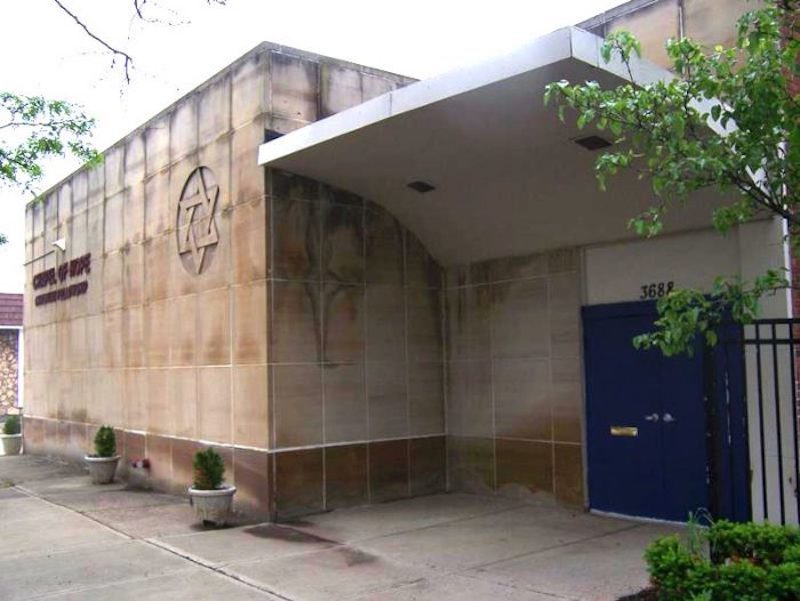
    <summary type="html"><![CDATA[<p><strong><em>The building currently occupied by Chapel of Hope Christian Fellowship at 3688 Lee Road has been used as a center for religious and cultural life for over 60 years. The history enshrined within its walls reveals the dynamic character of the Moreland neighborhood, and the diverse makeup of religious communities that have lived within its bounds.</em></strong></p><img src="https://mail.clevelandhistorical.org/files/fullsize/2178ccc0af10b897db5308f2791480ac.jpg" alt="Vestiges of the Kinsman-Lee Neighborhood" /><br/><p>In November, 1970, officers of Shaker-Lee Synagogue presented an $11,500 gift to the Jewish Welfare Fund Appeal for donation to the Israel Emergency Fund.  The substantial gift fulfilled a pledge made by the congregation to its recently deceased members, Mr. and Mrs. Sidney Gordon. Committed to do everything in their power to aid the Israeli cause, the Synagogue’s Sisterhood had raised $1,500 for this “tangible demonstration of…support for the Jews of Israel.” The remaining $10,000 was acquired through the sale of their synagogue property at 3688 Lee Road in Shaker Heights.  The sizable contribution marked an end to the small Orthodox congregation’s residence in Shaker Heights. Illustrated by persistent difficulties drawing ten male participants to hold minyan, changing conditions in the neighborhood were cited as a source of their depleted attendance.  The 135-member Synagogue determined that their religious needs would be best met by joining another congregation, and quickly secured permission to worship at Warrensville Center Synagogue in Cleveland Heights. </p><p>  The Jewish enclave surrounding Shaker-Lee Synagogue would also find a new home outside of Shaker Heights.  By the turn of the century, a large Shield of David etched into the building’s polished sandstone facade remained as one of the area’s few visual reminders of the sizable Jewish community that once lived in the surrounding neighborhood.  The structure’s history as a religious sanctuary, however, neither began nor ended with its use by the Shaker-Lee Synagogue. For over 60 years, the converted commercial building has been used by the communities of Shaker Heights and Mount Pleasant as a center for religious and cultural life. The physical transformation of the storefront space, and subsequent services and activities housed within its walls, reveal the dynamic character of the Moreland neighborhood and the diverse makeup of religious communities that have lived within its bounds.</p><p>  The construction of the building at 3688 Lee Road occurred fairly late within the context of Moreland’s residential and commercial development.  The southwest corner of the Kinsman-Lee intersection remained a homestead to descendants of the Manx farming community well into the first decade of the 1900s.  Then the area was acquired, improved and allotted by the Shaker Overlook Company. In 1918, the grounds were opened up for sale.  Antonio Lanese, an Italian sewer and water contractor, immediately purchased twenty-one lots along the boulevard that would become Nicholas Road.  Lanese eventually acquired nearly all the lands on both sides of Scottsdale Boulevard and Nicholas Avenue between East 163rd Street and Lee Road.  While most of the property was subdivided and sold to the Hillcrest Realty Company in the late 1920s, Lanese held onto a few allotments facing Lee Road into the mid-1930s.  A building permit for the property at 3688 Lee Road was submitted in 1935, although 1937 maps do not reflect the presence of a structure. The property was eventually sold in 1941, four years after Lanese’s death.  </p><p>  Sophie Schechter, a Russian immigrant living nearby on East 163rd Street, held the deed for the 3688 Lee Road property from 1941 to 1946.  Ownership then transferred to a dentist residing in Kenosha, Wisconsin. An April, 1947 advertisement for Culligan Soft Water Services offers the first evidence of a commercial structure having been built on the property. The Culligan franchise was operated out of this building until the early 1950s, but the entrepreneur eventually relocated his interests to the Lee-Miles neighborhood. In 1952, the property was deeded to Marguerite Kemmerling.  Kemmerling’s husband, Burt, owned a Ford dealership on Buckeye Road in Cleveland; Opened in 1949, the 20,000 square-foot dealership was one of the largest Ford passenger car and truck operations in Ohio.  Real estate agents for A.B. Smythe Company managed rentals of the couple’s commercial property on Lee Road.  </p><p>  By the time Kemmerling held the deed, the Moreland neighborhood housed a rapidly growing Jewish settlement. An era of economic prosperity had begun to spur rapid suburbanization in the region. Increased mobility and anxiety over racial transition in Cleveland’s east-side neighborhoods exacerbated this flight from the inner city.  Previously centralized around the Glenvillle and Mount Pleasant neighborhoods, Cleveland’s Jewish population moved en masse into the inner-ring suburbs between 1940 and 1960.    </p><p>  In Shaker Heights, affordable housing and discriminatory real estate practices steered the settlement of middle- and working-class Jews towards the Moreland and Lomond neighborhoods.   The proximity of these neighborhoods to the Orthodox Jewish community of Mount Pleasant, which had steadily expanded east along Kinsman Road since the 1920s, provided additional incentive for settlement in the area. Drawn by Shaker Heights’ superb school system and tree-lined lawns, a substantial Jewish community emerged near the Kinsman-Lee intersection.  </p><p>  The impetus to renovate the building at 3688 Lee Road grew from this rapid demographic shift. A study of the surrounding Kinsman-Lee neighborhood undertaken by the Jewish Welfare Federation in the late 1940s found the area lacking in adequate services and facilities.  In February, 1950, the Jewish Community Center purchased an eight-bedroom house at 3638 Lee Road to use as a branch in Shaker Heights.  With pre-existing locations in Glenville, Cleveland Heights and Mount Pleasant, the Cleveland-based organization provided cultural, recreational, and educational programming to Jewish communities throughout the city and its surrounds. Due to the proximity of the Mount Pleasant and Shaker-Lee branches, the former would eventually discontinue services in 1952.  </p><p>  One resource offered by the Jewish Community Center was its Drama Department. Guided by an objective to revitalize and reinterpret traditions of Jewish theater, the department staged productions of Jewish-themed plays. Since the establishment of the theater group in 1949, however, it lacked a central facility to house productions, rehearse and store equipment. The Jewish Community Center’s Board of Trustees approved the proposed costs of rent and equipment in 1953, and negotiations with A.B. Smythe commenced for use of the nearby commercial building at 3688 Lee Road. The brick structure was zoned as retail property, and contained 6,600 square feet evenly divided between two floors.  </p><p>  Funded by Friends of the Drama Department, the building was redesigned as a 175-seat playhouse that included a permanent stage, dressing rooms, rehearsal areas and workshop space.  It was dedicated in October, 1954. The Drama Department raised its curtains for the first time the following month for a presentation of Jan de Hartog’s “Skipper Next to God.” Chosen to commemorate the 300<sup>th</sup> anniversary of Jewish life in the United States, the play depicted the struggles of postwar Jewish refugees as they were refused entry into the Americas.  Both the staging of culturally relevant programming and the new playhouse were well received, and the theater group quickly garnered over 500 subscribers to its three annual productions.  The Drama Department’s value as a community service was also realized through the many hours dispensed training Jewish Community Center members in acting, directing, set design, makeup and lighting.   </p><p>  The Drama Center annex would also be used for a variety of recreation and ceremonial functions, such as banquets, religious ceremonies, fundraisers and dances. Due to the lack of any large Jewish-operated facilities in the Kinsman-Lee neighborhood prior to the opening of Beth El Synagogue in 1957, the new theater acted as both a cultural and recreational center for the Moreland neighborhood.  </p><p>  While the Jewish population of Shaker Heights steadily grew through 1961, Mount Pleasant’s Jewish community neighborhood had all but disappeared.  Religious institutions that remained behind quickly atrophied.  As early as 1954, Mount Pleasant’s once-popular Kinsman Jewish Center regularly rented the Drama Center hall to hold religious services within the neighborhood’s growing Jewish community.  The impact of this population shift became apparent as membership at the Shaker-Lee Jewish Community Center began to fall in 1956. While the Kinsman-Lee neighborhood was noted as being “enthusiastic” about the center, efforts to draw new members from other parts of the suburb proved futile.  The house on Lee Road did not “compare with the type of homes” that they were used to, and the Center did “not attract their interest or their parents.”</p><p>With trends in Jewish population movement appearing to shift towards Cleveland Heights, the Jewish Community Center elected Mayfield Road as the site of a new central facility in 1955.  Plans for the structure included a dedicated theater space, complete with graded seating. Following a performance of “The World of Sholom Aleichem” in May, 1960, the Drama Department began the process of relocating to their new air-conditioned quarters in Cleveland Heights. The doors of the Shaker-Lee Jewish Community Center closed the following year.   </p><p>  Even though the Jewish Community Center continued to work and hold functions out of the Kinsman-Lee Drama Center until late 1960, ownership of the property at 3688 Lee Road was transferred to the Ohel Jacob Anshe Sfard Congregation in November, 1957.  At the time of the sale, the formation of Ohel Jacob Yavneh Congregation was announced. The merger consolidated members of two Mount Pleasant Orthodox synagogues, Ohel Jacob and Ohel Yavneh.  As with many Jewish religious institutions that had grown along Kinsman Road, the two congregations were faced with dwindling membership. Re-centering their new synagogue within Kinsman-Lee’s Jewish community presented an opportunity to remain relevant in the religious lives of its members, and to grow. Following its purchase in 1957, the Drama Center auditorium housed the new congregation’s religious services. For over two years, both the Theater Department and Ohel Jacob Yavneh shared use of the building. The Ohel Jacob Yavneh Congregation also merged with members of Mount Pleasant’s Tifereth Israel Anshe Shard Congregation, and became known as Shaker-Lee Synagogue in 1959.   </p><p>  The building on Lee Road was once again remodeled, this time into a house of worship, following the departure of the Jewish Community Center Theater Department. In May, 1961, Shaker-Lee Synagogue was dedicated before a crowd of 300. Mayor Wilson G. Stapleton of Shaker Heights addressed the audience, welcoming a new Synagogue to the City.  Under the spiritual leadership of Rabbi Isaac Krislov, the synagogue would serve the religious needs of the Kinsman-Lee Orthodox community for over a decade. The congregation maintained an active Sisterhood, regularly offered adult study groups, and hosted gatherings associated with religious holidays.  Both the Rabbi and congregation members were also active in fundraising for pro-Israeli causes.  A shrinking congregation impelled the congregation to sell the synagogue in 1970.  As with the Jewish Community Center Theater Department, the congregation relocated to Cleveland Heights.   </p><p>  The closure of Shaker-Lee Synagogue in 1970 was indicative of a declining Jewish population in Shaker Heights. Estimations of Jewish public-school enrollment as a percentage of total enrollment plummeted from its peak of 47.3 percent in 1961 to 33.1 percent by 1968.  The Kinsman-Lee enclave soon gave way, as Orthodox communities increasingly centralized in University Heights, South Euclid, Beachwood, Cleveland Heights and Wickliffe.   </p><p>  These changes were most pronounced below Van Aken Boulevard in Shaker Heights, particularly within the Moreland community.  Ten percent of the neighborhood’s 600 homes were placed on the real estate market in both 1962 and 1963.  This was a sharp increase from prior years, and allowed for the rapid development of a Black enclave within Shaker Heights. Moreland, once known for its Italian and Jewish populace, quickly became a haven for an emerging middle-class African American community.  This transition was not uncharacteristic for Moreland, as witnessed during the Jewish migration into Shaker Heights at mid-century. While both an Italian and Jewish presence remained within the neighborhood, African-Americans comprised two-thirds of the Moreland population by 1970. </p><p>  Following the sale of Shaker-Lee Synagogue, the building continued functioning as a religious sanctuary.  Converted into a Christian church, the structure housed the religious activities of Full Gospel Assembly Church from 1970 to 2001. This evangelical congregation was led by Reverend Joseph Frano, an ordained minister of the Christian Churches of North America. Rooted in the Italian Pentecostal Movement, the religious institution was known as the Italian Christian Church prior to 1948. Reverend Frano was noted for teachings that blended traditions of Pentecostalism, Protestantism and Catholicism.    </p><p>  The Chapel of Hope Christian Fellowship has continued in the tradition of housing religious and community services for the surrounding neighborhood since 2001. Founded by Reverend Willard McFarland, development of the inclusive, non-denominational Christian congregation was guided by a belief that members should exemplify Christian teachings through daily actions in order to effect positive change in the world. Congregation members have sponsored a variety of aid programs over their many years of service in the Moreland neighborhood, including food drives, blood drives, and clothing giveaways. An annual Angel Tree outreach program is also sponsored during the Christmas season for children of incarcerated men and women.  Community services offered by the church have included raking leaves for elderly neighbors, jail ministry, financial seminars and leadership training. As the Chapel of Hope Christian Fellowship proceeds along a storied path of community outreach and faith-based service, the converted storefront at 3688 Lee Road acts as a reminder of the many religious communities that helped define the distinct character of the Moreland neighborhood.</p><p><em><strong><a href="https://mail.clevelandhistorical.org/items/show/839">For more (including 8 images) view the original article</a></strong></em></p>]]></summary>
    <published>2018-06-24T01:01:20+00:00</published>
    <updated>2026-04-17T19:17:42+00:00</updated>
    <link rel="alternate" type="text/html" href="https://mail.clevelandhistorical.org/items/show/839"/>
    <id>https://mail.clevelandhistorical.org/items/show/839</id>
    <author>
      <name>Richard Raponi</name>
    </author>
  </entry>
  <entry>
    <title type="html"><![CDATA[Django Reinhardt at the Music Hall]]></title>
    <summary type="html"><![CDATA[<img src="https://mail.clevelandhistorical.org/files/fullsize/28dc2cac98b564c4add6f55a6e7a2de7.jpg" alt="Picking at a Guitar" /><br/><p>On November 4, 1946 Django Reinhardt made his American debut at the Music Hall in Cleveland. Reinhardt, a Belgian jazz guitarist, had been invited to open for Duke Ellington on a small tour of the Midwest. Reinhardt, a headliner in Europe, arrived in Cleveland without a guitar. He assumed that music companies would compete for the honor of having him play their instruments. Reinhardt quickly learned otherwise and was forced to buy a guitar.</p><p>Local promoters further complicated Reinhardt's US debut and failed to capitalize on the moment, purchasing only a small ad in the local papers – an ad that failed to mention Reinhardt's involvement, simply stating, "Elroy Willis presents Duke Ellington and his Orchestra at the Music Hall." Despite the oversight, the Cleveland Plain Dealer reported that 1,800 people attended the concert.</p><p>After a 45 minute delay while the musicians awaited the arrival of a baggage car carrying Ellington Orchestra's instruments, the crowd finally heard Django Reinhardt's first U.S. performance. The act was such a hit that Reinhardt and Ellington would go on to play in other major cities in the Midwest before concluding their tour in New York City at Carnegie Hall. </p><p><em><strong><a href="https://mail.clevelandhistorical.org/items/show/525">For more (including 3 images&#32;&amp;&#32;1 audio file) view the original article</a></strong></em></p>]]></summary>
    <published>2012-07-24T12:05:12+00:00</published>
    <updated>2026-04-17T19:17:39+00:00</updated>
    <link rel="alternate" type="text/html" href="https://mail.clevelandhistorical.org/items/show/525"/>
    <id>https://mail.clevelandhistorical.org/items/show/525</id>
    <author>
      <name>Robin Meiksins</name>
    </author>
  </entry>
  <entry>
    <title type="html"><![CDATA[Colonial Theater]]></title>
    <summary type="html"><![CDATA[<img src="https://mail.clevelandhistorical.org/files/fullsize/4c8ae9c01c58a84ebd53011d15eac9da.jpg" alt="The Colonial Theatre" /><br/><p>Even before the Colonial Theater opened in 1903, vaudeville had emerged in America as a professionalized and more respected version of minstrel and burlesque shows.  By the time the first act hit the Colonial Theater's stage, variety shows had grown tremendously successful as they evolved into 'polite vaudeville.' Like other Cleveland playhouses, the Colonial Theater embraced this style of entertainment.  </p><p>Entertainers who appeared on opening night at the Colonial included Ida Fuller, "the greatest woman illusionist in the world"; Alcide Capitaine, who demonstrated her strength through acrobatics and other feats; a singing comedian; a ventriloquist; and an acrobatic comedy given by the Lavine Cameron trio. Not long after opening night, trick-performing animals, including dogs, monkeys, and a pig named "Connie," also appeared at the theater.</p><p>Beginning in the 1890s, large theater business began to control theaters across the country.  Like other Cleveland playhouses, the Colonial Theater changed hands a number of times to both local and national big business owners. In the case of the Colonial, the switch meant a substantial change in the theater's productions. In early 1904, the Drew & Campbell Theater Company was able to secure a lease over the Colonial. In order to get control of the theater, they were obligated to sign a contract stating that they would not allow vaudeville to continue there. Two days shy of the once independent theater's one-year anniversary, Drew & Campbell surrendered the Colonial's stage to the Vaughan Glaser Stock Company.</p><p>After five years under Vaughan Glaser, the Colonial was back in the hands of an independent manager who was neither part of the big-business theater trusts nor connected to any outside stock company. F. Ray Comstock leased the theater in 1909. A year later, however, Ray Comstock leased the theater to the Shuberts — major business owners who controlled theaters across the country and who had showed interest in the Colonial since the fall of 1903.  In the fall of 1918, the Colonial Theater's success under Shubert led to a name change. From that point on it was advertised as the Shubert Colonial.</p><p>Performances continued at the theater until 1930. Although Clevelanders at the time were unaware of the fact, "Mysteries of Love" was the Colonial Theater's last show. The show featured artist models and was advertised as being "For Men Only." It turned out, however, to be nothing more than a lecture-show. Because the show did not fulfill the expectations for risqué entertainment, Police Inspector George J. Matowitz put a stop to it, saying that the theater was "obtaining money under false pretenses." After Matowitz kept the theater from reopening the show, no other performances were given at the Colonial. In 1932, the long-empty theater was torn down to make way for a parking lot.</p><p><em><strong><a href="https://mail.clevelandhistorical.org/items/show/461">For more (including 6 images) view the original article</a></strong></em></p>]]></summary>
    <published>2012-05-16T11:06:39+00:00</published>
    <updated>2026-04-17T19:17:39+00:00</updated>
    <link rel="alternate" type="text/html" href="https://mail.clevelandhistorical.org/items/show/461"/>
    <id>https://mail.clevelandhistorical.org/items/show/461</id>
    <author>
      <name>Heidi Fearing</name>
    </author>
  </entry>
  <entry>
    <title type="html"><![CDATA[Euclid Avenue Opera House]]></title>
    <summary type="html"><![CDATA[<img src="https://mail.clevelandhistorical.org/files/fullsize/49d20adfd45f708c4ec39eb4f59a5e77.jpg" alt="Opera House Under Construction, ca. 1870s" /><br/><p>More than a century before it hosted ten-pin bowling matches, the southeast corner of Euclid Avenue and East 4th Street (then called Sheriff Street) offered operatic entertainment.  Indeed, the Euclid Avenue Opera House, which opened on September 6, 1875, stood at the heart of what was at the time Cleveland's theater district. </p><p>Stock companies were popular at the time, and John A. Ellsler's stock company and drama school was one of the most notable in Cleveland's history. This company and school took up residence in the Euclid Avenue Opera house when it opened. Like most of Cleveland's theaters, management of the Euclid Avenue Opera House changed on more than one occasion. Ellsler sank (and lost) a fortune in his Cleveland theaters. He also lost the Opera House. In 1877, Marcus A. Hanna bid $43,050 for a theater that had cost $200,000 to build. The Opera House's management continued to change hands as Hanna leased the theater to his cousin L.G. Hanna, Augustus Hartz, Abraham Lincoln Erlanger, and George Fox.</p><p>On October 29, 1892, the electrical fixtures that had contributed to the Opera House's status as "one of the Nation's best known theaters" in 1875, were blamed for starting the fire that destroyed it. In mid January 1893, the rebuilding of the Opera House started on the same location as its burnt predecessor. The new Opera House reopened less than a year after the fire.</p><p>The Euclid Avenue Opera House continued its theatrical productions for nearly thirty more years. Ironically, the fall of the Euclid Avenue Opera House coincided with the rise of Playhouse Square and had, in fact, been at the heart of an earlier, loosely arrayed theater district of sorts that predated Playhouse Square. On April 2, 1922, the last curtain was dropped after a revisited performance of Uncle Tom's Cabin. The morning after its last play, demolition on the Opera House began to make room for the one of S. S. Kresge Company's twenty-eight stores. In the wake of the decline of downtown retailing, the Kresge building found new life as the Corner Alley, a staple of the East 4th entertainment district.</p><p><em><strong><a href="https://mail.clevelandhistorical.org/items/show/460">For more (including 8 images) view the original article</a></strong></em></p>]]></summary>
    <published>2012-05-16T10:35:48+00:00</published>
    <updated>2026-04-17T19:17:39+00:00</updated>
    <link rel="alternate" type="text/html" href="https://mail.clevelandhistorical.org/items/show/460"/>
    <id>https://mail.clevelandhistorical.org/items/show/460</id>
    <author>
      <name>Heidi Fearing</name>
    </author>
  </entry>
  <entry>
    <title type="html"><![CDATA[Heights Art Theater]]></title>
    <summary type="html"><![CDATA[<img src="https://mail.clevelandhistorical.org/files/fullsize/0f57e310816b162c9e33738825d94e01.jpg" alt="Heights Theater, 1941" /><br/><p>A dramatic police raid.  A community up in arms.  A man taking his fight for justice all the way to the Supreme Court.  These events sound like the plot of a Hollywood movie, but they actually in Cleveland Heights. Cleveland Heights police raided a screening of the French film "Les Amants" ("The Lovers") at the Heights Art Theater. The net effect was an obscenity conviction for theater manager Nico Jacobellis and a five-year legal battle. The movie's offenses: a risqué theme and one two-second shot of a female breast!  </p><p>Controversy over "Les Amants" (directed by the legendary Louis Malle) was not the first time the movie theater on Euclid Heights Boulevard was the center of a community-wide moral debate. Nor was it the first time the theater had been raided by police.  In 1922, just three years after it opened, the (originally named) Heights Theater got into trouble for showing a movie on a Sunday afternoon. In the middle of the film, Cleveland Heights police arrested two managers and the theater's projectionist, clearing the theater of 500 patrons to a chorus of boos and catcalls.  A month later, a jury convicted the three of breaking Ohio's "blue law" which prohibited "theatrical or dramatic performances," as well as all other forms of commercial entertainment, on the Sabbath. Cleveland Heights City Council voted to allow Sunday movies in 1931, on the same day that Ohio's statewide "blue law" was repealed.  More than 9,000 Cleveland Heights residents signed a petition demanding the change.</p><p>In 1954, the Heights Theater became the Heights Art Theater, dedicated to showing "Only distinguished motion pictures of international prestige." From a publicity perspective "Les Amants" was the theater's peak. The movie, which tells the story of a married woman's love triangle, had been highly acclaimed in Europe, though the Cleveland Plain Dealer's review called it "shockingly nasty." On November 13, 1959, Chief of Cleveland Heights Police Edward Gaffney, upon hearing a report from the city's law director and the Cuyahoga County prosecutor, who had attended a showing of "Les Amants," ordered police to clear the theater, confiscate the film, and arrest Nico Jacobellis. After a lengthy trial that featured dueling film critics, clergymen, and university professors, Jacobellis was found guilty of possessing and exhibiting an obscene film and fined $2,500.  Throughout the trial, Jacobellis, an Italian immigrant who studied and taught film at Western Reserve University, insisted that he was just following the orders of the theater's owners who had screened the film in other cities without incident.  </p><p>Jacobellis' attorneys appealed the case all the way to the U.S. Supreme Court.  In June 1964 the Supreme Court ruled on Jacobellis v. Ohio, reversing the conviction in a 6-2 decision.  The ruling suggested that national standards of decency–and not those of individual local communities–mattered most, though this principle would come into question in later Supreme Court decisions. One of the Supreme Court's most famous quotes also emerged from the decision, when justice Potter Stewart noted that "I know [pornography] when I see it, and the motion picture involved in this case is not that."</p><p>In the 1970s and 1980s, the Heights Art Theater went on to show movies considerably racier than "Les Amants" and "Behind the Green Door." However, no further legal action was ever taken against the theater.  In 1984, the Heights Art Theater changed its name to the Coventry Theater and later to the Centrum, neither of which showed X-rated films. Lacking proximate parking and unable to compete with large multiplexes, the theater screened its last film in 2003. Nearby parking, comfy seats, expensive projection systems, and dozens of screens accomplished what two police raids and a series of legal fights could not. Today, a church, a whiskey bar, and a taqueria share the main floor, while an upstairs section includes a hookah parlor.</p><p><em><strong><a href="https://mail.clevelandhistorical.org/items/show/436">For more (including 10 images&#32;&amp;&#32;3 audio files) view the original article</a></strong></em></p>]]></summary>
    <published>2012-04-25T12:32:45+00:00</published>
    <updated>2026-04-17T19:17:39+00:00</updated>
    <link rel="alternate" type="text/html" href="https://mail.clevelandhistorical.org/items/show/436"/>
    <id>https://mail.clevelandhistorical.org/items/show/436</id>
    <author>
      <name>Michael Rotman</name>
    </author>
  </entry>
  <entry>
    <title type="html"><![CDATA[The Academy of Music]]></title>
    <summary type="html"><![CDATA[<img src="https://mail.clevelandhistorical.org/files/fullsize/eb2d7f30982620dd2438343449dff185.jpg" alt="Academy of Music " /><br/><p>On the evening of December 5, 1863, two thousand audience members at the Academy of Music enthusiastically applauded the acting of John Wilkes Booth.  Little did they know that the actor who gave "his greatest performance" as Charles D'Moor in The Robbers would not be remembered for his acting talents, but instead live on in infamy for the assassination of President Abraham Lincoln. Booth had appeared at the Academy of Music before starring in The Robbers. Other performers whose names became well known got their start on the same stage, such as John McCullough and Clara Morris. </p><p>The Academy of Music on Bank (now W. 6th) Street was one of the top American theaters of its time.  Theater doors were opened for the first time on April 16, 1853 for the production of School for Scandal. The early days proved challenging, and two years later the theater was leased by John A. Ellsler to save it from financial ruin.  It was under his rule that the theater had its heyday. "Uncle John" Ellsler started his stock company, one of the first American dramatic schools, at the Academy. It proved a great success. With the exception of some relatively brief absences, Ellsler's stock company provided Clevelanders with Shakespearean and popular entertainment for three decades. After the stock company system started to die, however, larger theater houses were built. Consequently, Cleveland's entertainment center shifted away from Bank Street and Ellsler decided to discontinue his lease for good. The Academy was then left in the hands of numerous managers, none of whom were able to regenerate the theater's previous success.  </p><p>Although the Academy of Music's popularity was dwindling, it was restored to serve as a vaudeville house after being gutted by a fire on June 30, 1889. Just over three years later, the theater was completely destroyed by another fire but not rebuilt. Before the second fire on August 8, 1892, audiences would have sat beneath a china candle chandelier hung from the auditorium ceiling. The music resonating from the orchestra pit was played by students and was conducted by their teacher.  Actors, comedians, and musicians performed their various talents on a downward sloped stage and were illuminated by gas footlights downstage. At the end of a night's show, a plush red curtain would drop, covering the entertainers and the stage.   </p><p><em><strong><a href="https://mail.clevelandhistorical.org/items/show/330">For more (including 5 images) view the original article</a></strong></em></p>]]></summary>
    <published>2011-08-27T15:47:05+00:00</published>
    <updated>2026-04-17T19:17:38+00:00</updated>
    <link rel="alternate" type="text/html" href="https://mail.clevelandhistorical.org/items/show/330"/>
    <id>https://mail.clevelandhistorical.org/items/show/330</id>
    <author>
      <name>Heidi Fearing</name>
    </author>
  </entry>
  <entry>
    <title type="html"><![CDATA[Palace Theater: Edward Albee&#039;s Showplace on Playhouse Square]]></title>
    <summary type="html"><![CDATA[<img src="https://mail.clevelandhistorical.org/files/fullsize/9fc664b4a2d49716c24df04ef10c7f40.jpg" alt="New Palace Marquee" /><br/><p>The Palace Theater at the B.F. Keith Building opened in 1922. Owner Edward Albee II (the grandfather of American playwright Edward Albee) named it for his late business partner B.F. Keith who had died in 1914.</p><p>Originally named Keith's Palace Theater, the building was designed to be the flagship of the Keith chain of Vaudeville theaters. At the time of completion the Keith Building was the tallest building in downtown Cleveland and represented the high point of development in Playhouse Square. The 3100-seat theater cost $3.5 million to open and was described as one of the most lavish in the land. The sign on top of the building was the largest electrical sign in the world, while the lobby housed a million-dollar art collection and the world's largest woven-in-one-piece carpet.</p><p>B.F. Keith was an American theater owner who helped evolve variety theater into vaudeville.  The Palace Theater emulated this model. The theater held two vaudeville shows a day during its first four years. During its first year, the Palace Theater sold 1.7 million tickets.  However, this trend did not last, as the motion picture era was beginning. By 1926, the twice daily performances were halted in favor of a combination of continuous live entertainment and motion pictures.  In 1932, daily live shows were dropped entirely, with films becoming the main attraction. Throughout this time, however, the Palace Theater never forgot its roots. Despite the theater indulging in film, it still held periodic vaudeville performances well into the 1950s.</p><p>Many famous performers of the age were associated with the Palace Theater. Bob Hope began his career on the Palace stage. It also showcased Bing Crosby, Harry Houdini, Frank Sinatra and the Three Stooges. George Burns and Gracie Allen were married on the Palace Theater stage in 1926.  </p><p>Through a combination of intensifying competition with suburban cinemas and television, the Palace's ticket sales dropped steadily throughout the 1950s and 1960s. Declining revenues and high real estate taxes increased the theater's financial burden, so when an air conditioning unit broke on July 20, 1969, rather than fix it, the theater closed. By the early 1970s, the Playhouse Square area had experienced considerable regression, and the attempts of civic and business groups to increase retail business and attract new commercial uses for the buildings failed.  However, the Playhouse Square Foundation soon began a massive theater restoration effort that eventually included the Palace Theater.</p><p>In April 1982, the Palace dressing rooms were restored in a joint project by a series of local businesses.  In total, the renovation project cost $36.4 million and took six years to complete.  In 1988, the Palace Theater reopened completely restored but with approximately 400 seats less than it originally had. Today, the Palace Theater serves as a venue for every sort of performance from comedy shows to Broadway plays.</p><p><em><strong><a href="https://mail.clevelandhistorical.org/items/show/246">For more (including 8 images&#32;&amp;&#32;1 audio file) view the original article</a></strong></em></p>]]></summary>
    <published>2011-07-11T18:26:10+00:00</published>
    <updated>2026-04-17T19:17:37+00:00</updated>
    <link rel="alternate" type="text/html" href="https://mail.clevelandhistorical.org/items/show/246"/>
    <id>https://mail.clevelandhistorical.org/items/show/246</id>
    <author>
      <name>Joe Petit</name>
    </author>
  </entry>
  <entry>
    <title type="html"><![CDATA[Beck Center for the Arts]]></title>
    <summary type="html"><![CDATA[<img src="https://mail.clevelandhistorical.org/files/fullsize/22ddd9bde67c374c150c4ecd1b38aea7.jpg" alt="Front Entrance" /><br/><p>The Beck Center for the Arts is a non-profit organization that is "dedicated to enriching the quality of life for Northeastern Ohioans" through the performing arts and art education. The history of the Beck Center can be traced back to 1931 to a group of eighteen thespians known as the Guild of the Masques. They were led by the London-trained director Richard Kay. The Guild rehearsed in Lakewood living rooms and performed where ever they could such as schools or churches. In 1933, they leased an old blacksmith's shop where they tore down a wall, built a stage, and performed to sold-out crowds. </p><p>The same year, the Guild of the Masques was incorporated as a non-profit arts organization and officially became the Lakewood Little Theater. Tragedy struck in 1934 when the Lakewood Fire Department turned the fledgling company out of the blacksmith's shop due to code violations.  So they took the show on the road once more. They became known for their radio dramas, in particular the story of the creation of the Red Cross by Clara Barton during the Civil War. The Little Theater charged no admission for their performances, which was greatly appreciated by those affected by the Depression.</p><p>The Lakewood Elks Club offered their facilities to the Little Theater due to their reputation of civic responsibility. However, the situation was less than ideal. Sets had to be built off site and carried by hand to the Elks Club in pieces. Local undertakers were asked to provide extra seats for the sold-out crowds. Patrons were routinely turned away due to lack of room. The Elks Club was the home the Lakewood Little Theater for three years, and ten productions a year were staged there, often receiving rave reviews. </p><p>In 1936, a group of dedicated Lakewood women decided to do something about the inadequate space of the Elks Club. They formed the Lakewood Little Theater Women's Committee and took over the fundraising efforts for the Little Theater. Not to be outdone, male Lakewood citizens formed the Lakewood Little Theater Men's Advisory Board with the intention of finding a permanent venue for the Little Theater. The Lucier Motion Picture Theater was leased with the eventual option to buy although it needed costly renovations. The men's and women's organizations set a $10,000 fundraising goal. The members of the Women's Committee opened their homes for floral themed tea parties, such as the Tulip Teas, and the press reported on what the ladies wore and where they vacationed. </p><p>On May 7, 1938 the Little Theater staged its first production, Fred Ballard's "Ladies of the Jury," in their new home to a sold out crowd of gentlemen in top hats and well-dressed ladies. In its first week the Little Theater drew 2,265 patrons. The press continued to love their productions, and the people kept coming. Even World War II didn't slow them down. In 1944, the lease on the Lucier was up, and the Little Theater purchased the building. The Lakewood Little Theater now had expanded its vision to include more space and provided theater education for the youth of the community.</p><p>In 1948, the Lakewood Little Theater School began led by actor Virginia Woodworth, called Woodbean by her students. One of the teachers she recruited was radio personality "Lady Jan" Egert. The purpose of the education programs Egert said, "was not on creating child stars. The objective was always to teach children to be more comfortable with the spoken word so that they could become better in school and in life. I was thrilled to be involved."  Classes involved instruction of basic theater techniques, diction, and characterization.  Students performed two plays a year which were often adaptations of fairy tale classics and other stories that would appeal to children. Lady Jan Egert even brought students to appear on her WJW radio show to perform. She stayed with the program until 1986.</p><p>In 1974, Kenneth Beck donated $300,000 to the Lakewood Little Theater, and later gave an additional $300,000. With additional fundraising from the public, construction of new facilities began. Beck was a retired partner in Beck & Wall the fifth largest manufacturer of advertising displays in the U.S. and millionaire. The Kenneth C. Beck Center was formally opened in 1976 with a black tie celebration. After a gourmet dinner, the 500 guests watched a production of Maxwell Anderson's "Mary Queen of Scotland." Kenneth Beck later said it was "the happiest day of his life." The Beck Center for the Arts was officially born. </p><p><em><strong><a href="https://mail.clevelandhistorical.org/items/show/227">For more (including 7 images) view the original article</a></strong></em></p>]]></summary>
    <published>2011-06-08T15:18:00+00:00</published>
    <updated>2026-04-17T19:17:37+00:00</updated>
    <link rel="alternate" type="text/html" href="https://mail.clevelandhistorical.org/items/show/227"/>
    <id>https://mail.clevelandhistorical.org/items/show/227</id>
    <author>
      <name>Sarah Kasper</name>
    </author>
  </entry>
  <entry>
    <title type="html"><![CDATA[Cedar-Lee Theatre]]></title>
    <summary type="html"><![CDATA[<img src="https://mail.clevelandhistorical.org/files/fullsize/329c1657c353422421d18e853e75f8a0.jpg" alt="Cedar-Lee Theatre, 1936" /><br/><p>The Cedar-Lee Theatre opened on Christmas Day 1925. The first movie screened there was <em>The King on Main Street</em>, a silent film about a rich European king (played by Adolphe Menjou) who falls in love with a common American girl during a visit to New York's Coney Island. The one-hour film was supplemented with a number of shorts, including <em>30 Years Ago</em>, <em>The Marionettes</em>, and <em>A Trip Thru Kimballville</em>. </p><p>The Cedar-Lee was originally a 1,100-seat, single-screen theater. After being purchased in 1977 by the newly created Cleveland Cinemas, however, the theater underwent a series of expansions that ultimately increased it to a six-cinema facility. Also in 1977, the Cedar-Lee was the site of the inaugural Cleveland International Film Festival, and the theater served as its home base until the festival moved to Tower City Cinemas in 1991. In recent decades the Cedar Lee has played primarily independent and foreign films. It is also known for its monthly midnight screenings of <em>The Rocky Horror Picture Show</em>. </p><p>Throughout the Cedar-Lee Theatre's history, the stretch of Lee Road surrounding it has been populated by a number of businesses. Bygone places to eat include a burger joint called Mawby's, Bruder's Creamery, and Marshall's Drug Store, which featured a soda fountain. These combined with various small food markets, hardware stores, and other locally owned shops to make the Cedar-Lee area a vibrant business district. While the names on the signs may have changed, the area around Cedar-Lee Theatre remains popular with shoppers and diners today.</p><p><em><strong><a href="https://mail.clevelandhistorical.org/items/show/194">For more (including 8 images&#32;&amp;&#32;2 audio files) view the original article</a></strong></em></p>]]></summary>
    <published>2011-04-21T14:09:58+00:00</published>
    <updated>2026-04-17T19:17:37+00:00</updated>
    <link rel="alternate" type="text/html" href="https://mail.clevelandhistorical.org/items/show/194"/>
    <id>https://mail.clevelandhistorical.org/items/show/194</id>
    <author>
      <name>Michael Rotman</name>
    </author>
  </entry>
  <entry>
    <title type="html"><![CDATA[Cleveland Public Theatre]]></title>
    <summary type="html"><![CDATA[<img src="https://mail.clevelandhistorical.org/files/fullsize/dscdo_detroitshoreway_clevelandpublictheatre_signstorefront_nd_8ed8e72065.jpg" alt="A Renovated Cleveland Public Theatre" /><br/><p>Cleveland Public Theatre was founded in 1982 by Cleveland native James Levin.  From its early years, CPT was instrumental in promoting, creating, and providing a home for experimental theater in the Cleveland area.  Initially sparking interest in local theater through productions such as Shakespeare at the Zoo and the New Plays Festival, the focus of CPT gravitated toward the latter by the late 1980's.  Over the next decade, the theater would make a name for itself both within and outside of Cleveland as a stage for original works by contemporary artists.</p><p>Ingrained into the mission of the theater is the belief that art can not only change individual lives, but that the theater can be a means to revitalize the surrounding neighborhood.  Beyond providing a space and forum for local artists to perform and display their work, CPT developed urban outreach programs that provide educational services to at-risk youth and homeless adults.  In addition, the success of Cleveland Public Theatre helped set the stage for the transformation of the surrounding neighborhood into an emerging arts district.  Working in collaboration with other community organizations, Cleveland Public Theater has played a key role in promoting the commercial and economic development of what is now the Gordon Square Arts District. </p><p><em><strong><a href="https://mail.clevelandhistorical.org/items/show/181">For more (including 5 images) view the original article</a></strong></em></p>]]></summary>
    <published>2011-03-13T20:01:56+00:00</published>
    <updated>2026-04-17T19:17:37+00:00</updated>
    <link rel="alternate" type="text/html" href="https://mail.clevelandhistorical.org/items/show/181"/>
    <id>https://mail.clevelandhistorical.org/items/show/181</id>
    <author>
      <name>Richard Raponi</name>
    </author>
  </entry>
  <entry>
    <title type="html"><![CDATA[Capitol Theatre]]></title>
    <summary type="html"><![CDATA[<img src="https://mail.clevelandhistorical.org/files/fullsize/capitoltheatre-dscdo-boxoffice-nd_e89dea3675.jpg" alt="Capitol Theatre Box Office" /><br/><p>On April 8, 1921, the Capitol Theatre opened its doors to the public at the dedication of the Gordon Square Arcade and Community Building. Developed by the West Side Amusement Co. and Canadian motion picture theater promoters Jule and J.J. Allen, the theater began as a vaudeville and silent film house.  During the surrounding neighborhood's prosperous years, the theater remained a centerpiece of Gordon Square. The arcade and theater slowly fell into disrepair, though, following the outmigration of both Cleveland residents and businesses following World War II.  </p><p>In 1978, the parapet of the Gordon Square Arcade collapsed and damaged the marquis. Plans were quickly prepared for the demolition of the building. Although the building itself was spared through the efforts of the Detroit Shoreway Community Development Organization, the Capitol Theatre eventually closed down in 1985 due to years of deterioration. With the revival of the Detroit Shoreway neighborhood and the designation of the Gordon Square area as a cultural arts district, the theater was renovated and reopened in 2009.  It is now owned by the Detroit Shoreway Community Development Organization and operated by the Cleveland Cinemas.</p><p><em><strong><a href="https://mail.clevelandhistorical.org/items/show/152">For more (including 6 images, 1 audio file,&#32;&amp;&#32;1 video) view the original article</a></strong></em></p>]]></summary>
    <published>2011-03-02T09:48:24+00:00</published>
    <updated>2026-04-17T19:17:37+00:00</updated>
    <link rel="alternate" type="text/html" href="https://mail.clevelandhistorical.org/items/show/152"/>
    <id>https://mail.clevelandhistorical.org/items/show/152</id>
    <author>
      <name>Richard Raponi</name>
    </author>
  </entry>
  <entry>
    <title type="html"><![CDATA[Playhouse Square]]></title>
    <summary type="html"><![CDATA[<img src="https://mail.clevelandhistorical.org/files/fullsize/e820b13c5ad7dceb90a64163b4b8b56d.jpg" alt="Billboard Sign, 2014" /><br/><p>Playhouse Square emerged in 1921-22 with the opening of the State, Ohio, Allen, Palace, and Hanna theaters near the intersection of Euclid Avenue and East Fourteenth Street. The brainchild of Joseph Laronge, four of the five theaters were interconnected. The largest theater, the Palace, was built to host B. F. Keith's vaudeville performances. In addition to vaudeville, the theater district featured plays, motion pictures, and eventually Cinerama films. By the end of 1969, however, all of the theaters but the Hanna had closed due to declining attendance.</p><p>The Junior League of Cleveland was instrumental in saving the theaters from demolition in the 1970s, forming the Playhouse Square Foundation and working with Cuyahoga County commissioners to restore and reopen the theaters. By the turn of the twenty-first century, all of the original theaters were again hosting performances, constituting the nation's second largest performing arts complex after New York's Lincoln Center. In addition to ticket sales, the Playhouse Square Foundation developed an extensive real estate portfolio stretching from the theater district to the suburbs, which supported ongoing preservation of the historic properties themselves while contributing to broader economic development.</p><p>In recent years Playhouse Square Foundation added dramatic arches at three major approaches to the district, along with LED sign boards and the centerpiece GE Chandelier at Euclid and East 14th. The Foundation also funded a 34-story apartment tower, the Lumen, just east of the Hanna Building.</p><p><em><strong><a href="https://mail.clevelandhistorical.org/items/show/61">For more (including 10 images, 4 audio files,&#32;&amp;&#32;3 videos) view the original article</a></strong></em></p>]]></summary>
    <published>2010-09-22T11:46:09+00:00</published>
    <updated>2026-04-17T19:17:37+00:00</updated>
    <link rel="alternate" type="text/html" href="https://mail.clevelandhistorical.org/items/show/61"/>
    <id>https://mail.clevelandhistorical.org/items/show/61</id>
    <author>
      <name>CSU Center for Public History and Digital Humanities</name>
    </author>
  </entry>
  <entry>
    <title type="html"><![CDATA[Cleveland&#039;s Second Downtown: East 105th Street and Euclid Avenue]]></title>
    <summary type="html"><![CDATA[<img src="https://mail.clevelandhistorical.org/files/fullsize/714bc755817731ebb961780c0d51542f.jpg" alt="Doan&#039;s Corners Postcard View, ca. 1905" /><br/><p>In the early 1800s the present-day intersection of Euclid Avenue and East 105th Street (then Doan Street) was known as Doan's Corners. Named after Nathaniel Doan, who owned a tavern, a hotel, and other businesses there, Doan's Corners was a stagecoach stop on the road between Cleveland and Buffalo, New York. Until the turn of the twentieth century, Doan's Corners lay in the midst of farmlands and country estates just east of "Millionaires' Row." Within a generation, however, many Clevelanders came to view the area around East 105th Street and Euclid Avenue as Cleveland's second downtown. The grand Alhambra Theater opened at 10403 Euclid Avenue in the early 1900s, and other entertainment venues followed in its wake. The area became a premier destination for arts and entertainment, with music clubs, restaurants, theaters, and retail shopping. These catered to a population that was increasingly moving eastward into neighborhoods like Hough, Glenville, and Wade Park. Streetcars also brought East Side suburbanites to the 105th Street area.</p><p>In the 1950s, nearby Hough and Glenville began to transform from majority-white to majority-black neighborhoods. The Euclid-East 105th area continued to attract a mostly suburban white clientele to its many entertainment venues.  Along with the Alhambra, there were a number of theaters. The Circle Theater hosted a number of musicians and Keith's 105th Street Theater showed motion pictures. The Circle Theater brought in big-time acts like Roy Acuff and his Grand Ole Opry.  Keith's 105th Street Theater and the Circle Theater helped give rise to artists and producers.  At midcentury the Euclid-East 105th area also began to attract a growing African American clientele. The change was not without problems. In the early 1950s a series of bombings rocked the Towne Casino, a music club that attracted interracial patronage. The venue finally closed amid fears of attacks possibly calculated to stave off integration.  By the 1960s, nearby University Circle institutional leaders and municipal officials eyed the district for urban renewal, envisioning an extension of their collective campus to replace this dense urban core.</p><p>After the Hough uprising and Glenville shootout in the later 1960s, white flight and disinvestment threatened to spell the end of the East 105th Street entertainment district. Not long after the riots, however, African American real estate developer Winston E. Willis stepped in and purchased many of the commercial properties around East 105th Street and Euclid Avenue, opening a number of adult-oriented businesses. However, Willis also opened a number of mainstream ventures, including the Scrumpy Dump Cinema and Winston's Place Fine Dining. He managed the block of businesses through his University Circle Properties Development Inc., whose UCPD signage mimicked that of the University Circle Police Department. Throughout the late 1970s and early 1980s, Willis was locked in legal battles with the city.  His use of the old Keith's 105th Theater as a billboard to rail against the nearby Cleveland Clinic's expansionist planning as an affront to African Americans surely added to the resolve of his opponents. Through a number of city investigations, Willis was imprisoned and his property confiscated. In the early 1980s, nearly all of Willis's properties   were demolished to make way for the William O. Walker Center, sounding the death knell for the anchor of Cleveland's "Gold Coast."</p><p><em><strong><a href="https://mail.clevelandhistorical.org/items/show/49">For more (including 9 images&#32;&amp;&#32;7 audio files) view the original article</a></strong></em></p>]]></summary>
    <published>2010-09-19T17:26:53+00:00</published>
    <updated>2026-04-17T19:17:36+00:00</updated>
    <link rel="alternate" type="text/html" href="https://mail.clevelandhistorical.org/items/show/49"/>
    <id>https://mail.clevelandhistorical.org/items/show/49</id>
    <author>
      <name>Adonees Sarrouh&amp;#32;&amp;amp;&amp;#32;J. Mark Souther</name>
    </author>
  </entry>
  <entry>
    <title type="html"><![CDATA[Hippodrome: Once Downtown&#039;s Premier Cinema House]]></title>
    <summary type="html"><![CDATA[<img src="https://mail.clevelandhistorical.org/files/fullsize/59a06b7879adf43b962c637753394bb7.jpg" alt="Marquee Months Before Demolition" /><br/><p>Eighteen months of planning and preparation preceded the opening of the massive Hippodrome Theater on December 31, 1907, with seating for 3,548 and the world's second largest stage. Architect John Eliot of Knox and Eliot designed the building to span the lot at 720 Euclid Avenue through to Prospect Avenue to the south. Ensconced in an eleven-story office building with theatre marquees and entrances on both streets, “The Hipp” was originally designed to host operas, plays, and vaudeville shows and prospered for two decades with a variety of live theater events. It hosted performances by the most famous performers of the early twentieth century, including Enrico Caruso, W. C. Fields, Will Rogers, Lillian Russel, John Phillip Sousa, and Al Jolson. </p><p>Modeled after the Hippodrome in New York, Cleveland’s version reflected developer Max Faetkenheuer’s dream of a theater that could house any size of production and staging. The central area in front of the stage held a pool which splashed the orchestra when horses paraded past. One backstage area was created that could dress up to 1,500 actors or be used for scenery staging. Faetkenheuer staged Aida with the Triumphant March to include elephants, horses, troops, and dancers. They continued circling onto and off the stage, “refreshed” by stage hands to look different for each circuit. The illusion supported the image of the largest theater to house so many animals and characters. Management evolved in 1912 when the B.F. Keith family of motion picture theaters leased the Hipp and managed it for the next decade of live theater operations.</p><p>The advent of projected film began to take popular hold during the 1920s, and the Hipp was primed to welcome and accommodate the new technology in 1922. Remodeling proceeded in 1931 with expanded seating for over 4,000 and an air-conditioning system utilizing water from Lake Erie. The Hipp became the nation's largest theater devoted exclusively to showing films and prospered for the next four decades, enjoying large movie crowds as Cleveland’s premier downtown movie house. The theater continued to show movies until the late 1970s, when declining attendance no longer supported the business. </p><p>The eleven-story office building to which the theater was attached became home to several tenants, including the longstanding street-level Green’s Jewelers, a haberdashery, and a shoe store. During its 73-year lifespan, the Hipp also was home to the Downtown Health Club and Danny Vegh’s Billiards and Table Tennis Center in the basement level between 1965 and 1980. The late 1960s brought increased challenges to maintain the building as tenants and visitors diminished. The Hippodrome closed all but its street-level operations by 1978. In 1979, a giant complex was proposed for the site to meet a perceived need for office space downtown. However, no tenants signed up and financing was not achieved. Similar to the campaign to rescue the theaters of Playhouse Square, the Cleveland Landmarks Commission was approached to initiate action to preserve the Hippodrome as an historic site, but the building’s condition was judged insufficient to warrant repair or restoration. In the summer of 1980, the Hippodrome fell to the wrecking ball to make way for a parking lot. In 2023, a 23-story tower called City Club Apartments replaced the surface lot.</p><p><em><strong><a href="https://mail.clevelandhistorical.org/items/show/25">For more (including 11 images&#32;&amp;&#32;2 audio files) view the original article</a></strong></em></p>]]></summary>
    <published>2010-09-16T11:38:39+00:00</published>
    <updated>2026-04-17T19:17:36+00:00</updated>
    <link rel="alternate" type="text/html" href="https://mail.clevelandhistorical.org/items/show/25"/>
    <id>https://mail.clevelandhistorical.org/items/show/25</id>
    <author>
      <name>Heidi Fearing</name>
    </author>
  </entry>
  <entry>
    <title type="html"><![CDATA[Masonic Temple]]></title>
    <summary type="html"><![CDATA[<img src="https://mail.clevelandhistorical.org/files/fullsize/3effdac1a637390133850fbe8eb1084a.jpg" alt="Masonic Temple Asylum" /><br/><p>The Masonic Temple and Performing Arts Center, built by the Scottish Rite Masons in 1919, was a testament to Cleveland's rich architectural and cultural heritage. Located at 3615 Euclid Avenue, the temple's opulent design featured marble staircases, elaborate meeting rooms, and a 2,000-seat auditorium. Though initially envisioned as part of a larger high-rise office building, the additional plans were never realized. Despite this, the temple became a cornerstone of Cleveland's arts and culture scene. For twelve years, it served as the home of the Cleveland Orchestra before Severance Hall's opening in 1931, and its fine acoustics ensured its continued use for many of the orchestra's recordings. Over the decades, the building also housed the Cleveland Masonic Library and Museum and renowned arts organizations such as Dancing Wheels, <a href="https://clevelandhistorical.org/items/show/1038">The Singing Angels</a>, and Red (an Orchestra). </p><p>Among these, the Dancing Wheels Company distinguished itself as a groundbreaking professional dance organization that celebrated inclusivity and artistic innovation. Founded in 1980 by Mary Verdi-Fletcher, one of the first professional wheelchair dancers, the company became an international leader in inclusive arts. Dancing Wheels blended artistry and advocacy, challenging societal perceptions of disability while showcasing the richness of diversity through performance. With a repertoire ranging from classical ballet to contemporary works, the company collaborated with esteemed choreographers to create dynamic, thought-provoking productions. Beyond performances, Dancing Wheels also prioritized education and outreach, offering workshops and programs that inspired people of all abilities to engage with the arts. Their residency at the Masonic Temple until 2018 underscored Cleveland's commitment to fostering a vibrant, progressive cultural landscape. </p><p>The Singing Angels, founded in 1964 by William C. Boehm, further exemplified the Masonic Temple's role as a hub for artistic excellence. This internationally acclaimed youth chorus inspired audiences through a diverse musical repertoire and an unwavering dedication to creative growth. The Masonic Temple served as an essential rehearsal space for the ensemble, providing a setting steeped in architectural grandeur and cultural significance. This inspiring environment nurtured the young performers' musical talents and fostered a sense of community within the group. The years spent rehearsing at the temple greatly influenced the ensemble's artistic development, solidifying their reputation as ambassadors of music and peace while strengthening their role in Cleveland's cultural legacy. </p><p>Similarly, Red (an Orchestra), founded in 2001, left an indelible mark on Cleveland's arts scene through its innovative approach to classical music. Renowned for reimagining traditional works and championing contemporary compositions, the orchestra delivered immersive, transformative performances that captivated audiences. Central to Red's mission was the use of unconventional venues that enriched the listening experience, and the Masonic Temple Auditorium stood out as a prime location. Its striking architecture, historical resonance, and exceptional acoustics provided the perfect backdrop for the orchestra's groundbreaking concerts. Unfortunately, financial challenges led to Red's sudden disbandment in 2008, but the ensemble's legacy continued to inspire. </p><p>In 2017, a new chapter began for the Masonic Temple when TempleLive, also known as Temple CLE, acquired the property. Facing declining membership and high maintenance costs, the Masonic organization sold the building, allowing for its transformation into a multipurpose venue. TempleLive embraced the challenge of preserving the historic charm of the structure while adapting it for modern use, hosting concerts, weddings, and other significant events. This revitalization successfully breathed new life into the storied building, continuing its legacy as a cultural and architectural landmark.</p><p><em><strong><a href="https://mail.clevelandhistorical.org/items/show/9">For more (including 9 images&#32;&amp;&#32;3 audio files) view the original article</a></strong></em></p>]]></summary>
    <published>2010-09-13T22:10:09+00:00</published>
    <updated>2026-04-17T19:17:36+00:00</updated>
    <link rel="alternate" type="text/html" href="https://mail.clevelandhistorical.org/items/show/9"/>
    <id>https://mail.clevelandhistorical.org/items/show/9</id>
    <author>
      <name>Dawn Culp</name>
    </author>
  </entry>
  <entry>
    <title type="html"><![CDATA[Cleveland Play House: From East Side Farmhouse to Playhouse Square Fixture]]></title>
    <summary type="html"><![CDATA[<img src="https://mail.clevelandhistorical.org/files/fullsize/b70a8cf58c3341e6b706f8fcc508e316.jpg" alt="CPH and CSU Join in the Allen Theatre" /><br/><p>The story of the Cleveland Play House begins in 1915 with a series of meetings held at the home of essayist Charles Brooks. Charles and his wife Minerva Brooks met each week with eight of their friends to discuss theatre and the arts. Eventually, the well-to-do couple decided to form the Cleveland Play House, a professional theatre company that would offer performances of a more substantive nature than the vaudeville and burlesque acts popular at the time. With Brooks as president, the company held its first show in May 1916 in an old farmhouse on land owned by industrialist Francis Drury, who lived across the street in <a href="https://clevelandhistorical.org/items/show/822">his mansion</a> at 8615 Euclid Avenue. </p><p>As attendance grew, the farmhouse became inadequate. In 1917 the Play House spent nearly $9,000 to purchase and renovate a Lutheran Church at East 73rd Street and Cedar Avenue that could seat 160 people. Audiences soon became too big for this space, too, and in 1926 the company moved back to the Drury estate. This time, Drury donated his land to the Play House and in place of the old farmhouse were two new interconnected theaters: the 522-seat Drury Theatre and the 160-seat Brooks Theatre. In 1949 the Play House also added a third theater in a converted Christian Science church on Euclid Avenue and East 77th Street. The Play House's continued success led to the 1983 opening of a new complex on East 86th Street at Carnegie Avenue. The complex, which comprised a former Sears store and a new building designed by renowned architect Philip Johnson, included the 550-seat Bolton Theater. </p><p>In 2009, after selling its East 86th Street complex to the Cleveland Clinic, Cleveland Play House announced it planned to move downtown. The move came just one year after the Great Lakes Theater Festival left its Lakewood home to take up residence in the Hanna Theatre. Cleveland Play House partnered with Cleveland State University to create a state-of-the-art complex for shared use in the revamped historic Allen Theatre.</p><p><em><strong><a href="https://mail.clevelandhistorical.org/items/show/6">For more (including 11 images&#32;&amp;&#32;6 audio files) view the original article</a></strong></em></p>]]></summary>
    <published>2010-09-12T20:56:42+00:00</published>
    <updated>2026-04-17T19:17:36+00:00</updated>
    <link rel="alternate" type="text/html" href="https://mail.clevelandhistorical.org/items/show/6"/>
    <id>https://mail.clevelandhistorical.org/items/show/6</id>
    <author>
      <name>CSU Center for Public History and Digital Humanities</name>
    </author>
  </entry>
</feed>
