<?xml version="1.0" encoding="UTF-8"?>
<feed xmlns="http://www.w3.org/2005/Atom">
  <title type="text">Cleveland Historical</title>
  <updated>2026-08-21T21:59:15+00:00</updated>
  <generator uri="http://framework.zend.com" version="1.12.20">Zend_Feed_Writer</generator>
  <link rel="alternate" type="text/html" href="https://mail.clevelandhistorical.org/"/>
  <link rel="self" type="application/atom+xml" href="https://mail.clevelandhistorical.org/items/browse?output=rss2"/>
  <id>https://mail.clevelandhistorical.org/</id>
  <author>
    <name>Cleveland Historical</name>
    <uri>https://mail.clevelandhistorical.org</uri>
  </author>
  <link rel="hub" href="http://pubsubhubbub.appspot.com/"/>
  <entry>
    <title type="html"><![CDATA[Alan Freed and the Moondog Coronation Ball: Rock &amp; Roll&#039;s Bumpy Debut]]></title>
    <summary type="html"><![CDATA[<img src="https://mail.clevelandhistorical.org/files/fullsize/8cb599cb7e3152e80d35f0943c632a3e.jpg" alt="Crowd Scene" /><br/><p>Alan Freed and the Moondog Coronation Ball are virtually synonymous with the breakthrough of rock & roll. Freed didn’t invent the term or the genre; but like no previous celebrity, he gave it a voice. And the Moondog Coronation Ball was far from rock & roll’s shining hour; but it ushered in a new era for live music. Together, the man and the event became the faces of a new medium, a revolutionary form of entertainment, and an ever-expanding musical lexicon. Their intertwined and flawed (but increasingly varnished) legacies endure to this day.</p><p>Already a seasoned radio disc jockey in Youngstown and Akron, Alan Freed had his first Cleveland gig in 1949 as an afternoon movie show host on WXEL-TV. In 1951 he was hired to host a classical music program on WJW-Radio. However, Freed’s direction soon changed when popular record-store owner Leo Mintz volunteered to sponsor a three-hour, late-night radio show with Freed spinning rhythm-and-blues records by Black musicians. Much like Sam Phillips at Sun Records, Mintz had recognized the burgeoning appeal of Black (“race”) music to young White consumers. Freed grabbed the opportunity and his new show, the Moondog Rock & Roll House Party, was a near-overnight success. As one of a small handful of White disc jockeys pushing rhythm and blues, Freed became an industry force, a true influencer with the power to make or break records with his airplay. The self-anointed Moondog was a “hit man.” And rock & roll was here to stay.</p><p>The two terms—rock & roll and moondog—are an etymological story unto themselves. Historians generally describe rock & roll as the confluence of traditionally Black musical styles, such as blues, jazz, and gospel, or as an evolving hybrid of rhythm & blues (R&B), pop, and country music. Throughout the 1950s, the terms rock & roll and R&B were often used interchangeably. However, the term rock & roll predates Freed by about 70 years. In 1881, comedian John W. Morton of Morton's Minstrels performed a song titled "Rock and Roll." Five years later, a comic song titled "Rock and Roll Me" was performed by the Moore's Troubadours. Still, these tunes did not refer to a musical form but, most likely, to swaying dance movements or (some believe) to the rocking and rolling movement of watercraft. These connotations held well into the 1930s, with rock & roll references adopted by performers such as the Boswell Sisters and Verne and Irene Castle. Around that time, however, many of the era’s popular blues singers recast rock & roll in significantly more explicit terms. Some of the starkest examples might be 1944’s "Rock Me Mama" by Arthur Crudup (“Rock me mama like a southbound train”) or 1951’s "Sixty Minute Man" by Billy Ward and his Dominoes ("I rock 'em, roll 'em all night long"). From that point forward, rock & roll—the music and the motion—became the disruptive and often sexualized experience that we know today.</p><p>Moondog (or moon dog), on the other hand, is a meteorological synonym for “paraselene (par-uh-si-lee-nee)”: faint glimmers caused by moonlight refracted through ice crystals in certain types of clouds. But this was not the inspiration for Freed's nickname. In 1949 an eccentric musician and composer named Louis Thomas Hardin Jr. christened himself Moondog (in honor of a pet that constantly howled at the moon) and composed a classical piece eponymously called "Moondog’s Symphony." Keen to hippify his image, Freed co-opted the name, thus paving the way for his <em>Moondog Rock & Roll House Party</em> radio show and 1952’s Moondog Coronation Ball. In 1954, Hardin sued Freed and won. Freed was ordered to apologize and cease using the name Moondog on the air. However, the term had already become enmeshed in American culture—the eventual subject of multiple rock songs, musical events, cafés, and even basketball-team mascots. One of the names initially considered by the Beatles was Johnny and the Moondogs.</p><p>The 1954 lawsuit was not Moondog Freed’s first humbling moment. That would be the seminal but scandal-plagued stumblefest he called the Moondog Coronation Ball. “Coronation” referred to an intermission event during which the most popular male and female teen would be crowned. Organized by Freed, Mintz, and concert promoter Lew Platt, what is now dubbed America’s first rock concert was set for March 21, 1952, at the <a href="https://clevelandhistorical.org/items/show/85">Cleveland Arena</a> on Euclid Avenue. The bash would include saxophonist Paul Williams and his Hucklebuckers, Tiny Grimes and the Rocking Highlanders (an African American instrumental group whose members wore kilts), the Dominoes (one of the early ’50s’ most successful rhythm and blues bands), teenage R&B singer Varetta Dillard, and jazz/blues-man Danny Cobb. According to former Rock & Roll Hall of Fame president Terry Stuart, “when Freed opened the show, the [overwhelmingly Black] audience could not believe the exuberant radio personality whose show they had been listening to for months was white. The delighted crowd went nuts."</p><p>The show’s downfall was a simple printing error: Tickets for a later Moondog event had been printed without a date, thus giving additional thousands access to the March 25 event. A number of tickets also were counterfeited. Ultimately, about 20,000 to 25,000 showed up, with the ticketed and ticketless stuffing the Arena far beyond its 9,500-seat capacity. Hundreds had forced their way in, broken down doors, smashed glass, and pushed past police. Accounts vary as to how long the 10:00 PM concert lasted: somewhere between 15 minutes and two hours. It also isn’t clear which authorities, police or fire, ultimately called a halt. Either way, the crowd was ordered to leave well before the midnight coronation. Most did so reluctantly. A few were more belligerent (one person reportedly was stabbed). The country’s first rock & roll concert—which one promotional poster had presciently called "the most terrible ball of them all"—was kaput.</p><p>Blowback was swift and brutal. Fire Department officials prepared charges (ultimately dropped) against Freed and his two associates. The <em>Cleveland Press</em> reported “a crushing mob of 25,000.” The <em>Plain Dealer</em> stuck closely to the facts, but the <em>Call & Post</em> hit Freed with both barrels, calling him unscrupulous and “the fast-talking, wisecracking Pied Piper of the airwaves.” The paper further accused Freed’s radio show of attracting “the most vicious and most depraved elements of society.” The next day, with his job on the line, Freed took to the air, apologizing effusively while claiming that he was not the promotor but rather a “hired hand.” Days later, the <em>Call & Post</em> fired back, citing evidence that Freed assuredly was a co-promoter. Two months after the concert a real moon dog was spotted in the sky over Cleveland (In folklore, moondogs are harbingers of stormy weather.).</p><p>Still, Freed won the PR battle, kept his job, and was quickly back in action. Another Moondog show—this time at Public Hall and featuring Dinah Washington, Woody Herman, and the Mills Brothers—came off with no problems on May 25, 1952. In July 1953, Freed returned to the Arena to host the Joe Lewis Show, an R&B event featuring the former heavyweight champion. A <em>Plain Dealer</em> reporter’s distressingly bigoted review of the concert referred to the audience as “trained squeals” and the evening’s “race music,” as recordings that “sell by the hundreds of thousands in shops South of Euclid Ave.”</p><p>Later that same year Freed caught what may have been his biggest break. WJNR began daily rebroadcasts of Freed’s shows to listeners in New York and New Jersey. Additional markets soon opened up, including the Armed Forces Network in Europe. By 1954 Freed had moved to WINS-AM in New York City, launching what might be considered his golden age. Over three years he expanded his radio empire, established his own record label (End Records), and produced (and appeared in) several cheesy rock & roll movies. So vast was his reach that J. Edgar Hoover's FBI put Freed under surveillance. As broadcast historian Mike Olszewski recalled, “Back then, it seemed, the United States was always looking for new enemies.”</p><p>Comprising equal parts PR and paranoia, Hoover’s actions reflected a nation of two minds. One side recognized a musical future of increased tolerance and innovation. The other saw an assault on long-held “traditional values.” In 1957, Freed’s rock & roll show on ABC television was cancelled after black R&B singer Frankie Lymon danced with a white girl on stage at a Freed-promoted concert. The next year, Freed lost his job at WINS radio after he supposedly yelled “The police don’t want you to have fun,” at an event in Boston. Although he quickly resurfaced on rival radio station WABC-AM, the beginning of the end wasn’t far off: On November 21, 1959, Freed was sacked after declining to sign an FCC document stating that he never received funds or gifts for playing records on the air. Although he was only fined, the implied admission effectively ended his broadcasting career and his high profile made him a poster child for the practice of payola. Payola is generally thought of as a “pay-to-play” arrangement between promoters and DJs. However, the then-common practice often involved more complex relationships, such as fake songwriting credits, royalty kickbacks, and hidden ownership of recording interests. Freed, for example, was wrongly given partial songwriting credit (and royalties) for Chuck Berry’s "Maybellene" and The Moonglows’ "Sincerely." Rock critic Nadine Cohodas once described Freed’s relation with the owners of Chess Records as “a warm friendship shaped by money.” </p><p>In 1960 payola was formally classified as a crime and two years later Freed was convicted of commercial bribery. Once again, he escaped with only a fine. The same activities got him indicted (but apparently not convicted) of tax fraud in 1964. By this time he had moved to Florida and was working only sporadically at Miami-area radio stations. Freed died January 1965 at the age of 43 and is buried in Cleveland’s Lake View Cemetery.</p><p>Since his death, Freed’s legacy has grown in mostly positive ways. Historically speaking, he may still be the face of payola. But his reputation as patron saint of rock & roll has largely pushed payola to the sidelines. Rock is now considered the musical font from which most popular music has emerged—from do-wop, soul, and psychedelic to punk, grunge, and pop. Moreover, the Moondog Coronation Ball is deemed the foundation stone upon which every live-rock event is built, and as DJ Norm N. Nite once stated, “If it wasn’t for Alan Freed and the Moondog Coronation Ball, Cleveland would not have the <a href="https://clevelandhistorical.org/items/show/704">Rock & Roll Hall of Fame</a>.”</p><p>Perhaps most important, Freed can legitimately be seen as an early crusader in the battle for racial equality. Opportunist though he was, Freed worked tirelessly to promote Black performers, reach mixed audiences, and stage events where racial integration was accepted and encouraged. More than most other media, “his” music transcends social classes, age groups, and race.</p><p><em><strong><a href="https://mail.clevelandhistorical.org/items/show/1021">For more (including 8 images) view the original article</a></strong></em></p>]]></summary>
    <published>2024-03-27T21:29:33+00:00</published>
    <updated>2026-04-17T19:17:43+00:00</updated>
    <link rel="alternate" type="text/html" href="https://mail.clevelandhistorical.org/items/show/1021"/>
    <id>https://mail.clevelandhistorical.org/items/show/1021</id>
    <author>
      <name>Chris Roy</name>
    </author>
  </entry>
  <entry>
    <title type="html"><![CDATA[Cedar-Central Apartments: Ernest Bohn&#039;s &quot;Housing Laboratory&quot; and the Legacy of Public Housing]]></title>
    <summary type="html"><![CDATA[<img src="https://mail.clevelandhistorical.org/files/fullsize/3b40278581516dacf274c16c3a4a16b5.jpg" alt="Aerial View of Cedar-Central Apartments" /><br/><p>In the depths of the Great Depression when urban housing conditions were desperate, Ernest J. Bohn, then in his early thirties, emerged as a champion of housing reform. Bohn, who had come to Cleveland from Hungary with his parents in 1911, was elected to the Ohio House of Representatives just as the stock market collapsed. Dismayed by the effects of poverty and substandard housing on urban social problems and impelled by his deep Catholic faith, Bohn resolved to bring change. By 1933, as a city councilman, he had written and shepherded to passage the first state public housing enabling legislation in the United States, resulting in the formation of the Cleveland (later Cuyahoga) Metropolitan Housing Authority (CMHA). He drew attention to the plight of the poor by supporting Father Robert B. Navin’s study of Cleveland’s Cedar-Central neighborhood, “The Analysis of a Slum Area in Cleveland,” which exposed the cost to the city of allowing such conditions and became influential in shaping national public housing policy. One of the fruits of his labor was Cedar-Central Apartments, one of the three earliest public housing projects in Cleveland to garner federal funding, and among the first nationwide.</p><p>The conditions that led to Cedar-Central Apartments as a first step toward remediating the conditions that Fr. Navins’s study exposed were a product of rampant urban growth and social inequality. Cleveland’s population had doubled to nearly 800,000 in the first twenty years of the 20th century. This increased the housing inequities in the city, with many people being forced to take residence in substandard housing that was technically unfit for human habitation. Nowhere were conditions worse than in Cedar-Central. Cleveland’s answer was to launch a landmark project. As Bohn put it, Cleveland would serve as the U.S.'s “housing laboratory.” </p><p>In 1933, the New Deal set aside $150 million for government subsidized housing. Thanks to Bohn’s efforts, the CMHA built the Cedar-Central Apartments on eighteen acres between East 22nd to East 30th streets over a two-year period. The new Cedar-Central apartments would be built after some 200 slum dwellings were razed for the new project. The complex was completed in 1937 at a cost of $10 million, and the apartments reflected that investment. The project opened up some 650 apartments for occupants to vie for. Each unit had a refrigerator, a gas range and steam heat. The complex also housed two playgrounds for children, and featured manicured lawns. The apartments themselves had ceramic tile and chrome fixtures, and they boasted the possibility of a cross breeze. </p><p>The reception for what became a massive and decades-long project was mixed and the outcome was much the same. While offering temporary relief to Clevelanders, the Cedar-Central Apartments housing project ultimately cemented a divide in access to and perception of public housing depending on race. Not yet a year into the public housing project, citizen action groups and newspapers were demanding justice for the racial segregation at the coveted Cedar-Central Apartments. Only eight Black families were selected for Cedar-Central versus 650 white families. Many Black families waited months without hearing of their selection or rejection, and when they went to make inquiries about status, it was either said the decision was still in process or that they should consider another of Cleveland’s housing projects, <a href="https://clevelandhistorical.org/items/show/11">Outhwaite</a>. </p><p>At the start, Cleveland offered a lifeline to some low-income families that most needed it in the form of affordable and comfortable housing. But by the start of the 1970s, the slum conditions that public housing was supposed to be ridding America of were now plaguing it, thereby worsening or perpetuating cycles of poverty and poor standards of living. Amid the drying up of federal funding in the Nixon years, new proposed housing projects were put on hold in 1973 and the government instead transitioned to using rent vouchers for low-income families. Those rent vouchers are commonly known today by the name of “Section 8.” Many of those buildings, seen as positive living opportunities in 1973, are still in use today in urban centers and suburbs, including in the City of Cleveland and the Cedar-Central Apartments.</p><p>Litigation over the Cedar-Central apartments continued. In 1972, a ruling originally brought forward by the NAACP and the ACLU and Legal Aid Society on behalf of “Negro and non-white tenants” that were denied equal opportunity for public housing in newer and integrated sites within and around Cleveland showcased the gap within Cleveland itself—the east side being predominantly Black and having limited job opportunity and the west side, which was largely white, having easier access to suburbs and jobs. Litigation over where the CMHA was allowed to have buildings continued. In 1982 a landmark ruling over where the CMHA was allowed to put public housing made integrating public housing into the community nearly impossible. Due to the conservative government at the time, funding for HUD and public housing was cut at the federal level, and little was done toward promoting integration of old and new housing, or of the ethnic/racial divide of its tenants. </p><p>The future of public housing is a far cry from its first iterations. The social and political climate today is inconducive for creating public housing projects as the carefully and thoughtfully designed spaces they were in the 1930s. When Cleveland built its first housing projects, they were located in neighborhoods that afforded people the opportunity to go easily to work and near opportunity-rich areas. This phenomenon is one possible explanation for the fallen glory for the Cedar-Central apartments and other housing projects in Cleveland. With limited economic opportunities in the city, it can be difficult to position the housing in places that foster economic prosperity for its residents, and ergo, economic growth for Cleveland.</p><p><em><strong><a href="https://mail.clevelandhistorical.org/items/show/931">For more (including 10 images) view the original article</a></strong></em></p>]]></summary>
    <published>2020-12-14T02:28:54+00:00</published>
    <updated>2026-04-17T19:17:42+00:00</updated>
    <link rel="alternate" type="text/html" href="https://mail.clevelandhistorical.org/items/show/931"/>
    <id>https://mail.clevelandhistorical.org/items/show/931</id>
    <author>
      <name>Shannon Trimble</name>
    </author>
  </entry>
  <entry>
    <title type="html"><![CDATA[The Glenville Shootout: Racial Conflict and Conspiracy in Cleveland]]></title>
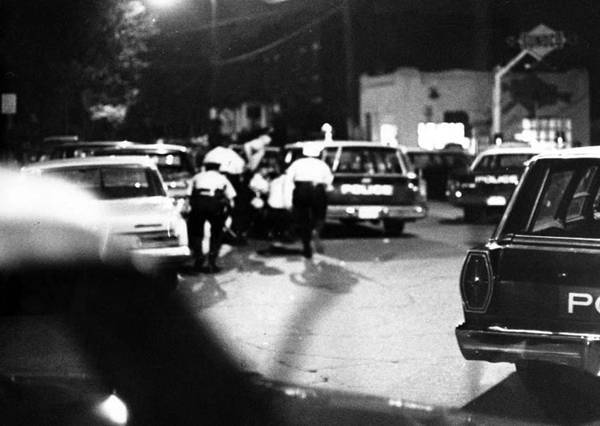
    <summary type="html"><![CDATA[<p><strong><em>Following the end of the hour-long gunfight that took place in Glenville on July 23, 1968, three white policemen, three black nationalists, and one black civilian lay dead in the streets of east Cleveland. Why did it happen and who was to blame?</em></strong></p><img src="https://mail.clevelandhistorical.org/files/fullsize/f3135ded34a34d0bb9e1803f7589d18c.jpg" alt="Policemen duck for cover during the Glenville Shootout" /><br/><p>On the evening of July 23, 1968, shots rang out in Cleveland’s predominantly black east side neighborhood of Glenville. Though it is unknown who fired the first shot, it is known that the Cleveland Police Department and the Black Nationalists of New Libya, a militant black nationalist group led by Fred (Ahmed) Evans, played a part in the fierce, hour-long gun battle now commonly referred to as the 'Glenville shootout'. Once gunfire died down, three white policemen, three black nationalists, and one black civilian lay dead in the streets of Glenville. After, rioting ensued for three straight days and resulted in the damaging or destruction of 62 buildings. Both during and after the riots, black Glenville residents were brutalized by white policemen fueled by racism and resentment from the deaths of fellow officers. Glenville would never be the same again.</p><p>Many black Clevelanders during the early-to-mid 1960s viewed white city authorities (as well as members of the Cleveland police department) as antagonistic white supremacists who did nothing to stop the urban decay, racism, discrimination, and violence that plagued their communities. Civil rights and black nationalist groups in Cleveland aimed to improve social and economic conditions for black Clevelanders but were often met with violent opposition from white residents, policemen, and city authorities. Racial tensions often culminated in episodes of intense racial violence, as was seen in neighboring communities, like <a href="https://clevelandhistorical.org/items/show/7">Hough</a>, throughout the 1960s. In 1967, the election of Carl Stokes, the first black mayor of a major city, helped calm racial tensions in Cleveland — but only temporarily.</p><p>Fred (Ahmed) Evans, leader of a militant black nationalist group known as the Black Nationalists of New Libya, faced constant conflict with white authorities and police throughout his life. To authorities, Evans’s black nationalist ideology and militant tendencies represented a threat to the perpetuation of white supremacy which their authority relied upon. Following the assassination of Martin Luther King Jr., Evans became increasingly concerned about what he saw as a white police state and began amassing a cache of weapons for the purpose of defending himself and his community. Tensions between Evans and the Cleveland Police Department reached a peak in the summer of 1968 when police surveillance was ordered on Evans’s 12312 Auburndale Avenue apartment following reports to city hall that Evans was planning to stage an attack against the police department. Though this report was unverified, police patrol cars (manned by white policemen) were stationed outside Evans’s apartment for several days prior to the shootout — despite black officials’ warnings to do precisely the opposite. </p><p>Neither the Cleveland police department nor members of New Libya agree to this day on exactly how or why the ensuing confrontation ended in violence. According to police, Evans orchestrated the shootout and was thus the one to blame; according to Evans and other black nationalists, police aggression and violence had instigated the shootout. Ultimately, the version of events told by city hall and the police department swayed the white public and media; blame for the bloodshed and destruction was placed solely on Evans while police racism, aggression, and violence went ignored. Evans’ trial jury was composed of seven white Clevelanders who were all, throughout the course of the trial, exposed to various forms of media, despite rules forbidding it. White members of the prosecution used racial slurs against Evans’ black defense team but were never disciplined. While it was proven that Evans had hidden in an attic during the gunfight and had never personally fired a single shot, this did not matter to the white judge and jury — Evans was charged with and convicted of first-degree murder. Evans originally received the death penalty, but was later re-sentenced to life in prison where he died of cancer in 1978.</p><p>Though it remains unknown exactly who initiated the shootout, it is known that the Cleveland police department had a history of largely antagonistic relations with Evans and black residents of Glenville which ultimately culminated in the events of July 23, 1968. Stokes’s decision to temporarily enact black community policing as a means of preventing additional deaths after rioting began lost him favor with many white Clevelanders, the police department, and city hall. Stokes was succeeded by Ralph Perk, a white ‘law-and-order’ mayor who stamped out any chance that black nationalist groups in Cleveland had of improving their social and economic situations. Glenville has still not fully recovered from the events of that night; the continued existence of vacant lots, burned-out buildings, and violent interactions with white police in the following years served to remind its residents that the conditions which had ultimately led to the shootout and riots had continued to endure. It has been suggested by both sides that the Glenville shootout was a conspiracy on some level - but whether the events that took place that July night were a conspiracy by the Black Nationalists of New Libya to ambush the police force or a conspiracy by the Cleveland police department to disrupt and destroy black nationalism in Cleveland is matter that also remains contested to this day.</p><p><em><strong><a href="https://mail.clevelandhistorical.org/items/show/858">For more (including 11 images) view the original article</a></strong></em></p>]]></summary>
    <published>2018-11-21T19:48:40+00:00</published>
    <updated>2026-04-17T19:17:42+00:00</updated>
    <link rel="alternate" type="text/html" href="https://mail.clevelandhistorical.org/items/show/858"/>
    <id>https://mail.clevelandhistorical.org/items/show/858</id>
    <author>
      <name>Riley Habyl</name>
    </author>
  </entry>
  <entry>
    <title type="html"><![CDATA[Shaker Barricades: Reinforcing Suburban Separation]]></title>
    <summary type="html"><![CDATA[<img src="https://mail.clevelandhistorical.org/files/fullsize/f40c31e118d79e9e287f18d920e44476.jpg" alt="Avalon at Invermere Road " /><br/><p>“Entering Apartheid Shaker: Home of Barricades” was the message commuters read as they drove under a large banner while entering Shaker Heights along the Cleveland border in September of 1990. The banner was put up by Cleveland city councilman Charles Patton, who stated that “if the Berlin Wall can come down, so can the Shaker barricades.” His frustration was fueled by years of negotiation leading nowhere regarding the traffic barriers installed along the Cleveland and Shaker Heights border fourteen years prior.</p><p>In 1976, temporary traffic barrels were placed on six streets in the Lomond neighborhood of Shaker Heights:  Scottsdale Boulevard at Lee, Avalon, Ingleside, and Warrensville Center Roads; Rawnsdale Road at Lomond Boulevard; and Kenyon Road just east of Lee Road. Some of these blocked Cleveland motorists from entering Shaker streets, creating overflow in the adjacent neighborhoods of Warrensville Heights and Lee-Harvard. Shaker Heights declared that the barriers were put up at the request of residents to prevent accidents and traffic jams. Few traffic accidents or backups were recorded in newspapers from this time, but traffic influx was a problem many suburbs faced during the increase of suburban migration during the twentieth century. By the time the barriers were installed, the suburban fringe that makes up the Cleveland-Shaker border had become predominantly African American as a result of black migration into the suburbs during the 1960s. Therefore, the roadblocks along or near the border were perceived as a racially driven decision by many Cleveland residents, some even decrying “the Berlin Wall for black people.” </p><p>The 1976 barricades were not the first racially charged traffic decision made by Shaker Heights. As early as 1959, Shaker changed the name of Kinsman Road to Chagrin Boulevard, beginning at the border of the suburb. The name was changed after the murder of a white businessman by three African American youths on Kinsman, about a mile west of the Shaker city limits. Merchants, business owners, and community members petitioned to have the name changed. Some residents even stated they were embarrassed to give their addresses while shopping because clerks would assume they “lived near the murder.”</p><p>That same year, Shaker Heights politicians were discussing the use of traffic diverters in their attempt to separate the wealthy suburb from its inner-city neighbors. Shaker Heights mayor Wilson G. Stapleton, who also happened to be the Dean of the Cleveland-Marshall College of Law, stated, “As mayor of this community … I certainly am not going to go out and promote integration in the face of many of our citizens who would not favor it…” Stapleton’s comments highlight the fear many suburbanites had toward city folk--particularly African Americans--for they thought the newcomers' presence would lower property values and jeopardize the safety of their neighborhoods. This fear is what led Shaker to attempt to block off streets in 1959, although the barricades were not approved by city council.</p><p>By 1976, the barricade debacle was in full swing and six streets had been blocked off as part of a 180-day trial. In 1979, two of the six original barriers became permanent, at Avalon and Ingleside Roads in the block between Scottsdale Boulevard in Shaker and Invermere Avenue in Lee-Harvard. With many residents upset about their permanent installation, the decades that followed saw an ebb and flow between local disputes and court battles. A Common Pleas Court hearing in 1985 resulted in an order to take down the barriers immediately at the suburb’s expense. The ruling was soon met by a 60-day reprieve ordered for Shaker Heights until the barricade dispute was officially settled. By 1987, after an 11-year conflict, the Ohio Supreme Court overturned the prior court rulings and stated that the suburb had constitutional rights when it first installed the traffic diverters. Shaker was now legally able to keep the barricades on the streets where they were permanent. </p><p>Shaker Heights was cheerful after the Supreme Court ruling, but with its excitement came discontent in Cleveland. Many residents worried about the relations worsening between the two cities. Frustrated with the pending debate, residents and community members of the Lee-Harvard neighborhood took matters into their own hands, planning protests and boycotts of Shaker businesses. One man, Everett Gregory of Invermere, along with fifty other demonstrators, held a protest at the Shaker Rapid one morning in October 1987. Gregory, 76 years old at the time, laid on the railroad tracks at 7:30 a.m., stopping five trains packed with more than 100 commuters. Although there were no injuries or arrests, Shaker Heights was upset and the mayor called his behavior undesirable and “uncivilized.”</p><p>Today, more than forty years later, two of the original barricades remain on Avalon and Ingleside Roads at Scottsdale Boulevard. Although they may be unusual locally, traffic diverters like these are also found elsewhere in the nation. In the late 1960s, an almost identical barrier was installed on Van Horne Avenue on the border of El Sereno and South Pasadena, California. Similarly, multiple roadblocks were installed in Detroit, Michigan, along Alter Road, a street that runs north and south along the border of Detroit and its wealthiest suburb, Grosse Pointe Park. In both of these cases, the barriers were ostensibly installed to prevent speeding motorists and to foster neighborhood safety.  After comparing the barricades in El Sereno, Detroit, and Shaker Heights, it is crucial to note a common element. All of the barriers only have traffic signs facing the non-white neighborhoods reading, “Not a Through Street” or “No Outlet,” whereas the signs facing the predominately white suburbs are left blank and in the case of Shaker Heights, nonexistent. Placement of signposts suggests that barriers were intended only for one community and in all three of these examples that community happens to be of a lower-income minority. </p><p>Defenders of the barricades have always denied racist motives  and mention that Shaker Heights is one of the most racially diverse suburbs in the United States. Other people question how race could be a factor when the Lomond neighborhood of Shaker Heights, which lies immediately to the north of the barricades, had a substantial black population when the barriers were erected. Approaching this question requires grappling with the messy intersection of class and race. In other words, we must consider the possibility that when middle-class blacks obtained homes in Shaker, perhaps they bought into an exclusive, if not exclusionary mindset. Shaker’s concerns on traffic and neighborhood safety are plausible and legitimate, but they are not necessarily independent from attitudes of class and race.    </p><p>Whether the reasoning behind the barriers was racism or not, they remain an example of the trials cities face in the wake of suburban migration during the twentieth century. The political issues that were created by the Shaker barricades are a result of the dual political cultures in the two cities. Localism and the often conflicting ideologies of the two communities were at the core of the debates in the years that followed the installation of the barricades. More importantly, the legacy of the barricades left a stamp on the community. The changing demographics in Cleveland, without doubt, created racial tension between the city and its suburban neighbors. After exploring the Shaker barricades, one thing is for certain: Local community politics play the most important role in shaping racial tensions on the suburban fringe. </p><p><em><strong><a href="https://mail.clevelandhistorical.org/items/show/824">For more (including 12 images) view the original article</a></strong></em></p>]]></summary>
    <published>2017-11-29T10:57:55+00:00</published>
    <updated>2026-04-17T19:17:41+00:00</updated>
    <link rel="alternate" type="text/html" href="https://mail.clevelandhistorical.org/items/show/824"/>
    <id>https://mail.clevelandhistorical.org/items/show/824</id>
    <author>
      <name>Liz Sisley</name>
    </author>
  </entry>
  <entry>
    <title type="html"><![CDATA[Jazz Temple: When Jazz Came to University Circle in the 1960s]]></title>
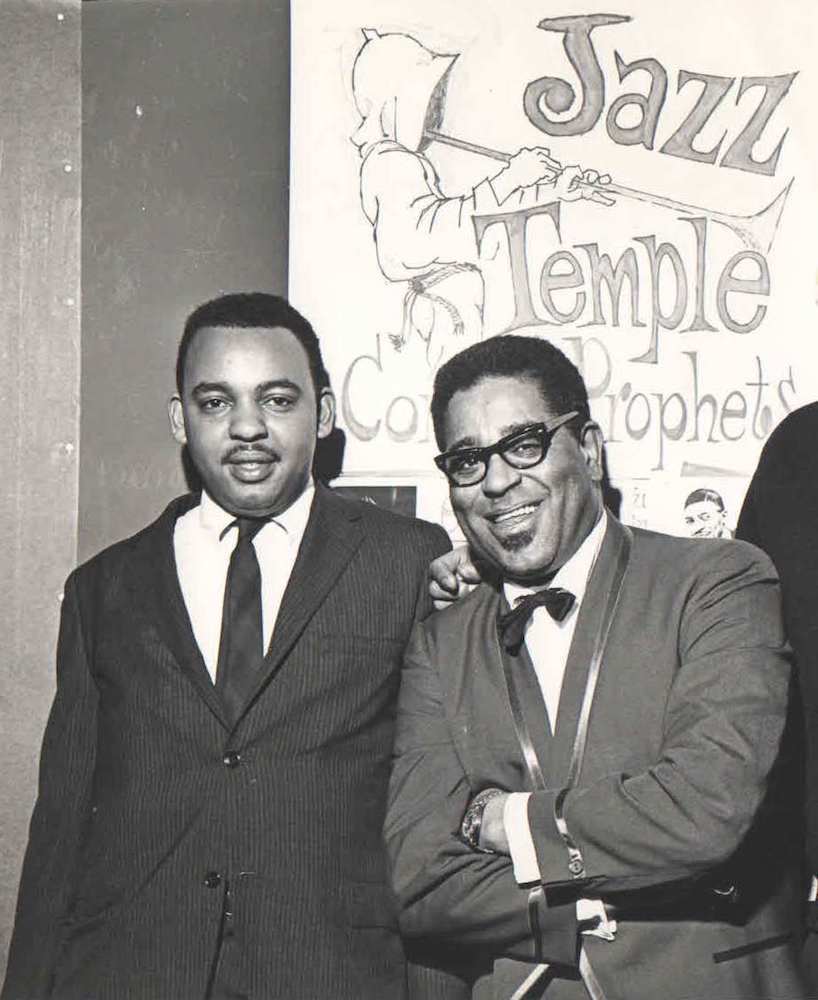
    <summary type="html"><![CDATA[<p><strong><em>Physical changes in neighborhoods are typical in most major cities, and with the passage of time they appear even more dramatic. Unlike fictional towns and buildings we’ve read about in childhood or seen in movies, change in community identity is inevitable.  Yet some images from the past populate our memories and we recall them with remarkable clarity.</em></strong></p><img src="https://mail.clevelandhistorical.org/files/fullsize/4be345c46cab75278d8b8288ce1d1ba8.jpg" alt="Winston Willis, Dizzy Gillespie in rear of Jazz Temple Building" /><br/><p>The Mayfield Triangle: The former street address 11339 Mayfield Road is now 11400 Euclid Avenue. And although official street numbering changes over the years for one reason or another (zoning requirements, city planning, urban renewal, or real estate development), certain historical facts about some properties often become lost amid the changes. Today, observing motorists and pedestrians teeming around the bustling Euclid Avenue and Mayfield Road intersection, it’s fair to say that few if any of them know the history of the Triangle area before it was transformed into the mini-metropolis now known as Uptown Cleveland. For a brief time in the early 1960s, the triangular lot, then known as the Mayfield Triangle, upon which now rests the Museum of Contemporary Art building, was the site of a popular coffee house jazz club called the Jazz Temple. </p><p>When the 1960s dawned in the United States, it was heralded as a new decade of youth and change by a dynamic young president, John F. Kennedy, who assumed office trumpeting his “new frontier”. In previous years, the calm complacency of the post World War-II era had lent a relative tranquility, but it was gradually disappearing as post-war babies were becoming young adults. With a cultural landscape that included sleek cars, the Twist, the Pill, and a persistent atmosphere of cigarette smoke, the nation was on the verge of a decade of counterculture and social revolution. A great deal of this culture fermented on college campuses where students were beginning to find their voices and express their own individual political views and values. </p><p>At a time when the U.S. was approaching some of its most explosive times, including the rise of a free speech movement, music was rapidly becoming the main vehicle of self-expression for young people. Jazz and one of its subgenres, free jazz/improvisational jazz, were very attractive, especially to college students. So when a shrewd and savvy young African American entrepreneur named Winston Willis brought his coffee house jazz club to University Circle, within arm’s reach of the Western Reserve University (now CWRU) campus, and at affordable prices, it appeared to be a dream come true for all concerned. Imagined, engineered and created by young Willis, who was also a big fan of the musical genre, the Jazz Temple arrived on the scene at the tail end of the Beatnik era and smack in the heyday of ’60s-type coffee houses. Willis chose the club’s name to symbolize a devout gathering place dedicated to the icons of the jazz world where legendary artists could be collectively enjoyed and appreciated. </p><p>Having operated several successful small businesses, he sensed that something was lacking in this upscale college community.  So, after making a careful assessment of the area and determining what was needed and what would be likely to work, he decided that high-quality jazz performances at a student-friendly and affordable price was the answer.  Then, quickly putting his idea into action, he secured a lease on a vacated building, a former Packard automobile showroom, and immediately began remodeling, devoting careful attention to acoustics. Shortly thereafter, in 1962, the club opened to immediate success.  </p><p>The liquor-less establishment that seated approximately 450 people was near the ethnic enclave known as Murray Hill (Little Italy), a place that was notably hostile toward African Americans. As noted by former Cleveland mayor Carl B. Stokes, "... Cleveland was in the hands of ethnics, the immigrants from Middle and East European countries." Historian Dr. Todd M. Michney has observed that "... Little Italy's residents historically marked their territory and sought to ward off racial residential transition through the use of violence..." With surrounding institutional neighbors in the city’s so-called "cultural oasis," the Jazz Temple was a noteworthy, if incongruous jewel in the Mayfield Triangle. </p><p>From all over Cleveland and surrounding areas, dedicated jazz enthusiasts assembled to enjoy and appreciate the musical genre. Soon, the terms “preaching at The Temple” and “worshipping at The Temple” became popular colloquialisms and catchphrases. Legendary jazz greats, many of whom were considered musical geniuses, frequently headlined at the club. Miles Davis was cool but Kind of Blue, John Coltrane took Giant Steps to play My Favorite Things, and Dizzy Gillespie was blowin’ and Boppin’ and Groovin’. Many other notable artists also performed magnificent solo riffs, instrumentations and stunning improvisations that became sealed in memories forever.  Though sometimes described erroneously in the local press as "the ultimate 'beatnik' club", the Temple also featured popular female jazz vocalists like Dinah Washington and Gloria Lynne, as well as great stand-up comics like Dick Gregory, Redd Foxx, and Richard Pryor.</p><p>During the early 1960s, the Western Reserve student body was predominantly white, and these students and others from surrounding universities accounted for a large percentage of the club’s patronage. But as is typical of jazz establishments, there was a noticeable amount of race mixing and many interracial couples in attendance each night. Individuals who managed to navigate the social inequities of the time and gather in a communal appreciation of jazz.</p><p>As the club’s notoriety grew, it came to be considered by many world-famous jazz musicians as the “Jazz Mecca." But the interracial dating and race-mixing at the club triggered widespread resentment in racially polarized Cleveland.  Particularly in the Murray Hill (Little Italy) community, where visible racial tensions mounted. With attempted intimidation by local law enforcement, some nights saw as many Cleveland police officers in attendance in the club as regular customers. These visits were routinely followed by unscheduled and unannounced inspections and bogus citations. The warnings were dire and persistent, and thereafter, months of ominous threats of violence and anonymous phone calls during and after business hours foretold of the coming end. Several famous acts appearing at the club refused to be intimidated initially, insisting on performing. But finally, after several thwarted bombing attempts, the frequency and intensity of the threats were followed by a tremendous after-hours explosion in 1964 that completely demolished the Jazz Temple and its brief reign ended soon after. As reported in the local press:  “Police were unable to find reasons for the bombing of the interracial house of jazz but they found remnants of a bomb." And the message was clear.</p><p><em><strong><a href="https://mail.clevelandhistorical.org/items/show/811">For more (including 10 images) view the original article</a></strong></em></p>]]></summary>
    <published>2017-09-23T21:49:29+00:00</published>
    <updated>2026-04-17T19:17:41+00:00</updated>
    <link rel="alternate" type="text/html" href="https://mail.clevelandhistorical.org/items/show/811"/>
    <id>https://mail.clevelandhistorical.org/items/show/811</id>
    <author>
      <name>Aundra Willis-Carrasco</name>
    </author>
  </entry>
  <entry>
    <title type="html"><![CDATA[The Elysium: The First 2,000-Seat Jim Crow Ice Skating Rink]]></title>
    <summary type="html"><![CDATA[<img src="https://mail.clevelandhistorical.org/files/fullsize/713c8e93850d40f068f3f5707b285e12.jpg" alt="Elysium" /><br/><p>The frequently recited story of the Elysium has been expertly told for decades. The traditional story is one of Cleveland lore, heavily laden with adjectives that conjure images of firsts, greatness, and business-genius. Missing from the Elysium story, however, are the multiple incidences of racial discrimination that took place at the famed ice skating rink.</p><p>Cleveland's new east side leisure-time hotspot opened to the public on November 23, 1907. The Elysium, a 2,000-seat indoor ice rink that stood on the corner of E. 107th and Euclid, held the title of the world's largest indoor ice skating rink – for roughly three years – until Berlin's Sportpalast opened in 1910. As reported, by the end of the Elysium's opening day, "hundreds of people had tried out the new ice." The papers praised the proprietor of the Elysium, Dudley Humphrey, of Euclid Beach Park and the popcorn ball fame, for erecting another place of wintertime recreation for the city's growing middle-class. </p><p>The Elysium's management encouraged almost all Clevelanders to forget about their winter blues. They hosted hockey games and people from all sides of Cleveland came to see the acclaimed Coddy Winters. In addition, you could free skate with your sweetheart, or buy tickets to watch figure skaters glide across the ice like elegant swans. One self-proclaimed "hockey bug" reminisced on the accessibility of the entertainment at the Elysium. Gordon Cobbledick, Sports Editor for the <em>Cleveland Plain Dealer</em>, said he often went to the Elysium as a young boy "because one could buy one's way into the Elysium for 35 cents, a sum which any red-blooded American boy could earn, with a nickel left over for popcorn, by shoveling only four snow-covered walks at a dime a piece." Of the hundreds of people that glided across the fresh ice with their friends, or cheered on one of Cleveland's first amateur hockey league teams, there was one group not in attendance – African Americans. </p><p>In 1939, the Humphrey Company was the target of two civil rights lawsuits because of incidents that occurred at the Elysium. In one of the episodes, an African American mother accompanied her children to the ice rink. The manager stopped the mother and children at the door and barred from admittance to the Elysium. The mother reported "that she and her children were approached by a Mr. Shannon … who informed her that the Elysium had never made preparations for Negro patrons, did not admit them, and had no intention of doing so in the future." In another incident, an African American child arrived at the Elysium for a school field trip. She too was prevented from joining her white classmates on the ice. The Elysium's front desk operator told her "gently…'Honey, colored children can't skate here.'" </p><p>These two racially motivated incidents were covered only by the <em>Cleveland Call and Post</em> and were settled outside of the courtroom. However, with the addition of these accounts a fuller picture can be formed concerning Cleveland's Humphrey Company. The Humphrey Company was repeatedly a "defendant in similar suits…which are reported to flagrantly discriminate against Negro[e]s." Rumors spread that the company even had a "slush fund" of "$10,000 annually set aside to take care of any suits that may arise out of their proclaimed policy of denying the use of the dance floor, and the roller rink to Negroes" at the Euclid Beach Park. The Humphrey Company appropriated some of this "slush fund" money to settle the discrimination lawsuits filed against the Elysium twice in 1939. The Humphrey Company's belief in segregation and prejudice filtered into all facets of its multi-venue operation, and Euclid Beach Park, like many amusement parks nationally, was marred by Jim Crow, leading to incidents such as the <a href="https://clevelandhistorical.org/items/show/562">Euclid Beach Park Riot</a> in 1946. </p><p>The beloved Elysium was clearly not a place of leisure for all Clevelanders. As the Elysium became the legendary birthplace of Cleveland hockey, the site's failure to abide by the State of Ohio's civil rights statutes was forgotten. In the 1930s, as hockey became more popular the old 2,000-seat Elysium could no longer host all of the fans. By 1941 the Elysium finally closed, and with it the stories of the blatant racial discrimination faded. </p><p>The old Elysium site operated as both a bowling alley and a used car-showroom over the ensuing decade, a far cry from its former glory. In 1951, the old Elysium site went up for sale. The city, after a lengthy debate as to whether or not to purchase the land, ultimately acquired the property. The city then tore down the Elysium as part of a beautification effort. The City of Cleveland anticipated the land would "add greatly to the beauty of the grand entrance of Wade Park." Once the original site of the Elysium was re-imagined as urban green space, the public leisure area could finally be enjoyed by all – regardless of race. However, the legacy of Jim Crow continued to plague skating into the 1950s. Often denied entrance to the popular Skateland at Euclid and East 90th, black skaters found sanctuary at <a href="https://clevelandhistorical.org/items/show/621">Pla-Mor Roller Rink</a>, located just two blocks south of the former Elysium.</p><p><em><strong><a href="https://mail.clevelandhistorical.org/items/show/808">For more (including 7 images) view the original article</a></strong></em></p>]]></summary>
    <published>2017-07-06T20:25:59+00:00</published>
    <updated>2026-04-17T19:17:41+00:00</updated>
    <link rel="alternate" type="text/html" href="https://mail.clevelandhistorical.org/items/show/808"/>
    <id>https://mail.clevelandhistorical.org/items/show/808</id>
    <author>
      <name>Sarah Nemeth</name>
    </author>
  </entry>
  <entry>
    <title type="html"><![CDATA[Collinwood Community Services Center: Community Development and Demographic Change]]></title>
    <summary type="html"><![CDATA[<img src="https://mail.clevelandhistorical.org/files/fullsize/276815a02292eae9d508df6141ed60e4.jpg" alt="Five Pointe Community Center" /><br/><p>Cleveland at the end of the 1960s saw entire neighborhoods change radically in only a few years. Collinwood is a neighborhood that went through such a transition. Collinwood, like much of Cleveland, as ethnic communities and whites left for the suburbs, African Americans and white Appalachians arrived to fill industrial positions. Racial tension and race-based violence became a major concern in Collinwood. In 1966, the Hough riots erupted in Cleveland demonstrating conclusively that race relations were at a low point.</p><p>The year 1967, which was a year after the Hough Riots, brought a great success for black Americans: Carl Stokes became the first black mayor of a major city. Stokes strove to improve the living conditions of Clevelanders through the use of his flagship program, Cleveland: NOW!. The Stokes administration applied the Cleveland: NOW! brand to a variety of initiatives related to community development. Stokes planned to use $177 million in funds to redevelop Cleveland and planned for the program to use over $1 billion during a ten-year period. Many of these programs from Cleveland: NOW! worked from neighborhood multi-service centers. </p><p>However, the Cleveland: NOW! program hit a snag early in development. The Glenville Shootout, a battle between black nationalists and the police, occurred on July 23, 1968. This battle and subsequent riots severely hampered the Cleveland Now! project and dashed the public’s enthusiasm for Stokes. The situation became even worse when it was discovered that Fred Ahmed Evans, the leader of the group that fought the police in Glenville, had purchased the weapons using money from the Cleveland: NOW! program. Most examinations of the Cleveland: NOW! program end here. Some works on the topic argue that the Glenville Shootout "killed prospects for the success of Cleveland: NOW!” However, the program did not officially end until after 1971 and continued to work successfully towards rebuilding Cleveland even after the riots. An example Cleveland: NOW!’s programming success is the Collinwood Community Services Center (Collinwood CSC).</p><p>The Collinwood neighborhood had many of the same issues on a smaller scale as the city. Collinwood experienced extreme demographic changes that led to racial conflicts at the time. The Collinwood CSC’s report shows 90% of the population of South Collinwood was ethnic Europeans and 5-10% was black in 1965. By 1968, they estimated that the black population had grown to 30%, the ethnic population had fallen to 40% and Appalachian whites had established themselves with 30% of the population. The area also saw a dramatic rise in crime rate. The Center associated the rise with violent conflicts between young Appalachian and African American men.</p><p>In this volatile scenario, the Collinwood CSC was established. Initially a project of the Alta House, it quickly signed up for the Cleveland: NOW! program. This pairing of settlement house and city government to establish a multi-service center was common. These multi-service centers all provided a variety of general social service functions. These functions ranged from job counseling, juvenile court office, city health offices, officials from county welfare, legal aid, and classes in health and safety. Many others included health care services and daycare. They drafted specific proposals for programs directed towards their community. </p><p>One of the first multi-service centers was in the Collinwood. The direct predecessor to the Collinwood CSC was the Collinwood Youth Association which began in 1967. The Center started operating in January 1968. It stood initially at 742 East 152nd Street. The multi-service center operated multiple locations in the area other than the main office. These were two drop-in centers on East 140th St and two other centers at Five Points (the intersection of St. Clair and 152nd St.). They proposed to move their main center to the Five Points area, and, in the end, it was moved to 813 East 152nd St. The community center became the Five Points Community Center sometime after 1989 and exists there to this day. </p><p>The Collinwood CSC was oriented to combatting the rising crime rate in the area through social programing and helping Appalachian migrants find employment. To accomplish this, the Collinwood CSC designed programs to engage young people and to provide job assistance and training. They developed programs specifically targeting job training, community programing, and drop-in centers for youths. These programs had good participation and a high success rate. The drop-in centers were places to gather for young blacks and Appalachian whites.  </p><p>The Collinwood CSC, like many of Cleveland: NOW!’s programs, has been written off as a failure. The writers who declare this are usually only examining Cleveland: NOW! via the effects of Carl Stokes political career, or its ability to prevent race-based conflict, or the popularity of the program. Examining the Collinwood CSC by looking at the successes of its programs and the number of people affected by it tells a different story. The Collinwood CSC is representative of the whole of Cleveland: NOW! in that it is pronounced dead with the Glenville Shootout, but is only getting started serving the community.</p><p><em><strong><a href="https://mail.clevelandhistorical.org/items/show/779">For more (including 5 images) view the original article</a></strong></em></p>]]></summary>
    <published>2016-12-12T22:29:04+00:00</published>
    <updated>2026-04-17T19:17:41+00:00</updated>
    <link rel="alternate" type="text/html" href="https://mail.clevelandhistorical.org/items/show/779"/>
    <id>https://mail.clevelandhistorical.org/items/show/779</id>
    <author>
      <name>Jacob Taylor</name>
    </author>
  </entry>
  <entry>
    <title type="html"><![CDATA[Sidaway Bridge: A Bridge over Troubled Neighborhoods]]></title>
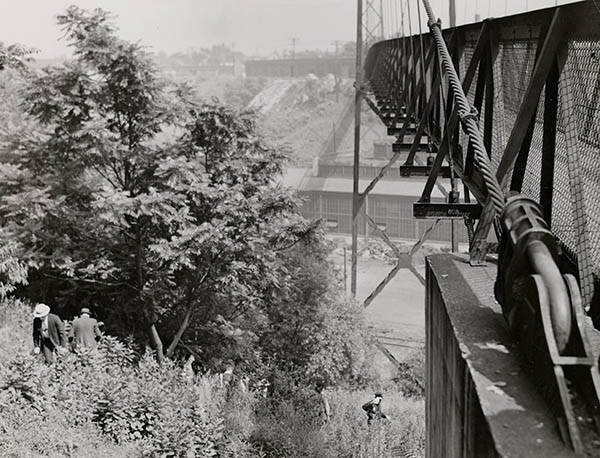
    <summary type="html"><![CDATA[<p><strong><em>It still spans Kingsbury Run, connecting Cleveland's Kinsman Road neighborhood to the city's historic Jackowo Polish neighborhood.  But no one uses the Sidaway Bridge anymore.  Not since the 1966 Hough Riots when someone tore out planking from the walkway and attempted to set the bridge on fire.  Shortly afterwards, Cleveland officials closed the bridge, and for fifty years it has waited patiently to resume its original purpose of bringing the people from these two neighborhoods together, rather than continuing to keep them apart. </em></strong></p><img src="https://mail.clevelandhistorical.org/files/fullsize/a54e5074d31f646f07dec599b61daf47.jpg" alt="The Sidaway Bridge" /><br/><p>It was not the first Sidaway Bridge. That one — the longest wooden bridge in Cleveland history — was a massive trestle bridge that stretched 675 feet across and 80 feet above the Kingsbury Run, connecting the Jackowo Polish neighborhood on the south side with the then largely Hungarian Kinsman Road neighborhood on the north.  It was built as a pedestrian or "foot" bridge in 1909 by the Tom Johnson administration at the urging of three citizen groups from the two neighborhoods who believed, according to a Plain Dealer editorial at the time, that connecting the two communities–then largely white and ethnic–with a bridge would contribute to their mutual commercial and general welfare.  </p><p>That bridge — initially called the Tod-Kinsman Bridge, but, within a year of its opening renamed the Sidaway Bridge after the new approach road that had been created during its construction — served that purpose for more than twenty years, and as well provided a convenient shortcut for folks on the north side of the Kingsbury Run to walk to Dahler's, a popular beer garden in the Jackowo neighborhood.  In the late 1920s, however, the bridge's  braced wooden framework became an obstruction for the Nickel Plate Railroad, now owned by the Van Sweringen Brothers, who desired to build several car barns at this location in Kingsbury Run for their Shaker Heights rapid transit line. The city and the railroad agreed that the trestle bridge would come down and that the railroad would bear the cost of replacing it with a new  bridge, one that would allow for continued pedestrian travel between the Jackowo and Kinsman Road neighborhoods, while at the same time creating  open space below for the new rapid transit buildings. </p><p>The new Sidaway bridge was designed in 1929 by Fred L. Plummer, a talented Cleveland engineer, who was both a professor of engineering at the Case School of Applied Science (later called the Case Institute of Technology) and a design professional at the engineering firm of Wilbur Watson and Associates.  Plummer designed it as a suspension bridge, a popular type of bridge form in the United States in the 1920s. Using an intricate series of weight-bearing steel cables, suspension bridges allow for great expanses of bridge deck with a minimum number of support towers. Completed in 1930, the new Sidaway Bridge was the first (and remains to this day) the only suspension bridge ever built in Cleveland.  </p><p>Just a few years after the new bridge opened and  pedestrian travel across the Kingsbury Run resumed, the Run became locally notorious as the result of a series of grisly murders, known as the Cleveland Torso Murders, which occurred between 1935 and 1938. At least 12 men and women were murdered in the stretch and, in at least four of the murders, the victim's mutilated corpses were dumped at various locations there. On top of this, just several years later, in June 1942, as the memory of the Torso Murders was fading, the body of another victim was found on a hillside under the Sidaway Bridge.  </p><p>Notoriety did not depart from this area of Cleveland even when the Kingsbury Run murders came to an end. In the next three decades, a new type of notoriety for the two neighborhoods arrived, when the Kinsman Road neighborhood transitioned from one that had been largely white and ethnic to one that was largely African-American. Portions of that latter neighborhood had severely deteriorated housing and, in the years 1955-1959, under a federal urban renewal program, 130 acres, between East 71st and East 79th Streets, was cleared of that housing and the 650-unit Garden Valley subsidized housing project built. An increased number of African-American children began using the Sidaway Bridge to walk to Tod Elementary School, the public school in the still largely white and ethnic Jackowo neighborhood. And now the Sidaway Bridge connected a black and a white community in a city where, in the early 1960s, racial tension was mounting.</p><p>In 1966, this tension erupted in the form of the Hough Riots. During the riots, the Sidaway Bridge became a flash point, literally, when someone (likely from the Jackowo neighborhood) removed planking from the bridge and attempted to set it on fire, preventing anyone, particularly residents of the Kinsman Road neighborhood, from using it.  Rather than repair the bridge and keep it open to the public, the City of Cleveland elected instead to close it. A decade later, that decision came back to haunt the city, when, in 1976, federal district court judge Frank Battisti, in the course of issuing his busing order to desegregate Cleveland's public schools, cited the closing of the Sidaway Bridge as evidence that city and school officials had worked in concert to segregate the schools on the basis of race. </p><p>Fifty years have now passed since the Sidaway Bridge was closed during the Cleveland Hough Riots. All that time the beautiful suspension bridge erected in 1930 has patiently waited for repair and reopening. From time to time, such proposals have been made, but to date they have come to naught.  Until it is repaired and reopened, it cannot serve the purpose for which it was built:  to bring the people of the Kinsman Road and Jackowo neighborhoods together for their mutual commercial and general welfare. And until that happens, it will remain a symbol of the mid to late twentieth century troubles that separated these two Cleveland neighborhoods and a reminder that they have perhaps not yet bridged that gap.</p><p><em><strong><a href="https://mail.clevelandhistorical.org/items/show/762">For more (including 12 images) view the original article</a></strong></em></p>]]></summary>
    <published>2016-04-02T18:05:36+00:00</published>
    <updated>2026-04-17T19:17:41+00:00</updated>
    <link rel="alternate" type="text/html" href="https://mail.clevelandhistorical.org/items/show/762"/>
    <id>https://mail.clevelandhistorical.org/items/show/762</id>
    <author>
      <name>Danielle Rose&amp;#32;&amp;amp;&amp;#32;Jim Dubelko</name>
    </author>
  </entry>
  <entry>
    <title type="html"><![CDATA[Chester K. Gillespie: The Struggle to End &quot;Jim Crow&quot; in Downtown Cleveland]]></title>
    <summary type="html"><![CDATA[<img src="https://mail.clevelandhistorical.org/files/fullsize/3de83b404dbc5a5767cf23693651808a.jpg" alt="Gillespie in Courtroom, 1958" /><br/><p>Chester K. Gillespie, who moved from Cincinnati to Cleveland as a young boy with his family, often said, "I do not take cases I don't believe in." Gillespie, an African American attorney who would be subjected to numerous incidents of racial discrimination over the course of his career in Cleveland, found no lack of worthy cases to pursue.</p><p>Gillespie earned his law degree from the Cleveland School of Law, now part of Cleveland State University. He started practicing law in 1920 and shortly after was appointed assistant city law director. Gillespie worked on multiple cases in regards to equality. In addition to his longstanding involvement in the Republican Party of Ohio, he was president of the Cleveland Branch of the National Association for the Advancement of Colored People (NAACP) in 1936-37. During his term, Gillespie addressed numerous court cases involving racial discrimination in the Cleveland area.</p><p>Gillespie battled racism not only in the courtroom, but also in his personal life. As a civil rights attorney, he needed a stable office suite to provide a working environment. In 1937, Gillespie was subjected to a very difficult dilemma. Gillespie worked with another attorney named Clayborne George. Gillespie's law firm occupied offices in the Erie Building at East 9th Street and Prospect Avenue from 1922 to 1937. After facing racial discrimination from numerous downtown building owners when they sought new quarters in 1937, the two gentlemen, with help from the State Commerce Department, moved into a suite at 241 Euclid Avenue.</p><p>By 1940 the Telenews modified the building at 241 Euclid, originally constructed as the First National Bank, into a newsreel theater, forcing Gillespie and George to move their law firm to the Hickox Building on the northwest corner of Euclid and East 9th. Gillespie and George remained there until the impending demolition of the building for a new Bond Clothing store again uprooted them in 1945. Their next targeted office space was the Citizens Building across Euclid Avenue. Unfortunately, Gillespie would never move the firm to that location because of racial discrimination. The manager refused in fear he would lose white tenants.</p><p>Unwilling to back down, the attorneys threatened to "pitch a trailer downtown" and practice law on the sidewalk if unable to find a proper office. As Gillespie remarked, "It is unthinkable that we will be unable to find a suitable office space in Cleveland which is rated as being the first city in the United States in civil liberties." After failing to force the Citizens Building owner's hand in court, Gillespie moved his law firm into the Kresge building at East 4th and Euclid-the one building willing to add, in the words of the Call and Post, "a touch of color."</p><p>After more than a decade of repeated brushes with "Jim Crow" in downtown Cleveland, in 1950, Gillespie and George were welcomed into the Public Square Building at 33 Public Square, which was owned by Columbus real estate magnate John Galbreath. Gillespie felt victorious in finding a suitable office suite after facing many years of tribulations regarding racism and demolition. Despite the fact that the Cleveland City Council had spoken out against racial discrimination against black professionals in the late 1930s, several years after World War II securing nondiscriminatory office leases often still relied on the goodwill of national firms or outside property owners.</p><p>Gillespie's struggle mirrored other struggles between the 1940s and early 1960s. African Americans were subjected to unfair working conditions within the city of Cleveland. For instance, Cleveland bank tellers consisted primarily of whites while African Americans held "hidden jobs." blacks were also not allowed to read residential water, electric, or gas meters due to irrational racist fears. Within Cleveland, occupations for blacks were limited to behind-the-scenes jobs. Prior to the 1960s African Americans were hindered from working as clerks on the main floor of downtown department stores. As in banks, they were forced into jobs that kept them hidden away from the public eye.</p><p>With the resolution of World War II happening concurrently with Gillespie's search, it may be suggested some realized how detrimental inequality was. After the war, Americans gradually realized they had fought against inequality and oppression in Nazi Germany while discounting their own nation's issues. Persistent unfair treatment happening at home ultimately sparked a breakthrough. As in the South, in northern cities African Americans would be aided by white supporters in the fight to bring equality within the city of Cleveland.</p><p><em><strong><a href="https://mail.clevelandhistorical.org/items/show/675">For more (including 7 images) view the original article</a></strong></em></p>]]></summary>
    <published>2014-12-04T16:03:40+00:00</published>
    <updated>2026-04-17T19:17:40+00:00</updated>
    <link rel="alternate" type="text/html" href="https://mail.clevelandhistorical.org/items/show/675"/>
    <id>https://mail.clevelandhistorical.org/items/show/675</id>
    <author>
      <name>Rhianna Gordon</name>
    </author>
  </entry>
  <entry>
    <title type="html"><![CDATA[Collinwood High School Riots]]></title>
    <summary type="html"><![CDATA[<img src="https://mail.clevelandhistorical.org/files/fullsize/94f4e6aa64bdc96b8bfd10d1b721d274.jpg" alt="Arresting Students" /><br/><p>On the morning of April 6, 1970, 350 to 400 whites, mostly students, gathered outside of Collinwood High School and began throwing rocks at the school, breaking 56 windows. Teachers told the 200 black students who attended school that day to go to the third-floor cafeteria for their protection. At 10:30 a.m., the white mob entered the school and went to the second floor. They damaged furniture, broke windows, and threw clubs at the school's music director. Afraid, the black students began breaking off the legs of chairs to arm themselves and blocking the stairs leading to the third floor with tables and chairs. Luckily, the white students left the school and the black students were escorted to buses to take them home. Teachers and policemen had to form a line in order to block the whites from attacking the students who were boarding. This was just one of many serious, racially motivated confrontations that took place in Collinwood over a fifteen-year period. </p><p>The first major incidents at Collinwood High School occurred in 1965, the same time the rest of the country was seeing racial clashes in schools. After the Supreme Court ruled that racial segregation in public schools was unconstitutional in the 1954 case of Brown v. Board of Education of Topeka, many schools in the South became places of protests and violence. Northern schools saw the same disturbances when they began to make efforts toward greater integration. In the case of Collinwood, industrialization not only increased its population, but also its diversity. According to a Cleveland Plain Dealer columnist, "with the passage of each year, the western fringes of the Collinwood area [were] being occupied by the Negro overflow from Glenville." This change in demographics, coupled with civil rights demonstrations, caused racial tensions to surface and intensify in Collinwood, particularly at the neighborhood's high school. </p><p>Finally, after fifteen years of violence in the country's schools, radical measures were being taken in some schools and by the federal government to stop the dangerous episodes once and for all. In a New York school, a committee was formed by the mayor to prevent future violence. Other schools suspended or expelled large groups of students for any racial confrontations and hired security force guards to keep the peace. In April 1969, Senator Robert C. Byrd asked Congress to pass a law that would make the disruption of any school that received federal aid a federal crime. </p><p>Cleveland's mayor Carl Stokes was prompted to follow these examples after the dangerous episode of April 1970. The mayor kept the school open but protected it with policemen backed by National Guard units in case a severe situation should arise. Nevertheless, Collinwood High School was still the scene of other racial clashes, the worst occurring in the fall of 1974. Three black students were stabbed in September of that year, and the next month another student was fatally shot by a sixteen-year-old white student. After these disturbing incidents, the racial violence at the Collinwood school began to dwindle.</p><p><em><strong><a href="https://mail.clevelandhistorical.org/items/show/392">For more (including 8 images&#32;&amp;&#32;4 audio files) view the original article</a></strong></em></p>]]></summary>
    <published>2012-01-12T19:20:56+00:00</published>
    <updated>2026-04-17T19:17:38+00:00</updated>
    <link rel="alternate" type="text/html" href="https://mail.clevelandhistorical.org/items/show/392"/>
    <id>https://mail.clevelandhistorical.org/items/show/392</id>
    <author>
      <name>Heidi Fearing</name>
    </author>
  </entry>
  <entry>
    <title type="html"><![CDATA[Stephen E. Howe Elementary : The Fight for Equal Schools]]></title>
    <summary type="html"><![CDATA[<img src="https://mail.clevelandhistorical.org/files/fullsize/9940672e6b1e1c8383e7d31484eb7a52.jpg" alt="Rev. Bruce W. Klunder " /><br/><p>The fight to desegregate schools in Cleveland in the post-World War II era led to a contentious and complicated debate in the city over the issues of race, freedom, and equality. Glenville's Stephen E. Howe Elementary School is central to the tale. On this site, in 1964, one man gave his life for his belief that all children should have equal access to a quality education.</p><p>Between 1950 and 1965, Cleveland's black population grew dramatically while the population of Cleveland as a whole decreased. This resulted in overcrowded schools on the city's predominantly black east side and under-enrollment in the predominantly white west side. By the early 1960s, black students were placed on waiting lists for kindergarten and subjected to half-day classes as white schools remained under-enrolled in full-day kindergarten. In response, parents formed the Relay Parents March to Fill Empty Classrooms and organized protests to challenge the inequities perpetuated by the School Board's policies.</p><p>School Board President Ralph McCallister agreed to bus some black children to under-enrolled schools in white areas, but to appease white voters his plan included stipulations that black students could not attend physical education classes, eat in the cafeteria, and could only use the bathroom once per day. As a result, African Americans looked to the Cleveland Congress on Racial Equality (CORE) and the United Freedom Movement (UFM) to take action and stand up to the school board.</p><p>When whites rioted in Little Italy in January 1964 to protest against black children being bused to schools in their neighborhood, it became clear that McCallister either would not or could not honor his September 1963 agreement to integrate the schools. The construction of new schools was seen as a less volatile alternative, especially as these schools would be built in black neighborhoods in order to maintain segregation in the district. The UFM demanded a stop to the construction of these new schools, arguing that any new schools should be built in racially mixed areas on the east side.</p><p>On April 6th, 1964, around 50 UFM protestors arrived at the construction site for the new Stephen E. Howe Elementary school, set to be built in a predominantly black area of the east side's Glenville neighborhood. On the following day, 27-year old Reverend Bruce Klunder - a founding member of the Cleveland CORE, father of two, and white - laid down behind a bulldozer as four protestors laid in front to prevent the construction from taking place. The operator, in his attempt to avoid the protestors in front, backed up the bulldozer without seeing Klunder, instantly crushing the reverend to death.</p><p>The following evening, over 2,000 people attended the memorial service for Klunder. Although these attempts to desegregate the schools were considered a failure and the new segregated schools were eventually built, Klunder's death helped to unify the black community to fight against injustice. The fight for equal schools continued, resulting in a <a href="https://clevelandhistorical.org/items/show/813">1976 federal court order</a> to desegregate Cleveland's schools through the implementation of a comprehensive busing program.</p><p><em><strong><a href="https://mail.clevelandhistorical.org/items/show/254">For more (including 8 images&#32;&amp;&#32;3 audio files) view the original article</a></strong></em></p>]]></summary>
    <published>2011-07-16T10:16:04+00:00</published>
    <updated>2026-04-17T19:17:38+00:00</updated>
    <link rel="alternate" type="text/html" href="https://mail.clevelandhistorical.org/items/show/254"/>
    <id>https://mail.clevelandhistorical.org/items/show/254</id>
    <author>
      <name>CSU Center for Public History and Digital Humanities</name>
    </author>
  </entry>
  <entry>
    <title type="html"><![CDATA[John Hay High School]]></title>
    <summary type="html"><![CDATA[<img src="https://mail.clevelandhistorical.org/files/fullsize/johnhay1_6b63c9d275.jpg" alt="Cafeteria Line, 1929" /><br/><p>Land for the Cleveland Public School District's new commercial high school was originally acquired in 1907 along East 107th Street in University Circle. However, disputes and discussions about the nature and design of the new high school in the Cleveland district would ensue for nearly twenty years. By 1926 a <i>Cleveland Press</i> clipping illustrated a labeled photograph of the district property along East 107th Street. Cathedral Latin School and the Normal School are labeled bordering the proposed placement of the new John Hay High School, named for the author, statesman, and political leader John Milton Hay. A <i>Cleveland Plain Dealer</i> article of September 14, 1929, cited the new school opening and dedication at that time. Taking its name from a great American statesman and Cleveland native, John Hay High School was like the school's predecessor, Longwood Commerce High School, focused on business training.</p><p>The school was ultimately created as a commercial school providing courses related to commerce, business, and office skills. As a result, enrollment at John Hay was predominantly female for many years to come and enjoyed much success graduating skilled office workers ready for employment. A May 14, 1954, article in the <i>Cleveland Press</i> was headlined "Men-Wanted Sign Out for 25 Years" and cited an 85% female graduate rate since the school's opening in 1929. A gradual redesign of John Hay's curriculum provided for a more comprehensive course of study that began to attract male students during the late 1950s and 1960s. The 'Bookeepers' changed to the 'Hornets' as male and female athletic programs were likewise designed to accommodate students seeking comprehensive studies and activities.</p><p>John Hay's reputation would change in time. With its transition to a comprehensive school, new challenges faced the administration, faculty, and students, not dissimilar to other schools in the district facing urban issues of racial and economic discord during the 1960s. The school became the site of student protests, lockouts, and other challenges in the next three decades. Disruptive students were responsible for a fire in the school in January 1968, resulting in 32 student suspensions. That November, students conducted a "wildcat strike" and held an assembly to protest a new discipline policy being imposed at the school. Several other items were on their agenda including lavatory conditions, cancellation of social events, classroom equipment complaints, and building access concerns. A cafeteria fight ensued the next day as school closed for the Thanksgiving holiday. By January 1969, parents, students, teachers, and administrators were disputing problems at the school, alleging drug trafficking, intoxicated teachers, and bad neighborhood influences. By February, more unrest was brewing as students called for "Black Unity." In late February and early March, John Hay was closed for more than six school days following student protests and grievances with the school district. Grievances were resolved and an orderly reopening of the school ensued on March 6.</p><p>Throughout the 1970s and 1980s as the Cleveland Schools worked to implement a federal desegregation order, John Hay remained a center of action and protest within the district. John Hay was temporarily closed in 2008-09 for remodeling before reopening to serve students as a thematic health care education facility in partnership with the Cleveland Clinic.</p><p><em><strong><a href="https://mail.clevelandhistorical.org/items/show/44">For more (including 8 images&#32;&amp;&#32;4 audio files) view the original article</a></strong></em></p>]]></summary>
    <published>2010-09-19T10:02:43+00:00</published>
    <updated>2026-04-17T19:17:36+00:00</updated>
    <link rel="alternate" type="text/html" href="https://mail.clevelandhistorical.org/items/show/44"/>
    <id>https://mail.clevelandhistorical.org/items/show/44</id>
    <author>
      <name>CSU Center for Public History and Digital Humanities</name>
    </author>
  </entry>
</feed>