<?xml version="1.0" encoding="UTF-8"?>
<feed xmlns="http://www.w3.org/2005/Atom">
  <title type="text">Cleveland Historical</title>
  <updated>2026-08-21T21:19:34+00:00</updated>
  <generator uri="http://framework.zend.com" version="1.12.20">Zend_Feed_Writer</generator>
  <link rel="alternate" type="text/html" href="https://mail.clevelandhistorical.org/"/>
  <link rel="self" type="application/atom+xml" href="https://mail.clevelandhistorical.org/items/browse?output=rss2"/>
  <id>https://mail.clevelandhistorical.org/</id>
  <author>
    <name>Cleveland Historical</name>
    <uri>https://mail.clevelandhistorical.org</uri>
  </author>
  <link rel="hub" href="http://pubsubhubbub.appspot.com/"/>
  <entry>
    <title type="html"><![CDATA[Stephen Buhrer House: Built for a Cleveland Mayor and  Close Friend of John D. Rockefeller]]></title>
    <summary type="html"><![CDATA[<img src="https://mail.clevelandhistorical.org/files/fullsize/097b7bd4c7a46e21570faa9d767335d4.jpg" alt="Stephen Buhrer House" /><br/><p>The Second Empire style house at 327 Franklin Avenue (today, 4606 Franklin Boulevard), designed by the notable architectural firm of Griese & Weile, was undoubtedly a place of refuge for Cleveland Mayor Stephen Buhrer, as the city struggled to sort itself out politically in the wake of the horrendous United States Civil War.  When Buhrer, a Democrat, was elected mayor on April 1, 1867 after three consecutive Republican administrations dating back to the beginning of that war, the Plain Dealer, then a partisian Democrat paper, couldn't resist.  In its next day edition, it not only celebrated the victory, but also mocked the local Republicans who had branded the Democrats as "traitors" and "disloyal."  A week later, on April 9, the Cleveland Leader, the partisan Republican paper, concluded that Buhrer had only been elected because of  "a fusion of the German beer-drinking vote and Democrats."  And the Leader was just getting started.  It spilled much ink during Buhrer's two terms (1867-1871), criticizing the mayor, who owned a distillery business,  often referring to him as  a "dictator" and claiming that his  police force was notoriously soft on liquor violations,  while hard on citizens when they publicly assembled to celebrate post-Civil War Republican achievements like the Civil Rights amendments to the Constitution.</p><p>Stephen Buhrer led a life that was a Horatio Alger rags-to-riches tale.  He was born in Zoar, Ohio in 1825.  When his father died in 1829, Buhrer was bound over to the Society of Separatists who operated a communal farm there.  He began working on the farm at a young age and learned the cooper trade.  He left the community when he turned 18 years old, eventually settling in Cleveland in 1844.  He initially worked as a cooper here,  but soon left the trade and founded Eagle Distillery, a wholesale and retail liquor business which made him wealthy.  It had offices and a warehouse  on Merwin Street in the fast-growing Cleveland Centre.  Working in a firm next door as a bookkeeper was young John D. Rockefeller,  who once asked Buhrer for a job.   The two later became life-long friends.</p><p>Buhrer married Eva Schneider, a German immigrant, in 1848, and the couple moved to a house in Ohio City.  In 1855, the year following that city's annexation to Cleveland, he entered local politics, winning the Ward 11 trustee (council) election at just 29 years of age.  Buhrer would go on to serve three terms as a ward councilman before being elected mayor in 1867.  As councilman, one of his universally acknowledged Civil War era achievements  was successfully satisfying the federal quota requirements for his ward,  thereby easing his constituents' fears of becoming subjected to what many then viewed as an oppressive federal draft.  Later, as Cleveland mayor, he was credited with building the city's first workhouse and for laying the groundwork for the construction of the first viaduct over the Cuyahoga River, subsequently completed in 1878.</p><p>In 1869, the same year in which he began his second term as mayor, Buhrer, and his wife and their three children, moved into the grand house on Franklin Avenue.  Buhrer lived in the house for almost 40 years, until his death in 1907 at the age of 82.  His second wife, Marguerite Paterson--Buhrer's first wife, Eva, had died in 1889-- continued to live there until her own death in 1914. It would be the last time that the large house with approximately 5,000 square feet of living space was used as a single family dwelling. </p><p>Upon the death of Stephen Buhrer's widow, the house at 4606 Franklin Avenue passed by will to her brother, Abraham Paterson. By the time Paterson inherited the property, Franklin Avenue was no longer the west side's answer to millionaires' row that it had been in the nineteenth century.  Like many other owners of large houses on Franklin Avenue, Paterson converted the Buhrer house into a multi-family dwelling.  According to the 1920 federal census, there were three families and a total of 13 persons, including Paterson and his wife, living there.  By 1930, Paterson had sold the house and, according to the census of that year, the new owner had increased the number of tenant families living there to eight, with 21 people sharing living space in the house.</p><p>Over the years that followed, which included the decade of the Great Depression, followed by several decades of general decline on Cleveland's near west side, the condition of the once grand Buhrer house also declined.  At some point in time between the 1930s and 1950s, the house lost its front porticos and its ornate window shutters.  By 1960, as a tax photo of the house taken in 1961 reveals,  it was a house which hardly resembled the structure designed by Carl Griese and Albert Weile.  By the end of the 1970s, the house appeared to be almost in shambles, with photos showing a board nailed across its front door.  But then in 1980, it was rescued by Charles and Alice Butts, who renovated the house along with a number of others in Ohio City during this period.  As a result of the Butts' efforts, the Buhrer house once again began to at least resemble its original design, although the porticos were not restored. Under the Butts family ownership, the Buhrer house has now for more than three decades served the Ohio City neighborhood as a multi-family dwelling with five suites.  In 2018, the house celebrated its 150th birthday on historic Franklin Boulevard.</p><p><em><strong><a href="https://mail.clevelandhistorical.org/items/show/805">For more (including 15 images) view the original article</a></strong></em></p>]]></summary>
    <published>2017-06-25T07:33:11+00:00</published>
    <updated>2026-04-17T19:17:41+00:00</updated>
    <link rel="alternate" type="text/html" href="https://mail.clevelandhistorical.org/items/show/805"/>
    <id>https://mail.clevelandhistorical.org/items/show/805</id>
    <author>
      <name>Jim Dubelko</name>
    </author>
  </entry>
  <entry>
    <title type="html"><![CDATA[The Justice Center: A City-County Collaboration More Than 50 Years in the Making]]></title>
    <summary type="html"><![CDATA[<p><strong><em>In 1923, the Cleveland Chamber of Commerce recommended the creation of a single facility to house both the Cuyahoga County Common Pleas and Cleveland Municipal Courts. Placing the two courts in the same building, it was hoped, would help address problems of corruption in the Municipal Court. In 1976, over fifty years later, the Justice Center finally opened.</em></strong></p><img src="https://mail.clevelandhistorical.org/files/fullsize/7cb45cb2dcc9777bd23be76aef644bd6.jpg" alt="A Redesign that quelled a Controversy" /><br/><p>In 1921, Harvard University's Dean Roscoe Pound and Professor Felix Frankfurter--a future United States Supreme Court Justice--issued a report containing a scathing indictment on the condition of criminal justice in Cleveland, particularly in Cleveland Municipal Court, which they found to be riddled with corruption.  Two years later, the Cleveland Chamber of Commerce responded with its own report, concluding that the problems could be solved by creating more courtroom and jail space in the City, and by placing Cleveland Municipal Court and Cuyahoga County Common Pleas Court together in a combined facility.  Little did anyone know back then that it would take the City and County more than 50 years to build that combined facility.  </p><p>The Chamber's recommendation slowly began to develop some traction in the community when, in 1926, the criminal division of the Municipal Court moved into the new Central Police Station at East 21st Street and Payne Avenue, and then two years later, in 1928, the County selected a site on  East 21st adjacent to the police station for its new Criminal Courthouse and Jail.  The County facility was completed in 1931, and for the next several decades, Municipal and Common Pleas criminal court proceedings, while not located in a combined facility, were better coordinated and benefited by being located in adjacent buildings.  By the time the 1950s arrived, however, the two Courts and the County Jail were no longer functioning well, caused, at least in part, by a swelling population and the proliferation of new laws and court procedures.  The Municipal Court had once again become a public embarrassment.  It was rundown and overcrowded, and was once again developing a reputation for corruption.   Conditions next door in the County courthouse and jail were not much better.  </p><p>At first, the City and County, as they had done in the past, decided to go it alone in addressing these court problems.  Between 1958-1962, the City submitted four separate bond issues to its voters to fund a new Municipal Court building.  All failed.  Finally, In 1968, the City and County made their first effort to build a combined facility, belatedly joining forces on separate county and city bond issues.  It was too little too late, and the two issues failed.  Two years later, however, they met with success at the polls when voters approved a $61 million joint bond issue to build a Justice Center--housing the Common Pleas and Municipal Courts, the Central Police Station, and the County Jail-- on the southwest corner of Lakeside Avenue and Ontario Street.</p><p>Success at the polls in 1970 did not, however, end the challenge of finally building a combined City-County court facility in Cleveland.  During the Justice Center's early development phase, the design by courthouse architects Prindle, Patrick & Partners became the subject of wide-spread criticism.  The Plain Dealer, in a  September 23, 1972 editorial, labeled it a "WPA design." The project was rescued only when the architects brought in Pietro Belluschi, a leading Modernist architect,  to make design changes.  Belluschi proposed adding a three-story Galleria to connect the three buildings for the courts, county jail, and central police station, and eliminating the floor-to-ceiling windows from those buildings and replacing much of it with Spanish pink granite.  Problems continued even after the City's Fine Arts Committee approved Belluschi's revised design in June 1973.  It soon became obvious that $61 million was woefully insufficient to build the project.  Two floors were shaved from the 25 floors of the Courts Tower and three from the 13 floors of the County Jail, but project costs nevertheless ballooned to well over $100 million by 1974, leading the Plain Dealer to call the Justice Center a "boondoggle."  When construction was finally completed in 1976, the price tag was slightly more than $133 million, more than twice what the  voters had approved six years earlier.</p><p>On September 15, 1976, the Justice Center was formally dedicated by U.S.  Senator Sam Ervin of Watergate fame, and shortly after that event police, prosecutors, judges, clerks, and prisoners began moving in.  Unfortunately, the new Justice Center soon was beset with post-construction problems which overshadowed the success of the City and County in finally building a combined court facility.  In January 1977, during an electric power outage, a pump failed causing a large hot water tank to overflow and flood three floors in the Courts Tower.  It wouldn't be the last time that water--too much of it in the wrong places--became a problem for the Justice Center.  Later in 1977, lightning struck the 23-story Courts Tower, raining down pieces of Spanish granite on pedestrians below.  In the following decades, elevator failures, which often stranded passengers for long periods of time, became routine occurrences, nervously talked about by lawyers and clients alike.  The County Jail, which had been reduced in size, soon became severely overcrowded, forcing the County to build a $68 million jail annex on the site in 1994.  And over the course of all these years, stories of people being knocked off their feet by gusts of lakefront wind hitting them as they traversed the long, open inclined walkway from the main entrance of the Justice Center to Lakeside Avenue became almost legendary.</p><p>Perhaps it was the accumulation of all of these problems, as well as a failure to budget sufficient dollars to repair and properly maintain the Justice Center over the years, that led the County in 2014 to order a study to determine whether the thirty-eight year old complex, which had had such a short, but troubled history, should be renovated and repaired, or instead torn down and replaced.   When the study was released, some criticized its premises and the financial estimates for the various options presented.  Others feared that historic Lakeside County Courthouse might be razed and Huntington Park next door to it bulldozed to make room for a new Justice Center.  Even if they get past these criticisms, the City and County will nevertheless still be forced at some point to face the past and decide whether it is likely that they could once again come together and build a combined City-County court facility better than the one they already have on the southwest corner of Lakeside Avenue and Ontario Street. </p><p><em><strong><a href="https://mail.clevelandhistorical.org/items/show/784">For more (including 15 images) view the original article</a></strong></em></p>]]></summary>
    <published>2017-02-14T18:13:39+00:00</published>
    <updated>2026-04-17T19:17:41+00:00</updated>
    <link rel="alternate" type="text/html" href="https://mail.clevelandhistorical.org/items/show/784"/>
    <id>https://mail.clevelandhistorical.org/items/show/784</id>
    <author>
      <name>Jim Dubelko</name>
    </author>
  </entry>
  <entry>
    <title type="html"><![CDATA[Masterson-Bivins Park: Twice Dedicated, Twice Forgotten, and Now Remembered]]></title>
    <summary type="html"><![CDATA[<p><strong><em>It is one of Cleveland's smallest parks.  Not much more than a patch  of grass and a lamp post on the northwest corner of West 25th Street and Detroit Avenue.  But it is an important public space-- dedicated twice, over the course of the last ninety years, as a memorial to two different legendary Clevelanders--Ward Eight political boss Bernard "Brick" Masterson and famed boxer James Louis "Jimmy" Bivins.</em></strong></p><img src="https://mail.clevelandhistorical.org/files/fullsize/33a01ceebda7a1f7819cba73d7f650f2.jpg" alt="A Very Small Park" /><br/><p>It  was, in the first place, road and bridge improvements that created the park — almost as an afterthought.  For much of the first two decades of the twentieth century, the city of Cleveland had planned and then constructed Bulkley Boulevard (today, the west Shoreway) and then the Detroit-Superior Bridge, thereby providing more direct access for Clevelanders living on the east side to travel to Edgewater Park on the west side.  To address anticipated congestion from traffic coming off the new bridge near West 25th Street, the city purchased, and in 1917 razed, several buildings on Detroit  and Vermont Avenues, immediately west of West 25th, using part of the  cleared land  to create a fan-shaped entrance way onto Bulkley Boulevard.  The land that was left over after the fan-shaped entrance way had been created?  Well, little thought was apparently given to it until west side Councilman Michael H. Gallagher came along and decided that the remnant land should be a park serving as a memorial to Bernard "Brick" Masterson.</p><p>In 1917, Gallagher, a Republican, had been elected Ward Eight Councilman — the ward that then encompassed much of the near west side — defeating three-term incumbent Democrat,  William J. Horrigan.   Gallagher owed much of his electoral success to Brick Masterson, the Republican ward leader.   Masterson, who also was owner of a popular saloon at 1313 West 25th Street, was known on the west side as  "Mayor of the Angle."  This was perhaps due to his success in turning out the Republican vote in 1909, which contributed significantly to the stunning defeat  of Cleveland's most famous mayor, Tom L. Johnson.  Nine years after Johnson's defeat, and just four months after he engineered Michael Gallagher's  victory  over incumbent Councilman Horrigan, the 44-year old Masterson died tragically from a fall he suffered on St. Patrick's Day.  </p><p>While other politicians likely forgot the colorful ward leader soon after his very public funeral, Councilman Gallagher did not.  In 1921,  several years after the entrance way to Boulkley Boulevard at West 25th and Detroit had been created, he successfully sponsored legislation to make that small leftover piece of land a park named "Masterson Square."  And while some may have poked fun at the little park, as the Plain Dealer did in an article published in 1926, for decades Masterson Square served as a gathering place for community events in the historically Irish Old Angle neighborhood.  As late as 1944, it  was the site of a gala fundraising event for the new memorial chapel at nearby St. Malachi Catholic Church.  And then, apparently, as time passed, and the ethnic composition of the neighborhood changed, the park lost its public identity as a memorial to Brick Masterson.  </p><p>In the year 2000, eight decades after the park had been first named as the result of one Cleveland councilman's efforts, another Cleveland councilman came along — Ward 14's Nelson Cintron, who decided that it would be a great idea to honor boxing great Jimmy Bivins by naming the park, which was by this time apparently only known to city officials as the "Detroit-West 25th Street park,"  after him.  </p><p>James Louis "Jimmy" Bivins, an African American whose family moved from Georgia to Cleveland in 1921 during the Great Migration, was one of the city's best boxers ever, fighting both as a light heavyweight and as a heavyweight.  His professional career lasted from 1940 to 1955, during which time he amassed a record of 86-25-1.  During the years of World War II, he won the "duration" championship — awarded when Joe Lewis and others were away in the service — in both the light heavyweight and heavyweight classes.  Bivins retired from boxing in 1955, but afterwards he became  a trainer at the Old Angle Gym, which for many years was located in the Campbell Block, a building catty-corner across the street from Masterson Square.  There, Bivins not only trained young men--many of whom came from impoverished areas of the near west side, but he also became a partner in the operation of the gym, contributing his money as well as his time to keeping the gym going, at a time when many Cleveland boxing gym owners were hanging up their gloves for good.  After the Campbell Block was torn down in 1975, Bivins moved the gym first to the West Side Community House at West 30th Street and Bridge Avenue, and then in 1978 to St. Malachi School, where he taught boxing to kids there until 1996 when old age and personal tragedy ended his career as a trainer.</p><p>On October 4, 2000, Cleveland City Council passed Councilman Cintron's sponsored legislation to name the little park at the corner of West 25th and Detroit Avenue  "Jimmy Bivins Park."  But no plaque or other signage was ever put up to identify the park.  And so it remained for fifteen years until 2015, when a redevelopment proposal came before the City that included the land upon which the park was located.  During the redevelopment review process, the City not only learned that the proposal included land that was a city park, but also that the park had been named on two different occasions in honor of two different legendary Clevelanders.  City officials are now considering  the possibility of upgrading the park, and, hopefully, once and for all, resolving its name.</p><p>2021 Update:  Apparently, the City has resolved the issue of the twice-named little park by reaffirming that it is Jimmy Bivins Park in honor of the late, great Cleveland boxer. Signage honoring Bivins has gone up in the park area on the northwest corner of Detroit Avenue and West 25th Street.</p><p><em><strong><a href="https://mail.clevelandhistorical.org/items/show/752">For more (including 12 images) view the original article</a></strong></em></p>]]></summary>
    <published>2015-12-16T07:42:43+00:00</published>
    <updated>2026-04-17T19:17:41+00:00</updated>
    <link rel="alternate" type="text/html" href="https://mail.clevelandhistorical.org/items/show/752"/>
    <id>https://mail.clevelandhistorical.org/items/show/752</id>
    <author>
      <name>Jim Dubelko</name>
    </author>
  </entry>
  <entry>
    <title type="html"><![CDATA[Tom L. Johnson: A Pillar of Progressivism]]></title>
    <summary type="html"><![CDATA[<img src="https://mail.clevelandhistorical.org/files/fullsize/33b2bbdd3a455bfaafb47417357d8ec6.jpg" alt="Tom Johnson Portrait" /><br/><p>Born into a wealthy family in 1854, Tom L. Johnson did not originally have political intentions or aspirations. Instead, he started off as an inventor and street railway magnate with holdings in companies in Indianapolis, St. Louis, Missouri, Brooklyn, New York, and Cleveland.   </p><p>In the 1880s, Johnson became involved in politics after being influenced by the progressive ideas of Henry George. He became an advocate of free trade and the single land tax. These values were often seen as a contradiction to the ideas and practices that made Johnson rich in the past. Some opponent claimed that his past thus made his new-found ideals and claims hard to trust. Even so, Johnson was elected to the US House of Representatives in 1890 and won the mayoral race in Cleveland in 1901.</p><p>As mayor of Cleveland, Johnson represented the ideals of the Progressive movement, seeking to use government to counter the strength of big businesses and bring relief to those struggling to make ends meet. He fought against monopolies by supporting the municipal ownership of public utilities.  He also fought against the city's streetcar companies in a long struggle to lower the fare to 3 cents. He supported efforts to aid Cleveland's poor residents by building public bathhouses, expanding the city's park system (as well as removing all "keep off the grass" signs), and improving public services. Under his leadership, the Group Plan Commission was formed and developed an ambitious plan to reshape the city.   </p><p>Tom Johnson was re-elected for three terms.  His defeat in 1909 ended what some historians have regarded as one of the greatest mayoralties in American history. In many ways, Johnson revitalized Cleveland and made the city into a lively, popular American city as concerned for the well-being of its citizens as it was for its industry. Four years after his death, an immortalized bronze likeness took his seat on Public Square in 1915.</p><p><em><strong><a href="https://mail.clevelandhistorical.org/items/show/329">For more (including 5 images&#32;&amp;&#32;3 videos) view the original article</a></strong></em></p>]]></summary>
    <published>2011-08-26T12:13:58+00:00</published>
    <updated>2026-04-17T19:17:38+00:00</updated>
    <link rel="alternate" type="text/html" href="https://mail.clevelandhistorical.org/items/show/329"/>
    <id>https://mail.clevelandhistorical.org/items/show/329</id>
    <author>
      <name>Robin Meiksins</name>
    </author>
  </entry>
  <entry>
    <title type="html"><![CDATA[Shiloh Baptist Church: The International Tea and Cleveland&#039;s Civil Rights Struggle]]></title>
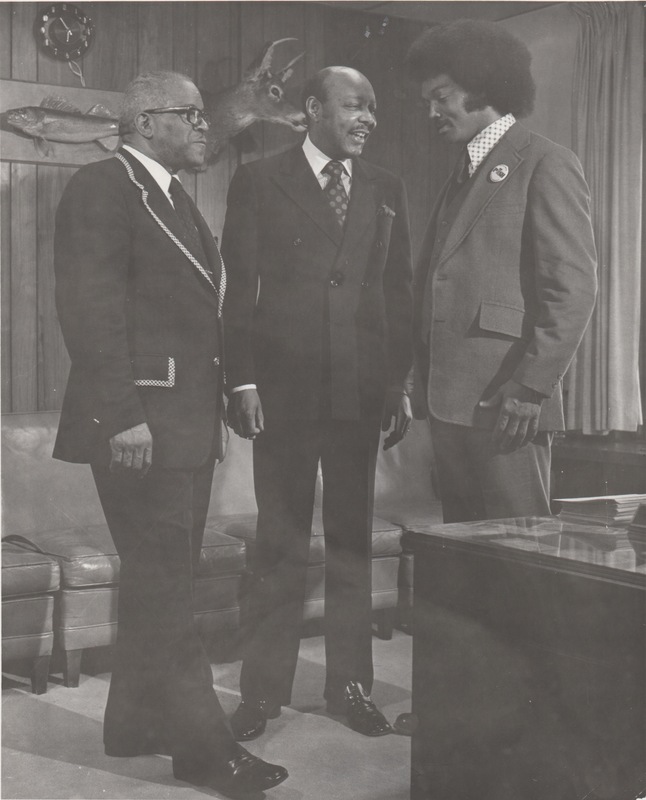
    <summary type="html"><![CDATA[<p><strong><em>Shiloh's International Tea hosted an array of prominent and challenging speakers. The annual event reflected the important political and social role that Black churches maintained in Cleveland during the 1960s and 1970s.</em></strong></p><img src="https://mail.clevelandhistorical.org/files/fullsize/6fdb42956ed4045e73e318e69cdc0e8d.jpg" alt="Rev. Waller with Louis Stokes and Jesse Jackson, 1975" /><br/><p>In 1975, Shiloh Baptist Church held its 10th annual International Tea. Dressed in costumes representative of different nations, congregation members had arranged a buffet of ethnic food in the building's basement; upstairs, Reverend Jesse Louis Jackson stood at the church pulpit to address a capacity crowd sitting beneath the stained-glass dome. In an hour-long sermon, the civil rights advocate equated Cleveland and the United States to a wrecked ship—both lacked in socially conscious political leadership, threatening to sink the fight for racial equality. Recalling the influence of the urban African American voting bloc in helping to elect Carl Stokes as Cleveland mayor, he urged the attendees not to dismiss new leaders and to continue effecting change through the ballot box. </p><p>Touching on contentious issues of politics, poverty, and race, Jackson's speech was not atypical for the tea social. A 1969 speech by Congressman Louis Stokes had pointed towards the turmoil of Cleveland's race relations, and denounced violence as a means of implementing social change.  In 1970, the first Black female president of the United Nations General Assembly, Miss Angie Elizabeth Brooks, had spoken to issues of racial inequality in the United States and criticized the Back to Africa movement. And in 1971, ABC News Correspondent to the United Nations, Malvin R. Goode, had denounced the war in Vietnam at the International Tea. Indeed, for ten years, Shiloh's International Tea had hosted an array of prominent and challenging speakers. The annual event reflected the important political and social role that Black churches maintained in Cleveland during the 1960s and 1970s.</p><p>The first International Tea at Shiloh was held in 1966, coinciding with a growing awareness in Cleveland of the political power held by the African American community. The following year, the election of Carl Stokes as mayor held a spotlight to the influence of churches and clergy within Black neighborhoods. Churches such as Shiloh were actively involved in promoting voter registration, and acted as spaces for public meetings and political rallies. While the unity of Cleveland's African American clergy behind Stokes's candidacy may have brought the power of a new voting bloc to the attention of politicians and the media, the influence of the church as a center of social, cultural, and political life for black communities was not new. Shiloh Baptist Church, organized from a mission of First Baptist Church in 1850, had long held an important place in the lives of Cleveland's African American citizenry. Countless mass meetings, social functions, and public gatherings were hosted at the various structures occupied by the congregation throughout its history. Shiloh also sponsored sports teams, missionary services, educational programs, and recreational activities for its congregation and Cleveland residents. </p><p>Intimately tied to Baptist concepts of mission, evangelism and fellowship, the influence of Shiloh in the community had historically extended to the social and cultural lives of Cleveland's African American residents. As the Civil Rights Movement progressed through the 1950s and 1960s, local houses of worship in Cleveland's highly segregated Black neighborhoods played an integral role in the fight for racial equality. Clergy members of black churches throughout the city increasingly became associated with social and political activism. Shiloh Baptist Church was no different; the acceptance of pastoral leadership by Rev. Alfred M. Waller in 1963, compounded by a rising African American population on Cleveland's East Side, helped fuel the expansion and influence of Shiloh Baptist Church during the 1960s.  Coming into his new church, Waller challenged the congregation to both grow the church and broaden their missionary role in the community. Believing the role of the African American church was to "think black, but act colorless," he urged the congregation towards social action in Cleveland's inner city neighborhoods. The mission work of the church was to provide hope to Cleveland's disenfranchised residents and cast the East Side in a more positive light. </p><p>The International Tea was one outgrowth of these efforts. The social event was designed to broaden the outreach and culture of the Black community by familiarizing them with the traditions and heritage of others. Congregation members researched the history and culture of different nationalities, often making contact with persons of different ethnicities from their neighborhood for recipes and costume suggestions. The event was also meant to act as a positive representation of the black community to the outside world; it not only echoed the language of the Civil Rights Movement, but provided a real-life example of its ideals. The International Tea presented themes that drew attention to commonalities between cultures, such as the universality of human rights, the brotherhood of man, the American Dream, and America as a melting pot. The political, social, and cultural commentary provided by prominent guest speakers on these subjects was meant to both challenge and shape the views of Cleveland's African American community. Shiloh Baptist Church, as well as other black houses of worship in Cleveland, continued to play an important role in shaping the politics and culture of Cleveland until the late 1970s. </p><p><em><strong><a href="https://mail.clevelandhistorical.org/items/show/176">For more (including 12 images&#32;&amp;&#32;3 audio files) view the original article</a></strong></em></p>]]></summary>
    <published>2011-03-09T11:24:40+00:00</published>
    <updated>2026-04-17T19:17:37+00:00</updated>
    <link rel="alternate" type="text/html" href="https://mail.clevelandhistorical.org/items/show/176"/>
    <id>https://mail.clevelandhistorical.org/items/show/176</id>
    <author>
      <name>Richard Raponi</name>
    </author>
  </entry>
</feed>