<?xml version="1.0" encoding="UTF-8"?>
<feed xmlns="http://www.w3.org/2005/Atom">
  <title type="text">Cleveland Historical</title>
  <updated>2026-08-21T21:05:45+00:00</updated>
  <generator uri="http://framework.zend.com" version="1.12.20">Zend_Feed_Writer</generator>
  <link rel="alternate" type="text/html" href="https://mail.clevelandhistorical.org/"/>
  <link rel="self" type="application/atom+xml" href="https://mail.clevelandhistorical.org/items/browse?output=rss2"/>
  <id>https://mail.clevelandhistorical.org/</id>
  <author>
    <name>Cleveland Historical</name>
    <uri>https://mail.clevelandhistorical.org</uri>
  </author>
  <link rel="hub" href="http://pubsubhubbub.appspot.com/"/>
  <entry>
    <title type="html"><![CDATA[A Public Service Message from David Blaushild Chevrolet: &quot;Let’s Stop Killing Lake Erie!&quot;]]></title>
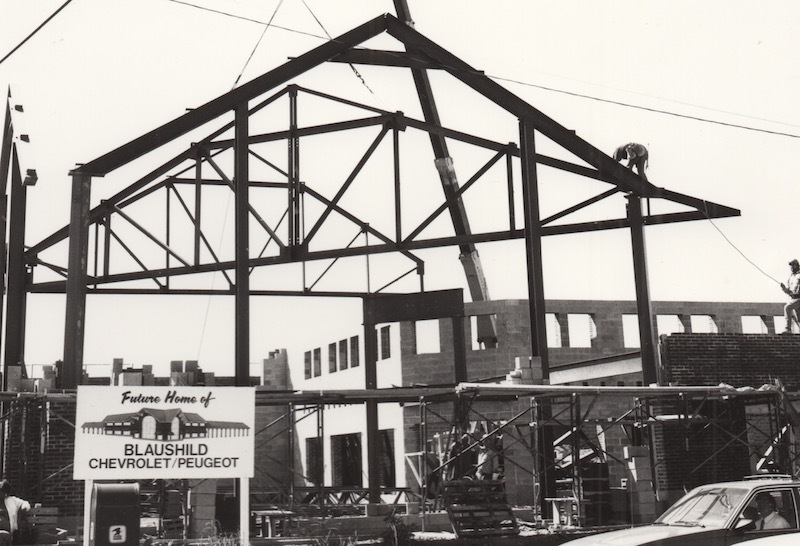
    <summary type="html"><![CDATA[<p><strong><em>In July of 1964, motorists were greeted by the newest billboard from Shaker Heights auto dealer David L. Blaushild.  Bold letters declared: “Let’s Stop Killing Lake Erie, have your council vote Anti-Pollution!"  Learn how one car salesman  helped initiate an environmental movement in Cleveland that pushed lawmakers to publicly recognize and respond to the lax enforcement of antipollution laws.  </em></strong></p><img src="https://mail.clevelandhistorical.org/files/fullsize/b52b771ceac298f1e9f52ffb08a7719e.jpg" alt="Future Home Of Blaushild Chevrolet / Peugeot" /><br/><p>In July of 1964, motorists traveling along the Inner Belt Freeway south of Memorial Shoreway were greeted by the newest billboard from Shaker Heights auto dealer David L. Blaushild. Bold letters spanning a giant 80- by 20-foot sign declared: “Let’s Stop Killing Lake Erie, have your council vote Anti-Pollution! write…David Blaushild 16003 Chagrin.” The environmentally conscious car salesman acquired free use of 15 billboards in the Cleveland area, and was using them to draw attention to the issue of lake pollution. A series of advertisements in Cleveland’s newspapers complemented the imposing signage, and called on the citizenry to join the crusade. Blaushild asked Clevelanders to express their support for the cause by filling out and mailing in a coupon to his dealership, which would be forwarded to public officials. An overflow of public response prompted the salesman to expand his efforts. He began sending both petitions and an antipollution resolution to those that replied to his ads. The respondents could then circulate the petitions within their communities throughout the greater Cleveland area, and submit with the proposed statement of position to local governing bodies for adoption. By some accounts, over half a million signatures were gathered between June and August. Twenty-six towns along Lake Erie passed Blaushild’s resolution calling on the Ohio Governor to take steps towards preventing industrial and sanitary pollution from reaching public waters. </p><p>David Blaushild’s Moreland-based Chevrolet dealership served as headquarters for the petition drive. Both his surname and automobile promotions had long been known in the Cleveland and Shaker Heights area. Just one year prior, he had caused a minor stir with another billboard located near Fairhill (Stokes Boulevard) and Petrarca Roads. As described by Cleveland Plain Dealer, “Tired businessmen driving home…have been met by the sight of two scantily clad young women cavorting on the catwalk of a billboard.” Police intervened after receiving complaints, which Blaushild chalked up to the doings of rival auto dealers. Beyond enlisting bikini-models to sell cars, he was also known for imaginative radio and print advertisements. In 1963, Blaushild employed the Cleveland Orchestra to record a minute-long jingle promoting a “classically, classical deal at David Blaushild Chevrolet.” </p><p>Beyond his sometimes-questionable promotional tactics, Blaushild’s name carried weight in the auto sales industry. Lester Blaushild, David’s father, opened a franchise of the Star-Durant car line around 1921 at 12100 Kinsman Road. Keeping up with the rapidly changing automobile industry, Lester switched to the Hudson-Essex line before finally settling with a Chrysler dealership in 1931. The Latvian immigrant brought members of his family to Cleveland during this time, including his brother Bennie. Bennie started working for Lester in 1924, and soon after opened B.W Blaushild Motors, Inc. at 15215 Kinsman Road. The Dodge-Plymouth dealership relocated within Mount Pleasant at 14307 Kinsman Road in 1932, and eventually opened a showroom at the Kinsman-Lee intersection in Shaker Heights at 16333 Kinsman Road by 1948. All the while, Lester’s dealership grew by bounds. Regularly touted as the largest Chrysler dealership in the region, at one time it was the third largest in the country. In 1949, Lester opened a new Chrysler-Plymouth showroom at 16005 Kinsman Road. </p><p>David Blaushild worked for his father’s auto dealership beginning in 1938. With the advent of World War II, David enlisted in the U.S Army Air Forces. Joining in 1942, he served as a photo intelligence officer in Europe for nearly the duration of the war. Upon his discharge, Lester offered David the choice to work in the mechanic shop or frontroom. David chose the latter, at which point his father removed himself from the business’ daily operations. Following the relocation of both the Dodge-Plymouth and Chrysler-Plymouth auto dealerships to Shaker Heights at midcentury, the Blaushild name became a fixture in the emerging Kinsman-Lee auto row. A year after Lester’s death in 1958, David transitioned the business into a Chevrolet dealership. The Chevrolet dealership expanded to include a showroom across the street at 16222 Chagrin Boulevard in 1963.</p><p>A trip to Shaker Lakes in the summer of 1963 drastically altered the trajectory of David Blaushild’s life for the next decade. Hoping to share fond childhood memories of visiting the recreation grounds with his young daughter, David Blaushild arrived to find the body of water emitting a rancid odor and littered with garbage. Similar to most cities situated along Lake Erie, both Shaker Heights’ and Cleveland’s sewage infrastructure was outdated and ineffective. With excessive rain, the sewer systems regularly failed and raw waste flowed into the surrounding rivers and lakes. He quickly discovered that Lake Erie was in just as bad of shape. In addition to being a final destination for much of the region’s sewage overflow, the lake was used as a dumping ground for untreated chemical waste by local industries. </p><p>Blaushild immediately began working to raise public awareness about the sad state of the region’s water supply. He was not alone in advocating for the modernization of sewage systems or holding industries accountable for breaking antipollution laws. Increasingly since the early 1960s, scientists and environmental activists voiced their concerns over the alarming levels of pollution in Lake Erie. Blaushild, however, effectively used his skills as an advertiser, salesperson and showman to bring this crisis to light and build a base of support that could influence policymakers. In addition to his billboard and print campaign, Blaushild booked television appearances, radio interviews and a speaking tour to spread his message. Local newspapers similarly began to call on lawmakers to take action on water pollution issues. </p><p> As support for Blaushild’s cause grew, governing bodies of communities along Lake Erie were quick to adopt his resolution. Cleveland Mayor Ralph Locher initially rejected the non-binding proposal, however, citing the potential negative economic impact on local industry if antipollution laws were strictly enforced. Following public outcry, the resolution passed in the fall of 1964. The following year, Ohio’s Governor requested a federal government conference be held concerning Lake Erie pollution. Blaushild used the opportunity to present state officials over 200,000 signed petitions and letters that had been collected over the course of his campaign. </p><p>The Woods and Water Club of Cleveland named Blaushild their Man of the Year in 1964, noting that he had “single-handedly…done more than any other person to fight pollution of our lake and waterways.” The highly visible media campaign, however, only marked the beginnings of a nearly decade-long battle waged by Blaushild to raise public awareness about the region’s water pollution crisis. In 1965, Blaushild sued the City of Cleveland for failing to enforce water pollution laws. He asserted that the local government turned a blind eye to local industries that dumped untreated chemical waste into the Cuyahoga River. </p><p> The case was drawn out over seven years, eventually making it to the Supreme Court. In the end, Blaushild lost. It was determined that the City was not the appropriate regulatory authority for enforcement of the antipollution laws. Despite its outcome, the lawsuit had served its purpose. The harmful and illegal dumping practices employed by a number of Cleveland industries were brought out into the open. Coinciding with the national media coverage of the 1969 Cuyahoga River fire, the work of environmental activists such as Blaushild attracted attention to the dire state of Lake Erie and set the stage for future regulatory protections of the region’s water supply. </p><p>Blaushild stepped away from his public role in the fight against water pollution during the early 1970s. Since the eye-opening visit to Shaker Lake in 1963, the crusade to save Lake Erie had taken over much of his life. Reflecting a tenacity and flare for salesmanship that is often disparagingly associated with used car dealers, Blaushild instigated lawmakers to publicly recognize and respond to the lax enforcement of antipollution laws. His campaign mobilized residents living near Lake Erie into action by offering a platform from which they could express their concerns.</p><p><em><strong><a href="https://mail.clevelandhistorical.org/items/show/845">For more (including 16 images) view the original article</a></strong></em></p>]]></summary>
    <published>2018-07-20T06:04:10+00:00</published>
    <updated>2026-04-17T19:17:39+00:00</updated>
    <link rel="alternate" type="text/html" href="https://mail.clevelandhistorical.org/items/show/845"/>
    <id>https://mail.clevelandhistorical.org/items/show/845</id>
    <author>
      <name>Richard Raponi</name>
    </author>
  </entry>
  <entry>
    <title type="html"><![CDATA[Brecksville VA Hospital]]></title>
    <summary type="html"><![CDATA[<img src="https://mail.clevelandhistorical.org/files/fullsize/318d7c206379f07b3924e55deee19ff7.jpg" alt="Aerial, 1964" /><br/><p>The Brecksville Veterans Administration Hospital had a tumultuous history that raised the question of whether the hospital was actually unhealthy for the environment. Although initially embraced by the community, the hospital soon became a lightning rod for concerns that would last many years. </p><p>The Brecksville Veterans Administration Hospital was a massive 999-bed facility built as a replacement for an <a href="https://clevelandhistorical.org/items/show/595">earlier facility</a> of the same name built in 1938 in the village of Broadview Heights, which at the time carried a Brecksville address. When construction was completed on an 87-acre site in Brecksville in 1961, the hospital was one of the largest veterans' hospitals in the U.S. After World War II the growth rate of long-term care patients in the Veterans Administration was over 1,000 a month. In late 1945 the federal government earmarked a generous sum of one billion dollars for the construction of hospitals to serve the large number of veterans needing care. </p><p>When the Brecksville facility was built, its designers chose to embrace nature, going so far as to incorporate a natural lake on the premises for use by the patients. However, concerns mounted over pollution generated by the hospital. In 1970 the hospital faced accusations of polluting the air in Brecksville due to the large amounts of coal it burned around the clock in order to heat the dozens of buildings and miles of hospital corridors. In 1971 the hospital administration admitted the Brecksville VA Hospital was severely polluting the air, prompting a switchover to cleaner-burning oil and gas. </p><p>The problems the hospital presented to the local community were greater than just pollution in the air and water. The 1970s saw a shift in the attitudes of many local residents toward the hospital. Some of this ill will can be linked to attitudes toward returning Vietnam veterans. At that time there was a prevailing shift in the nation's collective consciousness towards veterans, for never had the U.S. been embroiled in a war that was so controversial or, with the exception of the Korean conflict, with an end result that did not produce victory. In addition, much of the Brecksville communal backlash was due to the problems the Brecksville hospital presented to the community. The local press reported that mental patients from the hospital were escaping and wandering the town, which frightened some residents. In the late 1970s the hospital was also rocked by several scandals, including the theft and sale of prescription drugs. These crimes had led to several dozen convictions by the early 1980s.</p><p><em><strong><a href="https://mail.clevelandhistorical.org/items/show/594">For more (including 8 images) view the original article</a></strong></em></p>]]></summary>
    <published>2013-02-26T23:54:46+00:00</published>
    <updated>2026-04-17T19:17:40+00:00</updated>
    <link rel="alternate" type="text/html" href="https://mail.clevelandhistorical.org/items/show/594"/>
    <id>https://mail.clevelandhistorical.org/items/show/594</id>
    <author>
      <name>Daniel Zamborsky</name>
    </author>
  </entry>
  <entry>
    <title type="html"><![CDATA[Cedar Glen]]></title>
    <summary type="html"><![CDATA[<img src="https://mail.clevelandhistorical.org/files/fullsize/673888f5fa758b81544c09e6e2cb3160.jpg" alt="Cedar Glen at Ambleside, 1930" /><br/><p>Until the late 1800s, looking down from atop Cedar Hill you would have seen little more than a countryside landscape divided by an unkempt dirt road. The hillside known as Cedar Glen hosted few travellers aside from farm wagons and, later, visitors to the springs resort at the foot of the hill. In less than a century, this scene would be replaced by one of a busy, six-lane road as Cedar Glen became the biggest gateway to the Heights from the city of Cleveland. </p><p>One of Cedar Glen's most salient characteristics is its gradual rise in elevation. The western edge of the Portage Escarpment causes this natural formation. The Portage Escarpment not only divides the Allegheny Plateau and the Great Lakes Basin, but also acts as a boundary between Cleveland and its suburban "Heights" to the east. Originally the eastern part of Cedar Glen and the high ground to which it leads belonged to East Cleveland Township. When Cleveland Heights incorporated as a village in 1903, it engulfed the southern part of East Cleveland Township, which included farmland and Cedar Glen. </p><p>Another natural feature that, for a time, made Cedar Glen a well-known area was Doan Brook, which was piped and buried underground in 1929. In the early 1800s, bluish grey sandstone called Euclid bluestone was quarried along the brook. The hard sandstone was used for everything from laundry tubs to sidewalks. Later in the century Doan Brook again brought attention to Cedar Glen. Dr. Nathan Hardy Ambler was a former dentist and the owner of the Cedar Glen property through which Doan Brook passes on its way from Shaker Lakes to Lake Erie. Although the blue-green water tasted like sulfur, Ambler began bottling and selling it to local restaurants. Because patrons believed the water offered health benefits and hydrotherapy was becoming a popular treatment method, Ambler and his partner Daniel O. Caswell opened the Blue Rock Spring House in Cedar Glen. The water resort and sanitarium operated from 1880 until 1908 when popularity began to fade. </p><p>Cedar Glen began its transition to one of Cleveland's most important transportation gateways from the suburbs in 1896 when entrepreneur and suburban developer Patrick Calhoun donated a large tract of land to the city's park system. One of the conditions of the gift was that Calhoun would be permitted to run a double-line street railway through Cedar Glen. Construction began that fall on the street railway that was intended to bring passengers to and from Euclid Heights and Ambler Heights, prestigious residential allotments on the "Overlook." The increase in suburban residents and visitors made possible the construction of the <a href="https://clevelandhistorical.org/items/show/198">Cedar Fairmount</a> retail district at the top of the hill. </p><p>By the 1920s Cedar Glen was bustling with heavy streetcar and automobile traffic. At the end of that decade a tunnel and platform were built on the western end of Cedar Glen in conjunction with the construction of the Cleveland Union Terminal, further connecting Cleveland Heights to its urban neighbor. In the mid 1950s Cleveland Transit Service (CTS), the predecessor of today's RTA, built the University Circle Rapid Transit Station at the same location on the bottom of Cedar Glen where the tunnel was constructed twenty-five years earlier. Completely transformed from its onetime status as a barren, dirt road, Cedar Glen now remains a well-traveled gateway to and from Cleveland.</p><p><em><strong><a href="https://mail.clevelandhistorical.org/items/show/547">For more (including 13 images&#32;&amp;&#32;1 audio file) view the original article</a></strong></em></p>]]></summary>
    <published>2012-08-30T21:06:26+00:00</published>
    <updated>2026-04-17T19:17:39+00:00</updated>
    <link rel="alternate" type="text/html" href="https://mail.clevelandhistorical.org/items/show/547"/>
    <id>https://mail.clevelandhistorical.org/items/show/547</id>
    <author>
      <name>Heidi Fearing</name>
    </author>
  </entry>
  <entry>
    <title type="html"><![CDATA[Avon Lake Power Plant]]></title>
    <summary type="html"><![CDATA[<img src="https://mail.clevelandhistorical.org/files/fullsize/8f3bc520e6bae4f9eb5318e396d87074.jpg" alt="Rotor Installation" /><br/><p>With regard to Cleveland's west side, the addition of the Avon Lake Power Plant on Lake Road in 1926 is arguably the most significant project taken on by Cleveland Electric Illuminating Company (CEI).  Situated 23 miles west of CEI's Public Square headquarters, the plant added another massive range of power and opened "a new industrial area in which electrical power will be available in abundance." Announced in 1924, the Avon Lake plant was built from March 1925 to July 1926 at a cost of approximately $30,000,000.  The plant was constructed in Avon Beach Park in order to make use of the uniquely large, cool source of water in the Great Lakes. Cool water was necessary to condense steam as it left the turbines, and five-hundred tons of water were required for every ton of coal burned by the plant. To put this in perspective, so much water was needed for the Avon Lake plant that it had to pump twice the amount of water that the city water works did. When it opened, the Avon Lake plant became the largest of its kind in the world, capable of producing a magnificent 400,000 horsepower.</p><p>The Avon Lake plant's dependence on water led to an extraordinary dilemma on February 21, 1953. That day, "great masses of gizzard shad" collapsed the plant's water intake screens and caused each of the plan'ts seven generators to instantly shut down. This resulted in a significant power-outage throughout the entire Greater Cleveland area. After hours of scooping out the dead fish with a large crane, it took the work of another 50 men, including welders and divers, to fix the broken water intake screens located 35 feet below the surface. The Ohio Division of Wildlife determined that a sudden and significant drop in temperature had killed the fish, which subsequently created a large aggregation of dead fish on the surface near the plant's intake channel.</p><p>In addition to cool water, the plant also depended on a substantial amount of coal.  In 1950, the Avon Lake plant reportedly processed 4,000 tons of coal a day.  Despite a late-fifties effort by CEI to beautify the immediate area surrounding the Avon Lake power plant, significant backlash over the plant's environmental impact eventually led to its demise. In November of 2011, Ohio Representative Dennis Kucinich publicly addressed the Ohio Environmental Protection Agency, (EPA). Kucinich urged the EPA to take action against the plant, now controlled by GenOn, and limit its toxic air pollution.  Kucinich cited that the "power plant in Avon Lake had released more than two million [tons] of toxic chemicals in 2010."  The EPA determined that the Avon Lake power plant was guilty of excessive ozone emissions, and cited GenOn.  In order to become compliant under stricter EPA regulations, the power plant would have to undergo an overhaul costing hundreds of millions of dollars. This pressured GenOn to announce plans to close the Avon Lake power plant in 2015, but instead the plant changed hands and continued to operate for six more years before finally shutting down in 2021. It was mostly demolished over the next two years as part of a lakefront redevelopment plan.</p><p><em><strong><a href="https://mail.clevelandhistorical.org/items/show/458">For more (including 8 images) view the original article</a></strong></em></p>]]></summary>
    <published>2012-05-15T23:16:03+00:00</published>
    <updated>2026-04-17T19:17:39+00:00</updated>
    <link rel="alternate" type="text/html" href="https://mail.clevelandhistorical.org/items/show/458"/>
    <id>https://mail.clevelandhistorical.org/items/show/458</id>
    <author>
      <name>Matthew Sisson</name>
    </author>
  </entry>
  <entry>
    <title type="html"><![CDATA[Cuyahoga River Fire: The Blaze That Started a National Discussion]]></title>
    <summary type="html"><![CDATA[<img src="https://mail.clevelandhistorical.org/files/fullsize/riverfire-press-oilslick65_a14ac5ba8c.jpg" alt="Oil Slick, 1965" /><br/><p>The story of the Cuyahoga River fire of 1969 - the event that sparked pop songs, lit the imagination of an entire nation, and badly tarnished a city's reputation - is built more on myths than reality. Yes, an oil slick on the Cuyahoga River - polluted from decades of industrial waste - caught fire on a Sunday morning in June 1969 near the Republic Steel mill, causing about $100,000 worth of damage to two railroad bridges. Initially the fire drew little attention, either locally or nationally. The '69 fire was not even the first time that the river burned. Dating back to the beginning of the twentieth century, the river had caught fire on several other occasions.</p><p>The picture of the Cuyahoga River on fire that ended up in Time Magazine a month later - a truly arresting image showing flames leaping up from the water, completely engulfing a ship - was actually from a much more serious fire in November 1952. No picture of the '69 river fire is known to exist. </p><p>Throughout much of Cleveland's history, water pollution did not trouble the city's residents very much. Instead, water pollution was viewed as a necessary consequence of the industry that had brought prosperity to the city. This attitude began to change in the 1960s as ideas associated with what would become known as environmentalism took shape. In 1968, Cleveland residents overwhelmingly passed a $100 million bond initiative to fund the Cuyahoga's cleanup. Also, by this time deindustrialization was somewhat alleviating the pollution problem, as factories closed or cut back operations. Ironically, the city and its residents were beginning to take responsibility for the cleanliness of the river in the years before the infamous fire of 1969.</p><p>The '69 fire, then, was not really the terrifying climax of decades of pollution, but rather the last gasp of an industrial river whose role was beginning to change. Nevertheless, Cleveland became a symbol of environmental degradation. The Time article contributed to this, as did the notoriety of Cleveland Mayor Carl Stokes. Stokes, who was the first black mayor of a major city when elected in 1967, became deeply involved with the issue, holding a press conference at the site of the fire the following day and testifying before Congress - including his brother US Representative Louis Stokes - to urge greater federal involvement in pollution control. The Stokes brothers' advocacy played a part in the passage of the federal Clean Water Act of 1972. In Cleveland, a number of Cleveland State University students celebrated the inaugural Earth Day in 1970 by marching from campus to the river to protest pollution.  </p><p>Even though it has been misunderstood, the 1969 Cuyahoga River fire did help bring about positive change. The river's water quality improved during the following decades, and business investors capitalized on this by converting parts of the Flats' abandoned industrial landscape into an entertainment district featuring restaurants, nightclubs, and music venues.  </p><p>Much of the industry that both made Cleveland rich and caused its river to burn may never be coming back, but Clevelanders are meeting this challenge by reshaping their city to reflect its current realities.</p><p><em><strong><a href="https://mail.clevelandhistorical.org/items/show/63">For more (including 8 images&#32;&amp;&#32;2 videos) view the original article</a></strong></em></p>]]></summary>
    <published>2010-09-22T13:36:07+00:00</published>
    <updated>2026-04-17T19:17:37+00:00</updated>
    <link rel="alternate" type="text/html" href="https://mail.clevelandhistorical.org/items/show/63"/>
    <id>https://mail.clevelandhistorical.org/items/show/63</id>
    <author>
      <name>Michael Rotman</name>
    </author>
  </entry>
  <entry>
    <title type="html"><![CDATA[Cleveland Museum of Natural History: From Humble Shack to Venerable Institution]]></title>
    <summary type="html"><![CDATA[<img src="https://mail.clevelandhistorical.org/files/fullsize/cmnh1_ae14055c96.jpg" alt="Happy the Haplocanthosaurus, ca. 1977" /><br/><p>The Ark was a small, two-room frame house located on the northeast side of Public Square. It housed taxidermy ranging from birds to reptiles and mammals, which led to its being called the Ark in reference to the biblical story of saving the world's fauna from the great flood. The Arkites, as the group of 26 young men who frequented the Ark came to be known, were led by William Case, mayor of Cleveland from 1850 to 1851, and his brother Leonard Case Jr. Their father Leonard Case Sr. had started the Ark in the 1830s as a place to relax. After buying the property, he let his two sons take charge of the building and began to fade from popular society because of health issues. William Case worked in his father's companies but spent much of his time at the Ark. The Ark is important because there were no museums in Cleveland during this time. The Arkites collected, researched, and discussed findings with each other. As time passed, other societies were interested in representing Cleveland history and the Arkites were the most knowledgeable within the city. They began to present papers and work with others to curate and show their research. William Case's taxidermy bird collection is still on display in the Cleveland Museum of Natural History (CMNH) today.</p><p>CMNH considers the Ark as a part of its founding because of the work that was done by the Arkites. The Ark moved into adjacent Case Hall in 1876 after its building was demolished to build a new post office. Many other societies also used Case Hall, including the Kirtland Society, whose leader Jared Kirtland was also an Arkite. Case Hall lasted until 1916, when it too gave way to the new Cleveland Public Library.</p><p>When the Natural History Museum was established in 1920, it was located in the Lennox Building at Euclid Avenue and East 9th Street. The museum first moved down Euclid Avenue onto Millionaires Row in the Leonard Hanna Mansion. The mansion held many exhibits but most notably many of them were from the original Arkites, including William Case's birds as well as many exhibits donated by the Kirtland Society  in 1920. As the museum began to gather more and more collections, such as Jeptha Wade II's precious stone collection and discoveries of new animals and plants from the a safari that the museum had sponsored in Kenya in 1930, eventually it either had to expand or find a larger building.</p><p>The choice was made for the museum when the Hanna mansion was in the path of a planned highway. In 1958 the museum moved to Wade Park, where it is still located today. Since that time, the museum has enjoyed many achievements. In 1971 the CMNH sponsored a team of zoologists to breed bald eagles, which were threatened with extinction and had only a handful of working nests. They were the first team ever to artificially inseminate a bald eagle and repopulated the area and others with the national bird.</p><p>The CMNH's accomplishments built upon a firm foundation. The Arkites, with the Case family at its center, set the stage for this venerable institution in both spirit and collections. Thus, as this nationally significant museum looks toward its official centennial, it must also cast a glance back-more than 80 years before its official inception-to the humble shack that started it all. </p><p><em><strong><a href="https://mail.clevelandhistorical.org/items/show/41">For more (including 9 images&#32;&amp;&#32;5 audio files) view the original article</a></strong></em></p>]]></summary>
    <published>2010-09-18T20:58:32+00:00</published>
    <updated>2026-04-17T19:17:36+00:00</updated>
    <link rel="alternate" type="text/html" href="https://mail.clevelandhistorical.org/items/show/41"/>
    <id>https://mail.clevelandhistorical.org/items/show/41</id>
    <author>
      <name>Emily Splain</name>
    </author>
  </entry>
</feed>
