<?xml version="1.0" encoding="UTF-8"?>
<feed xmlns="http://www.w3.org/2005/Atom">
  <title type="text">Cleveland Historical</title>
  <updated>2026-04-18T02:24:00+00:00</updated>
  <generator uri="http://framework.zend.com" version="1.12.20">Zend_Feed_Writer</generator>
  <link rel="alternate" type="text/html" href="https://mail.clevelandhistorical.org/"/>
  <link rel="self" type="application/atom+xml" href="https://mail.clevelandhistorical.org/items/browse?output=rss2"/>
  <id>https://mail.clevelandhistorical.org/</id>
  <author>
    <name>Cleveland Historical</name>
    <uri>https://mail.clevelandhistorical.org</uri>
  </author>
  <link rel="hub" href="http://pubsubhubbub.appspot.com/"/>
  <entry>
    <title type="html"><![CDATA[Landmark Office Towers: The Professional and Corporate Heart of the Terminal Group]]></title>
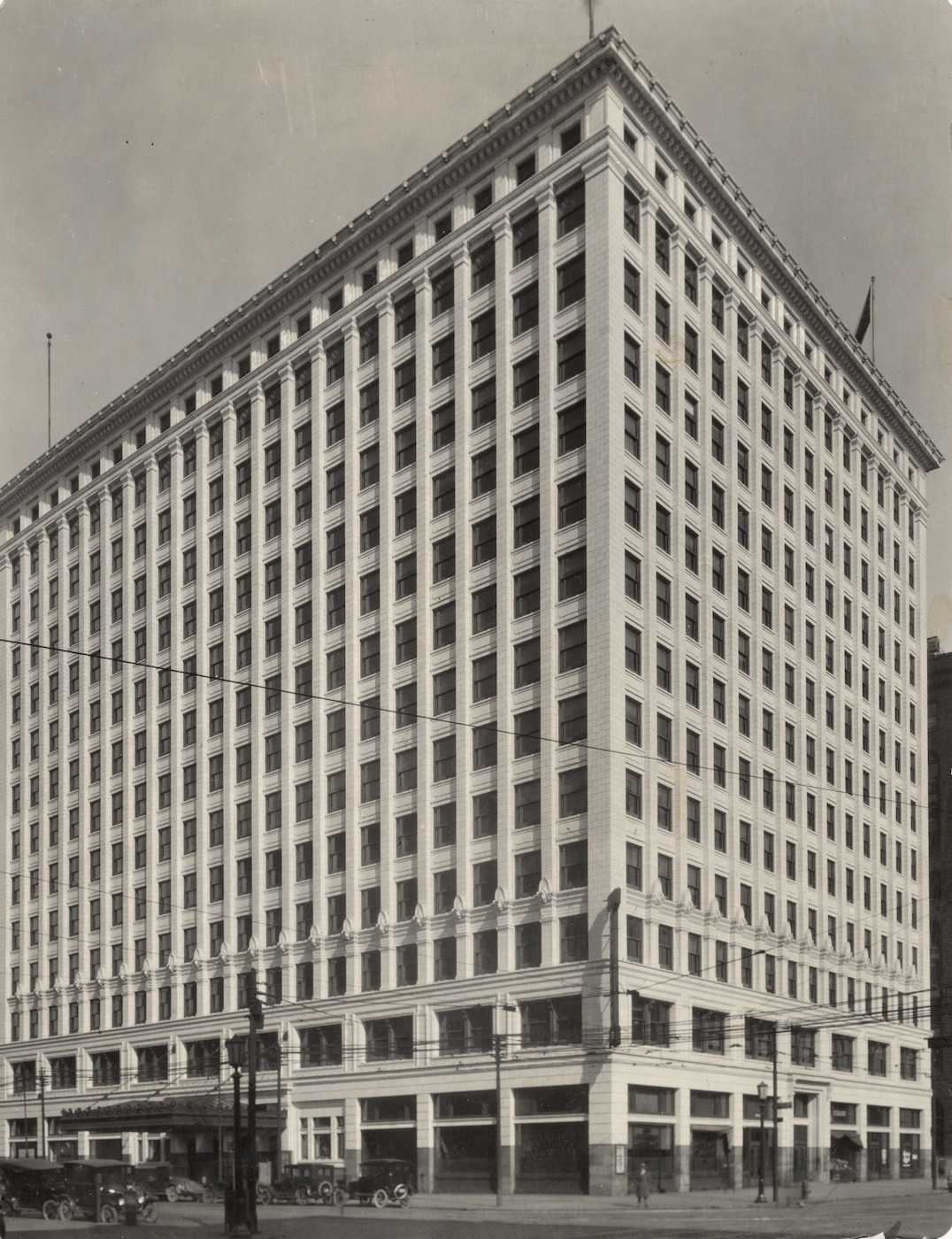
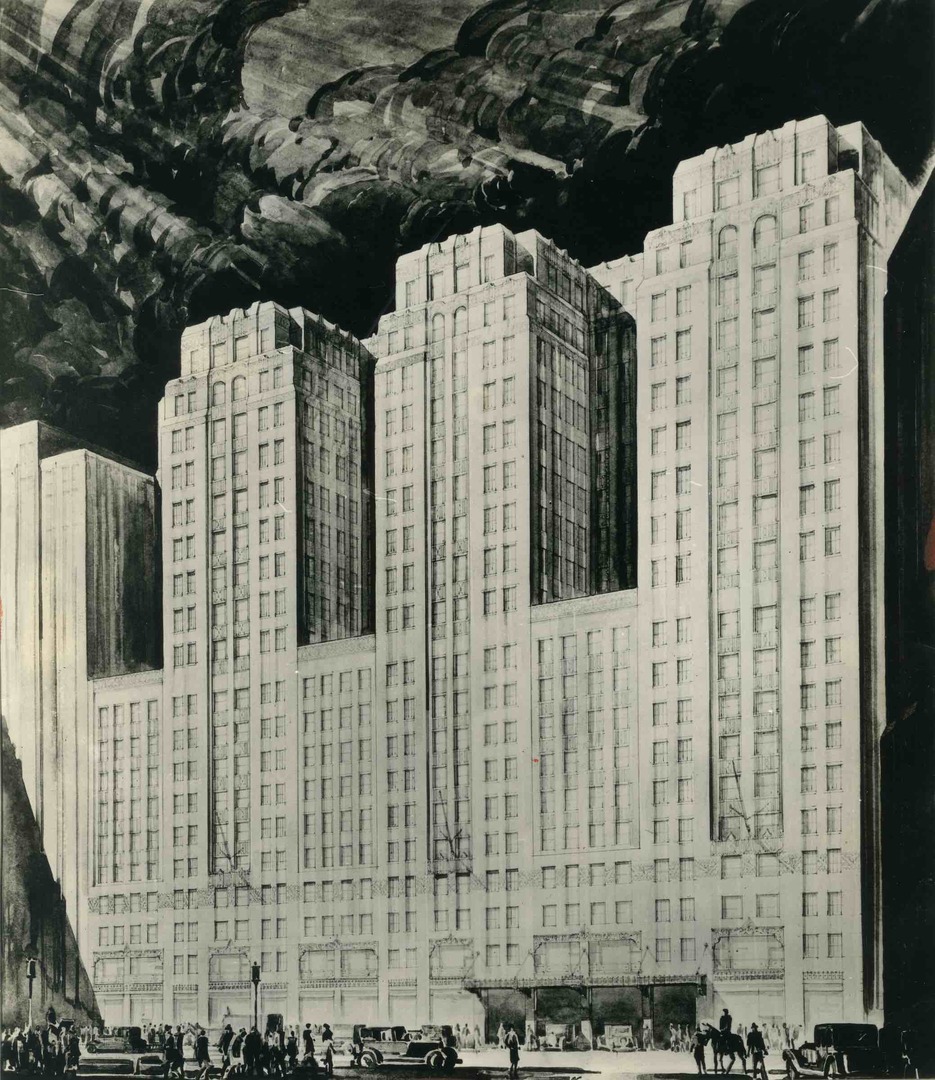
    <summary type="html"><![CDATA[<p><strong><em>Tower City Center, with its Public Square entrance, iconic tower, and flanking hotel and casino, has long overshadowed the office buildings to its rear despite their shared lineage as heirs of the Van Sweringen brothers’ vision. Yet the Landmark Office Towers complex on West Prospect Avenue deserves more attention for its splendid architectural details, novel interior features, and place in the history of some of Cleveland’s most significant corporate giants. </em></strong></p><img src="https://mail.clevelandhistorical.org/files/fullsize/cf17bb9783a0e01e8bcbc10cdc20b577.jpg" alt="Original Rendering of Builders Exchange Building" /><br/><p>The three adjoining buildings that comprise Landmark Office Towers were originally conceived as part of Oris P. and Mantis J. Van Sweringen’s Cleveland Union Terminal complex, the “city within a city” the brothers launched in the 1920s. Designed by Graham, Anderson, Probst & White of Chicago and built between 1929 and 1930, the buildings occupied an entire city block bounded by Prospect Avenue, Huron Road, Ontario Street, and West 2nd Street, all of which were built as viaducts above the railroad tracks entering the Union Terminal. </p><p>In keeping with the idea of a city within a city, each building focused on a different sector: the Medical Arts Building was built for physicians’ and dentists’ offices; the Builders Exchange Building was devoted to businesses associated with the building trades; and the Midland Bank Building was dedicated to banking institutions and other business firms. The buildings included passageways connecting them with each other and with other components of the Terminal complex. A skybridge over Prospect, planned to link the Medical Arts Building with Higbee’s department store, was never added. </p><p>The three buildings were all built with structural steel frames clad with gray limestone on the lower four floors, cream face brick above, and terra-cotta trim near the tops. Detailed Art Deco motifs graced each facade, and the complex featured setbacks and light wells to break their bulk and provide ventilation. Inside, they featured travertine marble floors, fluted pilasters, plaster ceilings with ornamental friezes, and bronze elevator doors. The three-story lobby of the Midland Bank Building featured a wood-burning fireplace, a mezzanine, and pillars and panels carved from the trunks of seven giant oak trees. The trees were selected from an English estate and transported by steamship from Liverpool. The Builders Exchange Building included Guildhall, a tenth-floor restaurant inspired by a 15th-century London namesake, and a two-story demonstration house called the <a href="https://clevelandhistorical.org/admin/items/show/1028">Home in the Sky</a> on its two top levels.</p><p>The introduction of such an expansive block of choice office space soon after the onset of the Great Depression had a profound impact on downtown, precipitating a consolidation of business and professional activity around the Terminal and leaving older office buildings with hard-to-fill vacancies. Four major corporate headquarters relocated to the complex between 1930 and 1935. Two were local: Sherwin-Williams moved its offices from its Canal Road property into portions of the Midland Building and Builders Exchange Building, while Standard Oil Co. of Ohio (Sohio) left the East Ohio Gas Building on East 6th for the Midland Building. The Midland Building also attracted the Erie Railroad headquarters away from New York City in 1931 and Republic Steel from Youngstown in 1935. The arrival of the latter led the Medical Arts Building to be renamed the Republic Building. </p><p>Yet the Depression also forced the complex to grapple with challenges. In 1932, Midland Bank went bankrupt and merged into Cleveland Trust, closing its offices in its namesake building. Three years later, the Van Sweringen Company went bankrupt. Thereafter, ownership of the towers complex was administered by the Prospect Terminals Building Co., a subsidiary of Cleveland Terminal Building Co. In 1940, the Cleveland Builders Exchange left for a new headquarters on Euclid Avenue, and Sherwin-Williams expanded to the floors that had housed the Exchange's Home in the Sky. At that time, the building was named the Guildhall Building.</p><p>In 1950, Cleveland Terminal Building Co. sold the entirety of the Union Terminal group except the rail station in 1950 to the 66 Trust of Philadelphia. That same year, the four main tenants of the towers complex — Republic Steel, Erie Railroad, Sohio, and Sherwin-Williams — formed RESS Realty (a portmanteau of their names) to coordinate leasing of office space in the three conjoined towers. For the 35 years that followed, the complex harbored a workforce of around 5,000 people. </p><p>In 1986, ten years after the Erie-Lackawanna Railroad (formerly Erie Railroad) closed its Cleveland headquarters following its merger into Philadelphia-based Conrail, Sohio completed its move from the Midland Building to its new 45-story headquarters on Public Square. Following the departures of these firms and Republic’s recent merger into LTV Steel, RESS Realty was administered by only LTV and Sherwin-Williams. In the year preceding Sohio’s exit, RESS Realty renovated and rebranded the LTV-Guildhall-Midland Building complex as Landmark Office Towers. </p><p>During the renovations, Sherwin-Williams bought the complex, bringing its ownership back to Cleveland. Changes included a central lobby for the elevator banks serving all three buildings, along with the revitalization of the Midland Building’s lobby, which Sohio had modernized into offices with dropped ceilings in 1970, as the Van Sweringen Arcade. The bank’s vault became Haymarket Restaurant, later Piperade, and then Hyde Park Chophouse until the space closed in 2011. </p><p>The renovation and promotion succeeded in turning around the towers at a critical time. After Sohio moved out, the complex’s occupancy dropped from 100% to 62%, but upon completion of the renovations, it bounced back to 90%. Landmark Office Towers had a nearly four-decade run until its owner, Sherwin-Williams, sold the complex to Detroit-based Bedrock in 2023 ahead of the paint and coatings company’s move to its new 36-story headquarters tower on Public Square. Today, the future of the complex seems tied to Bedrock’s Riverfront Cleveland project, but its precise use is uncertain. Office demand in downtown districts has not recovered from the pandemic collapse of 2020, and conversion of such a massive structure to residential use is costly. But the towers — with their Art Deco flourishes, contribution to a big-city atmosphere, and central location in an evolving downtown — deserve a new, bold vision.</p><p><em><strong><a href="https://mail.clevelandhistorical.org/items/show/1084">For more (including 21 images) view the original article</a></strong></em></p>]]></summary>
    <published>2026-04-03T13:57:15+00:00</published>
    <updated>2026-04-17T19:17:44+00:00</updated>
    <link rel="alternate" type="text/html" href="https://mail.clevelandhistorical.org/items/show/1084"/>
    <id>https://mail.clevelandhistorical.org/items/show/1084</id>
    <author>
      <name>J. Mark Souther</name>
    </author>
  </entry>
  <entry>
    <title type="html"><![CDATA[Cleveland Athletic Club: The Star-Studded History Behind the Athlon ]]></title>
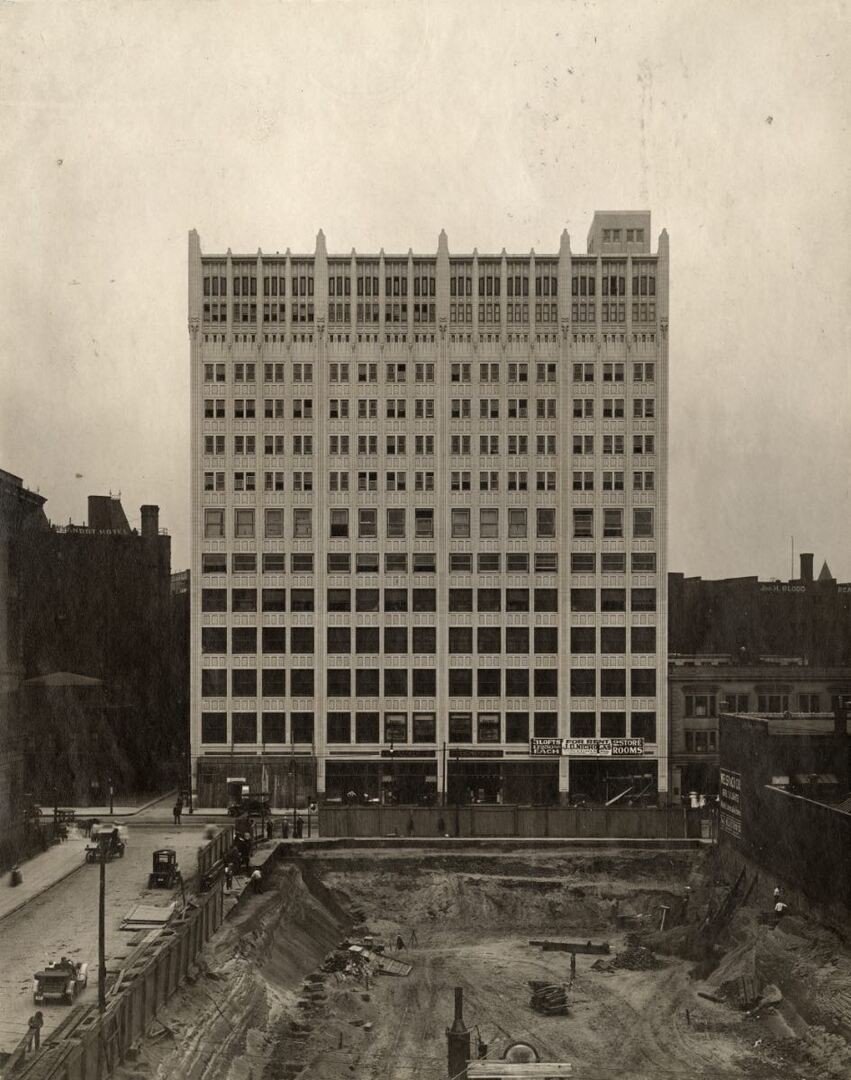
    <summary type="html"><![CDATA[<p><strong><em>The Cleveland Athletic Club was an epicenter of sports culture in Cleveland  for almost a century. Athletes from home and abroad used the CAC's state-of-the-art training facilities and amenities, including a large gymnasium, an indoor track, and an Olympic-sized swimming pool, some of them making sports history in the process.</em></strong></p><img src="https://mail.clevelandhistorical.org/files/fullsize/3045ffb5f072f18bc25d854d4ddf7bba.jpg" alt="CAC under Construction " /><br/><p>For much of the twentieth century, sports and physical fitness were interwoven with Cleveland’s civic life. One place where this sporting culture took shape was the Cleveland Athletic Club (CAC) Building on Euclid Avenue, designed by architect J. Milton Dyer, who also held other notable local commissions, including for the design of Cleveland City Hall. The architectural contract awarded to Dyer totaled $150,000, marking the building as a significant investment for its time. Operating from 1908 until its closure in 2007, the Cleveland Athletic Club served generations of members and offered state-of-the-art athletic facilities that reflected the growing interest in organized recreation and physical training in the early twentieth century. </p><p>The CAC’s origins date to the night of August 10, 1907, when a group of founding members held their first preliminary meeting in the rooms of the Cleveland Auto Club. At that meeting, they elected a temporary president, secretary, and treasurer, and began organizing what would become one of Cleveland’s leading private athletic institutions. Most of these early members were affluent businessmen and professionals who contributed their own funds to establish the club and recruit additional members. Membership grew steadily during the club’s early years, even as members debated the final location of the clubhouse. </p><p>Formal elections were held in 1908. W. P. Murray was once again elected president. Also elected that evening were A. J. Huston as vice president, George A. Schneider as secretary, and A. H. Bedell as treasurer. After two more years of discussion, members decided on a site on Euclid Avenue in 1910. The finished clubhouse occupied the upper ten floors of the 15-story Cleveland Athletic Club Building, which opened in November 1911, giving the CAC a permanent home. </p><p>From its earliest years, the Cleveland Athletic Club distinguished itself through its facilities, which included multiple gymnasiums, boxing rings, handball courts, and a large indoor swimming pool, as well as dining rooms, meeting spaces, and social areas. These amenities made the club both a center for athletic training and a favored spot for Cleveland’s business and professional community to gather. </p><p>The clubhouse attracted many prominent athletes to its facilities for training exercises. Boxing legend Joe Louis trained for several days at the CAC during a visit to Cleveland in 1936. Swimming exhibitions and competitions were also held in the club’s twelfth-floor natatorium, attracting many skilled swimmers. The most illustrious was Johnny Weissmuller, who set the world record for 150-yard backstroke in the club pool in 1922 before going on to win five gold medals in the next two summer Olympics and, later, starring in the <i>Tarzan</i> films. </p><p>Track meets hosted by the club marked another contribution to the city’s sporting culture and gave young athletes a place to develop their skill during the winter months. Among them was Jesse Owens, who participated in meets there during his school years. At the time, Owens was already gaining recognition locally for his remarkable speed, shattering several records—some of them his own—on the club’s track. </p><p>The Cleveland Athletic Club remained a strong institution for nearly a century, serving as one of a number of prestigious anchors on the city’s most celebrated street. Although the CAC closed in 2007, the building continues to offer a reminder of the era when large cities’ athletic clubs were prominent features of urban civic life. When it was converted into apartments in 2019, the CAC Building got new name—The Athlon—that commemorates its history as a place that connected the city to regional and national athletic networks and gave Clevelanders an opportunity to see some of the great athletes of their time.</p><p><em><strong><a href="https://mail.clevelandhistorical.org/items/show/1075">For more (including 8 images) view the original article</a></strong></em></p>]]></summary>
    <published>2025-12-01T17:13:53+00:00</published>
    <updated>2026-04-17T19:17:43+00:00</updated>
    <link rel="alternate" type="text/html" href="https://mail.clevelandhistorical.org/items/show/1075"/>
    <id>https://mail.clevelandhistorical.org/items/show/1075</id>
    <author>
      <name>Clark Helm</name>
    </author>
  </entry>
  <entry>
    <title type="html"><![CDATA[Hermit Club : The Evolution of Cleveland&#039;s Oldest Private Club Dedicated to the Performing Arts]]></title>
    <summary type="html"><![CDATA[<img src="https://mail.clevelandhistorical.org/files/fullsize/ca4a7f164a9b812e223d53fcf1c3bdfc.jpg" alt="Second Hermit Club" /><br/><p>The Hermit Club was founded in 1904 by Cleveland architect Frank B. Meade, who was inspired by a visit to New York City's Lambs Club, a private social club devoted to the performing arts. After returning to Cleveland, Meade envisioned a similar space to serve the city's musicians and actors. He designed a clubhouse in a British pub style modeled after the Lambs Club.</p><p>Meade and his associates recruited members from all over Cleveland, notably from the Gatling Gun Company, which employed many musicians and performers. A budget of $10,000 was set for constructing a clubhouse on <a href="https://clevelandhistorical.org/items/show/806">Hickox Alley</a> (now East 3rd Street), near the Euclid Avenue Opera House, then the center of Cleveland's theater district. The building's brickwork, leaded windows, and floral wood engravings evoked its English inspiration. </p><p>From its beginning, the Hermit Club was both ambitious and exclusive. By 1909 it had grown large enough to need a bookkeeper, and its annual dues increased from $20 to $60, a substantial sum at the time. This high membership fee ensured that members were affluent and dedicated to musicianship and performance. The Club formed house and finance committees by 1910 to organize events and collaborations. </p><p>The Hermit Club quickly became a center for musical performance. Under the leadership of Meade, himself a trained musician, the Club featured musical concerts by the Original Fadette Jazz Orchestra, which included five violinists, a cellist, a bass violist, a clarinetist, a cornetist, and two pianists. The Club's first production, Hermits in Holland, set the tone for other musical "pilgrimages," including performances set in Spain, Austria, Mexico, Africa, California, the American South, and so forth. These location-specific shows involved elaborate costumes, makeup, and acting as the Hermits tried to embody the cultures they portrayed on stage. By the mid-1920s, the Hermit Club hired an orchestra conductor and began composing original music. </p><p>The Hermit Club also played a notable role in Cleveland's civic and charitable life. Proceeds from early productions supported causes such as the Cleveland Day-Nurse Premature-Babies Dispensary and the Hospital of Cleveland. The Club shared costumes and resources with other organizations, hosted “ladies' nights,” fielded its own baseball team, and even branded tobacco and cigarette boxes. In 1911, the Club began accepting junior members between the ages of 21 and 23, offering them reduced dues and training from senior members, all in an effort to connect with colleges and engage younger performers. </p><p>The Club also adapted to legal and social change. When Ohio adopted prohibition in 1912, the Club halted its alcohol sales, resuming only after repeal in 1933. Membership held steady at around 100 members, but it then dropped during World War II when 40 members left for military service. After the war, membership rebounded. In 1971, the Hermits voted to permit women to attend meetings and participate formally, though women had long been present at some social events and galas. </p><p>A major physical change came in 1928, when the Hermit Club sold its original clubhouse as demand for office and retail space intensified on lower Euclid Avenue. The Club followed the eastward drift of Cleveland's entertainment district to Playhouse Square, building its new clubhouse at 1628 Dodge Court in a similar Tudor style to that of the original. Although Meade stepped down as the Club's president in 1938, the organization he founded continued to thrive. </p><p>In more recent decades, the Hermit Club maintained its status as a private institution with roughly 100 dues-paying members. Its biggest modern transformation came in 2016, when a 50-seat public restaurant serving German cuisine opened inside the building. While most of the clubhouse remains private, the restaurant allows non-members to experience the space and learn about Cleveland's cultural legacy. The Club has also maintained its musical tradition, contributing performances honoring figures such as Judy Garland and Frank Sinatra. </p><p>More than a century after its founding, the Hermit Club remains a living testament to Cleveland's artistic heritage. Like Playhouse Square, it nurtures a performance culture interwoven with civic engagement while providing a place for people to enjoy food and music.</p><p><em><strong><a href="https://mail.clevelandhistorical.org/items/show/1070">For more (including 10 images) view the original article</a></strong></em></p>]]></summary>
    <published>2025-11-18T19:35:38+00:00</published>
    <updated>2026-04-17T19:17:43+00:00</updated>
    <link rel="alternate" type="text/html" href="https://mail.clevelandhistorical.org/items/show/1070"/>
    <id>https://mail.clevelandhistorical.org/items/show/1070</id>
    <author>
      <name>Jordan Gallegos </name>
    </author>
  </entry>
  <entry>
    <title type="html"><![CDATA[Hart &amp; Co. Building: How One Building Helped Save a Struggling District]]></title>
    <summary type="html"><![CDATA[<p><strong><em>By 1980, 40 percent of the structures in the Warehouse District were gone. John Cimperman, head of the Cleveland Landmarks Commission,  summed up the situation best when he stated, “We need luck, money, and cooperation, but saving and restoring this area is [a] must.” The Hart & Co. Building was a starting point for the restoration of the Warehouse District in a broader trend of adaptive reuse.</em></strong></p><img src="https://mail.clevelandhistorical.org/files/fullsize/36069c526aa18707bd0098b219f3c1fe.jpg" alt="Hart &amp; Co. Building in 1897" /><br/><p>The Hart & Co. Building is located at 1235 West 6th Street in the Warehouse District and currently contains the Hat Factory Lofts and Richardson Design. The Hart & Co. Building was commissioned in 1888 by Elbert Irving Baldwin, one of the city’s oldest dry goods merchants, who came to Cleveland in 1857. The building’s first tenant was E. L. and F. W. Hart & Co., which leased the building until 1900. Hart & Co. was one of the most prominent millineries in a millinery market that ranked third in the nation (behind New York and Chicago) by 1895. Hart & Co. made hats for women and imported hats and materials from Europe. Hart & Co. sold straw, felt goods, feathers, flowers, ostrich plumes, ribbons, silk, velvets, ornaments, and other goods for making hats; many of these items the company sold made their way to the “far west and extreme south.” Furthermore, in 1897 it was reported that thousands of milliners (most of whom were women) came to Cleveland each year from Ohio, Indiana, Kentucky, Michigan, and Pennsylvania to see the latest spring hat designs. </p><p>On April 15, 1899, catastrophe struck Hart & Co. At noon, a fire erupted in the building occupied by Comey & Johnson behind the Hart & Co. Building. The fire threatened the entire block bounded by West St. Clair Ave and West Lakeside Avenues and West 3rd and West 6th Streets. Eventually, the fire spread to the Hart & Co. Building; by 1:00 p.m. the building was “doomed.” The heaviest loss was suffered by Hart & Co. whose building was a wreck, with damage estimated at approximately $75,000. In 1899, the building was rebuilt and redesigned by F. S. Barnum and Co. and Hart & Co. moved and rented out the Brush Building. It is unclear whether the entire building was destroyed or if only parts of it were destroyed. What is certain is the building suffered significant damage from the fire.</p><p>In 1900, the building was sold to Adams & Ford, a wholesale dealer in rubber goods that primarily made boots and shoes. In 1941, White Tool & Supply Co. bought the building and used it as a warehouse until 1983. White Tool & Supply Co. seemed especially prosperous in the 1950s. In July 1951, it was reported that the company sold more than $3,000,000 of tools, equipment and machinery each year. Business likely declined from the 1960s to 1980s as many of the businesses in Cleveland (and elsewhere) saw a decline due to deindustrialization and urban decline. Additionally, other factors that led to the decline of the machine tools industry included the failure to modernize/innovate, the failure to sell internationally, bigger companies buying smaller companies in the industry, and the dismantling of the iron and steel industry, which was linked with the machine tool industry. Hence, many buildings in cities became vacant/abandoned and left to deteriorate. The solution many cities implemented due to the crisis of deteriorating structures was demolition. From the 1940s to 1970s, approximately one-third of the buildings in the Warehouse District were cleared and replaced with surface parking. By 1980, 40 percent of the structures in the Warehouse District were gone. </p><p>In 1971, in response to demolition in Cleveland, the Cleveland Landmarks Commission was formed. The Landmarks Commission’s mission was to find architecturally and historically significant buildings in Cleveland and label them as landmarks to prevent their demolition. In April 1977, John D. Cimperman, head of the Landmarks Commission and Cleveland City Council member, revealed a plan for the Warehouse District that focused on reusing buildings through renovations and creating urban housing. Cimperman was aware of the historic value of the Warehouse District: it contained early commercial skyscrapers and much of the early wealth acquired in Cleveland was earned in the district. Cimperman summed up the situation best when he stated, “We need luck money, and cooperation, but saving and restoring this area is [a] must.” In 1982, the Warehouse District gained further protection from destruction. That year, Cleveland City Council established the Warehouse Historic District and the National Park Service approved listing the Warehouse District in the National Register of Historic Places. However, in 1983, White Tool & Supply Co. left the Hart & Co. Building, leaving its fate in question. </p><p>Luckily, on January 8, 1984, the Cleveland City Planning Commission approved an Urban Development Action Grant proposal for the building and in March, the U.S. Department of Housing and Urban Development approved the application. This meant funds of $800,000 and a $2 million mortgage were approved to help restore and repurpose the building. The renovation was undertaken by the Old Cleveland Properties division of the Dalad Group and turned into an apartment building with thirty-three loft-style suites. The first floor was used as a commercial space where a restaurant and tavern were expected to be installed. Additionally, the developers tried to keep elements of the industrial history of the building but also made it look like a cozy residential space. In June 1985, the Hat Factory Lofts opened. Thus, the Hart & Co. Building began its life as the first legal housing unit in the Warehouse District. </p><p>The transformation of the Hart & Co. Building into the Hat Factory Lofts was the first step in the spread of adaptive reuse in the Warehouse District. The Hat Factory Lofts was one of twenty-one buildings the Dalad Group planned to develop in the Warehouse District. Additionally, there were plans to establish pedestrian walkways and courtyards in the district to make it pedestrian friendly and to transform it into a mixed-use neighborhood. In 1987, Old Cleveland Properties undertook a $3 million renovation of the Hoyt Block, a four-story Victorian building. This led to the creation of eighty thousand square feet of retail space at ground-level and upper-floor offices. In 1988, Old Cleveland Properties made fifty-six apartments out of upper-story space in the Hoyt Block. In 1990, only three buildings in the Warehouse District had apartments: the Bradley Building, Hat Factory Lofts, and the <a href="https://clevelandhistorical.org/items/show/1062">Hart Building</a>. Hence, the adaptive reuse of the Hart & Co. Building paved the way to revitalize the Warehouse District and served as part of the national trend to use adaptive reuse to save struggling cities like Baltimore, Minneapolis, and Pittsburgh. In the end, the Hat Factory Lofts tips its hat to the building’s first inhabitant, Hart & Co., through its name and architectural features, continuing to provide a sense of Cleveland’s past as the city continues to live on.</p><p><em><strong><a href="https://mail.clevelandhistorical.org/items/show/1064">For more (including 8 images) view the original article</a></strong></em></p>]]></summary>
    <published>2025-11-13T19:36:21+00:00</published>
    <updated>2026-04-17T19:17:43+00:00</updated>
    <link rel="alternate" type="text/html" href="https://mail.clevelandhistorical.org/items/show/1064"/>
    <id>https://mail.clevelandhistorical.org/items/show/1064</id>
    <author>
      <name>Casey Smith</name>
    </author>
  </entry>
  <entry>
    <title type="html"><![CDATA[Hart Building: A Cast-iron Landmark of the Furniture Trade]]></title>
    <summary type="html"><![CDATA[<p><strong><em>At the center of one of two remaining clusters of nineteenth-century commercial buildings on West 9th Street, a slender gray facade stands out in a row of brick-faced buildings. The five-story Hart Building is only nine feet wide, making it Cleveland’s narrowest downtown building. Named for William Hart, a Connecticut-born cabinetmaker turned furniture manufacturer-merchant, it exemplifies Cleveland’s golden age of cast-iron facades and Hart’s gradual rise from a poor teenage orphan to one of the city’s prominent business and civic leaders.</em></strong></p><img src="https://mail.clevelandhistorical.org/files/fullsize/839cd3f2260d0ebef88c4fdd293c40ca.jpg" alt="Hart Building" /><br/><p>William Hart (1811–1892) was born in Norwich, Connecticut, and migrated to the former Western Reserve with his parents and seven siblings in 1821 or 1822. Hart’s first experience in Cleveland was sleeping in the family’s covered wagon a couple of blocks west of Public Square, where they stopped on their way to the place they settled in Lorain County. About two years later, Hart’s parents both died within days of each other, orphaning eight children. In 1825, the same year that the Ohio & Erie Canal construction began, 14-year-old William moved to Cleveland to work as a cabinetmaking apprentice to Asabel Abel. After his apprenticeship ended, he opened his own small workshop and store at 49 Water Street near present-day Lakeside Avenue in 1834. That same year, he married and took up residence a block east of the shop on Bank Street. </p><p>The young cabinetmaker worked hard to provide for his younger siblings as well as for nieces and nephews that he and his wife adopted. Hart’s fortunes rose alongside Cleveland’s in the years after the canal launched the city’s upward arc of development, and in 1843 he moved just south to a larger building at 59 Water Street. By mid-century, William Hart & Co. was one of the six furniture wholesale houses that lined Water Street. However, soon thereafter, he suffered some setbacks. First, he nearly severed his arm in a circular saw accident in 1850, leading sympathetic voters to elect him City Treasurer, then a light job that enabled him to remain focused on his furniture business. Two years later, a fire destroyed his building and entire stock. </p><p>Undeterred, in 1853 Hart reopened briefly on Bank Street while he completed a larger four-story building at 103-105 Water Street (today 1370 West 9th Street). In 1868, two years after partnering with his son-in-law Hezekiah P. Malone to become Hart & Malone, he expanded to encompass the nine-foot-wide space between his building and the newly built Crittenden Block to its south. This became 107 Water Street (now 1374 West 9th Street). To match its cast-iron facade, he covered the old building with ornamental tinwork. This was at the height of the popularity of cast-iron facades, which also covered similar buildings erected in other cities in the 1850s-80s, perhaps most notably in New York’s SoHo and Tribeca districts. Hart also added a mansard roof on the fifth floor that further unified the two buildings. Today the facades appear more distinct because the older building’s tin facade was later removed to expose the brick.</p><p>In 1874, Hart & Malone was on the leading edge of an eastward shift of retailing when it moved from Water Street to 2 & 4 Euclid Avenue at the southeast corner of Public Square, lending higher visibility in what was on the cusp of becoming the heart of downtown. Hart & Malone probably struggled amid the economic downturn after the Panic of 1873. In 1875, Hart, who had already retired a few years before, left the business in the hands of an assignee and moved to Bradford, Pennsylvania, where he invested in the oil business, only to lose much of what remained of his onetime fortune. Meanwhile, his furniture store moved a block south to 15 & 17 Prospect Street just east of Ontario Street, where it continued to unload its remaining stock until it closed in 1877. </p><p>After the departure of the furniture business, the Hart Building saw a succession of business uses. Among the longest-running was the Cleveland office of Chicago-based Fairbanks, Morse & Co., a manufacturer of scales, engines, pumps, and windmills, which occupied the building in the 1880s to 1910s. After business declined on and around West 9th Street following World War II, the Hart Building became a part of efforts in the 1970s and '80s to revamp Cleveland’s so-called Warehouse District, including the ill-fated Lawrence A. Halprin plan for Settlers Landing. Jacobs Investments bought the Hart Building in 1984 and renovated its upper floors as apartments. As the district revitalized, the ground-floor space at 1370 West 9th became an antique store in 1988 and then housed two art galleries in succession in the 1990s to 2010s. Since 1995 the Hart Building’s five residential units have been condominiums. Its 1868 addition remains as a rare remnant of a time when the Warehouse District had many tall, narrow commercial blocks.</p><p><em><strong><a href="https://mail.clevelandhistorical.org/items/show/1062">For more (including 13 images) view the original article</a></strong></em></p>]]></summary>
    <published>2025-10-05T21:56:34+00:00</published>
    <updated>2026-04-17T19:17:43+00:00</updated>
    <link rel="alternate" type="text/html" href="https://mail.clevelandhistorical.org/items/show/1062"/>
    <id>https://mail.clevelandhistorical.org/items/show/1062</id>
    <author>
      <name>J. Mark Souther</name>
    </author>
  </entry>
  <entry>
    <title type="html"><![CDATA[Central National Bank Euclid Avenue Office: &quot;Modernity Prevails&quot;]]></title>
    <summary type="html"><![CDATA[<p><strong><em>In 2019, the 28-story Beacon opened on the northwest corner of Euclid Avenue and East 6th Street as the first newly constructed apartment tower in downtown Cleveland since the 1970s. The Beacon’s undulating, checkered geometrical pattern of dark glass and light metal creates what is known as the “Cafe Wall” illusion. Seven decades before the Beacon and within its giant footprint, another modernist building made its own striking geometrical statement.</em></strong></p><img src="https://mail.clevelandhistorical.org/files/fullsize/02cb12ddae0122cb2d66ebb947c0ad64.jpg" alt="Postcard of CNB Euclid Avenue Office" /><br/><p>In 1943, Central National Bank sold its slender 17-story headquarters building at 308 Euclid Avenue to the F. W. Woolworth Co., which later demolished the building for a much shorter retail store (now the House of Blues). The bank continued to lease space in the “matchstick” building until it opened its new headquarters in 1949 in five floors of the Midland Building at West Prospect Avenue and West 2nd Street. Central National also acquired property at 509 Euclid near the northwest corner of East 6th Street to build a “service bank” convenient for downtown shoppers. The separation of main operations from transient services was part of an emerging postwar banking trend in large cities. The bank's purchase of 509 Euclid prompted the termination of Clark's Paul Revere Restaurant's lease, ending the eleven-year run of this replica of the silversmith and Patriot Revere's Boston home. </p><p>The new five-story, air-conditioned Central National Bank Euclid Avenue Office, designed by Conrad, Hays, Simpson & Ruth of Cleveland, opened with fanfare in November 1948. With its facade of imperial red Swedish granite, stainless-steel geometric panels, plate-glass windows, and six-foot electric clock, it could not have been more different from the rustic, log-sided Paul Revere Restaurant. As a <i>Cleveland Press</i> reporter observed, “modernity prevail[ed]” inside as well. The ultra-modern building featured the first “moving stairway” (escalators) to be installed in a Cleveland bank. Its first and second floor lobbies featured terrazzo floors, white oak paneling and furniture, and formica counters in the tellers’ cages under a "luminous ceiling" like that in the United Nations Security Council chamber at Lake Success, New York.</p><p>The new building’s cost ultimately exceeded its million-dollar budget by a quarter, leading Central National to lease most of the three upper floors to other firms to offset its expense. Less than four decades after it opened, Central National’s Euclid Avenue branch closed quietly in 1986 after being sold to Ohio Savings Association as a real estate investment. Ohio Savings also acquired adjacent buildings, giving it control of everything between the Arcade and East 6th. Ohio Savings in turn sold to developers who built a parking garage in 2005 and, in 2019, completed the Beacon apartments above it, lending a new ultra-modern look to the block.</p><p><em><strong><a href="https://mail.clevelandhistorical.org/items/show/1060">For more (including 16 images) view the original article</a></strong></em></p>]]></summary>
    <published>2025-08-23T16:00:07+00:00</published>
    <updated>2026-04-17T19:17:43+00:00</updated>
    <link rel="alternate" type="text/html" href="https://mail.clevelandhistorical.org/items/show/1060"/>
    <id>https://mail.clevelandhistorical.org/items/show/1060</id>
    <author>
      <name>J. Mark Souther</name>
    </author>
  </entry>
  <entry>
    <title type="html"><![CDATA[Fountain of Eternal Life: Reaching Upward to Peace]]></title>
    <summary type="html"><![CDATA[<img src="https://mail.clevelandhistorical.org/files/fullsize/e1f073f873e93589f1b25bde321f8480.jpg" alt="The &quot;Fountain of Eternal Life&quot;" /><br/><p>Located prominently on downtown Cleveland’s Public Mall A, the Fountain of Eternal Life, also known as the War Memorial Fountain, stands to honor the bravery and sacrifice of Americans lost in armed conflicts from the Spanish-American War to the present day. Envisioned as a memorial to Clevelanders lost during the Second World War and Korean War at the time of its initial dedication in 1964, the fountain has served as a site of reflection of Clevelanders' attitudes towards armed conflict as well as a subject of debate on historic preservation over the decades of its existence.</p><p>The Fountain of Eternal Life’s sculptor, Marshall Fredericks, was a graduate of the Cleveland Institute of Art and had served in the United States Army Corps of Engineers and the United States Air Force during the Second World War. As the conflict came to an end in 1945, several organizations and media outlets in Cleveland began formulating a plan to develop a memorial to honor local residents who were lost. By the end of 1945, the <em>Cleveland Press</em> had raised $104,000 through a public subscription drive, enough for the initial planning and sourcing of materials for a monument to take place and for Fredericks to be officially selected as the designer and sculptor of the memorial. By 1946, it was decided that the memorial, dubbed the War Memorial Fountain in the media, would be built on Cleveland’s Mall.</p><p>March 25, 1955, marked the official groundbreaking ceremony for the memorial. The event was highlighted by the first turning of dirt being performed by Cleveland’s then-mayor Anthony J. Celebrezze alongside the president of the Cuyahoga County Gold Star Mothers, Stella Stark. As the monument was initially planned ten years earlier as a memorial to Clevelanders lost during the Second World War, organizers already had to contend with the fact that another conflict, the Korean War, would have to be addressed upon the memorial’s completion. This restructuring of exactly which conflicts are being represented by the monument would be a constant throughout the memorial’s life.</p><p>As the monument’s development and construction continued beyond the initial groundbreaking, it would not be without some adversity. In 1959, the City of Cleveland held public hearings on a proposal to lease Mall A to build a skyscraping <a href="https://clevelandhistorical.org/files/show/10320">Hilton hotel</a>. If approved, the memorial would have been forced to relocate, potentially undercutting its significance by not allowing for a prominent location to be held. Although some on Cleveland’s City Council highlighted financial upsides to the hotel’s existence on the Mall, voters ultimately rejected the plan in a special referendum, permitting development of the monument to continue.</p><p>After 19 years of preparations and construction, the memorial was ready to be officially dedicated. On May 30, 1964, thousands of residents and spectators descended on Cleveland’s downtown Mall for Memorial Day celebrations and the dedication of the “Press War Memorial Fountain,” which featured the Fountain of Eternal Life sculpture. The sculpture itself featured four large granite slabs and a towering bronze figure arising upwards out of flames and a sphere meant to represent the universe. In all, the monument towered 46 feet above the ground. Marshall Fredericks described his work on the sculpture, stating, “This figure expresses the main theme of the Memorial Fountain, namely, the spirit of mankind rising out of the encircling flames of war, pestilence, and the destructive elements of life, reaching and ascending to a new understanding of life. Man rising above death, reaching upward to his God and toward peace.” Placed around the monument and inlaid upon the granite labs would be inscribed bronze tablets containing the names of local residents who perished during the Second World War and the Korean War.</p><p>In the years following the fountain’s dedication, the site was consistently utilized as a location for parades and speeches in celebration of patriotic holidays and days of remembrance. However, coinciding with this continued use of the Fountain of Eternal Life as a place of honor was the entrenchment of the United States in another major armed conflict: The Vietnam War. By 1971, the fountain had transitioned from a location seen as primarily honoring Cleveland’s perished soldiers to one that often hosted rallies and protests against all war. News publications of the time often highlighted the symbolism of holding such antiwar gatherings around a sculpture that depicts a figure striving upwards for peace, as Marshall Fredricks had originally intended.</p><p>Moving into the 1980s, the Fountain of Eternal Life experienced yet another major evolution in its perception and meaning. On May 30, 1983, the 19th anniversary of the monument’s dedication, <em>Plain Dealer</em> columnist William F. Miller ran a story with the very provocative title “Memorial fountain in sad shape.” In this piece, Miller detailed the current condition of broken concrete, failed water pipes, and cracked granite across the basin of the fountain. Miller went even further in describing the cracked sidewalks and rusted-over trash cans in the immediate vicinity of the fountain, further detracting from any aesthetic quality or any attempt to convey the memorial’s meaning. By 1987, discussion amongst media publications and within City Council meetings regarding the possible removal of the Fountain of Eternal Life had sparked Marshall Fredericks himself to comment on the matter. Fredericks depressingly stated to a reporter shortly before the fountain's 23rd anniversary, “I spent my whole life… doing sculpture. But what’s the point of it all when the most important one I did in my life is about to be torn down.” Ultimately, plans to preserve the Fountain of Eternal Life moved forward, and by November 1989 the monument was being hoisted from its place in Mall A and taken to a local restoration center. The occasion, which occurred on November 6, 1989, was marked by a small performance from a United States Marine color guard, in which the soldiers saluted the monument as it was taken away.</p><p>The Fountain of Eternal Life was returned to its place atop the now-named Memorial Plaza in 1991. With this, the sculpture itself was rededicated and became the centerpiece of what would now be named the “Peace Memorial Fountain.” Moving forward to the end of the 20th century and into the 21st, the fountain continued to serve as a site for both military memorialization and occasionally for antiwar and peace rallies. In 2004, the monument was once again rededicated, with this occasion officially marking the site’s commemoration of Clevelanders lost in all conflicts from 1899 to the present day.</p><p><em><strong><a href="https://mail.clevelandhistorical.org/items/show/1050">For more (including 5 images) view the original article</a></strong></em></p>]]></summary>
    <published>2024-12-03T10:53:42+00:00</published>
    <updated>2026-04-17T19:17:43+00:00</updated>
    <link rel="alternate" type="text/html" href="https://mail.clevelandhistorical.org/items/show/1050"/>
    <id>https://mail.clevelandhistorical.org/items/show/1050</id>
    <author>
      <name>Andrew Zelina</name>
    </author>
  </entry>
  <entry>
    <title type="html"><![CDATA[Frank Drew and His Dime Museum: Cleveland&#039;s Short-lived Sideshow]]></title>
    <summary type="html"><![CDATA[<p><strong><em>In 1881, Frank Drew – a protégé of famed showman P. T. Barnum – struck out on his own. Over the next few years, Drew brought Barnum’s signature sideshow style to several cities, including Cleveland.</em></strong></p><img src="https://mail.clevelandhistorical.org/files/fullsize/26753a9580316230f41f181f4008b296.jpg" alt="Dime Museum in Commercial Building" /><br/><p>More than 130 years after his death, Phineas Taylor (P. T.) Barnum remains a household word. Despite being a philanthropist, newspaper publisher, writer, legislator, and abolitionist, he is best remembered as a co-founder of the “Greatest Show on Earth,” a circus he didn’t launch until he was in his 60s. But long before that, at age 32, he birthed Barnum’s American Museum, a wildly popular mashup of live beasts, clowns, acrobats, jugglers, magicians, and musical acts. Less savory, but every bit as popular, were the museum’s human oddities—albinos, giants, little people, the physically malformed—as well as any number of hoax exhibits: a creature with the body of a monkey and the tail of a fish, a 10-foot human corpse, George Washington’s 161-year-old nursemaid. Located on Broadway in lower Manhattan, the museum’s outside was garnished with giant images of animals and other exhibits. From the roof, attendees could go aloft in a hot air balloon. To Barnum it was all about hot air. He was, after all, the godfather of hucksterism—the self-described “Prince of Humbugs.”</p><p>From its inception, Barnum’s creation was known as a “dime museum,” a live entertainment cousin of circuses, minstrel shows, music halls, burlesque and, eventually, vaudeville. In fact, many of vaudeville’s most famous names (Harry Houdini, the Griffin Sisters, Maggie Cline) began their careers in dime museums. Still, it was freaks and fakes that most likely attracted the masses. In his own way, Barnum also sought to educate the unwashed, to offer what he called a “moral education” proffered through lectures, concerts, and the importation of exotic (translation: “savage and inferior”) humans. This mission—concurrently enlightening, amusing, and horrifying audiences—was more or less unique to dime museums. </p><p>Barnum’s first connection to Cleveland came in November 1851, when he brought the uber-famous Swedish soprano Jenny Lind to Cleveland. More than one thousand people paid $4 (about $150 in today’s money) to see and hear her at Kelley’s Hall on Superior Street at the corner of Bank Street (now West 6th). By 1871, however, Barnum had a protégé—an adept and highly ambitious showman named Frank Drew. And it is because of Frank Drew that Cleveland got its first dime museum. </p><p>Frank M. Drew was born in New York City on June 30, 1852, and, like Barnum, seemed born for show business. An actor and circus performer, Drew was a cousin of theater legend John Drew Jr. and the eventual uncle of acting greats John, Ethel, and Lionel Barrymore. Drew’s father (also named Frank) was an actor who often performed at Cleveland’s Park Theater. </p><p>After splitting with Barnum in 1881, Drew opened his first dime museum in Providence, Rhode Island. By 1884, he had moved to Cleveland and opened Drew’s Dime Museum at 189 Superior Street, just east of Bank Street and around the corner from the Academy of Music. By the late 1880s, he would also launch dime museums in Columbus, Ohio, and Indianapolis. </p><p>Housed in the Commercial Building, a multi-use structure, Drew’s Cleveland museum was largely featureless on the outside. The interior, however, was ever so Barnumesque. A “thin dime” admitted enquiring Clevelanders who, upon reaching the building’s third floor, might come face to face with Felix Wehrle (“The Elastic Skin Man”), Eugene Ward (“The Footless Song-and-Dance Man”), Jo-Jo (“The Dog-Faced Man”), R. J. James (“The Ohio Fat Boy”), or even “The Fairy Dwarf Sisters.” Inert creatures—e.g., a two-headed cow—drew abundant stares. Drew also offered what was, at the time, mainstream entertainment: black-face (minstrel) acts, trained animals (generally old, toothless, and tired), and a variety of laugh generators. The Four Mortons, a popular family act, performed at the museum early in their careers, as did comedy legends Sam Bernard and Weber & Fields. </p><p>But true to dime museums’ dual mission, Drew also hosted plays, concerts, lectures, and other forms of what Walt Disney would later dub "edutainment." For example, Drew hawked displays of animals and exotic humans as “cultural explorations,” as well as living proof of westerners’ supposed superiority over “lowly beasts and primitive cultures.” Such attractions in this era of scientific racism included the February 1884 appearances of “Cetewayo’s Zulu Princess and Suite” and nine Australian Boomerang Throwers: “ferocious, treacherous, uncivilized cannibals and savages." </p><p>Fortunately, other forms of enrichment were less dubious: In August 1884, four of the seven survivors of the tragic 28-man Greely Expedition to Ellesmere Island in the Canadian Arctic shared maps, curiosities, and stories. In January 1887, visitors were treated to a demonstration of clog dancing, followed by a concert featuring the Beethoven Quartet. And October 1889 brought to Drew’s a demonstration of shadowgraphs (silhouettes made by casting shadows from a bright light source) along with a visit from quarrelsome puppets Punch & Judy. </p><p>In late 1889, Drew closed his museum and became manager of the Star Theater on Euclid Avenue (opened two years earlier as The Columbia and now the site of PNC Center). In 1903, Drew also assumed management of the Cleveland’s Colonial Theater at Erie and Superior Streets. He eventually retired to Gerard, Pennsylvania, and later to St. Petersburg, Florida, dying in 1949 at the astonishing, stupendous, amazing, incredible age of 95 or 96.</p><p><em><strong><a href="https://mail.clevelandhistorical.org/items/show/1045">For more (including 7 images) view the original article</a></strong></em></p>]]></summary>
    <published>2024-11-27T18:49:31+00:00</published>
    <updated>2026-04-17T19:17:43+00:00</updated>
    <link rel="alternate" type="text/html" href="https://mail.clevelandhistorical.org/items/show/1045"/>
    <id>https://mail.clevelandhistorical.org/items/show/1045</id>
    <author>
      <name>Chris Roy</name>
    </author>
  </entry>
  <entry>
    <title type="html"><![CDATA[Caxton Building: Cleveland’s Historic Printing and Publishing Hub]]></title>
    <summary type="html"><![CDATA[<p><strong><em>The Caxton Building, located in downtown Cleveland, is a historic landmark that embodies the city's industrial past. Constructed in 1898-1900, the eight-story structure was designed by the architect F. S. Barnum as one of the nation’s earliest fireproof office buildings, tailored for printing and publishing businesses. Today, the Caxton Building stands as a testament to Cleveland’s rich history, housing a variety of modern offices while maintaining its vintage character through preserved architectural details.</em></strong></p><img src="https://mail.clevelandhistorical.org/files/fullsize/1494a8988e3d83f1bc0ace442fef0381.jpg" alt="Caxton Building Entrance" /><br/><p><span>The Caxton Building is named after William Caxton, a 15th-century British printer who was the first person to introduce the printing press to England. Caxton was known for printing the earliest English-language version of the Bible, along with other classical works. The Caxton Building’s namesake reflected the original motivation for its construction. Stockholders of the Caxton Building Co., Worcester R. Warner, Ambrose Swasey, Samuel T. Wellman, Rollin C. White, Luther Allen, and Wilson M. Day were behind the building's planning and construction. (Warner and Swasey were already widely known as the principals of a major Cleveland machine-tool and telescope manufacturing company bearing their name; Allen was a founder of Cleveland's White Motor Corp.) Their leadership and vision helped the Caxton Building develop as an aggregated space for printing and publishing businesses by providing the necessary infrastructure to attract such firms. The creation of nodes or hubs of aligned businesses, including so-called "power block" buildings like the Caxton, was a common practice during the rise of American downtowns.</p><p>Designed by architect Frank Seymour Barnum, the Caxton Building is an outstanding example of Chicago School architecture, which was popular in the late 19th and early 20th centuries. Completed in 1900, the building stands eight stories tall and is noted for its steel-frame construction, one of the earliest uses of this Chicago-born technology in Cleveland. This architectural style allowed for larger windows, a lighter appearance, and more flexibility in interior space, and the building’s reinforced concrete floors were especially suited to support the heavy equipment used by printing, publishing, and graphic design firms.</p><p>The arrival of enterprise publishers establishing their quarters in the Caxton Building soon fulfilled its developers’ hopes for it to become the recognized center for printing and publishing in Cleveland. The movement of the Chautauqua Assembly’s headquarters and publication office from Buffalo, New York, to the Caxton Building was a major milestone in the building's history and it brought a unique book publishing and magazine business in the city. Among the famous products developed at the Caxton Building were the <em>Chautauquan </em>(magazine), <em>Engineers’ Magazine</em>, <em>Iron Trade Review</em>, and the <em>Jesuit Relations</em> book series. Other notable printing businesses located there were the Cleveland Printing and Publishing Company and Arthur H. Clark Company, which specialized in historical and geographical publications. Perhaps the most famous Caxton Building business was the World Publishing Company, a major publisher of Bibles, dictionaries, and children's books, which was begun in 1902 by Alfred H. Cahen.</p><p>The Caxton Building was listed in the National Register of Historic Places in 1973 and a Cleveland Landmark three years later, solidifying its reputation as a historic building. As many publishing and printing firms closed or moved away, however, the building became largely vacant by the early 1990s. When the Gateway sports and entertainment complex arrived soon afterward, it spurred new business interest in the surrounding blocks. A well-timed renovation in 1994 gave the Caxton Building many much-needed modern updates while preserving its historic architectural features and well-lit interiors. In the years since, the building’s adaptability has enabled it to attract and new tenants, including architectural firms, law offices, digital media firms, design studios, and civic organizations. The Caxton Building is an excellent but rare example of how a building constructed for a specialized purpose adapted to changing needs while remaining a commercial and civic hub.</p></p><p><em><strong><a href="https://mail.clevelandhistorical.org/items/show/1041">For more (including 5 images) view the original article</a></strong></em></p>]]></summary>
    <published>2024-11-26T07:51:18+00:00</published>
    <updated>2026-04-17T19:17:43+00:00</updated>
    <link rel="alternate" type="text/html" href="https://mail.clevelandhistorical.org/items/show/1041"/>
    <id>https://mail.clevelandhistorical.org/items/show/1041</id>
    <author>
      <name>Ansh Doshi</name>
    </author>
  </entry>
  <entry>
    <title type="html"><![CDATA[Saint Maron Church: A Spiritual Center of Lebanese Cleveland]]></title>
    <summary type="html"><![CDATA[<img src="https://mail.clevelandhistorical.org/files/fullsize/0e4d365a8333724593847ea2840a1f4c.jpg" alt="St. Maron in Its Modern Context" /><br/><p>In view of Progressive Field stands a historic landmark of Cleveland’s Lebanese community. Wedged between Aladdin’s Bakery and Market on its east flank and a double-decker parking garage topped by the statues of eight saints to its west, the twin-spired red-brick edifice of St. Maron Church offers a hint of a long-lost neighborhood that was once home to thousands of immigrants from the eastern Mediterranean before central-city redevelopment and suburbanization simultaneously pushed and pulled them away. </p><p>St. Maron Church, with close to 1,000 parishioners, is a Lebanese parish that follows the Maronite Rite, a liturgy recited in Syriac, a dialect of the Aramaic language believed to have been spoken by Jesus Christ at the Last Supper. The Maronite Rite is one branch of the Antiochene or Antiochian Rite that arose from St. Peter’s establishment of the Church of Antioch. Cleveland’s St. Maron is part of the Maronite Christian denomination, named for St. Maron, a 4th-century Syrian Christian priest who later became a hermit monk. His disciples went on to settle in the cedar-forested highlands of Mount Lebanon. The Maronites have been in communion with Rome since the 12th century but retained autonomous governance under the Patriarch of Antioch in Lebanon.</p><p>Lebanese and Syrian immigration to Cleveland dates as far back as the 1870s but was more pronounced in the 1890s and 1900s. Although they settled in various parts of the central city, most concentrated in the Haymarket District around what is now Progressive Field. Among the immigrants were more than 100 Maronite families, who formed the St. John Maron Society in 1914 to raise money to establish their own parish. In 1915, they succeeded in forming St. Maron Church in an 1870 two-story brick apartment building they purchased at 2214 East 21st Street just north of Cedar Avenue. The parish converted the building into its church with an upstairs rectory. Fr. Peter Chalala of Baalbek, Lebanon, served as St. Maron’s first pastor for its first six years. The congregation had four subsequent pastors over the thirty-two years after 1921. The longest-serving pastor, Fr. Joseph Komaid, a missionary originally from Sahel Alma, Lebanon, served the church for twenty-five years (1927-1952). </p><p>Under Fr. Komaid’s leadership, St. Maron acquired the former St. Anthony Church at 1245 Carnegie Avenue in 1939. St. Anthony, an Italian parish, had formed in 1886 and met in a small wood-frame building on Ohio Street (Central Avenue) until it was able to build a large Romanesque-style church on Carnegie in 1904. As the Haymarket neighborhood it served experienced an outmigration of parishioners, St. Anthony merged with St. Bridget’s, an Irish parish on East 22nd Street off Scovill Avenue, in 1938. St. Anthony sold its Carnegie Avenue church property to St. Maron the following year. St. Maron held its dedicatory mass, followed by a banquet at Hotel Carter, on April 7, 1940. </p><p>Over the years, a flourishing St. Maron expanded even as it faced some challenges. The congregation built a rectory in 1951 and renovated the church four years later, adding new stained-glass windows. In 1971, it had to repair substantial damage inflicted by a bomb that detonated inside a car parked in the East 13th Street alley between the church and Middle East Bakery (later Aladdin’s), which had been the target of three bombing attempts since it opened the previous year. In the early 1980s the church undertook the second major renovation and built a new administration building along its rear on Bronson Court. In the 1990s, St. Maron continued to attract an increasing number of parishioners, which necessitated additions to the church in 1997 and again two years later. The opening of Jacobs Field (now Progressive Field) west of St. Maron made parking more difficult for parishioners, leading the church to demolish its social hall in 1998 for a two-story garage that could ease access for churchgoers while raising money through event parking. </p><p>Continued congregational growth led the “landlocked” church to pursue building a larger church in Independence on land once occupied by Marcus A. Hanna II’s Rhea-Mar country estate and, later, the Sisters of the Good Shepherd’s Marycrest convent. When the suburb’s government tried to block St. Maron’s plan in 2007, citing drainage concerns, the parish sued and won the right to build. Thereafter, the church initiated a long-term building fund and has since used the Independence property, christened Maronite Village, for its administrative office, chapel, and community events such as its annual Middle Eastern Food Festival even as it continues its tradition of Sunday mass along downtown’s southern edge.</p><p><em><strong><a href="https://mail.clevelandhistorical.org/items/show/1032">For more (including 5 images) view the original article</a></strong></em></p>]]></summary>
    <published>2024-10-13T01:34:41+00:00</published>
    <updated>2026-04-17T19:17:43+00:00</updated>
    <link rel="alternate" type="text/html" href="https://mail.clevelandhistorical.org/items/show/1032"/>
    <id>https://mail.clevelandhistorical.org/items/show/1032</id>
    <author>
      <name>J. Mark Souther</name>
    </author>
  </entry>
  <entry>
    <title type="html"><![CDATA[Greek Town: Onetime Heart of Cleveland&#039;s Eastern Mediterranean Communities]]></title>
    <summary type="html"><![CDATA[<img src="https://mail.clevelandhistorical.org/files/fullsize/b075cf420e41bd644a4bd93b2effeaf3.jpg" alt="Acropolis Coffee House" /><br/><p>Cleveland’s Greek population, only 6 in 1890 and 42 ten years later, soared to near its peak of 5,000 before immigration restrictions in 1924 imposed low quotas for further newcomers from Greece and other eastern Mediterranean nations. A smaller but still sizable community of immigrants had also come from what are now Lebanon and Syria. So many Greeks settled in the Haymarket district around the Central Market that the enclave that some Clevelanders referred to this area as "Greek Town." Some Greeks worked as fruit and vegetable peddlers, others as day laborers or steelworkers. Over time, a number became storekeepers, bakers, and proprietors of coffee houses and wholesale import grocery houses selling everything from olives to dried devil fish. Bolivar Road emerged as the social center for Greeks, its numerous coffee houses serving as places where Greek men sipped coffee or tea, shared hookahs, gossiped, played cards, dominoes, or barbouth, and caught up on news from their homeland. Yet even as Greek Town lost more and more Greek residents to Tremont and neighborhoods along East 79th Street in the years after World War I, its businesses remained a magnet drawing them back both to buy goods and socialize.</p><p>By the early 1940s, <em>Plain Dealer</em> columnist S. J. Kelly lamented that he “found Bolivar Road sadly depleted of its Greek. It is, in fact, a modern business thoroughfare and most of its classic residents are scattered over the city.” In the postwar years, as so many Clevelanders departed for the suburbs, remnants of ethnic communities beckoned as “old and colorful” anomalies in a downtown increasingly dominated by office towers and parking garages. As Bolivar Road transitioned from a complete neighborhood to the central business district for Greek, Lebanese, Syrian, and Palestinian populations that were now spread across the metropolitan area, it also gained greater popularity beyond these communities. A succession of "Grecian-American" restaurant-clubs at 714 Bolivar — The Athenian, Grecian Nites, and Never On Sunday — enticed patrons with belly dancers and bouzouki music. Middle East Restaurant, opening in 1962, introduced many Clevelanders to Middle Eastern cuisine. The restaurant’s proprietor, Edward Khouri, a native of Aramoun, a village near Beirut, built a loyal clientele with inexpensive, authentic dishes prepared and served by Josephine Abraham, also Lebanese. As Abraham later recalled, pita and hummus were so exotic to many customers when she started at the restaurant that she had to instruct them on how to use pita to eat hummus; “It was like feeding babies,” she quipped. </p><p>In 1973, the Greek and Middle Eastern businesses on Bolivar Road, along with the L&K Hotel, a single-room-occupancy hotel for “down-on-their-luck men,” fell to the wrecking ball to make way for a parking lot, which was later replaced with a garage for Progressive Field and Rocket Mortgage FieldHouse. <em>Plain Dealer</em> columnist George Condon echoed S. J. Kelly’s lament of three decades before, complaining that “downtown is diminished again.” While the Middle East Restaurant and Shiekh Grocery were able to find space in and next to the Carter Manor (formerly the Hotel Carter), other businesses dispersed. Today there is no sign of the Greek, Lebanese, and Syrian enclave on Bolivar. Greek culture revolves more around churches such as Tremont’s <a href="https://clevelandhistorical.org/items/show/95">Annunciation Greek Orthodox Church</a>. However, on nearby Carnegie Avenue, <a href="https://clevelandhistorical.org/items/show/1032">St. Maron Church</a> and Aladdin’s Bakery and Market still offer visible reminders of where Cleveland’s Middle Eastern communities got their start.</p><p><em><strong><a href="https://mail.clevelandhistorical.org/items/show/1031">For more (including 6 images) view the original article</a></strong></em></p>]]></summary>
    <published>2024-10-13T00:40:24+00:00</published>
    <updated>2026-04-17T19:17:43+00:00</updated>
    <link rel="alternate" type="text/html" href="https://mail.clevelandhistorical.org/items/show/1031"/>
    <id>https://mail.clevelandhistorical.org/items/show/1031</id>
    <author>
      <name>J. Mark Souther</name>
    </author>
  </entry>
  <entry>
    <title type="html"><![CDATA[Western Reserve Building: Weathering the Shifting Winds of Downtown Property Markets]]></title>
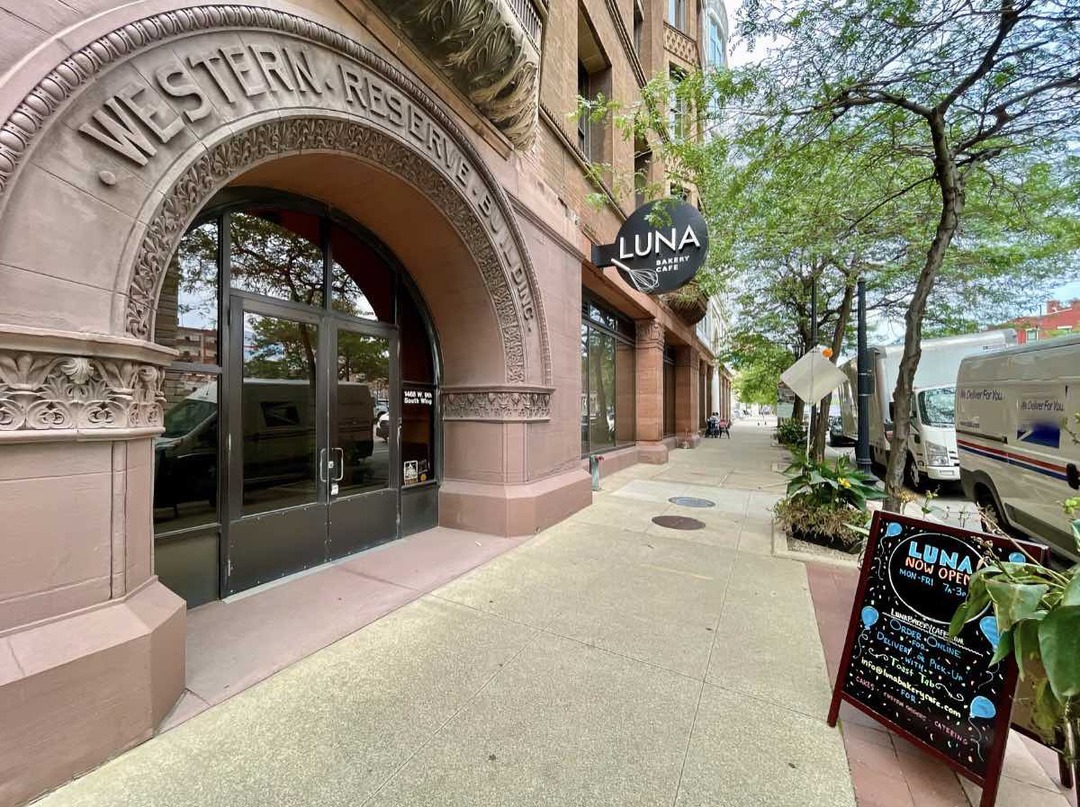
    <summary type="html"><![CDATA[<p><strong><em>Samuel L. Mather perched his offices in the Western Reserve Building above the river harbor where he plied his iron-mining and shipping business. At the time, he probably never imagined how the brick and stone edifice would fare as downtown and the city's economy evolved, but his onetime headquarters defied the odds, managing to retain its original function as an office building long after most other first-generation skyscrapers were demolished or converted to other uses.</em></strong></p><img src="https://mail.clevelandhistorical.org/files/fullsize/b24eb52bdd6ec25243308a1cd22ba2a4.jpg" alt="Romanesque Arch Entrance" /><br/><p>Samuel L. Mather, the grandson of one of the founding fathers of the Connecticut Land Company whose investment had led to the establishment of Cleveland, co-founded the iron-ore mining and shipping firm of Pickands, Mather & Co. in 1883, which helped him amass a new fortune on top of his already formidable wealth. Pickands Mather had kept offices for only a short time in the <a href="https://clevelandhistorical.org/items/show/1029">Perry-Payne Building</a> on Superior Avenue when Mather commissioned the Chicago architectural firm of Burnham & Root (already known locally for its <a href="https://clevelandhistorical.org/items/show/305">Society for Savings Building</a>) to design a headquarters office building on land that he and John Hay had purchased on the northwest corner of Superior and Water Street (now W. 9th).</p><p>The aptly named Western Reserve Building occupied a triangular parcel on the crest of a steep hill descending into the flats along the river. The land had once been home to the Carter Tavern, a hewn-log inn that early Western Reserve of Connecticut settler Lorenzo Carter had built in 1803. Following Carter's death in 1814, Phineas Shepard operated the inn for an unknown span of time, and it was the site of the meeting in 1816 that organized Trinity Parish, later <a href="https://clevelandhistorical.org/items/show/81">Trinity Episcopal Cathedral</a>. After it closed, deeds show that Carter's children Alonzo and Laura sold the land to the Oviatt family in two transactions in 1825 and 1830. By 1828, the Oviatts had replaced the old two-story inn with a three-story brick building that stood until Orson M. Oviatt razed it for a new four-story commercial block called the Franklin Buildings in 1835. The Franklin Buildings housed various dry-goods houses and professional offices, including the men's clothing store of George A. Davis, who owned the block from 1851 until his death ten years later. </p><p>The Franklin Buildings later housed Western Union Telegraph Company, which added "innumerable adornments of fencing and wires which surmount[ed] the electric ridden structure," according to an account in the <em>Plain Dealer</em> in 1886. Three years later, Hay and Mather, the executors of Amasa Stone's estate, purchased the property in the estate's name and set out to redevelop it. (Hay's and Mather's wives Clara and Flora were Stone's daughters.) Following on the heels of the Perry-Payne Building, the announcement of a new building to replace the Western Union block was a welcome news to those who feared Euclid Avenue's inroads. As the <em>Plain Dealer</em> pointed out in 1889, "Enough is now promised in the way of new buildings to save the street from becoming what it had at one time threatened to do—a street for banks and the wholesale trade plentifully mixed up with saloons."</p><p>Mather’s new eight-story pressed-brick and sandstone Western Reserve Building, which opened in 1892, is considered a transitional skyscraper. Like Burnham & Root’s Monadnock Building in Chicago and Cudell & Richardson's Perry-Payne Building, it had traditional load-bearing masonry exterior walls but also incorporated some interior steel framing, a recent innovation. On the ground floor, the Western Reserve Building featured pink sandstone piers capped by Romanesque capitals and a large Romanesque arch framing its Water Street entrance. Its upper floors had either rectangular, segment arch, or full arch windows, some of them in oriel bays. Samuel Mather had an elaborate cherry-paneled office inside. </p><p>In addition to Pickands Mather, the Western Reserve Building housed American Steel & Wire, Cleveland-Cliffs Iron, Island Creek Coal, and other shipping, mining, and manufacturing concerns. The building’s uses reflected business leaders’ desire to locate offices in the Wholesale District (later renamed the Warehouse District) close to Cleveland’s harbor. The riverside location was also attractive to the U.S. Weather Bureau. On May 1, 1892, Cleveland’s weather observatory and signal station opened there, 135 feet above the street, giving it a commanding view of the lake and river. From this lofty perch, signalman and weather observer W. B. Stockman hoisted flags to alert ship captains and downtown pedestrians to impending changes in the weather. The station had previously operated on top of the six-story Wilshire Block on Superior Avenue a block and a half west of Public Square. Now it was another beneficiary of Mather’s eagerness to be closer to the harbor. </p><p>In 1903, the Western Reserve Building was expanded northward along Water Street with an interior lightwell that may have drawn inspiration from Burnham & Root’s Rookery Building in Chicago or perhaps from a similar feature inside the Perry-Payne Building. The expansion increased the original building's size by about 40 percent. The building flourished into the 1920s, but like other buildings west of Public Square, it faced increasing competition from newer ones that rose to the east along Euclid Avenue. In 1924, Mather sold his interest in the Western Reserve Building to the Union Lennox Company, a firm named for the mammoth Union Trust Building that had recently replaced the Lennox Building on the northeast corner of Euclid and East 9th. Soon after, Pickands Mather moved its headquarters into the Union Trust Building. With the loss of its identity as a hub of the city's iron-ore business and the rise of newer, larger skyscrapers, the Western Reserve Building's future was in question.</p><p>The Western Reserve Building changed hands twice during World War II and, under Louis E. Goldman, it underwent a modernization in 1947 that covered its Romanesque arch entrance with a blocky granite façade. Despite this effort to renew its appeal, over the next three decades, the building stood sentinel over a part of downtown that was gradually decaying and receding in civic importance. Toward the end of that time, Goldman was no longer able to attract tenants, so the building sat mostly vacant. The exception to the rule was the opening in 1970 of the Cleveland Urban Learning Community, an experiment by St. Ignatius High School that took advantage of cheap rent to place its headquarters in the Western Reserve Building.</p><p>The Cuyahoga River’s east bank had been a natural place for Samuel Mather to envision an office building housing his iron mining and shipping business in the early 1890s. Although seemingly less natural, Herbert W. Strawbridge, chairman of the Higbee Company department store, felt a similar pull toward the western edge of the derelict Warehouse District nine decades later. Several years earlier, Strawbridge had visited San Francisco’s Ghirardelli Square, a shopping, dining, and entertainment complex filling the shell of its namesake chocolate manufacturer’s former factory. As Higbee’s downtown store sales slipped, Strawbridge recalled Ghirardelli Square. Then he hatched a daring plan to buy a swath of property overlooking the river and create a similar venue. Settlers’ Landing, as it would be named, would evoke Cleveland’s start along its river and, like Ghirardelli Square, reuse existing buildings as much as possible. More importantly, Strawbridge reasoned, Settlers’ Landing could draw large numbers of tourists and suburbanites back to a sagging downtown—and hopefully to Higbee’s.</p><p>Among the properties that the newly formed Higbee Development Corporation bought through agent John H. Bustamante was the Western Reserve Building, which Goldman was doubtless thrilled to unload in 1973. Strawbridge then hired Lawrence Halprin, the man behind Ghirardelli Square, to plan Settlers’ Landing. Higbee Development sank $4.5 million into a full renovation of the Western Reserve Building in 1974-76. The results drew a mixed response locally. Some decried the sandblasting that pitted the delicate sandstone facade. Others looked askance at the similarly insensitive treatment of the building’s interior. To avoid removing any leasable space, Higbee Development enclosed the historic lightwell to add an interior fire escape, heating and cooling ducts, and new restrooms on each floor. Halprin’s designer Angela Tzvetin created a modern lobby with “domed brick vaults” and spiderweb-like iron designs between their pillars, leading one architectural critic to dub the “corny” concept “early wine cellar.” The same critic went so far as to suggest that the Western Reserve Building was “second-rate Burnham and Root” that would have been better off bulldozed.</p><p>When the Western Reserve Building reopened in 1976, it seemed that the building had a new relevance as the Flats transitioned from maritime to leisure uses, but renewal was slow and difficult. Higbee’s operated a sandwich shop off the lobby while it searched (ultimately in vain) for a full-service restaurant to assume the space. At the time of the opening, only 1,220 of 53,840 square feet of office space was leased. Then Higbee’s plans for Settlers’ Landing collapsed after a major fire consumed some of the buildings the company had hoped to renovate. Despite efforts to promote the building, including hosting an exhibit and slideshow as part of the 1977 sesquicentennial of the opening of the Ohio Canal, the Western Reserve Building underperformed expectations. Coupled with Higbee’s expenses from opening new stores at Euclid Square and Randall Park malls, its renovation of Pickands Mather’s onetime headquarters building contributed to record quarterly losses that year. By 1981, the building was reportedly at 97 percent occupancy, but Higbee’s needed an infusion of cash, so it sold the building to another syndicate headed by developer John Ferchill.</p><p>Though Settlers’ Landing had flopped, the Flats and Warehouse District boomed in the 1980s. Nightspots, restaurants, and loft apartment conversions reinvigorated an area that earlier downtown planners had largely forsaken in their fixation on <a href="https://clevelandhistorical.org/items/show/909">Erieview</a>. It was too late for Higbee’s, which sold out to Youngstown developer Edward J. DeBartolo and the Little Rock-based Dillard’s chain in 1987 (though the Higbee’s name survived another five years). As for the Western Reserve Building, it flourished anew. Among the firms based there was Those Characters from Cleveland (now CloudCo Entertainment), a subsidiary of Cleveland-based American Greetings that formed in 1981 to develop and license characters developed by the card company such as Holly Hobbie and Strawberry Shortcake. That year saw Cleveland artist Elena Kucharik’s creation of the Care Bears, making the Western Reserve Building the birthplace of one of the 1980s’ popular culture icons. </p><p>Ferchill and his partners undertook yet another renovation in 1990 and built an eight-story addition to the north that doubled the size of the 1892/1903 building. The sandstone- and microcotta-faced addition featured a new arched entry, while the syndicate uncovered and restored the long-hidden one on the original building. After initial success, the enlarged building gradually languished again. By 2016, it was two-thirds vacant and in foreclosure, leading Ferchill to sell it the following year to WRB Partners (comprised of developer Fred Geis, real estate firm Cushman & Wakefield, and others). During the COVID-19 pandemic, the Western Reserve Building clung to its original function as an office building in a new era marked by the loss of downtown office-based work and a spate of office to residential conversions. In addition to attracting a global co-working company, WRB Partners added to its amenity-driven approach to combatting the loss of traditional dedicated office work by doing what Higbee’s had tried and failed to do fifty years earlier: entice a restaurant operator. In 2023, the popular Cleveland Heights-based Luna Bakery opened its third cafe on the building’s ground floor.</p><p><em><strong><a href="https://mail.clevelandhistorical.org/items/show/1030">For more (including 19 images) view the original article</a></strong></em></p>]]></summary>
    <published>2024-09-10T21:00:07+00:00</published>
    <updated>2026-04-17T19:17:43+00:00</updated>
    <link rel="alternate" type="text/html" href="https://mail.clevelandhistorical.org/items/show/1030"/>
    <id>https://mail.clevelandhistorical.org/items/show/1030</id>
    <author>
      <name>J. Mark Souther</name>
    </author>
  </entry>
  <entry>
    <title type="html"><![CDATA[Perry-Payne Building: Standing at a Place of Historic Memory]]></title>
    <summary type="html"><![CDATA[<p><strong><em>In the Spring of 1887, workmen tore down a number of three-story commercial buildings that had long stood on the north side of Superior Street between the National Bank Building on the northeast corner of Superior and Water (West 9th) Street and the Scovill Building (formerly the Franklin House), located midway up the block. The site was cleared to make room for the construction of the eight-story Perry-Payne Building. A little less than a year later, while the new Perry-Payne Building was going up, an article appeared in the <em>Plain Dealer</em> on April 15, 1888 recalling those earlier buildings and noting that "while the old must give way to the new," a number of Cleveland's most prominent pioneer merchants, including William Bingham and George Worthington, had started their businesses in the old buildings and that therefore "the place is of historic memory."</em></strong></p><img src="https://mail.clevelandhistorical.org/files/fullsize/cdb5ba97d0c460c22c2c6b53c94355bd.jpg" alt="Perry-Payne Building, 740 W. Superior Avenue" /><br/><p><span style="font-weight:400;">The historic land upon which the Perry-Payne Building at 740 W. Superior Avenue stands, and much of the land that surrounds it in Cleveland's Warehouse District, was first commercially developed by the Nathan Perry family. Nathan Perry Sr. (1760-1813) was an innkeeper in western New York's Genesee County when, in 1796, he was hired by Moses Cleaveland to provide food supplies to the surveying party that founded Cleveland. Almost a decade later, he, his wife Sophia, and their children moved here. In 1806, Perry purchased six acres of land northwest of the Public Square. On that land, which had frontage on Superior, St. Clair and Water (West 9th) Streets, Perry opened a trading post in a cabin that stood less than fifty feet from where the Perry-Payne Building stands today. </p><p>Nathan Perry, Sr. was one of Cleveland's first merchants. Less than a decade after arriving in Cleveland, however, he died unexpectedly. Four of his six acres, including the land upon which the Perry-Payne Building stands, passed to his son Nathan Perry Jr. (1786-1865), who transformed his father's trading post into a dry goods store and, in 1819, replaced the cabin with a two-story brick commercial building, one of Cleveland's first. Nathan Jr. operated his dry goods business in that building until 1826, when he sold the business but retained ownership of the building and the land upon which it stood. </p><p>In addition to running his dry goods business, Nathan Perry Jr., as early as 1814, had been making shrewd purchases of land in Cleveland, and, by 1830, he had become one of the city's wealthiest landowners. In that latter year, he moved his family from the simple frame house they had lived in on Water Street, just north of his dry goods store, into an early-era mansion on Euclid Avenue. It stood where Berkman Hall stands today on Cleveland State University's campus, just east of East 22nd Street.</p><p>In 1835, Perry decided to lease some of his land near the corner of Superior and Water to two hardware merchants, William Cleveland and Elisha Sterling. The terms of their two leases—drawn up by a young Cleveland lawyer named Henry B. Payne—required them to construct two three-story brick commercial buildings on the land they leased. Each of the two brick buildings they built had two storefronts. The buildings with their four storefronts became known as the "Central Buildings" because the corner of Superior and Water was then the center of Cleveland's commercial business district. It was in these buildings that William Bingham, George Worthington, and other prominent early Cleveland merchants, who were mentioned in the <em>Plain Dealer</em> article of April 15, 1888, got their business start.</p><p>As important as the Central Buildings were to the enlargement of Nathan Perry Jr.'s real estate portfolio, lawyer Henry B. Payne, who drafted the leases that required they be built, would soon become even more important. In 1833, Henry B. Payne was a law student in Hamilton, New York, when he was impelled to travel to Cleveland to help nurse his best friend, Stephen A. Douglas, who was suffering from a severe illness. Douglas, who later became the Illinois Senator whom Abraham Lincoln famously debated in 1858, left Cleveland after recovering. Henry Payne chose to stay. Payne completed his law studies here and, in 1836, when Cleveland officially became a city, Henry Payne became its first solicitor. In August 1836, Payne, who had in 1835, as noted above, served as Nathan Perry's lawyer, married Perry's only daughter, Mary, who thereafter became known to all in Cleveland as Mary Perry Payne. </p><p>Henry Payne practiced law in Cleveland for more than a decade before he decided to leave the practice. In 1849 he joined forces with Alfred Kelley and Richard Hilliard to build Cleveland's first railroad, the Cleveland, Columbus and Cincinnati ("CCC"). In the process, he became that railroad's first president. In 1855, Payne turned his attention to government service and was appointed to the City Waterworks Commission. It built Cleveland's first waterworks system. Then, in 1862, he took on the work of chairing a city sinking fund board which reportedly stabilized Cleveland's finances for years. Henry Payne also became active in local and state politics. He served in a number of Democrat party positions, before being elected in 1874 to the United States House of Representatives. A decade later, in 1885, he was elected Ohio's first United States Senator from Cleveland. </p><p>It was during the second year of Henry Payne's term as a United States Senator that local newspapers reported that Senator Payne was planning to build a new commercial building on Superior Avenue that would be named the Perry-Payne Building.  Different reporters and different historians writing in different eras have speculated differently as to the reason why Henry Payne named the Perry-Payne Building as he did. They all, however, may have been looking to the wrong person for an answer to their question. </p><p>When plans were made to build the Perry-Payne Building, the land upon which it was to be built was owned by Mary Perry Payne. The decade of the 1880s was one in which American women were beginning to acquire greater property rights, including the right to own, develop and dispose of real property in their own name. Henry B. Payne was uniformly said to be a progressive person of kind disposition who had a very loving marriage with Mary Perry Payne. Given all of the foregoing, there is no reason not to believe that Mary Perry Payne, probably with her husband's full support, was the person who chose the name of the building that was to be built upon her land. So perhaps the question that we should ask today, even if it was not asked by newsmen in 1887, or by historians thereafter, is: Why did Mary Perry Payne choose to so name her building? While we do not know the answer to that question with any degree of certainty, it might be as simple as that was where she first met Henry Payne.</p><p>In proceeding with their plans to build the Perry-Payne Building, Henry and Mary Perry Payne selected Cudell & Richardson, one of Cleveland's most prominent late nineteenth-century architectural firms, to design it. Cudell & Richardson, in additional to this historic building, also notably designed the following buildings still standing in Cleveland: St. Stephen Roman Catholic Church on West 54th Street; Franklin Circle Christian Church at 1688 Fulton Road; Belden Seymour Block at 2513-2525 Detroit Avenue; Franklin Castle at 4318 Franklin Boulevard; the George Worthington Company Building at 802-832 W. St. Clair Avenue; the Root and McBride Building at 1220 West 6th Street; and the Bradley Building at 1212-1224 West 6th Street. Additionally, Cleveland's Cudell Commons Park and the city's Cudell neighborhood are both named after Frank Cudell, one of the two named partners in that architectural firm.</p><p>The building Cudell & Richardson designed for Henry and Mary Perry Payne was described in a June 19, 1887 <em>Cleveland Leader</em> article. It was to be constructed "of brown stone and granite, in the Rennaissance style of architecture. The side and rear walls will be of brick. . . . The floor joists will be of iron and the floors fire clay tile. . . . [T]he stairs will be made of iron and cement or marble. Iron balconies will be provided on the fifth and seventh floors." The article stated that the building would be "eight stories high in the middle and seven on either side, with a basement. It will have a frontage of 138 feet, a depth of 100 feet, and will be 120 feet high." The article noted that the first floor of the building would be designed for the offices of banks, and the upper floors would have a total of 46 offices with an average size of 18 x 26 feet. </p><p>Other articles noted that the interior of the building would feature an eight-story interior court illuminated by a sky light. (The design of this light court, as well as the building's front facade, were reminiscent of Chicago's Rookery Building designed by Burhnam and Roots.) Other interior features of the Perry-Payne Building were its modern elevators and mail chutes that carried mail from all of the building's upper floors down to a first floor mail room. Designed with interior iron support columns, the Perry-Payne Building is notable architecturally as a transitional building between earlier buildings with masonry support walls and later buildings, including the Society for Savings Building erected just one year later, having interior steel support beams which enabled them to be built to great heights and led to them becoming known as "skyscrapers."</p><p>Construction of the Perry-Payne building commenced in the summer of 1887 after all of the old commercial buildings on the site had been razed. While construction was expected to be completed in 1888, financing difficulties encountered by Henry and Mary Perry Payne appear to have delayed completion of construction until the summer of 1889. The first tenants of the Perry-Payne Building included Bingham Hardware and National City Bank, who opened their offices in the new building on July 1, 1889.  When the Perry-Payne Building opened, it was the tallest and most grand commercial building in Cleveland, and it attracted many of the largest iron ore, coal, and shipping companies in Cleveland as tenants. It also attracted a number of Cleveland law firms, including a new firm named Squire, Sanders and Dempsey (today, Squire, Patton and Boggs), which has since become one of the city's largest and most historic law firms. </p><p>In the first two decades of its existence, even as larger and grander commercial building went up in downtown Cleveland, the Perry-Payne Building continued to attract more than its fair share of Cleveland's coal, iron, and shipping-related businesses, as well as a number of law firms and insurance companies. However, almost all of its core tenants departed after 1913 when Marcus Hanna's son Dan completed his construction of the enormous 15-story Leader Building on the corner of Superior Avenue and East 6th Street. Thereafter, for decades, the Perry-Payne Building survived with much less than full occupancy.</p><p>During its early years, ownership of the Perry-Payne Building remained with the Perry-Payne family and their descendants through the Perry-Payne Company formed in 1899, several years after the deaths of Henry and Mary Perry Payne. However, in 1945, that company sold the Perry-Payne Building to another corporation that was unrelated to the family. The building had many new owners in the years that followed and these new owners struggled to find and hold onto tenants. Then, in 1965, the State of Ohio leased the entire building for a number of its agencies with offices in Cleveland. This, however, only temporarily solved the building's occupancy problems for, in the summer of 1979, the State agencies departed when the new <span>Frank J. Lausche State Office Building, directly across the street, opened</span>.</p><p>In the 1980s and early 1990s, the owners of the Perry-Payne Building struggled anew with occupancy problems. In 1994, however, a new partnership purchased the building, hired an architectural firm known for its restoration work, and proceeded to restore the front facade of the Perry-Payne Building; renovate the remainder of it; and convert it into an apartment building with 91 apartments and 8,000 square feet of retail space. As of the writing of this story in 2024, the Perry-Payne Apartments remain a prestigious address in downtown Cleveland's Warehouse District.</p><p>If Mary Perry Payne were alive today and learned that her Perry-Payne Building had been converted into an apartment building, she might say that it really didn't matter, so long as Clevelanders today believe, as she and her husband and Clevelanders of her generation more than a century ago believed, that the Perry-Payne Building stands at a place of historic memory.</p><p> </p>
</p><p><em><strong><a href="https://mail.clevelandhistorical.org/items/show/1029">For more (including 19 images) view the original article</a></strong></em></p>]]></summary>
    <published>2024-08-06T01:52:23+00:00</published>
    <updated>2026-04-17T19:17:43+00:00</updated>
    <link rel="alternate" type="text/html" href="https://mail.clevelandhistorical.org/items/show/1029"/>
    <id>https://mail.clevelandhistorical.org/items/show/1029</id>
    <author>
      <name>Jim Dubelko</name>
    </author>
  </entry>
  <entry>
    <title type="html"><![CDATA[The Home in the Sky: &quot;A Doll&#039;s House for Grown-Ups&quot;]]></title>
    <summary type="html"><![CDATA[<p><strong><em>On the evening of Friday, April 4, 1930, members of the Builders Exchange (a nonprofit building trades association) dined with their families in the Guildhall, a restaurant on the tenth floor of the association’s headquarters building in the Terminal Group. After dinner, they rode elevators up to the Exchange’s brand-new indoor model home exhibit, known as the Home in the Sky. Governor Myers Y. Cooper delivered a dedication speech broadcast from Mount Gilead, Ohio, and pressed a radio-control button to remotely illuminate the home. The next day, airplanes circled the skyscraper and dropped “festoons of roses.” Then Mayor John D. Marshall and his wife turned the key to officially open the house to the public. Speaking amid a worsening Great Depression that threatened the construction industry, Marshall predicted reassuringly, “Here home ownership will be fostered.” By the close of the opening weekend, an estimated 10,000 people had viewed downtown's novel new attraction.</em></strong></p><img src="https://mail.clevelandhistorical.org/files/fullsize/4b4740dd1eeaf73422d3577dc9b7cd09.jpg" alt="Drawing of the Home in the Sky" /><br/><p>The Home in the Sky was a 39 x 31 foot, two-story, six-room, Colonial-style house erected by Building Arts Exhibit Inc. in a 51-foot-tall open court on the 17th and 18th floors of the Builders Exchange Building. A gallery on the 18th floor enabled close inspection of the house's second story and roof. The house showcased the latest building materials, home decoration and furnishings, all surrounded by a landscaped lawn and additional "Building Arts" displays. The Home in the Sky emerged from plans by the Builders Exchange in the late 1920s. In cooperation with the American Institute of Architects Cleveland Chapter and the Better Homes Association, it held a statewide contest in 1929 to design the house. Fred J. Abendroth of Dunn & Copper Architects in Cleveland won first prize, beating about 2,500 other contestants. The house’s conservative design mirrored that of the nearby Terminal Tower, which mimicked 20- to 30-year-old skyscrapers in New York and Chicago rather than embracing the modernism of Art Deco.</p><p>The house's conservative architecture was perhaps best evoked in the Cleveland Builders Supply Company’s explanation of the use of “Cleveland Rustic” face brick for much of the exterior: “Vision, with closed eyes, a home of brick nestled amongst groups of trees and masses of flowering shrubs; a home, not glaringly new in appearance, but reflecting the softened, weathered touch which is Nature’s gift alone; a home redolent with the atmosphere and age-old glamour which typifies the architecture of our forefathers. This pictures, briefly, the effects created by ‘Cleveland Rustics’ in ‘The Home in the Sky.’”</p><p>The May Company’s home decorating department furnished the Home in the Sky. The house’s first floor featured a vestibule with coat closet; a living room with a bay window, a fireplace, and wooden mantel flanked by bookcases with a door opening onto a garden porch; a dining room; a modern kitchen with the latest electric appliances and a breakfast nook. The second floor included a stair-hall, three bedrooms with closets (one of them a nursery), and a green and mauve bathroom. In the basement was a pine-paneled recreation room with a fireplace, bright-red leather lounge chairs, and laundry with “electrical labor-saving devices designed to lighten the work on the modern home-maker.”</p><p>Visitors were free to roam the house on their own or to take a guided tour led by Florence LaGanke, who also served as the exhibit’s director of women’s activities. They could not only see a range of materials and furnishings in what the <i>Plain Dealer</i> called "a doll's house for grown-ups" but also obtain expert advice on construction, furnishings, home management, and even landscaping and gardening techniques. WTAM also broadcast a regular biweekly program from the exhibit to explore such topics. Clubs were also welcome to reserve space for their meetings. </p><p>In its first year, the Home in the Sky attracted 300,000 visitors. As novel as the Home in the Sky was, however, the Builders Exchange wanted to ensure that there was always something new to see so that Cleveland’s would make return visits. In May, as Clevelanders’ attention turned to the outdoors, it debuted a “summer cottage” and horticultural exhibition on the 18th floor and partnered with a number of local organizations to offer an eight-day gardening clinic. To make the garden as useful as possible, the exhibit builders hauled in tons of soil donated by gardeners all over Cuyahoga County and representing common types in the Cleveland area: “Raw Parma subsoil that has not seen the light of day for 6,000 years is there. Then there is well worked clay loam from the W. G. Mather estate, prize winning garden soil from Lakewood, the much maligned but fertile soil of downtown Cleveland, sands of Euclid Avenue, clay of the Heights. Your soil will be represented,” one newspaper article assured. The exhibit also displayed a flagstone terrace, a hedgerow, shrubs, and a backyard garden with “onions, spinach, beets and other homely vegetables.” </p><p>For a time, updates continued. In the fall of 1930, the Home in the Sky received a top-to-bottom refurnishing, this time by Higbee’s. The following spring, it opened a new exhibit called Sky City, a model streetscape lined by rows of homes exhibiting “building products in their proper settings.” It also featured the “Court in the Sky,” a courtyard to showcase different floor materials. In 1934, <a href="https://clevelandhistorical.org/items/show/958">Kinney & Levan</a> assumed responsibility for furnishing the Home in the Sky, along with the newest addition to the Builders Exchange exhibit, the American Institute of Architects Cleveland Chapter–designed “House of Tomorrow.” However, coverage of the Home in the Sky exhibit dropped precipitously thereafter. Occasional mentions suggest that it remained open but was not promoted. In 1941, the Builders Exchange moved to Euclid Avenue and East 18th Street and Sherwin-Williams took over its former space to house some of its operations formerly handled at its Canal Road facility. It is not recorded how the Builders Exchange dismantled the Home in the Sky.</p><p>The Home in the Sky was surely one of the nation's most ambitious demonstration houses because of its novel location atop a skyscraper. But downtown Cleveland also saw several other demonstration houses in the 1930s. Four of them appeared on the grounds of the Great Lakes Exposition in 1936. Two of those served as commemorative replicas of the log cabins that had once housed early settler Lorenzo Carter and future President James A. Garfield. (Local interest in commemoration had led civic leaders to build a <a href="https://clevelandhistorical.org/files/show/11993">log cabin</a> on Public Square for the city’s 1896 centennial and would later inspire a <a href="https://clevelandhistorical.org/items/show/286">replica</a> of Carter’s cabin in the Flats on the occasion of the U.S. Bicentennial in 1976.) In contrast, the other two were showcases for the home construction and real estate industries. Nestled between City Hall and the Cuyahoga County Court House were a small brick demonstration house built by Cleveland Builders Supply Co. and a large wood-frame, columned mansion constructed by the Cleveland Lumber Institute and furnished by the Halle Bros. Co. The Halle House invited visitors to see how they could recapture the flavor of colonial Virginia in their own homes by shopping Halle’s. In 1939, yet another demonstration house, this one sponsored by the American Legion, opened to the public on Euclid Avenue at East 21st Street in front of the Legion’s headquarters (now the site of CSU’s Student Center). Known as the Low Cost Demonstration Home, the diminutive Cape Cod measured only 28 x 26 feet and surely reflected the harsh reality that a decade of depression posed for the building trades. </p><p>Two decades later, the city’s building trades had a new reason for downtown demonstration homes. Unlike in the context of the Great Depression, when the Builders Exchange attracted Clevelanders to the city center in hopes of inspiring them to build new homes on the suburban periphery, by the 1950s, civic leaders were grappling with the consequences of outward population movement for the central city. In 1955, on the cusp of federal urban renewal, the National Retail Lumber Dealers Association unveiled Operation Demonstrate on the Mall, adopting the slogan “Live Better Where You Are.” The organization split in half and hauled two “age-blacked shells” of houses from Charity Avenue (a street that would in a few years be obliterated for the St. Vincent urban renewal project) to the Mall, where they were rebuilt and renovated to become Operation Demonstrate’s Traditional House and a Contemporary House. After the demonstration ended, the houses were put up for sale, to be moved by the buyer. Ultimately, the houses were loaded onto a barge at the foot of East 9th Street and ferried fifty miles west to Huron, Ohio.</p><p>The Home in the Sky, along with other demonstration houses, was a symbol of the ascendancy of the idea of housing as a consumer product. Fearing the effects that the Great Depression (and, later, urban decay) might have on homeownership, those with a profit stake in the private housing market used demonstration houses to entice the public into a marketplace with countless materials and products that might make the American Dream their reality. In that sense, a visit to the Home in the Sky was not unlike how people today browse Zillow, watch HGTV, or visit the Home & Garden Show at the I-X Center for home buying, remodeling, landscaping, and gardening inspiration.</p><p><em><strong><a href="https://mail.clevelandhistorical.org/items/show/1028">For more (including 14 images) view the original article</a></strong></em></p>]]></summary>
    <published>2024-06-29T16:35:12+00:00</published>
    <updated>2026-04-17T19:17:43+00:00</updated>
    <link rel="alternate" type="text/html" href="https://mail.clevelandhistorical.org/items/show/1028"/>
    <id>https://mail.clevelandhistorical.org/items/show/1028</id>
    <author>
      <name>J. Mark Souther</name>
    </author>
  </entry>
  <entry>
    <title type="html"><![CDATA[Bertsch Building: Built for Wohl&#039;s Hungarian Restaurant<br />
]]></title>
    <summary type="html"><![CDATA[<p><strong><em>The Hungarian dishes that Rosa Wohl cooked at the Wohl Boarding House on Seneca (West 3rd) Street in the 1880s were so popular with their guests that she and her husband Ludwig were encouraged to open a restaurant of their own. By 1888, they had opened one at the boarding house. It was said to be Cleveland's first Hungarian restaurant.  In 1903, the Wohls moved that restaurant, which by then had become one of the city's most popular, across the street into a new three-story building that still stands today at 1280 West 3rd Street.</p></strong></p><img src="https://mail.clevelandhistorical.org/files/fullsize/3f92931a2c9528b48c33f9b420015ec7.jpg" alt="Bertsch Building" /><br/><p>It is difficult to learn much detail about the early lives in Europe of Ludwig and Rosa Wohl, the founders of Wohl's Hungarian Restaurant. According to Ludwig's petition for U.S. citizenship, he was born on April 8, 1837, in Bator, Hungary. By the late 1860s, when he would have been about 30 years old, he had already married Rosa Friedman, was living in Kassa, Hungary (today, Kosice, Slovakia), and was father to his and Rosa's four young sons, Ferdinand (Fred), Sandor (Alexander), Maximilian (Mike) and Julius. According to his obituary, Ludwig and his family then moved to Vienna, where he became a successful livestock trader and distiller until the Panic of 1873 financially ruined him. In 1878, all of the Wohl family, except for Sandor who remained in Europe to pursue an acting career in German theater, moved to the United States.</p><p>Upon arriving in America, the Wohl family traveled to Cleveland where Rosa Wohl appears to have had relatives.  Ludwig, now in his forties, became a dry goods peddler for a few years, and the family lived for a time on Water (West 9th) Street before they moved to Seneca (West 3rd) Street where Ludwig leased a two family house and then converted it into a boarding house. Rosa cooked such delicious Hungarian meals for their guests, including goulash, fresh baked bread and Hungarian pastries, that the Wohls were soon encouraged to open a restaurant in the boarding house, which they did in 1888. According to local newspapers, it was Cleveland's first Hungarian restaurant. Eventually, the Wohls closed the boarding house and devoted all of the house to the operations of the restaurant, which included living quarters for both the Wohl family and the restaurant staff. By 1900, according to the federal census, there were eight Hungarian immigrants living with the Wohl family—one listed as a cook, two as waitresses, and the other five as "kitchen help."</p><p>Even though the two-family house in which the original Wohl's Hungarian Restaurant was located had no signage that indicated it was a restaurant and was in such a dilapidated condition that it was referred to as "the Shanty," Clevelanders loved the restaurant and patronized it in large numbers. A March 8, 1903, article in the Cleveland Plain Dealer referred to it as the most popular "foreign"restaurant in Cleveland. It was also an important meeting place for Cleveland's Hungarian community. In late March 1894, it had served as the place where leaders of that community gathered to plan a memorial to Hungarian national hero Lajos Kossuth, who had died earlier that month.</p><p>In 1902, the Wohl family began making plans to move their restaurant into a new building across Seneca Street from their old restaurant building, and next door to the Cleveland Press building. Designed by Progressive architect Morris Gleichman in a style which local historian Drew Rolik called "Dutch Baroque Domestic (Revival)," the building, which still stands today at 1280 West 3rd Street, is three stories tall with an exterior of vitrified brick. It features two massive arches at its front door which originally led into the restaurant's main dining room. The first two floors of the building were devoted to dining and private meeting rooms, and a kitchen. The third floor, and perhaps outbuildings on the property, housed the residences of the Wohl family as well as the restaurant staff, which, according to the 1910 census, now numbered 19 individuals—all Hungarian immigrants—two employed as bartenders and the other 17 as waitresses. The new restaurant opened on June 6, 1903. The opening was attended by many prominent Clevelanders including Mayor Tom L. Johnson.</p><p>At about the time that the new restaurant building was opening, Alexander Sandor Wohl, the son of Ludwig and Rosa, who by this time had become a well-known actor and director of theater in Berlin, Germany, and who had made trips to and from the United States in the late 1880s and 1890s, returned to the United States and became active in the theater life of Cleveland. He also became involved in the family restaurant business, perhaps as the result of the death of his brother Mike in 1902 and the aging of his father Ludwig, who was now well into his 60s.  According to Alexander's obituary, he used his theater connections in Cleveland to arrange for members of the Cleveland Opera House orchestra to appear and play pieces by Mozart, Beethoven, and Strauss at Wohl's Hungarian restaurant, making it, according to Cleveland newspapers, the first restaurant in Cleveland to play music while patrons dined.</p><p>In the first two decades of the twentieth century, Wohl's Hungarian Restaurant remained one of Cleveland's most popular restaurants. When President Howard Taft visited Cleveland in 1912 during his presidential reelection campaign, he made a point of visiting the restaurant. After the death of Ludwig Wohl in 1910, management of the restaurant was left to his sons, Alexander and Julius. In 1920, the restaurant was dealt a blow from which it never really recovered by the start of Prohibition. Another blow to the restaurant was delivered in 1927 when Rosa Wohl, Ludwig's widow, whose Hungarian cooking had made the restaurant one of Cleveland's best, died.  </p><p>The final blow to Wohl's Hungarian Restaurant was the Great Depression, which began in 1929. By the time that the 1930 federal census was taken, only Alexander and Julius Wohl were still living in the building at 1280 West 3rd. Three years later, the brothers executed a deed conveying whatever interest in the property that they may have had  to the heirs of Frank W. Hubby from whom the Wohl family had leased the new restaurant building since 1903. Two years after this, in May 1935, despondent over their businesses losses, Alexander and Julius Wohl committed suicide in a back room of the restaurant. They both were cremated and their ashes interred with the bodies of their parents and siblings at Mayfield Cemetery in Cleveland Heights.</p><p>Following the deaths of Alexander and Julius Wohl, the Wohl family's longtime employee Ernest Mueller attempted to keep the restaurant going, but was ultimately unsuccessful. In 1936, the Hubby family heirs sold the building at 1280 West 3rd street to a union official representing the interests of the Cleveland Building and Trades Council. For approximately the next 50 years, the building was home to several different Cleveland labor organizations and was known for a time as the Cleveland Building and Trades Hall and later as the Painters' Union Building. In 1985, the building was sold to a corporation owned by a law firm headed by Richard Bertsch, after whom the building is now named. The Bertsch law firm, and its successor law firms, owned the building through various corporate entities until 2020, when it was sold to a local real estate developer. Recently, that developer has floated plans to demolish both the Bertsch Building and the next door Marion Building and build a hotel and apartment building on the site. Only time will tell whether the Bertsch Building, home to Cleveland's first Hungarian Restaurant, will be torn down, thereby removing from downtown Cleveland the last vestige of that historic trend setting restaurant owned and operated by the Ludwig and Rosa Wohl family.</p><p><em><strong><a href="https://mail.clevelandhistorical.org/items/show/1019">For more (including 15 images) view the original article</a></strong></em></p>]]></summary>
    <published>2024-03-25T19:51:17+00:00</published>
    <updated>2026-04-17T19:17:43+00:00</updated>
    <link rel="alternate" type="text/html" href="https://mail.clevelandhistorical.org/items/show/1019"/>
    <id>https://mail.clevelandhistorical.org/items/show/1019</id>
    <author>
      <name>Jim Dubelko</name>
    </author>
  </entry>
  <entry>
    <title type="html"><![CDATA[Hilliard Building: The Oldest Commercial Building in Downtown Cleveland]]></title>
    <summary type="html"><![CDATA[<p><strong><em>Richard Hilliard achieved much as a businessman and civic leader in the thirty years (1826-1856) that he lived in Cleveland.  Most of his achievements have long since faded from the public's memory.  However, the three story brick building that he erected in 1850 still stands today on West 9th Street as a reminder to Clevelanders of who he was.</p></strong></p><img src="https://mail.clevelandhistorical.org/files/fullsize/f6a53caee7076de0abc61048028a060b.jpg" alt="Hilliard Building" /><br/><p>In Cleveland's Warehouse District, northwest of Public Square, the historic Hilliard Building stands on the corner of West 9th Street and Frankfort Avenue. A visitor to the area can't help but notice how isolated it is from other buildings. In fact, it is entirely surrounded by parking lots. There is a parking lot to the west of it, directly across West 9th Street. There is another to the south of it between Frankfort and the Brotherhood of Railroad Trainmen Building on Superior Avenue. And finally there is a very large parking lot that extends north from the Hilliard Building all the way to St. Clair Avenue and also to the east behind the building all the way to West 6th Street. </p><p>Such parking lots, when covering large areas of a city's downtown, have become known as "parking craters," a term popularized by blogger Angie Schmitt who wrote that they render urban landscapes "inhospitable and unattractive." How and why the Hilliard Building came to occupy such an isolated location on West 9th Street, in the middle of a "parking crater," is an important part of the history of this building. </p><p>The Hilliard Building is named after Richard Hilliard, who was born in Chatham, New York in 1800. When he was a teenager, Hilliard began working in dry goods stores in western New York. One of those stores opened a branch in Cleveland in 1824, locating its new store at the southwest corner of Water (West 9th) and Superior, across Superior from where the Western Reserve Building stands today. Two years later, Hilliard who had by then become a partner in that business, moved to Cleveland. He soon bought out his partner and then formed a new partnership with William Hayes, a dry goods merchant in New York City. At about the same time that they formed their partnership, Hilliard married Sarah Katherine Hayes, a sister of his new partner, not an unusual way to cement a business relationship in the nineteenth century. </p><p>The dry goods business of Hilliard and Hayes, according to Hilliard's biographers, soon became very successful, and Richard Hilliard developed into an important figure in Cleveland's early history. In 1830, he was elected President of the Board of Trustees of Cleveland Village, and in 1836, when Cleveland became a city, he was elected one of its first aldermen. In the decade of the 1830s, he was one of the developers of Cleveland Centre in the Flats, a bold, but ill-fated, effort to make Cleveland the center of international trade in the Midwest. In the 1840s, Hilliard and Henry B. Payne, became more successfully involved in the incorporation of the Cleveland, Columbus and Cincinnati Railroad, Cleveland's first railroad, both of them becoming directors of that railroad. (Payne, an attorney, later built the Perry-Payne Building on Superior Avenue in downtown Cleveland.) In the early 1850s, Hilliard served as the first president of the Cleveland Water Works Commission, which led to the creation of Cleveland's first public water works system in 1856. </p><p>In 1850, Hilliard built the three story brick commercial building which is the subject of this story, moving his dry goods business into the building in the same year. According to an article appearing in the Plain Dealer on June 27, 1851, the building had 48 and 1/2 feet of frontage on Water Street and 100 feet on Centre (today, Frankfort) Street. The interior of the building was arranged as follows. There was a dry goods room measuring 25 by 100 feet on the Centre Street side of the building, and rooms on the two upper floors of the building that were also used in the dry goods business. The balance of the front of the building consisted of a room approximately 21 by 80 feet which served as a grocery store. The rear 20 feet of that part of the building was "furnished and used as a Counting-room." </p><p>Hilliard and Hayes, which then became Hilliard, Hayes and Co., was, according to newspaper sources, the largest dry goods wholesale business in the Midwest in the 1850s. It provided dry goods to retail stores in Ohio, Michigan, Indiana, Illinois and Wisconsin, and had sales that annually exceeded $500,000, equivalent to almost $20 million in 2024 dollars. However, shortly after returning from a business trip to New York, Richard Hilliard died on December 21, 1856 from typhoid fever. He was only 56 years old. His death had a profound effect upon his wholesale business operated out of the Hilliard Building, then known as the Hilliard Block. Several new partnerships were formed with combinations of Hilliard's son Richard Jr. and several of his father's former partners, but none lasted. On March 22, 1858, an advertisement appeared in the Plain Dealer, offering the "stock . . . business and good will" of the company for sale. By 1860, a new wholesale dry goods firm, S. Raymonds & Co., was operating its business out of the Hilliard Block. </p><p>S. Raymond and Co. occupied the Hilliard Block as a tenant for more than a decade under leases from the Hilliard family who still owned the building. Then, in 1875, the building took on new tenants when it was remodeled as an office building for merchants in Cleveland's coal and oil trade. Among those new tenants in the building now known as the Coal and Iron Exchange Building was Rhodes and Hanna, a business started by prominent early west side industrialist Daniel Rhodes, but, following his retirement in 1867, operated by a partnership that included his son Robert Russell Rhodes and son-in-law Marcus Hanna. (Known to history as "Cleveland's kingmaker," Hanna later directed the successful 1896 and 1900 presidential campaigns of William McKinley.) From 1875 to 1887, a number of Cleveland's most prominent coal and iron merchants had their offices in the building. </p><p>In the mid to late 1880s, as new and grander commercial buildings were erected in the Warehouse District like the Grand Arcade (1883) and the Perry-Payne Building (1889), coal and iron merchants left the Hilliard Block for these more prestigious addresses. For a time, the Hilliard building then served as home to the offices of several stocks, grains, provisions and oil brokers. In the early 1900s, several related wholesale fire equipment and marine supply companies operated out of the building. In 1914, Laura Hilliard, the youngest daughter of Richard Hilliard, who had owned the Hilliard Building since the 1880s, sold it to Koblitz Brothers Realty Company, who, under several different corporate names, owned and leased it to various tenants until 1950. </p><p>During the 1920s, when Koblitz Brothers owned the Hilliard Building, the Warehouse District, according to local historian and archivist Drew Rolik, reached its pinnacle of commercial development and then began a slow decline as some of its aging buildings were, beginning in the mid 1920s, demolished to make room for parking lots. At first these new lots were few and far between, but the pace of parking lot creation increased following the end of World War II and the building of the interstate highway system which facilitated a massive movement of urban dwellers to the suburbs in the post war era. </p><p>In the 1950s, government officials like County Engineer Albert Porter advocated for more parking lots in downtown Cleveland to encourage suburban residents to come downtown to work and shop. His sentiments were echoed by business leaders like Alfred Benesch who, in a letter published in the Plain Dealer on April 21, 1957, wrote that the Warehouse District (then known as the Wholesale District or as part of the Garment District) was an ideal location for such parking lots as it was filled with "buildings a hundred or more years old . . . which are not any asset to Cleveland . . [and] might be well condemned and razed in order to provide parking facilities . . " </p><p>With encouragement like this from government and private sector leaders, the pace of building demolition and parking lot creation in the Warehouse District increased in the 1960s and 1970s. However, in the latter decade the tide began to turn as preservationists made their voices heard. In 1977, aided by a report from architect William A. Gould, the Cleveland Landmarks Commission adopted a comprehensive preservation plan for the Warehouse District. Five years later, in 1982, with the Commission's urging, the City of Cleveland created the Warehouse Historic District, which was later accepted and added to the National Register of Historic Places. By 1988, the Landmarks Commission felt comfortable in proclaiming victory for the preservation of the District. </p><p>According to Stephanie Ryberg-Webster in her book <em>Preserving the Vanishing City</em>, by the time victory was declared, more than a third of the buildings that were standing in Cleveland's Warehouse District in its peak year of 1921 had been demolished.  The result was the creation of a number of "parking craters" in the District, including the earlier mentioned one within which the Hilliard Building still stands today.  That crater began to form in the 1930s when a number of buildings on Frankfort Avenue between West 9th and West 6th were torn down, as well as a part of the Payne Brothers Building on the southeast corner of West 9th and St. Clair. In circa 1950, the old W. Bingham building across Frankfort from the Hilliard Building was torn down for a parking lot, and, as that decade progressed, more buildings were torn down on Frankfort, as well as a number on the west side of West 9th across the street from the Hilliard Building.  </p><p>The decade of the 1960s and 1970s saw additional buildings demolished on the west side of the West 9th Street, many of them as the result of fires of unknown origin.  And then, perhaps most notably for the Hilliard Building, one by one the buildings that lined the east side of West 9th immediately north of the Hilliard Building and south of St. Clair Avenue were demolished for parking lots.  The remaining part of the Payne Brothers Building was the first to go in 1966; the Vincent Block next door to it then was torn down in the 1970s; and finally the Board of Trades Building, the last building standing on that side of the street between St. Clair and the Hilliard Building, in the 1980s. By the time the dust settled and the Cleveland Landmarks Commission declared victory in stemming the tide of demolition, the Hilliard Building was left in the middle of the parking crater that it still occupies today, almost 40 years after victory was declared.</p><p>The Hilliard Building avoided the fate of the other nineteenth century buildings that once surrounded it, most likely for two reasons. First, in 1950, the building was purchased by two brothers, Sidney E. and Albert E. Saltzman, who, during the peak years of demolition in the Warehouse District, operated a successful wholesale business called Drug Sundries Co. out of the building. And second, in 1983, after the tide had turned toward preservation rather than demolition in the district, attorneys Stanley Yulish and Mark Twohig purchased the building from the Saltzmans; renovated and restored it; and moved their law firm into the building. </p><p>Since 2000, the Hilliard Building has been owned by several different limited liability companies, and in 2020 it was further renovated and remodeled in order to convert the second and third floors of the building into apartments. Now, in 2024, almost 175 years old, the Hilliard Building is not just downtown Cleveland's oldest commercial building.  It is also a remarkable survivor of the second half of the twentieth century in this city when, for a time, parking in the Warehouse District was king.</p><p><em><strong><a href="https://mail.clevelandhistorical.org/items/show/1018">For more (including 14 images) view the original article</a></strong></em></p>]]></summary>
    <published>2024-03-05T20:17:12+00:00</published>
    <updated>2026-04-17T19:17:43+00:00</updated>
    <link rel="alternate" type="text/html" href="https://mail.clevelandhistorical.org/items/show/1018"/>
    <id>https://mail.clevelandhistorical.org/items/show/1018</id>
    <author>
      <name>Jim Dubelko</name>
    </author>
  </entry>
  <entry>
    <title type="html"><![CDATA[Rose Building: &quot;The New Center&quot;]]></title>
    <summary type="html"><![CDATA[<p><strong><em>In 1898-1900, Benjamin Rose financed the construction of the largest office building ever built in Ohio up to that time. At a time when conventional wisdom dictated a Euclid Avenue address, Rose did the unthinkable, selecting a spot at the corner of Prospect Avenue and Erie Street. Naysayers were convinced Rose's daring venture was doomed to fail, but they were wrong.</em></strong></p><img src="https://mail.clevelandhistorical.org/files/fullsize/1e18dd70994fd06dc46874a9b5534ab0.jpg" alt="Main Entrance" /><br/><p>The ten-story Rose Building took its name from its developer, an English immigrant and pioneer in the meatpacking industry. In 1854 Benjamin Rose and Chauncey Prentiss established Rose & Prentiss, later renamed Cleveland Provision Company, which embraced refrigeration and other innovations early and was the city’s largest packinghouse for more than a century. With the fortune he amassed selling cuts of meat, in 1898 Rose commissioned architect George Horatio Smith to design what would become Ohio’s largest office building.</p><p>When the Rose Building was constructed, Erie Street (now East 9th), was on the eastern fringe of downtown, but Rose cleverly dubbed the intersection “The New Center” and used this slogan to entice businesses that might otherwise have considered the location too distant. Indeed, the Rose Building stood out. Its first five stories were sixteen feet high, while floors six to ten were eleven feet high. The choice to make the ceiling height of the lower floors so much higher than usual was reportedly Rose’s wish. </p><p>Upon its opening in 1900, the building’s primary tenants on the lower floors included Lederer Furniture, Scott Dry Goods, and offices of the White Sewing Machine and Cleveland Gas & Electrical Fixture companies. The upper floors contained doctors’ and dentists’ offices, an artist’s studio, a correspondence school, and the offices of fifteen oil companies. In its early years the Rose Building also hosted many exhibitions, including the works of Cleveland artists, a Slavic craft fair, and even a mock Congressional session. </p><p>In 1908 Rose was poised to stake out the next speculative “new center” of downtown. He bought out the St. John’s African Methodist Episcopal Church on East 9th across from Erie Street Cemetery with plans to build a twelve-story office building, but before he could carry out the plan, he died during a trip to England. Instead of burnishing his reputation in life as a visionary developer, in death Rose seeded the legacy for which he is known today. In 1909, the Rose Building gained a new tenant. Tucked away in small, sparely furnished office on the tenth floor was the Benjamin Rose Institute. Funded by Rose’s $3 million bequest, it used the office to review applications for small pensions to enable elderly men and women to afford to remain in their own homes.</p><p>In 1984, the Institute sold the Rose Building to Medical Mutual of Ohio, which had located its headquarters there in 1947. Medical Mutual owned the building until 2000, when it sold it to California-based BentleyForbes and leased its space. When the owner fell into foreclosure, Medical Mutual bought the building back in 2017, but its future in downtown was anything but certain. After much deliberation, Medical Mutual vacated the Rose Building in 2023 and merged its operations in its Brooklyn, Ohio, offices in the former American Greetings headquarters. While pessimists might quip that Benjamin Rose's doubters were ultimately proven right, the Rose Building's now much more central location makes it a likely candidate for a new lease on life.</p><p><em><strong><a href="https://mail.clevelandhistorical.org/items/show/1012">For more (including 12 images) view the original article</a></strong></em></p>]]></summary>
    <published>2024-01-11T16:07:38+00:00</published>
    <updated>2026-04-17T19:17:43+00:00</updated>
    <link rel="alternate" type="text/html" href="https://mail.clevelandhistorical.org/items/show/1012"/>
    <id>https://mail.clevelandhistorical.org/items/show/1012</id>
    <author>
      <name>J. Mark Souther</name>
    </author>
  </entry>
  <entry>
    <title type="html"><![CDATA[Anthony J. Celebrezze Federal Building: Federal Modernism Comes to Cleveland]]></title>
    <summary type="html"><![CDATA[<p><strong><em>When the federal government began planning its new building as part of the Erieview Plan, it departed from I. M. Pei’s original vision and chose a stunning new design that drew from the latest in Modernist thought. Forty years later, that building was showing its age and required a dramatic intervention. The solution was an innovative facade overclad system that changed the building’s appearance but maintained its original purpose and function.</em></strong></p><img src="https://mail.clevelandhistorical.org/files/fullsize/08179223f0e96be7ec08765e524e5ec3.jpg" alt="The Anthony J. Celebrezze Federal Building" /><br/><p>The 1960s were a very active period for the construction of federal buildings in cities across the country, and Cleveland was no exception. As early as 1957, area members of Congress began pushing for the construction of a centrally located downtown federal office building that would consolidate federal services in the city. The site of the building was determined in 1960 as an integral part of the Erieview Urban Renewal Project in downtown Cleveland. This large scale, multi-phased urban planning project was led by renowned architecture firm I. M. Pei and Associates.</p><p>Pei’s 1960 master plan for the Erieview development included a mix of high- and low-rise commercial and residential buildings with more than fifty percent of the land left open for parks and malls. The plan was designed to be completed in two phases; a western area of 96 acres to be designated for primarily commercial use and an eastern area of 67 acres to be designated for residential buildings. The focal point, at the center of the development, was a forty-story office tower. Completed in 1964 and dubbed the Erieview Tower, this was the first part of the Erieview plan to be built. A new six-story federal building that was to occupy an entire city block was also a key part of Pei’s plan. In preparation for the Erieview redevelopment, more than 200 buildings were demolished, including the old Armory that was located on the site of the current Federal Building.</p><p>While I. M. Pei developed the master plan for the Erieview development, other architects were brought in to design the individual buildings, including the new federal building. The General Services Administration (GSA), established in 1949 to meet the needs of the growing federal government, selected three local architecture firms to work together on the design of the federal building: Outcalt, Guenther, Rode, Toguchi & Bonebrake; Schafer, Flynn & Associates; and Dalton & Dalton Associates. However, the GSA did not choose a lead designer for the project and left the three firms to resolve the issue. All three firms wanted to lead the project, so a compromise was reached that they would bring in an outside architect to be the lead designer. The firm principals originally thought about bringing in a famous architect to lead the project, but eventually decided to find an architect that worked for one of these significant architects. Peter van Dijk was working for Eero Saarinen and Associates in Bloomfield Hills, Michigan, at the time and was selected based on a suggestion by one of Calvin Dalton’s employees. Upon speaking with van Dijk, the principals at the three firms quickly decided he was the right person to lead the design of the Federal Building project.</p><p>The design process began in 1961 and continued through 1962. The architectural team was charged with designing a one million square foot federal office building with an “open, flexible, well-planned loft space for offices.” GSA also requested that a two-level parking garage, large cafeteria, and loading dock be included. According to van Dijk, the goal was “to produce a most elegant steel cage. A façade executed with strength and precision. A stressed skin smoothness with machine-like clarity. Good proportion, scale, detail and choice of appropriate materials and colors.”</p><p>After careful consideration and study of the site and GSA programmatic requirements, it was decided that the team would design a tall building, which was in direct contradiction to the concept design in Pei’s Erieview Master Plan. The designers’ decision to abandon the Pei design was based on their belief that a tall structure would relate to the existing Terminal Tower and the other buildings being designed in proximity at the time. In their opinion, the large donut-shaped plan did not conform with the “plans for open space and plazas.” They believed a tall building would provide for more space for outdoor plazas, as well as views of the downtown and lake from the upper floor offices. Following their conclusion, the team convinced Pei and GSA that “a tall, slim structure would be more in keeping” with the other high structures planned in the renewal area. </p><p>The building was designed as a simple rectangular shape and had the proportions of a golden rectangle. The design also contained a definite base, middle, and top and was intended to utilize simple materials (glass and stainless steel). Furthermore, according to van Dijk, the steel frame of the building became “the basis of the architectural expression of the façade.” The siting was also important to the designers. The building was purposely set back from East Ninth Street to provide room for a plaza at the main entrance and set back even farther on East Sixth Street to create a “garden plaza.”</p><p>The design was substantially completed by June 1962 when GSA issued an official press release regarding the new federal building in Cleveland. In the press release, GSA described the thirty-two story building as “an important element in the city’s Erieview Redevelopment Plan” that would “provide the lake-shore metropolis with an imposing landmark.” They also estimated that the building would cost $41.2 million to complete. </p><p>The Celebrezze Building was designed during a period of growing public acceptance of Modernist design. The Modernist movement in architecture, which had roots in Europe, began to flourish in the United States following World War II as architects like Walter Gropius and Mies van der Rohe expanded their influence. As the movement continued to thrive throughout the 1950s and into the 1960s, Modernism became the preferred style of architecture for office buildings across the country. Buildings such as the Seagram Building (1958) in New York City by Mies van der Rohe and Philip Johnson, as well as the Inland Steel Building (1957) in Chicago, Illinois by Bruce Graham and Walter Netsch of SOM, continued to push the envelope in Modernist design. Significant Modernist skyscrapers in Cleveland include the McDonald Investment Center (1968) by Charles Luckman; the Cleveland Trust Tower/Ameritrust Tower (1971) by Marcel Breuer; Earnest J. Bohn Housing Tower (1972) by William Dorsky Associates; the Diamond Building (1972) by SOM; the Holiday Inn Lakeside (1974) by William Bond; and the Sheraton City Centre Hotel (1975) – now the Crowne Plaza Hotel – by Bialosky and Manders.</p><p>The policies of the federal government also reflected the shift toward Modernist design. When John F. Kennedy assumed the presidency in 1961, he found many federal buildings to be lacking in efficient office space and inadequate for modern use. As a result, he requested that an Ad Hoc Committee on Federal Office Space be formed to develop solutions for short- and long-term space needs in federal buildings. In 1962 the committee issued its report, which included the “Guiding Principles for Federal Architecture.” In the “Guiding Principles” the committee recommended new mandates for “high quality architectural designs” for all new federal buildings across the country and developed a three-point system for federal architecture standards. They also encouraged modern principles of architecture through choice words within the standards, such as “contemporary,” “functional,” and “economical.” With the adoption of the new principles, the monotonous architecture of the previous decade gave way to new, innovative, quality design. Although the design of the Celebrezze Building was initiated before the Principles were published, it clearly exemplifies the Principles’ embrace of high-quality modern design.</p><p>The building’s expression of structure on the exterior façade follows the design principles of Mies van der Rohe, which can be seen in many of his works, including the Dirksen Federal Courthouse in Chicago completed in 1965. However, unlike Mies who used protruding mullions on his buildings, Peter van Dijk used only contrasting materials – stainless steel and glass – to emphasize the grid of columns and floor plates. According to van Dijk, the solid of the stainless steel and the void of the glass created a solid and void effect that clearly emphasized the building’s skeletal structure. The idea of an exterior skin with no protruding mullions was a concept van Dijk learned in the office of Eero Saarinen from projects such as the General Motors Technical Center in Warren, MI, and Bell Labs in Holmdel, NJ. It continued to be the subject of experimentation with other Saarinen followers, most notably Anthony Lumsden and Cesar Pelli. </p><p>In 1965, in the midst of the Civil Rights era, the construction of the new federal building in Cleveland became the subject of protests that received nationwide attention. Led by the National Association for the Advancement of Colored People (NAACP), picketers protested discriminatory hiring practices among the predominantly white trades unions involved in the construction of the building. The protest’s leadership also targeted the federal government “for its failure to enforce civil rights laws.” The Erieview plan, of which the federal building was a part, also appears to have strained community relations. Across the country at this time, many cities had undertaken similar projects that resulted in the displacement of their most vulnerable residents and the destruction of their homes, with disproportionate effects being felt by the African American population. In Cleveland, many poor Black residents perceived that the Erieview project, which was located in the heart of the downtown area and treated as a showpiece by politicians and government officials, was diverting badly needed resources from projects in critically underserved east side neighborhoods. This resentment, combined with myriad other factors, burst out into the open the following summer in the Hough Uprisings, an episode of violent unrest comparable to the riots that occurred in Harlem, Watts, and other urban areas during the 1960s. </p><p>The Cleveland Federal Building was substantially completed in the fall of 1966 at a cost of $31,968,000 (substantially less than the budgeted $41.2 million) and officially opened in early 1967. The new building housed more than fifty government agencies that had previously been spread out in buildings throughout the city. In 1973, the building was renamed in dedication of Anthony J. Celebrezze, former Mayor of Cleveland, Ohio Congressman, Secretary of Health, Education and Welfare in the Kennedy Administration, and U.S. Appeals Court Judge. As mayor, Celebrezze was an early proponent of the Erieview Urban Redevelopment Project and helped in the process of bringing the Federal Building project to realization. </p><p>Following its completion, the building underwent relatively few significant alterations until 2009, when GSA utilized funds available through the American Recovery and Reinvestment Act (ARRA) to begin a massive intervention addressing the condition of the curtain wall. Flaws in the original detailing and installation, water infiltration, the action of wind forces, and the harsh Cleveland winters had resulted in advanced deterioration on the façade’s various components. Additional assessments found the curtain wall to be strikingly deficient in terms of modern energy efficiency and security standards. Ultimately GSA decided to install a second skin on top of the existing façade, effectively overcladding the original building with an entirely new window wall system. </p><p>Pursuing this innovative approach allowed GSA to retain the existing building, thereby avoiding the expense and inefficiency of constructing an entirely new building and relocating the current building’s occupants. Additionally, it allowed the agency to preserve a historic asset. In 2011, the Celebrezze Building was determined eligible for listing in the National Register of Historic Places for its exceptional local historic and architectural significance. This determination rests on the Celebrezze Building’s distinguished modernist design and its role in the history of the Erieview plan and the development of the modern Cleveland skyline. It also recognizes Peter van Dijk as a master architect. Comparatively unknown at the time that he designed the Celebrezze Building, van Dijk went on to become one of the Cleveland area’s most celebrated designers. Following the Celebrezze Building, he designed the Blossom Music Center (1968) in Cuyahoga Falls. Subsequently, his firm developed a global reputation for expertise in the design of performance venues. A committed preservationist, van Dijk was also a driving force behind the plan to save Cleveland’s Playhouse Square theaters. Recognizing the need to address issues with the original design and construction of the Celebrezze Building, van Dijk supported and participated in the façade renewal project. Peter van Dijk passed away in 2019 at age 90.</p><p>Following the completion of the facade overcladding, the Celebrezze Building was identified as a contributor to the Erieview Historic District, which was listed in the National Register of Historic Places in 2021.</p><p><em><strong><a href="https://mail.clevelandhistorical.org/items/show/1004">For more (including 13 images) view the original article</a></strong></em></p>]]></summary>
    <published>2023-06-10T14:32:46+00:00</published>
    <updated>2026-04-17T19:17:43+00:00</updated>
    <link rel="alternate" type="text/html" href="https://mail.clevelandhistorical.org/items/show/1004"/>
    <id>https://mail.clevelandhistorical.org/items/show/1004</id>
    <author>
      <name>Jorgen Cleemann</name>
    </author>
  </entry>
  <entry>
    <title type="html"><![CDATA[Rosenblum&#039;s: &quot;One Account Outfits the Family&quot;]]></title>
    <summary type="html"><![CDATA[<p><strong><em>When most people think about Cleveland’s downtown department stores, they think about Higbee’s or the May Company. There were, however, many other significant stores that contributed to the iconic image of downtown Cleveland, especially the many stores along Euclid Avenue. Among those stores was Rosenblum’s, a popular clothing store that was a shopping staple in Cleveland for close to a century. </em></strong></p><img src="https://mail.clevelandhistorical.org/files/fullsize/8d222439b3d92080b893c291a533d464.jpg" alt="Rosenblum&#039;s" /><br/><p>Max Rosenblum was born in Austria-Hungary on December 5, 1877, and at the age of six he and his family immigrated to the United States, arriving in Cleveland not long after. Rosenblum attended grammar school in Cleveland, but left school after the sixth grade. As a child, at 3:30 every morning he would grab as many Plain Dealers as he could, bringing them down to Union Station and selling them before serving regular customers and then going to school. After leaving school, Max Rosenblum continued to sell papers and shined shoes at Superior Avenue and West 3rd Street (then known as Seneca Street). At 17, Rosenblum was given a job at a clothing concern where he worked in every department and went on to work at other businesses as well. In 1910, at the age of 32, he decided to go into business for himself, and open up his own clothing store on Public Square with the motto “New ideas, new methods, new policies.”
Rosenblum’s first store was located at 2014 Ontario Street on the second floor of a building that predated the Terminal Tower and the Higbee building where JACK Casino now operates. Rosenblum poured all that he had into opening the store. In order to put up the sign for his new business, he even had to borrow a month of rent from an uncle. Rosenblum was an early adopter of ready-to-wear clothing, much like what is seen in today's clothing stores. Rosenblum’s sold clothes for men, women, and children, and in addition to the ready-to-wear clothing, Rosenblum’s also made tailored suits to order for both men and women. Rosenblum also believed in easy credit. Newspaper ads for Rosenblum’s carried the motto as advertised was “It’s easy to pay the Rosenblum way.” In 1910 just one dollar per week paid over a period of forty weeks would buy any article of clothing at the store. Rosenblum’s also offered Eagle or Merchants stamps with all sales. These stamps, which were redeemable for cash or merchandise, were introduced by the May Company in 1903.
With Rosenblum’s business thriving, in 1920 Max Rosenblum moved the store just down the street to 321 Euclid Avenue. The new Rosenblum’s was located on the second floor of the building, later above Mills Restaurant, with private elevator service to bring customers up to the store. Once a customer stepped off the elevator, they were greeted by a large, eleven thousand square-foot store filled with clothes for men, women, boys, and girls of all ages and sizes. By 1922 the Rosenblum’s department store employed over one hundred employees and had a reputation as one of Cleveland’s oldest and most reliable business institutions. Rosenblum’s was open from 8:00 to 5:30 most days and on Saturdays closed at 6:00. Advertisements, however, stressed that shopping in the morning had greater benefits than other times of the day. Salespeople were fuller of vigor and, with fewer customers in the store, they were able to provide better one-on-one service. Fewer customers in the store also meant there were no crowds to contend with, making shopping less stressful and more comfortable.
Rosenblum’s department store prided itself on many things: high-quality products, wide array of styles in all sizes, stellar customer service, low prices, and easy pay-as-you-go credit that allowed customers to pay the price of an item over a period of forty weeks. Payments could be made weekly, semi-monthly, or monthly without paying interest or carrying charges. While customers might not get the product right away, this style of charge account allowed for greater flexibility for the shopper to make purchases. While this form of payment, which is similar to layaway, has fallen out of favor for most retailers today, one hundred years ago it was a popular and convenient way to purchase products.
What sort of products could you expect to find at Rosenblum’s? Much like any clothing retailer, Rosenblum’s, had a wide array of varying products for all ages and in all sizes. In the 1920s Rosenblum’s primarily sold women’s dresses, suits and fur coats, and for men they sold suits, dress shirts, slacks, and overcoats. Rosenblum’s also offered free tailoring service on all clothing, and for both men’s and women’s clothing Rosenblum's offered tailor made clothing as well. Rosenblum’s also had an extensive children’s section, and every year, much like now, they would advertise for back-to-school shopping. Everything they sold came in a variety of styles and fabrics. Women’s fur coats were a popular product at Rosenblum’s and were made from materials such as raccoon, muskrat, marmot, mink and more, while dresses were made from various types of silk and twill.
Rosenblum’s downtown store was a success, but after World War II shopping gradually began moving from downtown to the suburbs. Although it was relatively late in embracing suburban expansion, Rosenblum’s eventually opened stores in Cleveland's growing southern suburbs. Rosenblum’s second store opened in December of 1967 in the Parmatown Mall in Parma, and a third location was opened in October of 1980 in the Southgate Shopping Center in Maple Heights. These new branches sold kitchen wares and household appliances in addition to clothing. Sadly, at the end of May 1981, less than 8 months after their most recent suburban expansion, the downtown Rosenblum’s closed its doors for the last time. Rosenblum’s Parmatown store continued successful operations into the latter half of the 1990s. Rosenblum’s final remaining location at Southgate closed in 2006.</p><p><em><strong><a href="https://mail.clevelandhistorical.org/items/show/1000">For more (including 6 images) view the original article</a></strong></em></p>]]></summary>
    <published>2023-04-07T21:12:27+00:00</published>
    <updated>2026-04-17T19:17:43+00:00</updated>
    <link rel="alternate" type="text/html" href="https://mail.clevelandhistorical.org/items/show/1000"/>
    <id>https://mail.clevelandhistorical.org/items/show/1000</id>
    <author>
      <name>Matthew Steenbergh</name>
    </author>
  </entry>
  <entry>
    <title type="html"><![CDATA[Lake View Park: The Rise and Fall of  Cleveland&#039;s Forgotten First Park]]></title>
    <summary type="html"><![CDATA[<p><strong><em>“Lake View Park! How many can remember the view from there, north, east, west far to the horizon of Lake Erie. Sailing vessels would stand along the sky line, jibs and mainsails immovable as in a picture. Down below passenger engines would move on the Lake Shore tracks, with stately shining stacks, deer horns behind the head lights, and flashing flag rods. From your seat under trees along Summit Street you would look again. Those vessels had moved. You could see it. Slowly creeping ahead until past or off Cleveland’s harbor.” —S. J. Kelly, <em>Plain Dealer</em> columnist (1936)</em></strong></p><img src="https://mail.clevelandhistorical.org/files/fullsize/45bdb96df37dff9953bca297c45eb4e0.jpg" alt="An Artistic Rendition of Lake View Park" /><br/><p>In 1936, Cleveland newspaper columnist S. J. Kelly reminded Clevelanders of the loss of what was once the pride of the Forest City—Lake View Park. The origins of Lake View Park can be traced back to 1867, when a group of citizens visited Mayor Stephen Buhrer to request a lakeside park, leading the city council to recommend acquiring land. In 1869, the Ohio legislature passed a bill that enabled the city council to condemn and purchase land for Cleveland’s first park. Council approved buying property between the lakefront railroad tracks and Summit Street (a street that once ran a block to the north of today’s Lakeside Avenue) from Seneca (W. 3th) to Erie (E. 9th) Streets. In 1871 the mayor appointed the first Board of Park Commissioners, empowering them to levy taxes for park purposes. It took two more years before the land was fully appraised and purchases were completed to assemble ten acres.</p><p>In 1874 the park commissioners authorized issuing $50,000 in bonds for park development. The city then removed the shanties along Summit Street and graded and terraced the bluff. Landscape gardener C. T. Shueren devised a plan of improvements. City workers planted trees, sculpted ponds, and created decorative features. Instead of allowing the entirety of Cleveland’s downtown lakefront to be given over to shipping and industrial interests, the city had used its natural resources to its advantage, opening up the first city park as a showcase for the natural beauty of the lakefront. For the 1876 U.S. Centennial, the park offered a favored vantage point for Clevelanders and out-of-towners to watch a “sham” reenactment Commodore Perry’s battle on Lake Erie. Through ongoing beautification work, by 1885, Lake View Park was reportedly a showplace that must have impressed railroad passengers on the Lake Shore & Michigan Southern line that ran past the lower level of the park.</p><p>Lake View Park included many pathways which visitors could walk through to observe the gorgeous flower fields, rock grottos, manmade lakes, and unique features such as the large fountain—fashioned in the likeness of what observers variously described as a dinosaur, dragon, or lizard—which stood in the middle of the park grounds. The public reception to Lake View Park was overwhelmingly positive, with many praising the naturalistic environment that was in stark contrast to the dominant industrial and commercial sections of the central city.</p><p>Despite the attractiveness of Lake View Park, it was not without its problems. Periodic news reports make clear that by the 1880s, the park already had “acquired a tough reputation.” It was a “rendezvous” for “improper purposes,” “infested by mashers” (a Victorian-era reference to men who sexually harassed women), lined with saloons, and often “virtually deserted.” Given the park’s prime location alongside downtown, existing railroad rights-of-way, and the lake, not to mention the problems the park faced, the city entertained various proposals from business interests to redevelop the area. One proposal in 1889-90 was for a 10,000-seat exposition hall in the park, which it was held would rival similar venues in Detroit and Pittsburgh as a tourist attraction.<span> </span>However, iron and steel interests hoped eventually to expand the industrial usage of the lakefront, and some city officials decried the loss of Cleveland’s only central park on the lake. Ultimately the plan was dropped.</p><p>External pressure from rising industrial powers to replace Lake View Park would be enough for most local governments to consider the offers, especially with the promise of a future economic boom. However, Cleveland officials and citizens regularly pushed back against threats to close the park. Citizens formed committees and brought petitions to court to protect Lake View Park, and the local government regularly hosted events on park grounds to show that interest was still high. However, industrialists’ interest in the lakefront was unmoved by citizen interest in public access to the waterfront. Therefore, it came as little surprise that, in 1907, a new union railroad depot was approved for the Lake View Park site as part of the <a href="https://clevelandhistorical.org/items/show/56">Group Plan</a>. The station plan, however, met with severe backlash in 1910 from park supporters, who argued that the establishment of a railroad depot was antithetical to the very reason that Lake View Park was established and offered a less-people-friendly experience to visitors. Despite grievances from the public, city officials viewed the union depot as far too important to reject. Only the federal government’s concern during World War I about local rail traffic impeding cross-country traffic along the lakefront lines prevented the lakefront union station from reaching fruition.</p><p>Nevertheless, even as the debate over building a union depot raged, the decline of Lake View Park became apparent and too rapid to stop. The worsening pollution caused by the aforementioned railroad, as well as the numerous factories established through the city, suffocated the natural life in the park. The park’s trees and flowers began to wilt and die and its manmade lakes, which were once a beautiful highlight, became toxic and polluted. Despite preventing industrial society from directly destroying Lake View Park, the city was unable to stop the negative effects that industrialism had on the environment, which destroyed the park all the same.</p><p>The effect that pollution had on Lake View Park led to a further drop in attendance, but the park’s end did not come right away. Instead, as is usually the case with redevelopment, it awaited a firm plan that could make it off the drawing board. That firm plan came in early in the 1930s, soon after construction of the multipurpose <a href="https://clevelandhistorical.org/items/show/149">Cleveland Municipal Stadium</a>, when the city built an underground garage for nearby City Hall. By that time, “made land” (or fill) had shifted the water's edge some 1,000 feet to the north, making the “lake view” a more distant one. Ever an astute observer of Cleveland’s changing cityscape, <em>Plain Dealer</em> columnist S. J. Kelly noted that the dragon fountain, once the park’s conversation piece, was headless by that time and carried off by a junk dealer.</p><p>Despite efforts from citizens and local city planners, this beautiful and unique landmark which afforded a place to marvel at the majesty of one of the Great Lakes was allowed to waste away until its final demise went unmourned. Clevelanders today have no memory of Lake View Park, which has been buried beneath parking garages for nearly a century. Lake View Park was a final bastion of naturalist beauty and appreciation along a Cleveland downtown lakefront dominated by capital interests. With its demise, officials, planners, and citizens would struggle for the next century to give Clevelanders a people-friendly lakefront.</p><p><em><strong><a href="https://mail.clevelandhistorical.org/items/show/996">For more (including 9 images) view the original article</a></strong></em></p>]]></summary>
    <published>2022-12-02T03:42:46+00:00</published>
    <updated>2026-04-17T19:17:42+00:00</updated>
    <link rel="alternate" type="text/html" href="https://mail.clevelandhistorical.org/items/show/996"/>
    <id>https://mail.clevelandhistorical.org/items/show/996</id>
    <author>
      <name>Will Bailie</name>
    </author>
  </entry>
  <entry>
    <title type="html"><![CDATA[Mall Victory Garden : A Wartime Demonstration]]></title>
    <summary type="html"><![CDATA[<img src="https://mail.clevelandhistorical.org/files/fullsize/6a8f58930a18ed03e5c48f7f115ca906.jpg" alt="Overhead View of Mall Victory Garden" /><br/><p>While the Second World War was raging across the globe, a different war was being fought on the homefront against food shortages. But victory gardens were more about supporting the U.S. war effort than fighting hunger. <a href="https://clevelandhistorical.org/items/show/312">The Mall</a>, a park-like civic space in downtown Cleveland, was selected by the city to host a community victory garden as a wartime demonstration project to inspire and educate students and people unfamiliar with growing vegetables. With land donated by the city, the victory garden grew as a successful community project that even lasted for some time after the end of the war.
Victory gardens were a nationwide federal initiative promoted by the U.S. Department of Agriculture with the purpose of feeding people amid wartime food rationing and farm labor shortages during World War II. Victory gardens were intended to grow a wide array of vegetables that would feed families while most processed food was shipped overseas to feed the military fighting the war. Victory gardens were thus seen as a patriotic duty towards the war effort. </p><p>While many rural Americans already grew their own food, this was less true of people in cities, towns, and suburbs. Most gardens were in suburban residential areas or in small towns, but cities also had gardens in parks, on school grounds and vacant lots, and on rooftops in the most urban areas. It has been estimated that victory gardens produced about 40% of all produce consumed by Americans during the war. However, after the D-Day landings, as an Allied victory looked increasingly attainable, victory gardens slowly declined in popularity.
Cleveland's demonstration victory garden was located on Mall B (the southern portion of the Mall), between Rockwell and St. Clair Avenues. Mayor Frank Lausche and city officals approved the Mall site because it was the a highly visible, central space with natural ground for growing vegetables.The groundbreaking for the Mall Victory Garden did not come until February 1943, during the height of the victory garden craze across the nation. Breaking ground was difficult due to contractors' fear of damaging their plows and equipment on rocks while plowing the ground for the plots. Planting of seeds for the various vegetables started in May, the start of the growing season. </p><p>After planting, Bee Taylor was assigned by the Cuyahoga County Victory Garden Committee to be the full-time attendant of the gardens for day-to-day duties. A resident of South Euclid, Taylor was a member of the Harvey Rice Garden Club. The Garden Center (later renamed the Cleveland Botanical Garden) paid her salary. By June, the garden began holding demonstrations to educate people on how to tend to certain vegetables. With twenty-four different kinds of vegetables under cultivation, the garden was a popular attraction for people who came and see the garden grow as well as watch demonstrations. Most of the produce raised there was either sent to local institutions or canned for display purposes. In the 1943 season alone, Bee Taylor counted 50,000 people visiting the garden "to ask questions, compare the growth of their own vegetables with those on the Mall, and hear experienced growers" in 24 lecture demonstrations. The garden was so popular that it expanded to include more plots for crops. By April 1944, the garden was open again with the new expansion. The garden surely played a role in inspiring the planting of some of the 115,000 victory gardens in the Cleveland area. </p><p>However, as the war started to shift in favor of Allied victory after D-Day, attendance started to decline slightly. Despite the decline, the Mall Victory Garden remained popular for students and those who wanted to learn gardening. There were even talks and demonstrations held by editors of victory garden columns and other publications. By the end of the 1944 growing season, the gardens closed and prepared for the 1945 season. When victory came in 1945, victory gardens decreased significantly after the surrender of the Axis forces and the government program ended a year later. Despite the end of the victory garden program, the city of Cleveland wanted to keep the community gardens around years after the end of the war. However, popularity was never the same as during the war. The Mall Victory Garden finally closed in late 1947. The former Mall Victory Garden site was later repurposed in 1964 for a "war memorial fountain" that is now known as the <a href="https://clevelandhistorical.org/items/show/1050">Fountain of Eternal Life</a>.</p><p><em><strong><a href="https://mail.clevelandhistorical.org/items/show/988">For more (including 8 images) view the original article</a></strong></em></p>]]></summary>
    <published>2022-11-30T01:07:24+00:00</published>
    <updated>2026-04-17T19:17:42+00:00</updated>
    <link rel="alternate" type="text/html" href="https://mail.clevelandhistorical.org/items/show/988"/>
    <id>https://mail.clevelandhistorical.org/items/show/988</id>
    <author>
      <name>Tyler Jarosz</name>
    </author>
  </entry>
  <entry>
    <title type="html"><![CDATA[Mall Theaters: Cleveland&#039;s First Double-Decker Movie Theater ]]></title>
    <summary type="html"><![CDATA[<img src="https://mail.clevelandhistorical.org/files/fullsize/361ad9ae4073f111f2469c1a89e0849f.jpg" alt="The Mall Theaters&#039; Marquee from Euclid Avenue" /><br/><p>In the years following World War I, a real estate broker named Joseph Laronge set out to transform a section of downtown Cleveland into a rich entertainment district, complete with fine shops, restaurants, and many theaters. Today, he is credited as the father of Playhouse Square. Among these theaters were the Upper and Lower Mall, an innovative two-story duplex theater located between Euclid and Superior Avenues and named for the <a href="https://clevelandhistorical.org/items/show/312">Mall</a>, the civic plaza and grouped public buildings across Superior. Owned and operated by the Loew’s theater chain for most of its existence, the Mall Theaters played an integral role in establishing the multiplex theater concept, which the film industry relies on today.</p><p>According to a 1932 article in <em>The Plain Dealer</em>, the idea for the Upper and Lower Mall was developed in 1914 after a lawyer, Fred Desberg, became involved in the entertainment business through one of his clients, Mark Greenbaum, who owned a theater on the East Side. Greenbaum was presented with the opportunity to take over the Alhambra Theater, also located on Euclid Avenue, and invited Fred Desburg, along with one Ed P. Strong, to be partners in this decision. A few years later, the Mall Theaters were built, and Joseph Laronge was brought on as a financial connection. Laronge’s vision for Euclid Avenue could only be realized with the help of his partner, Marcus Loew. Loew, after overcoming serious financial struggles in the 1880s, had begun to make a name for himself in the theater scene, opening several nickelodeons in New York and Cincinnati by 1903. The success of these first theaters led to the founding of Loew’s Ohio Theaters Inc. in 1904, spearheaded by Loew and Joseph Laronge. </p><p>In 1916, the Upper and Lower Mall Theaters were built at 310 Superior Avenue but later used the address 303 Euclid Avenue, presumably for its greater cachet. Designed by Edward Richardson and Arthur Yost, the layout of these auditoriums was quite clever, with one situated directly above the other. They occupied what had previously been a large section of empty space between Euclid and Superior Avenues. Due to a change in elevation between the two streets (approximately eleven feet), entering on the Euclid side would take patrons to the Upper Mall, and the Superior side to the Lower. The lower auditorium seated 600, and included a small passageway to function as the theaters’ lobby. A stairway could be taken to the upper auditorium, which seated 750 and included a balcony. </p><p>Though the unique design of the theaters was new to Cleveland, whether or not the Mall was the nation’s first multiplex theater has been a point of some contention. In 1921, <em>The Plain Dealer</em> published an article boldly referring to the Mall as the only duplex theater in the world. However, Detroit boasted its own Duplex Theater as the first ever built in the US, which is recorded to have opened in 1915, a year before the Mall Theaters' completion. The Detroit theater featured two side-by-side auditoriums, but despite its novelty closed in 1922 after a seven-year run. Even closer to home, though, was the Oxford Theater on Ontario Street, which opened in either 1912 or 1913. The Oxford was essentially one large auditorium split in half by a fireproof curtain, with a screen on each side. It is possible that the Oxford Theater was responsible for introducing the duplex theater concept not only to Cleveland, but to the entire country. However, neither the Detroit Duplex Theater nor the Oxford utilized the double-decker architectural design of the Upper and Lower Mall. </p><p>Following impressive changes to the theater district in downtown Cleveland during the 1910s and ’20s, The Mall Theaters were within walking distance of several shops and restaurants, meaning that one could enjoy a meal or shopping trip before seeing a film. According to a map included in Eric Johanessen’s <em>From Town to Tower</em>, the Upper Mall shared a block with <a href="https://clevelandhistorical.org/items/show/1000">Rosenblum’s</a> clothing store in the 1920s, next door on Euclid Avenue. The store was opened in 1910 by Cleveland native Max Rosenblum, and was associated with a luxury atmosphere and easy credit for its customers. On the Superior side of the theaters stood <a href="https://clevelandhistorical.org/items/show/937">Weber’s Restaurant</a>, a popular eatery known especially for its decor at the time. The three-story establishment is recorded as having oak-paneled interior and charming stained-glass windows. </p><p>Both of the Mall Theaters were closed on August 31, 1960. The last movies to be shown in the Lower Mall were <em>The Naked Road</em> and <em>The Prime Time</em>, and the Upper Mall concluded its life of film with <em>Man on a String</em> and <em>The Young Land</em>. The Upper Mall would be replaced by nearly ten thousand square feet of office space, to be used for the Women’s Federal Savings and Loan Office, and the Lower Mall would be converted into a parking garage for the Sohio headquarters building. As for Marcus Loew, his chain of theaters proved to be one of the most successful in the country (and perhaps the world) at the time, owning movie houses across 23 states, as well as in Canada, England, and Chile. However, his theaters amounted to only a fraction of his success. In April 1924, Loew founded Metro-Goldwyn-Mayer (MGM) Studios, which dominated the film industry from 1924 to 1954. Until 1948, film studios had complete ownership over the distribution of their films, meaning that MGM’s films ran almost exclusively in Loew’s own theaters. This period marked incredible wealth for Marcus Loew. He was associated with MGM until 1959, when he left the company due to the long lasting effects of United States v. Paramount Studios, Inc., a Supreme Court ruling that affected studios’ rights to own their own theaters and methods of distribution.</p><p><em><strong><a href="https://mail.clevelandhistorical.org/items/show/982">For more (including 8 images) view the original article</a></strong></em></p>]]></summary>
    <published>2022-11-23T21:46:54+00:00</published>
    <updated>2026-04-17T19:17:42+00:00</updated>
    <link rel="alternate" type="text/html" href="https://mail.clevelandhistorical.org/items/show/982"/>
    <id>https://mail.clevelandhistorical.org/items/show/982</id>
    <author>
      <name>Sara Brown </name>
    </author>
  </entry>
  <entry>
    <title type="html"><![CDATA[Gund Arena: A Catalyst for the &quot;Comeback City&quot;]]></title>
    <summary type="html"><![CDATA[<img src="https://mail.clevelandhistorical.org/files/fullsize/ee9b43abcfc97ecf7cdcc8a650c5c730.jpg" alt="&quot;Artist rendering of Gund Arena&quot;" /><br/><p>In the 1970s, Cleveland's outlook was grim. The city was losing large swaths of its population, defaulting on its loans, planning on converting Playhouse Square to a parking lot, and becoming known as "Bomb City USA" due to mob violence. The Cuyahoga River was dying, and manufacturing in the city was on the decline. The city's National Basketball Association franchise, the Cleveland Cavaliers, was established in 1970, at the beginning of this tumultuous decade. The first home of the Cavs was the historic <a href="https://clevelandhistorical.org/items/show/85">Cleveland Arena</a> on Euclid Avenue near E. 36th Street. The Arena was beloved by some for hosting Alan Freed's Moondog Coronation Ball in 1952, but was well past its prime and hardly suitable for a modern NBA team. After only four years, the Cavaliers, like many downtown Cleveland businesses, moved out of the city and into the suburbs. </p><p>Richfield, Ohio would be the new hometown of the Cavaliers and the <a href="https://clevelandhistorical.org/items/show/886">Richfield Coliseum</a> their arena. Although the Coliseum featured state-of-the-art architecture at the time of its opening, Richfield never developed the way that Cavaliers' owner Nick Mileti had hoped. Mileti imagined Richfield developing rapidly with new roads, businesses, and sports facilities to create "a megalopolis stretching from Cleveland to Akron." Due to the creation of the 50-square-mile Cuyahoga Valley National Recreation Area in 1974, this never materialized and Richfield remained an isolated and rural town, far from most of the team's fans and overwhelmed by out-of-town car traffic. The Richfield experiment had failed. </p><p>When Gordon Gund became the principal owner of the Cavaliers in 1983, the organization began searching for a new home in Cleveland, with hopes of sparking a downtown revitalization. To make an impact, Cleveland needed something more significant than just a sports arena with four walls and a roof. To accomplish this, the city used the concept of an urban entertainment district, or UED, in the creation of Gund Arena. In 1990, the Gateway Economic Development Corporation was formed to build a stadium for the Cavaliers and to create a financially productive district for Cleveland. </p><p>The Gateway project was unveiled amidst years of sports-related controversy. A plan for a domed sports complex had already failed to generate sufficient public and political support. In 1984, voters had rejected a $150 million bond issue to fund the domed stadium by a vote of nearly two to one. For the Gateway plan to succeed, the city and the team would need to generate support for the public funding portion of the project. In 1990, following endorsements from business and civic leaders, voters approved a "sin tax" on liquor and cigarettes by a narrow margin of 52 percent to 48 percent. With public funding secured, the path was cleared for the Gateway Project to begin and for the Cavaliers to build their new home downtown.
Gund Arena opened on October 17, 1994. After a decade of planning and work, the result was a state-of-the-art sports facility that was "well integrated into the existing fabric of downtown." At the grand opening of the venue, visitors got their first look at the curved roof, glass walls, and large arcades throughout the stadium. The interior of the complex was visible from the outside and featured, "lobbies, a restaurant and sports bar, box offices, stairways and escalators." The architects – from Ellerbe Becket and <a href="https://clevelandhistorical.org/items/show/639">Robert P. Madison International</a> – succeeded in making the stadium seem open and living in accordance with the rest of downtown Cleveland. </p><p>Team and public expectations for stadiums and arenas never remain unchanged. By the 2010s, Gund Arena, by then known as Quicken Loans Arena following its purchase by Dan Gilbert, was no longer state-of-the-art in comparison to some cities' newer venues. The impetus for renovation drew strength from the increasing importance of the venue. Quicken Loans Arena (or "the Q" as it was then known) hosted the 2016 Republican Convention and was also one of six finalists to host the 2016 Democratic National Convention. That same year, the Cavaliers won the NBA championship. In 2018-2019, the arena underwent a massive $185 million renovation in which the team and taxpayers shared the cost, with the Cavs contributing around 68% of the total after cost overruns. The changes included an increase in square footage, a new glass entryway to emphasize a connection to downtown Cleveland, new wireless access points, luxury suites, membership spaces, and an additional 731 television monitors. With renovations complete, and the arena newly-rechristened as Rocket Mortgage FieldHouse, the Cavaliers signed a lease to occupy the space until 2034. When that lease expires, the arena will have been home to the Cavaliers for 40 years following their move in 1994. </p><p>In 2022, Rocket Mortgage FieldHouse (or "the Rock," as it has come to be known) hosted the National Basketball Association's All-Star Weekend event. Thanks to continuous improvement and innovation, the complex was able to host these events in both 1997 and 2022, for the 50th and 75th anniversaries of the NBA. Despite controversy regarding the initial funding for the project as well as for ongoing maintenance, Rocket Mortgage FieldHouse has proven to be an unwavering symbol of Cleveland.</p><p><em><strong><a href="https://mail.clevelandhistorical.org/items/show/981">For more (including 8 images) view the original article</a></strong></em></p>]]></summary>
    <published>2022-11-23T21:43:00+00:00</published>
    <updated>2026-04-17T19:17:42+00:00</updated>
    <link rel="alternate" type="text/html" href="https://mail.clevelandhistorical.org/items/show/981"/>
    <id>https://mail.clevelandhistorical.org/items/show/981</id>
    <author>
      <name>Stirling Musselman</name>
    </author>
  </entry>
  <entry>
    <title type="html"><![CDATA[Little Ted&#039;s Restaurant and Bar: The Lost Little Hole in the Wall]]></title>
    <summary type="html"><![CDATA[<p><strong><em>It’s Saturday night, and you’re looking for somewhere to cruise. You don’t want to head to Mac and Jerry’s; the last time that you were there you went for a tall drink of water who didn’t quite swing your way. But he did plenty of swinging once you dared to speak to him. You can’t go back to the Cadillac Lounge; you broke Gloria’s “twelve-inch rule” with a quick kiss and got yourself banned last week. The other places that sprang up after the war have dwindled, and you can never be sure what other "safe" bar is open this month. Well, there’s always Little Ted’s…</em></strong></p><img src="https://mail.clevelandhistorical.org/files/fullsize/f81dc06857949879f0899dfc5c0c9993.jpg" alt="Little Ted&#039;s Restaurant and Bar" /><br/><p>Little Ted’s Restaurant and Bar was nestled in a dense business block catty-corner from Superior Avenue and East 3rd Street, right across from the Cleveland Public Library, and was owned and operated by restaurateur Ted Miclau. From 1944 to 1955, people would have been able to see the neon signs and walk in for some chicken paprikash or steak and greens, while enjoying the novelty of air-conditioning on a hot summer’s day and televisions showing live broadcasts throughout the day. The restaurant was popular, with regular advertisements in local papers touting well-cooked meals for a decent price, as well as musical acts for the bar downstairs. Little Ted’s also regularly appeared in papers as the venue for various events: A luncheon for the local American Civil Liberties Union, where the national head spoke to the assembled about new legislation and what it meant for labor rights. A dinner for the Yugoslavian University Club, where college students could mingle and listen to talks about conditions abroad from the <em>Plain Dealer's</em> foreign affairs editor. And, on December 31st, a big blowout party where guests would be able to enjoy live music, party favors, hats, and noisemakers to ring in the New Year included with their purchase of dinner.
By all accounts, Little Ted’s was a cornerstone of the community, and Ted Miclau was a pillar that rested on it. Born in Romania, Theodore Miclau was later apprenticed to a beautician, for whom he worked until he moved to Chicago, Illinois in 1926, where he built up a chain of five beauty shops and parlors. While there, he earned the nickname “Little Ted” due to his short stature and gentle speaking voice. With the repeal of the Prohibition Act, he purchased and renovated an old building and opened up one of the first legal nightclubs in the city, “Little Ted’s Garden.” Unfortunately, the Chicago Mafia had a vested interest in ensuring the bars of the city did not compete with their own now-legal speakeasies. Not without paying for protection, at least. “...one night, gangsters kidnapped me from my night club… They stuck a gun in my ear, beat me up, and threatened my family unless I bought their protection.” </p><p>The Chicago Mafia’s scare tactics did not end with this incident, and Miclau was forced to flee back to Romania in 1937. He would not return to the United States until 1943, and chose to re-settle in Cleveland, where he attempted to renovate an old nightclub called “the Showboat.” The project wound up falling through, and Miclau purchased a property at 304 Superior Avenue Northeast, renovated it, and named it “Little Ted’s Restaurant and Bar,” which would become quite an upstanding establishment and the start of a chain of “Little Ted’s” businesses. These included Little Ted’s Black Angus Restaurant, Little Ted’s Loop Cafe, Little Ted’s Latin Lounge, Little Ted’s Towne Casino, and Little Ted’s Pearl Motel. However, Little Ted’s had a secret. It was not just a family restaurant that hosted police balls and big meetings and wedding receptions… its basement was also a safe space for gay men to socialize and cruise.
Pre-Stonewall Cleveland had few options for members of the queer community to get together safely. Civil rights groups like the Mattachine Society and <a href="https://clevelandhistorical.org/items/show/880">G.E.A.R.</a>, the Gay Educational and Awareness Resources foundation, would not come to the city for decades. And openly queer bars and nightclubs like Snickers or the Five-Cent-Decision were even further off. In his very directly titled essay, “The Cleveland Bar Scene in the Forties,” John Kelsey described a world of uncertainty and shifting safe spaces. Gay men had no option to be open due to Ohio’s existing anti-gay laws, and had to make do with bars owned and operated by straight people for straight people, hoping that they would be willing to tolerate gay patrons. This created a boom-and-bust cycle as gay men spread information via word-of-mouth—printed guidebooks like <em>Bob Damron's Address Book</em> would not exist until 1964— about a new bar that was willing to accept their business, only to become disenchanted and leave or find the bar failing, at which point they would jump ship to a new place. Some bars and clubs had staying power, like the upscale Cadillac Lounge at East 9th and Euclid, with its fine decorations, live music, and beautiful murals. However, the Cadillac had a strict dress code and a “twelve-inch rule” for male patrons that was enforced by its owner, Gloria Lenihan, with all of the fierceness of a prom chaperone at a Catholic school. This rule prevented any male customers from making physical contact, or getting closer than a foot apart from each other, while on the premises.
Little Ted’s, by contrast, had no dress code and there seems to have been nothing to prevent two men from shaking hands or getting chummy at the bar. However, these more lax standards carried a special danger. As John Kelsey wrote, “Here things were more informal; almost anyone was let into this large, dark room, and there was no dress code. Yet you had to watch yourself there; sometimes rather shady characters, such as shakedown artists, would turn up in the weekend crowd.” An event just like what Kelsey described did occur on May 26, 1952, where a 48-year-old veteran named Walter Koppitch bonded with a younger patron via stories of their mutual times in the military, and invited him home… only to be robbed. The younger man stole Walter’s wallet, containing $14, and his watch. The thief was later apprehended. Now, whether Walter was a gay man, or if he was just a kindhearted veteran looking to help a fellow out, his experience was not the first nor the last shakedown a Little Ted’s patron received.
In the end, however, this is all that ties Little Ted’s to the queer community of Cleveland in the early twentieth century, a handful of lines in an essay, a few crimes and "crimes" between men, and the occasional whisper. The restaurant is gone, abandoned in 1955 when Little Ted’s moved locations, and Ted Miclau died in 1991. With him, died the only man that could give a definitive reason for why he opened his restaurant to the queer community during a time when queer people were forced into hiding. The building that hosted the business was torn down to make room for the expansion of other businesses and even the numbering system has changed. Little Ted’s, like many other pieces of Cleveland’s history, is now dead and buried with the man that built it.</p><p><em><strong><a href="https://mail.clevelandhistorical.org/items/show/979">For more (including 6 images) view the original article</a></strong></em></p>]]></summary>
    <published>2022-11-21T22:22:09+00:00</published>
    <updated>2026-04-17T19:17:42+00:00</updated>
    <link rel="alternate" type="text/html" href="https://mail.clevelandhistorical.org/items/show/979"/>
    <id>https://mail.clevelandhistorical.org/items/show/979</id>
    <author>
      <name>Madison Matuszak</name>
    </author>
  </entry>
</feed>