<?xml version="1.0" encoding="UTF-8"?>
<feed xmlns="http://www.w3.org/2005/Atom">
  <title type="text">Cleveland Historical</title>
  <updated>2026-04-18T02:18:45+00:00</updated>
  <generator uri="http://framework.zend.com" version="1.12.20">Zend_Feed_Writer</generator>
  <link rel="alternate" type="text/html" href="https://mail.clevelandhistorical.org/"/>
  <link rel="self" type="application/atom+xml" href="https://mail.clevelandhistorical.org/items/browse?output=rss2"/>
  <id>https://mail.clevelandhistorical.org/</id>
  <author>
    <name>Cleveland Historical</name>
    <uri>https://mail.clevelandhistorical.org</uri>
  </author>
  <link rel="hub" href="http://pubsubhubbub.appspot.com/"/>
  <entry>
    <title type="html"><![CDATA[Saint Maron Church: A Spiritual Center of Lebanese Cleveland]]></title>
    <summary type="html"><![CDATA[<img src="https://mail.clevelandhistorical.org/files/fullsize/0e4d365a8333724593847ea2840a1f4c.jpg" alt="St. Maron in Its Modern Context" /><br/><p>In view of Progressive Field stands a historic landmark of Cleveland’s Lebanese community. Wedged between Aladdin’s Bakery and Market on its east flank and a double-decker parking garage topped by the statues of eight saints to its west, the twin-spired red-brick edifice of St. Maron Church offers a hint of a long-lost neighborhood that was once home to thousands of immigrants from the eastern Mediterranean before central-city redevelopment and suburbanization simultaneously pushed and pulled them away. </p><p>St. Maron Church, with close to 1,000 parishioners, is a Lebanese parish that follows the Maronite Rite, a liturgy recited in Syriac, a dialect of the Aramaic language believed to have been spoken by Jesus Christ at the Last Supper. The Maronite Rite is one branch of the Antiochene or Antiochian Rite that arose from St. Peter’s establishment of the Church of Antioch. Cleveland’s St. Maron is part of the Maronite Christian denomination, named for St. Maron, a 4th-century Syrian Christian priest who later became a hermit monk. His disciples went on to settle in the cedar-forested highlands of Mount Lebanon. The Maronites have been in communion with Rome since the 12th century but retained autonomous governance under the Patriarch of Antioch in Lebanon.</p><p>Lebanese and Syrian immigration to Cleveland dates as far back as the 1870s but was more pronounced in the 1890s and 1900s. Although they settled in various parts of the central city, most concentrated in the Haymarket District around what is now Progressive Field. Among the immigrants were more than 100 Maronite families, who formed the St. John Maron Society in 1914 to raise money to establish their own parish. In 1915, they succeeded in forming St. Maron Church in an 1870 two-story brick apartment building they purchased at 2214 East 21st Street just north of Cedar Avenue. The parish converted the building into its church with an upstairs rectory. Fr. Peter Chalala of Baalbek, Lebanon, served as St. Maron’s first pastor for its first six years. The congregation had four subsequent pastors over the thirty-two years after 1921. The longest-serving pastor, Fr. Joseph Komaid, a missionary originally from Sahel Alma, Lebanon, served the church for twenty-five years (1927-1952). </p><p>Under Fr. Komaid’s leadership, St. Maron acquired the former St. Anthony Church at 1245 Carnegie Avenue in 1939. St. Anthony, an Italian parish, had formed in 1886 and met in a small wood-frame building on Ohio Street (Central Avenue) until it was able to build a large Romanesque-style church on Carnegie in 1904. As the Haymarket neighborhood it served experienced an outmigration of parishioners, St. Anthony merged with St. Bridget’s, an Irish parish on East 22nd Street off Scovill Avenue, in 1938. St. Anthony sold its Carnegie Avenue church property to St. Maron the following year. St. Maron held its dedicatory mass, followed by a banquet at Hotel Carter, on April 7, 1940. </p><p>Over the years, a flourishing St. Maron expanded even as it faced some challenges. The congregation built a rectory in 1951 and renovated the church four years later, adding new stained-glass windows. In 1971, it had to repair substantial damage inflicted by a bomb that detonated inside a car parked in the East 13th Street alley between the church and Middle East Bakery (later Aladdin’s), which had been the target of three bombing attempts since it opened the previous year. In the early 1980s the church undertook the second major renovation and built a new administration building along its rear on Bronson Court. In the 1990s, St. Maron continued to attract an increasing number of parishioners, which necessitated additions to the church in 1997 and again two years later. The opening of Jacobs Field (now Progressive Field) west of St. Maron made parking more difficult for parishioners, leading the church to demolish its social hall in 1998 for a two-story garage that could ease access for churchgoers while raising money through event parking. </p><p>Continued congregational growth led the “landlocked” church to pursue building a larger church in Independence on land once occupied by Marcus A. Hanna II’s Rhea-Mar country estate and, later, the Sisters of the Good Shepherd’s Marycrest convent. When the suburb’s government tried to block St. Maron’s plan in 2007, citing drainage concerns, the parish sued and won the right to build. Thereafter, the church initiated a long-term building fund and has since used the Independence property, christened Maronite Village, for its administrative office, chapel, and community events such as its annual Middle Eastern Food Festival even as it continues its tradition of Sunday mass along downtown’s southern edge.</p><p><em><strong><a href="https://mail.clevelandhistorical.org/items/show/1032">For more (including 5 images) view the original article</a></strong></em></p>]]></summary>
    <published>2024-10-13T01:34:41+00:00</published>
    <updated>2026-04-17T19:17:43+00:00</updated>
    <link rel="alternate" type="text/html" href="https://mail.clevelandhistorical.org/items/show/1032"/>
    <id>https://mail.clevelandhistorical.org/items/show/1032</id>
    <author>
      <name>J. Mark Souther</name>
    </author>
  </entry>
  <entry>
    <title type="html"><![CDATA[Saint Mark&#039;s Episcopal Church: Built for a Burgeoning 19th-Century West Side Population]]></title>
    <summary type="html"><![CDATA[<img src="https://mail.clevelandhistorical.org/files/fullsize/fdba4f8ab2b6a05da0c177bfc18ddaf5.jpg" alt="St. Mark&#039;s Episcopal Church" /><br/><p>In May 1867, a reporter for the Plain Dealer trudged up 70 steps to the top of the Kentucky Street Reservoir on Franklin Avenue (Boulevard) near Kentucky (West 38th) Street.  Perhaps after first stopping for a moment to catch his breath, he looked  to the south and to the west at the houses he could see from that elevation.  Judging the newness of houses by the appearance of their roofs and siding, he concluded that almost every other house within his field of vision was a new one, counting at least 75 of them, he wrote, before giving up.  In this way, he was able to confirm one aspect of the incredible growth of Cleveland's west and south sides that had followed the end of the Civil War.  </p><p>The Plain Dealer reporter wasn't the only person in Cleveland counting new houses on the city's west and south sides around this time.  Reverend Lewis Burton, the long-time rector of historic St. John's Episcopal Church, was likely counting them too. By 1869, he had concluded that St. John's needed to expand and seed new Episcopal parishes on Cleveland's burgeoning west and south sides.  How to do this, however, challenged him.  St. John's had suffered a disastrous fire in April 1866 and its modest parish was still saddled with debt that had been incurred rebuilding after that fire.  Burton solved the problem when, in January 1870, he formed a new parish group which he named the "Missionary and Church Extension Association of St. John's Parish" and asked them to help. He soon found that not only had the Association raised enough money to build chapels for the west and south side missions he desired, but it had also in the process reduced the parish's debt.  He reported this serendipitous development at the Ohio Episcopal Diocese General Convention in June 1870.</p><p>Much of the housing growth which both the rector and the reporter had noted in the 1860s was in residential subdivisions to the north and south of Franklin Avenue,  west of Taylor (West 45th) Street.  Prominent west side developers Silas S. Stone, Jacob Perkins, George Benedict, and Elias Root had laid out large subdivisions in this area in the 1850s, around the time of Ohio City's annexation to the City of Cleveland.  It was in the midst of these large subdivisions that St. John's Episcopal parish in the summer of 1870 sited its west side mission, building a small wooden chapel near the southwest corner of Franklin and Liberty (West 48th) Street.  As soon as it was completed, Reverend Burton began holding weekly services in the chapel every Sunday.  By 1872 so many were attending those services that a new Episcopalian parish was organized.  Burton then resigned as rector of  St. John's so that he could be elected the first rector of the new parish, which was named St. Mark's.  At about the same time, he and his family moved from their house on Vestry Street, not far from St. John's, to a new house on the lot immediately to the west of where the chapel (now  St. Mark's Episcopal church) stood.  Burton served as rector of the new parish until his retirement in 1887. Thereafter, he served as rector emeritus until his death in 1894.</p><p>It was during the period 1890-1892, under the leadership of Burton's successor, the Reverend Francis Mason Hall, that St. Mark's parish built a new, larger church, the one which still stands on the southwest corner of Franklin Boulevard and West 48th Street and which is the subject of this story.  Made of stone and featuring cathedral windows, the new church was erected just to the north of the original wooden church, which subsequently became a parish meeting hall.  The new church was designed by architect H. B. Smith in the English Gothic style, according to an article appearing in the Plain Dealer on September 30, 1890. Perhaps its most significant architectural feature is its 62-foot-tall tower which looms over the corner of Franklin and West 48th.  The church has more than 3000 square feet of internal space--almost three times that of the original wooden church--and it was reported to have a seating capacity when built of approximately 400.  Church records,  local histories, and newspaper articles, suggest that the new, larger church was needed by the parish to accommodate growth.  According to available sources, in 1879 the parish had 151 communicants.  By 1901, this number reportedly had nearly tripled to 425.</p><p>The stone church on the corner of Franklin and West 48th served the St. Mark's parish as a place of worship for nearly a half century before the parish moved out of it in 1940 and into a new church at 15305 Triskett Road in Cleveland's West Park neighborhood.  A lack of primary or secondary sources makes it difficult to determine exactly why the parish moved in that year from its long-time Franklin Boulevard location.  However, a review of Cleveland necrology records from the period 1870-1940 suggests that, by the third decade of the twentieth century, many of the church's parishioners had moved from the near west side to either the far west side or to west side suburbs of Cleveland, especially Lakewood. Thus, it is possible that the church moved west simply to be located in closer geographical proximity to a majority of  its parishioners.  In addition, the number of parishioners may have declined, rendering the church on Franklin Boulevard too large for a dwindling, distant parish population.  St. Mark's new church on Triskett Road was smaller and had, according to newspaper accounts, seating for only 160 people.</p><p>After the departure of St. Mark's parish, the stone church on Franklin Boulevard stood vacant for a number of years.  The  original wooden church on the property, however, continued to serve a purpose within the Ohio Episcopal Diocese, becoming home to St. Agnes Episcopal Church for the Deaf from 1940 to 1953.  In March 1953,  according to an article appearing in the Plain Dealer on July 4th of that year, the Episcopal Diocese of Ohio sold the former St. Mark's church property to the First United Pentecostal Church.  The article noted that the new congregation had been in the process of renovating and remodeling the stone church when it was damaged during the historic June 8, 1953 tornado which caused extensive damage to many buildings on the west side of Cleveland.  It is not clear from the article whether the damage to the church included its tower and/or whether the 1953 renovation of the church included covering much of the tower with the red siding emblazoned with a large cross still seen on it today.  The covering of the tower, however, was done by the Pentecostal Church at some point in time before the summer of 1970, when sketches of the church in ads appearing in the Plain Dealer clearly showed the tower already covered.</p><p>During the last three decades of the twentieth century, the former  St. Mark's Episcopal church at the corner of Franklin and West 48th was home to several other Christian denominations, including the Foursquare Gospel Church (1972-1981), Calvary Christian Center (1986-1992), and God is Love (1992-1995).  In 1995, it became home to a Hispanic Evangelical congregation known as Iglesia del Salvador, which it remains to this day.</p><p><em><strong><a href="https://mail.clevelandhistorical.org/items/show/947">For more (including 13 images) view the original article</a></strong></em></p>]]></summary>
    <published>2021-06-16T04:38:31+00:00</published>
    <updated>2026-04-17T19:17:42+00:00</updated>
    <link rel="alternate" type="text/html" href="https://mail.clevelandhistorical.org/items/show/947"/>
    <id>https://mail.clevelandhistorical.org/items/show/947</id>
    <author>
      <name>Jim Dubelko</name>
    </author>
  </entry>
  <entry>
    <title type="html"><![CDATA[Cleveland’s Croatian Churches: St. Paul Croatian Church and St. Nicholas Croatian Byzantine Catholic Church<br />
]]></title>
    <summary type="html"><![CDATA[<img src="https://mail.clevelandhistorical.org/files/fullsize/853941bb66a97d2b4a936ba54cf5d576.jpg" alt="St. Paul Croatian Catholic Church " /><br/><p>Early Croatian immigrants attended religious services at St. Vitus Church prior to creating churches that fit their own needs. St. Vitus Church seemed like a logical place to attend mass for early Croatians who did not yet fashion their own church because St. Vitus Church held mass in a similar language (Slovenian) and the Slovenes had a similar culture. There was a natural split away from St. Vitus Church, in part due to the increased population of Croatians in Cleveland leading to a collective desire for church services to be performed in Croatian. The last push towards establishing a new church came when the Slovenian priest at St. Vitus accused the Croatian parishioners of adhering to their Greek Orthodox practices rather than conforming to St. Vitus’ way of worship. Originally, Greek Catholic and Roman Catholic Croatians, as well as members of St. Joseph Society wanted to create one united Croatian church; however, there were disagreements on the name that could not be rectified due to the Greek Orthodox members wanting the church to be called the “Croatian Roman and Greek Catholic Church,” while the Roman Catholics wanted it to be called the “Croatian Roman Catholic Church.” </p><p>As a result of this disagreement, two important churches were established in Cleveland to fit the religious needs of Greek Orthodox and Roman Catholic Croatian immigrants. The first Croatian Catholic Church of Byzantine Rite in the United States was Cleveland’s St. Nicholas Church, which was established in 1901. Rev. Mile Golubić was sent from Zumberak to be the priest of St. Nicholas Church. Golubić would not stay the priest of this new Cleveland church for long. He asked to return to the old country due to a scuffle with the church board over his salary, separation from his family, the burden of fundraising on top of his religious duties, poor health, and the poor Cleveland air. The Diocese sent another priest, Rev. Marko Relić originally for a term of six years but he only stayed from 1903 to 1905. St. Nicholas Church did not have a priest for nearly ten years, so the church board sold the church and parsonage. During this time, some parishioners attended St. John the Baptist Church, which was a Rusyn Greek Catholic Church. Most former St. Nicholas Church parishioners attended mass at St. Paul’s Church. Vlado Hranilović was able to procure a new priest in 1913 for St. Nicholas Church. Coincidentally, he went to Croatia to visit family and was able to convince his brother Rev. Milan Hranilović to head the church and his brother was the priest until 1928. Rev. Relić returned as the church’s priest for a little while but left due to failing health. His successor was Ilija Severović. </p><p>After a rocky start to the church’s history, St. Nicholas Church became more stable in the 1930s under Severović. After World War II, Cleveland’s Croatian population increased and there was a greater need for a larger church to serve the growing community. In April 1975, St. Nicholas Church constructed a new church in the place of the old church to accommodate more parishioners and their families that grew since their migration to Cleveland thirty years prior. By the 1970s, St. Nicholas Church served 250 families. Although there were many parishioners that attended services at St. Nicholas, attendance dwindled over the years as the Croatian community started to move outside Cleveland. St. Nicholas Church is located at Superior and East 36th Street and was a fixture in the community until its closure in 2020 due to low parishioner attendance. </p><p>Another church in Cleveland that served Latin Rite Croatians was St. Paul Croatian Church. The Roman Catholic Croatians decided to buy a plot of land at East 40th south of St. Clair Avenue in 1901, and the forming church secured its first priest, Br. Milan Sutlić, after sending a letter to Zagreb. The cornerstone for what would be known as St. Paul’s Church was laid on August 2, 1903. On Easter Sunday in 1904, the first mass in the newly constructed church was held by Rev. Milan Sutlić. Like other priests sent over from the old country, Rev. Sutlić left Cleveland and returned to Zagreb’s Archdiocese after reportedly claiming “he would rather beg in the old country than be [a] parson in America.” Rev. Sutlić was replaced in 1904 by Rev. Niko Grsković and he was able to garner a lot of support not only by Roman Catholic Croatians, but also Greek Catholic Croatians and Slovenes to the detriment of St. Vitus Church. He left the church in 1917, due to his political work and support during World War I for Yugoslavia. Rev. Michael Domladovac left his parish in Youngtown, Ohio to head St. Paul’s Church where he was immediately challenged by the Spanish Flu outbreak. The flu killed fifty parishioners cutting the church’s income; however, the parishioners were able to support one another through this difficult time. Economic issues continued to plague the church when many Cleveland factory workers lost their jobs in the early 1920s, as well as when the Great Depression hit in the 1930s. </p><p>After the Croatian population increased following World War II, St. Paul’s church was dedicated to helping new Croatian immigrants find a home and a job after the war. By the 1970s, St. Paul’s Church served 5,000 parishioners. With this ever-growing population, St. Paul’s Church continued to support its community by helping to fund Cuyahoga County Croatian activities and organizations into the 1990s. From 1995 to 2018 Rev. Marko Hladni was the pastor of St. Paul’s church and Rev. Zvonko Blaško took over as the church’s pastor after Hladni’s death. Despite these early setbacks, St. Paul’s Church continued to serve its parishioners through the 20th century and remains an important church in Cleveland and continues to serve the Croatian population.</p><p>Although the two Croatian churches were established due to religious differences, they both played pivotal roles in the religious and social fabric of the Croatian community. Through the years, the churches have not only offered religious services, but have also helped keep the Croatian community together after many Croatians settled in the broader Cleveland community. </p><p><em><strong><a href="https://mail.clevelandhistorical.org/items/show/941">For more (including 5 images) view the original article</a></strong></em></p>]]></summary>
    <published>2021-04-18T15:11:27+00:00</published>
    <updated>2026-04-17T19:17:42+00:00</updated>
    <link rel="alternate" type="text/html" href="https://mail.clevelandhistorical.org/items/show/941"/>
    <id>https://mail.clevelandhistorical.org/items/show/941</id>
    <author>
      <name>Sarah White</name>
    </author>
  </entry>
  <entry>
    <title type="html"><![CDATA[Saint Sava Serbian Orthodox Cathedral: A Community and a Church Divided and Reunited]]></title>
    <summary type="html"><![CDATA[<img src="https://mail.clevelandhistorical.org/files/fullsize/2c884eed1f3e9cd2dff0cf3e3d929ae2.jpg" alt="Mosaic of St. Sava" /><br/><p>The newly constructed St. Sava Cathedral was the centerpiece of the Serbian and Eastern Orthodox community. It boasted a spacious area for worship, welcoming crowds on Sundays and festive holidays, and featured a large hall for gatherings like weddings, festivals, and communal dinners. Its establishment filled a void that the Serbian community felt with their previous church on East 36th Street. Yet, the political upheavals in Yugoslavia soon impacted this harmonious community, leading to the existence of two identically named churches in close proximity. How did this happen? Read on.</p><p>Cleveland’s Serbian history traces back to 1893 when Lazar Krivokapic, the first Serb-Montenegrin, arrived. Unlike many other early Serbian immigrants who worked in low-wage, industrial jobs, Krivokapic was a highly educated diplomat stationed in Constantinople, then part of the Ottoman Empire. The Serbian population in Cleveland steadily increased, reaching over 1,000 by 1914. Most of these immigrants lived in extended family units called <em>Zadruge</em>, housing up to sixty members each. The transition to American family structures was often jarring, especially for those from rural Serbia who had little exposure to industrial work environments. Their residential choices were influenced by work, leading to settlements in areas close to their workplaces.</p><p>World War I brought devastation to Serbia, claiming approximately 3.1 million lives. Answering the call to defend their homeland, between 400 and 500 Cleveland-based Serbs joined the war effort. The local paper, <em>The Plain Dealer</em>, highlighted the potential for an exodus that could disrupt the city’s industrial and commercial activities. It was important to ensure that southern Slavs, who primarily worked in the industrial sector, were not coerced into striking during the war. Today, the St. Sava Cathedral in Parma displays a plaque honoring those who fought and died in World War I.</p><p>As Eastern Orthodox Christians, Serbians’ lives are intertwined with the Church calendar. The absence of a designated church building until 1919, however, left early Serbian settlers without a spiritual home. Instead, they held worship services and celebrations in rental halls and cultural societies. The community eventually purchased a German Lutheran church on East 36th Street in 1919, which became the first St. Sava in Cleveland.</p><p>After World War II, another wave of immigration from Yugoslavia to Cleveland ensued. New immigrants, largely comprised of war prisoners, Chetniks loyal to the Serbian monarchy and Church, and those seeking economic opportunities, settled south in Parma and Seven Hills. They chose not to return to Yugoslavia, which had transformed into a communist state. However, the increased influx of new Serbian immigrants strained the resources of the small church on East 36th Street, leading to the purchase of land for a new church in Parma.</p><p>In 1963, amid financial problems, disputes arose within the church community. A division was formed when the Holy Synod of Belgrade, under Patriarch German’s leadership, removed Bishop Dionisije as the sole leader of the American-Canadian diocese and created three new dioceses. Some parishioners believed this move indicated communist infiltration of the Serbian Orthodox Church. Two factions emerged, one siding with Father Branko Skaljac and Belgrade, and the other with Bishop Dionisije and Father Branko Kusonjic. Both factions laid claim to the newly constructed St. Sava and its properties.</p><p>After twelve years of protracted legal battles, the pro-Belgrade faction was granted St. Sava and half the lot in 1975, while the faction loyal to Bishop Dionisije received the other half and the picnic grounds in Broadview Heights. In 1980, the Bishop Dionisije faction, now recognized as the Free Serbian Orthodox Church, completed another St. Sava in Broadview Heights. It was not until Patriarch Pavle’s intervention in 1992 that the dispute was finally resolved. Today, members from both churches interact during events, religious services, picnics, and soccer tournaments, reflecting a harmony long awaited.</p><p><em><strong><a href="https://mail.clevelandhistorical.org/items/show/921">For more (including 9 images) view the original article</a></strong></em></p>]]></summary>
    <published>2020-12-12T19:56:33+00:00</published>
    <updated>2026-04-17T19:17:42+00:00</updated>
    <link rel="alternate" type="text/html" href="https://mail.clevelandhistorical.org/items/show/921"/>
    <id>https://mail.clevelandhistorical.org/items/show/921</id>
    <author>
      <name>Stefan Nikolic</name>
    </author>
  </entry>
  <entry>
    <title type="html"><![CDATA[North Presbyterian Church : &quot;A Mighty Fortress&quot;]]></title>
    <summary type="html"><![CDATA[<img src="https://mail.clevelandhistorical.org/files/fullsize/eda6b2a8823147b085d4ca6eb94fdec5.jpg" alt="North Presbyterian Church" /><br/><p>When the North Presbyterian Church was dedicated on October 23, 1887, the congregation held its first two services with 800 people in the pews. According to a contemporary account, “The interior is very cheerful, being finished with light drab and terracotta tints. The circular dome is filled with handsome windows of stained glass which flood the whole amphitheatrical interior with mellow light… Before the altar numerous flowering plants lifted up their fragrant blossoms seemingly in joy and thanksgiving… The choir, which is led by a cornet, two violins and an organ then rendered an anthem…‘Christ is Our Corner Stone.’” The next day, the <em>Cleveland Plain Dealer</em> observed, “When you enter the sanctuary at North Church, you feel transported to an otherworldly, protected place…The building is an architectural expression of ‘A Mighty Fortress Is Our God.’”</p><p>The church started as a Sunday School Mission of the First Presbyterian (Old Stone) Church in 1859. From that Sunday school, North Church Congregation was established on St. Clair Avenue in 1870. The congregation moved from location to location before ultimately finding a home at East 40th Street and Superior Avenue in 1887, serving this primarily industrial neighborhood under the leadership of Dr. William H. Goodrich (then assistant minister at Old Stone) and then elders Ruben F. Smith and George H. Ely. Fifty former members of the Old Stone church became charter members of the new North Presbyterian Church, with Rev. Anson Smyth D.D. as their first pastor. The church was additionally responsible for starting other Presbyterian churches as Sunday schools, including the Madison Avenue Presbyterian Church in 1890 and the Glenville Presbyterian Church in 1893.</p><p>The North Presbyterian Church was designed in 1886-87 by the architectural firm of Forrest A. Coburn and Frank Seymour Barnum. Although not traditionally considered architects of sacred spaces, Coburn and Barnum were responsible for designing only a few of the churches in Cleveland in the late 19th century. The firm designed North Presbyterian in the Gothic style and styled the interior according to what was known as the Akron Plan.</p><p>The Akron Plan was a popular type of religious building construction so named for its origin in the First Methodist Episcopal Church built in Akron, Ohio, in the 1860s. The main feature of the Akron Plan is a large open “rotunda” surrounded by smaller classrooms on one, or even two levels. All of the rooms opened into the rotunda by means of folding, sliding or rolling doors/shutters. In the case of North Presbyterian, the Akron Plan served the purpose of the building well. The architectural plan of the church lends itself to an environment whose main concerns were church, education, and community. The Akron Plan reflects a Uniform Lesson System within the church. This system dictated that all children learn weekly lessons in addition to attending church service. This system caught on in the latter portion of the 19th century. An Akron Plan Sunday school is a direct result of the Uniform Lesson System, by combining the space needed for worship and prayer, but also providing the compartmentalized space for individualized teaching for children of all age groups.</p><p>After North Presbyterian opened, Sereno P. Fenn served as the superintendent of the Sunday school from 1879 to 1906. During this time the church reached a peak membership of more than 1,200, making it one of the largest churches in Cleveland at the time. When Rev. Robert J. McAlpine accepted a call from Boulevard Presbyterian Church in 1909, however, many North Presbyterian parishioners followed, only leaving around 300 members. Despite the setback, the church managed to thrive again and serve its local community. </p><p>Under Dr. Harvey E. Holt’s pastorate (1918-1930), the church initiated many community programs. The church also became a center for offering emergency food, clothing, childcare and other services, all administered by other community volunteer organizations. Throughout the twentieth century, the church also served many of the increasing numbers of minorities arriving in Cleveland. This included Slovaks, Croatians, Serbians, and Romanians. Many of these individuals were employed in the mills and factories of Cleveland, and the church served as a space to otherwise occupy individuals in the bustle of cosmopolitan life. The church continued these programs under Rev. Arthur R. Kinsler Jr.’s pastorate (1930-1968).</p><p>The congregation celebrated its 100th anniversary in 1970, and in the coming years it continued to serve the primarily industrial neighborhood. The church was listed on the National Register of Historic Places in 1974. In recent years, the North Presbyterian congregation got too small to afford the continued upkeep of its building and moved down the street to a building on East 45th Street, where it shares a space with Lutheran Metropolitan Ministry. North Presbyterian is still a vibrant congregation with a diverse socioeconomic and spiritual background, and continues to serve the Midtown community. The new sanctuary, although much more modern in construction, still relies greatly on the same multi-functionality aspects of the Akron Plan to fit the varying needs and missions of the congregation.</p><p>Created in 1870, the North Presbyterian congregation founded a space that they would have never thought would hold such a rich history. The building itself stands as a living memory, not only of a widespread architectural movement, but also of a vibrant congregation. The Akron Plan of the building worked perfectly in conjunction with the mission of the congregation to provide educational and personal resources not only for their congregation, but also for their greater community. Although the congregation continues to strive towards serving the local Midtown community, the churches need for an Akron Plan Sunday school has become unnecessary. Churches, like North Presbyterian, have changed their Sunday school approach to be more one on one with students, and separate from entire sessions. This eliminates a need for school-wide spaces, and has churches abandoning their, what they now might deem, awkwardly shaped and imperfectly soundproofed rooms for more traditional style classrooms. Today the North Presbyterian Church building stands as one of the few remaining spaces with an Akron Plan interior, and provides an example of this religious practice in Cleveland history.</p><p><em><strong><a href="https://mail.clevelandhistorical.org/items/show/877">For more (including 8 images) view the original article</a></strong></em></p>]]></summary>
    <published>2019-10-20T15:44:45+00:00</published>
    <updated>2026-04-17T19:17:39+00:00</updated>
    <link rel="alternate" type="text/html" href="https://mail.clevelandhistorical.org/items/show/877"/>
    <id>https://mail.clevelandhistorical.org/items/show/877</id>
    <author>
      <name>Rebekah Knaggs </name>
    </author>
  </entry>
  <entry>
    <title type="html"><![CDATA[Ukrainian Village: Suburban Heir of a Tremont Legacy]]></title>
    <summary type="html"><![CDATA[<img src="https://mail.clevelandhistorical.org/files/fullsize/1e3d7fa8fe82aa3e7087cadc08140c50.jpg" alt="Ukrainian Village Sign" /><br/><p>When you leave Cleveland for the suburbs, perhaps the last thing you expect to find is a slice of another country nestled along the streets. In 2009, the suburban municipality of Parma to the southwest of Cleveland officially recognized its long-standing settlement of Ukrainians, giving them a "village" of their own. Ukrainian Village, located along a two-mile stretch of State Road, had been the vision of Ukrainian Americans since the 1940s. The rise of suburbs began to push them out of their original enclave in Cleveland’s Tremont neighborhood, setting the stage for the emergence of the vibrant community that is present today.  </p><p>In the late nineteenth century, immigrants of all walks of life arrived in Cleveland because of many different factors. Ukrainians were escaping political and economic hardships by coming to the United States, looking for work in any shape they could find. Ordinarily, they took up various jobs in Cleveland’s thriving industrial plants and mills. These jobs helped them to save money to send back to their relatives in the “old country.” They ended up establishing cultural and religious centers that have changed over time yet still stand as strong symbols of Ukrainian pride.   </p><p>Ukrainian settlement in Cleveland began in Tremont. The community began to put down roots in order to keep their memories and customs from home alive. The first of these Ukrainian institutions was the Saints Peter and Paul Ukrainian Church, built in 1910 on West 7th Street. Shortly after, St. Vladimir Church was also established in Tremont. The first few years of worship took place at Craftman’s Hall on West 14th Street.  In 1933 the congregation's original church building was dedicated. It still stands on West 11th Street but it is now the Spanish Assembly of God Church. In 1967, the St. Vladimir Ukrainian Orthodox Cathedral in Parma was opened for worship. Its shift from Tremont to Parma reflected the trend of people moving to the suburbs after an influx of immigration, pushed by the Holodomor (famine) of the 1930s, German occupation of the Ukraine during World War II, and displacement under Stalinist rule in the Cold War era. </p><p>Churches like St. Vladimir’s were the anchor of the Ukrainian community. Not only did they provide a sense of community in a new and strange country, they also kept the cultural of the old country alive. One of the many new organizations was the Ridna Shkola, a school teaching heritage, language, and customs to the youth of the community. Today, classes are held at St. Josaphat Cathedral on State Road.  </p><p>Churches are not the only anchors of Ukrainian culture in the Ukrainian Village today. Many shops, such as Lviv International Foods and State Meats, offer a taste of the ethnic fare unique to many people. These places, among others, serve as the backbone of the Ukrainian community. In 2007, the board of trustees from St. Vladimir’s Church asked the city of Parma to hang decorative banners and to dub State Road Ukrainian Village. First, however, much work had to be done, including landscaping, restoring storefronts, and placing banners and murals to signify the village’s presence. The vision came to life only a year and five months after work began. Ukrainian Village was officially dedicated on September 19, 2009, and was celebrated with a festival, religious services, and a parade.  </p><p>The lasting legacy of the Ukrainian immigrants can be viewed not only through Ukrainian Village, but also in Tremont where some of the original settlements still stand. These institutions, regardless of their locations, stand for the progress of a people and the achievements they have made.  </p><p><em><strong><a href="https://mail.clevelandhistorical.org/items/show/863">For more (including 12 images) view the original article</a></strong></em></p>]]></summary>
    <published>2019-01-23T01:06:06+00:00</published>
    <updated>2026-04-17T19:17:42+00:00</updated>
    <link rel="alternate" type="text/html" href="https://mail.clevelandhistorical.org/items/show/863"/>
    <id>https://mail.clevelandhistorical.org/items/show/863</id>
    <author>
      <name>Olivia Garl</name>
    </author>
  </entry>
  <entry>
    <title type="html"><![CDATA[Saint Andrew Kim Korean Catholic Church]]></title>
    <summary type="html"><![CDATA[<p><strong><em>“Repurposed” churches are not uncommon in Tremont. Some structures have become businesses or residences. Others are now home to newer congregations with different religions and ethnicities</em></strong></p><img src="https://mail.clevelandhistorical.org/files/fullsize/c05368f5eb12bd6be99657d3a4a49e03.jpg" alt="St. Andrew Kim" /><br/><p>Throughout most of 19th and 20th Century, Tremont was a multi-ethnic stew. Settled in the 1840s by New England Puritans, the neighborhood soon became home to immigrant Germans, Greeks, Irish, Poles, Ruthenians, Slovaks and Syrians. Most of these groups built their own houses of worship, giving South Side (as Tremont was long referred to) one of the greatest concentrations of churches in America. Later in the century, some of these structures were repurposed to serve later-arriving populations such as African-Americans and Hispanics. And although Korean Catholics were never a significant part of Tremont’s residential mix, they too have a repurposed house of worship: Saint Andrew Kim Korean Catholic Church at 2310 West 14th Street. </p><p>“Korean Catholic” is actually a far larger faction than one might think—in Korea as well as America. Introduced by scholars who visited China and brought back Western books translated into Chinese, Roman Catholicism began to take root in the early to mid 18th century. The first Catholic missionaries arrived in Korea in 1836. St. Andrew Kim Taegon, the first Korean priest and Korea’s patron saint, was ordained in China in 1845. He returned to Korea at age 25 and almost immediately was arrested and beheaded by officials of the ruling Joseon dynasty which had banned Catholicism (the state-mandated religion was Confucianism). Religious freedom came to Korea in 1883. </p><p>The Cleveland congregation known as Saint Andrew Kim Korean Catholic Church was launched in 1978 in the basement chapel of St. Ann Church in Cleveland Heights. A year later, Father Francis Kwang Nam Kim, a priest from the Scranton, PA, Catholic Diocese, formally established the Cleveland Korean Catholic community. As the community grew, a larger space became necessary and an unused school building belonging to St. Augustine Parish in Tremont filled the bill. The structure’s classrooms were converted into a chapel. This arrangement lasted until 1988, when the community purchased its own church and rectory less than a quarter mile to the north. </p><p>The object of this particular repurposing was the former Polish National Church, Sacred Heart of Jesus. Congregants of this church first assembled in a long-gone hall at the corner of Fairfield Avenue and West 11th Street in 1913. Two years later, three buildings were acquired on the east side of West 14th but financial obligations associated with the site were too great. Finally, in November 1916, the congregation purchased another site on the west side of West 14th and built the church building that stands to this day. Polish congregants worshipped in the structure until the mid-1980s when the facility closed. On behalf of St. Andrew Kim, the Catholic Diocese took control of the church on October 1, 1987. The Cleveland area’s only remaining Polish National Churches are now Holy Trinity on Broadway Avenue and St. Mary’s on Broadview Road. </p><p>St. Andrew Kim Korean Catholic Church has become a spiritual epicenter for Korean Catholics throughout northeastern Ohio. The church offers mass in Korean and English, helps Korean immigrants adjust to life in the US and organizes religious lectures and retreats. In 1996, the Korean Catholic community received a relic of St. Tae Gon Kim. On August 24, 1997, the parish welcomed Bishop Anthony M. Pilla who celebrated Mass and formally unveiled a statue of the parish’s patron saint.</p><p><em><strong><a href="https://mail.clevelandhistorical.org/items/show/850">For more (including 4 images) view the original article</a></strong></em></p>]]></summary>
    <published>2018-10-08T15:20:48+00:00</published>
    <updated>2026-04-17T19:17:42+00:00</updated>
    <link rel="alternate" type="text/html" href="https://mail.clevelandhistorical.org/items/show/850"/>
    <id>https://mail.clevelandhistorical.org/items/show/850</id>
    <author>
      <name>Chris Roy&amp;#32;&amp;amp;&amp;#32;Eileen Sotek</name>
    </author>
  </entry>
  <entry>
    <title type="html"><![CDATA[Shaker-Lee Synagogue: A Tradition of Service on Lee Road]]></title>
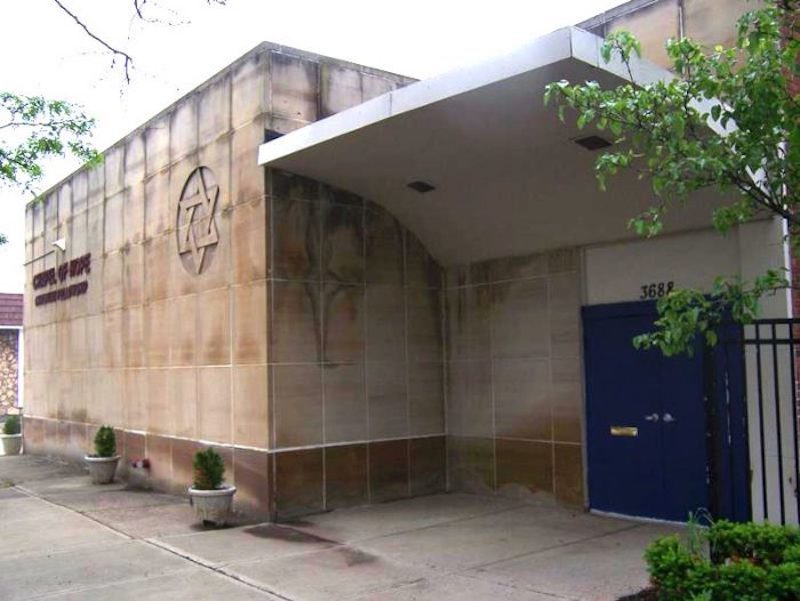
    <summary type="html"><![CDATA[<p><strong><em>The building currently occupied by Chapel of Hope Christian Fellowship at 3688 Lee Road has been used as a center for religious and cultural life for over 60 years. The history enshrined within its walls reveals the dynamic character of the Moreland neighborhood, and the diverse makeup of religious communities that have lived within its bounds.</em></strong></p><img src="https://mail.clevelandhistorical.org/files/fullsize/2178ccc0af10b897db5308f2791480ac.jpg" alt="Vestiges of the Kinsman-Lee Neighborhood" /><br/><p>In November, 1970, officers of Shaker-Lee Synagogue presented an $11,500 gift to the Jewish Welfare Fund Appeal for donation to the Israel Emergency Fund.  The substantial gift fulfilled a pledge made by the congregation to its recently deceased members, Mr. and Mrs. Sidney Gordon. Committed to do everything in their power to aid the Israeli cause, the Synagogue’s Sisterhood had raised $1,500 for this “tangible demonstration of…support for the Jews of Israel.” The remaining $10,000 was acquired through the sale of their synagogue property at 3688 Lee Road in Shaker Heights.  The sizable contribution marked an end to the small Orthodox congregation’s residence in Shaker Heights. Illustrated by persistent difficulties drawing ten male participants to hold minyan, changing conditions in the neighborhood were cited as a source of their depleted attendance.  The 135-member Synagogue determined that their religious needs would be best met by joining another congregation, and quickly secured permission to worship at Warrensville Center Synagogue in Cleveland Heights. </p><p>  The Jewish enclave surrounding Shaker-Lee Synagogue would also find a new home outside of Shaker Heights.  By the turn of the century, a large Shield of David etched into the building’s polished sandstone facade remained as one of the area’s few visual reminders of the sizable Jewish community that once lived in the surrounding neighborhood.  The structure’s history as a religious sanctuary, however, neither began nor ended with its use by the Shaker-Lee Synagogue. For over 60 years, the converted commercial building has been used by the communities of Shaker Heights and Mount Pleasant as a center for religious and cultural life. The physical transformation of the storefront space, and subsequent services and activities housed within its walls, reveal the dynamic character of the Moreland neighborhood and the diverse makeup of religious communities that have lived within its bounds.</p><p>  The construction of the building at 3688 Lee Road occurred fairly late within the context of Moreland’s residential and commercial development.  The southwest corner of the Kinsman-Lee intersection remained a homestead to descendants of the Manx farming community well into the first decade of the 1900s.  Then the area was acquired, improved and allotted by the Shaker Overlook Company. In 1918, the grounds were opened up for sale.  Antonio Lanese, an Italian sewer and water contractor, immediately purchased twenty-one lots along the boulevard that would become Nicholas Road.  Lanese eventually acquired nearly all the lands on both sides of Scottsdale Boulevard and Nicholas Avenue between East 163rd Street and Lee Road.  While most of the property was subdivided and sold to the Hillcrest Realty Company in the late 1920s, Lanese held onto a few allotments facing Lee Road into the mid-1930s.  A building permit for the property at 3688 Lee Road was submitted in 1935, although 1937 maps do not reflect the presence of a structure. The property was eventually sold in 1941, four years after Lanese’s death.  </p><p>  Sophie Schechter, a Russian immigrant living nearby on East 163rd Street, held the deed for the 3688 Lee Road property from 1941 to 1946.  Ownership then transferred to a dentist residing in Kenosha, Wisconsin. An April, 1947 advertisement for Culligan Soft Water Services offers the first evidence of a commercial structure having been built on the property. The Culligan franchise was operated out of this building until the early 1950s, but the entrepreneur eventually relocated his interests to the Lee-Miles neighborhood. In 1952, the property was deeded to Marguerite Kemmerling.  Kemmerling’s husband, Burt, owned a Ford dealership on Buckeye Road in Cleveland; Opened in 1949, the 20,000 square-foot dealership was one of the largest Ford passenger car and truck operations in Ohio.  Real estate agents for A.B. Smythe Company managed rentals of the couple’s commercial property on Lee Road.  </p><p>  By the time Kemmerling held the deed, the Moreland neighborhood housed a rapidly growing Jewish settlement. An era of economic prosperity had begun to spur rapid suburbanization in the region. Increased mobility and anxiety over racial transition in Cleveland’s east-side neighborhoods exacerbated this flight from the inner city.  Previously centralized around the Glenvillle and Mount Pleasant neighborhoods, Cleveland’s Jewish population moved en masse into the inner-ring suburbs between 1940 and 1960.    </p><p>  In Shaker Heights, affordable housing and discriminatory real estate practices steered the settlement of middle- and working-class Jews towards the Moreland and Lomond neighborhoods.   The proximity of these neighborhoods to the Orthodox Jewish community of Mount Pleasant, which had steadily expanded east along Kinsman Road since the 1920s, provided additional incentive for settlement in the area. Drawn by Shaker Heights’ superb school system and tree-lined lawns, a substantial Jewish community emerged near the Kinsman-Lee intersection.  </p><p>  The impetus to renovate the building at 3688 Lee Road grew from this rapid demographic shift. A study of the surrounding Kinsman-Lee neighborhood undertaken by the Jewish Welfare Federation in the late 1940s found the area lacking in adequate services and facilities.  In February, 1950, the Jewish Community Center purchased an eight-bedroom house at 3638 Lee Road to use as a branch in Shaker Heights.  With pre-existing locations in Glenville, Cleveland Heights and Mount Pleasant, the Cleveland-based organization provided cultural, recreational, and educational programming to Jewish communities throughout the city and its surrounds. Due to the proximity of the Mount Pleasant and Shaker-Lee branches, the former would eventually discontinue services in 1952.  </p><p>  One resource offered by the Jewish Community Center was its Drama Department. Guided by an objective to revitalize and reinterpret traditions of Jewish theater, the department staged productions of Jewish-themed plays. Since the establishment of the theater group in 1949, however, it lacked a central facility to house productions, rehearse and store equipment. The Jewish Community Center’s Board of Trustees approved the proposed costs of rent and equipment in 1953, and negotiations with A.B. Smythe commenced for use of the nearby commercial building at 3688 Lee Road. The brick structure was zoned as retail property, and contained 6,600 square feet evenly divided between two floors.  </p><p>  Funded by Friends of the Drama Department, the building was redesigned as a 175-seat playhouse that included a permanent stage, dressing rooms, rehearsal areas and workshop space.  It was dedicated in October, 1954. The Drama Department raised its curtains for the first time the following month for a presentation of Jan de Hartog’s “Skipper Next to God.” Chosen to commemorate the 300<sup>th</sup> anniversary of Jewish life in the United States, the play depicted the struggles of postwar Jewish refugees as they were refused entry into the Americas.  Both the staging of culturally relevant programming and the new playhouse were well received, and the theater group quickly garnered over 500 subscribers to its three annual productions.  The Drama Department’s value as a community service was also realized through the many hours dispensed training Jewish Community Center members in acting, directing, set design, makeup and lighting.   </p><p>  The Drama Center annex would also be used for a variety of recreation and ceremonial functions, such as banquets, religious ceremonies, fundraisers and dances. Due to the lack of any large Jewish-operated facilities in the Kinsman-Lee neighborhood prior to the opening of Beth El Synagogue in 1957, the new theater acted as both a cultural and recreational center for the Moreland neighborhood.  </p><p>  While the Jewish population of Shaker Heights steadily grew through 1961, Mount Pleasant’s Jewish community neighborhood had all but disappeared.  Religious institutions that remained behind quickly atrophied.  As early as 1954, Mount Pleasant’s once-popular Kinsman Jewish Center regularly rented the Drama Center hall to hold religious services within the neighborhood’s growing Jewish community.  The impact of this population shift became apparent as membership at the Shaker-Lee Jewish Community Center began to fall in 1956. While the Kinsman-Lee neighborhood was noted as being “enthusiastic” about the center, efforts to draw new members from other parts of the suburb proved futile.  The house on Lee Road did not “compare with the type of homes” that they were used to, and the Center did “not attract their interest or their parents.”</p><p>With trends in Jewish population movement appearing to shift towards Cleveland Heights, the Jewish Community Center elected Mayfield Road as the site of a new central facility in 1955.  Plans for the structure included a dedicated theater space, complete with graded seating. Following a performance of “The World of Sholom Aleichem” in May, 1960, the Drama Department began the process of relocating to their new air-conditioned quarters in Cleveland Heights. The doors of the Shaker-Lee Jewish Community Center closed the following year.   </p><p>  Even though the Jewish Community Center continued to work and hold functions out of the Kinsman-Lee Drama Center until late 1960, ownership of the property at 3688 Lee Road was transferred to the Ohel Jacob Anshe Sfard Congregation in November, 1957.  At the time of the sale, the formation of Ohel Jacob Yavneh Congregation was announced. The merger consolidated members of two Mount Pleasant Orthodox synagogues, Ohel Jacob and Ohel Yavneh.  As with many Jewish religious institutions that had grown along Kinsman Road, the two congregations were faced with dwindling membership. Re-centering their new synagogue within Kinsman-Lee’s Jewish community presented an opportunity to remain relevant in the religious lives of its members, and to grow. Following its purchase in 1957, the Drama Center auditorium housed the new congregation’s religious services. For over two years, both the Theater Department and Ohel Jacob Yavneh shared use of the building. The Ohel Jacob Yavneh Congregation also merged with members of Mount Pleasant’s Tifereth Israel Anshe Shard Congregation, and became known as Shaker-Lee Synagogue in 1959.   </p><p>  The building on Lee Road was once again remodeled, this time into a house of worship, following the departure of the Jewish Community Center Theater Department. In May, 1961, Shaker-Lee Synagogue was dedicated before a crowd of 300. Mayor Wilson G. Stapleton of Shaker Heights addressed the audience, welcoming a new Synagogue to the City.  Under the spiritual leadership of Rabbi Isaac Krislov, the synagogue would serve the religious needs of the Kinsman-Lee Orthodox community for over a decade. The congregation maintained an active Sisterhood, regularly offered adult study groups, and hosted gatherings associated with religious holidays.  Both the Rabbi and congregation members were also active in fundraising for pro-Israeli causes.  A shrinking congregation impelled the congregation to sell the synagogue in 1970.  As with the Jewish Community Center Theater Department, the congregation relocated to Cleveland Heights.   </p><p>  The closure of Shaker-Lee Synagogue in 1970 was indicative of a declining Jewish population in Shaker Heights. Estimations of Jewish public-school enrollment as a percentage of total enrollment plummeted from its peak of 47.3 percent in 1961 to 33.1 percent by 1968.  The Kinsman-Lee enclave soon gave way, as Orthodox communities increasingly centralized in University Heights, South Euclid, Beachwood, Cleveland Heights and Wickliffe.   </p><p>  These changes were most pronounced below Van Aken Boulevard in Shaker Heights, particularly within the Moreland community.  Ten percent of the neighborhood’s 600 homes were placed on the real estate market in both 1962 and 1963.  This was a sharp increase from prior years, and allowed for the rapid development of a Black enclave within Shaker Heights. Moreland, once known for its Italian and Jewish populace, quickly became a haven for an emerging middle-class African American community.  This transition was not uncharacteristic for Moreland, as witnessed during the Jewish migration into Shaker Heights at mid-century. While both an Italian and Jewish presence remained within the neighborhood, African-Americans comprised two-thirds of the Moreland population by 1970. </p><p>  Following the sale of Shaker-Lee Synagogue, the building continued functioning as a religious sanctuary.  Converted into a Christian church, the structure housed the religious activities of Full Gospel Assembly Church from 1970 to 2001. This evangelical congregation was led by Reverend Joseph Frano, an ordained minister of the Christian Churches of North America. Rooted in the Italian Pentecostal Movement, the religious institution was known as the Italian Christian Church prior to 1948. Reverend Frano was noted for teachings that blended traditions of Pentecostalism, Protestantism and Catholicism.    </p><p>  The Chapel of Hope Christian Fellowship has continued in the tradition of housing religious and community services for the surrounding neighborhood since 2001. Founded by Reverend Willard McFarland, development of the inclusive, non-denominational Christian congregation was guided by a belief that members should exemplify Christian teachings through daily actions in order to effect positive change in the world. Congregation members have sponsored a variety of aid programs over their many years of service in the Moreland neighborhood, including food drives, blood drives, and clothing giveaways. An annual Angel Tree outreach program is also sponsored during the Christmas season for children of incarcerated men and women.  Community services offered by the church have included raking leaves for elderly neighbors, jail ministry, financial seminars and leadership training. As the Chapel of Hope Christian Fellowship proceeds along a storied path of community outreach and faith-based service, the converted storefront at 3688 Lee Road acts as a reminder of the many religious communities that helped define the distinct character of the Moreland neighborhood.</p><p><em><strong><a href="https://mail.clevelandhistorical.org/items/show/839">For more (including 8 images) view the original article</a></strong></em></p>]]></summary>
    <published>2018-06-24T01:01:20+00:00</published>
    <updated>2026-04-17T19:17:42+00:00</updated>
    <link rel="alternate" type="text/html" href="https://mail.clevelandhistorical.org/items/show/839"/>
    <id>https://mail.clevelandhistorical.org/items/show/839</id>
    <author>
      <name>Richard Raponi</name>
    </author>
  </entry>
  <entry>
    <title type="html"><![CDATA[East View United Church of Christ]]></title>
    <summary type="html"><![CDATA[<img src="https://mail.clevelandhistorical.org/files/fullsize/e77a6cf13cfd63150b2094e65303ba66.jpg" alt="East View Congregational Church, 1944" /><br/><p>On November 1, 1970, Reverend George Ramon Castillo and his wife were received into the membership of East View United Church of Christ. The ceremony marked the occasion of Reverend Castillo being installed as the first Black pastor of a Shaker Heights church. Presiding over the service, Rev. John Huston passed on a mission of expanding the fledgling house of worship to his successor with a sermon titled “A Man for This Time.”  When Huston accepted the post just four years prior, the future had appeared bleak for the small church. The congregation had not been able to afford a full-time pastor for over six years, during which time membership dropped from 550 to under 100. The congregation held votes on whether to disband or move to a new site in both 1959 and 1965. Each time, however, members chose to stay at the present location.  The aging institution, with over half its members in their sixties, was financially distressed and facing atrophy; change was needed to remain relevant and survive. </p><p>Although East View would only find stability following 1979 through the efforts of Rev. Valentino Lassiter, the church was given new life by Huston and Castillo’s pastoral leadership between 1966 and 1973.  Membership numbers slowly rose during these years, and the church was rescued by the new African American community it served and represented. A rapid demographic shift in the surrounding Shaker Heights community was at the heart of these changes; regional and national efforts by the United Church of Christ to promote integration within both its congregations and society provided the backdrop to realize this transformation. This moment of transition required that East View reach out to its surrounding community and address what the United Church of Christ recognized as the most pressing moral issue of the day: promoting racial equality by breaking down race barriers and battling the discriminatory behavior inherent in a segregated society. </p><p>The troubles that accompanied declining church membership were nothing new for East View by the 1960s. While many Cleveland religious institutions shuttered their doors or relocated as congregants increasingly moved to the city’s outer suburbs following World War II, living within a rapidly changing neighborhood was par-for-the-course for East View church members. Transformation was illustrative of life in the dynamic Moreland neighborhood, imprinted on the community's design as a stepping stone into the exclusive world of Shaker Heights.  Since its founding in December of 1912, seldom had extended stretches of time passed for the Protestant congregation when either an empty pulpit or financial distress wasn’t following closely behind. A contributing factor to these lurking obstacles, as well as the congregation’s resilience, was the church location: the religious institution was born and grew up along the ever-morphing Kinsman Road. Within the first year of the congregation’s founding, members briefly worshiped at a storeroom near East 139th, quickly moved to a six-room home on East 143rd, and finally purchased a lot on 142nd Street (Elm Street) where a stucco building was constructed.</p><p>Formally named East View Congregational Church, the thirty-member organization was received into the Cleveland Congregational Union in January of 1913.  The small band of founders came from households of Bavarian, German, English and Manx descent, and held jobs such as a factory foreman, rolling stock laborer, steel mill clerk, paint factory tester, and motorcar machinist. The streetcar line running down Kinsman Road not only connected the City of Cleveland with Chagrin Falls, but allowed these workers to live in the semi-rural environs of East View Village.</p><p>While land west of East 140th Street was annexed by Cleveland in February of 1913, the area remained fairly undeveloped until the 1920s. The congregation spent its first decade at this border of Cleveland and East View Village. The area would develop outward from Kinsman Road during these early years. On the Cleveland side, population grew in bounds and extended east towards East View Village. Known as Mount Pleasant and Kinsman Heights, the neighborhoods predominately attracted eastern and southern Europeans; they also included one of Cleveland’s few Black enclaves. To the east of the small church, the Van Sweringen brothers were purchasing all the available lots and farmlands in East View Village that their agents could acquire at a reasonable price.</p><p>With East View Village’s population never growing much beyond 600 persons, the pool of potential recruits for East View Congregational Church was severely limited during its first decade of existence. A growing Jewish and Catholic community of neighbors along Kinsman Road in Cleveland didn’t increase the odds for growth either. Despite these evangelical limitations, the congregation slowly increased and an addition to their building was constructed in 1918 for use in programs such as Sunday School. The church struggled to retain their leadership throughout this time, and often relied on support from the Congregational Union of Cleveland to assist with salaries. During periods between the revolving cast of pastors, it was common for visiting ministers to arrive at the church only to find a handful of attendees. In 1919 and 1920, the congregation voted on whether to disband. Both times it was decided to persevere despite financial hardship. To save money, East View began sharing a pastor with the struggling United Church Congregational Church in 1920. Additionally, joint services were held with local Methodist Episcopal congregations during summer months.</p><p>By the end of 1922, East View was once financially again able to employ their own pastor - the congregation’s sixth in ten years; with the hiring of Reverend John Logan, the church would find a period of relative stability between 1922 and 1929.  Although characterized as a “man without the slightest suggestion of gifts as a speaker,” the new minister offered patience, persistence and administrative capabilities. This set the stage for the congregation to not only grow, but embark on a campaign to build a new place of worship. In June of 1923, the members of East View Congregational Church unanimously voted to sell their property on East 142nd Street and relocate a half mile to the east on Kinsman Road.</p><p>East View Village was no more by the time the congregation voted to move. The area surrounding East View Congregational Church had been annexed to Cleveland in September of 1917, as well as additional sections of the village being acquired by the city in February of 1919. With much of their lands gone, residents of East View Village voted to be annexed by Shaker Heights in November of 1919. The church on 142nd Street sat within Cleveland, and the ruralesque character of Kinsman Road was beginning to change as the Jewish and Italian communities grew and migrated eastward. Similar to the residents of East View Village, the small church congregation looked towards the restrictive suburban community of Shaker Heights to be their new home.  Herbert C. Van Sweringen, treasurer of the Congregational Union of Cleveland, assisted East View Congregational Church in finding the new location. The brother and occasional employee of Oris and Mantis Van Sweringen encouraged the congregation to choose land in Shaker Heights, and negotiated the purchase of a lot of land and farmhouse where the church now sits.</p><p>By March 1924, the deal was complete and East View’s congregation acquired the Gibbs homestead at East 156th and Kinsman Road. The farmhouse was used by the congregation while construction of the new structure was underway, and later sold in order to help pay for the new church. Reverend Logan then began the laborious project of scraping together the necessary $100,000 in funding to move forward with church building plans. This proved difficult as the congregation only consisted of 195 members, but they held high hopes for expanding their institution within the rapidly growing Village of Shaker Heights. The only competition for the church would be the more affluent Plymouth Congregational Church, which was miles away and served a “different constituency.” While encouraged to keep their eye on the goal, East View was advised by the Congregational Union against taking steps toward construction in 1926. Undeterred, the congregation proceeded to reduce their expenses by convinced the Church Building Society and Congregational Union to provide the necessary loans and approval. The final cost of the new structure was $60,000. On February of 1928, a capacity congregation attended the dedicatory rites for East View Congregational Church in Shaker Heights.</p><p>Having successfully utilized his skills to build a home for the East View congregation, Reverend Logan “wisely left to open the way for a man capable of building a larger congregation” in 1929.  With a pristine building in the rapidly growing village of Shaker Heights, the church was finally positioned to thrive.   Then came the next stumbling block for the working and middle-class congregation: The Great Depression. A brand-new debt in tow, the congregation found themselves in a financial struggle that lasted through the 1930s. Not all was bad, however. With salary supplements from the Congregational Union, the church procured a dedicated full-time pastor willing to work for below average wages.  Membership grew to above 300 by the mid-1930s. Membership collections, on the other hand, plummeted. </p><p>The anticipated expansion of the church was checked by changes to the areas surrounding the Moreland neighborhood. Throughout the 1930s, the population of Mount Pleasant along Kinsman Road rapidly grew and expanded eastward.  As part of a member canvas performed by the congregation in 1935, a census of the community a half mile distance from East View claimed that 80 percent of residents were either Catholic or Jewish. By 1939, the church reached what they viewed as the “maximum strength of 275 members including children and young people” from about 100 families.  Congregants contributed this ceiling to the continued influx of Italian families into the community.  Anticipated annual collections were only between $3,000 and $3,500 that year, as at least 25 percent of families were either unemployed or on relief. The “distressing condition” of outstanding loans was accompanied by the physical deterioration of the building, which was in need of a cosmetic makeover and some minor repairs. </p><p>The church fared much better over the next two decades as America’s economic depression ended and organized religion experienced a revival following World War II. The 1940s brought the creation of multiple auxiliary groups to foster the social, professional and religious development of its membership. Church grounds were improved in 1942 as the congregation contributed time and labor during a drive to prepare for the institution’s 15th anniversary. Members also undertook a campaign to eliminate indebtedness and pay off $16,000 of outstanding loans in 1944. In December of that year, the congregation burned its mortgage.  </p><p>The impact of the war went beyond just bringing in new church members and temporarily ending economic woes. To the west of East View, the area along Kinsman Road was undergoing a new demographic shift. African Americans from the South migrated en masse to northern cities during and following World War II to meet demands for industrial labor. Cleveland’s Black community grew from 85,000 in 1940 to 279,350 in 1965.  While Cleveland’s African American population was highly segregated in the Cedar-Central neighborhood, the community quickly reached outwards towards Kinsman Road. Discriminatory lending and rental policies similarly shaped the population movement and segregation of working class and poor African Americans along the inner city’s east side.  </p><p>The African American enclave in Mount Pleasant had already expanded to as many as 700 families by 1940.  Lacking deed restrictions or restrictive covenants, this long-standing Black community continued to attract middle class and professional African Americans with the financial resources to move away from the deteriorating and over-priced inner-city housing.   Simultaneously, both physical and economic pathways such as new highway infrastructure and the G.I. Bill presented much of the city’s white and European-descendant communities the opportunity for suburban home ownership.  The Kinsman Road Jewish community began to disperse, moving further east into both Cleveland Heights and Shaker Heights neighborhoods following a U.S. Supreme Court decision making deed restrictions illegal in 1948.  Cleveland’s border with the Moreland neighborhood and East View church was predominately African American by 1960.  Beyond a small population of live-in domestic help and a grouping of about 80 black families in the Ludlow neighborhood, however, Shaker Heights remained nearly all-white. While East View Congregational Church was listed as open to integration in 1957 by the Congregational Union of Cleveland, congregants that year determined that segregation was not yet a pressing problem for their church. Church members decided against taking any type of action at the time to address the issue.</p><p>As the problem of segregation was increasingly brought to light by a national civil rights movement, the small church faced institutional changes.  In 1957, Congregational Christian churches merged with the Evangelical and Reformed church to create the United Church of Christ.  East View voted to join the United Church of Christ in 1961, although the delay was not unique.  The process of creating, redrafting and receiving approval for a church constitution took time: meeting the needs of 1,419,000 Congregationalists and 810,000 Evangelical and Reformed Church members, in over 8,000 semi-autonomous congregations, proved to be a long and labor-intensive undertaking.  With a united leadership, however, the national institution could provide a stronger voice promoting its religious and social agendas.  National, state and regional offices were also better equipped to offer financial support to economically distressed institutions such as East View Congregational Church.</p><p>At the time of joining the United Church of Christ, East View Congregational Church was once again financially troubled. The aging congregation was led by an interim pastor completing studies at Oberlin Theological School.  While congregants previously voted to both remain open and not relocate following the resignation of their pastor due to health issues in 1959, church membership decreased dramatically. Demographic changes in the Moreland neighborhood during the 1960s presented the congregation a new chance for growth. Moreland transitioned from a nearly all white community to over two-thirds African American by the end of the decade.  Previous problems of growing the church in a predominately Catholic and Jewish community no longer applied as this wave of Protestants settled into the neighborhood; issues of integration and segregation could no longer be ignored, however, if the church wished to remain relevant to its surrounding community.  </p><p>Despite declining membership, the path to integration was not clearly laid out and little changed for the church until the mid-1960s.  The issue of segregation and race, however, became the primary national social cause for the United Church of Christ after its Fourth General Synod in 1963. With civil rights legislation being filibustered in the U.S. Senate, and a mass movement pivoted against segregation visibly displayed on America’s streets, issues of racial justice were at the forefront of the nation’s consciousness. Informed by studies and over 20 years of work by sociologists at Fisk University’s Race Relations Department, the United Church of Christ narrowly approved a new policy at its annual national conference that helped define the progressive character of the church going forward. The newly formed United Church of Christ would cut off all funding to churches that practiced segregation.  Additional efforts to advance racial justice were also approved that provided legal aid to demonstrators, developed scholarships for African Americans, supported civil rights legislation, and promoted voter registration drives.</p><p>Born from a union of the Board of Home Mission of the Congregational Christian Churches and the Board of National Missions of the Evangelical and Reformed Church, the United Church of Christ-affiliated United Church Board for Homeland Ministries was charged with administering and leading the efforts to desegregate all churches within the year. Open membership covenants were sent to all members, but it was soon discovered that the demands for integration had little effect at the local level.  A 1964 survey indicated that churches were still discriminating against African Americans, even if by not soliciting for new memberships. Only one-third of United Church of Christ churches were open to all races. Outside of the South, the Midwest had the smallest proportion of integrated congregations at 6.6 percent. Problems in the North rested with its highly segregated society: white churches sat in white neighborhoods, and few African Americans were available for membership. </p><p>Since East View Congregational Church was located in a rapidly integrating neighborhood of Shaker Heights, and bounded on the West by a predominately African American section of Cleveland, the struggling church presented an opportunity for the United Church of Christ to develop a strong interracial congregation. In 1964, the Board for Homeland Ministries voted to provide substantial financial support for this project in Shaker Heights.   State and regional associations of the United Church of Christ also offered financial assistance to the endeavor of integrating East View; the United Church of Christ’s regional governing body, the Western Reserve Association, undertook a research project and set aside money to assist with hiring a full-time minister and developing a complete church program.  The pastor-less East View congregation consisted of 145 members at the time, and its membership only included three Black families.  </p><p>After a year of declining membership and financial troubles, the church received its new full-time pastor.  In January of 1966, it was announced that John Huston would leave his 1,000-member congregation in Lorain, Ohio to take up the cause of rebuilding East View Congregational Church.  Huston was known for his anti-poverty and race relations work in Lorain, and chosen for the Shaker Heights “interracial project” because of his commitment to civil rights. In leaving the large church where he had spent over a decade, the pastor wished to concentrate on his ministerial role as a counselor while earning a doctorate in psychology. </p><p>East View membership had fallen to just 95 members at the time Huston stepped into his new role. A publicity campaign was immediately initiated to let residents of the surrounding community know that the church desired to be integrated. As part of reinventing the church, the congregation changed its name to East View United Church of Christ. After-school programs and Sunday School, both of which had disappeared over the prior decade, were reinstated. Church doors were opened for daily use by community service groups and area students. Huston’s stated goal was to build a symbol of friendship and service, thereby dispelling any distrust or suspicion the community had about the institution. The efforts were met with success over the following year. Huston successfully engaged local youths to participate in a youth choir and multiple charitable volunteer programs. He also implemented an integrated nursery school program that proved popular with parents wishing to give their children a chance to play with youngsters of different races. Organizations such as the Scouts, Brownies and Moreland Community Association used the church space on a formal basis, while neighborhood children took advantage of an open invitation for after-school play and study groups. </p><p>Between 1966 and 1970, Huston continued his efforts to advocate for racial and economic justice. The church would be used as a dialogue center to host group discussion of racial problems, and two college students working at East View coordinated support for the Poor People’s Campaign and Operation Breadbasket. Huston also acted as a member of Mayor Stokes’ Citizens Advisor Committee for Community Development, and worked with other United Church of Christ ministers to develop ways of dealing with problems of urban renewal, police regulations, discrimination in housing and unemployment, and school integration. Huston expanded his role for the United Church of Christ in 1968 to fill a vacancy of pastor for another struggling parish, the Immanuel Church of Shaker Heights.</p><p>National and regional efforts of the United Church of Christ during the late 1960s also continued to focus on promoting race relations and battling discrimination both within the church and in society. Rooted in the premise that the church had a responsibility to remain active in promoting civil rights, the Board of Homeland Ministries continued to allocate its financial resources to support efforts at breaking down racial barriers.  New programs aimed to recruit civil rights workers to fight a rise in terrorism by southern segregationists. Recognizing shortcomings within the church, a committee of Black ministers was formed to act as a pressure group in 1966 to give a stronger voice to the church’s African American membership and address the limited opportunities available to ministers of color. </p><p>As the 1970s drew near, increased national focus was placed on promoting social and economic opportunities for African Americans and promoting racial pluralism.  The church also began using its economic and social influence to advocate for an end to the Vietnam War, combat apartheid, draw attention to ecological exploitation, and fight gender discrimination.   At the regional level, efforts were made to invest United Church of Christ funds in Black-owned businesses and promote church development in African American communities. Localized attempts to improve race relations also continued, as through the development of a Western Reserve Association task force to identify ways of eliminating conscious and unconscious white racism within the church structure. Much of the regional group’s focus on issues of racial discrimination receded in the 1970s, though, as other pressing issues of church development arose.</p><p>In a 1967 letter posted to Martin Luther King Jr., John Huston wrote, “I have felt that unless I did something significant in the area of racial justice I would have been wasting much of my life.”  Huston found this calling in his work with Operation Breadbasket, a selective patronage program implemented by the Southern Christian Leadership Conference that was meant to improve economic opportunities in African American neighborhoods.   A little over a year later, hoping to find “a greater opportunity to work in race relations, helping to achieve justice in our society, reconciliation and understanding,” Huston submitted his written resignation as pastor of both East View and Immanuel Church. During his brief stay at East View, both the church and the neighborhood had transitioned to becoming predominately African American.  Church membership stabilized at around 145 members and the day nursery program continued to be popular within the Shaker Heights community. The small church, however, still required financial assistance from both regional and national offices for survival. </p><p>In November 1970, Rev. George Castillo replaced John Huston. Castillo, who had previously held a pastorate in Detroit, was brought into the church with a track record of recruiting new members, working with youth, and developing educational activities for the community. Newspapers accounts reported that Sunday service attendance doubled during his brief stay at East View United Church of Christ, although general membership numbers dropped slightly. The pastor expanded upon United Church of Christ efforts to reach out to the Moreland community; a new Sunday School program was initiated, and the church began offering day care services to working mothers. He also helped found the Western Reserve Association’s Criminal Justice Committee of the United Church of Christ, acted as chaplain of the Warrensville Workhouse, and was a member of the Ohio Black Minister’s Conference. In June 1973, however, the pastor assumed new duties as a chaplain for the Atlanta Federal Penitentiary in Georgia. Castillo was soon after replaced by Rev. Michael Barker, but the remainder of the decade presented new obstacles to the small church’s survival.</p><p>As the popularity of institutional religion waned over the 1960s, and eventually fell below pre-Cold War averages in the early 1970s, regional and state offices of the United Church of Christ were forced to explore budget cuts. In this changing environment, East View United Church of Christ found company in its difficulties attracting both steady pastoral leadership and hordes of new congregants. Over 75 percent of Western Reserve Association congregations had less than 300 members by 1974. East View faced additional financial burdens that year, however, having received notice from the City of Shaker Heights of building code violations. The repairs would cost at least $10,000, and the small church needed to take out new loans from both the Board of Homeland Mission and the Western Reserve Association to cover them. </p><p>The Board of Homeland Ministries quickly renewed its commitment to the small church during this time of crisis. In part due to the efforts of Castillo and Huston in opening the church to the surrounding community, East View was one of only a handful of churches in Ohio representative of the United Church of Christ’s goals of promoting church desegregation and fostering racial pluralism in its ranks. The Western Reserve Association held the highest percentage of African American membership of any Ohio conference at three percent, primarily because this governing body placed value on its affiliation with churches such as East View United Church of Christ, Hough Avenue United Church of Christ, Shaker Heights Community Church, and the People’s Church in East Cleveland. The Transitional Church Committee was formed in 1975 by the Western Reserve Association to research strategies for aiding these east side churches. The committee developed plans to help the congregations become self-sustaining, and provided each church five years of financial support to be divided by and paid through the United Church of Christ’s regional, state and national offices.</p><p>With financial assistance in place, the congregation was once again confronted with the all-too-common problem of an empty pulpit. Reverend Barker accepted a calling in Chicago to act as pastor in September 1976.  East View faced plenty of competition in attracting new leadership; eleven Western Reserve Association churches simultaneously had vacancies of either pastor or assistant-pastor that year, four of which were on Cleveland’s East Side.  East View remained without a full-time minister until the installation of Reverend Valentino Lassiter in September 1979.  Church membership fell to 79 persons. Lassiter later recollected that, upon becoming the new pastor, Sunday services rarely attracted more than twenty-five persons. </p><p>Starting from scratch, the new pastor personally reached out to the surrounding community and began slowly re-growing the congregation. Using fliers and word of mouth, Lassiter worked to revive interest in the small church. Even after more than a decade as a predominately African American congregation, the new pastor found many neighborhood residents did not know that East View aimed to serve the surrounding community.  As in the past, the church was opened to the community for use by clubs and community service organization such as the Scouts and Moreland on the Move. Departing from precedent, though, the new pastor slowly revamped services that were steeped in traditional Congregational practices to take on elements of the Black church and African American worship.  Within a decade of Lassiter's arrival, church membership had expanded to over 200 persons. More importantly, Sunday masses — with the church's gospel choir sitting high above the pulpit — was regularly filled with just as many joyful attendees.   Beyond the popular children's and gospel choir, East View United Church of Christ offered its growing congregation a variety of opportunities for civic, religious and social involvement.  Church members advanced the formation of a large bible study group, held a popular annual community essay competition, and cultivated a variety of women's and men’s social clubs. </p><p>Rev. Lassiter also kept busy.  The full-time pastor began work in John Carroll's religious studies department shortly after the completion of his theology doctorate in 1989, where he eventually became the pastor in residence.   In addition to his day jobs, the pastor participated as a member of a variety of community groups including Moreland on the Move, the Interchurch Council of Greater Cleveland, the Harambee Board, the Mt. Pleasant Ministerial Alliance, the Moreland Community Association Credit Union, the Greater Cleveland Roundtable, and the 25th District advisory committee.</p><p>Valentino Lassiter continued to act as pastor of the parish until his death in the summer of 2015. Under his leadership, the United Church of Christ's mission for the small parish was finally achieved. The church had become a vibrant religious institution within the community it served.  Rev. Lassiter's leadership and thirty five-plus year tenure as pastor offered a stability that allowed the church to not only evolve under his guidance, but to be both shaped by and representative of its congregants' lives, experiences and interests.</p><p><em><strong><a href="https://mail.clevelandhistorical.org/items/show/833">For more (including 11 images) view the original article</a></strong></em></p>]]></summary>
    <published>2018-04-17T20:12:19+00:00</published>
    <updated>2026-04-17T19:17:41+00:00</updated>
    <link rel="alternate" type="text/html" href="https://mail.clevelandhistorical.org/items/show/833"/>
    <id>https://mail.clevelandhistorical.org/items/show/833</id>
    <author>
      <name>Richard Raponi</name>
    </author>
  </entry>
  <entry>
    <title type="html"><![CDATA[Bethany Presbyterian Church: The West Side&#039;s First Presbyterian Church]]></title>
    <summary type="html"><![CDATA[<img src="https://mail.clevelandhistorical.org/files/fullsize/23cfc1ce549042e359ed7693e065555b.jpg" alt="Bethany Presbyterian Church" /><br/><p>The small stone church on the southeast corner of West Clinton Avenue and West 65th Street, almost shrouded with trees, is Bethany Presbyterian Church.  It was originally a west side Sunday school mission of the Old Stone Church that evolved into a new parish, which was organized in 1889.  For the first five years of its existence, the new parish, which had about 60 members when it was organized, worshiped in rented quarters: first in a building near Pearl (West 25th) and Lorain Streets, and later in the Wieber Block at the corner of Pearl and Jay Street.  In June 1894, when, according to its founding pastor Rev. Giles H. Dunning, membership had "boomed," the parish purchased two lots on the corner of West Clinton and Gordon (West 65th) to build a church that would provide it with sufficient space as well as a permanent home.  </p><p>Construction of the new church began in 1894, with the cornerstone laid on November 4.  It was completed in 1895, and dedicated on June 2 of that year.  The church, as originally built, was 52 feet by 89 feet, had an exterior facade of stone and brick, and fronted on West Clinton.  At the time, church officials planned to add onto the church and construct a grander front facing Gordon (West 65th).  That never happened.  The new church had a capacity of between 500-600.  It was designed by architect William Warren Sabin, who designed several Presbyterian churches in Cleveland, as well as two Cleveland police precinct stations.  Total construction cost of the church was approximately $10,000.</p><p>This was the neighborhood church where Raymond L. Pianka, Cleveland's long-time Housing Court Judge, worshiped as a boy. His family lived at 6310 West Clinton, just down and across the street from Bethany Presbyterian.  Ray's mother was a deacon and a member of the session at the church, and later, so was Ray.   According to Rev. Don Gordon, pastor of the church from 1964-1968, Ray Pianka, though just a teenager at the time, was one of the most helpful of his parishioners. He ran errands, assisted the secretary, and brought to the church the neighborhood news--both good and bad.  What Rev. Gordon remembered most though about young Ray Pianka was his love of church and community.</p><p>Bethany Presbyterian's original parish was composed of Scottish, Welsh and Irish immigrants.  The parish peaked in size in the 1940s when it had about 700 members.  By the time the Pianka family began worshiping there a decade later, Italian-Americans, especially after the closing of the Church of the Redeemer on West 69th Street, were added to the ethnic mix.  By the 1970s, parish membership had declined to about 140.  In recent years, however, the church has experienced a renewal as it has become home to neighborhood Hispanic parishioners. In 2014, the parish celebrated its 125th anniversary.</p><p><em><strong><a href="https://mail.clevelandhistorical.org/items/show/799">For more (including 9 images) view the original article</a></strong></em></p>]]></summary>
    <published>2017-05-31T08:55:35+00:00</published>
    <updated>2026-04-17T19:17:41+00:00</updated>
    <link rel="alternate" type="text/html" href="https://mail.clevelandhistorical.org/items/show/799"/>
    <id>https://mail.clevelandhistorical.org/items/show/799</id>
    <author>
      <name>Jim Dubelko</name>
    </author>
  </entry>
  <entry>
    <title type="html"><![CDATA[Father Albert A. Koklowsky: Hough’s “Slum Priest” and His Parish]]></title>
    <summary type="html"><![CDATA[<img src="https://mail.clevelandhistorical.org/files/fullsize/63a4925674699764c9f3fcf2a75e76cf.jpg" alt="Ladies and Gentleman" /><br/><p>In the wake of the Civil Rights movement, the Hough Riots broke out in Cleveland in 1966, bringing attention to the predominantly African American community’s need for change. Growing racial tension between blacks and whites crippled Hough, like similar racially transitioning neighborhoods in many cities in the 1960s. Father Albert A. Koklowsky, pastor of Our Lady of Fatima Parish, heard the plea for reform.</p><p>Father Koklowsky was born in Clifton, New Jersey, and attended St. Joseph’s Preparatory Seminary in Holy Trinity, Alabama, in 1929. He was ordained in the Order of Missionary Servants of the Most Holy Trinity in 1944. Father Koklowsky worked at parishes in North Carolina (1946), Mississippi (1953-1958), and Puerto Rico (1958) prior to being transferred to Our Lady of Fatima. </p><p>Our Lady of Fatima Church was founded in 1949 and was built where the former League Park movie theater stood across Lexington Avenue from League Park. The first pastor to serve the church was Rev. Raymond Smith. In 1958, the Missionary Servants of the Most Holy Trinity took charge of Our Lady of Fatima Parish. Father Koklowsky was transferred to Our Lady of Fatima Parish in 1963 to serve the members of the growing Spanish-speaking Puerto Rican population that St. Agnes Church was not able to serve. The two parishes later merged to form St. Agnes–Our Lady of Fatima. </p><p>Father Koklowsky’s goal for the Hough community was to help rehabilitate housing and assist African Americans with job training and placement. Sister Henrietta Gorris C.S.A. and several nuns from the Sisters of Charity assisted Father Koklowsky. They began their work in Hough by educating the residents with techniques on how to keep their houses and themselves clean. They later began to work on housing projects on Lexington Avenue.</p><p>The first renovation that Father Koklowsky worked on was an apartment complex  attached to Our Lady of Fatima’s rectory. Father Koklowsky turned the apartment complex into a convent and community center. This project would provide new housing for Sister Henrietta and three other nuns belonging to the Sisters of Charity of St. Augustine. He would later refurbish housing on Lexington Avenue for members of the community. These residents would pay rent to HOPE Inc.</p><p>Father Koklowsky started HOPE Inc. in 1965, a private non-profit developed for projects that the city of Cleveland was unable to assist. Father Koklowsky’s weekly column in the Catholic Universe Bulletin provided the goals and visions he had for Hough to be achieved through HOPE Inc.  This column was entitled “a voice from the slums” and would feature the story of a different person in the community each week. The readers of the column learned how they could help those who lived in Hough. </p><p>The column readers assisted Father Koklowsky and Our Lady of Fatima by donating and raising funds to restore houses or initiate public programs. The parish also utilized the publicity generated through the Plain Dealer to gain funds and create connections with contractors and lawyers, who donated their time to assist Father Koklowsky and Our Lady of Fatima with their project. </p><p>Father Koklowsky was transferred to Sacred Heart Chapel in Lorain, Ohio, on September 1, 1969. He left behind the foundations of housing rehabilitation through his private non-profit HOPE Inc., which was underfunded.  HOPE Inc. clung to life until the 1980s when it faded into obscurity, but was far from completing its task of revitalizing Hough.</p><p><em><strong><a href="https://mail.clevelandhistorical.org/items/show/785">For more (including 6 images) view the original article</a></strong></em></p>]]></summary>
    <published>2017-02-21T21:12:16+00:00</published>
    <updated>2026-04-17T19:17:41+00:00</updated>
    <link rel="alternate" type="text/html" href="https://mail.clevelandhistorical.org/items/show/785"/>
    <id>https://mail.clevelandhistorical.org/items/show/785</id>
    <author>
      <name>Elizabeth Cielec</name>
    </author>
  </entry>
  <entry>
    <title type="html"><![CDATA[HOPE Inc.: The Rise and Fall of a Grassroots Housing Movement ]]></title>
    <summary type="html"><![CDATA[<img src="https://mail.clevelandhistorical.org/files/fullsize/0eea3aee2f820465e420014624392286.jpg" alt="Belvidere Avenue, 1950" /><br/><p>The mid- to late 1960s were a very turbulent time of demonstrations and uprisings in scores of major American cities. One such riot erupted in July 1966 in Hough, a troubled inner-city neighborhood on Cleveland’s East Side. In the year before the riot, Hough seemed to be mostly forgotten and feelings of helplessness were on the rise. The University-Euclid Urban Renewal Project, announced at the start of the decade, was supposed to leverage spending on campus improvements by University Circle institutions to trigger federal funds for redevelopment and rehabilitation in adjacent Hough, but the program was poorly administered and, if anything, worsened the plight of the neighborhood. Although most observers tend to fixate on the loss of hope, several grassroots groups decided to take matters into their own hands. One such group was created in June 1965 from a plan by Rev. Walter E. Grevatt Jr. and Fr. Albert A. Koklowsky to fix up dilapidated houses in Hough and then sell them to poor families in need. This organization was called Housing Our People Economically, or HOPE Inc. Despite their good intentions, this isn’t a story with a happy ending.</p><p>HOPE Inc.’s first rehabilitation, an apartment house at 6516 Hough Avenue, went successfully. However, when attempting to restore two more buildings on nearby Belvidere Avenue, their funds began to run dry and they had effectively stalled by January 1966. HOPE Inc. appeared unable to do even on a small scale what the larger urban renewal campaign was failing to do on a grand scale. The growing tension and lack of aid would mount until they boiled over, leading to the Hough riots. Things finally began looking up as HOPE Inc. became the first organization in the nation to receive federal rent subsidies. However, the election of Carl B. Stokes as mayor in November 1967 could be seen as the biggest turning point. Stokes wanted to improve race relations and revive inner-city Cleveland, ambitions that he packaged in his Cleveland: NOW! program starting in May 1968.</p><p>HOPE Inc. was able to finish the restoration of the Belvidere apartments and keep on going to other projects. The organization was even able to expand beyond house restoration, teaching classes and donating food and clothing to those in need. Other similar organizations also benefitted from Stokes’ success in lifting the federal government’s freeze on funding to Cleveland community development, as well as from the aid of some businesses like the Forest City Materials Company, which placed a prefabricated home on HOPE-owned property. With money coming from both local and governmental levels, projects began to be finished. Neighborhood revitalization finally seemed to be getting off the ground.</p><p>Unfortunately this wasn’t to last. Even at its best, the amount of restoration was nowhere near enough. While organizations like HOPE Inc., Better Homes for Cleveland Foundation, and Hough Development Corporation were moving, they were still somewhat underfunded and, admirable as their efforts were, it would likely have taken well over a decade fix up all of Cleveland’s inner-city neighborhoods even if they had proper funding. There was a growing impatience and general loss of faith not only in Cleveland but also for other similar programs across the nation thanks to the federal government’s retreat from President Lyndon Johnson’s War on Poverty. The event that killed Cleveland’s progress was the Glenville Shootout, which started July 23, 1968, and continued for five days. After the disorder, it came to light that the group that instigated the violence, headed by Fred “Ahmed” Evans, had bought weapons using funds gained from the Cleveland: NOW! and everything fell apart. Although Stokes won reelection in 1969, his political capital was so depleted that he didn’t run in 1971. Funding quickly began drying up along with faith in these programs in general. Government aid stopped not long after as Johnson’s War on Poverty was gradually dismantled in the years after Richard Nixon took office in 1969.  </p><p>Unfortunately, this is where the story ends, with inner cities far from restored and many of the organizations devoted towards helping revitalize them either closing down or being radically changed. HOPE Inc. would continue to cling to life throughout the 1970s, only to fade into obscurity in the early 1980s. </p><p><em><strong><a href="https://mail.clevelandhistorical.org/items/show/780">For more (including 6 images) view the original article</a></strong></em></p>]]></summary>
    <published>2017-01-01T16:05:21+00:00</published>
    <updated>2026-04-17T19:17:41+00:00</updated>
    <link rel="alternate" type="text/html" href="https://mail.clevelandhistorical.org/items/show/780"/>
    <id>https://mail.clevelandhistorical.org/items/show/780</id>
    <author>
      <name>James Mastandrea</name>
    </author>
  </entry>
  <entry>
    <title type="html"><![CDATA[Saint Thomas Aquinas Catholic Church: The Demise of the &quot;Irish Cathedral&quot;]]></title>
    <summary type="html"><![CDATA[<img src="https://mail.clevelandhistorical.org/files/fullsize/0cd10d4e787e1a232903bb957976bcad.jpg" alt="Exterior View of St. Thomas Aquinas" /><br/><p>To answer the need of the expanding Catholic population, Bishop Ignatius F. Horstmann, the bishop of Cleveland, appointed Reverend Thomas F. Mahon as pastor of St. Thomas Aquinas Parish on June 26, 1898. In 1905, construction finished on the grand Romanesque church, located at 9205 Superior Avenue. The Sisters of St. Joseph had overseen the parish school since 1899, and a formal St. Thomas Aquinas school building opened on November 25, 1929. Irish and German immigrants and first generation Irish and German Americans comprised the congregation. Due to the large Irish influence, this church became known as the “Irish Cathedral.”  </p><p>After a half century, St. Thomas Aquinas Church faced a new challenge. Whites started moving to the suburbs as African Americans moved into the neighborhood. This trend was also happening nationwide. After World War II, an economic boom occurred. White Catholics began to earn more money at the same time as almost 1.5 million African Americans left the South to find better job opportunities and wages in the industrial North. The recent economic prosperity, combined with the movement of African Americans into cities, caused numerous white Catholic families to eventually move to the suburbs. Those white Catholics who remained in the cities had to think about how their parishes would survive after this great exodus.</p><p>The American bishops released a statement in November 1958, arguing that like European immigrants, African Americans would thrive once segregation and prejudice were removed from society. However, many white parishioners did not welcome African Americans. They believed African Americans could be members of the Church, but they did not want them living in their neighborhoods. Since the Church could not discover a way to stop white Catholics from leaving the cities while also advocating for integration in the neighborhoods, many pastors and parishioners had to make these decisions for their own parishes. Without a unified front from church officials, priests could promote their desire for segregation.</p><p>By the 1950s, real estate agents helped to create fear among whites in the neighborhood of St. Thomas Aquinas. They went door to door telling the white families that their houses would lose value if they did not sell now due to the increase in African Americans in the neighborhood. However, African Americans did not want to live in white neighborhoods; they wanted to live in a neighborhood where they received respect. African Americans also had their own reservations regarding whites, but they overcame their hesitations faster than whites by focusing on character rather than race in regards to their neighbors.</p><p>In addition to declining attendance, the deterioration of the physical building of St. Thomas Aquinas Church became a large issue for the parish as well. By the 1970s, the church building was condemned structurally, but the parish did not end. In November 1975, the 70-year-old Cleveland landmark was demolished. Masses continued to be held on Sundays in the nearby St. Mary Seminary on Ansel Road. Rather than build a new church, the parish planned on turning the 30-seat chapel in the priests’ rectory into a 300-seat chapel. The new chapel was located at 1230 Ansel Road. Some African Americans believed the Diocese of Cleveland to be downsizing St. Thomas Aquinas Church due to the large percentage of the congregation being African American. Thus, they blamed the Diocese for not working as diligently to rebuild the church as they would have for a white congregation.  </p><p>By the end of the 20th century, the relationship between African Americans and the Catholic Church in Cleveland showed signs of improvement. In 1981, a former bishop of Cleveland, Bishop James A. Hickey, claimed that the Diocese now represented African Americans in all of its religious orders, including having Bishop James Lyke, the first African American bishop in the Midwest, serving in Cleveland. Progress in this relationship extended to St. Thomas Aquinas Church as well. In 1984, John H. Blackburn became the first African American deacon to serve at St. Thomas Aquinas Church. The parish celebrated its 90th anniversary in 1988. However, it seemed that St. Thomas Aquinas Church would never return to the prosperous “Irish Cathedral.” Unfortunately, the parish of St. Thomas Aquinas Church came to an end with its final mass on October 31, 1993, but the merged school of St. Thomas Aquinas-St. Philip Neri stayed open at the original St. Thomas Aquinas School site. </p><p><em><strong><a href="https://mail.clevelandhistorical.org/items/show/776">For more (including 9 images) view the original article</a></strong></em></p>]]></summary>
    <published>2016-12-11T13:29:23+00:00</published>
    <updated>2026-04-17T19:17:41+00:00</updated>
    <link rel="alternate" type="text/html" href="https://mail.clevelandhistorical.org/items/show/776"/>
    <id>https://mail.clevelandhistorical.org/items/show/776</id>
    <author>
      <name>Katherine Behnke</name>
    </author>
  </entry>
  <entry>
    <title type="html"><![CDATA[Calvary Presbyterian Church: The Successful Integration of an Inner-city Congregation]]></title>
    <summary type="html"><![CDATA[<img src="https://mail.clevelandhistorical.org/files/fullsize/9c4243b73966b09110c9a66acb00a934.jpg" alt="On the Corner of East 79th and Euclid Avenue" /><br/><p>On April 6, 1953, Dr. John Bruere, pastor of Calvary Presbyterian Church, mentioned that a "certain colored woman has been attending our services frequently of late." The appearance of an African American woman in the church's congregation "raised in his mind the question of segregation." Further discussion concerning the vices of racial segregation ensued during the Session meeting of Calvary's Elders. After some discussion the Elders agreed Calvary would stand opposed to racial segregation.  </p><p>Dedicated in 1890 on the corner of East 79th and Euclid Avenue, Calvary first catered to Cleveland's white elite. Women in fur coats and men dressed glamorously with top hats and overcoats, strolled down Euclid Avenue on Sunday mornings. They entered the church eager to socialize with their neighborhood acquaintances and spread their fortunate circumstances, in the name of religion, to less fortunate members of society. From the church's inception, Calvary's congregation prided itself on being a neighborhood church. </p><p>Since the church's founding, the surrounding community had made up the majority of the membership. As the elite left Euclid Avenue after the 1900s during the "flight to the Heights" phenomenon, Calvary chose to remain at its original location. When World War I created need for an alternative labor force, Cleveland factories turned to southern African Americans. In the ensuing Great Migration, southern blacks flooded into the central city, setting up residence predominantly in the Central neighborhood. By the 1950s, displacement due to urban renewal in Central caused African Americans to spread eastward into the neighborhoods surrounding Calvary. </p><p>Even before the influx of African American population, the neighborhoods surrounding Calvary had succumbed to neglect and visibly exuded a slum-like character. As African Americans moved in, they arrived in neighborhoods already tainted with poverty and despair. In the 1950s, with landlords' inattention to their properties and a lack of city housing inspections, slum-like conditions worsened. In addition, now racial tension accented the impoverished neighborhoods. </p><p>After Dr. Bruere had drawn attention to the question of racial segregation, Calvary's congregation emerged from behind the church's stone walls and filtered into the community. The congregation engaged with community members to clean up the neighborhood's houses and streets, close down bars, and rid the community of pesky vermin. In addition to polishing the surface of the neighborhoods, Calvary penetrated deep into the community to heal the wounds of racially spurred neglect. The programs aimed to instill pride, construct a new community image, and propagate the power of spirituality and morality to combat the negativity rampant in the neighborhoods. As a result of the cleanup programs, many area residents joined the church. Calvary's award-winning youth programs also attracted community residents. The Saturday Program aimed to keep the youth off the streets, providing a safe haven for children that came from broken homes. The church's free youth programs provided meals and educated the youth on practical skills. Calvary even had recreational sport teams. In the youth programs' heyday of 1966, WKYC-TV reported that, despite the Hough Riots, "nearly five thousand children" participated in Calvary's Saturday Youth Program.   </p><p>The betterment of the neighborhoods surrounding Calvary, as well as the promotion of social justice, remained the church's mission. Upholding the charter members' credo, Calvary remained a neighborhood church. During the 1950s and 1960s the nation struggled with racial segregation and discriminatory rhetoric. Calvary succeeded in achieving a racially integrated congregation through community outreach programs. By 1967, many saw Calvary as a beacon of social justice and activism in the inner city. </p><p>Calvary today continues to promote the same mission of social justice the church followed in previous decades. Through hot meal and childcare programs and cultivation of a welcoming atmosphere, Calvary still engages the community. A gradual decline of church attendance, however, forced Calvary pastors following Dr. Bruere to focus on membership retention and scouting. The racial congregational balance, once highlighted as one of the church's defining features, has since dissipated. Today Calvary Presbyterian Church, under the new name New Life at Calvary, has been described as one of "the largest predominantly African-American churches in Ohio." Regardless of the church's demographics, New Life at Calvary remains at the corner of East 79th and Euclid Avenue and continues to fight for social justice. New Life at Calvary remains a relevant fixture on Cleveland's east side. </p><p><em><strong><a href="https://mail.clevelandhistorical.org/items/show/775">For more (including 8 images) view the original article</a></strong></em></p>]]></summary>
    <published>2016-12-06T23:07:36+00:00</published>
    <updated>2026-04-17T19:17:41+00:00</updated>
    <link rel="alternate" type="text/html" href="https://mail.clevelandhistorical.org/items/show/775"/>
    <id>https://mail.clevelandhistorical.org/items/show/775</id>
    <author>
      <name>Sarah Nemeth</name>
    </author>
  </entry>
  <entry>
    <title type="html"><![CDATA[Church Square: Hough&#039;s Neighborhood Shopping Center]]></title>
    <summary type="html"><![CDATA[<img src="https://mail.clevelandhistorical.org/files/fullsize/0eb37f9d511a3d331d9d792bc24b0412.jpg" alt="Before Church Square" /><br/><p>In 1991 a derailed construction project had left an abundance of weeds and hills of mounded dirt in the vacant 19.3-acre lot that stretched from East 79th to East 84th Street between Euclid and Chester Avenues. The project to build a shopping center for east side Clevelanders had been postponed after its 1986 reveal, leading to a string of buyouts, sellouts, and revisions. However, from the efforts and dedication of NOAH (Neighbors Organized for Action Housing), the importance of the project was finally realized by the Cleveland City Council. The Church Square shopping plaza symbolized a crowning achievement in the undertaking to rejuvenate highly visible Euclid Avenue face of the Hough neighborhood. </p><p>NOAH started in response to the devastation left by the Hough Riots of 1966. The leaders of Calvary Presbyterian Church, St. Agnes Church, Glenville Presbyterian Church, and the Hough Community Council joined forces in 1968 to construct and/or advise the construction of adequate housing for the local residents of Hough. Calvary under the leadership of Rev. Roger Shoup provided the seed money to get the grassroots redevelopment project in motion. Along with Calvary's seed money, the group also obtained federal funds to jumpstart the housing project. NOAH sought opportunities to purchase land or locate buildings that could be rehabilitated. Even in the organization's infancy, NOAH envisioned that in a three-year period up to one hundred family units would be constructed or rehabilitated up to code. NOAH stood out as an organization as it championed a holistic approach towards the redevelopment of Hough and adjacent neighborhoods. </p><p>NOAH not only provided adequate family and single dwelling units for the Hough community residents. NOAH sought to rehabilitate not only housing in the area, but also the individual. Those who moved into one of NOAH's housing developments were encouraged to attend church programs and take advantage of counseling services. Church Square plaza was envisioned to complete this holistic aim of the project. Developers, from a stipulated string attached to the city council loan allocated to bail out the project, were required to hire local Clevelanders for the construction of the plaza and for permanent jobs. Church Square gave local residents, many of whom lived in NOAH housing like Rainbow Place apartments on the northwest corner of Euclid Avenue and East 79th Street, a place to seek employment opportunities. </p><p>Church Square was an important piece of a larger effort to revitalize the Fairfax and Hough neighborhoods. By 1992 the once-vacant lot on the northeast corner of East 79th and Euclid heralded the promise of economic advancement for the neighborhood. Church Square represented an important step towards achieving the successful revitalization of the Hough community. Church Square sought to provide a local and easily accessible place for community residents to do their shopping. The shopping plaza also offered middle-class shoppers speeding down Chester or Euclid Avenues from their suburban residences to downtown a quick stop to meet their consumer needs. With the promise of an influx in outside revenue and jobs for local residences, many fragile futures hinged on the success of Church Square. Today the notable hustle and bustle around the plaza symbolizes a piece of a comprehensive and successful grassroots effort to revitalize one of Cleveland's downtrodden districts.  </p><p><em><strong><a href="https://mail.clevelandhistorical.org/items/show/774">For more (including 6 images&#32;&amp;&#32;1 audio file) view the original article</a></strong></em></p>]]></summary>
    <published>2016-12-04T11:40:38+00:00</published>
    <updated>2026-04-17T19:17:41+00:00</updated>
    <link rel="alternate" type="text/html" href="https://mail.clevelandhistorical.org/items/show/774"/>
    <id>https://mail.clevelandhistorical.org/items/show/774</id>
    <author>
      <name>Sarah Nemeth</name>
    </author>
  </entry>
  <entry>
    <title type="html"><![CDATA[Immaculate Conception Church: The Cleveland Catholic Diocese Grows Eastward]]></title>
    <summary type="html"><![CDATA[<p><strong><em>As the city's near east side neighborhoods expanded rapidly in the mid 19th century, new churches developed and flourished to serve several ethnic communities. Twentieth century growth and population transitions redefined parish roles and practices. </em></strong></p><img src="https://mail.clevelandhistorical.org/files/fullsize/9c20e52972bf8d3d485048550bde3381.jpg" alt="Immaculate Conception Church, Thomas Thorpe, Pastor" /><br/><p>The mid-1800s were a busy time for the near east side Catholic residents of Cleveland along the Superior Avenue corridor. The Cathedral of St. John the Evangelist was dedicated upon completion in 1852 and also housed a school on its grounds. Within a year, Father John Luhr founded Saint Peter parish just nine blocks east on Superior Avenue for Cleveland's German congregation and completed construction of a church and school within two years. The demand was not finished. Further out Superior, the spiritual needs of the Irish residents required the attention of the Bishop. In 1855, Bishop Rappe chartered a mission at Superior and Lyman (East 41st) Streets to become the Church of the Immaculate Conception. The first structure of the mission was the Church of the Nativity which originally stood at the site of the Cathedral of St. John. It served as the mission church and school for a decade. Another frame building was built to serve the parishioners for the next decade until the present church structure was completed.</p><p>During the growth of the mission into the parish (1856 - 1870), the congregation fluctuated in size and support under two pastors, delaying the development and construction of its permanent home. An energetic pastor, Fr. Thomas Thorpe, mounted the effort to see the construction through and on August 17, 1873, the cornerstone of the Church of the Immaculate Conception was laid with nearly 10,000 city residents looking on. By its dedication in 1878, the early English Gothic designed church structure of Berea sandstone measured 169 by 91 feet. Two "well proportioned spires, the highest of which will be two hundred and seventy-five feet" grace the front of the church with another smaller spire at its rear. Fr. Thorpe enjoyed the support of both his parishioners and many non-parishioner neighborhood residents. Bishop Gilmour reflected upon that support in his comments during the ceremony marking "progress in the world both in intelligence and in virtue." </p><p>Rapid population growth during the next 20 years saw the development of new neighboring parishes that emerged east and south of Superior Avenue: St. Aloysius in Glenville, St. Agnes and St. Agatha on Euclid Avenue, St. Columbkille on Superior Avenue. While its school continued to thrive, Immaculate Conception hosted temperance societies, a band, and was the center of many Irish festivities and celebrations every year including the central gathering place for St. Patrick's Day parade festivities. The parish maintained its prominence in the community through the second world war, however, the postwar suburban growth and urban transition brought reduced numbers of parishioners and school enrollees. Over the past few decades, Immaculate Conception has maintained a multiethnic parish and school, while serving the whole Cleveland community with the celebration of the Tridentine Latin masses.  </p><p><em><strong><a href="https://mail.clevelandhistorical.org/items/show/769">For more (including 10 images) view the original article</a></strong></em></p>]]></summary>
    <published>2016-09-27T13:55:10+00:00</published>
    <updated>2026-04-17T19:17:41+00:00</updated>
    <link rel="alternate" type="text/html" href="https://mail.clevelandhistorical.org/items/show/769"/>
    <id>https://mail.clevelandhistorical.org/items/show/769</id>
    <author>
      <name>Jim Lanese</name>
    </author>
  </entry>
  <entry>
    <title type="html"><![CDATA[Cleveland Centre: The Flats&#039; short-lived International Trade Center]]></title>
    <summary type="html"><![CDATA[<p><strong><em>The 1833 development proposal for Case's Point in the Flats featured streets named after foreign countries, all radiating from a hub called Gravity Place.  The hub's name was meant to signify that this place was destined to one day become the center of all Cleveland business and trade. Historian Samuel Peter Orth, looking back on the idea in 1910, called it "pretentious."  </em></strong></p><img src="https://mail.clevelandhistorical.org/files/fullsize/e8d97959e7f8530fcc7c404bd7e15696.jpg" alt="Cleveland Centre" /><br/><p>As the Ohio-Erie Canal, built between 1828 and 1832, was nearing completion, many in Cleveland caught "canal fever" and began to believe that their town was so strategically situated on the Great Lakes and along the new canal that it was destined to become an important world trade center.  One man who invested in that belief was James S. Clarke, the former Sheriff of Cuyahoga County and, in the decade of the 1830s, one of the biggest real estate speculators in Cleveland.  In 1831, Clarke, Richard Hilliard (a wealthy dry goods merchant), and Edmund Clark (an insurance agent and banker) formed a partnership and purchased fifty acres of land just south of the Village of Cleveland in Cleveland Township.  The acreage constituted the southern part of a peninsula surrounded on three sides by the Cuyahoga River and located just south of the river's first bend.  On this land, then known as Case's Point (but which today is a part of the Flats we know as Ox Bow Bend or Columbus Road Peninsula), the partnership platted a development in 1833 called "Cleveland Centre," which featured streets named after foreign countries—British, French, German, China and Russia—radiating from a hub called Gravity Place, an appropriate name, they thought, for a future center of world trade and business.  The land was ideally situated just south of the new Canal Basin, where Great Lakes ships traveling up the Cuyahoga River were expected to anchor and receive or transfer cargo to or from awaiting canal boats.  </p><p>Lots in the new development sold well in the early years and soon a small village sprouted at Cleveland Centre.  Commission merchant offices, warehouses and docks were built on the western side of the development, primarily on Merwin Street, where a young John D. Rockefeller got his first job as an accounting clerk years later.  On the east side of the development, a residential neighborhood formed around Columbus Street (today, Columbus Road), the main avenue running north-south through the Centre.  It wasn't long before there were so many Irish and German working-class immigrants living there that, in 1838, they built the first Roman Catholic church in Cleveland,  St. Mary's on the Flats.  Cleveland Centre also received a boost from Clarke's construction of the Columbus Street Bridge in 1835—the first permanent bridge across the Cuyahoga River at Cleveland—and in 1836 by the platting of Willeyville.  Another development by Clarke and others, Willeyville was located on land directly across the river from Cleveland Centre and connected to it by the Columbus Street Bridge.</p><p>Despite James S. Clarke's optimism and promotion, and the promising beginning in the decade of the 1830s, Cleveland Centre, which was annexed to Cleveland in 1835, did not become a center of international trade and business.  Instead, a national economic crisis—the Panic of 1837—intervened, ending "canal fever" in Cleveland and ruining James S. Clarke.  After the economy recovered, it was the Cleveland, Columbus and Cincinnati Railroad (CC&C), rather than international trade merchants, that arrived in Cleveland Centre.  In 1851, the CC&C purchased twelve acres of land on the south end of the Centre—almost one-quarter of the entire development—and there built an engine roundhouse and other maintenance and repair facilities for its trains.  The arrival of railroads here and elsewhere in Cleveland in this era coincided with the city's early industrial development, and in the years that followed a number of industrial buildings went up at Cleveland Centre, on or near the tracks of the railroad.  Sometimes, the construction of these buildings required that portions of the streets that radiated from Gravity Place be vacated, and this, over the years, damaged the beauty and symmetry of the original street plan.  The residential neighborhood on the east side of the development likewise suffered from the arrival of the railroad and the intense industrial development.  By 1880, St. Mary's had closed its doors and many of its former parishioners had moved out of the Flats.  </p><p>The name "Cleveland Centre" itself lost its cachet sometime in the late nineteenth century as the place became better known as just part of the industrial Flats.  When Cleveland experienced de-industrialization in the mid-twentieth century, Cleveland Centre, like the rest of the Flats, languished for several decades as a place of mostly closed factories and empty warehouses.  That began to turn around in the decade of the 1970s when the Flats experienced rebirth as a city entertainment district.  Cleveland Centre was not, in the early years of this rebirth, home to many of the entertainment venues, which tended to locate to the north, closer to the lake.  However, in the early twenty-first century, a number of acres in the southern part of the Centre, formerly owned by the CC&C Railroad and its successors, were re-purposed for recreational use and became home to the Commodore's Club Marina, the Cleveland Rowing Foundation and Cleveland Metroparks' Rivergate Park, which featured a skatepark and a riverside restaurant called Merwin's Wharf.  With Cleveland Centre becoming a trendy place once again, Dan Rothenfeld, a local artist, taking it all in and perhaps channeling the ghost of James S. Clarke, proposed in 2016 that historic markers be placed there and that the original radial streets and hub at Gravity Place be lighted so that both on the ground and from the air people could remember and commemorate this early era attempt to build an international trade center in the Flats.  And why not? It is not the first time that grand plans have been laid out at this place. </p><p><em><strong><a href="https://mail.clevelandhistorical.org/items/show/767">For more (including 12 images) view the original article</a></strong></em></p>]]></summary>
    <published>2016-09-12T19:55:39+00:00</published>
    <updated>2026-04-17T19:17:41+00:00</updated>
    <link rel="alternate" type="text/html" href="https://mail.clevelandhistorical.org/items/show/767"/>
    <id>https://mail.clevelandhistorical.org/items/show/767</id>
    <author>
      <name>Jim Dubelko</name>
    </author>
  </entry>
  <entry>
    <title type="html"><![CDATA[Cathedral of Saint John the Evangelist: The Cornerstone of the Cleveland Roman Catholic Diocese]]></title>
    <summary type="html"><![CDATA[<p><strong><em>Cleveland's cathedral was one of the diocese's first churches established upon its creation in 1847.  A series of renovations and expansions to the cathedral complex reflected the growth of Cleveland's Catholic community and diocesan responses to evolving guidance from the Vatican.</em></strong></p><img src="https://mail.clevelandhistorical.org/files/fullsize/d9eebf4f2141f0d2db1152042c9f5820.jpg" alt="View of the Nave" /><br/><p>Amadeus Rappe was Cleveland's first Roman Catholic Bishop. He was born and ordained in France during the first half of the nineteenth century and recruited to serve in the United States in 1840 by Cincinnati, Ohio, Bishop John Purcell. He led the St. Francis DeSales parish in Toledo until 1847 when the Vatican created the Cleveland Diocese and appointed him Bishop. One of Bishop Rappe's first initiatives was to provide a 'downtown' church for the region's growing Catholic population and to initiate efforts to erect a Cathedral for the new diocese. He began both efforts simultaneously on land acquired by Father Peter McLaughlin, the pastor of Cleveland's existing Catholic parish, St. Mary of the Flats. The property is at the corner of Erie (East 9th) and Superior streets, Cleveland's eastern boundary at the time. A frame chapel, the Church of the Nativity, was consecrated on Christmas Day, 1848, while construction of the Cathedral of St. John the Evangelist was already begun on adjacent land facing Erie Street. During these early years, the Church of the Nativity would be utilized daily as a school, emphasizing the importance of Catholic education that Bishop Rappe  championed. </p><p>Construction of the Cathedral continued while the bishop sought funding in the United States and Europe to complete the project. The brick structure in ornamental Gothic style was designed by Patrick Keely, a noted Catholic church architect, and featured interior columns, delicate stained-glass windows, and a stucco finish. The handcut wood altar came from France. The exterior featured buttresses and pinnacles in the Gothic tradition. The Cathedral was consecrated on November 7, 1852, by Bishop Purcell of Cincinnati who praised the growth and ambition of the Cleveland Catholic community. Cleveland's cathedral also served as a parish for local residents with an appointed pastor. St. John's maintains that role today. </p><p>Schools for boys and girls were added, respectively, in 1857 and 1867 on the property and a separate residence facing Superior Avenue for the Bishop of Cleveland was added in the 1870s. Exterior and interior renovations commenced in 1874. A steeple and spire were added while sandstone facing was completed. By 1884 a thorough interior renovation which included stained-glass windows and black walnut furnishings in the sanctuary was completed and in 1888, a new Cathedral school was built. The boys were taught by the Brothers of Mary, while the Ursuline Sisters continued to educate the girls.</p><p>In 1927, the Cathedral was redecorated and the crypt was rmodified and rededicated to hold the relics of St. Christine and the remains of Cleveland's deceased bishops. Also, the high school division of the Cathedral school had been phased out, and the newly organized Sisters' College (later called St. John's College), for teacher preparation, moved into the school space in 1928.  </p><p>The Cathedral shared in one of the greatest events in the history of the Diocese when the Seventh National Eucharistic Congress was held in Cleveland in 1935. Thousands of people from throughout the United States and the around world came to Cleveland to adore and pledge their fidelity to Our Lord present in the Eucharist. </p><p>The Cathedral was again extensively refurbished and enlarged between 1946 and 1948 under the direction of Bishop Edward F. Hoban in celebration of its centennial. The firm of Stickle, Kelly and Stickle served as the architects with interior work by the local firm of John W. Winterich and Associates. The original brick exterior was replaced with Tennessee crab-orchard sandstone. The existing tower and transcepts were removed and a new tower constructed. Interior colored marbles and oak woodwork complemented the original decor. The newly rebuilt Cathedral was consecrated on September 4, 1948.</p><p>In 1977, yet another phase of Cathedral renovation began. In response to the mandates of the Second Vatican Council, the Cathedral's sanctuary was again redesigned and the main altar moved forward to the same location it occupied in the Cathedral of the 1850s. In 1988, six real bells for the Cathedral's tower were installed and rang for the first time on Christmas Eve. </p><p><em><strong><a href="https://mail.clevelandhistorical.org/items/show/760">For more (including 7 images) view the original article</a></strong></em></p>]]></summary>
    <published>2016-03-24T19:54:43+00:00</published>
    <updated>2026-04-17T19:17:41+00:00</updated>
    <link rel="alternate" type="text/html" href="https://mail.clevelandhistorical.org/items/show/760"/>
    <id>https://mail.clevelandhistorical.org/items/show/760</id>
    <author>
      <name>Jim Lanese</name>
    </author>
  </entry>
  <entry>
    <title type="html"><![CDATA[The Conversion of Saint Paul Shrine: &quot;A Church Without Boundaries&quot;]]></title>
    <summary type="html"><![CDATA[<p><strong><em>In 1876, St. Paul Episcopal was a preferred place of worship for Cleveland's political and economic elite. In 1932, as Millionaire's Row was fading away, the campus became a home to cloistered Catholic nuns. From 1949 to 2008, it served as a Catholic parish, under the care of  Capuchin Franciscan friars beginning in 1978. Through its many conversions, the Shrine has continued to respond to its environment and reinvent its service to the larger community.</em></strong></p><img src="https://mail.clevelandhistorical.org/files/fullsize/5806ae27cd68559dacd6f893086eaf40.jpg" alt="St. Paul&#039;s Episcopal Church, ca. 1915" /><br/><p>The Episcopal congregation of St. Paul's in Cleveland made its third stop on its eastbound journey at the southeast corner of Case Avenue (East 40th Street) and Euclid Avenue in 1876. Founded in 1846 at the American House Hotel at Superior Avenue and West 6th Street, St. Paul's held services  in rented rooms until it completed a frame church at Sheriff (East 4th Street) and Euclid Avenue. In 1851 St. Paul's built a brick Gothic church on the same site that served the congregation until 1876, when prominent members convinced church officials to build on the site further east on Euclid Avenue in the middle of Millionaires' Row. </p><p>The new Victorian Gothic structure was designed by architect Gordon Lloyd of Detroit and built by Andrew Dall of Cleveland. Berea sandstone was used to complete the cruciform plan with a 120-foot bell tower complete with exaggerated turrets and pinnacles. The interior features decorative wood trusses in an inverted ship's keel style and Tiffany stained-glass windows. Neighbors' homes at the intersection included John D. Rockefeller on the southwest corner and Jeptha H. Wade and Sylvester T. Everett on the north side of Euclid. </p><p>The first service in the new St. Paul's was held on Christmas Eve, 1876, where the city's aristocracy would come to worship. Notable socially prominent patron services were routine at St. Paul's including weddings and the funeral of Marcus Hanna attended by President Theodore Roosevelt. St. Paul's tower bell tolled to summon Cleveland's nabobs to services but the sound proved too much for some neighbors. "Some arrangement was made," wrote reporter S. J. Kelly of the Plain Dealer, in which an annual $100 contribution to the church would silence the bell for more than 15 years. In 1902, an enthusiastic bridegroom handed the janitor five dollars and the bell pealed thereafter! </p><p>The church served the congregation for 52 years until it moved again eastward to Cleveland Heights. St. Paul's sold its magnificent building to the Cleveland Catholic Diocese which re-dedicated it as the Shrine of the Conversion of St. Paul on October 2, 1931. In 1932 a convent was built on the grounds and Cleveland Bishop Joseph Schrembs invited the Franciscan Order of the Poor Clare nuns, a group that had come to Cleveland about a decade before from Austria, to establish the devotion of Perpetual Adoration and to "pray for the needs of the city" at St. Paul, a devotion which continues today. The millionaire neighborhood dissolved in the 1930s and St. Paul Shrine assumed various ministries during its ensuing 85 years as a Catholic institution. </p><p>The neighborhood surrounding the former Millionaires' Row was heavily populated during and after World War II, and the Shrine drew many worshipers to its services. In 1949, the Diocese declared St. Paul a parish to serve the community north and south of Euclid Avenue. In the early 1950s, many Puerto Rican migrants arriving in Cleveland were drawn to St. Paul's by Fr. Thomas Sebian, a Spanish-speaking priest in residence there. Along with Our Lady of Fatima Parish in Hough, St. Paul Shrine contributed to the expansion of the Puerto Rican community on the East Side before many Puerto Ricans re-centered on the Near West Side in the 1960s. The St. Paul Shrine congregation peaked in 1978 with more than 700 members, who represented a diversity of people. Continued change in the neighborhood brought varied worshipers while St Paul's maintained its vibrancy as a "way station for shorter term parishioners" and a place for those struggling with addictions or homelessness. St. Paul's welcomed the gay community and other marginalized communities to its services, leading one close observer to liken it to the "Island of Misfit Toys." </p><p>The Shrine of the Conversion of St. Paul was decommissioned as a parish in 2008 yet remains a Shrine for Perpetual Adoration of the Blessed Sacrament and a destination for faithful from around the city and the world. In fact, some of its nuns, trained through St. Paul's missions to India, are now cloistered at St. Paul's. The Shrine of the Conversion of St. Paul remains an anchor on Euclid Avenue drawing worshipers from millionaires to the homeless.</p><p><em><strong><a href="https://mail.clevelandhistorical.org/items/show/758">For more (including 9 images&#32;&amp;&#32;4 audio files) view the original article</a></strong></em></p>]]></summary>
    <published>2016-02-16T11:36:02+00:00</published>
    <updated>2026-04-17T19:17:41+00:00</updated>
    <link rel="alternate" type="text/html" href="https://mail.clevelandhistorical.org/items/show/758"/>
    <id>https://mail.clevelandhistorical.org/items/show/758</id>
    <author>
      <name>Jim Lanese</name>
    </author>
  </entry>
  <entry>
    <title type="html"><![CDATA[Immaculate Heart of Mary Church: The Struggle for a Polish Church in Cleveland&#039;s Warszawa]]></title>
    <summary type="html"><![CDATA[<img src="https://mail.clevelandhistorical.org/files/fullsize/2de719f08ce6b4117e818e067f895dc6.jpg" alt="Immaculate Heart of Mary" /><br/><p>On August 19, 1894, Immaculate Heart of Mary Church opened its doors for the first time to its congregation, all of whom had been recently excommunicated from the Catholic Church by the Bishop of Cleveland. Excommunication did not bother the ethnic Polish parishioners  attending Immaculate Heart of Mary Church because the opening of an independent Polish-American church was a triumph they had waited years to achieve.</p><p>In the early 1890s, parishioners of the Polish Catholic Church, St. Stanislaus, became unhappy with the role of the Diocese of Cleveland in their religious affairs. Members of the congregation, led by Father Anton Francis Kolaszewski, demanded that St. Stanislaus should have a more autonomous role in the diocese as a separate Polish church. The congregation wanted to be able to select its own pastors, parish leaders, and manage church finances independently. Because the congregants were Polish, they did not feel comfortable being managed by an American diocese, and wanted church business to operate in a more ethnically and culturally sensitive manner. The Bishop of Cleveland, Frederick Horstmann, refused. Despite this rejection, Fr. Kolaszewski continued to preach his desire for an independent Polish church. In 1892, frustrated by Kolaszewski’s refusal to accept the authority of the Diocese and accusations of sexual abuse against him, Horstmann forced Kolaszewski to resign as pastor of St. Stanislaus.</p><p>Many supporters of Kolaszewski’s and an independent Polish catholic church met this decision with indignation. When the new pastor Benedict Rosinski arrived at St. Stanislaus to assume his duties, members of the parish greeted him with their broomsticks; they wanted Kolaszewski to continue as pastor and pursue a more independent Polish Catholic Church, and Rosinski represented a departure from that rhetoric. As news of the conflict spread throughout the Warszawa neighborhood, rival supporters of both the diocese and Kolaszewski arrived on the scene to participate in the brawl.</p><p>While violent scenes like the one that greeted pastor Rosinski did not occur with regularity, the Polish community continued to request permission to form an independent church from Bishop Horstmann. Again, Horstmann refused those requests. In early 1894, after two years of consistent denial, the St. Stanislaus parishioners called upon Pastor Kolaszewski to return to Cleveland. Kolaszewski returned to assist the community in fundraising and other planning related to the construction of the new, independent Polish-American Catholic Church. Despite threats of excommunication from Bishop Horstmann, Immaculate Heart of Mary opened its doors to parishioners later that year.</p><p>Immaculate Heart of Mary’s parishioners remained outsiders until both Kolaszewski and Horstmann died several years later. After both of their deaths, the Diocese of Cleveland accepted the church into its diocese and it continued as a regular member of the church district. </p><p>When Poles discuss the conflict today, they often characterize as a conflict between the diocese and Kolaszewski, rather than a major fracture in the social structure of Warszawa. This distinction is important, as the memories of the conflict passed down reflect a struggle of authority and a demagogue, rather than one that divided a community.</p><p>The story of Immaculate Heart of Mary Church illustrates two major themes of immigrant Polish life: the importance of religion to Poles and the desire for an independent Polish-American rhetoric. Polish communities across the United States participated in squabbles over church ownership, resulting in myriads of independent Polish churches. The church's providing the grounds for this kind of conflict is also significant as it blatantly displays how central the church was and is to Polish life. Poles wanted independent control in their churches because in Polish communities, the church not only provides religious support, but also social and educational support. Control over their own churches therefore meant greater control over all aspects of life in a Polish community.</p><p><em><strong><a href="https://mail.clevelandhistorical.org/items/show/756">For more (including 5 images) view the original article</a></strong></em></p>]]></summary>
    <published>2016-01-30T12:07:56+00:00</published>
    <updated>2026-04-17T19:17:41+00:00</updated>
    <link rel="alternate" type="text/html" href="https://mail.clevelandhistorical.org/items/show/756"/>
    <id>https://mail.clevelandhistorical.org/items/show/756</id>
    <author>
      <name>Mackenzie Paul</name>
    </author>
  </entry>
  <entry>
    <title type="html"><![CDATA[Saints Peter and Paul Ukrainian Catholic Church]]></title>
    <summary type="html"><![CDATA[<img src="https://mail.clevelandhistorical.org/files/fullsize/a032baef9a3c25c18c1e1fc13cf3c2bd.jpg" alt="Statues" /><br/><p>Saints Peter & Paul Ukrainian Catholic Church on West 7th Street and College Avenue projects a somewhat ghostly vibe — an impression that this handsome building and nearby parish house were more vibrant in some bygone era. The church’s stained glass windows are covered by semi-opaque protective glass. Landscaping is minimal. A forlorn wrought-iron fence separates the sidewalk from the hilltop church. The area almost seems asleep, as if it were a scene from “Sleeping Beauty” or perhaps “Rebecca.” </p><p>The reality, however, is that Saints Peter & Paul is very much alive. Congregants recently celebrated the structure’s 105th birthday, as well as the 40th anniversary of the installation of Father Dennis Morrow. Every September, the church grounds are particularly effervescent, with a Ukrainian Carnival that features games, concessions, raffles, and ethnic foods and beer. The somber yellow-brick church on the hill lives on. </p><p>A branch of the Ruthenian (East Slavic) National Association, the Brotherhood of Saints Peter & Paul was founded in 1902, when Ukrainian Byzantine Rite Catholics from Galicia withdrew from Saint John the Baptist Byzantine Rite Cathedral. Located in a part of Tremont that was largely Ukrainian, the new congregation’s first Holy Liturgy was held at the German Association at Jefferson Avenue and West 10th Street. Saints Peter & Paul’s current facility on West 7th Street was completed in 1910. It was designed by architect Stephen Paliwoda and originally featured a single central tower topped by an onion dome. The building’s style is somewhat Byzantine, although semicircular arches and a front rose window suggest a Romanesque influence. </p><p>Throughout most of the 20th century, Saints Peter & Paul served the community, offering adult education, fine arts classes and Ukrainian language lessons. Numerous renovations also were undertaken: Murals depicting scenes in the life of Christ were installed in 1943. A new convent was built in 1953. The onion dome was replaced with a bell tower during a 1956 renovation that also included major renovations to the facility’s interior. More renovations were undertaken in 1978. A highlight of this makeover was new stained glass windows commemorating the Millennium of Ukrainian Christianity. </p><p>Like most parishes in the Tremont area and throughout Cleveland, the congregation of Saints Peter & Paul is smaller than in previous decades. But despite its sleepy appearance, the church continues to serve the community. In fact, it is the mother church of three area parishes: Saint Mary's in Solon (originally on Kinsman Rd.) and Saint Josaphat and Saint Andrew in Parma. According to one recently interviewed congregant of Saints Peter & Paul, “We love attending liturgy at this parish. [The] sermons are interesting and thought provoking. The parishioners are wonderfully friendly and supportive, like a large family who always welcomes someone new.” </p><p><em><strong><a href="https://mail.clevelandhistorical.org/items/show/738">For more (including 3 images) view the original article</a></strong></em></p>]]></summary>
    <published>2015-09-29T22:20:37+00:00</published>
    <updated>2026-04-17T19:17:41+00:00</updated>
    <link rel="alternate" type="text/html" href="https://mail.clevelandhistorical.org/items/show/738"/>
    <id>https://mail.clevelandhistorical.org/items/show/738</id>
    <author>
      <name>Chris Roy</name>
    </author>
  </entry>
  <entry>
    <title type="html"><![CDATA[Saint Vitus Church: A Rocky Start for the Bedrock of the Cleveland Slovenian Community]]></title>
    <summary type="html"><![CDATA[<img src="https://mail.clevelandhistorical.org/files/fullsize/13661d30d869dfdaaa0e1af1c9d337cf.jpg" alt="St. Vitus Church" /><br/><p>Jožef Turk arrived in Cleveland from Slovenia on October 25, 1881, and was soon followed by so many of his fellow countrymen that by the early 20th century Cleveland could be considered the third largest ‘Slovenian’ city in the world. These staunchly Catholic Eastern European immigrants began settling on the northeastern outskirts of the city, working, like Turk, in local industries such as the Otis Steel Company located on nearby Lakeside Avenue. As Turk’s wealth and influence expanded, he opened a saloon, a grocery and boardinghouses along St. Clair Avenue, but the growing Slovenian community also demanded a church of its own. In 1893 he arranged for a young priest named Vitus Hribar to be sent from Kamnik, Slovenia, to minister to this burgeoning community in their mother tongue. Hribar initially held services at the old St Peter’s Church located further west on East 17th and Superior while Turk raised $6,000 to acquire suitable land within the neighborhood. On October 4, 1894, taking less than a month to construct, a small wooden church was opened on the corner of Norwood and Glass (now Lausche) Avenues. It was named St. Vitus Church after the namesake of its founding priest, and was the first Slovenian Roman Catholic parish in Ohio.
In the ten years that followed, however, the congregation began growing less pleased with their priest. By June of 1904 several conflicts arose between Hribar and a segment of his parishioners that would splinter the community and lead to the formation of a breakaway church. Hribar maintained that the dispute stemmed from his refusal to allow beer sales at a lunchtime fundraiser to take place on church grounds—a charge vehemently denied by his opponents. Instead, the disgruntled faction complained that Hribar used the church treasury as his own personal account, further enriched himself by overcharging for such things as weddings and christenings, and refused to make badly needed renovations to the church. Anton Grdina, who was the most prominent member of the congregation, was removed as treasurer of the church after he confronted Hribar over these financial concerns. Together with Louis Lausche, whose son Frank would later become mayor of Cleveland and governor of Ohio, and a group of at least 300 parishioners, Grdina petitioned Bishop Ignatz Horstmann for the removal of Hribar. This conflict would continue to boil for the next four years.
Many incidents required police intervention and legal action during this period. Right from the start Hribar feared for his life and was eventually granted round-the-clock police protection from August 5, 1905. Later that month he stood before a church tribunal of twelve fellow priests, after being charged with the misadministration of church affairs. The day before the trial was set to begin, Hribar arrived at St. Vitus on Sunday August 23 to discover that the door of the church was nailed shut and he was unable to enter. A belligerent mob soon surrounded him and the police arrested 11 men, though Hribar ‘forgave’ them and refused to press charges. Hribar was admonished by the church council regarding his financial improprieties, but returned to his duties while tensions continued to percolate over the next year.
Bishop Horstmann finally recognized the situation was untenable, and on January 5, 1907 he called for a separate, though un-funded, church to be formed for the anti-Hribar coalition. Father Kasimir Zakrajšek had recently arrived in the United States from Ljubljana and was brought to Cleveland to head the new breakaway church—fittingly named Our Lady of Sorrows. It operated out of Ulmann’s Hall, which was attached to a saloon just down the street from St. Vitus on the corner of Stanard and East 55th. Zakrajšek was immediately popular with the new congregation, and they continued to push the Bishop to replace Hribar with him and reunite the church. These protests intensified, culminating with large marches involving thousands of people in the spring of 1907—first to Hortsmann’s residence, and then to Mayor Tom Johnson’s after the Bishop successfully eluded them. As they returned from one such march on June 6, they approached Hribar sitting on the porch of his house beside the church. Angry words were exchanged until a firecracker exploded near his chair. The protesters claimed that Hribar had fired upon them and a melee ensued, which was further fueled by hundreds of interested bystanders flooding from the nearby bars and dance halls. Dozens of arrests followed. Finally, on August 2, Hribar was transferred to a church in Barberton. Unfortunately, he was replaced, not by the beloved Zakrajšek, but by Father Bartholomew Ponikvar, which initially did little to quell the turmoil.
That winter Horstmann attempted to further defuse the situation, this time by removing the popular Zakrajšek, who would go on to become an influential Franciscan monk serving a diocese outside Chicago. He was replaced at Our Lady of Sorrows by Father Casimir Stefanic, but his appointment split that troublesome congregation in half again when 500 members, including Grdina and Lausche, refused to recognize him and demanded the return of Zakrajšek. One of Stefanic’s first actions was to move Our Lady of Sorrows out of Ulmann’s saloon and into a storefront that previously served as a Greek church on East 41st and St Clair. This new church was immediately vandalized on January 16, 1908, with Stefanic accusing the Zakrajšek faction, while they blamed St. Vitus parishioners.
The steady and capable influence of Ponikvar at St. Vitus, along with the realization that Zakrajšek was not coming back, eventually led to a reconciliation beginning later in 1908. By 1930 Ponikvar was leading the largest Slovenian congregation in the United States, and the small wooden church was bursting at the seams. He arranged for the construction of a new church to begin a block away on East 61st and Glass. The new Byzantine-style church made of yellow Falston brick was designed by William Jansen, a prodigious architect responsible for over two dozen Catholic churches in the area, for the cost of $350,000. When it was completed just two years later, it was, and still is, the largest Slovenian Roman Catholic church in America. Despite the shaky origins of St. Vitus Church, it has ever since served as the heart and soul of Cleveland’s vibrant Slovenian community—through good times and bad.</p><p><em><strong><a href="https://mail.clevelandhistorical.org/items/show/737">For more (including 12 images) view the original article</a></strong></em></p>]]></summary>
    <published>2015-09-27T18:36:12+00:00</published>
    <updated>2026-04-17T19:17:41+00:00</updated>
    <link rel="alternate" type="text/html" href="https://mail.clevelandhistorical.org/items/show/737"/>
    <id>https://mail.clevelandhistorical.org/items/show/737</id>
    <author>
      <name>Michael Barkacs</name>
    </author>
  </entry>
  <entry>
    <title type="html"><![CDATA[Saint Wendelin Catholic Church: The West Side&#039;s First Slovak Catholic Parish]]></title>
    <summary type="html"><![CDATA[<img src="https://mail.clevelandhistorical.org/files/fullsize/ea4f6004d86a846259ff8f9ad6f69d7c.jpg" alt="Old Parish Hall" /><br/><p>On July 29, 2012—nine months shy of its 110th birthday—St. Wendelin Catholic Church opened its doors. The Romanesque structure on Columbus Road had been closed since 2010, when Cleveland Bishop Richard Lennon shuttered 50 area churches, citing low attendance, insufficient priests and budget problems. Parishioners of eleven of the affected churches appealed to the Vatican, which subsequently decreed that Lennon had not followed proper procedure when closing the churches. Roughly a dozen churches have subsequently been reopened. "This is a good day, wouldn't you agree?" crowed St. Wendelin’s Reverend Robert Kropac on July 29th. "Welcome home," added parishioner Jeff Koscak.</p><p>St. Wendelin Parish was established on May 3, 1903, by Bishop Ignatius F. Horstmann, with administration of parish by Father Joseph Koudelka, the pastor at St. Michael Parish. St. Wendelin was the first Slovak Roman Catholic parish on Cleveland's west side. Masses initially were said in private homes and a rented hall. On December 6, 1903, Father Koudelka celebrated St. Wendelin’s first mass in its own facility: a wood-framed church built for $14,000 on Columbus Road near West 25th Street (then called Pearl Road). On one side of the property was the Phoenix Brewery. On the other side, a saloon.</p><p>The following March, St. Wendelin welcomed its first pastor, Father J. P. Kunes, who was succeeded shortly thereafter by Father Thomas Wilk. In October 1904, the Sisters of Notre Dame began classroom instruction. There were two schoolrooms in the convent building, staffed by two sisters who were paid $25 per month. In 1905, a new brick school building was built to accommodate the increasing enrollment. The cost of the new school was $7,570. The school grew rapidly. Before long, there were five sisters teaching the children of the parish. By 1928, the school was educating more than 1,000 students annually.</p><p>With a rapidly growing congregation and student population, the need for more land and larger facilities became dire. Parish leaders found a nearby tract of land at Columbus Road and Freeman Avenue. It was on this site that the current church and school, designed by architect William Jansen, were built in 1925. Through wise stewardship, all parish debts were paid off by 1943. The church and school structures were thoroughly renovated. The organ was modernized, the sanctuary was enlarged and new stained glass windows were installed. That same year, people could attend one of six masses weekly; 136 baptisms were performed and 33 couples were married. </p><p>By the 1960s, urban decay and new freeways were taking their toll on virtually every inner city community. The St. Wendelin parish was no exception. Membership slipped and school enrollment declined. Older neighborhoods like Tremont began to thin as parishioners moved to the suburbs. In 1976, the school operation was merged with Urban Community School, and Ursuline Sisters took over from the Sisters of Notre Dame. </p><p>Still, St. Wendelin held on. Buildings were renovated and new social activities frequently drew people from around the Cleveland area. In 2002, parish leaders declared a Year of Jubilee to mark the centennial. A century-old statue of St. Wendelin was taken out of storage, repaired, and placed inside the church where a confessional once stood. The bell, which had been removed from the belfry, was reconditioned and now sits in the church building. Still, the Lennon ax descended in 2009, when 50 churches were closed over a 15-month period, including St. Wendelin in 2010.</p><p>Since St. Wendelin’s re-opening in 2012, both the neighborhood and the pews have enjoyed population increases. Accordingly, St. Wendelin announced a large property-beautification initiative in July 2015. Of particular note is a Parish Prayer Garden which was completed behind the rectory in 2017. The Garden, which includes a walking prayer labyrinth, benches, a bike rack, and new foliage, is accessible to all parishioners and the greater Tremont community. Consistent with the mission of churches worldwide, things at St. Wendelin are looking up. </p><p><em><strong><a href="https://mail.clevelandhistorical.org/items/show/735">For more (including 9 images) view the original article</a></strong></em></p>]]></summary>
    <published>2015-09-15T20:46:07+00:00</published>
    <updated>2026-04-17T19:17:41+00:00</updated>
    <link rel="alternate" type="text/html" href="https://mail.clevelandhistorical.org/items/show/735"/>
    <id>https://mail.clevelandhistorical.org/items/show/735</id>
    <author>
      <name>Chris Roy</name>
    </author>
  </entry>
  <entry>
    <title type="html"><![CDATA[Calvary Pentecostal Church]]></title>
    <summary type="html"><![CDATA[<img src="https://mail.clevelandhistorical.org/files/fullsize/7fdc2bb758da558714576f2f379ca897.jpg" alt="Iglesia Pentecostal El Calvario Church, ca. 1910" /><br/><p>Like so many Tremont structures, Calvary Pentecostal Church has led many lives. In fact, the roots on its site at the corner of West 14th Street and Starkweather Avenue run about as deep as any church in the neighborhood. In 1865, when the area was still known as University Heights, German immigrants built Emmanuel Evangelical United Bretheren Church. At the time, grand mansions dotted West 14th Street (then Jennings Avenue). Across from the church, what we now know as Lincoln Park was a private fenced-in property. Less than a mile away, a Civil War training camp and hospital were still in operation. No bridges connected the neighborhood with Ohio City or downtown. </p><p>Services at the wooden structure were held until 1908, when the present yellow-brick facility was erected. Gothic in nature, the new church’s architectural highlights include large pointed windows with hood moldings and corbel stops (decorative supports) on the front and sides. The entry porches and short steeple are more English in origin. </p><p>Services at Emmanuel Evangelical were held almost exclusively in German until World War I. (Interestingly, Cleveland’s Germans did not suffer extensively from anti-German hysteria during and after World War I.) By the mid-1930s, Emmanuel Evangelical had more than 300 regular members. Because of a declining German population in the area, the church was sold in 1968 to the Cleveland Baptist Temple. This congregation remained there until 1994 when Calvary Pentecostal Church – known by its predominantly Puerto Rican members as Iglesia Pentecostal El Calvario ("Iglesia" is Spanish for "Church") – purchased the property. That congregation had been located at 4502 Bridge Avenue in Ohio City (now the Metro Alliance Church) since 1978. </p><p>Today, Iglesia Pentecostal El Calvario is one of several neighborhood churches that serve the area’s Hispanic population. It is one of seven Churches Assembly Of God In Cleveland. The church also is one of four anchors on a corner with exceptional spiritual beauty. Across Starkweather Avenue and West 14th Street reside two other heavenly gems: Pilgrim Congregational Church and St. George Antiochian Orthodox Christian Church. And across West 14th to the east, Lincoln Park – sans fences, adorned by a 100-year-old gazebo, and festooned with old sycamore trees – provides its own type of divine radiance. </p><p><em><strong><a href="https://mail.clevelandhistorical.org/items/show/734">For more (including 3 images) view the original article</a></strong></em></p>]]></summary>
    <published>2015-09-15T20:26:00+00:00</published>
    <updated>2026-04-17T19:17:41+00:00</updated>
    <link rel="alternate" type="text/html" href="https://mail.clevelandhistorical.org/items/show/734"/>
    <id>https://mail.clevelandhistorical.org/items/show/734</id>
    <author>
      <name>Chris Roy</name>
    </author>
  </entry>
</feed>