<?xml version="1.0" encoding="UTF-8"?>
<feed xmlns="http://www.w3.org/2005/Atom">
  <title type="text">Cleveland Historical</title>
  <updated>2026-04-18T02:27:59+00:00</updated>
  <generator uri="http://framework.zend.com" version="1.12.20">Zend_Feed_Writer</generator>
  <link rel="alternate" type="text/html" href="https://mail.clevelandhistorical.org/"/>
  <link rel="self" type="application/atom+xml" href="https://mail.clevelandhistorical.org/items/browse?output=rss2"/>
  <id>https://mail.clevelandhistorical.org/</id>
  <author>
    <name>Cleveland Historical</name>
    <uri>https://mail.clevelandhistorical.org</uri>
  </author>
  <link rel="hub" href="http://pubsubhubbub.appspot.com/"/>
  <entry>
    <title type="html"><![CDATA[La Cave: From Espresso Café to &quot;Cleveland&#039;s House of Folk Music&quot;]]></title>
    <summary type="html"><![CDATA[<p><strong><em>Entering the door marked 10615 from the sidewalk on the north side of Euclid Avenue near East 105th Street in the late 1960s, you would have descended a staircase and entered a large, dim room with tables surrounding a stage. Posters and artwork glowed purple on the walls, thanks to the black lights overhead. As one Western Reserve University student observed, the room’s layout created “an intimacy between audience and performer that [was] impossible in a large auditorium.” The atmosphere of this basement venue reflected a transformation from its early ’60s start that was every bit as dizzying as the metamorphosis of popular music in the same years. </em></strong></p><img src="https://mail.clevelandhistorical.org/files/fullsize/5c9b73888d79cc67806fabdcc9a2d36d.jpg" alt="La Cave Entrance " /><br/><p><span>Into the early 1960s, Cleveland nightlife opportunities for students and young adults were limited until the opening of La Cave, a coffeehouse turned folk music club within walking distance of University Circle. La Cave provided an affordable and eclectic local music venue that enhanced the nightlife for younger crowds and helped establish Cleveland’s future reputation in rock music culture. </span><span> </span>
<span>La Cave opened in 1962 in Cleveland’s “<a href="https://clevelandhistorical.org/items/show/49">second downtown</a>” area, which was centered at Euclid Avenue and East 105</span><span>th Street</span><span>. Taking its place alongside movie theaters, bars, restaurants, and stores, La Cave opened as a coffee and folk music house but was not initially successful, at least not until Stan Kain, an eager businessman and folk music lover, took charge of the business with a plan to bring popular folk artists to the Cleveland area. </span><span> </span>
<span>Kain brought acts like</span><span> Phil Ochs, Simon & Garfunkel, Janis Ian, Tim Buckley, and countless more successful folk artists to La Cave in its earlier years.</span><span> A mixture of the artists who played at La Cave and the accessible location drew in a young clientele from nearby schools such as Western Reserve University, the Case Institute of Technology, and the Cleveland Institute of Art.</span><span> </span><span>Overall, the music and atmosphere was something</span><span> fresh</span><span>, making La Cave popular for the younger generation.</span><span> </span><span> </span>
<span>La Cave truly filled a void. College students' concerns about a lack of on-campus entertainment in the early 1960s were especially pronounced where music was concerned. </span><span>As the <em>Case Tech</em> newspaper reported, students leaned towards blaming the “lack of adequate facilities.” </span><span>However, this issue came not from the university but from the performers. The Case Student Congress president noted that “big-name performers would ask exorbitant rates due to the seating capacity problem.”</span><span>Cleveland lacked small clubs like La Cave that offered affordable tickets, high-value performances, and a unique listening experience.</span><span> Students were unhappy with the prices of higher profile groups, but also dissatisfield when less well-known groups performed (even with cheaper ticket costs). </span>
<span>Despite the rapid growth of La Cave’s popularity, Stan Kain managed to maintain a business that suited the younger generation. With costs and types of food, drinks, and a consistent yet different atmosphere, La Cave still drew in college students as its main demographic. Examples of these aspects include food such as </span><span>“nibbles” like sandwiches, pastries, seafood, and pretzels, and drinks like beer, coffee, tea, and soft drinks. </span><span>La Cave’s advertisements emphasized the affordability of these offerings. A central line for most of its advertisements was, “BEER and FOOD TO FIT A COLLEGE BUDGET.” </span><span>Advertisements also made sure to include ticket prices (starting at $2.00), new hours, and in-house activities like bridge, darts, and pool.</span><span> </span>
<span>Kain worked hard to maintain the La Cave experience through the performers he booked to play there and the events he hosted. One of these events was a folk festival featuring Bob Gibson, Josh White, Tom Pasle, and the Knob Lick Upper 10000. By booking bands like the Knob Lick Upper 10000, a pure bluegrass group, the festival allowed listeners to see the typical La Cave performance while also engaging with what was for many patrons an unfamiliar genre. This festival gave Kain an opportunity to explore the idea of venturing beyond just folk music.</span><span> </span>
<span>Over time these acts built La Cave’s popularity and helped the club change alongside the evolving rock music scene of the mid to late ’60s,</span><span> potentially jeopardizing their reputation and integrating unconventional music in Cleveland. </span><span>One of the main acts that brought a new wave of popularity to La Cave was the Velvet Underground, whose shows — especially “La Cave 1968: Problems In Urban Living” — were some of the most influential concerts in La Cave’s history. The Velvet Underground’s shows at La Cave opened doors for other rock performers to test out the crowds in Cleveland.</span><span> The reputation of La Cave changed from a folk cafe to a rock 'n' roll venue where managers and agents of big acts (such as Jefferson Airplane, Hello People, Jeff Beck Group, etc.) were now contacting Kain to have their performers play while hooking the younger generation on rock 'n' roll sound</span><span>.</span>
<span>Although a big reason for La Cave’s popularity was its affordability, it was harder to maintain as the years went on. Many artists that regularly played at La Cave began to outgrow the small venue, and it was harder to get replacements or new performers in general. Price rises in tickets and food heavily affected the turnout at shows and diminished its draw for students. </span>As the Cleveland underground newspaper <i>The Buddhist Third Class Junkmail Oracle </i>observed in 1969, “The major source of problems seems to be a conflict between the kind of concerts students want, and what can be afforded.”<span class="Apple-converted-space"> Ultimately, Kain was unable to overcome the challenges and the financial problems they caused, forcing him to close down in July 1969. </span>
<span>La Cave’s journey from a small bohemian café to one of the most influential rock venues in Cleveland assured its status as one of Cleveland's most impactful music venues. </span><span>Despite its short run, </span><span>La Cave enhanced the college experience in University Circle while simultaneously pointing to Cleveland’s future reputation as the nation’s “Rock and Roll Capital.”</span><span> </span></p><p><em><strong><a href="https://mail.clevelandhistorical.org/items/show/1049">For more (including 6 images) view the original article</a></strong></em></p>]]></summary>
    <published>2024-12-03T04:25:15+00:00</published>
    <updated>2026-04-17T19:17:43+00:00</updated>
    <link rel="alternate" type="text/html" href="https://mail.clevelandhistorical.org/items/show/1049"/>
    <id>https://mail.clevelandhistorical.org/items/show/1049</id>
    <author>
      <name>Caroline J. Sullivan</name>
    </author>
  </entry>
  <entry>
    <title type="html"><![CDATA[Van Horn and Clarke Fields: Pre-Merger Football at Case Western Reserve University]]></title>
    <summary type="html"><![CDATA[<p><strong><em>Case School of Applied Sciences and Western Reserve University grew up as next-door neighbors and friends — until it was time to compete on the athletic field. Seventy-five years of competition ended as the Case Rough Riders and Western Reserve Red Cats  joined forces as the CWRU Spartans.</em></strong></p><img src="https://mail.clevelandhistorical.org/files/fullsize/9cd012990a06ef39581119ed226c2c2b.jpg" alt="Football Players on Van Horn Field" /><br/><p>The blending of Case School of Applied Sciences and Western Reserve University (Adelbert College) began in 1882 as the schools relocated from downtown Cleveland and Hudson, respectively, to adjoining land plots in University Circle. Amasa Stone donated money to acquire land for Adelbert College, and other donors stepped up to contribute funds to acquire adjoining property for Case. The concept of cooperation and collaboration of the two schools appealed to the donors and trustees of both institutions. The northwest-southeast campus spaces were bounded by Euclid Avenue, a railroad line, Adelbert Road, and Doan Brook. Adelbert College faced Case School of Applied Sciences with a shared “front yard” delineated by a sidewalk and, at times, a fence. The faculties and school administrations began a friendly relationship to complement each school’s programs which also manifested the sharing of space and facilities over time as needed. Despite the boundary, students and faculty shared experiences on campus at both institutions. </p><p>So, the story begins with buildings as Case began developing the southwestern ’stripe’ of campus land with one building in 1886 while Adelbert built five buildings on the northeastern ‘stripe’. By 1900, the Case campus occupied six buildings and WRU had nineteen. A center sidewalk marked the schools’ property line. Both schools dedicated space on the south side of campus to athletic fields which mirrored each other. Athletics in colleges in the later 1800s were typified by “pickup” games among students and faculty (intramural games) or “club” games with neighborhood teams involving track and field sports, baseball and, the newcomer, football. Two of Adelbert’s opponents in 1890 were Cleveland high school teams. By 1900, football had grown in national popularity among high school and college sports to the top of the scholastic sporting list. Case and Western Reserve were growing as well. Interscholastic competition was becoming popular and both schools sought to enter the competition. It is noteworthy that collegiate athletics and competition were generally governed not by the schools’ administrations, but by organizations of students, faculty, and patrons (boosters) to support sports programs.</p><p>Frank R. Van Horn was hired to the Case faculty in 1897 as a professor of assaying (geology) but was also assigned extra-curricular duties with the Case Athletic Association, the campus sports organization. Dr. Van Horn took a keen interest in the growing interscholastic scene and its demands upon the community to support the teams with both spirit and financial resources. He began a campaign to raise funds via ticket sales by fencing the field and building grandstands to accommodate spectators at the events in 1903. His planning succeeded with Case ‘Rough Rider’ football thriving for 36 seasons playing 167 home games on Van Horn Field and occasionally hosting 34 Reserve home games as well through 1939. Case, like Reserve, played area teams; the two schools hosted games in Cleveland nearly every week to the pleasure of local fans. Van Horn Field was the campus home field during these four decades, but many of both schools’ games were played at local venues — <a href="https://clevelandhistorical.org/items/show/16" title="League Park">League Park</a>, Shaw High Stadium, and Cleveland<a href="https://clevelandhistorical.org/items/show/149" title="Cleveland Municipal Stadium"> Municipal Stadium</a> — to accommodate larger crowds.</p><p>At Reserve, the blend of alumni and students to organize and ‘administer’ intercollegiate sports began during the 1890s and remained in force until 1919 when an unscrupulous alumnus absconded with the athletic treasury. The school ‘enrolled’ the sports program administration into the physical education department. Reserve ‘Red Cat’ football adopted and maintained a seven- to nine-game schedule in each season between 1891 and 1903 with opponents from around Ohio, Pennsylvania, and New York. Reserve home games were played on Justice John H. Clarke Field on campus as well as other local venues. The development of Van Horn Field provided shared facilities for Reserve as well. Improvements and additions to Clarke Field at mid-century made it the primary home site for WRU with 70 games and Case with 43 games between 1952 and 1966. Each season ended with Case as the opponent on a campus field or at the local League Park.</p><p>Both Case and Reserve scheduled annual opponents that also included Ohio State, Penn State, Cornell, Syracuse, Michigan, Notre Dame, Navy, and once with Alabama along with smaller neighboring college and university teams from the multi-state region during the first four decades decades of the 20th century. The allure of college football grew throughout the first half of the century and both schools maintained healthy fan bases and local attendance on fall Saturdays. Attendance at Saturday football began to diminish in the early 1950s signaling declining interest among students and fans. </p><p>By the end of the 1953 season, Case President T. Keith Glennan assembled a committee to review the athletic program. In December, he announced that football would be dropped from the athletic program. Reactions were strong on both sides of the issue; the loss of tradition and a popular sport versus the increasingly competitive and costly circumstances of intercollegiate football. A “funeral” was held on campus complete with a coffin, deflated football, and one-ton gravestone. Meanwhile, Glennan instructed the Case committee to draft a proposal to assemble a league of schools using Ivy League guidelines for athletics: no athletic scholarships and an emphasis on academics as the primary focus for all students. </p><p>Football continued unabated in 1954. Two years later, both schools became members of the newly formed Presidents Athletic Conference (PAC), which fielded between four and eleven teams over the years. The newly renovated Clarke Field was home to both schools through 1966 while space on campus north of Euclid Avenue was developed for Ed Finnigan athletic fields. Case and Western Reserve cooperated in several ways for the 70+ years they shared space in and around University Circle. On July 1, 1966, the schools announced a federation agreement to become Case Western Reserve University under a single Board of Directors and President. Presidents Glennan of Case and John Millis of WRU had worked towards this merger for several years. The merging of institutional programs would ensue for about four years, but meanwhile the two football teams maintained separate annual schedules through the 1969 season ending with their annual rivalry, a 28–14 victory for WRU on November 15, 1969, played on Finnigan Field. The 1970 CWRU team continued as the Spartans with student athletes from the new federated university. Teams maintained home schedules on Finnigan Field through the 2004 season. In 2005, the new $126 million DiSanto Field opened to host home football and soccer games and house the Bill Sudeck Track. The state-of-the-art facility is nestled among seven dormitory buildings between East 115th and 117th Streets north of Euclid Avenue. </p><p>Meanwhile, Van Horn Field and Clarke Field remained next-door neighbors for 75 years serving intercollegiate and intramural athletics at both institutions in different phases of growth and development. Van Horn remains today, realigned with new facilities as a recreational field in the original location of Van Horn and Clarke Fields on the Case Western Reserve University campus.</p><p><em><strong><a href="https://mail.clevelandhistorical.org/items/show/1034">For more (including 19 images) view the original article</a></strong></em></p>]]></summary>
    <published>2024-10-27T16:08:27+00:00</published>
    <updated>2026-04-17T19:17:43+00:00</updated>
    <link rel="alternate" type="text/html" href="https://mail.clevelandhistorical.org/items/show/1034"/>
    <id>https://mail.clevelandhistorical.org/items/show/1034</id>
    <author>
      <name>Jim Lanese</name>
    </author>
  </entry>
  <entry>
    <title type="html"><![CDATA[Dittrick Medical History Center: A Showcase for Two Centuries of Healthcare Advancements]]></title>
    <summary type="html"><![CDATA[<p><strong><em>In the late nineteenth century, the Cleveland Medical Library Association opened a fledgling museum "that represented a collection of heterogeneous articles stored in boxes, not arranged systematically, and not catalogued." By the twenty-first century, the Dittrick Medical History Center was recognized as one of the foremost medical museums. Its evolution unfolded alongside not only medical advances but also the city's broader growth as a healthcare hub.</em></strong></p><img src="https://mail.clevelandhistorical.org/files/fullsize/ef7f6a8ea3687947e8d93b8f9918ab79.jpg" alt="Dittrick Medical History Center Today" /><br/><p>Medical history museums long existed in Europe prior to their origins in the United States, which occurred following the outbreak of the Civil War, and were initially used as educational centers for medical students. The Army Medical Museum was one of the United States’ first known medical history museums and was established to support the Union Army Medical Department’s library. Although the funding for the Army Medical Library decreased over the years, causing relocation and merging, other medical history museums in the U.S. somehow managed to survive and thrive, helping promote the continuance of medical education. For the surviving medical history museums, credit can surely be granted to institutional funding, but the real praise goes to the dedicated educators and collectors, the commitments made to their communities, and an ability to connect relevantly to an ever-changing audience. In its origins, the Dittrick Medical History Center, like the Army Medical Museum, struggled with financing and sustainability. The Dittrick’s history begins with a small library on Prospect Avenue for members and associates of the Cleveland Medical Library Association. Dudley P. Allen, one of the founders of the CMLA, was an avid collector, educator, and surgeon who collected medical books and instruments, which he would later donate to the museum. Upon his death, Allen’s will left a fund of roughly $200,000 to support the library’s maintenance. Allen’s generosity and commitment made him a most appropriate namesake for the medical library and museum on Western Reserve University’s campus, dedicated as the Allen Memorial Medical Library in 1926. Canadian physician Howard Dittrick came to Cleveland in the early twentieth century to work in healthcare and educate about medicine. Unsurprisingly, Dittrick connected with Allen and began researching and collecting medical instruments, tools, and practices from other parts of the world and previous time periods. Dittrick and Allen both aspired to turn the collection of “obsolete types of surgical instruments, microscopes, stethoscopes, diplomas, war material, and personal objects from prominent doctors” into a more robust museum, eventually for public audiences. Early nineteenth-century meeting minutes from the CMLA Executive Council reveal that the museum did not always exist on a large scale. Yet due to Dittrick’s advocacy, avid collecting, fundraising, and work cataloging the artifacts, a museum eventually gained traction within the CMLA community, which decided that the new space in the Allen Memorial Medical Library would have a specific section on the third floor established for a museum space. Although an achievement for Dittrick, it was not until 1934 that the museum, initially named the Museum of Historical and Cultural Medicine, earned enough respect and praise to become its own department. Dittrick continued to work avidly as the Director of the Museum of Historical and Cultural Medicine for about ten more years. In 1945, the CMLA decided to dedicate the Museum to Dittrick in honor of his fierce dedication and advocacy to make a museum of its kind flourish not only for the medical field but for the public. The Howard Dittrick Museum of Historical Medicine continued to grow and flourish over the years under new direction and guidance, all still with the spirit of Dittrick in mind. While museums like the Army Medical Museum were not able to sustain themselves, the Howard Dittrick Museum continued to receive donated artifacts, lend out collections, host guest lecturers, and keep its doors open for both research and public education. </p><p>Throughout the twentieth century and into the twenty-first, the Dittrick has mounted many permanent and temporary exhibits. Many of the exhibits have been timely. For the U.S. Bicentennial, the museum presented an exhibit that depicted health and medical care in the era of the American Revolution. Other, more permanent exhibits depict the history and improvement of medical technologies, including microscopes and stethoscopes. As the museum and its exhibits continued to adapt to changing times, such as online cataloging and technologically engaging activities, the Dittrick underwent another name change in 1998 to better reflect the mission and collections of artifacts, rare books, images, and other materials. Today, the Dittrick Medical History Center has one of the most prominent collections of contraceptives in the United States, as well as one of the largest collections of antique surgical instruments.</p><p><em><strong><a href="https://mail.clevelandhistorical.org/items/show/985">For more (including 7 images) view the original article</a></strong></em></p>]]></summary>
    <published>2022-11-28T05:05:18+00:00</published>
    <updated>2026-04-17T19:17:42+00:00</updated>
    <link rel="alternate" type="text/html" href="https://mail.clevelandhistorical.org/items/show/985"/>
    <id>https://mail.clevelandhistorical.org/items/show/985</id>
    <author>
      <name>J. Wilson</name>
    </author>
  </entry>
  <entry>
    <title type="html"><![CDATA[Adele&#039;s Lounge Bar: A Home for Beatniks, Bikers, Co-eds, and Hippies]]></title>
    <summary type="html"><![CDATA[<p><strong><em>For a short time, a small and humble lounge served as a home for a diverse assortment of people to enjoy each other's company, write poetry, organize activism, and sometimes seek a higher level of consciousness. But surrounding institutions did all in their power to close it down.</em></strong></p><img src="https://mail.clevelandhistorical.org/files/fullsize/17b684014c408712aa2b75d489c25474.jpg" alt="Martin Prengler Serving Patrons" /><br/><p>Travel back in time to the sixties, and the epicenter of Cleveland’s counterculture scene may well have been 11605 Euclid Avenue, where a small and humble bar was nestled in an ordinary storefront built in front of a turreted Victorian rooming house on the north side of the street between East 115th and 116th Streets. There, one could find an inclusive atmosphere that hosted patrons of many backgrounds and worldviews, a place where Marty and Sam would welcome their patrons with a pint of beer. This little gathering place was Adele’s Lounge Bar, which opened in 1954 in a commercial building that also housed L. Schwartz Antique Shop next door.</p><p>One faithful patron, Paul Hilcoff, recalls, “It was a long, fairly narrow space. When you entered from the street, the bar was along the wall on the right. An aisle ran behind the bar and the remaining space was filled with wooden tables. I'm fairly sure there were no booths…. By evening on most days, it was crowded, and there was a perceptible buzz in the air. On weekend nights you'd be lucky to squeeze in there at all, let alone get a table. Lighting was typical barroom-dim, but adequate to pick out faces at the other end of the room… just the usual stale-beer-and-cigarette-smoke background radiation that always permeated well-attended bars.” Yet there was something more important than appearances at Adele’s—the atmosphere and culture it created.</p><p>Adele’s is remembered for its diverse clientele, as it was home to bikers, college kids, poets, artists, musicians, hippies, members of the LGBTQ community, interracial couples, and the not-so-occasional high schooler. Hilcoff describes what made Adele’s important to its former patrons: “One of the chief attractions of Adele's, at least from my perspective, was that it was a place where outsiders and misfits could feel comfortable. This atmosphere had already been established by the time I started going there.” But by being home to so many diverse patrons, Adele's caught the attention of University Circle institutional leaders and the Cleveland and Circle police forces, who increasingly disliked the unpredictability and sometimes disorder along Euclid Avenue.</p><p>Adele’s peaceful bliss and coexistence within its own community would soon come to end. In the years after its formation in 1957, the University Circle Development Foundation (UCDF) set its sights on de-urbanizing the Circle as well as discouraging establishments and crowds that it believed would be undesirable for the community. Unfortunately, in its view, Adele's Lounge Bar and other popular hangouts along Euclid Avenue fit this description. </p><p>As a home to countercultural ideas, Adele’s saw a lot of activism being conducted underneath its roof. Adele’s was also known as one of the few inclusive bars that were friendly toward LGBTQ people, which troubled a lot of traditionalists. In addition, Adele’s was home to underground activist and post-Beat poet d. a. levy, who infamously ran multiple periodicals such as <em>Buddhist Third Class Junkmail Oracle</em> and <em>Marrahwanna Quarterly</em>. Institutional leaders had no room for places like Adele’s in their new plans for the Circle.</p><p>Adele’s had a darker side that made it easier for its antagonizers to prey upon it. The culture of Adele's was not so different from the counterculture sweeping the rest of the country. Adele’s, neatly located near Case Tech and Western Reserve University, attracted hordes of young people, many of them from nearby colleges or the Heights suburbs, and some of them engaged in illicit drug use or consumed alcohol under age. By 1966 the use of marijuana, LSD, and other drugs started to catch the attention of the community and law enforcement. Some accounts suggest that dealers sold drugs to adolescents not only outside of the lounge but in it as well. There were also multiple accounts of alcohol being served to minors in the establishment. With violations of this nature, Adele’s soon found itself in the court systems.</p><p>The way to permanently shut down Adele’s Lounge Bar seemed to be through inflicting harsh punishments for liquor violations. Throughout its remaining years, Adele’s would spend a great amount of time temporarily closed or operating without a liquor license. Tragically, on February 3, 1969, a fire broke out in the early morning hours, leaving Adele’s completely destroyed and condemned by the city. Authorities blamed an arsonist for the fire, but the destruction of the business would go unpunished. Finally, then, fire accomplished what heavy policing and litigation could not—forcing Adele’s to close for good.</p><p>Though some in the media derided it as a haven for “alcoholics and LSD freaks,” Adele’s and similar establishments nearby served as oases for poets, musicians, and activists. And, as one article stated, Adele’s had been “perhaps the only place where an interracial couple wouldn’t feel watched, or where people could talk about socialism or the Bomb without being harassed.” Despite the backlash that Adele’s stirred, its community seemed to look back fondly on the decade of peace, love, and drugs when Adele’s was the heart of countercultural Cleveland.</p><p><em><strong><a href="https://mail.clevelandhistorical.org/items/show/984">For more (including 10 images) view the original article</a></strong></em></p>]]></summary>
    <published>2022-11-24T16:40:03+00:00</published>
    <updated>2026-04-17T19:17:42+00:00</updated>
    <link rel="alternate" type="text/html" href="https://mail.clevelandhistorical.org/items/show/984"/>
    <id>https://mail.clevelandhistorical.org/items/show/984</id>
    <author>
      <name>Savannah Shaver</name>
    </author>
  </entry>
  <entry>
    <title type="html"><![CDATA[Building the Cleveland Museum of Art: 1888 to 1916]]></title>
    <summary type="html"><![CDATA[<img src="https://mail.clevelandhistorical.org/files/fullsize/02b11a0c1507e3ced61e847e8b420725.jpg" alt="Cleveland Museum of Art Under Construction" /><br/><p>In the late 19th and early 20th centuries, the museum movement was sweeping the United States. Some cities had long-established art museums while others looked to form new ones. Cities without permanent exhibition spaces welcomed traveling exhibits for short periods of time. Cleveland was one of these cities that lacked a permanent art museum, so it hosted traveling exhibitions at Central High School. A spate of influential art museum openings in the 1880s helped ignite local interest in securing a museum for Cleveland. In 1880 President Rutherford B. Hayes dedicated the Metropolitan Museum of Art in New York City. With Cincinnati and Detroit founding art museums in 1881 and 1885, respectively, Clevelanders wanted a museum of their own. Some Cleveland artists were showing their work in the Met and made sure to note that they were unable to show their work in Cleveland due to the lack of a museum. </p><p>The first opportunity for a Cleveland art museum came with the death of Hinman Hurlburt. With the probating of his will in 1884 came the announcement that the majority of his estate and art collection should be put toward an art gallery. However, the part of his estate set for a museum would have to wait until his wife passed. The question, “Who will found for us a museum of art?” was posed at the Annual Patron Banquet for the Art School in 1888. This open call for creation of a museum in Cleveland continued to circulate and build momentum. These calls also brought whispers of potential donors. John Huntington contemplated creating a museum with the proposal of donating his personal art collection to Cleveland in 1889. The Art School also began to discuss plans for a combined museum and college. When Horace Kelley died late in the following year, he left most of his $500,000 estate for an art museum. </p><p>Two more years passed before the next big advance in museum plans. On December 25, 1892, Jeptha H. Wade II gifted a plot of land in Wade Park to the Kelley Art Trustees for the museum. The location in Wade Park was a little larger than four acres and sought after by Western Reserve University, the School of Art, and the Cleveland Park Commission. Wade originally expected the Kelley Art Trustees to pay for the parcel but chose to gift the land with newspaper announcements being made on Christmas Day. The acquisition of the land and the money from the Horace Kelley Trust led to increased pressure from Clevelanders asking for a museum to be built. Even with the land for the museum secured, seven more years passed before the Horace Kelley Trust set up a corporation for the museum. </p><p>Henry Clay Ranney was one of the trustees for both the Hurlburt and Kelley trusts, but he was also one of the executors of John Huntington’s estate. Huntington’s wishes for a museum were rumors until his death in 1893, when his will was released setting up a trust for a gallery and museum. Ranney, now trustee of all three estates, worked to unite all three to make one museum because he saw that they all had similar wishes. On March 16, 1899, Ranney sent off articles of incorporation to formally establish the <a href="https://clevelandhistorical.org/items/show/29">Cleveland Museum of Art</a>. He was elected as the first President of the museum that May. The newly formed Board of Trustees was composed of many notable men including J. H. Wade, George H. Worthington, Samuel Mather, William B. Sanders, Samuel Williamson, and Liberty Holden. John D. Rockefeller and Charles F. Brush were also elected but decided not to serve due to other engagements. </p><p>Despite the pressure to build immediately, preliminary steps toward the creation of the museum were being taken slowly. Another seven years passed before the architects Hubbell and Benes were chosen for the project in 1906. Preliminary plans were set in motion after the selection of the architects. In April 1907, a six-person committee discussed the first plans but called for revisions. The committee included Ranney, J. M. Jones, J. H. Wade, William Sanders, Liberty Holden, and Hermon Kelley. The committee traveled to Boston to talk to Edmund Wheelwright, the consulting architect for the Boston Museum of Fine Arts, and trekked across Europe taking notes, and its members continued to discuss and revise plans for another six years before building began. </p><p>During planning, battles erupted with the city over location disputes. The Museum Committee wanted to orient the museum east-west which would change the boundary of the land gifted by Wade, an action requiring city approval. The city rejected this proposal due to the cost to the city, but ultimately approved a new proposal in December 1908 with the building facing University Circle and Wade Lagoon to the south. The Committee and the city, particularly Mayor Tom Johnson, also disagreed on payment which was tied to when the museum would be open to the public. The Huntington will stipulated that the museum would offer admission-free days, but Mayor Johnson was trying to force the hand of when the free days would occur. The dispute ended with the conclusion of Johnson's five-term run in January 1910. Herman Baehr came into power and helped settle the dispute. Behind closed doors the Kelley Trust received a quitclaim deed from Wade to secure museum expansion in 20 to 30 years. More bad news came in March of that year. The Museum discovered that only $75,000 would come from the Hurlbut gift, not the original estimate of $500,000 that they had planned. The shortfall was resolved when the Huntington Trust agreed to pay two-thirds and the Kelley Trust one-third toward the cost of building, finally permitting the first steps to commence on building the museum. </p><p>The headline “First Stake Driven for Art Museum” introduced surveying action that occurred on the property in 1911 and Hubbell’s promise that the building would be completed in two years. Despite his claim of such a short build time, more challenges appeared. Even with the Huntington and Kelley Trusts taking on the cost, they were over their $1 million budget. The original plans centered around the three trusts were now questioned. The design committee went over a variety of new plans presented by Hubbell including new one-story options to help save money. Ultimately, they chose to go with a two-story option that gives the look of a single story from the north but presents a grander facade when viewed from across Wade Lagoon to the south. The design, rendered in white Georgian marble, reflected the Beaux-Arts influence that accompanied the pervasive City Beautiful movement of the time. In the fall of 1912, with little progress made, the Trustees blamed the architects for the delay of the museum. In the meantime, roads around the planned museum location were being constructed and by 1913 excavation was under way to move the Perry Monument from its spot in Wade Park to Gordon Park to make room for the museum. Excavation continued without pause until 1914 when police stopped construction due to missing permits. Along with missing permits, the plans for the building violated state building codes and Hubbell had to adjust the plans again to add more exits and reach code approval. After obtaining the proper permits, construction continued. </p><p>The museum committee announced the hiring of J. Arthur MacLean from the Boston Museum of Fine Arts to be the curator for the museum on September 6, 1914. Through the final phases of construction, the museum committee had calls for donations and searches for collections, but on June 7, 1916, it finally opened to the public. The accounts of opening night detailed it as marvelous and well attended. According to one, “the event marked the culmination of the dream and plans of thousands of Clevelanders to have a Cleveland art museum which would stand as a civic asset.” The museum was officially turned over to the people by the president of the museum association Judge William B. Sanders, who paid tribute to the founding donors John Huntington, Horace Kelley, and Jeptha Wade as well as the architects. The opening also welcomed new announcements for collection donations to help fill the museum’s galleries. </p><p>In addition to being known for its extraordinary collections, perhaps the Cleveland Museum of Art’s most singular attribute was its free days. From the start, the museum was open two days a week to the public at no charge. Not only was admission free but the museum was focused on education and provided free spaces for students to draw. This set the museum apart from art institutions in other cities. In keeping with its founding principles, the Cleveland Museum of Art later expanded this legacy, and its permanent collection is now always free to the public.</p><p><em><strong><a href="https://mail.clevelandhistorical.org/items/show/970">For more (including 10 images) view the original article</a></strong></em></p>]]></summary>
    <published>2022-11-07T03:15:53+00:00</published>
    <updated>2026-04-17T19:17:42+00:00</updated>
    <link rel="alternate" type="text/html" href="https://mail.clevelandhistorical.org/items/show/970"/>
    <id>https://mail.clevelandhistorical.org/items/show/970</id>
    <author>
      <name>Jasmine Prezenkowski</name>
    </author>
  </entry>
  <entry>
    <title type="html"><![CDATA[Wade Park Manor: Judson Manor]]></title>
    <summary type="html"><![CDATA[<img src="https://mail.clevelandhistorical.org/files/fullsize/fe96dd69dc4b643163530918f8b560d2.jpg" alt="Wade Park Manor Postcard" /><br/><p>On September 15, 1921, Martin Daly used a silver spade to break ground near East 107th Street signifying the start of construction on Wade Park Manor, a high-end residential hotel. The announcement of plans for the hotel were made a year earlier by Daly, George Schneider, and Edwin Henn. Projected to cost $4,000,000 and contain 150 suites and 500 rooms, the hotel, its promoters predicted, would be “the last word in family hotel construction, equipment and service.”   </p><p>Residential hotels were built to serve the same purpose as a home or apartment but with the addition of different amenities and a community. Unlike transient hotels they were meant for semi-permanent or permanent stays. The first floor had public spaces and included a dining area for residents and visitors. Residential hotels were occupied by singles, widows and widowers, or young couples more so than families due to room sizing. Wade Park Manor followed this same pattern, catering to the middle and upper classes. </p><p>Headed by Daly, Henn, and Schneider, the Wade Park Manor Company commissioned George B. Post & Sons to design the hotel and John Gill & Sons as building contractors. Post & Sons was a well-known architecture firm that had designed The New York Stock Exchange, College of the City of New York, and the Cleveland Trust Company. They had their hand in the creation of other Cleveland hotels including <a href="https://clevelandhistorical.org/items/show/923">Hotel Statler</a> and <a href="https://clevelandhistorical.org/items/show/918">Fenway Hall</a>. The lead architect, Sydney Wagner, designed the building in the Georgian Revival style. The exterior was built of red brick in a U-shape that helped maximize lighting through the building. The lobby, made of stone and marble, was in the small vestibule that projected from the curve of the U at the center of the building. Attached at the back of the hotel was a three-story garage. Wade Park Manor boasted a variety of public spaces including a ballroom, dining room, library lounge, sun parlor, porches, and an enclosed heated sunroom on the roof.  </p><p>The interior was as well thought out as the exterior with the winning contract for furnishing going to Albert Pick and Company at over $500,000. Albert Pick and Company, once the third-largest hotel chain in the United States, had since become a hotel equipment supplier. The furnishings for Wade Park Manor were designed in the English style best exemplified by the grand fireplace and paneled walls found in the first-floor library lounge. Some of the rooms were outfitted with small kitchenettes including a sink, storage space, an outlet for appliances, and an electrical cabinet. Residential hotels provided dining services so it was expected that most residents would eat food made by hotel staff, but Schneider recommended small kitchens for cases when the hotel food was insufficient.   </p><p>Wade Park Manor opened on January 4, 1923, welcoming residents and visitors alike. Not only was it home to many Clevelanders, but the first floor acted as a social gathering place accessible to the public. Wade Park Manor soon became the exclusive, luxury place to be. There were conventions, weddings, small group meetings, and women’s events hosted at the Manor over the years. The hotel hosted some well-known guests including former president Dwight D. Eisenhower, Walt Disney, and Jack Benny. With its proximity to Severance Hall, Wade Park Manor also often housed several Cleveland Orchestra musicians. Outside famous individuals and large events, many people from the surrounding area also came and enjoyed dining at Wade Park Manor. The Lincoln Room, which opened at Wade Park Manor in 1942, was marketed as “the ultimate in dining facilities” and often the go-to spot for wedding anniversaries and celebrations. Others recount visiting Wade Park Manor for Sunday breakfast. </p><p>Although seen as the go-to place, there were multiple controversies around racial discrimination when it came to events being held at Wade Park Manor in the late 1940s and early 1950s. In 1947 there were claims that the management at Wade Park Manor had asked the Jewish Children's Bureau not to hold events there after discovering that there were black teachers in attendance. A second incident occurred in 1951 when the Delta Sigma Theta sorority was asked to cancel a dance at Wade Park Manor; the Manor had belatedly discovered Delta Sigma Theta were a group of African American women. In 1952, facing years of public backlash, management finally changed course, approving an application for the Boule Affair, a black men’s fraternity meeting. <em>Cleveland Call and Post</em> was prompted to publish an article with the headline "Wade Pk. Manor Quits Jim-Crow for Boule Meet."</p><p>Wade Park Manor remained a residential hotel for the upper and upper-middle classes until June 1964 when it was purchased by the Christian Residence Foundation. After purchasing the Manor, the Christian Residence Foundation renovated and transformed the hotel into a “full-service apartment house for single and married retired persons.”  Wade Park Manor, having lost its residential hotel status, lost its name in 1984 when Judson took ownership in 1983 from the Christian Residence Foundation. Newly named Judson Manor, the building underwent $7.3 million in renovations that were completed in 1985.</p><p><em><strong><a href="https://mail.clevelandhistorical.org/items/show/932">For more (including 7 images) view the original article</a></strong></em></p>]]></summary>
    <published>2020-12-14T16:23:21+00:00</published>
    <updated>2026-04-17T19:17:42+00:00</updated>
    <link rel="alternate" type="text/html" href="https://mail.clevelandhistorical.org/items/show/932"/>
    <id>https://mail.clevelandhistorical.org/items/show/932</id>
    <author>
      <name>Jasmine Prezenkowski</name>
    </author>
  </entry>
  <entry>
    <title type="html"><![CDATA[Fenway Hall Hotel: Hotel Living in University Circle]]></title>
    <summary type="html"><![CDATA[<img src="https://mail.clevelandhistorical.org/files/fullsize/74949a1564510026d75c58db09bee4ab.jpg" alt="Fenway Hall, East Facade" /><br/><p>On a chilly evening in November 1923, hundreds of Clevelanders gathered for a tour of Fenway Hall, “Cleveland’s New Exclusive Apartment Hotel.” The delegation “inspected everything from the Florentine furniture in the lobby to the nutmeg grater in the kitchen of an eleventh-floor suite” and “chatted in Peacock Alley,” a corridor offering interior access to a row of shops and services. Along with nearby Park Lane Villa and <a href="https://clevelandhistorical.org/items/show/932">Wade Park Manor</a>, Fenway Hall was one of three residential hotels that opened that year on the border between the Doan’s Corners business and entertainment district and the University Circle educational and cultural district. </p><p>Doan’s Corners had long been a focal point for development in what was East Cleveland Township. In 1799, Nathaniel Doan built a cabin with a pond for watering horses along the stage road between Cleveland and Buffalo, later named Euclid Avenue, just east of its intersection with Doan (later East 105th) Street. In 1817, Doan’s son Job replaced the structure with a larger tavern, later known as Jim Wright’s Tavern. In 1876, Liberty E. Holden and other investors erected the four-story, mansard-roofed Fairmount Court Hotel on the old tavern site. The hotel stood on the northwest corner of Euclid Avenue and the newly cut Fairmount (later East 107th) Street. </p><p>After World War I, dozens of storefronts, theaters, and apartment buildings sprouted along Euclid Avenue, turning Doan’s Corners into a veritable “<a href="https://clevelandhistorical.org/items/show/49">second downtown</a>.” In 1922 the Euclid-Fairmount Co. purchased the former Holden property (by that time owned by the nearby Case School of Applied Science) and commissioned George B. Post and Sons to design a new residential hotel. The New York-based firm had designed the Hotel Statler in downtown a decade before and was also designing Wade Park Manor just to the north. Post’s Georgian Revival design, prepared in collaboration with Reynold H. Hinsdale of Cleveland, guided construction of the thirteen-story, brick and limestone faced, steel-framed, “fireproof” Fenway Hall. </p><p>Like other residential hotels, Fenway Hall promised an elegant, convenient lifestyle, free of the burdens of housekeeping. Early ads contrasted its advantages with the headaches of owning a suburban home. “When you pay your rent at Fenway Hall,” one ad observed, “you have also paid the coal man, the ice man, the gas and electric light men, the plumber, the repair man and the electrician, as well as the maid, the flat laundry, etc.” Indeed, Fenway Hall offered all the services that defined hotel living. On its ground floor were a dining room, delicatessen, coffee shop, beauty and barber shops, haberdashery, and, by 1924, Fenway Hall Golf School, staffed by Canterbury Golf Club instructor Jack Way. What’s more, each of its 192 one- to three-bedroom “Bachelor and Light Housekeeping Suites” was amply furnished—right down to linen, silver, china, glassware, and kitchen utensils—by Albert Pick and Co. of Chicago, which did the same for Wade Park Manor. </p><p>More than an address for Clevelanders seeking an alternative to a home in suburban Shaker Heights, Fenway Hall was a part-time residence for some wealthy locals who summered in lakefront estates or wintered in Florida, as well as a fashionable destination for out-of-town guests. One hotel ad noted, “transient guests over the holidays are accepted,” adding, “their nearness to your home, while at Fenway, and the completeness of our facilities make this service of real value to those entertaining friends from out-of-town.” Hotel residents shared Fenway Hall’s dining spots with those from across Cleveland and afar. For its part, the dining room advertised Sunday dinners for $1.50 and, in one very detailed ad, highlighted its commitment to locally sourced foods: milk and cream from Maple Leaf Dairy, seafoods from Edward J. Metzger and fruits and vegetables from De Gaetano & Parrino (both in the nearby Euclid-East 105th Street Market), and meats and poultry from Brandt Co. in the Sheriff Street Market. </p><p>Within a few years, the dining room was remodeled as the Jade Room. Billed as a “metropolitan supper club,” the Jade Room, with its green walls, yellow tables and chairs, and blend of “Georgian style” and “Chinese ornament,” featured nightly dance band concerts broadcast on radio station WTAM. The Jade Room, later restyled the Coral Room and then the Conga Room, was a popular stop before or after vaudeville shows and movies at the nearby Alhambra, Keith’s 105th, and Circle Theaters. In addition, Fenway Hall welcomed conventions and numerous local club meetings and weddings, and it housed some of the players on the Cleveland Falcons hockey team, which played in the Elysium, a giant indoor ice rink across East 107th Street from the hotel. </p><p>In the hotel’s early years, ads had promised jobs for white bellboys, maids, and other staff positions, with the first apparent job open to African Americans—dishwasher—only appearing after three years. Although references to racial qualifications for hotel jobs disappeared by the 1930s, Fenway Hall continued to target the patronage of well-heeled whites. In 1942 the hotel manager grudgingly accepted eleven Black physicians and their wives from Philadelphia as guests while they were in town for a medical convention. But the hotel’s days of exclusivity and exclusionary practices were drawing to a close. The former Doan’s Corners, more commonly called the Euclid–East 105th area, stood on the northeastern fringe of Cedar-Central (later Fairfax), Cleveland’s largest African American neighborhood, and by the 1950s the business district was simultaneously becoming a rare nexus for interracial nightlife and facing the leading edge of disinvestment. </p><p>These changes added to the growing challenges residential hotels faced. Affluent Clevelanders’ preference for suburban homes meant that University Circle would not see its Wade Park become Cleveland’s answer to Central Park West. After having been operated by the same company for its first quarter century, Fenway Hall changed hands repeatedly in the two decades after World War II. Despite the modernizations made by each new operator, the hotel was no longer a fashionable address but it remained an anchor for an evolving district. In 1960, E. L. Koenemann, president of Carnegie College at 4707 Euclid Avenue (a training school for medical technologists, assistants, and secretaries), bought the Fenway with the vision of relocating the college to University Circle and housing its students in the old hotel. Instead, under the name Fenway Motor Inn, the property became an economy accommodation for overnight and transient residents. </p><p>In November 1966, Marjorie Winbigler, a Cleveland Orchestra chorister who lived in Shaker Heights, disembarked at the bus stop outside Fenway Hall. Before she could reach Severance Hall on foot, she was assaulted and murdered in Wade Park. Combining with white racial fears elevated by the Hough rebellion earlier that year, the crime alarmed University Circle leaders. Case Institute of Technology and Western Reserve University purchased Fenway Hall and the nearby Tudor Arms Hotel months before the schools merged in 1967. They sought these buildings to provide graduate student housing but also to remake the western fringe of University Circle. However, following a subsequent decision to build new dormitories on Cedar Hill, Case Western Reserve University divested itself of Fenway Hall in 1975. The City of Cleveland paid CWRU $840,000 for the hotel and then resold it to University Circle Inc. (UCI), for $710,000, thereby letting the university avoid a loss. UCI hired the Orlean Co. to turn the building into a federally subsidized elderly housing development named Fenway Manor, which reopened in 1978. </p><p>Today Fenway Hall sits in a very different context. The Euclid–East 105th district yielded to the transformation wrought by the Cleveland Clinic’s relentless expansion, leaving the old hotel as the lone survivor from the district’s heyday, although recent and planned high-rise apartment developments promise to create the apartment row that never fully materialized along Cleveland’s Doan Brook park belt a century before.</p><p><em><strong><a href="https://mail.clevelandhistorical.org/items/show/918">For more (including 15 images) view the original article</a></strong></em></p>]]></summary>
    <published>2020-11-13T21:52:04+00:00</published>
    <updated>2026-04-17T19:17:42+00:00</updated>
    <link rel="alternate" type="text/html" href="https://mail.clevelandhistorical.org/items/show/918"/>
    <id>https://mail.clevelandhistorical.org/items/show/918</id>
    <author>
      <name>J. Mark Souther</name>
    </author>
  </entry>
  <entry>
    <title type="html"><![CDATA[Hessler Road and Hessler Court: Two Streets, One Vibe]]></title>
    <summary type="html"><![CDATA[<img src="https://mail.clevelandhistorical.org/files/fullsize/b79850344a39acb518e0e52ba60c21c2.jpg" alt="A Tale of Two Pavements" /><br/><p>Visitors to University Circle are often struck by the area’s grandeur. Magnificent museums. Huge hospital systems. A sprawling college campus interspersed with innovative new structures, iconic old buildings and well-preserved mansions. </p><p>Yet University Circle is still home to a few intriguing pockets of modest living and relatable scale. One example is the southern section of East 115th Street. Bordered on Mayfield Road (where the 160-year old Cozad-Bates House stands) and Cornell Road (sentried by a well-preserved 100-year old apartment house), East 115th Street is an amiable elbow of a street filled with smaller, tightly clustered homes that mainly house university students and hospital employees. East 115th comprises homes largely owned by University Hospitals. It is a micro neighborhood under constant threat of redevelopment. </p><p>Even more intriguing—festooned with history, greenery and more than a little anachronism—are brick-paved Hessler Road and wood-paved Hessler Court.  At 300 feet, the latter is the shortest street in Cleveland. Bordered by Ford Drive to the west and Bellflower Road to the north, the two Hesslers constitute a wrinkle in time: a vibrant 1920s enclave enveloped in a sleepy 1960s miasma. </p><p>Several things make the two Hesslers unique. The sudden quiet. The surprising road surfaces. The tunnel-like flora. Tightly clustered, endearingly decadent homes, apartments and row houses. And for those familiar with their history, the streets can project a strange, retro vibe. Occasionally referred to as a Midwestern Haight Ashbury, the Hesslers are a spiritual home to ghosts with long stringy hair, muumuus, protest signs, and perhaps a doobie clutched between a happy resident’s thumb and forefinger. </p><p>Originally part of the Wade Park development (as is most of University Circle), Hessler Road and Court were cut through around the turn of the 20th Century. At the time, the Norfolk pine streets with which Hessler Court is paved were fairly common. Seasoned, infused with creosote, and mounted on end, the wood was durable, affordable, somewhat quiet, and easy to maintain. Still comprised largely of wood a hundred years later, Hessler Court is quite a contrast to the bumpy, albeit charming, brick paving along the much longer and more densely populated Hessler Road. </p><p>Cleveland city records reveal that, in the late 19th Century, the two streets were part of a large tract owned by Emery M. Hessler, a medical supplies salesman. It was he who installed the distinctive wood paving on what was originally a private drive before being deeded to the city as a public street in 1908. By 1914, Hessler owned land bounded by Bellflower Road on the north, Euclid Avenue on the south, Ford Drive on the west, and East 115th Street on the east. In 1911, he sold land along Hessler Road to a developer. Most of the rambling Neoclassical and Tudor Revival structures, virtually all of which are on Hessler Road—there is only one actual address on Hessler Court—thus date to the late 1910s and 1920s, although a few were built as early as 1900. </p><p>By the 1940s, Hessler Road had become less exclusive and more prone to offer affordable housing to hospital personnel and employees and students at Western Reserve University and the Cleveland School of Art. (The latter was renamed Cleveland Institute of Art in 1948.) Apartment buildings and a now-sadly-dilapidated rowhouse were particularly well-suited to folks of modest means. </p><p>Less than two decades later, the Hessler community began to hone its distinctive counter-culture aura. A key driver was the formation of the Hessler Neighborhood Association (HNA) in 1969, whose primary mission was to stop a recently federated Case Western Reserve University from replacing several homes with dormitories and parking lots. By this time many Hessler homes were owned by CWRU and University Circle Development Foundation (soon to be renamed University Circle Inc., or UCI), both of which were arguably focused more on land banking and future development than maintaining quality housing stock for current residents. In 1976, Hessler residents participated in rent strikes that forced UCI to make needed repairs on the homes it owned on the street. The Hessler Housing Cooperative was subsequently formed when UCI sold five of its properties to the Hessler Neighborhood Association. A similar strike was held against an absentee landlord in 1980. </p><p>The Hessler Street Fair further cemented the streets’ counter-culture reputation. Organized as a fundraising event for the newly formed Hessler Neighborhood Association, the first festival was launched in 1969. The festival was held annually through 1984. After a ten-year break, it resumed in 1995 and continues to this day. Arts and crafts, vegetarian food, buskers, poetry readings, capoeira, and folk and reggae music, and, of course, tie-dyed T-shirts are annual mainstays. An estimated 10,000 people attend each year. </p><p>Hessler Road and the Hessler Court Historic District were dedicated by Cleveland's Landmarks Commission on November 1, 1975. Hessler Court—believed to be the only remaining Cleveland street with wood block paving—was listed on the National Register of Historic Places seven months earlier. To paraphrase Abraham Lincoln, it is “altogether fitting” that such designations were bestowed on this unique area. “But in a larger sense,” no historical designation can fully capture the colorful and independent spirit that, for more than a century, has given the two Hesslers an altogether special personality. </p><p><em><strong><a href="https://mail.clevelandhistorical.org/items/show/829">For more (including 7 images) view the original article</a></strong></em></p>]]></summary>
    <published>2017-12-11T21:44:03+00:00</published>
    <updated>2026-04-17T19:17:41+00:00</updated>
    <link rel="alternate" type="text/html" href="https://mail.clevelandhistorical.org/items/show/829"/>
    <id>https://mail.clevelandhistorical.org/items/show/829</id>
    <author>
      <name>Chris Roy</name>
    </author>
  </entry>
  <entry>
    <title type="html"><![CDATA[Jazz Temple: When Jazz Came to University Circle in the 1960s]]></title>
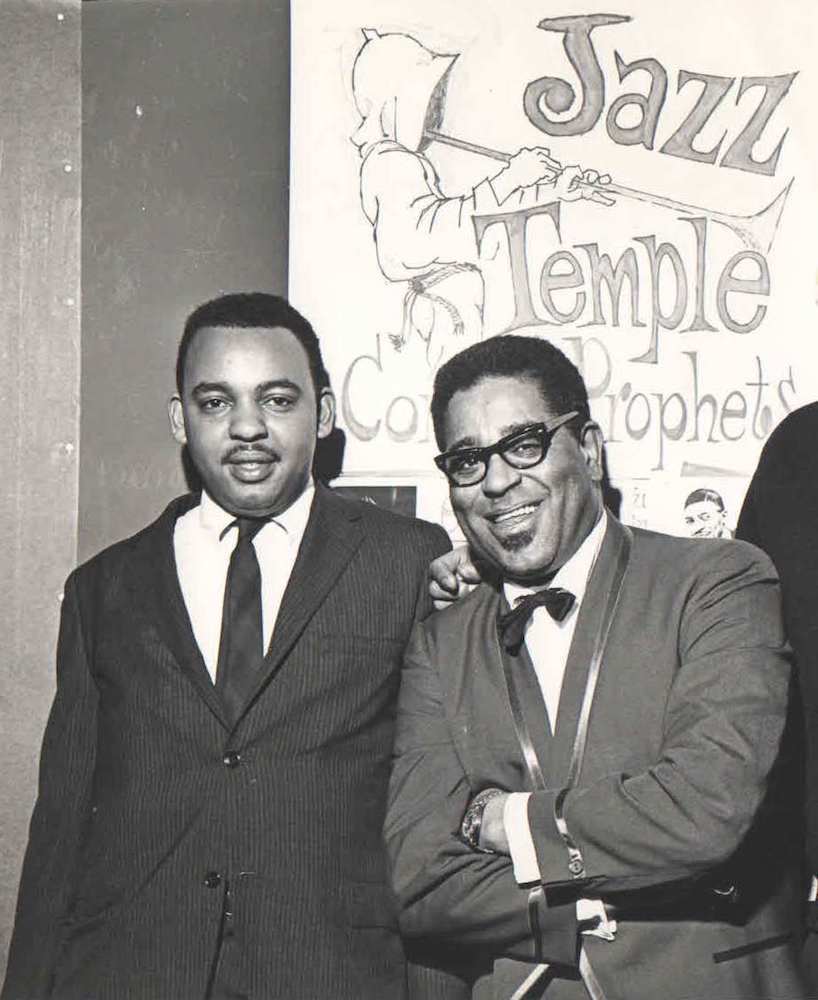
    <summary type="html"><![CDATA[<p><strong><em>Physical changes in neighborhoods are typical in most major cities, and with the passage of time they appear even more dramatic. Unlike fictional towns and buildings we’ve read about in childhood or seen in movies, change in community identity is inevitable.  Yet some images from the past populate our memories and we recall them with remarkable clarity.</em></strong></p><img src="https://mail.clevelandhistorical.org/files/fullsize/4be345c46cab75278d8b8288ce1d1ba8.jpg" alt="Winston Willis, Dizzy Gillespie in rear of Jazz Temple Building" /><br/><p>The Mayfield Triangle: The former street address 11339 Mayfield Road is now 11400 Euclid Avenue. And although official street numbering changes over the years for one reason or another (zoning requirements, city planning, urban renewal, or real estate development), certain historical facts about some properties often become lost amid the changes. Today, observing motorists and pedestrians teeming around the bustling Euclid Avenue and Mayfield Road intersection, it’s fair to say that few if any of them know the history of the Triangle area before it was transformed into the mini-metropolis now known as Uptown Cleveland. For a brief time in the early 1960s, the triangular lot, then known as the Mayfield Triangle, upon which now rests the Museum of Contemporary Art building, was the site of a popular coffee house jazz club called the Jazz Temple. </p><p>When the 1960s dawned in the United States, it was heralded as a new decade of youth and change by a dynamic young president, John F. Kennedy, who assumed office trumpeting his “new frontier”. In previous years, the calm complacency of the post World War-II era had lent a relative tranquility, but it was gradually disappearing as post-war babies were becoming young adults. With a cultural landscape that included sleek cars, the Twist, the Pill, and a persistent atmosphere of cigarette smoke, the nation was on the verge of a decade of counterculture and social revolution. A great deal of this culture fermented on college campuses where students were beginning to find their voices and express their own individual political views and values. </p><p>At a time when the U.S. was approaching some of its most explosive times, including the rise of a free speech movement, music was rapidly becoming the main vehicle of self-expression for young people. Jazz and one of its subgenres, free jazz/improvisational jazz, were very attractive, especially to college students. So when a shrewd and savvy young African American entrepreneur named Winston Willis brought his coffee house jazz club to University Circle, within arm’s reach of the Western Reserve University (now CWRU) campus, and at affordable prices, it appeared to be a dream come true for all concerned. Imagined, engineered and created by young Willis, who was also a big fan of the musical genre, the Jazz Temple arrived on the scene at the tail end of the Beatnik era and smack in the heyday of ’60s-type coffee houses. Willis chose the club’s name to symbolize a devout gathering place dedicated to the icons of the jazz world where legendary artists could be collectively enjoyed and appreciated. </p><p>Having operated several successful small businesses, he sensed that something was lacking in this upscale college community.  So, after making a careful assessment of the area and determining what was needed and what would be likely to work, he decided that high-quality jazz performances at a student-friendly and affordable price was the answer.  Then, quickly putting his idea into action, he secured a lease on a vacated building, a former Packard automobile showroom, and immediately began remodeling, devoting careful attention to acoustics. Shortly thereafter, in 1962, the club opened to immediate success.  </p><p>The liquor-less establishment that seated approximately 450 people was near the ethnic enclave known as Murray Hill (Little Italy), a place that was notably hostile toward African Americans. As noted by former Cleveland mayor Carl B. Stokes, "... Cleveland was in the hands of ethnics, the immigrants from Middle and East European countries." Historian Dr. Todd M. Michney has observed that "... Little Italy's residents historically marked their territory and sought to ward off racial residential transition through the use of violence..." With surrounding institutional neighbors in the city’s so-called "cultural oasis," the Jazz Temple was a noteworthy, if incongruous jewel in the Mayfield Triangle. </p><p>From all over Cleveland and surrounding areas, dedicated jazz enthusiasts assembled to enjoy and appreciate the musical genre. Soon, the terms “preaching at The Temple” and “worshipping at The Temple” became popular colloquialisms and catchphrases. Legendary jazz greats, many of whom were considered musical geniuses, frequently headlined at the club. Miles Davis was cool but Kind of Blue, John Coltrane took Giant Steps to play My Favorite Things, and Dizzy Gillespie was blowin’ and Boppin’ and Groovin’. Many other notable artists also performed magnificent solo riffs, instrumentations and stunning improvisations that became sealed in memories forever.  Though sometimes described erroneously in the local press as "the ultimate 'beatnik' club", the Temple also featured popular female jazz vocalists like Dinah Washington and Gloria Lynne, as well as great stand-up comics like Dick Gregory, Redd Foxx, and Richard Pryor.</p><p>During the early 1960s, the Western Reserve student body was predominantly white, and these students and others from surrounding universities accounted for a large percentage of the club’s patronage. But as is typical of jazz establishments, there was a noticeable amount of race mixing and many interracial couples in attendance each night. Individuals who managed to navigate the social inequities of the time and gather in a communal appreciation of jazz.</p><p>As the club’s notoriety grew, it came to be considered by many world-famous jazz musicians as the “Jazz Mecca." But the interracial dating and race-mixing at the club triggered widespread resentment in racially polarized Cleveland.  Particularly in the Murray Hill (Little Italy) community, where visible racial tensions mounted. With attempted intimidation by local law enforcement, some nights saw as many Cleveland police officers in attendance in the club as regular customers. These visits were routinely followed by unscheduled and unannounced inspections and bogus citations. The warnings were dire and persistent, and thereafter, months of ominous threats of violence and anonymous phone calls during and after business hours foretold of the coming end. Several famous acts appearing at the club refused to be intimidated initially, insisting on performing. But finally, after several thwarted bombing attempts, the frequency and intensity of the threats were followed by a tremendous after-hours explosion in 1964 that completely demolished the Jazz Temple and its brief reign ended soon after. As reported in the local press:  “Police were unable to find reasons for the bombing of the interracial house of jazz but they found remnants of a bomb." And the message was clear.</p><p><em><strong><a href="https://mail.clevelandhistorical.org/items/show/811">For more (including 10 images) view the original article</a></strong></em></p>]]></summary>
    <published>2017-09-23T21:49:29+00:00</published>
    <updated>2026-04-17T19:17:41+00:00</updated>
    <link rel="alternate" type="text/html" href="https://mail.clevelandhistorical.org/items/show/811"/>
    <id>https://mail.clevelandhistorical.org/items/show/811</id>
    <author>
      <name>Aundra Willis-Carrasco</name>
    </author>
  </entry>
  <entry>
    <title type="html"><![CDATA[The Elysium: The First 2,000-Seat Jim Crow Ice Skating Rink]]></title>
    <summary type="html"><![CDATA[<img src="https://mail.clevelandhistorical.org/files/fullsize/713c8e93850d40f068f3f5707b285e12.jpg" alt="Elysium" /><br/><p>The frequently recited story of the Elysium has been expertly told for decades. The traditional story is one of Cleveland lore, heavily laden with adjectives that conjure images of firsts, greatness, and business-genius. Missing from the Elysium story, however, are the multiple incidences of racial discrimination that took place at the famed ice skating rink.</p><p>Cleveland's new east side leisure-time hotspot opened to the public on November 23, 1907. The Elysium, a 2,000-seat indoor ice rink that stood on the corner of E. 107th and Euclid, held the title of the world's largest indoor ice skating rink – for roughly three years – until Berlin's Sportpalast opened in 1910. As reported, by the end of the Elysium's opening day, "hundreds of people had tried out the new ice." The papers praised the proprietor of the Elysium, Dudley Humphrey, of Euclid Beach Park and the popcorn ball fame, for erecting another place of wintertime recreation for the city's growing middle-class. </p><p>The Elysium's management encouraged almost all Clevelanders to forget about their winter blues. They hosted hockey games and people from all sides of Cleveland came to see the acclaimed Coddy Winters. In addition, you could free skate with your sweetheart, or buy tickets to watch figure skaters glide across the ice like elegant swans. One self-proclaimed "hockey bug" reminisced on the accessibility of the entertainment at the Elysium. Gordon Cobbledick, Sports Editor for the <em>Cleveland Plain Dealer</em>, said he often went to the Elysium as a young boy "because one could buy one's way into the Elysium for 35 cents, a sum which any red-blooded American boy could earn, with a nickel left over for popcorn, by shoveling only four snow-covered walks at a dime a piece." Of the hundreds of people that glided across the fresh ice with their friends, or cheered on one of Cleveland's first amateur hockey league teams, there was one group not in attendance – African Americans. </p><p>In 1939, the Humphrey Company was the target of two civil rights lawsuits because of incidents that occurred at the Elysium. In one of the episodes, an African American mother accompanied her children to the ice rink. The manager stopped the mother and children at the door and barred from admittance to the Elysium. The mother reported "that she and her children were approached by a Mr. Shannon … who informed her that the Elysium had never made preparations for Negro patrons, did not admit them, and had no intention of doing so in the future." In another incident, an African American child arrived at the Elysium for a school field trip. She too was prevented from joining her white classmates on the ice. The Elysium's front desk operator told her "gently…'Honey, colored children can't skate here.'" </p><p>These two racially motivated incidents were covered only by the <em>Cleveland Call and Post</em> and were settled outside of the courtroom. However, with the addition of these accounts a fuller picture can be formed concerning Cleveland's Humphrey Company. The Humphrey Company was repeatedly a "defendant in similar suits…which are reported to flagrantly discriminate against Negro[e]s." Rumors spread that the company even had a "slush fund" of "$10,000 annually set aside to take care of any suits that may arise out of their proclaimed policy of denying the use of the dance floor, and the roller rink to Negroes" at the Euclid Beach Park. The Humphrey Company appropriated some of this "slush fund" money to settle the discrimination lawsuits filed against the Elysium twice in 1939. The Humphrey Company's belief in segregation and prejudice filtered into all facets of its multi-venue operation, and Euclid Beach Park, like many amusement parks nationally, was marred by Jim Crow, leading to incidents such as the <a href="https://clevelandhistorical.org/items/show/562">Euclid Beach Park Riot</a> in 1946. </p><p>The beloved Elysium was clearly not a place of leisure for all Clevelanders. As the Elysium became the legendary birthplace of Cleveland hockey, the site's failure to abide by the State of Ohio's civil rights statutes was forgotten. In the 1930s, as hockey became more popular the old 2,000-seat Elysium could no longer host all of the fans. By 1941 the Elysium finally closed, and with it the stories of the blatant racial discrimination faded. </p><p>The old Elysium site operated as both a bowling alley and a used car-showroom over the ensuing decade, a far cry from its former glory. In 1951, the old Elysium site went up for sale. The city, after a lengthy debate as to whether or not to purchase the land, ultimately acquired the property. The city then tore down the Elysium as part of a beautification effort. The City of Cleveland anticipated the land would "add greatly to the beauty of the grand entrance of Wade Park." Once the original site of the Elysium was re-imagined as urban green space, the public leisure area could finally be enjoyed by all – regardless of race. However, the legacy of Jim Crow continued to plague skating into the 1950s. Often denied entrance to the popular Skateland at Euclid and East 90th, black skaters found sanctuary at <a href="https://clevelandhistorical.org/items/show/621">Pla-Mor Roller Rink</a>, located just two blocks south of the former Elysium.</p><p><em><strong><a href="https://mail.clevelandhistorical.org/items/show/808">For more (including 7 images) view the original article</a></strong></em></p>]]></summary>
    <published>2017-07-06T20:25:59+00:00</published>
    <updated>2026-04-17T19:17:41+00:00</updated>
    <link rel="alternate" type="text/html" href="https://mail.clevelandhistorical.org/items/show/808"/>
    <id>https://mail.clevelandhistorical.org/items/show/808</id>
    <author>
      <name>Sarah Nemeth</name>
    </author>
  </entry>
  <entry>
    <title type="html"><![CDATA[Cleveland Botanical Garden: Eleanor Squire&#039;s Gift]]></title>
    <summary type="html"><![CDATA[<img src="https://mail.clevelandhistorical.org/files/fullsize/215400b1a3866d83ea99061d7553de01.jpg" alt="Wade Park Lagoon Boathouse" /><br/><p>The Cleveland Botanical Garden, the first civic garden center in the country and now part of an expanded and renamed entity known as Holden Forests & Gardens, has a growing presence in University Circle. </p><p>The Garden’s origins date to 1916 when Eleanor Squire donated a large collection of horticultural books to the Garden Club of Cleveland. In 1930 members of the club—led by Mrs. Thomas P. Howell, Mrs. William G. Mather, Mrs. Charles A. Otis, Mrs. John Sherwin, Mrs. Walter C. White, and Mrs. Windsor T. White—remodeled an empty boathouse on the shore of Wade Lagoon to house their literature collection. They christened their new home and organization The Garden Center of Greater Cleveland, with a mission to “promote such knowledge and love of gardening as will result in a more beautiful community.” Seven years later the Center was incorporated as a non-profit organization, offering individual memberships, expanding its affiliations with other garden clubs and allying itself with the Garden Program of the Cleveland Public Schools. A renovation in 1939 tripled the building's size. During World War II, the Garden Center maintained victory gardens and delivered flowers to veterans at local hospitals and infirmaries.</p><p>In 1966, a new Garden Center facility was completed at 11030 East Boulevard, a quarter mile to the north of the old boathouse. The new site had, from 1889 to 1907, housed the <a href="https://clevelandhistorical.org/items/show/387">Wade Park Zoo</a>, Cleveland’s original zoo. That facility’s Monkey House stood where the Center’s herb garden is today and the Bear Pit was located alongside East Boulevard in what is now the Japanese Garden. Wade Hall (1886) had been the Zoo’s Deer Barn, one of the oldest zoo buildings in North America. In 1975 it was moved to the current Cleveland Metroparks Zoo in Old Brooklyn. Remodeled as a Victorian-style ice cream parlor, the building now sits adjacent to Waterfowl Lake. </p><p>The 1966 move followed a half dozen years of disastrous springtime flooding. Water from heavy storms often surged down the hills from Cleveland Heights, inundating much of University Circle. The Garden Center's boathouse was badly damaged on several occasions, ultimately necessitating its demolition. A concurrent City initiative to install new sewers in the Heights and several massive “interceptors” at key locations near the Circle was launched concurrently to contain floodwaters. </p><p>The Garden Center changed its name to the Cleveland Botanical Garden in 1994. In 2003, the building was remodeled to dramatically expand its footprint. That effort resulted in expanded outdoor gardens, a parking garage underneath Wade Oval, a climate-controlled environment for the library’s rare-book collection and, most notably, the Eleanor Armstrong Smith Glasshouse—two giant “biodomes” featuring the flora of Madagascar's Spiny Desert and a simulated Costa Rican Cloud Forest. Within these massive terraria live more than 350 species of plants and 50 species of animals, including hundreds of butterflies.</p><p>In 2014, the Cleveland Botanical Garden joined forces with <a href="https://clevelandhistorical.org/items/show/846">Holden Arboretum</a> to become Holden Forests and Gardens, thus putting CBG on far firmer financial ground. Today, its patrons enjoy a unique all-season, indoor-outdoor experience: an extensive horticultural museum; special events such as Orchid Mania, Gourmets in the Garden and WinterShow; as well as ten acres of gardens, including the Herb Garden (1969), Rose Garden (1971), Reading Garden (1973), Japanese Garden (1975), Woodland Garden (1989) and Children’s Garden (1999). Cleveland Botanical Garden also supports community outreach, environmental research and urban-farming programs, and an applied research initiative focused on turning abandoned properties into green infrastructure.</p><p><em><strong><a href="https://mail.clevelandhistorical.org/items/show/764">For more (including 12 images&#32;&amp;&#32;2 audio files) view the original article</a></strong></em></p>]]></summary>
    <published>2016-04-12T20:03:49+00:00</published>
    <updated>2026-04-17T19:17:41+00:00</updated>
    <link rel="alternate" type="text/html" href="https://mail.clevelandhistorical.org/items/show/764"/>
    <id>https://mail.clevelandhistorical.org/items/show/764</id>
    <author>
      <name>Rachel L. Littler&amp;#32;&amp;amp;&amp;#32;Chris Roy</name>
    </author>
  </entry>
  <entry>
    <title type="html"><![CDATA[Cozad-Bates House: Anti-Slavery Activism in Cleveland]]></title>
    <summary type="html"><![CDATA[<img src="https://mail.clevelandhistorical.org/files/fullsize/7b14c2ddd9e3969ac9d352550b3d0337.jpg" alt="Cozad-Bates House, 2008" /><br/><p>Arriving in 1807, Cleveland pioneer Andrew Cozad settled in the area east of the city that is known today as University Circle, later establishing what proved to be a successful commercial brick-making business. He and his wife Sally had five children with one of their four sons, Justus, being born to them in 1833. As a young boy Justus was, by his own later admission, a difficult child but quickly realized his life's ambition of becoming a civil engineer and soon committed fully to educating himself. Before long he was employed in a railroading career earning a substantial salary for that time of $60 a month. Justus passed the majority of these earnings on to his father, who invested them into the construction of a house for Justus which he personally completed in 1852.</p><p>This house is reputed to have been involved with the Underground Railroad, and if this is in fact the case Justus Cozad could not have been a "conductor," having moved to Nebraska the year after its completion to pursue work in land surveying and not returning permanently to Cleveland until 1862. During those years Justus's brother-in-law's father Andrew Duty resided in the home and while there is no definitive evidence linking him to the aiding of fugitive slaves, certain clues suggest that he likely did. Duty contributed generously to and served as trustee of the Euclid Avenue Congregational Church throughout his life. Congregational churches were known to be largely abolitionist, and a number of Euclid Avenue's members had documented Underground Railroad involvement. Among them were immediate neighbors, the Fords, who owned land all along Euclid Avenue between Doan's Corners and Dugway Brook. Thus, while it may be impossible to confirm that Andrew Duty operated Justus Cozad's house as an Underground Railroad stop, at the very least it can be said that a strong connection exists between the house and the time, place, and people involved in those activities.</p><p>When Justus finally returned to Cleveland it was only a year before he moved again, this time to Indianapolis for work. He returned in 1871, completing the Italianate addition to the front of the house the following year. He also entered into the title abstract business but was eventually forced to sell many of his business interests along with his home after his brother Marcus defaulted on a substantial loan that he had extended to him. The house was soon purchased by Justus's daughter Olive and her husband Theodore Bates, however, and Justus moved into a home across East 115th  Street from them. It was here that he lived until his death in 1910, and nine years later both Olive and Theodore also passed away.</p><p>After the passing of Olive and Theodore the house was divided into apartments and managed by Bates & Springer Inc., catering to the thriving academic and medical communities of the area for the next sixty-five years. Gaining historic landmark status in 1974, the residence continued to operate as a rooming house until it was purchased by University Hospitals in 1985. After its acquisition by UH, the house sat vacant and neglected for the better part of twenty years before University Hospitals decided to donate the property to University Circle Inc. (UCI) in 2006. Thereafter, the organization Restore Cleveland Hope worked with UCI to transform the Cozad-Bates House into a teaching center that celebrates Cleveland's Underground Railroad history.</p><p>Today the house seems rather out of place amongst the towering medical buildings, large parking structures, and high-rise apartment buildings that surround it. However, if you look at the historical circumstances that surround the house it becomes clear why it is located and still standing in the heart of Cleveland's cultural center.</p><p><em><strong><a href="https://mail.clevelandhistorical.org/items/show/651">For more (including 6 images&#32;&amp;&#32;1 audio file) view the original article</a></strong></em></p>]]></summary>
    <published>2014-04-16T08:20:05+00:00</published>
    <updated>2026-04-17T19:17:40+00:00</updated>
    <link rel="alternate" type="text/html" href="https://mail.clevelandhistorical.org/items/show/651"/>
    <id>https://mail.clevelandhistorical.org/items/show/651</id>
    <author>
      <name>Joseph Wickens</name>
    </author>
  </entry>
  <entry>
    <title type="html"><![CDATA[Euclid Heights Allotment: Patrick Calhoun&#039;s &quot;Garden City&quot; atop the Overlook]]></title>
    <summary type="html"><![CDATA[<img src="https://mail.clevelandhistorical.org/files/fullsize/4e1697c453f81282f1f1c85acec7786b.jpg" alt="Euclid Heights Stock Certificate, 1903" /><br/><p>The Euclid Heights Allotment was the first major real estate subdivision up on Cleveland's "Heights" above University Circle and Euclid Avenue. Early on, Euclid Heights’ developers sought to attract wealthy Millionaires’ Row residents who, in the late 19th century, had begun migrating eastward away from the city's pollution and commercial bustle. The development benefited from the advent of electrified streetcars, which could conquer the steep grades leading up to the Heights. Tucked in the corner of a green space framed by Doan Brook and Lake View Cemetery, Euclid Heights offered a stylish retreat where those able to handle longer commutes could enjoy spacious lots, curving streets, handsome architecture, spectacular views, fresh air, privacy and a chance to put distance between themselves and the increasingly dirty, problem-plagued city below.</p><p>The story goes that Atlanta and New York railroad lawyer Patrick Calhoun, grandson of U.S. Vice President and Senator John C. Calhoun, traveled to Cleveland on business in 1890. Having time to spare, Calhoun rode out to Lake View Cemetery to see the recently dedicated memorial to the slain President James A. Garfield, a structure Calhoun’s family had supported. On the way he noticed the building boom going on in the East End (Hough area), and wondered where that was heading. Calhoun had been involved earlier in the Richmond Terminal railroad project in Virginia and was familiar with the groundbreaking work that Frank Sprague, the "Father of Electric Traction," had done there in using electric railroads to promote urban development. Knowing that the East Cleveland Railway Company had recently done some innovative work electrifying streetcars locally, Calhoun saw an opportunity to develop an important streetcar suburb at the top of Cedar Glen.</p><p>Working with local partners, including John D. Rockefeller's real estate man, J.G.W. Cowles, attorney William Lowe Rice and merchant John Hartness Brown, Calhoun had development plans drawn up by 1892. The Panic of 1893 put their plans on hold but by 1896 an amended site plan was recorded—more or less identical to today's layout of the area with Euclid Heights Boulevard bisecting the site from the southwest corner at the crest of Cedar Hill. In the northeast corner of the development would be the commercial district, what we now know as Coventry Village. Other prominent features included The Overlook—Overlook Road southwest of Edgehill Road and featuring large mansions featuring splendid north- and west-facing views—and the Euclid Club, a country club that sported a golf course spanning both sides of Cedar Road and a grand quarter-mile entry path beginning at what is now the corner of Derbyshire and Surrey Roads. </p><p>The development gradually attracted fine homes and also spurred other beautiful subdivisions, such as Barton Deming’s Euclid Golf Allotment on the south portion of the former golf course (which closed in 1912). Moreover, the Van Sweringen brothers, are believed to have been paperboys in the Euclid Heights area and later went on to adopt themes from the Euclid Heights Allotment in their famous Shaker Heights and Shaker Farm communities (the latter comprises streets such as Stratford, Marlboro, Fairfax and Guilford, west of Lee Road and immediately north of Fairmount Boulevard) . Calhoun, however, was distracted by legal problems running the San Francisco streetcar franchise after the Great Earthquake and saw his Euclid Heights development company forced into bankruptcy in 1914. By then William Rice had been murdered while walking home to the Overlook from the Euclid Club, a sensational case that featured John Hartness Brown as a suspect. Although it still maintains its picturesque “Garden City” look, Euclid Heights soon evolved from a private hilltop retreat to a busy gateway to the rapidly developing Heights. A large portion of Calhoun-owned land in the area’s eastern sector was sold off and subdivided, thus explaining why Cleveland Heights homes east of Coventry Road tend to be somewhat more modest than those near the top of the hill. Today Euclid Heights is listed on the National Register of Historic Places. It remains full of architecturally significant homes (including Calhoun's at 2460 Edgehill), but its main significance is the role it played in opening the Heights as a streetcar suburb for wealthy Clevelanders.</p><p><em><strong><a href="https://mail.clevelandhistorical.org/items/show/650">For more (including 9 images) view the original article</a></strong></em></p>]]></summary>
    <published>2014-03-18T17:25:17+00:00</published>
    <updated>2026-04-17T19:17:40+00:00</updated>
    <link rel="alternate" type="text/html" href="https://mail.clevelandhistorical.org/items/show/650"/>
    <id>https://mail.clevelandhistorical.org/items/show/650</id>
    <author>
      <name>William C. Barrow</name>
    </author>
  </entry>
  <entry>
    <title type="html"><![CDATA[Milan R. Stefanik Statue: Finding a New Home for a Slovak Cultural Hero]]></title>
    <summary type="html"><![CDATA[<img src="https://mail.clevelandhistorical.org/files/fullsize/8d0b4f244614dc0ec8e8d2509f59eb66.jpg" alt="Cleveland Stefanik Statue " /><br/><p>In years past, when you traveled Martin Luther King Jr. Drive to the Cleveland Museum of Art, you likely noticed the formidable-looking bronze statue towering over the road's intersection with Jeptha Drive, the little road that takes you up to the Museum parking lot.  The statue was erected as a memorial to Milan R. Stefanik, Slovakia's greatest and most treasured national hero.  It had been a featured monument in Wade Park for nearly 90 years and was a source of pride for Cleveland's Slovak community.  However, on your next trip to University Circle, don't going searching for this statue in Wade Park.  It's  no longer there.  As a result of extensive road and sewer construction work in Wade Park, the statute was removed in 2013 from its site at this intersection and, in a somewhat controversial move, eventually relocated to to the Slovak Cultural Garden, down the road in Rockefeller Park.</p><p>It's easy to understand why the memory of Milan Stefanik is so treasured by Cleveland's Slovak-American community and why even after 90 years moving his statue to a new location created some controversy in this ethnic community.  Stefanik, son of a Lutheran minister, was born in 1880 in a village in what is today western Slovakia.  In his youth, he was a brilliant student.  He attended Charles University in Prague where he earned a PhD in Philosophy.  In 1904, he immigrated to France where in the space of a decade he achieved an international reputation as a Renaissance man who excelled in a number of different fields of scientific endeavor.  In 1914, when World War I broke out in Europe, Stefanik joined the French Army becoming a military pilot, flying missions against Axis forces in Europe.  Within a short time, he was promoted to the rank of general.  In addition to his military duties, he traveled extensively in Europe and in the United States with future first president Tomas Masaryk and others lobbying for the creation of Czechoslovakia.  After the war ended, Stefanik was returning to the new republic in May 1919 to become its first minister of defense, when the plane he was piloting--just after it had crossed over the border into Czechoslovak airspace,  mysteriously crashed, killing him. </p><p>Within months of Stefanik's death, Cleveland's Slovak community undertook plans to have a statue sculpted in his honor.  It was not an easy project to complete.  Slovak-American leaders in New York and in other U.S. cities argued that the statue should be sited in a more important venue, Washington, D.C.   Back in Cleveland, some members of City Council wanted the statue to be located in a park in Garfield Heights.  Cleveland's Slovak community, however, led by ethnic journalist and civic leader, John Pankuch, was persistent and succeeded in 1924 in erecting the statue in Wade Park--where, according to Pankuch, it would be visible to thousands of members of the general public who "would pass by [it] every hour." </p><p>In 1929, just five years after the statue was placed in Wade Park, a proposal was made to move it to the new Slovak Cultural Garden that was being planned in Rockefeller Park.  Drawings were made, footers were laid, and preliminary work to raise the statue off its pedestal was started.  But then John Pankuch and others stepped in and persuaded the Slovak community to keep the statute in Wade Park where it remained ever since until its relocation in 2013.  Now as the centerpiece of the Slovak Cultural Garden, the Milan R. Stefanik statue sits on a pedestal that was built upon the same footers that the Slovak Civic League had poured for it in the early 1930s.  It is situated between the busts and pedestals of two other Slovak cultural heroes, poet Jan Kollar and Stephen Furdek, the father of American Slavs.  While, as noted, this move was not without controversy, many in the Slovak community shrug it off and say that the statue has simply finally come home.</p><p><em><strong><a href="https://mail.clevelandhistorical.org/items/show/611">For more (including 12 images) view the original article</a></strong></em></p>]]></summary>
    <published>2013-05-18T06:04:14+00:00</published>
    <updated>2026-04-17T19:17:40+00:00</updated>
    <link rel="alternate" type="text/html" href="https://mail.clevelandhistorical.org/items/show/611"/>
    <id>https://mail.clevelandhistorical.org/items/show/611</id>
    <author>
      <name>Jim Dubelko</name>
    </author>
  </entry>
  <entry>
    <title type="html"><![CDATA[The Thinker: Cleveland’s Philosopher King ]]></title>
    <summary type="html"><![CDATA[<img src="https://mail.clevelandhistorical.org/files/fullsize/3542f9211f0684c9285147950e56dcbc.jpg" alt="Hell on Earth" /><br/><p>Wounded but forever pensive, The Thinker graces the Cleveland Museum of Art’s original main entrance. In 2017 he quietly celebrated the 110th anniversary of his casting and the 100th anniversary of his installation in Cleveland. In 2020 he’ll stoically acknowledge 50 years since the assault that ripped him from his base and shredded his legs below the calf. Ironically, that March 1970 bombing might have increased The Thinker’s metaphoric permanence: Lacking ambulation, University Circle’s marquis gatekeeper, philosopher and historical symbol is more intransient than ever. </p><p>The Thinker is one of 25 identical twins: 900-pound bronze casts based on a 27-inch-high clay and plaster model created by Auguste Rodin in 1880. Rodin supervised roughly ten of these castings, including Cleveland’s, but he died shortly before installation occurred in 1917. The Thinker model was part of a commission for the proposed Museum of Decorative Arts in Paris. The museum was never built but a number of Rodin masterworks emerged, including The Gates of Hell, The Kiss and The Thinker, all inspired by Dante’s Divine Comedy. The bronze Gates of Hell (20 feet high, 13 feet wide and weighing eight tons) was slated to be the Museum’s front door. A small cast of The Kiss can be seen in the lower right section of the door. The Thinker (Le Pensure), originally entitled The Poet (Le Poète), resides atop the door panels. Some believe he is Dante observing his characters in The Inferno. Others postulate that The Thinker is Adam, musing about the destruction his sin brought upon mankind. </p><p>The Gates of Hell and bronze casts of The Thinker and The Kiss now reside at the Musée Rodin in Paris. Another of The Thinker’s identical siblings stands atop the graves of Rodin and his wife Rose, and a third guards the entrance to the Rodin Museum in Philadelphia. Other US cities in which he resides include Baltimore (2), Denver, Detroit, Louisville, New York (2), Pasadena, San Francisco and Kansas City. Thinkers can also be found in Argentina, Germany, Denmark, Japan, Belgium, Russia and Sweden. Cleveland’s Thinker is one of last casts that Rodin supervised personally.</p><p> </p><p>At about 1:00 AM on March 24, 1970, a bomb equivalent to three sticks of dynamite exploded beneath The Thinker, knocking him from (and destroying) his pedestal and turning his lower legs to shrapnel. He landed face down, perhaps using the occasion to contemplate Hell more directly. The Cleveland Art Museum opted not to replace the statue and reinstalled it without repairing the damage. The decision’s prime motive was a desire to preserve and honor Rodin's original work which, in turn, might memorialize the turmoil of the Vietnam War years. It’s generally agreed that the attack was undertaken by a Cleveland faction of the Weathermen (aka., the Weather Underground) an ultra-radical political group that voiced its opposition to the Vietnam War (and US imperialism in general) by bombing government buildings, banks and other targets. A spray-painted message at the base of the toppled statue read “Off the ruling class.” No one admitted to, or was ever charged, for the crime. </p><p>Thus The Thinker goes on doing what he does best. Stabilized with Incralac (a copper and copper-alloy coating) and washed and waxed twice annually, he endures miserable winters and occasional scorching summers without complaint. If statues could only talk.</p><p><em><strong><a href="https://mail.clevelandhistorical.org/items/show/575">For more (including 7 images) view the original article</a></strong></em></p>]]></summary>
    <published>2013-02-05T20:52:51+00:00</published>
    <updated>2026-04-17T19:17:39+00:00</updated>
    <link rel="alternate" type="text/html" href="https://mail.clevelandhistorical.org/items/show/575"/>
    <id>https://mail.clevelandhistorical.org/items/show/575</id>
    <author>
      <name>Chris Roy</name>
    </author>
  </entry>
  <entry>
    <title type="html"><![CDATA[Glidden House: An Inn in a Historic Paint Company Executive&#039;s Former Home]]></title>
    <summary type="html"><![CDATA[<img src="https://mail.clevelandhistorical.org/files/fullsize/1fa32f3d2bf5a3568620ca0952c6a45f.jpg" alt="The Glidden House" /><br/><p>In 1909, Francis K. Glidden, the son of the founder and president of Glidden Paint Co., built a dream home for his family in the University Circle district. The family chose to build in the Wade Park Allotment, a residential development near the current Case Western Reserve University campus. The area was designed for well-to-do residents of Cleveland. Even in the company of the affluent, the Glidden mansion was one of the largest and most impressive in the neighborhood, with dozens of rooms, a full basement, a stately corner yard, and a carriage house.  </p><p>The Glidden House was built to serve as the family's main residence. Francis (Frank) and his family moved from East 55th Street to the new mansion in 1910. After his death in 1933, his wife Mary resided in the home with her sister - another prominent Clevelander, Ida Winifred - until she passed away in 1939. Mrs. Winifred stayed in the home into the early 1950s. </p><p>Like most of Cleveland's elite neighborhoods, Wade Park lost most of its wealthier inhabitants to the nearby suburbs. The expanding suburbs boasted close proximity to Cleveland without the noise and pollution associated with the city. The suburbs also offered safety, larger yards, and lower price tags. This migration left many of the older homes at the mercy of  surrounding institutions. Fortunately, because the Glidden House was so centrally located to the WRU campus, the school purchased the property and put it to good use. Originally used as the Psychology Department Building for many years, it later became part of the Law School. </p><p>In the mid-1980s, Glidden House evolved into its current life as a boutique hotel. The house is part of the greater movement for more housing in University Circle. Previously, the most common developmental practices here included replacing residential buildings with institutional ones. While many original homes were demolished to make way for high-tech campus buildings or expansive museums, these same institutions also saved some of the magnificent homes. The Glidden House is one home which has not just survived, but has continually been used to contribute to the development of University Circle. </p><p><em><strong><a href="https://mail.clevelandhistorical.org/items/show/472">For more (including 6 images) view the original article</a></strong></em></p>]]></summary>
    <published>2012-05-22T20:21:15+00:00</published>
    <updated>2026-04-17T19:17:39+00:00</updated>
    <link rel="alternate" type="text/html" href="https://mail.clevelandhistorical.org/items/show/472"/>
    <id>https://mail.clevelandhistorical.org/items/show/472</id>
    <author>
      <name>Eleanor Kaiser</name>
    </author>
  </entry>
  <entry>
    <title type="html"><![CDATA[Tudor Arms Hotel: Originally the Cleveland Club]]></title>
    <summary type="html"><![CDATA[<p><strong><em>At the corner of Carnegie Avenue and Stokes Boulevard stands a baronial fortress of a building that looks as though it would be perfectly at home on Manhattan's Upper West Side. A closer inspection reveals city founder Moses Cleaveland in bas-relief, his stone likeness peering down on the corner of Carnegie and Stokes. The Cleaveland carving offers a clue to the building's origin.</em></strong></p><img src="https://mail.clevelandhistorical.org/files/fullsize/b59490fa334baa2a1d6f5c67b384de71.jpg" alt="Looking West Toward Tudor Arms " /><br/><p>Constructed in 1926-30, the Tudor Arms opened in 1930 as the swanky, exclusive Cleveland Club. The enormous Gothic Revival structure, designed by Frank Meade (who also designed countless extravagant homes in Cleveland Heights and Shaker Heights), was the tallest and grandest in the University Circle area. The twelve-story building boasted ballrooms, a swimming pool, a bowling alley, tall ceilings, huge leaded windows, intricate and expensive detailing including gargoyles and even a sculpture of Moses Cleaveland, whose presence reflects the club's intent to represent his namesake city. Over the years, the Cleveland Club rented out its ballrooms and also hosted lavish parties and events. But the club could not sustain the building for very long. The tough economy finally forced the Cleveland Club to forfeit its lease on the building in 1939. </p><p>On July 1, 1939, hotel operator Torrance C. Melrose assumed the lease, opening the Tudor Arms Hotel with rooms on the upper seven floors and sub-leasing existing club spaces to the Cleveland Club. The Tudor Arms soon became a noted entertainment venue. Jazz musicians kept its grand ballroom, the Empress Room, swinging well into the night. The ballroom functioned as a supper club and offered dinner along with the entertainment, which included jazz as well as many types of performances, from the conservative Lawrence Welk to the flamboyant Patrice Wymore. The Plain Dealer described one of Wymore's performances at the Tudor Arms in the following way: "Patrice Wymore, the singer and dancer [who] beats up no small storm of entertainment performed in the Empress Room. Her rhinestone studded hosiery, by the way, retails at $75 a pair, and on her they're worth it!" At the time, many frowned upon Wymore's provocative performance believed such acts at the hotel tarnished the neighborhood's respectability. </p><p>In 1960, as racial tensions began to sweep the city's east side, University Circle institutions regarded the flashy hotel nightclub as an undesirable tenant in the neighborhood. Accordingly, Western Reserve University and the Case Institute of Technology took over the property for use as a graduate student dormitory. They started the process by slowly changing some of the rooms into dormitories, while others continued to be rented nightly. The process was successful, and by 1963 the building had been fully converted for student use. During the conversion, the Tudor Arms got a $500,000 facelift, but it was not an extensive remodel. Eventually, the newly federated Case Western Reserve University leased the building to Cleveland Job Corps, which occupied the Tudor Arms until the building was sold in 2007.</p><p>After years of neglect, the Tudor Arms Hotel needed restoration. Minimal updates over the years had kept the building running, but it was a far cry from the glory days of the 1930s. In 2011, four years after Cleveland developers MRN Ltd purchased the property and undertook a $22 million restoration plan, the Tudor Arms reopened as a Doubletree hotel. </p><p><em><strong><a href="https://mail.clevelandhistorical.org/items/show/466">For more (including 13 images&#32;&amp;&#32;1 audio file) view the original article</a></strong></em></p>]]></summary>
    <published>2012-05-21T20:29:26+00:00</published>
    <updated>2026-04-17T19:17:39+00:00</updated>
    <link rel="alternate" type="text/html" href="https://mail.clevelandhistorical.org/items/show/466"/>
    <id>https://mail.clevelandhistorical.org/items/show/466</id>
    <author>
      <name>Eleanor Kaiser</name>
    </author>
  </entry>
  <entry>
    <title type="html"><![CDATA[Cathedral Latin School]]></title>
    <summary type="html"><![CDATA[<img src="https://mail.clevelandhistorical.org/files/fullsize/c0333dca34fc4417c7f01de12e7c42ef.jpg" alt="Cathedral Latin School Postcard" /><br/><p>A growing Cleveland urban and east side community brought increased demand for Catholic educational opportunities for young men after the beginning of the twentieth century.  In 1916 Cleveland Bishop John Farrelly announced the creation of a new Catholic preparatory school for boys to be built at University Circle. Cathedral Latin School opened in the fall of 1916 in temporary quarters in Hitchcock Hall of Western Reserve University at 11105 Euclid Avenue while its permanent home was built on 107th Street between Euclid and Carnegie Avenues.  The new building's cornerstone was set in 1917 to initiate the Italian Renaissance design by Boston Architect E. T. Graham. The first eleven graduates commenced from the school in 1919 at the formal dedication of the new building. Hitchcock Hall stands today; Cathedral Latin does not.</p><p>Thirteen diocesan priests would staff the school for academic courses and five Marianist Brothers would teach the science and business courses. The Society of Mary (Marianist order) of priests and brothers was founded in Bordeaux, France and by 1849, the first Marianists arrived in New York City to pursue their mission of elementary and secondary teaching.  Cleveland Bishop Amadeus Rappe invited Marianists to Cleveland. When Cathedral Latin opened, the brothers withdrew from the parish schools in the city and staffed the new preparatory school. </p><p>Cathedral Latin's historian, Gene Gibbons characterized the state of Cleveland's public school system at the time Latin was founded as struggling with a largely immigrant, non-English speaking population to fit a "working class with cultural values compatible with the requirements of the modern factory." Further, the city's new inhabitants were mostly Catholic; Cleveland's Catholics numbered 60,000 in 1860 and over 440,000 in 1920. </p><p>Latin was modeled after Boston's Latin School and, combined with the Bishop's intent to build a cathedral on the site now occupied by Severance Hall, the school would serve a function for the cathedral community. Bishop Farrelly's plans were never completed following his untimely death in 1921.</p><p>Cathedral Latin prospered, nonetheless, and grew with enrollments and facilities. Residence halls for students and faculty were added as well as an annex to the building to accommodate more than 11,000 men from 1916 through the schools closing in 1979. Peak enrollments of 1200 men were reached in the mid 1960's. Throughout its history, Latin distinguished itself in academics, extra curricular programs, and athletics in the East Senate with Cleveland's public schools and several other Catholic high schools. The demand for parochial education saw the growth of Catholic schools in Cleveland and its suburbs expand in the early 1960's. Thirty-seven Catholic high schools met the demands of 21,000 students. However, in time, the expansion strategy would complicate the system. </p><p>By 1970, Latin's enrollment declined to just over 800 students as neighboring Doan's Corners block deteriorated with urban blight and parents grew wary of neighborhood issues. In 1975, a threatened closing of Cathedral Latin prompted a three week rally of resources including its strong alumni to support the program and manage its future. "Latin is here to Stay" announced a banner on the front of the school. A study to determine future strategies would keep the school open. The effort would only last four years as enrollments continued to fall to 300 students by the end of the decade. In February, 1979, the Marianist provinciate announced the closing of Cathedral Latin following a lengthy study of its current and future status and outlook. Several efforts were undertaken to save the school by the alumni association to reopen the school with a different administration. However, without diocesan support, the effort did not materialize.</p><p>The diocese promptly sold the buildings and land along the west side of East 107th street to the state/city/UCI in 1980. Corresponding actions to legally shut down and seize the Euclid Avenue strip of undesirable establishments owned by Winston Willis made way for a project suited to the desires of the University Circle master plan. In its space stands the former state-owned W.O. Walker Industrial Rehabilitation facility which was grossly underutilized to serve patients until it was jointly 'adopted' by the University Hospitals and the Cleveland Clinic Foundation in 1995.</p><p><em><strong><a href="https://mail.clevelandhistorical.org/items/show/456">For more (including 7 images) view the original article</a></strong></em></p>]]></summary>
    <published>2012-05-10T22:12:35+00:00</published>
    <updated>2026-04-17T19:17:39+00:00</updated>
    <link rel="alternate" type="text/html" href="https://mail.clevelandhistorical.org/items/show/456"/>
    <id>https://mail.clevelandhistorical.org/items/show/456</id>
    <author>
      <name>Jim Lanese</name>
    </author>
  </entry>
  <entry>
    <title type="html"><![CDATA[Observation Elementary School: &quot;On-the-job&quot; Teacher Training]]></title>
    <summary type="html"><![CDATA[<p><strong><em>The responsibility for training and licensing teachers evolved from a school district function a century ago to the current university model. Cleveland's Observation School provides a glimpse of this evolution.</em></strong></p><img src="https://mail.clevelandhistorical.org/files/fullsize/8c462150a0e65c99f7930b422f756794.jpg" alt="Cleveland Normal School." /><br/><p>The former four-story orange brick Cleveland School of the Arts building on Stearns Road in University Circle was highlighted by three ornate terra cotta entrances.  It was built as Observation Elementary School in 1910. According to the Cleveland Restoration Society, this makes it one of the oldest school buildings in the Cleveland Metropolitan School District. </p><p>On November 20, 1907, the Cleveland Plain Dealer reported that the Board of Education purchased about 88,000 square feet of land between East 107th Street and Marlborough (now Stearns) Road to accommodate both John Hay High School and the new normal school. While John Hay awaited another 20 years of planning and debate, the Normal school was built by 1910, supplying facilities and teachers to the growing public school district. </p><p>During the earlier days of public schooling, the school districts were responsible for training teachers and normal schools were utilized for this purpose. Specifically, teacher-education efforts in Greater Cleveland resulted from the Common School Law of 1836. There was a model school, forerunner of laboratory schools, for children under 14, where prospective teachers of both sexes could gain some practical experience. Cleveland school superintendent Andrew J. Rickoff established the Cleveland City Normal School in 1872, with the first school opening on Eagle Street in 1874. Here, teachers-to-be practiced in actual [normal] school settings - while being supervised by 'critic teachers' - to develop their teaching skills. The goal was for these teacher-students to learn enough to eventually be hired to teach in the Cleveland schools. </p><p>In 1914, the state of Ohio passed legislation which governed the certification of teachers and imposed additional standards regarding their preparation. Later, a department of education was established in Mather College, where both Mather and Adelbert students could take professional education courses for certification. In 1928, the university's School of Education was managed by both the Board of Education and the university. In 1945, courses for practicing teachers were transferred to Cleveland College where professional education courses required for state certification were taken. During this transitional period of teacher education, the normal school became "Observation Elementary School". The name came from the fact that the school still provided access to a real, observable school setting to help complement teacher training at nearby Western Reserve University.</p><p>In 1981, the building again underwent a role transition. The Cleveland Public Schools were working to comply with several components of a complex federal court order to desegregate its schools. One of the strategies employed by the district was the creation of thematic and magnet schools featuring unique and focused coursework for students. The Cleveland School of the Arts was identified and located at the Observation School facility. The school's proximity to all the cultural resources of University Circle made the site and ideal choice. The Arts school prospered at the Stearns Road location until 2009 when it was moved to a temporary school building awaiting its redevelopment on stearns Road. A presentation at the Cleveland Planning Commission in November 2011 showed the design of the new Cleveland School of the Arts building, which includes an intention to salvage the historic school's terra cotta for use on the interior of the new building. Terra cotta removal started in late December 2011. Demolition was completed in 2012.</p><p><em><strong><a href="https://mail.clevelandhistorical.org/items/show/455">For more (including 4 images) view the original article</a></strong></em></p>]]></summary>
    <published>2012-05-10T16:55:09+00:00</published>
    <updated>2026-04-17T19:17:39+00:00</updated>
    <link rel="alternate" type="text/html" href="https://mail.clevelandhistorical.org/items/show/455"/>
    <id>https://mail.clevelandhistorical.org/items/show/455</id>
    <author>
      <name>Jim Lanese</name>
    </author>
  </entry>
  <entry>
    <title type="html"><![CDATA[Viktor Schreckengost: One of America’s Most Prolific and Influential Industrial Designers]]></title>
    <summary type="html"><![CDATA[<img src="https://mail.clevelandhistorical.org/files/fullsize/740dc7b72155a866f33d120e9d6a92d8.jpg" alt="Viktor Schreckengost at Age 32" /><br/><p>Nottingham-Spirk Innovation Center looms high above University Circle, its stiletto-like tower visible from miles away. Originally built in 1930 as First Church of Christ Scientist, the classically inspired building that served as a model for Severance Hall later became home to a firm opened by John Nottingham and John Spirk, students of a man heralded as a pioneer of American industrial design.</p><p>The same year that the future home of Nottingham-Spirk opened, Viktor Schreckengost began his career as an industrial designer. Born in 1906 in Sebring, Ohio, Schreckengost went on to attend what was then known as the Cleveland School of Arts, which became the Cleveland Institute of Art in 1948. Schreckengost's talents were many: At 26, he was an established artist/designer and working as a ceramics instructor at the Cleveland School of Arts. In 1933, he became director of the school’s (and the nation’s first) industrial design department. By 1934, Schreckengost's work was part of the permanent collection at the Cleveland Museum of Art. In the mid-1930s, he launched a pottery design studio in Sebring, where he produced sculptural works for galleries and art shows, and did freelance designs for local companies. During World War II, he worked at the Naval Air Corps Training Station in Rhode Island, developing, among other things, artificial limbs and voice-recognition and map-making equipment. Over the decades, his creations have graced several Cleveland May Shows, as well as countless area landmarks, theater sets, family dinner tables, and even backyards.</p><p>Schreckengost also designed bicycles and toys for the Murray Ohio Company. He created several "motorcycle" looks, including a tricycle. The first of his bicycles was the 1939 Murray Mercury, which was exhibited at that year’s New York World's Fair. Based on Schreckengost's education as a sculptor, it was natural for him to apply that training in his bicycle designs. His bicycles had functional purpose and they captured the fantasies of children. Schreckengost went on to develop a line of toy pedal cars for children—taking the shape of planes, fire trucks, or race cars.</p><p>Outside of the bicycle industry, Schreckengost designed wheeled steel machines for various companies such as Murray Ohio, White Motor, and Sears, Roebuck & Company. He developed the first cab-over-engine truck as well as double-decker buses, riding lawn mowers, streetlights, and printing presses. Not surprisingly, given his talents in sculpting and ceramics, Schreckengost also designed a line of dinnerware. Limoges China, in his hometown of Sebring, Ohio, employed him to design fine pieces for everyday use. </p><p>In his later years, Schreckengost added painting and print making to his resume—creating large and colorful works (often with a musical theme) and sophisticated designs for cards that were produced by American Greetings. A magnificent talent, Schreckengost passed away in 2007 at the age of 101. </p><p><em><strong><a href="https://mail.clevelandhistorical.org/items/show/454">For more (including 9 images&#32;&amp;&#32;1 audio file) view the original article</a></strong></em></p>]]></summary>
    <published>2012-05-10T11:38:39+00:00</published>
    <updated>2026-04-17T19:17:39+00:00</updated>
    <link rel="alternate" type="text/html" href="https://mail.clevelandhistorical.org/items/show/454"/>
    <id>https://mail.clevelandhistorical.org/items/show/454</id>
    <author>
      <name>Cindy Ciulla</name>
    </author>
  </entry>
  <entry>
    <title type="html"><![CDATA[Cleveland Music School Settlement: Almeda Adams&#039;s Gift of Music]]></title>
    <summary type="html"><![CDATA[<img src="https://mail.clevelandhistorical.org/files/fullsize/ceee7cbaa6150996210e713b2313a786.jpg" alt="Almeda Adams" /><br/><p>The Music Settlement offers music lessons to a wide audience, especially underprivileged children, to create a community of artistic expression. Created as part of the settlement movement, the Music Settlement remains one of the largest settlement houses in the country. The settlement movement began in the late nineteenth century and peaked during the early twentieth. Social reformers hoped to alleviate the poverty of their neighbors and create a more equitable society. They hoped to achieve this through settlement houses in which upper and middle class volunteers provided education, healthcare, and other services in poor, urban areas.</p><p>Almeda Adams established the Music Settlement in 1911 inside the walls of the Goodrich House with support from future Cleveland Orchestra founder <a href="https://clevelandhistorical.org/items/show/464">Adella Prentiss Hughes</a>. Although blind, Adams mastered and taught music with the help of colleagues and a $1,000 donation from the Fortnightly Musical Club. The settlement house provided free or inexpensive musical training for the Cleveland's immigrant population, especially children. Within a few years, attendance more than tripled and the school was forced to move several times to accommodate growing class sizes. During the Depression, class fees were waived for most students. In 1938 Edmund Burke, a wealthy banker, sold his forty-two room house to the Cleveland Music School Settlement. The Music Settlement still resides in the Burke Estate at 11125 Magnolia Drive although the campus now encompasses five buildings. </p><p>By 1963 the Cleveland Music School Settlement had 1,300 active members. In 1966, it began a music therapy program which assist both children and adults with special needs. Currently, the organization offers early childhood education for children ages 3 to 8 and allows people of all ages to begin taking music lessons in instruments ranging from violin to the harp. Just as Almeda Adams might have dreamed, the Music Settlement remains a force in the artistic community and many of its graduates perform with the Cleveland Orchestra. Today it is one of the largest schools of its kind in the United States, serving 4,500 students from infants to adults.</p><p><em><strong><a href="https://mail.clevelandhistorical.org/items/show/402">For more (including 5 images) view the original article</a></strong></em></p>]]></summary>
    <published>2012-01-25T10:06:06+00:00</published>
    <updated>2026-04-17T19:17:38+00:00</updated>
    <link rel="alternate" type="text/html" href="https://mail.clevelandhistorical.org/items/show/402"/>
    <id>https://mail.clevelandhistorical.org/items/show/402</id>
    <author>
      <name>Sule Holder&amp;#32;&amp;amp;&amp;#32;Sarah Kasper</name>
    </author>
  </entry>
  <entry>
    <title type="html"><![CDATA[Wade Park Zoo: Cleveland&#039;s Original Zoo]]></title>
    <summary type="html"><![CDATA[<img src="https://mail.clevelandhistorical.org/files/fullsize/c1593541c472ebde607a8ff485d79822.jpg" alt="Sea Lions at Wade Park Zoo" /><br/><p>Jeptha Wade, whose fortune was largely derived from his establishment of the Western Union Telegraph, was a philanthropist whose generosity led to the creation of many cultural institutions in the Cleveland area.  The Cleveland Museum of Art and the Cleveland Metroparks Zoo owe a great deal to this portrait painter turned industrialist.  He was also very involved in what became Case Western Reserve University and the Hathaway Brown School. </p><p>In the late nineteenth century, Cleveland was a booming city and men like Jeptha Wade, John D. Rockefeller and the Severance family wanted to bring culture and an appreciation of the arts to the community.  The development of busy cities from rural areas changed the landscape. In the midst of the explosive urban growth, efforts were made to preserve nature and give residents an escape from the noise and bustle of the city by creating parks.  A popular feature included in some of these urban located parks were zoos.</p><p>In 1882, Jeptha Wade gave Cleveland its first zoo.  He donated over 70 acres of land from his estate and 14 deer along with their enclosure. This was the beginning of a zoo in what later became Wade Park. Along with the zoo attractions, Wade Park also housed a lagoon, tennis courts, picnic areas, and ball fields. The city added to the zoo population by purchasing 100 pigeons, two vultures and a seagull. Eventually, this early zoo became home for two black bears, elk, rabbits, two peccaries and a pair of lions. It contained the Deer Park, the Octagon Animal House, animal cages, a barn, a sea lion pool, and a carp pond.  </p><p>With time, the zoo outgrew the space in Wade Park. A decision was therefore made by the City Council in 1907 to move the zoo to Brookside Park. Following the move, the original location of the zoo was redeveloped as part of the Natural History Museum and the Cleveland Museum of Art projects.</p><p><em><strong><a href="https://mail.clevelandhistorical.org/items/show/387">For more (including 6 images) view the original article</a></strong></em></p>]]></summary>
    <published>2012-01-09T21:33:11+00:00</published>
    <updated>2026-04-17T19:17:38+00:00</updated>
    <link rel="alternate" type="text/html" href="https://mail.clevelandhistorical.org/items/show/387"/>
    <id>https://mail.clevelandhistorical.org/items/show/387</id>
    <author>
      <name>Lisa Alleman</name>
    </author>
  </entry>
  <entry>
    <title type="html"><![CDATA[Wade Memorial Chapel: Louis Comfort Tiffany&#039;s Tribute to the Founder of Western Union]]></title>
    <summary type="html"><![CDATA[<img src="https://mail.clevelandhistorical.org/files/fullsize/d5325ecf60861ad9def989711a106583.jpg" alt="Portico of Wade Memorial Chapel" /><br/><p>Within Lake View Cemetery stands a beautiful, white structure - the Wade Memorial Chapel. More than a century old, this structure has been referred to as one of the finest small buildings in America and is listed on the National Register of Historic Places. Over the chapel doors, you will find an inscription: "Erected in Memory of Jeptha H. Wade by the Grandson, A.D. MDCCCC."  Mr. Wade is best known for being the founder of the Western Union Telegraph Company. He also dedicated his life to hard work and good deeds, making him worthy of the honor his grandson bestowed upon him.</p><p>Jeptha H. Wade was born on August 11, 1811, in Seneca County, New York.  He was the youngest of nine children.  When Jeptha was a baby, his father passed away, leaving his mother to struggle to raise him  and his siblings.  He left home at the age of twelve for a series of apprenticeships. He thus got to try his hand as a shoemaker, a bricklayer and a carpenter. By the age of twenty he was a partner and soon owner of his first company: a sash door and blind factory in Seneca Falls.  In 1847, he acquired his first job in the telegraph industry. He would make his fortune in this field over the next twenty years, eventually forming the Western Union Telegraph Company. </p><p>At the height of his telegraphy success, Wade became ill and settled in Cleveland.  His illness did not slow him down, however.  He held six presidencies in banks and railroads, and became a director and stockholder in nine concerns, including the Cleveland Rolling Mill and the Cleveland Shipbuilding Company.  </p><p>Wade also made his mark in Cleveland through his philanthropy.  He constructed the Cleveland Orphan Asylum and gave it a $140,000 endowment, a hefty sum in the late 1800s. In 1885, he donated 75 acres for the creation of Wade Park in University Circle. By 1960, it was estimated that the Wade family had donated over $25 million in Cleveland. The family has also donated a number of artworks to the Cleveland Museum of Art. </p><p>The Wade Memorial Chapel is truly a thing of beauty that creates a sense of awe in its visitors. The exterior was constructed by Hubbell & Benes, an architectural firm that was responsible for many other notable buildings around Cleveland.  The interior was designed by Louis C. Tiffany. From the mosaic tile floor with its swirly design, up to the simple wood pews, and finally to the walls, Tiffany has left a significant mark in Wade's chapel. The left and right walls contain massive panels consisting of thousands of cut pieces of mosaic glass, showcasing the 'River of Life' and the 'River of Death.'  It is said that when Tiffany was given the commission to create the wall panels, he proclaimed that it was just the opportunity he had been waiting for, and that he would make it the work of his life. Three years later, when Tiffany arrived in Cleveland to inspect the finished work, he said, "I am perfectly satisfied."</p><p><em><strong><a href="https://mail.clevelandhistorical.org/items/show/380">For more (including 9 images&#32;&amp;&#32;3 audio files) view the original article</a></strong></em></p>]]></summary>
    <published>2011-12-21T22:50:44+00:00</published>
    <updated>2026-04-17T19:17:38+00:00</updated>
    <link rel="alternate" type="text/html" href="https://mail.clevelandhistorical.org/items/show/380"/>
    <id>https://mail.clevelandhistorical.org/items/show/380</id>
    <author>
      <name>Ashley Hardison</name>
    </author>
  </entry>
  <entry>
    <title type="html"><![CDATA[Gwinn Estate: A Garden Retreat for Cleveland’s “First Couple”]]></title>
    <summary type="html"><![CDATA[<img src="https://mail.clevelandhistorical.org/files/fullsize/6154e9471642e02349a6e636ac0e3328.jpg" alt="Gwinn as Seen from Lake Erie" /><br/><p>Sheltered in the quiet of Bratenahl Village, the Gwinn Mansion sits on the shoreline overlooking Lake Erie. It was home for William Gwinn Mather, the "first citizen" of Cleveland and one of the many wealthy industrialists who inhabited Bratenahl at the turn of the twentieth century. One million dollars went into the construction of his mansion in 1908. The Italianate villa, whose portico was inspired by the south facade of the White House, is considered to be one of the finest of architect Charles A. Platt's works. The gardens at Gwinn, whose cost equaled that of the mansion, became as famed as the house they surrounded.</p><p>William G. Mather lived alone at his estate until he married his widowed neighbor, Elizabeth Ring Ireland, in 1929. Mr. Mather had made millions from Cleveland-Cliffs Iron Company, the business he inherited from his father and expanded. But these millions did not just build his estate. Along with being a prominent industrialist in Cleveland, Mather was also known as a philanthropist. He was the president of the Cleveland Museum of Art for many years and donated many pieces to its collection.</p><p>Mrs. Mather was devoted to civic involvement in Cleveland, a commitment that seemed to grow after her marriage to one of the city's most prominent leaders. Her love for gardening led her to start the Garden Center of Greater Cleveland (now Cleveland Botanical Garden) and underwrite a master plan to redesign University Circle, the city's cultural commons. Through both of these endeavors she was able to help beautify the city of Cleveland. Besides serving as President of the Garden Center and hosting fundraising events at Gwinn, Mrs. Mather devoted time to the Red Cross. She even gave her talents to city government when she became the first female foreman of the grand jury in Cuyahoga County.</p><p>Mr. Mather died in 1951, and Mrs. Mather followed him just six years later in 1957. She left Cleveland-Cliffs stock to the University Circle Development Foundation in her will. She also instructed her son to make Gwinn into a community center. For a few years after her death, Gwinn continued to be used by civic groups for fundraisers and meetings for free. Today the estate is privately owned and not open to the public. In this and other ways, Gwinn embodied much of the character of both Mr. and Mrs. William G. Mather: millionaires, civic leaders, and socialites. It was the home and sanctuary for a couple who devoted themselves to their city.</p><p><em><strong><a href="https://mail.clevelandhistorical.org/items/show/363">For more (including 9 images) view the original article</a></strong></em></p>]]></summary>
    <published>2011-12-13T20:05:33+00:00</published>
    <updated>2026-04-17T19:17:38+00:00</updated>
    <link rel="alternate" type="text/html" href="https://mail.clevelandhistorical.org/items/show/363"/>
    <id>https://mail.clevelandhistorical.org/items/show/363</id>
    <author>
      <name>Kelsey Smith</name>
    </author>
  </entry>
</feed>