<?xml version="1.0" encoding="UTF-8"?>
<feed xmlns="http://www.w3.org/2005/Atom">
  <title type="text">Cleveland Historical</title>
  <updated>2026-04-18T02:24:00+00:00</updated>
  <generator uri="http://framework.zend.com" version="1.12.20">Zend_Feed_Writer</generator>
  <link rel="alternate" type="text/html" href="https://mail.clevelandhistorical.org/"/>
  <link rel="self" type="application/atom+xml" href="https://mail.clevelandhistorical.org/items/browse?output=rss2"/>
  <id>https://mail.clevelandhistorical.org/</id>
  <author>
    <name>Cleveland Historical</name>
    <uri>https://mail.clevelandhistorical.org</uri>
  </author>
  <link rel="hub" href="http://pubsubhubbub.appspot.com/"/>
  <entry>
    <title type="html"><![CDATA[Saint Josaphat of Parma: From Mission to Parish to Cathedral]]></title>
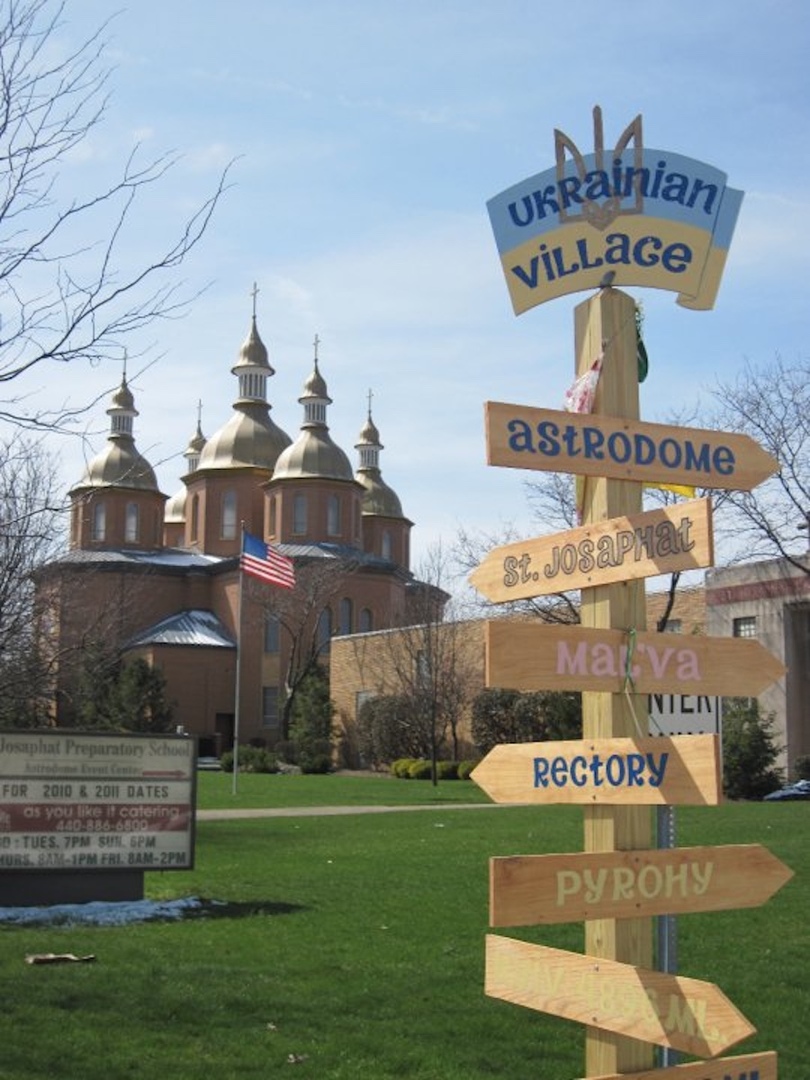
    <summary type="html"><![CDATA[<p><strong><em>Like the Ukrainian population itself in Parma, Saint Josaphat Ukrainian Catholic Church had an inauspicious start—a simple brick and stone schoolhouse built in 1949 on ten acres of land on State Road.  However, less than forty years later, as the Ukrainian population in Parma was growing into the largest in the State of Ohio, Saint Josaphat became a Cathedral church and  the seat of  a new Ukrainian Catholic eparchy whose territory includes Ohio, part of Pennsylvania and most of the South.</em></strong></p><img src="https://mail.clevelandhistorical.org/files/fullsize/dd208222bed267ab663c6c38be39d65e.jpg" alt="Saint Josaphat Cathedral in the Shadow of Parma Ukrainian Village Signage" /><br/><p>The first generation of Catholic Ukrainians to come to Cleveland in the late nineteenth and early twentieth centuries were Ruthenians, who had immigrated from a mountainous area within Galicia known as Ruthenia. Their lands were then located within the Austro-Hungarian Empire. Today, they are part of Ukraine and Poland. Religiously, these Ruthenians were Byzantine or Greek Catholics, or sometimes called Uniates. They were spiritual descendants of Eastern Orthodox Ruthenians and other Eastern European groups who, through the Union of Brest in 1596, had sworn allegiance to the Roman Catholic pope, while retaining a right to practice most of their historic Eastern Orthodox customs, rituals, and liturgy.</p><p>Settling in the Tremont neighborhood, the immigrant Ruthenians, in 1910, built a church of their own that still stands today on West 7th Street, near College Avenue. It was first called Saints Peter and Paul Ruthenian Catholic Church, but was renamed <a href="https://clevelandhistorical.org/items/show/738">Saints Peter and Paul Ukrainian Catholic Church</a> at the conclusion of World War I when the first modern Ukrainian state was established.</p><p>For most of the first half of the twentieth century, the children of the parishioners at Saints Peter and Paul Church attended school either in the basement of their church in Tremont or at other places in Cleveland. In 1947, Pastor Dmytro Gresko and his parishioners decided that they would build an elementary school for the parish children on land located in the suburb of Parma. Their decision was likely influenced by the number of parishioners who, since the end of World War II, had been moving out of Tremont and into that fast growing suburb.</p><p>The land selected for the new elementary school was a 10-acre parcel that lay on the west side of State Road between Kenmore Avenue and Liggett Drive. It was located just two blocks north of Saint Francis de Sales Catholic Church, and almost directly across the street from the Saint Stanislaus Novitiate, later renamed the Jesuit Retreat House. In the 1920s, the Order of the Polish Sisters of Saint Joseph had planned to construct a convent and school on this land. However, the Sisters later decided to instead construct those buildings—the latter of which was later known for many years as Marymount High School—on Granger Road in Garfield Heights. The Sisters then sold the land in Parma in 1929. </p><p>The land's new owners agreed, in October 1947, to sell it to Saints Peter and Paul Ukrainian Catholic Church for $17,500. In April 1949, construction began on the new two-story, brick and stone Saints Peter and Paul school building. Completed that fall, it had eight classrooms for students on its north end and a large assembly hall on its south end that could hold 500 persons and also serve as a chapel. On November 6, 1949, a dedication ceremony was held at the new school, led by Ukrainian Catholic Archbishop Constantine Bohachevsky of the Philadelphia Archeparchy, with assistance from Cleveland Bishop Edward F. Hoban and other Catholic church officials. At the ceremony, it was noted that this was the first Ukrainian Catholic grade school built in the Cleveland area. </p><p>Two years after dedicating the new school, Archbishop Bohachevsky returned to Parma on May 12, 1951 to bless the chapel in the school building which was named Saint Josaphat Chapel, after Josaphat Kuntsavych, a Ukrainian priest who had been murdered in 1623 because of his efforts, consistent with the tenets of the Union of Brest, to bring together Eastern Orthodox Christians and Roman Catholics living in Galicia, which in that period was part of the Polish-Lithuanian Commonwealth. </p><p>Classes began at Saints Peter and Paul grade school on November 15, 1949, with a total of 135 students attending only grades one through three in that first year. Because many of those students still lived in Tremont, the parish also purchased a bus to transport children to and from the school in Parma. One of those bus drivers was Father Myroslav Lubachivsky, then an assistant pastor at Saints Peter and Paul. Some thirty-five years later, in 1985, he would be appointed a Cardinal of the Ukrainian Catholic Church by Pope John Paul II. </p><p>During the period 1950-1960, the number of people of Ukrainian, and other Eastern and South European ethnicities, moving into Parma more than tripled, as that city became one of the fastest growing suburbs in America. In order to address the increases in the Ukrainian Catholic population, Saints Peter and Paul added several new buildings to the Parma campus, including another classroom building, a rectory and a convent, and expanded the grades taught at the school to include from kindergarten to eighth grade. </p><p>In August 1959, recognizing the significant increase in the Ukrainian Catholics living in Parma, Archbishop Bohachevsky announced the creation of a new Ukrainian Catholic parish in Parma, to be sited on the grounds of Saints Peter and Paul grade school. The new parish was named—and the grade school renamed—like the chapel, Saint Josaphat. Father Andrew Ulicky, an assistant pastor at Saints Peter and Paul, was appointed the first pastor of this new Ukrainian Catholic parish. </p><p>Shortly after his appointment as pastor, Father Ulicky initiated plans to build a high school on the State Road campus. Construction of the building began in 1961, largely funded through the efforts of parishioners who not only gave money to the project, but also volunteered to do much of the skilled construction work. The new circular-shaped high school building was designed by architect and engineer Michael Stefanyk, who volunteered his services to the parish. </p><p>The building featured a wooden domed roof with a 141-foot diameter. However, because of mounting costs and limitations on the amount of time that could be spent on construction by parish volunteers, construction of the building lagged for years, taking many more years to complete than the two years initially anticipated. In the interim, while it sat unfinished, the building became a favorite haunt of Parma teenagers, who visited it often at night, conducting what might be called an early form of urban (or suburban) exploration. </p><p>The proposed high school building was finally completed in 1969 and blessed by Metropolitan Archbishop Ambrose Senshyn on April 20 of that year. By that time, however, the plan to use the building as a high school had been abandoned, largely due to the establishment of Saint Andrew Ukrainian Catholic parish on the south end of Parma in 1965. The creation of the new parish prompted the departure of about 500 families from Saint Josaphat. </p><p>When the circular, domed building was blessed, it was given the name Saint Josaphat Astrodome Hall—commonly known as the "Astrodome" in reference to Houston's recently completed domed stadium. Rather than serving students as their new high school, the building was repurposed as an assembly hall for the use of the Saint Josaphat parish. Since its completion, it has been the venue for many parish events, as well as serving as a venue for the events of other organizations, such as ethnic festivals, and for individual events, including weddings. </p><p>After the completion of the Astrodome, Father Ulicky and the parish's second pastor, Father Yaroslav Sirko, who succeeded Father Ulicky in 1971, turned their attention to building a church on the State Road campus. The need to do so became pressing when, on April 11, 1973, a horrific fire at Saint Josaphat grade school destroyed the chapel within the school building. As a temporary measure, masses were thereafter held in the Astrodome. Father Sirko, who was the pastor at the time of the 1973 fire, wanted to immediately construct a new church, but was unable to do so due to the state of parish finances at the time. </p><p>As a result, the challenge to build the new church fell to the parish's third pastor, Father Michael Fedorowich, who came to Saint Josaphat in 1979. By 1981, the parish finances had sufficiently improved to enable Father Fedorowich to begin construction. By the summer of 1983, when construction was almost completed, word was received by the parish that the new Saint Josaphat church was to become a Ukrainian Catholic cathedral and seat of a new eparchy—the equivalent of a Roman Catholic diocese—for the Ukrainian Catholic Church in the United States. As a result of this development, additional construction was required in order to render the building's interior suitable as a cathedral. The following year, Father Robert Moskal was appointed the first bishop of the new Ukrainian Catholic Eparchy of Parma, Ohio.</p><p>When the 1990 federal census was taken—the first one following the completion of Saint Josaphat Cathedral and creation of the new Parma Ukrainian Catholic Eparchy, the results of the community questionnaires for Parma showed that the city's Ukrainian population, which in 1950, had been one of the smallest for residents of East European ancestry, had now become one of the largest, behind only the Polish and Slovak populations. In subsequent years, the Parma Ukrainian community continued to grow until it became, according to an article appearing in the Cleveland Plain Dealer on March 24, 2022, the largest in the State of Ohio. </p><p>Along the way of their journey as one of the most important Ukrainian institutions in Parma, Saint Josaphat and its parishioners have experienced their share of joys and sorrows at their now historic State Road campus. In 2008, Saint Josaphat Ukrainian Catholic grade school,which had served children of the parish for nearly 60 years, closed its doors for good. However, in what must have been somewhat consoling to the parish, several years later the school building became home to a new K-8 public community school called the Global Village Academy, which offers language and cultural programs to students in every grade. </p><p>On an even more positive note, in 2008 the Parma City Council passed a resolution recognizing the many contributions that Ukrainians at Saint Josaphat and other institutions in the City had made, and honoring the Ukrainian community with the establishment of <a href="https://clevelandhistorical.org/items/show/863">Ukrainian Village</a>, a section of State Road beginning at Tuxedo Avenue on its north end and extending south all the way to Grantwood Drive, with signs alerting drivers of the existence of the Village. </p><p>Today, visitors to Parma, who drive to the suburb on State Road will, as they cross Brookpark Road, immediately take notice of the colorful signage which announces that they are entering Ukrainian Village. Within moments thereafter, they will see the five majestic onion domes of the beautiful Saint Josaphat Cathedral. The signs and the domes inform visitors not only of the historical importance of Saint Josaphat to Parma's Ukrainian community, but also of its importance to the City of Parma itself.</p><p><em><strong><a href="https://mail.clevelandhistorical.org/items/show/1078">For more (including 16 images) view the original article</a></strong></em></p>]]></summary>
    <published>2026-01-08T16:48:20+00:00</published>
    <updated>2026-04-17T19:17:43+00:00</updated>
    <link rel="alternate" type="text/html" href="https://mail.clevelandhistorical.org/items/show/1078"/>
    <id>https://mail.clevelandhistorical.org/items/show/1078</id>
    <author>
      <name>Jim Dubelko</name>
    </author>
  </entry>
  <entry>
    <title type="html"><![CDATA[GEAR Foundation: For the Benefit of Cleveland&#039;s Gay and Lesbian Community]]></title>
    <summary type="html"><![CDATA[<img src="https://mail.clevelandhistorical.org/files/fullsize/c93bcbc747863196184c74365ad76b98.jpg" alt="Bernard Furniture Building, 1969" /><br/><p>In the summer of 1975, Art MacDonald was 25. He had been kicked out of the Navy a few years before for his orientation. He had since partnered, and founded and continued to lead a Metropolitan Community Church (MCC) congregation in spite of death threats aimed at him, serious harassment and assaults on his congregation, and his lack of theological education. He had also founded <em>High Gear</em> the year before and continued to write for it, and he co-founded the Gay Educational and Awareness Resources (GEAR) Foundation earlier that year and continued to lead it. </p><p>GEAR intended to provide activities and services in hopes of uniting the lesbian and gay community. One of GEAR’s main purposes was furnishing information, through <em>High Gear</em> and a hotline, and another was providing social space, through the Gay Community Center. <em>High Gear</em> covered a wide variety of topics but mainly focused on political news affecting the gay and lesbian community and on lesbian and gay events in northeast Ohio. The hotline was staffed by volunteers and answered evening and weekend calls. Some callers were simply going out of their way to harass the community, but the majority of calls were actually from gay and lesbian people with a variety of concerns: those considering suicide, individuals looking for nonjudgmental healthcare for STIs, folks wanting information about the bars and baths, and people who were just coming out. GEAR was concerned about gay and lesbian youth, but ambivalent or uncertain about how to interact with them or allow them space without reinforcing negative public perceptions of lesbian and gay people. In the early 1980s, the organization focused on helping youth through the hotline.</p><p>GEAR’s founders and board members were against gender and racial discrimination, at least in principle, but active inclusion was more difficult to achieve. The composition of GEAR’s board of trustees shifted from all men to nearly half women and back again from the late 1970s to the mid-1980s, while that of the foundation membership remained fairly steady at approximately one-third women. Bisexuals, transgender people, crossdressers, and people involved in the drag scene were seen as less a part of the community, and very few of these individuals were involved with GEAR. Participation by straight allies was also uncommon in the 1970s and 1980s, with most of the few around being parents in Parents of Gays (now PFLAG). GEAR did host groups for black and Asian gay men, but participation of people of color in GEAR was limited.</p><p>With the discriminatory social climate and limited financial resources, GEAR was frequently looking for suitable space to host Cleveland’s lesbian and gay community. Before opening the Gay Community Center, GEAR initially met at MacDonald’s home, but he moved to Chicago early in 1976 to attend seminary. Starting around November 1975, GEAR had its office and the hotline at 2999 W. 25th Street, in a shared space with the offices of the Cleveland Gay Federation and the Cleveland MCC congregation. On March 27, 1977, the Gay Community Center had its first open house in GEAR’s new location, a few rooms in the CoventrYard building, a mini-mall at the corner of Euclid Heights Boulevard and Coventry Road in Cleveland Heights. Eleven months later, CoventrYard was destroyed in a fire. GEAR moved into a basement room at New Dimensions, a club downtown at 1012 Sumner Court, across from Erie Street Cemetery. The room was cold and small, holding only fifteen to thirty people at most, and quite loud when the club was operating. GEAR began to look for another location but didn’t find a suitable place until 1980.</p><p>In February 1980, GEAR’s board made its initial decision to buy the former Bernard Furniture Building on the northeast corner of West 14th Street and Auburn Avenue in Tremont. The wooden building was approximately 80 years old and needed substantial work, but GEAR’s trustees assumed they could gain enough rental income from the upper floor to make the finances work, and moved forward with the purchase. After GEAR made the down payment early in March, a few neighborhood organizations got wind of the planned move and disapproved of it. GEAR became concerned over safety and attempted to back out of buying the building, but the organization couldn’t find a way to without losing its down payment. The board initially planned to resell, but renovations progressed slowly, and with no immediate incident of significant prejudice GEAR moved in to save money. However, the problems of owning a building – particularly issues with tenants and the physical state of the Bernard building – quickly exacerbated GEAR’s money woes. By September 1982, the building had failed a city inspection, almost all its utilities were past due, and some had been disconnected. The next month, all the trustees resigned and the mortgage was foreclosed. A meeting of the foundation membership was held in November, electing new trustees who began to turn the situation around, and GEAR continued to use the Bernard building into the fall of 1983 before moving to a board member’s home at 2100 Fulton Road by December 1983.</p><p>The Gay Community Center continued despite GEAR’s decline, and became the stable foundation of Cleveland’s LGBT community over the next thirty years. It moved only three additional times over that period, and with a few name changes continues to exist as the LGBT Center of Greater Cleveland.</p><p><em><strong><a href="https://mail.clevelandhistorical.org/items/show/880">For more (including 6 images) view the original article</a></strong></em></p>]]></summary>
    <published>2019-11-20T20:07:46+00:00</published>
    <updated>2026-04-17T19:17:38+00:00</updated>
    <link rel="alternate" type="text/html" href="https://mail.clevelandhistorical.org/items/show/880"/>
    <id>https://mail.clevelandhistorical.org/items/show/880</id>
    <author>
      <name>Katie Cummings</name>
    </author>
  </entry>
  <entry>
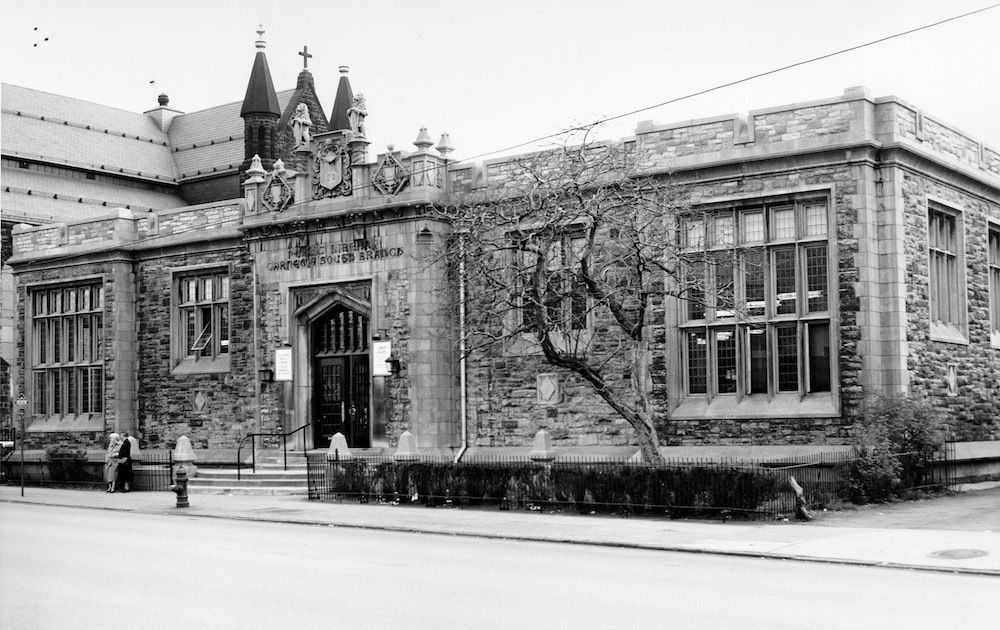
    <title type="html"><![CDATA[South Branch Library: An Original Carnegie Library Enters Its Second Century in Grand Style ]]></title>
    <summary type="html"><![CDATA[<p><strong><em>On December 1, 2018, the Gothic jewel of Cleveland-area libraries was reintroduced to Tremont. The celebration was immense: nearly 1,000 people turned out to marvel at the all-stone castle-like façade and experience a wholly renovated yet historically faithful interior. It had been a long wait. </em></strong></p><img src="https://mail.clevelandhistorical.org/files/fullsize/ab312c110cc8fd89626b0495e99aa1c6.jpg" alt="South in the Sixties" /><br/><p>The structure on the northwest corner of Clark Avenue and Scranton Road was closed for more than five years, during which time library officials, architects, community development organizations and neighborhood residents worked to reconcile views of the building’s future and subsequently orchestrate a massive renovation. But it all worked: At the age of 107, one of Cleveland’s original Carnegie Libraries was reborn.</p><p>The South Branch Library story predates Andrew Carnegie’s largess. The first library in the vicinity opened in 1897 in a rented building on the corner of Clark Avenue and Joseph Street (changed to West 20th Street in 1906 and Twinkie Lane in 1976). It was yellow brick with stone trimmings. Oak desks, bookcases and tables held as many as 7,000 volumes. Books were fumigated in 1901-02 due to a smallpox epidemic. </p><p>In 1903 the Cleveland Public Library “branch building program” was launched with a $250,000 gift from Andrew Carnegie. By 1914 a total of $590,000 was received. These monies ultimately underwrote the construction of 14 library branches: Broadway, Brooklyn, Carnegie West, East 79th Street, Hough, Jefferson, Lorain, Miles Park, Quincy, St. Clair, Sterling, Superior, Woodland and, of course, “South.” Each branch had its own collection of books and a full complement of librarians and assistants. More than 100 years later, the Brooklyn, Carnegie West, Jefferson, Lorain, Sterling and South buildings are still being used as libraries.</p><p>South Branch was the eighth to be built and the first Carnegie facility in the city to be made of stone rather than brick. Described as English Gothic on the outside and Tudor on the inside, it opened on June 12, 1911. Total cost for the land and building was $71,800. Architect Henry Whitfield, who previously designed Tufts College in Massachusetts and myriad other Carnegie libraries, cited Hoghton Tower in Lancashire, England, as his inspiration for South Branch. </p><p>The building is constructed of rough-hewn gray limestone and features a rectangular framed front entrance and windows. Crenellations (castle-like cutouts) line the roof parapet. An octagonal skylight over a central court gives the interior a remarkable “outside” feel. Fireplace tiles—designed in a style called “Medieval Decoratives”—were made by Moravian Pottery & Tile Works in Bucks County, Pennsylvania. </p><p>When South Branch opened, the neighborhood primarily comprised German, Bohemian and American-born families. By 1924 many long-term residents had moved on, replaced by a wider variety of immigrants. Around that time, 21 different nationalities were represented in the South Branch register.</p><p>In the 1960s, the South Branch community was dealt a variety of serious blows: Most severe were the construction of Interstate 71 several hundred yards to the east and Interstate 90/490 roughly the same distance to the north. Hundreds of area homes were destroyed and the library was symbolically separated from thousands of neighbors. An ongoing residential exodus (an estimated population drop of 31 percent from 1960 to 1970) further reduced the library’s patronage. </p><p>Today, South Branch is one of two libraries serving a recovering Tremont neighborhood as well as visitors from surrounding communities such as Clark-Fulton, Stockyards and Ohio City. The population served by the library is still smaller than it was several generations ago, but the range of services it provides and the strength of support it receives from neighbors and patrons are greater than ever. </p><p>“The only thing that you absolutely have to know is the location of the library.” —Albert Einstein</p><p><em><strong><a href="https://mail.clevelandhistorical.org/items/show/862">For more (including 10 images) view the original article</a></strong></em></p>]]></summary>
    <published>2019-01-15T14:27:27+00:00</published>
    <updated>2026-04-17T19:17:42+00:00</updated>
    <link rel="alternate" type="text/html" href="https://mail.clevelandhistorical.org/items/show/862"/>
    <id>https://mail.clevelandhistorical.org/items/show/862</id>
    <author>
      <name>Ann Marie Wieland&amp;#32;&amp;amp;&amp;#32;Chris Roy</name>
    </author>
  </entry>
  <entry>
    <title type="html"><![CDATA[Saint Andrew Kim Korean Catholic Church]]></title>
    <summary type="html"><![CDATA[<p><strong><em>“Repurposed” churches are not uncommon in Tremont. Some structures have become businesses or residences. Others are now home to newer congregations with different religions and ethnicities</em></strong></p><img src="https://mail.clevelandhistorical.org/files/fullsize/c05368f5eb12bd6be99657d3a4a49e03.jpg" alt="St. Andrew Kim" /><br/><p>Throughout most of 19th and 20th Century, Tremont was a multi-ethnic stew. Settled in the 1840s by New England Puritans, the neighborhood soon became home to immigrant Germans, Greeks, Irish, Poles, Ruthenians, Slovaks and Syrians. Most of these groups built their own houses of worship, giving South Side (as Tremont was long referred to) one of the greatest concentrations of churches in America. Later in the century, some of these structures were repurposed to serve later-arriving populations such as African-Americans and Hispanics. And although Korean Catholics were never a significant part of Tremont’s residential mix, they too have a repurposed house of worship: Saint Andrew Kim Korean Catholic Church at 2310 West 14th Street. </p><p>“Korean Catholic” is actually a far larger faction than one might think—in Korea as well as America. Introduced by scholars who visited China and brought back Western books translated into Chinese, Roman Catholicism began to take root in the early to mid 18th century. The first Catholic missionaries arrived in Korea in 1836. St. Andrew Kim Taegon, the first Korean priest and Korea’s patron saint, was ordained in China in 1845. He returned to Korea at age 25 and almost immediately was arrested and beheaded by officials of the ruling Joseon dynasty which had banned Catholicism (the state-mandated religion was Confucianism). Religious freedom came to Korea in 1883. </p><p>The Cleveland congregation known as Saint Andrew Kim Korean Catholic Church was launched in 1978 in the basement chapel of St. Ann Church in Cleveland Heights. A year later, Father Francis Kwang Nam Kim, a priest from the Scranton, PA, Catholic Diocese, formally established the Cleveland Korean Catholic community. As the community grew, a larger space became necessary and an unused school building belonging to St. Augustine Parish in Tremont filled the bill. The structure’s classrooms were converted into a chapel. This arrangement lasted until 1988, when the community purchased its own church and rectory less than a quarter mile to the north. </p><p>The object of this particular repurposing was the former Polish National Church, Sacred Heart of Jesus. Congregants of this church first assembled in a long-gone hall at the corner of Fairfield Avenue and West 11th Street in 1913. Two years later, three buildings were acquired on the east side of West 14th but financial obligations associated with the site were too great. Finally, in November 1916, the congregation purchased another site on the west side of West 14th and built the church building that stands to this day. Polish congregants worshipped in the structure until the mid-1980s when the facility closed. On behalf of St. Andrew Kim, the Catholic Diocese took control of the church on October 1, 1987. The Cleveland area’s only remaining Polish National Churches are now Holy Trinity on Broadway Avenue and St. Mary’s on Broadview Road. </p><p>St. Andrew Kim Korean Catholic Church has become a spiritual epicenter for Korean Catholics throughout northeastern Ohio. The church offers mass in Korean and English, helps Korean immigrants adjust to life in the US and organizes religious lectures and retreats. In 1996, the Korean Catholic community received a relic of St. Tae Gon Kim. On August 24, 1997, the parish welcomed Bishop Anthony M. Pilla who celebrated Mass and formally unveiled a statue of the parish’s patron saint.</p><p><em><strong><a href="https://mail.clevelandhistorical.org/items/show/850">For more (including 4 images) view the original article</a></strong></em></p>]]></summary>
    <published>2018-10-08T15:20:48+00:00</published>
    <updated>2026-04-17T19:17:42+00:00</updated>
    <link rel="alternate" type="text/html" href="https://mail.clevelandhistorical.org/items/show/850"/>
    <id>https://mail.clevelandhistorical.org/items/show/850</id>
    <author>
      <name>Chris Roy&amp;#32;&amp;amp;&amp;#32;Eileen Sotek</name>
    </author>
  </entry>
  <entry>
    <title type="html"><![CDATA[Clark Field]]></title>
    <summary type="html"><![CDATA[<img src="https://mail.clevelandhistorical.org/files/fullsize/447580b69c6c476372cb9f4a38a13663.jpg" alt="Clark Field, 1970" /><br/><p>Like so many parts of the city and the nation, Clark Field was once a farm—a swampy but arable plot stretching from Auburn Avenue to the Cuyahoga River. In the late 1940s, the city of Cleveland bought 67 acres of the farm to use as a recreation area for area residents. For the next three years, the city filled in the swampy areas. On immediately adjoining land, the federal government continued to maintain garages stocked with army surplus material. These 17 acres were later added to the park and the garages were removed. </p><p>In 1951 the City of Cleveland allocated $75,000 for a Clark Field play area, a football field and two baseball diamonds. Later, a stadium was built with concession stands and restrooms. For several decades, Lincoln High School and Cleveland Central Catholic High School played football games on Friday nights and often practiced there during the week. Tennis courts were built and children were enrolled in city-sponsored tennis leagues and tournaments. Every child in the program received a free tennis racket and lessons.</p><p>Over the years, the field deteriorated and the stadium was demolished. Concurrent with the depopulation of Tremont, park use plummeted. Baseball teams still played there (Little League, men’s leagues, a Republic Steel team), but the park’s principal features became discarded tires, empty beer bottles, drug paraphernalia and danger. Large gaps appeared in the tennis courts. Clark Field became a dumping ground and the place to go to burn a car.</p><p>In 2001, area residents banded together to take the park back. Friends of Clark Field was formed in 2002—in collaboration with the Mentor-Castle-Clark block club, Kent State Urban School of Design, and the City of Cleveland’s Parks and Recreation Department and Research, Planning and Development Departments. The new organization developed a master plan focused on cleaning up the park, bringing back recreation activities and maximizing safety. More than 100 trees were planted, a basketball court was added, and waste receptacles, picnic tables and benches made from recyclable materials were installed. Friends of Clark Field also worked to bring the first dog park to the city. </p><p>From 2012 to 2014, friends of Clark Field held regular free events for children and families. Funded by grants, Clark Field hosted Friday night movies, Easter egg hunts, Halloween parties, arts and crafts days, and family nights with ice cream, snow cones, popcorn, balloons, face painting, free books, pizza, apples and entertainment. Flag football teams began using Clark Field. High school baseball and men’s and women’s softball teams played weekly games. High school football practices returned. Flower and tree planting continued, along with regular maintenance and cleanup days. Under the aegis of the Cleveland Metroparks, plans were laid for a Towpath Trail Extension, which will ring the western and northern borders of Clark Field,  running from the northern entrance of Steelyard Commons to Literary Avenue. </p><p>In 2015, the City of Cleveland stopped issuing permits for events and sports at Clark Field so soil testing could be undertaken in preparation for additional park upgrades. Unfortunately, EPA tests revealed that several areas required soil reclamation—a slow and costly process. Consequently, the flow of traffic and events slowed significantly. Tests continue as of this writing. However, members of Friends of Clark Field are confident that—once remediation efforts are completed, the master plan fully implemented, and the Towpath Trail completed—Clark Field will reclaim and most likely exceed the significant progress achieved in the previous one and a half decades. </p><p><em><strong><a href="https://mail.clevelandhistorical.org/items/show/771">For more (including 3 images) view the original article</a></strong></em></p>]]></summary>
    <published>2016-10-20T14:32:31+00:00</published>
    <updated>2026-04-17T19:17:41+00:00</updated>
    <link rel="alternate" type="text/html" href="https://mail.clevelandhistorical.org/items/show/771"/>
    <id>https://mail.clevelandhistorical.org/items/show/771</id>
    <author>
      <name>Beverly Wurm</name>
    </author>
  </entry>
  <entry>
    <title type="html"><![CDATA[Sokolowski&#039;s University Inn]]></title>
    <summary type="html"><![CDATA[<img src="https://mail.clevelandhistorical.org/files/fullsize/7de35f13a2577bc1c1149fde14bdab0f.jpg" alt="Exterior of University Inn, 2015" /><br/><p>Victoria and Michael Sokolowski opened Sokolowski’s University Inn in 1923 as a tavern at the corner of University Road and West 13th Street. For nearly a century, the family served up exceedingly generous portions of traditional Polish-style food, making it a popular spot for generations of visitors from every walk of life. Local heroes from steel workers to accountants. Hollywood types from Ursula Andress to Jimmy Fallon. Politicos from Lech Walesa to Bill Clinton. Rock ‘n rollers from Dion DiMucci to Trent Reznor. Celebrity chefs from Bobby Flay to Michael Symon.</p><p>When Sokolowski’s opened its doors in 1923, Tremont was rather different from the gentrifying neighborhood it became around the turn of the 21st century. For one thing, the area was called the South Side. The neighborhood was more densely populated. Poles rubbed shoulders with Ukrainians, Russians, and a host of other nationalities. Large families in small houses were the norm. And there were many more houses than there are today. Construction of Interstates 71, 90 and 490 resulted in the loss of hundreds of residential structures. In fact, when Sokolowski’s opened, homes along University Road rimmed the Flats as far west as West 14th Street. Homes also lined both sides of West 14th as far north as University. Abbey Avenue stopped at West 14th instead of West 11th. On the south side of Abbey in 1923 — just up from Sokolowski’s — there was a stable. Directly across Abbey from the stable there was a Horse and Dog Hospital.</p><p>Ironically, the freeway that lopped off the tavern's neighbors to the west also turned Sokolowski's into its modern form. The most dramatic evolution may have been Sokolowski’s expansion from bar to full restaurant. It wasn’t until the late 1950s — when iron workers building the Inner Belt bridge started coming in at lunchtime — that the family began serving cafeteria-style food. The establishment expanded over the years, including the addition of three new dining rooms. Sokolowski's remained a family-owned and -operated business through the generations, with successive owners growing up in the business and living next door to the restaurant.</p><p>Sokolowski’s was a cult favorite among Cleveland diners for decades before it began attracting attention from well-known food critics across the US. Sokolowski’s appeared on Anthony Bourdain’s “No Reservations” program on the Travel Channel in 2007 and on Michael Symon’s “The Best Thing I Ever Ate” on the Food Network in 2010. In 2014, Sokolowski’s won the James Beard “American Classics” Award — one of only five designations the prestigious New York-based foundation makes each year to honor "enduring, quality restaurants and food establishments that reflect the character and hospitality of their cities and communities.” Mike Sokolowski – grandson and namesake of the founder – observed at the time that winning a Beard award was "like winning the Oscar." </p><p>Like many small businesses, Sokolowski's University Inn did not survive the COVID-19 pandemic. On October 13th, 2020 – after three generations of family ownership across 97 years – the Sokolowski family announced that they would close the restaurant. In 2023, the property was purchased by a real estate developer.</p><p><em><strong><a href="https://mail.clevelandhistorical.org/items/show/759">For more (including 5 images) view the original article</a></strong></em></p>]]></summary>
    <published>2016-03-07T12:37:18+00:00</published>
    <updated>2026-04-17T19:17:41+00:00</updated>
    <link rel="alternate" type="text/html" href="https://mail.clevelandhistorical.org/items/show/759"/>
    <id>https://mail.clevelandhistorical.org/items/show/759</id>
    <author>
      <name>Chris Roy</name>
    </author>
  </entry>
  <entry>
    <title type="html"><![CDATA[Olney Art Gallery: The City&#039;s First Art Museum]]></title>
    <summary type="html"><![CDATA[<img src="https://mail.clevelandhistorical.org/files/fullsize/4a7882afbb16bfc15c61bc8ca870d2fe.jpg" alt="Olney Art Gallery Interior" /><br/><p>For decades, visitors to Tremont have wondered about the three magnificent, but poorly maintained mansions they encounter when exiting Interstate 90 at Abbey Avenue and West 14th Street. What are (or were) these structures? Why have buildings in such a high-profile location been so neglected? What plans (if any) exist for their regeneration? </p><p>The answer to these questions reaches back to the late 19th century. At that time, Tremont (then known as Lincoln Heights) was home to scores of wealthy industrialists, and Jennings Avenue (renamed West 14th Street in 1906) was their street of choice—a sort of south-side Millionaire's Row, not unlike Euclid or Franklin Avenues. </p><p>Just north of Fairfield Avenue, two of Jennings Avenue’s most majestic homes belonged to Samuel Sessions and brothers Thomas and Isaac Lamson, founders of the Lamson & Sessions Company. In 1912, The Pan-Hellenic Union purchased and razed these houses, and subsequently erected Annunciation Greek Orthodox Church which stands to this day. However, most of the block to the south (across Fairfield Avenue) also was owned by Sessions and the Lamson brothers; and two of the structures in this area are among those noted at the beginning of this article: the Olney Residence (2255 West 14th Street) and the Olney Gallery (2241 West 14th Street). </p><p>Meant from the start to be an exhibition space, the Olney Gallery was built in 1892 for Charles Fayette Olney, an art collector and academic who came to Cleveland from New York City in the 1880s. This handsome Renaissance Revival building (with “Olney Art Gallery” etched in stone above the front portico) was created to display Olney’s extensive collection of oil and watercolor paintings, ivories, porcelains, statuary and bronzes. The building was designed by the firm of Forrest A. Coburn and Frank Seymour Barnum, which also created more than twenty houses along Euclid Avenue’s Millionaires’ Row, as well as several buildings for Case Institute of Technology and Western Reserve University. Physically adjoining the Gallery to the south is the giant mansion (built around 1870) that Olney and his wife Abigail Bradley Lamson, the widow of Lamson & Sessions founder Thomas Lamson, occupied after they married in 1887 (Abigail had previously lived in the house with Thomas Lamson). Around that time, the home was extensively remodeled—shifting in style from its original Italianate to the more popular Colonial Revival. The house’s belvedere and wraparound porch were added at that time.  </p><p>The Olneys became major benefactors of Pilgrim Church, which opened its doors at Starkweather Avenue and West 14th Street in 1894.</p><p>When the Olney Art Gallery opened in 1893, it became the city’s first publicly accessible art space, pre-dating the Cleveland Museum of Art by more than two decades. More than 200 objects from the Olney’s private collection populated the gallery. Other prominent Clevelanders, such as Windsor White and Charles Brush, also donated works. Charles and Abigail Olney died in 1903 and 1904, respectively. The Olney Gallery closed in 1907, and most of its inventory was donated to Oberlin College, where it became the foundation of the Dudley Allen Memorial Art Museum.</p><p>The two structures were used briefly by the Polish National Church before being sold in 1920 to the Ukrainian National Home Company for $45,000. Ukrainians had been coming to America since the 1870s, and by the 1880s many had settled in the Tremont area. So great was the surge that the need for worship and meeting space became acute (the city’s first Ukrainian Catholic parish, organized in Tremont in 1902, was headquartered in a former trolley garage). These critical needs weren’t met until a new house of worship—Saints Peter & Paul Church at 2280 West 7th Street—was built in 1910 and the Olney Residence and Gallery was acquired a decade later to provide a social and meeting space.</p><p>A short walk from Saints Peter & Paul, the Olney structures (renamed the “Ukrainian National Home”) filled a variety of needs: organizing educational, social and recreational events; hosting union meetings; and serving as a temporary refuge for the Ukrainian political émigrés and displaced persons who came to Cleveland following World War II. By the 1960s, however, much of the Ukrainian community had moved to Parma and other western suburbs and the Ukrainian National Home closed in 1967. Still, the area continues to maintain a strong Ukrainian presence, primarily in the form of Saints Peter & Paul Church and the widely renowned Ukrainian Museum-Archives at 1202 Kenilworth Avenue. Reflecting the changing nature of Tremont’s community, the two Olney buildings later became a Puerto Rican social hall. </p><p>Since 1990, nearby Grace Hospital has owned the buildings and, aided by a large historic preservation grant in 2015, renovated the two structures, along with a third, somewhat smaller home, the Higbee House, to the immediate south. (It does not appear that this home was occupied by Edwin Converse Higbee, the founder of Higbee’s Department Store, but the building may have housed a relative.) Grace Hospital has turned the former Olney residence into a health/spa facility and is using the former gallery for special events. Plans for the former Higbee house have not been finalized. </p><p><em><strong><a href="https://mail.clevelandhistorical.org/items/show/757">For more (including 15 images) view the original article</a></strong></em></p>]]></summary>
    <published>2016-02-09T22:28:18+00:00</published>
    <updated>2026-04-17T19:17:41+00:00</updated>
    <link rel="alternate" type="text/html" href="https://mail.clevelandhistorical.org/items/show/757"/>
    <id>https://mail.clevelandhistorical.org/items/show/757</id>
    <author>
      <name>Chris Roy&amp;#32;&amp;amp;&amp;#32;Michael Rotman</name>
    </author>
  </entry>
  <entry>
    <title type="html"><![CDATA[Duck Island]]></title>
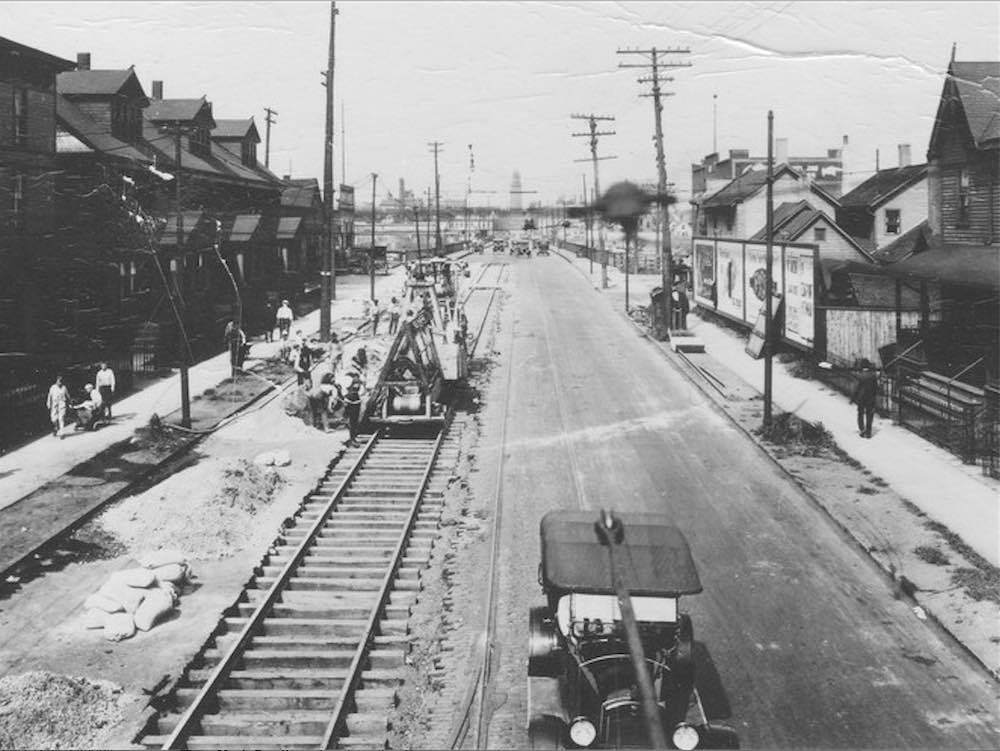
    <summary type="html"><![CDATA[<p><strong><em>Duck Island has nothing whatsoever to do with ducks (although you may see an occasional duck sign or banner). Most folks believe that Duck Island got its name during Prohibition—a place where bootleggers would “duck” the law.</em></strong></p><img src="https://mail.clevelandhistorical.org/files/fullsize/7b06c6df641fd3988edf3df5c9a42853.jpg" alt="Construction on Abbey Avenue, ca. 1920" /><br/><p>Even people who live nearby may not know about Duck Island. Among suburbanites, the name is even less likely to resonate. What’s more, if you do a Google Images search you’ll get pretty pictures of an island off the cost of Maine. Some of these photos include ducks, but none of them are Cleveland’s Duck Island. </p><p>So where is Duck Island and what does it have to do with ducks? The answer to the first question is that Duck Island is a small community (perhaps one square mile) between Tremont and Ohio City. Bisected by Abbey Avenue, Duck Island is bordered by Carnegie Avenue to the north, Train Avenue and Scranton Road to the south and east, and the RTA Red Line rapid tracks to the west. For municipal planning and management purposes, Duck Island is considered part of Tremont. The answer to the second question is that Duck Island has nothing whatsoever to do with ducks (although you may see an occasional duck sign or banner). Most folks believe that Duck Island got its name during Prohibition—a place where bootleggers would “duck” the law.</p><p>But Duck Island’s profile is rising rapidly. In fact, it might be hard to find a Cleveland locale whose popularity has increased more swiftly. Plans are underway for large “ultra green” housing developments at West 20th and Lorain; West 20th and Abbey; and West 19th and Freeman. Toney new homes dot Columbus Road and West 17th, 18th and 19th Streets. Abbey Park, located at the corner of West 19th Street and Smith Court is earmarked for a major facelift. Gateway Clinic on Abbey Avenue has become a haven for quality pet care. Several new breweries are on the books. And to the cheers of myriad residents, St. Wendelin Catholic Church on Columbus Road reopened its doors in 2012—two years after being closed by the Catholic Dioceses of Cleveland. </p><p>To be sure, a number of residents are squeamish about Duck Island’s burgeoning popularity. Concerns about inflation, noise, parking and population density are common and largely valid. Fortunately, organizations like Tremont West Development Corporation, the Duck Island Block Club, the Duck Island Development Collaborative, Cleveland Neighborhood Progress and Kent State University’s Cleveland Urban Design Collaborative are working hard to build figurative bridges. That’s a good thing because Duck Island has become too hot to not trot: It’s equidistant between Tremont and Ohio City; a short drive, train ride or walk to downtown; and a hop/skip/jump to riverfront destinations like the Towpath Trail, Scranton Peninsula and Merwin’s Wharf. Plus it has killer views of the city.</p><p>Like Tremont and Ohio City, Duck Island is an old neighborhood. Most of its original housing stock dates to the late 1800s. These homes were inhabited primarily by blue-collar workers who staffed steel mills, factories, warehouses and river-shipping interests in the Flats. In fact, the geography of Duck Island is such that, until the early 20th Century, Tremont residents could not walk north or east without first descending into the Flats. In 1887, however, the Central Viaduct, was constructed. Initially, the Viaduct consisted of two bridges: The first structure (more than one-half-mile long) extended from Jennings Ave. (now West 14th Street) to Central Avenue (now Carnegie Avenue). It followed the same basic path taken by what is now Interstate 90. Deemed unsafe, the bridge was torn down in the early 1940s. The second structure—the Abbey Avenue Bridge—continues to bind Tremont and Ohio City, with Duck Island smack in the middle. </p><p>Even with the bridges, Duck Island retained most of its isolated, blue collar status throughout the 20th Century. That sense of sequestration was exacerbated by the fact that, over the years, Duck Island was alternately claimed and disowned by Ohio City and Tremont. In the mid 1920s, moreover, Duck Island became even more isolated on the west when a deep trench was dug to accommodate railroad tracks for passenger trains serving the new Union Terminal complex. A half-dozen city blocks were removed—thus separating Duck Island from Ohio City. The only bridge subsequently erected to cross the divide was on Abbey Avenue. </p><p>Beginning in the 1970s, populations declined precipitously throughout the area. Businesses closed and even fewer people than usual wanted to move to a disadvantaged neighborhood with elderly housing stock and close proximity to a downtown with little to offer. However, Duck Island might have been rediscovered sooner, were it not for residents’ extreme suspicions about redevelopment. This mindset peaked in the 1990s, when residents staunchly opposed any initiatives that smelled even vaguely of gentrification. Rosemary Vinci, a community leader with a frequently ambiguous agenda, urged residents to reduce density by acquiring neighboring properties and demolishing dwellings. Vinci was a former strip club manager who, at the time of her death in 2008, was being investigated alongside her superiors, Jimmy Dimora and Frank Russo. Vinci also led opposition to a development next to the West 25th Street Station along Columbus Road south of Lorain. Rosemary’s father, by the way, was James Vinci, reputed organized crime figure and owner of the famed Diamond Jim's in the Flats. </p><p>Vinci or no Vinci, change is coming to Duck Island, including the kind of mixed-income, high-density residential development Rosemary so vociferously opposed. The plusses and minuses of urban renaissance will continue to be debated, but Duck Island’s unified wall of resistance is beginning to quack.</p><p><em><strong><a href="https://mail.clevelandhistorical.org/items/show/754">For more (including 9 images) view the original article</a></strong></em></p>]]></summary>
    <published>2016-01-11T15:27:50+00:00</published>
    <updated>2026-04-17T19:17:41+00:00</updated>
    <link rel="alternate" type="text/html" href="https://mail.clevelandhistorical.org/items/show/754"/>
    <id>https://mail.clevelandhistorical.org/items/show/754</id>
    <author>
      <name>Chris Roy</name>
    </author>
  </entry>
  <entry>
    <title type="html"><![CDATA[A Christmas Story House: Home of a Holiday Classic]]></title>
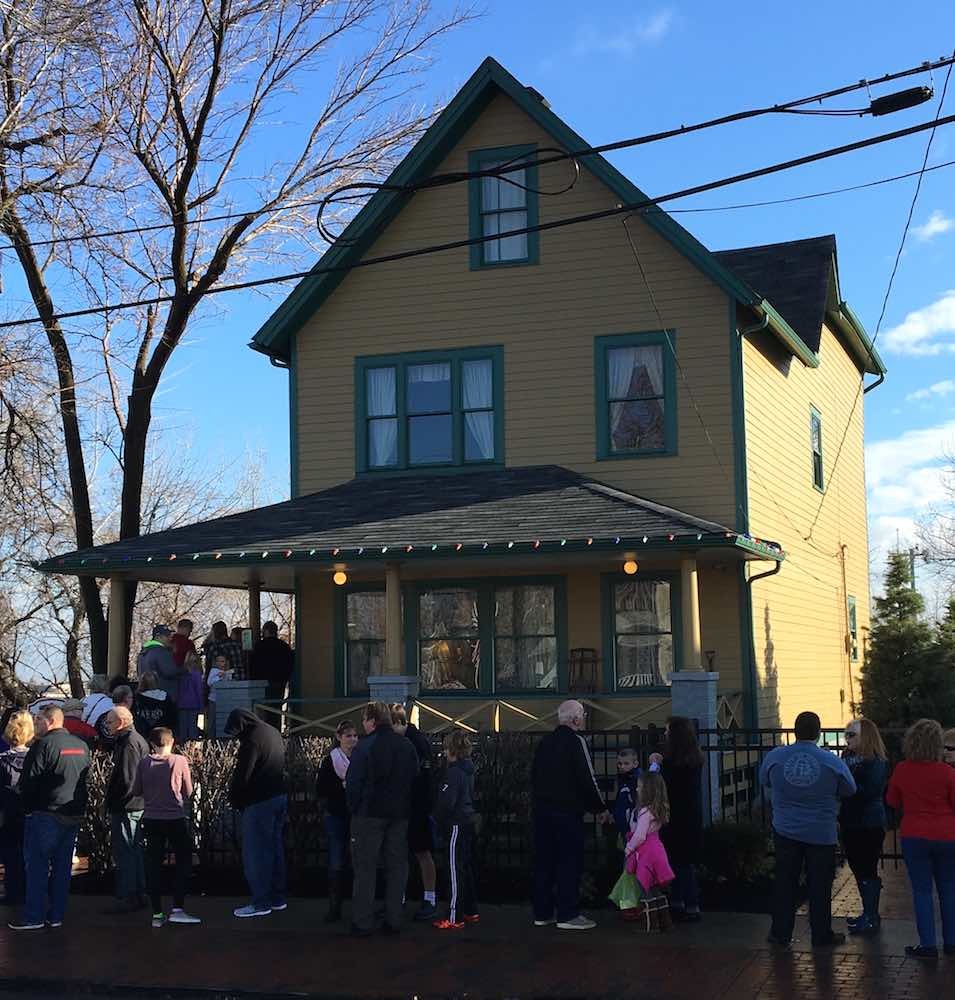
    <summary type="html"><![CDATA[<p><strong><em>The fortunes of the house, and eventually the immediately surrounding area, began to change in the early 1980s when director Bob Clark began scouting for a location.</em></strong></p><img src="https://mail.clevelandhistorical.org/files/fullsize/394fda037b6f240a8a8147791acf2598.jpg" alt="A Christmas Story House (3159 West 22th Street)" /><br/><p>The film takes place in a fictional town called Hohman, Indiana. Most exteriors were shot in Toronto. Interior scenes were done on a stage set. But in every sense, Ohio’s Tremont neighborhood is where Ralphie Parker and his family experienced <em>A Christmas Story</em>. </p><p>3159 West 11th Street, just south of Clark Avenue, is A Christmas Story House. Across the road is A Christmas Story Museum and a gift shop. All three locations are open 365 days a year for tours, along with a chance to buy everything from leg lamp nightlights and pink bunny suits to Lifebuoy Soap and faux Red Ryder carbine-action, two-hundred-shot, range-model air rifles. Be careful not to shoot your eye out! </p><p>The house was built in 1895: a colonial-style home in an area comprised largely of families whose men worked in the nearby Flats. The Mittal Steel plant (formerly J&L and Republic Steel) can be seen from the house’s back yard. The neighborhood’s arc mirrored that of Tremont—clinging to working-class status for much of the 20th century and floundering in the 1960s and 1970s when suburban flight and freeway construction desecrated the area. Spurred by artists and urban pioneers, Tremont began its upswing several decades later, but Ralphie’s neighborhood—well outside the borders of “hip Tremont”—has remained solidly blue collar. According to staff at the Christmas Story House, 3159’s basement used to host many an illegal cockfight.</p><p>The fortunes of the house, and eventually the immediately surrounding area, began to change in the early 1980s when director Bob Clark began scouting for a location in which to set <em>A Christmas Story</em>. Clark visited more than 20 cities looking for the perfect house. Since a vintage department store was needed for the parade and Santa-line scenes, Clark also sent letters to about 100 department stores around the country. Only Higbee’s in downtown Cleveland responded, but that was okay because both the department store and 3159 West 11th were ideal. Clark also liked the way the Tremont neighborhood had looked in 1978’s <em>The Deer Hunter</em>. Local auto club members lent Clark their antique cars. To thank the city, the producers named the house’s fictional thoroughfare Cleveland Street.</p><p>A mild sort of cinematic history was made in 1983 when <em>A Christmas Story</em> was released. The film was marginally successful at the outset, but its accolades and popularity increased over time. Leonard Maltin gave the film four stars, calling it “delightful” and “truly funny.” AOL, IGN, E! Entertainment, and at least one viewer poll have cited <em>A Christmas Story</em> as the top holiday film of all time. The movie earned Bob Clark two Genie Awards and in 2012, <em>A Christmas Story</em> was selected by the Library of Congress for preservation in the National Film Registry as being “culturally, historically, or aesthetically significant.” Every year, TBS runs <em>A Christmas Story</em> for 24 consecutive hours beginning on Christmas Eve. </p><p>Twenty-one years after the film was released, entrepreneur Brian M. Jones, a native of San Diego, bought the house on eBay for $150,000. He used revenue from his business, The Red Rider Leg Lamp Company, for the down payment. It was, in the words of Old Man Parker, a “major award,” an opportunity to create a new kind of museum in Cleveland. Watching the movie frame by frame, Jones drew interior plans and spent $240,000 to reconfigure the structure as a single-family dwelling and a near-perfect replica of the movie set. Jones then stocked the interior with movie props. Entering the house, visitors now are greeted by the infamous leg lamp, the Parker’s decorated tree, a kitchen stocked with Ovaltine, and the sink where Randy hid. Upstairs, they can see the bathroom where Ralphie’s decoder ring and a bar of Lifebuoy soap reside. The back yard, where several scenes were filmed, looks just like the movie. Near the front entrance is a memorial bench dedicated to Clark. It sits on the exact spot where he had a cameo as a nosy neighbor. </p><p>The house and museum opened to the public on November 25, 2006, with original cast members attending the grand opening. The site drew 4,300 visitors during its opening weekend, and tens of thousands of faithful fans have made the pilgrimage since. Most went because they, like many pundits and critics, believe that <em>A Christmas Story</em> is one of Hollywood’s best. A few, however, may have been “double-dog dared” to attend.</p><p><em><strong><a href="https://mail.clevelandhistorical.org/items/show/753">For more (including 5 images) view the original article</a></strong></em></p>]]></summary>
    <published>2015-12-23T21:01:30+00:00</published>
    <updated>2026-04-17T19:17:41+00:00</updated>
    <link rel="alternate" type="text/html" href="https://mail.clevelandhistorical.org/items/show/753"/>
    <id>https://mail.clevelandhistorical.org/items/show/753</id>
    <author>
      <name>Chris Roy</name>
    </author>
  </entry>
  <entry>
    <title type="html"><![CDATA[Fairmont Creamery]]></title>
    <summary type="html"><![CDATA[<img src="https://mail.clevelandhistorical.org/files/fullsize/596e8347012cdf776c9e159500b94900.jpg" alt="Fairmont Creamery Delivery Drivers, 1941" /><br/><p>Fairmont Creamery Company was founded in Fairmont, Nebraska, near Omaha, in 1884—an early “national dairy” with operations stretching from the Dakotas to Buffalo, New York. Fairmont was a pioneer in milk can pickup and one of the first creameries to provide farmers with their own hand-operated cream separators. In 1948 the company was re-branded as Fairmont Foods. It also became a Fortune 500 company and was granted a seat on the New York Stock Exchange in 1959.</p><p>Fairmont Creamery’s Cleveland operation opened in 1930 in a five-story building at 2306 West 17th Street, directly across Willey Avenue from what is now the Animal Protective League. Designed with two floors of manufacturing space and room for 75 delivery trucks, the facility also could accommodate railcar delivery input and output through its lower floor receiving room. For decades, a variety of dairy products were processed and distributed at the Cleveland facility. Local residents bought ice cream cones at a retail window. Employees from Tremont and Ohio City enjoyed short walks to work. </p><p>In the early 1980s all of Fairmont Foods’ properties and subsidiaries were either sold or closed, including the Cleveland operation. The West 17th Street building stayed largely empty for roughly 30 years, save for a small nickel-chrome-plating business that worked out of the basement. Dust, debris and an occasional squatter were all that occupied the remaining spaces.</p><p>In 2013, a trio of aggressive young developers—recent graduates of Oberlin College—stepped in and brought new life to the old building. Ben Ezinga, Josh Rosen and Naomi Sabe, founders of Sustainable Community Architects, purchased the building for $450,000. Comprising federal New Markets Tax Credits; state and federal historic preservation tax credits; a JobsOhio grant; city vacant property initiative funds; private equity investment; and a Goldman Sachs construction loan, $15 million was poured into a residential/commercial renovation, which was completed in 2015. The repurposed creamery includes 30 apartments and several ground-floor businesses. </p><p>Sustainable Community Architects worked to retain and celebrate the building’s history. Walk-in coolers were transformed into bedrooms and gym locker rooms. Huge concrete columns and beams, along with brick interior walls (originally glazed for food safety) became interior highlights. Windows, doors and signs were rebuilt in the 1930s style. According to Josh Rosen “the building is a reminder that people make stuff in this city; we wanted to expose the building’s original features rather than hide them.” </p><p>At the same time, the property also incorporates the best of the new. Natural light permeates living spaces. Each apartment has a unique design and layout. A 3,500-square-foot rooftop deck offers a place to lounge, garden, picnic and enjoy panoramic views of downtown Cleveland. However, the best juxtaposition of old and new may be that Fairmont Creamery is concurrently a Cleveland Landmark and a site on the National Register of Historic Places, and conforms to modern eco-friendly standards such as Leadership in Energy and Environmental Design (LEED) and Enterprise Green Communities. </p><p><em><strong><a href="https://mail.clevelandhistorical.org/items/show/751">For more (including 5 images) view the original article</a></strong></em></p>]]></summary>
    <published>2015-12-10T07:42:17+00:00</published>
    <updated>2026-04-17T19:17:41+00:00</updated>
    <link rel="alternate" type="text/html" href="https://mail.clevelandhistorical.org/items/show/751"/>
    <id>https://mail.clevelandhistorical.org/items/show/751</id>
    <author>
      <name>Chris Roy</name>
    </author>
  </entry>
  <entry>
    <title type="html"><![CDATA[Union Gospel Press]]></title>
    <summary type="html"><![CDATA[<img src="https://mail.clevelandhistorical.org/files/fullsize/1d0690b86d088d358bf7a2c4344c8e04.jpg" alt="Union Gospel Press Building" /><br/><p>The Union Gospel Press building—now known as Tremont Place Lofts—looms over Tremont like a holy ghost. It is more than 160 years old and comprises 300,000 square feet, two acres, four stories and 15 linked buildings. Like no other structure in the neighborhood, it is a larger-than-life presence and a constant reminder of Tremont’s elaborate history.  </p><p>On June 3, 1850, The Herald, a Cleveland newspaper, announced that a national university would be built in Cleveland. Patterned after Brown University in Rhode Island, the new institution would be called Cleveland University (CU): 275 acres stretching northeast from what we now know as Lincoln Park to the lip of Cleveland’s Flats. Accordingly, the name of the area morphed from Cleveland Heights to University Heights, which explains the preponderance of academically oriented street names—College, Professor, University and Literary—all of which are located within the boundaries of the proposed university. CU’s (unimplemented) plans also called for a female seminary, an orphan asylum and a home for the aged. Unfortunately, Thirza Pelton, the prime mover and benefactor of “CU” died in 1853 and the University soon folded, having graduated only 11 students. Only a small number of CU structures were actually built. A few of the buildings that now compose Union Gospel Press (Tremont Place Lofts) are all that remain of Cleveland University. </p><p>In 1858, Professor Ransom Humiston opened the Humiston Institute, a co-ed college preparatory school, in several of the CU buildings. During the Civil War, the Institute provided free educational services to disabled soldiers, many of whom trained or mustered out at Camp Cleveland, just a stone’s throw away. Humiston Institute closed in 1869 (in its final year it had an enrollment of 196 pupils) and the site soon became the Cleveland Homeopathic Hospital College, one of many sites that eventually combined to become Huron Road Hospital. When the latter facility opened in East Cleveland in 1880, the Cleveland Homeopathic property was no longer needed. </p><p>In 1907, the Herald Publishing House and the Gospel Workers Society relocated its headquarters from Williamsport, PA, to the CU site at Jefferson Avenue and West 7th Street. The organizations were rechristened Union Gospel Press when they merged in 1922. For the next quarter century, the company added buildings, housed workers and missionaries in on-site dormitories, and became the largest producer of religious materials in the world. According to a 2003 oral history, “Many [workers would don] the Gospel Worker Society navy-blue dress uniform to join sidewalk singing and preaching efforts on Public Square.” In 1950, Union Gospel Press left Tremont and took up residence at its present location at Brookpark and Broadview Roads.</p><p>After Union Gospel Press’ closing, the buildings were used at various times for offices, light manufacturing, a thermo electrical company, a lithography school, a church, and a rooming house. For a time, books were printed for the Cleveland Catholic Diocese. By the mid 1960s, only 10,000 square feet—less than 5 percent of the complex was rented. Squatters often occupied the many vacant spaces.</p><p>The building(s) fell further into disrepair for several more decades. In 1987, Joe Scully, a former iron worker, longshoreman, boxer and metal sculptor, bought the complex for $74,000. Scully resided in one of the attached buildings—an 1870s house facing Jefferson Avenue—and worked (for the most part unsuccessfully) to turn the complex into an artists’ colony. </p><p>In June, 2003, Scully sold the buildings to Corvallis Development Company for $1.4 million. Corvallis launched a $21 million renovation, with the aid of Sandvick Architects and a $4 million tax credit from the state of Ohio. The end product, completed in 2009, was a high-end 102-apartment community called Tremont Place Lofts. </p><p>Six years later, Will Hollingsworth opened a 60-seat bar at the base of Tremont Place Lofts. Hollingsworth named it The Spotted Owl, noting the legend that a spotted owl “is wisely infused with spirits of nuns and poets.” For the bar’s edgy, old-world feel, Hollingsworth channeled the “Dead Rabbit” cocktail bar in New York, where he had once worked. The Dead Rabbits were a notorious 19th Century Irish-American street gang. The floor of The Spotted Owl once lined a barn in central Ohio. </p><p>Students. Bibles. Artists. Yuppies. Owls. Rabbits. Clearly, this odd amalgam of buildings epitomizes the strange historical patchwork that is Tremont.</p><p><em><strong><a href="https://mail.clevelandhistorical.org/items/show/747">For more (including 6 images) view the original article</a></strong></em></p>]]></summary>
    <published>2015-11-16T12:07:36+00:00</published>
    <updated>2026-04-17T19:17:41+00:00</updated>
    <link rel="alternate" type="text/html" href="https://mail.clevelandhistorical.org/items/show/747"/>
    <id>https://mail.clevelandhistorical.org/items/show/747</id>
    <author>
      <name>Dennis Keating&amp;#32;&amp;amp;&amp;#32;Chris Roy</name>
    </author>
  </entry>
  <entry>
    <title type="html"><![CDATA[Prosperity Social Club: Neighborhood History On Tap]]></title>
    <summary type="html"><![CDATA[<p><strong><em>In 1938, Stanley Dembowski opened a small pub called Dempsey's Oasis at 1109 Starkweather Avenue. The establishment would become one of Cleveland's most enduring taverns.</em></strong></p><img src="https://mail.clevelandhistorical.org/files/fullsize/147f95cac83399229036103c7a930207.jpg" alt="Stanley and Richard Dembowski Exemplifying the &quot;Family Business&quot;" /><br/><p>What kind of pub gets shout-outs from national media ranging from Maxim and GQ to Huffington Post and Better Homes and Gardens? The answer is Prosperity Social Club—one of Tremont’s, and Cleveland’s, homiest and most storied spots for drinking and dining. </p><p>Prosperity Social Club, formerly known as Dempsey's Oasis, has a history that comprises almost 80 years. That history started with Jack Dempsey, heavyweight boxing champion of the world from 1919 to 1926, and namesake of the pub's original incarnation. Stanley Dembowski, born in Dulsk, Poland, in 1896 (one year after Jack Dempsey was born in Manassa, CO), opened Dempsey’s Oasis on Starkweather Avenue in 1938. Dembowski fought in France in World War I and was discharged on June 18, 1919. Sixteen days later, Dempsey won the heavyweight crown, knocking out Jess Willard. In a 1982 interview with The Plain Dealer, Stanley Dembowski recalled betting $500 that Dempsey would defeat Gene Tunney in their 1926 fight. Dempsey lost, but from then on “Everyone began calling me Dempsey. So when I started this business [at 1109 Starkweather, which previously hosted an establishment called Hot Dog Bill’s], I called it Dempsey’s. The Oasis part was added because an oasis is where thirsty people go to get dethirsted.” Stanley retired in 1967 and his son Richard, together with wife Theresa, took over. They remained until 2000 when the pub was sold to a pair of Irish businessmen. Veteran restaurateur Bonnie Flinner purchased the establishment five years later and renamed it Prosperity Social Club—a salute to the sardonic optimism that pervaded the Great Depression. </p><p>In a 2015 interview, Richard Dembowski stated that one of the restaurant’s keys to success was its ability to attract a diverse clientele: Tremont residents, downtown businesspeople, steelworkers, healthcare workers from Metro General and so on. He noted sanitation as another cornerstone—that the family made such a strong commitment to cleanliness that the local health inspector became a regular patron. According to Dembowski, “The inspector knew where he could get a good, safe meal.” The Dembowskis also gained a place in the neighborhood’s heart by actually being “locals” (they lived next door) and by being exceptional citizens. The family worked on Saint Augustine Church’s Food for the Poor campaigns and spearheaded Coats for Kids programs. In the 1980s, Stanley and Richard became local spokesmen for the Polish Solidarity campaign—the first independent labor union in a Soviet-bloc country and a key contributor to the eventual collapse of the Soviet Union. </p><p>A final success factor, recalled Dembowski, was that Dempsey’s was the first public house in the neighborhood to have a television. Good food, drinks, camaraderie and TV: a winning combination in any decade. Small wonder that people occasionally refer to Dempsey’s/Prosperity as a real-world “Cheers.” </p><p>Like any great old pub, Prosperity Social Club has changed little in appearance. Art Deco influences, wormy chestnut walls, a walnut bar, and vintage beer memorabilia abound. Most of the tables and chairs are original. A flickering television quietly displays shows from the 1950s and 1960s. A kitschy game room includes an old-fashioned bowling machine and vintage board games. One thing the pub lacks, however, is clichéd celebrity photos, although there certainly have been enough notable visitors. Over the years, Dempsey’s/Prosperity has been patronized by notables ranging from Dennis Kucinich and George Voinovich to John Glenn and Robert De Niro (the latter showed up in full “army greens” during the 1977 filming of The Deer Hunter). </p><p>Not only is Prosperity Social steeped in history, it also is surrounded by history. Immediately to the west is the Lincoln Park Baths (c. 1921), the last of 10 bathhouses erected in Cleveland to provide sanitary services to the working poor. Next to the Baths is the building that once housed the Royal movie theater, one of several theaters in or near the Tremont neighborhood. And across the street is Lincoln Park, public green space whose “roots” date to the 1850s. But in that special way that only pubs can be, Prosperity Social Club is truly ”living history.”</p><p><em><strong><a href="https://mail.clevelandhistorical.org/items/show/743">For more (including 6 images) view the original article</a></strong></em></p>]]></summary>
    <published>2015-10-28T21:53:13+00:00</published>
    <updated>2026-04-17T19:17:41+00:00</updated>
    <link rel="alternate" type="text/html" href="https://mail.clevelandhistorical.org/items/show/743"/>
    <id>https://mail.clevelandhistorical.org/items/show/743</id>
    <author>
      <name>Chris Roy</name>
    </author>
  </entry>
  <entry>
    <title type="html"><![CDATA[Saints Peter and Paul Ukrainian Catholic Church]]></title>
    <summary type="html"><![CDATA[<img src="https://mail.clevelandhistorical.org/files/fullsize/a032baef9a3c25c18c1e1fc13cf3c2bd.jpg" alt="Statues" /><br/><p>Saints Peter & Paul Ukrainian Catholic Church on West 7th Street and College Avenue projects a somewhat ghostly vibe — an impression that this handsome building and nearby parish house were more vibrant in some bygone era. The church’s stained glass windows are covered by semi-opaque protective glass. Landscaping is minimal. A forlorn wrought-iron fence separates the sidewalk from the hilltop church. The area almost seems asleep, as if it were a scene from “Sleeping Beauty” or perhaps “Rebecca.” </p><p>The reality, however, is that Saints Peter & Paul is very much alive. Congregants recently celebrated the structure’s 105th birthday, as well as the 40th anniversary of the installation of Father Dennis Morrow. Every September, the church grounds are particularly effervescent, with a Ukrainian Carnival that features games, concessions, raffles, and ethnic foods and beer. The somber yellow-brick church on the hill lives on. </p><p>A branch of the Ruthenian (East Slavic) National Association, the Brotherhood of Saints Peter & Paul was founded in 1902, when Ukrainian Byzantine Rite Catholics from Galicia withdrew from Saint John the Baptist Byzantine Rite Cathedral. Located in a part of Tremont that was largely Ukrainian, the new congregation’s first Holy Liturgy was held at the German Association at Jefferson Avenue and West 10th Street. Saints Peter & Paul’s current facility on West 7th Street was completed in 1910. It was designed by architect Stephen Paliwoda and originally featured a single central tower topped by an onion dome. The building’s style is somewhat Byzantine, although semicircular arches and a front rose window suggest a Romanesque influence. </p><p>Throughout most of the 20th century, Saints Peter & Paul served the community, offering adult education, fine arts classes and Ukrainian language lessons. Numerous renovations also were undertaken: Murals depicting scenes in the life of Christ were installed in 1943. A new convent was built in 1953. The onion dome was replaced with a bell tower during a 1956 renovation that also included major renovations to the facility’s interior. More renovations were undertaken in 1978. A highlight of this makeover was new stained glass windows commemorating the Millennium of Ukrainian Christianity. </p><p>Like most parishes in the Tremont area and throughout Cleveland, the congregation of Saints Peter & Paul is smaller than in previous decades. But despite its sleepy appearance, the church continues to serve the community. In fact, it is the mother church of three area parishes: Saint Mary's in Solon (originally on Kinsman Rd.) and Saint Josaphat and Saint Andrew in Parma. According to one recently interviewed congregant of Saints Peter & Paul, “We love attending liturgy at this parish. [The] sermons are interesting and thought provoking. The parishioners are wonderfully friendly and supportive, like a large family who always welcomes someone new.” </p><p><em><strong><a href="https://mail.clevelandhistorical.org/items/show/738">For more (including 3 images) view the original article</a></strong></em></p>]]></summary>
    <published>2015-09-29T22:20:37+00:00</published>
    <updated>2026-04-17T19:17:41+00:00</updated>
    <link rel="alternate" type="text/html" href="https://mail.clevelandhistorical.org/items/show/738"/>
    <id>https://mail.clevelandhistorical.org/items/show/738</id>
    <author>
      <name>Chris Roy</name>
    </author>
  </entry>
  <entry>
    <title type="html"><![CDATA[Saint Wendelin Catholic Church: The West Side&#039;s First Slovak Catholic Parish]]></title>
    <summary type="html"><![CDATA[<img src="https://mail.clevelandhistorical.org/files/fullsize/ea4f6004d86a846259ff8f9ad6f69d7c.jpg" alt="Old Parish Hall" /><br/><p>On July 29, 2012—nine months shy of its 110th birthday—St. Wendelin Catholic Church opened its doors. The Romanesque structure on Columbus Road had been closed since 2010, when Cleveland Bishop Richard Lennon shuttered 50 area churches, citing low attendance, insufficient priests and budget problems. Parishioners of eleven of the affected churches appealed to the Vatican, which subsequently decreed that Lennon had not followed proper procedure when closing the churches. Roughly a dozen churches have subsequently been reopened. "This is a good day, wouldn't you agree?" crowed St. Wendelin’s Reverend Robert Kropac on July 29th. "Welcome home," added parishioner Jeff Koscak.</p><p>St. Wendelin Parish was established on May 3, 1903, by Bishop Ignatius F. Horstmann, with administration of parish by Father Joseph Koudelka, the pastor at St. Michael Parish. St. Wendelin was the first Slovak Roman Catholic parish on Cleveland's west side. Masses initially were said in private homes and a rented hall. On December 6, 1903, Father Koudelka celebrated St. Wendelin’s first mass in its own facility: a wood-framed church built for $14,000 on Columbus Road near West 25th Street (then called Pearl Road). On one side of the property was the Phoenix Brewery. On the other side, a saloon.</p><p>The following March, St. Wendelin welcomed its first pastor, Father J. P. Kunes, who was succeeded shortly thereafter by Father Thomas Wilk. In October 1904, the Sisters of Notre Dame began classroom instruction. There were two schoolrooms in the convent building, staffed by two sisters who were paid $25 per month. In 1905, a new brick school building was built to accommodate the increasing enrollment. The cost of the new school was $7,570. The school grew rapidly. Before long, there were five sisters teaching the children of the parish. By 1928, the school was educating more than 1,000 students annually.</p><p>With a rapidly growing congregation and student population, the need for more land and larger facilities became dire. Parish leaders found a nearby tract of land at Columbus Road and Freeman Avenue. It was on this site that the current church and school, designed by architect William Jansen, were built in 1925. Through wise stewardship, all parish debts were paid off by 1943. The church and school structures were thoroughly renovated. The organ was modernized, the sanctuary was enlarged and new stained glass windows were installed. That same year, people could attend one of six masses weekly; 136 baptisms were performed and 33 couples were married. </p><p>By the 1960s, urban decay and new freeways were taking their toll on virtually every inner city community. The St. Wendelin parish was no exception. Membership slipped and school enrollment declined. Older neighborhoods like Tremont began to thin as parishioners moved to the suburbs. In 1976, the school operation was merged with Urban Community School, and Ursuline Sisters took over from the Sisters of Notre Dame. </p><p>Still, St. Wendelin held on. Buildings were renovated and new social activities frequently drew people from around the Cleveland area. In 2002, parish leaders declared a Year of Jubilee to mark the centennial. A century-old statue of St. Wendelin was taken out of storage, repaired, and placed inside the church where a confessional once stood. The bell, which had been removed from the belfry, was reconditioned and now sits in the church building. Still, the Lennon ax descended in 2009, when 50 churches were closed over a 15-month period, including St. Wendelin in 2010.</p><p>Since St. Wendelin’s re-opening in 2012, both the neighborhood and the pews have enjoyed population increases. Accordingly, St. Wendelin announced a large property-beautification initiative in July 2015. Of particular note is a Parish Prayer Garden which was completed behind the rectory in 2017. The Garden, which includes a walking prayer labyrinth, benches, a bike rack, and new foliage, is accessible to all parishioners and the greater Tremont community. Consistent with the mission of churches worldwide, things at St. Wendelin are looking up. </p><p><em><strong><a href="https://mail.clevelandhistorical.org/items/show/735">For more (including 9 images) view the original article</a></strong></em></p>]]></summary>
    <published>2015-09-15T20:46:07+00:00</published>
    <updated>2026-04-17T19:17:41+00:00</updated>
    <link rel="alternate" type="text/html" href="https://mail.clevelandhistorical.org/items/show/735"/>
    <id>https://mail.clevelandhistorical.org/items/show/735</id>
    <author>
      <name>Chris Roy</name>
    </author>
  </entry>
  <entry>
    <title type="html"><![CDATA[Calvary Pentecostal Church]]></title>
    <summary type="html"><![CDATA[<img src="https://mail.clevelandhistorical.org/files/fullsize/7fdc2bb758da558714576f2f379ca897.jpg" alt="Iglesia Pentecostal El Calvario Church, ca. 1910" /><br/><p>Like so many Tremont structures, Calvary Pentecostal Church has led many lives. In fact, the roots on its site at the corner of West 14th Street and Starkweather Avenue run about as deep as any church in the neighborhood. In 1865, when the area was still known as University Heights, German immigrants built Emmanuel Evangelical United Bretheren Church. At the time, grand mansions dotted West 14th Street (then Jennings Avenue). Across from the church, what we now know as Lincoln Park was a private fenced-in property. Less than a mile away, a Civil War training camp and hospital were still in operation. No bridges connected the neighborhood with Ohio City or downtown. </p><p>Services at the wooden structure were held until 1908, when the present yellow-brick facility was erected. Gothic in nature, the new church’s architectural highlights include large pointed windows with hood moldings and corbel stops (decorative supports) on the front and sides. The entry porches and short steeple are more English in origin. </p><p>Services at Emmanuel Evangelical were held almost exclusively in German until World War I. (Interestingly, Cleveland’s Germans did not suffer extensively from anti-German hysteria during and after World War I.) By the mid-1930s, Emmanuel Evangelical had more than 300 regular members. Because of a declining German population in the area, the church was sold in 1968 to the Cleveland Baptist Temple. This congregation remained there until 1994 when Calvary Pentecostal Church – known by its predominantly Puerto Rican members as Iglesia Pentecostal El Calvario ("Iglesia" is Spanish for "Church") – purchased the property. That congregation had been located at 4502 Bridge Avenue in Ohio City (now the Metro Alliance Church) since 1978. </p><p>Today, Iglesia Pentecostal El Calvario is one of several neighborhood churches that serve the area’s Hispanic population. It is one of seven Churches Assembly Of God In Cleveland. The church also is one of four anchors on a corner with exceptional spiritual beauty. Across Starkweather Avenue and West 14th Street reside two other heavenly gems: Pilgrim Congregational Church and St. George Antiochian Orthodox Christian Church. And across West 14th to the east, Lincoln Park – sans fences, adorned by a 100-year-old gazebo, and festooned with old sycamore trees – provides its own type of divine radiance. </p><p><em><strong><a href="https://mail.clevelandhistorical.org/items/show/734">For more (including 3 images) view the original article</a></strong></em></p>]]></summary>
    <published>2015-09-15T20:26:00+00:00</published>
    <updated>2026-04-17T19:17:41+00:00</updated>
    <link rel="alternate" type="text/html" href="https://mail.clevelandhistorical.org/items/show/734"/>
    <id>https://mail.clevelandhistorical.org/items/show/734</id>
    <author>
      <name>Chris Roy</name>
    </author>
  </entry>
  <entry>
    <title type="html"><![CDATA[Immanuel Evangelical Lutheran Church]]></title>
    <summary type="html"><![CDATA[<img src="https://mail.clevelandhistorical.org/files/fullsize/871b9ce79e5dcdc1d8e2644292b00b52.jpg" alt="Immanuel Church" /><br/><p>History looms large in the neighborhood surrounding Immanuel Evangelical Lutheran Church. Immediately to the north, Interstate 90 is a noisy reminder of Tremont’s 1960s evisceration. Across Scranton Road from the church, a cluster of Victorian-era homes are in various stages of renovation. Two hundred yards to the west, three young women spent a decade or more in horrendous captivity. And throughout the area, optimism is widespread—with redevelopment on the rise, a massive, $400 million transformation of MetroHealth Medical Center’s main campus, and Scranton Road’s recent addition to the National Register of Historic Places. </p><p>Immanuel Lutheran’s own history dates to 1853, when Trinity Lutheran Church built a school on West 30th Street. At the time, however, many members resided in the Brooklyn neighborhood (which then encompassed what is now Tremont), so a second school was erected at the corner of Scranton Road and Seymour Avenue. The resulting Brooklyn Congregation was formalized in 1879 and a new structure—Immanuel Evangelical Lutheran Church—was dedicated the following year. </p><p>Beginning with 537 communicants and 58 voting members, Immanuel Lutheran grew rapidly. By 1881, school enrollment topped 400. By 1884 the congregation had 2,354 baptized members. In 1885, a balcony was built to handle the overflow of worshipers. Growth was so great that a second Lutheran church, St. Matthew’s, opened in 1885 about a dozen blocks south of Immanuel Lutheran. </p><p>A tornado devastated parts of Cleveland on April 21, 1909, carving a particularly damaging swath in a northeasterly direction through the Clark-Fulton, Warszawa (Slavic Village), and Cedar-Central neighborhoods. The worst church-related damage was to St. Stanislaus Church on East 65th Street and St. Wenceslas on East 35th Street (the latter’s steeple broke off, landing on two homes and reducing them to rubble). But Immanuel Lutheran was not spared: Several of the church’s upper segments were torn off. The steeple was cracked to the point where it had to be replaced. Two years later, a new social hall was built. More renovations were performed in 1930 and 1953. Still, the structure we see today is hardly different from 100 years ago: a square, segmented bell tower and open belfry, and Gothic-style detailing around the windows and doors. </p><p>In 1978, the elements threatened again. The nearby construction of Interstate 90 caused a shift in the water table that undermined the church’s foundation. The resulting renovation cost more than the church’s original construction nearly a century earlier. Today, however, the church and its congregation are stable, and the Word of God continues to be proclaimed in German and English.</p><p><em><strong><a href="https://mail.clevelandhistorical.org/items/show/730">For more (including 6 images) view the original article</a></strong></em></p>]]></summary>
    <published>2015-08-03T11:20:34+00:00</published>
    <updated>2026-04-17T19:17:41+00:00</updated>
    <link rel="alternate" type="text/html" href="https://mail.clevelandhistorical.org/items/show/730"/>
    <id>https://mail.clevelandhistorical.org/items/show/730</id>
    <author>
      <name>Chris Roy</name>
    </author>
  </entry>
  <entry>
    <title type="html"><![CDATA[Saint Michael Archangel Catholic Church: Cleveland&#039;s Tallest Church]]></title>
    <summary type="html"><![CDATA[<img src="https://mail.clevelandhistorical.org/files/fullsize/799cab0873f154c19fc9c91d6b0485ab.jpg" alt="A &quot;Holey&quot; Cross, 2015" /><br/><p>Not long ago, the elders of St. Michael Archangel Roman Catholic Church removed a copper cross from atop the structure’s massive 232-foot steeple. Expecting little more than the need for a thorough cleaning, they were surprised to find that the cross was riddled with more than a dozen bullet holes! Stark symbol of a declining neighborhood? Sad reminder of a troubled inner-city community? Not exactly. After a short investigation, it was revealed that a former priest vehemently disliked pigeons and often sought to dispatch them with a shotgun.</p><p>The church’s genesis is less notorious but nonetheless noteworthy: The St. Michael congregation was founded in 1881 as a mission of St. Mary’s On-The-Flats, the first Catholic church in Cleveland. That same year, a frame school was built on St. Michael’s current site (Scranton Rd. and Clark Ave.). By 1883, a small church had been added. The cornerstone of the present church was set in position in 1889 by future Cleveland Mayor Thomas L. Johnson, who would be elected to the U.S. House of Representatives in 1890. Entombed in the cornerstone were, among other things, copies of the Cleveland Plain Dealer and Cleveland Press; photos of Mssr. Johnson, President Harrison, Pope Leo XIII, and the church’s founding pastor Joseph Koudelka; and a collection of American, German and (in an interesting case of foreshadowing) Spanish coins. The old building burned on June 29, 1891, while construction of the new church was underway. </p><p>Designed by Adolph Druiding of Chicago and completed in 1892 for a cost of $148,000, the new St. Michael Archangel is a fine example of High Victorian Gothic architecture. Highlights of the building’s exterior include rock-faced stone walls, two towers of unequal height (in which are housed four tons of bells), three archways and a front-facing rose window. As a tribute to St. Michael, two large archangels crown the central portal. The originally buff (but now black) sandstone was mined in Berea, Ohio. For many years, this was the largest, costliest, and most artistically significant church in the Cleveland Diocese. Not until 1922 was there a taller building in the city (the Keith Building), and St. Michael Archangel remains Cleveland’s tallest church. </p><p>The church’s interior is particularly breathtaking—perhaps even overwhelming in its quantity of religious iconography. The vestibule, nave and side aisles are groin vaulted with myriad ribs. The nave columns (colonettes) are thin and clustered, with naturalistic foliated (flower-like) capitals at their tops. The church is furnished with more than 50 colorful statues, many of which were imported from Germany. The altar is modeled after the altar of the Church of St. Francis in Borgo, Italy. </p><p>Congregation size at St. Michael Archangel reached its peak in the late 1950s although, by this time, only 25 percent of parishioners were of German descent. Hispanic congregants soon dominated and the first Spanish mass was said in 1971. The congregation now is mostly Latin American, with masses spoken in English and Spanish.</p><p><em><strong><a href="https://mail.clevelandhistorical.org/items/show/717">For more (including 6 images) view the original article</a></strong></em></p>]]></summary>
    <published>2015-07-07T23:24:02+00:00</published>
    <updated>2026-04-17T19:17:41+00:00</updated>
    <link rel="alternate" type="text/html" href="https://mail.clevelandhistorical.org/items/show/717"/>
    <id>https://mail.clevelandhistorical.org/items/show/717</id>
    <author>
      <name>Chris Roy</name>
    </author>
  </entry>
  <entry>
    <title type="html"><![CDATA[Halloween in Cleveland: The Cremation on Scranton Avenue]]></title>
    <summary type="html"><![CDATA[<img src="https://mail.clevelandhistorical.org/files/fullsize/62ad2f31fca0a054aae4a71f979bc633.jpg" alt="Hallowe&#039;en in Cleveland, 1900" /><br/><p>As the clock neared midnight on Halloween in 1897, a band of boys armed with hatchets and axes descended on the intersection of Scranton and Clark Avenue. In the spirit of the holiday, the weapon-toting youths began their vicious attack on the neighborhood's most peculiar structure--a 23 foot-high fence. The eyesore had been constructed three weeks prior as part of a dispute between neighbors D. Z. Herr and M. Moon. Following Moon's raising of a barn, Herr stacked boards to build the absurdly tall wall in an effort to block the view. Herr, convinced that his neighbor was attempting to strong-arm him into purchasing his property, refused to remove the barrier until the barn was removed.  Moon declared that the fence did not bother him. As the vandals chopped away at the "spite fence," Herr emerged from his home and tried to intervene. Quickly restrained by the hoodlums, Herr watched as the structure was torn down and transported to a nearby vacant lot. The noise generated by the disturbance had attracted a crowd of hundreds from surrounding blocks, who idly looked on as the boards were doused with coal oil and set on fire. By the time the police arrived, the neighborhood had joined the boys in singing and dancing wildly around the flames. The police sat by and watched, but strangely were unable to identify any of the boys despite their best efforts. No arrests were made. When the fire finally died down, a sign was erected on the site: "Here lies the remains of the fence that Herr built."</p><p>At the turn of the 20th century, Halloween in Cleveland offered a night of excess and structured chaos for the city's children and young adults. Similar throughout the United States, this ancient holiday that symbolically transgressed the boundary between life and death provided communities a moment of release from social norms. Mischievous acts that would generally be deemed as impermissible by community standards were overlooked, and even encouraged. Adults openly reminisced on their past exploits, and children were expected to aid fairies, witches and imps in a night of delinquency. Reflective of the festivities that occurred at the intersection of Scranton and Clark avenues, a perceived shift in communal roles underpinned the holiday tradition. Most often, though, Halloween night offered an outlet of revenge and sense of retribution for the city's powerless youth. It would have been no surprise to any adult that had crossed local children to experience the wrath of vengeful spirits come Halloween night. </p><p>Every November 1st, Cleveland newspapers provided a familiar list of pranks and acts of vandalism that had occurred during the prior evening. A description of a "quiet" Halloween by the Cleveland Police in 1905 recounts what was fairly standard fare for the night of celebration.  Iron and wood gates were torn from their hinges, doors were tied to verandah posts, windows in grocery stores were broken for some light looting, a wagon was rolled down an embankment and set ablaze, an occupied chicken coop was relocated to the roof of a home, a six-foot tall barricade was placed in a major intersection, bonfires were set in residential streets, and Wade Park pond became a receptacle for stolen items of all sorts. Other Halloween traditions included chalking doors, ringing house-bells, pelting homes and policemen with produce, leading livestock into church steeples, and throwing dummies in front of automobiles and streetcars. Arrests were uncommon, and generally reserved for the most disruptive offenders.</p><p>While hooliganism would remain a public expectation through the mid century, a tradition of "handouts" became commonplace in Cleveland by the late 1930s. Masked children began to show up on doorsteps, chiming "we want a handout."  While this tradition of blackmail can be traced to Old-World roots of the holiday, it first found favor in some Cleveland neighborhoods at about the time of the first World War. The costumed beggars were treated with cookies, popcorn balls, candy, doughnuts and cider. This precursor to "trick-or-treat," however, was just one aspect of a much larger change in how the holiday was celebrated. Largely due to the effects of Halloween's commercialization following the turn of the century, the holiday was gradually co-opted by adults; the popularity of costume parties and festive public events grew, and traditional festivities were increasingly sanitized. By the end of the 1950s, Halloween had ceased to be a night for hell-raising throughout the city. The holiday tradition of flipping social roles did not completely disappear, however, as the pranks and vandalism of yesteryear provided credence to the empty threats of masked marauders extorting payment from their community.</p><p><em><strong><a href="https://mail.clevelandhistorical.org/items/show/622">For more (including 10 images) view the original article</a></strong></em></p>]]></summary>
    <published>2013-10-29T21:24:56+00:00</published>
    <updated>2026-04-17T19:17:40+00:00</updated>
    <link rel="alternate" type="text/html" href="https://mail.clevelandhistorical.org/items/show/622"/>
    <id>https://mail.clevelandhistorical.org/items/show/622</id>
    <author>
      <name>Richard Raponi</name>
    </author>
  </entry>
  <entry>
    <title type="html"><![CDATA[Hotz Cafe: Cleveland&#039;s Oldest Tavern]]></title>
    <summary type="html"><![CDATA[<img src="https://mail.clevelandhistorical.org/files/fullsize/d2bf797a3c0b1d8d02ab113849e10891.jpg" alt="Hotz Cafe" /><br/><p>Founded in 1919, Hotz Café, located at the corner of Starkweather Avenue and West 10th Street in the Tremont neighborhood, is believed to be Cleveland's oldest tavern. The current owner, John Hotz, is the grandson of the founder, John Hotz, Sr., a Rusyn immigrant who came to the United States in 1905. In the late nineteenth and early twentieth centuries, Tremont became home to many Rusyns, a Slavic ethnic group that lived in a region of Eastern Europe that is today parts of Poland, Slovakia and the Ukraine. John Hotz, Sr., according to his family, founded the tavern to create a place of comfort, leisure and fraternity for fellow countrymen and local laborers. The tavern quickly became a “home-away-from-home” for its blue-collar patrons. In the early era, amenities at the tavern included a “shoe-shine boy,” Blind Robbins herring, and such fine cigar brands as White Owl and R.G. Dun. Regulars also gathered at the tavern to play popular card games like “66.”</p><p>Hotz Café was only in business for about a year when Prohibition began. The café survived that era (1920-1933) as a speakeasy, attracting such high-profile characters as Ty Cobb, Lou Gehrig and Babe Ruth. During the Great Depression, John Hotz, Sr., showed concern for his patrons by keeping prices low and providing food to struggling neighborhood families. Around the same time, Hotz Café also became known as a place where politicians, judges and even police detectives could meet to anonymously carry on private conversations. Elliot Ness, Cleveland's safety director from 1935 to 1940, was known to patronize Hotz Café. Franklin D. Roosevelt visited the tavern prior to his election as President in 1932.</p><p>After World War II, two of John Hotz, Sr.'s sons, Andrew and Mike, joined the family business, which expanded to a storefront next door where Andrew's wife operated a beauty salon. In the post-war era, the café continued to serve as a haven for steel mill workers and laborers stopping in after a shift, or before a shift just to pass the time. Regulars also included police officers and war veterans affiliated with local posts . The tavern featured in these years two Myna birds named Billy and Gabby Girl, who would talk to customers, and a spotted Dalmatian named Tony donated by the Cleveland Fire Department. When Tony was let outside to lounge near the front steps, customers knew that the café was open for business.</p><p>In the later decades of the twentieth century, the closing of area steel mills and a declining population brought transition to Tremont. The tavern, however, continues to be a hub of activity and social life for many locals. Today, a fourth generation of Hotzes is active in the family's tavern business. While the faces in the tavern have changed, the physical elements—the original bar and soda-pop-style barstools, the 24-foot-long shuffle-board game, the nostalgic photos and vintage décor—remain intact, as has the tavern's atmosphere and service.</p><p><em><strong><a href="https://mail.clevelandhistorical.org/items/show/509">For more (including 7 images) view the original article</a></strong></em></p>]]></summary>
    <published>2012-06-25T12:00:13+00:00</published>
    <updated>2026-04-17T19:17:39+00:00</updated>
    <link rel="alternate" type="text/html" href="https://mail.clevelandhistorical.org/items/show/509"/>
    <id>https://mail.clevelandhistorical.org/items/show/509</id>
    <author>
      <name>Tremont History Project&amp;#32;&amp;amp;&amp;#32;Jim Dubelko</name>
    </author>
  </entry>
  <entry>
    <title type="html"><![CDATA[Our Lady of Mercy Church: &quot;The Little Cathedral&quot;]]></title>
    <summary type="html"><![CDATA[<img src="https://mail.clevelandhistorical.org/files/fullsize/355e77464c2be520ebb60e4b441fbf08.jpg" alt="Our Lady of Mercy Church" /><br/><p>According to an article in the Cleveland Plain Dealer, when the new Our Lady of Mercy church opened in October 1949, its Slovak-American parishioners called it "The Little Cathedral on the South Side." The exterior of the small church does, in fact, bear a resemblance to St. John Cathedral in downtown Cleveland. Designed in the Romanesque style, Our Lady of Mercy is constructed with crab orchard stone — similar to what was used in the 1946-1948 reconstruction of St. John's Cathedral. Our Lady of Mercy was designed during that same time period by the same architectural firm —Stickle, Kelly and Stickle—that oversaw reconstruction of St. John Cathedral.</p><p>The history of Our Lady of Mercy parish tracks to the early twentieth century. At that time, the Tremont neighborhood, then called South Side, was home to myriad immigrants from Eastern Europe, including Poles, Ukrainians, Rusyns, and Slovaks. By 1915, neighborhood Poles, Ukrainians and Rusyns could worship at a neighborhood church, but Catholic Slovaks had to travel to St. Wendelin Church on Columbus Road. The trip was lengthy and potentially dangerous, especially for children, who had to cross three streetcar lines and either cross the railroad tracks or negotiate the Abbey Avenue bridge to reach St. Wendelin.</p><p>In 1915, Catholic Slovaks living in Tremont petitioned the Bishop of the Catholic Diocese to grant them a parish of their own in Tremont. Their petition was denied, leading to a brief schism within the Diocese. In 1917, a small wood-frame church was built on West 11th Street which, from 1917 to 1922 was known as St. John the Baptist. In 1922, the rift between Tremont's Slovak Catholics and the Diocese was mended, and permission was granted to worship at the small church whose name was changed to Our Lady of Mercy.</p><p>Over the next quarter century, a number of improvements — including enlargement of the sisters' house and construction of a new school building, were made by Rev. John Krispinsky, the parish's long-serving second pastor. During this era, Father Krispinsky also became active in the Tremont neighborhood — assisting at the Merrick Settlement House and supporting the 1939 Valleyview Homes public housing project. Building on the church grounds was completed in 1949 with the dedication of the "The Little Cathedral on the South Side."</p><p>In 2010, Our Lady of Mercy Church was closed as part of Bishop Lennon's parish-reorganization plan. Only a few years later, however, the three-building complex became a textbook example of adaptive reuse.  Following a $5 million renovation, Our Lady of Mercy is now home to Hermes Cleveland (a sports- and events-management firm) and MCM Company (historic renovation specialists), which together purchased the three-building property from the Diocese of Cleveland. A third tenant, The Historic Preservation Group, has also signed on and others are expected soon.</p><p><em><strong><a href="https://mail.clevelandhistorical.org/items/show/493">For more (including 9 images) view the original article</a></strong></em></p>]]></summary>
    <published>2012-06-10T16:54:15+00:00</published>
    <updated>2026-04-17T19:17:39+00:00</updated>
    <link rel="alternate" type="text/html" href="https://mail.clevelandhistorical.org/items/show/493"/>
    <id>https://mail.clevelandhistorical.org/items/show/493</id>
    <author>
      <name>Tremont History Project&amp;#32;&amp;amp;&amp;#32;Jim Dubelko</name>
    </author>
  </entry>
  <entry>
    <title type="html"><![CDATA[Lemko Hall]]></title>
    <summary type="html"><![CDATA[<img src="https://mail.clevelandhistorical.org/files/fullsize/11d4782592985335cb6f68175b49c7c9.jpg" alt="Lemko Hall, ca. 1970s" /><br/><p>Lemko Hall may be best known as the location of the wedding reception in the 1978 film "The Deer Hunter." The facility’s rich non-Hollywood history is less well known. In fact, few people know the meaning of the word Lemko, which refers to a Slavic ethnic group whose people came from a part of the Austro-Hungarian Empire that is now southeastern Poland. </p><p>Lemkos began immigrating to Cleveland in the late 19th-century (around the same time as other Central and Eastern Europeans) and settled in Tremont in large numbers. Immigrant Andrew Koreny constructed "Koreny Hall" in 1911, and it became a social center with a saloon and a ballroom for special events and performances. For a time, a savings and loan serving Rusyn immigrants also was located in the building.</p><p>Cleveland's Lemko population continued to grow and, by the early 1930s, it was the largest of any city in the nation. Until it moved to Yonkers, New York, in 1939 the Lemko Association of the USA and Canada (founded in Cleveland in 1931) had its headquarters in Cleveland and published its newspaper in the city.</p><p>In the 1930s, the local branch of the Lemko Association purchased Koreny Hall and renamed it Lemko Hall. For almost six decades, the building continued to serve as a community and cultural center for Lemkos, hosting theatrical performances, concerts, lectures, weddings, language classes, and several of the Lemko Association's national congresses. Neighborhood residents continued to frequent its bar, as well. The Lemko Association sold the building to a developer in 1987. It now contains a mix of condominiums and ground-floor commercial spaces.</p><p><em><strong><a href="https://mail.clevelandhistorical.org/items/show/325">For more (including 5 images) view the original article</a></strong></em></p>]]></summary>
    <published>2011-08-15T15:57:27+00:00</published>
    <updated>2026-04-17T19:17:38+00:00</updated>
    <link rel="alternate" type="text/html" href="https://mail.clevelandhistorical.org/items/show/325"/>
    <id>https://mail.clevelandhistorical.org/items/show/325</id>
    <author>
      <name>Michael Rotman</name>
    </author>
  </entry>
  <entry>
    <title type="html"><![CDATA[Camp Cleveland]]></title>
    <summary type="html"><![CDATA[<img src="https://mail.clevelandhistorical.org/files/fullsize/f802325db8afa3aee936d9677013d158.jpg" alt="Camp Cleveland historical marker" /><br/><p>On November 24, 1862, in what was then University Heights and now is Tremont, Governor David Tod ascended a large hill to be greeted by a 15-gun salute from the 20th Ohio Independent Battery. The governor was here to inspect Camp Cleveland—the largest of Cleveland’s six Civil War training camps and the only one in operation after 1861. Although the 20th had only been at Camp Cleveland for about a month, other regiments had occupied the camp as early as August, 1862. In fact, just three weeks before Governor Tod arrived, 8,100 men were stationed there. By the war’s end more than 15,000 soldiers (five percent of the troops raised in Ohio) had trained at Camp Cleveland.</p><p>Other Civil War training camps—Taylor (E. 30th and Woodlawn), Wade (occupying a part of what became Camp Cleveland), Brown (Euclid and East 46th), Wood (E. 37th and Woodland) and Tod (also along Woodland)—were launched at the beginning of the war, but all closed in late 1861. There were no camps in the area until Camp Cleveland opened in July 1862—once the reality of a long, bloody war became apparent. </p><p>Camp Cleveland was distinctive in many ways: Situated on 35.5 acres owned by real estate developer Silas Stone, Camp Cleveland enjoyed an elevated but exceptionally flat location, ample clean water, and primarily wooden structures rather than tents. It was close to the river and easily accessible to Cleveland’s west side, downtown and (by travelling through the Flats) the east side. Recruitment for the camp was done at a variety of downtown locations as well as in a barn on Auburn Avenue, about a mile south of the Camp.</p><p>Camp Cleveland’s borders comprised Hershel (now West 5th Street) on the east, University Street (now West 7th Street) on the west, Railway Avenue (now University Road) on the north, and South Street (now Marquardt Avenue) on the south. A small salient west of University Street (West 7th) and south of Franklin Street (now Jefferson Avenue) contained buildings for the camp staff: two for the commandant, three for quartermaster’s stores and a stable. </p><p>Walking around Camp Cleveland on the day of his visit, Governor Tod would have seen scores of buildings used for privates’ quarters. Behind these were officers’ barracks. On the eastern side of the camp were six buildings occupied by artillery troops. An arsenal was located in the center of the camp. Other structures included a guardhouse and a chapel. Natural springs and a well supplied the camp’s drinking water.</p><p>Barracks were made of unfinished pine wood and were 20 feet wide and 60 feet long, held 32 men and had a stove for heating. Soldiers slept on un-planed wooden bunks, using straw for mattresses and knapsacks for pillows. Meals were brought into the barracks and dished out to each man. A typical evening meal consisted of meat, vegetables, soup and bread. Coffee was drawn by dipping cups into a large kettle. Milk, butter and sugar were rarely available. Troops had to stand while eating due to a lack of barracks furniture. Shelves were used as tables.</p><p>In their leisure time, soldiers received visitors, wrote letters, attended worship services, held picnics, listened to music and ventured into Cleveland to frequent the city’s many taverns, see the sights or have photographs taken. Bands often came to Camp Cleveland to entertain the troops. Street vendors sold souvenirs and photographers set up shop to take pictures of soldiers in their new uniforms. “Base-ball” games were played on the parade grounds.</p><p>To serve the camp, the U.S. General Hospital Cleveland (USGHC) was built at what is now the southeast corner of West 5th Street and Jefferson Avenue. The 3.76-acre complex consisted of a main building (300 feet long, oriented north to south along Herschel Street), a half-dozen wards and myriad detached buildings. At the crest of the ridge overlooking the Flats was Ward I: the Pest-House (contagious disease ward). Close by was the morgue. Other structures included an office and forage house; a stable and stable sheds; and a mess house. A hospital reading room was open from 8:30 AM to tattoo. On the wall was a sign declaring . . . </p><p>•	No card playing, loud talk or disorderly conduct.</p><p>•	Smoking is permitted but spitting on the floor is forbidden.</p><p>•	No whittling on tables or benches.</p><p>•	No papers or books may be taken out of the room without special permission of the chaplain. </p><p>Ill and wounded soldiers headed for the Camp Cleveland hospital would generally arrive by train at Cleveland’s Union Depot, where they would be transported by various means—private citizens, omnibus hacks (carriages), volunteers from the Ladies’ Aid Society—to the hospital. Throughout the war, more than 3,000 sick and injured soldiers were treated at USGHC. Most deaths at the hospital were due to disease—primarily malaria, typhoid, diarrhea and measles. One man died of liquor poisoning and another slit his throat rather than undergo an amputation without anesthesia. Only six died from wounds received in battle.</p><p>As the war came to an end, more than 11,000 troops made their final stop at Camp Cleveland to be paid and discharged (“mustered out”) before returning home.</p><p>In July, 1865, Camp Cleveland was closed and disassembled, with the property returned to its lessor, Silas Stone, who sold it to a group of investors. The land subsequently was surveyed and divided into building lots. Many of the barracks were sold to private individuals and, although it has never been researched, several likely ended up as tool sheds or chicken coops on properties scattered around the city. Camp equipment and government property were sold at public auction. The hospital closed in late summer, with remaining patients sent to Camp Dennison General Hospital near Cincinnati. By October, the Camp Cleveland barracks, hospital and prison had been razed. </p><p>In 1896 (Cleveland’s centennial) Pelton park was renamed Lincoln Park to honor both the president and the memory of Camp Cleveland. In October, 2003, the State of Ohio placed a historical marker near the site of the original Camp Cleveland. A dedication program was held, with participation by the 19th OVA Reenactment Battery and the Cleveland Grays Color Guard.</p><p><em><strong><a href="https://mail.clevelandhistorical.org/items/show/314">For more (including 7 images) view the original article</a></strong></em></p>]]></summary>
    <published>2011-08-02T13:23:47+00:00</published>
    <updated>2026-04-17T19:17:37+00:00</updated>
    <link rel="alternate" type="text/html" href="https://mail.clevelandhistorical.org/items/show/314"/>
    <id>https://mail.clevelandhistorical.org/items/show/314</id>
    <author>
      <name>Heidi Fearing&amp;#32;&amp;amp;&amp;#32;Chris Roy</name>
    </author>
  </entry>
  <entry>
    <title type="html"><![CDATA[Ukrainian Museum-Archives]]></title>
    <summary type="html"><![CDATA[<img src="https://mail.clevelandhistorical.org/files/fullsize/5d59fc64c3c821a21c9e030c25db70d4.jpg" alt="Ukrainian Museum-Archives" /><br/><p>While much of Tremont's Ukrainian population moved to the suburbs in the decades following World War II, the Ukrainian-Museum Archives remains a presence—drawing international recognition for its extensive collections. The museum started in 1952 when Leonid Bachynsky, a scholar-turned-machinist who left Ukraine to escape Communism after World War II, began collecting materials relating to Ukrainian immigration to America. He was later joined by Alexander Fedynsky, another post-World War II Ukrainian immigrant, and the museum's collection continued to grow. It now contains more than 20,000 books, thousands of newspapers and sound recordings, as well as documents, photographs, artwork, clothing, pysanky (Ukrainian Easter eggs), and other artifacts relating to Ukrainian culture. The facility is one of the largest Ukrainian archives in North America.</p><p>The museum officially opened to the public in 1977. The 3-story house across from Lincoln Park was once a convent for Ukrainian nuns and later served as home to a Ukrainian Boy Scouts organization. Alexander Fedynsky's son Andrew became the museum's director in 1986 and, with the help of volunteers, began organizing its collections and rehabilitating the old house. Today, the museum continues to grow. An annex recently opened behind the main building—providing additional archival space and a gallery for special exhibitions. The museum regularly hosts educational events and has collaborated with other institutions in Ohio and throughout the world to further the study of Ukrainian culture and history.</p><p><em><strong><a href="https://mail.clevelandhistorical.org/items/show/313">For more (including 6 images) view the original article</a></strong></em></p>]]></summary>
    <published>2011-08-01T16:46:18+00:00</published>
    <updated>2026-04-17T19:17:38+00:00</updated>
    <link rel="alternate" type="text/html" href="https://mail.clevelandhistorical.org/items/show/313"/>
    <id>https://mail.clevelandhistorical.org/items/show/313</id>
    <author>
      <name>Michael Rotman</name>
    </author>
  </entry>
  <entry>
    <title type="html"><![CDATA[Lincoln Park Baths]]></title>
    <summary type="html"><![CDATA[<img src="https://mail.clevelandhistorical.org/files/fullsize/cphdh-lincolnparkbaths2009_15488ea325.jpg" alt="Lincoln Park Baths, 2009" /><br/><p>The construction of city-run public bathhouses in Cleveland began around the turn of the twentieth-century as municipal leaders became concerned about health and sanitation in the city’s teeming immigrant neighborhoods. Many of Cleveland’s poorest residents at this time did not have bathtubs in their residences. According to an 1899 survey, only one bathtub existed for every 600 Cleveland homes. Even those who did have tubs could not always afford to heat bath water and thus used their tubs for storage instead of bathing. Aside from improving sanitation, the proponents of public baths believed that public bathhouses would help teach middle-class American values to the city’s newly-arrived European immigrants. Personal cleanliness, they argued, would instill self-respect and improve moral character, making better American citizens out of immigrants.</p><p>The city opened its first bathhouse in 1904 at 1609 Orange Avenue and initially charged $.02 for a bath or shower. New bathhouses soon opened in other immigrant neighborhoods, including the Lincoln Park Baths in Tremont in 1921. Between 1904 and 1921, ten public bathhouses were opened and run by the City of Cleveland, the Lincoln Park facility being the last. Interestingly, the term “bathhouse” is a misnomer since few (and eventually, none) of the houses contained bathtubs. They did, however, have dozens of showers—generally separate stalls on the main floor for men and women, and open children’s shower rooms in the basement, separated by gender.</p><p>A 1920 Cleveland Foundation survey marveled at the fact that 482,000 baths and showers had been taken at the four bathhouses that had been built by 1918. The report rhetorically (and clumsily) asked, “May we not assume that these 482,000 baths were by all odds better baths, by reason of having been taken under public showers, than they would have been if taken under the multifariously improvised arrangements that have to be resorted to in the many homes, in the more congested districts, that lack bath tubs?”</p><p>However, Cleveland bathhouses (Lincoln Park included) provided more than bathing services. Many contained gymnasiums, swimming pools, playgrounds, meeting spaces, and community clinics. In this way, the bathhouses took on the role of community centers, where neighborhood residents could interact with one another and participate in enriching activities outside of their home, school or workplace. </p><p>Despite the fact that bathers paid a fee to use the baths, the bathhouses always cost the city money to operate. In 1918, for example, Cleveland’s four bathhouses took in $17,000 while expenditures came to around $56,000. And although bathhouses in Cleveland went through a period of expanded use and importance during the Great Depression, actual bathing declined in the years following World War II as indoor plumbing and private, in-home bathrooms proliferated. Declining revenues and high operational costs in the aging facilities eventually led all of the city’s bathhouses to close by 1954.</p><p>Like many government buildings built in the early 20th Century, elegance, style and a sense of power, durability and stability were central. For example, Lincoln Park Baths’ terra cotta tile roof and round-arched clerestory (an upper portion of a wall containing windows for supplying natural light to a building) clearly were meant to emulate an elite Roman bathhouse. The building’s surface is raised/textured stucco, framed by Doric columns and ornamented with three carved, raised fish murals: one on either side of the door and one over it. Other ornamental touches include smaller, sculpted, nautilus shell murals; “egg and dart” molding below the roofline; and a highly inviting central walkway connecting the front and back.</p><p>Recast in the 1930s as Lincoln Park Recreation Center, the facility remained open as Tremont, and many other inner-city neighborhoods, fell further into poverty, neglect, and disrepair. Shower facilities remained in the building’s basement, but plumbing was removed from the upper floors and replaced by open space for meetings, ping pong, pocket billiards, basketball, boxing, medical dispensaries, boy scout meetings, dances, drama and orchestra rehearsals.</p><p>By the early 1980s, the Lincoln Park Recreation Center’s condition was such that an estimated $600,000 was required for plumbing, wiring, masonry and window replacement, and to reduce hazards of asbestos insulation and repair a leaking roof. Unable to swallow these costs, the facility closed its doors in March 1984. </p><p>Only two years later, Westlake-based Zaremba Company bought the building with intentions to make it the anchor of an imaginative and aggressive plan that also included “six free-standing townhouses and a duplex.” The structure’s reincarnation was underway. In 1996, redevelopment was complete and the Lincoln Park Baths/Recreation Center was now the Lincoln Park Condominiums. Three floors consisting of four units were available: two three-story units totaling 2065 square feet and two single-story units of 1094 square feet each. Four years later, one of the larger units sold for $269,000—roughly ten times the median price of a typical Tremont residence, and precisely ten times as much as the entire appraised value of the facility prior to its renovation.</p><p><em><strong><a href="https://mail.clevelandhistorical.org/items/show/154">For more (including 6 images&#32;&amp;&#32;1 audio file) view the original article</a></strong></em></p>]]></summary>
    <published>2011-03-08T08:26:34+00:00</published>
    <updated>2026-04-17T19:17:37+00:00</updated>
    <link rel="alternate" type="text/html" href="https://mail.clevelandhistorical.org/items/show/154"/>
    <id>https://mail.clevelandhistorical.org/items/show/154</id>
    <author>
      <name>Michael Rotman&amp;#32;&amp;amp;&amp;#32;Chris Roy</name>
    </author>
  </entry>
</feed>