<?xml version="1.0" encoding="UTF-8"?>
<feed xmlns="http://www.w3.org/2005/Atom">
  <title type="text">Cleveland Historical</title>
  <updated>2026-08-22T00:32:31+00:00</updated>
  <generator uri="http://framework.zend.com" version="1.12.20">Zend_Feed_Writer</generator>
  <link rel="alternate" type="text/html" href="https://mail.clevelandhistorical.org/"/>
  <link rel="self" type="application/atom+xml" href="https://mail.clevelandhistorical.org/items/browse?output=rss2"/>
  <id>https://mail.clevelandhistorical.org/</id>
  <author>
    <name>Cleveland Historical</name>
    <uri>https://mail.clevelandhistorical.org</uri>
  </author>
  <link rel="hub" href="http://pubsubhubbub.appspot.com/"/>
  <entry>
    <title type="html"><![CDATA[The William F. Cody Lawsuit: Buffalo Bill&#039;s Failed Attempt to Recover His Grandfather&#039;s Euclid Avenue Property]]></title>
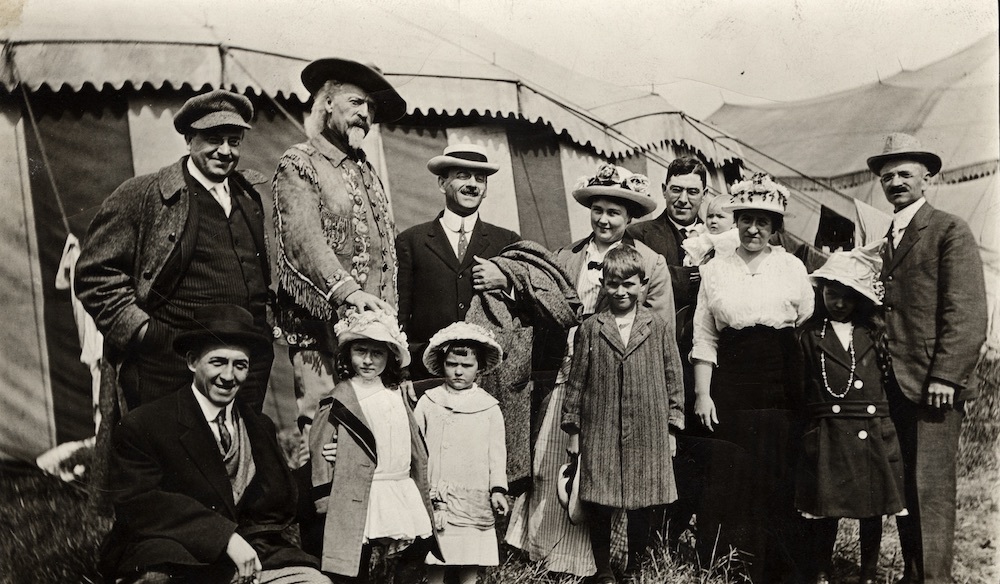
    <summary type="html"><![CDATA[<p><strong><em>He hunted buffalo on horseback.  He was a top scout for the United States Army.  He created and starred in his own magnificent Wild West Show which played to huge crowds all across America and before the crowned heads of Europe.  However, in 1882, William F. "Buffalo Bill" Cody was simply no match for Cleveland's justice system.</em></strong></p><img src="https://mail.clevelandhistorical.org/files/fullsize/af805ab6e91c3669e2965ddcd732b431.jpg" alt="Meeting with his Cleveland family." /><br/><p>Philip Cody, the grandfather of Buffalo Bill Cody, was one of Cleveland's pioneer settlers. A Massachusetts native, he lived much of his life in Toronto, Canada, where he became wealthy operating a tavern and speculating in real estate. In about 1830, when he was 60 years old, Cody, his wife Lydia, and nine of their 11 children, moved to Cleveland, then a small village on the south shore of Lake Erie. According to Cody family tradition, they moved here because of political unrest in Canada and because of business opportunities in Cleveland, which was beginning to boom as the result of the construction from 1825 to 1832 of the Ohio and Erie Canal. Cody settled on a 55-acre farm in what was then Cleveland Township. (It became East Cleveland Township in 1845, and in 1872 was annexed to the City of Cleveland.) The farm had 342 feet of frontage on the south side of Euclid Avenue just west of what is today East 86th Street, and stretched all the way south to Quincy Avenue in what is today Cleveland's Fairfax neighborhood. Philip Cody lived on this farm for almost twenty years, continuing to engage, as he had in Canada, in real estate transactions, many of them with members of his family who lived nearby. In or about 1847, the year Lydia died, he moved in with his daughter Sophia, whose husband Levi Billings operated a tavern near Doan's Corners, just a half mile or so east of the Cody farm. A few years later, on January 2, 1850, at the age of 80, Philip Cody died. </p><p>And that might have been the end of this story except for two developments which occurred in the Cody family almost three decades after Philip's death. First, according to newspaper accounts, in October 1878, Joseph A. Cody, a son of Philip Cody who had lived with or nearby his father during the 1840s, confessed on his deathbed to his nephew Lindus Cody that he had forged deeds and swindled his siblings and their descendants out of their share of Philip's farm. And second, the story about Joseph Cody's deathbed confession eventually reached the ears of Lindus' cousin, William F. "Buffalo Bill" Cody, who by this time had become one of the most famous celebrities in late nineteenth century America.</p><p>"Buffalo Bill" Cody was born near LeClaire, Iowa in 1846. His father, Isaac, was one of Philip Cody's 11 children. Isaac had come to Cleveland with the rest of the family, but had left the area around 1840, following his brothers Elijah and Philip Jr. west to Iowa, before eventually moving to Kansas in 1854. Shortly after his arrival there, Isaac was stabbed twice in the chest while giving a speech opposing the extension of slavery in the state, suffering injuries from which he never fully recovered. When he died in 1857, his 11-year-old son Bill had to go to work, according to biographers, in order to help his mother and four sisters. He became a wagon train messenger, a pony express rider, a buffalo hunter, and finally a scout for the U.S. Army. By 1870, his western exploits caught the attention of Edward Judson, who, under the pseudonym "Ned Buntline," began writing a series of dime novels about "Buffalo Bill" Cody which soon made him a household name in America. Capitalizing on his newfound fame, Cody, when he was not scouting for the Army, began starring in plays (called "combinations"). His performances in these plays, which were based upon his reputed feats in the Wild West, further enhanced his fame, especially back East. Then, in 1883, Cody, with the assistance of his publicist John Burke and others, created Buffalo Bill's Wild West, a show, which, unlike the plays in which he appeared, featured real cowboys engaged in rodeo events, reenactments of buffalo hunts, feats of marksmanship (starring, among others, Ohio's Annie Oakley), and amazing tricks performed on horseback (some by <a href="https://clevelandhistorical.org/items/show/904">Adele von Ohl Parker</a>, who later created her own Wild West Show on Parker Ranch in North Olmsted, Ohio), all performed in outdoor venues. The performances of these shows over the next three decades would cement Cody's fame for several generations of Americans, and was a major influence on the development of twentieth century western films, rodeos and circuses in this country.</p><p>In 1880, just three years before Buffalo Bill Cody launched his Wild West Show, his Aunt Margaret, the widow of his father's brother Elijah, learned about the alleged fraudulent acts of Joseph Cody and, according to news accounts, launched her own two-year long personal investigation into the matter, traveling around the country, examining deeds, identifying heirs, and talking to family members and others with knowledge of Joseph Cody and the mental condition and business acumen of Philip Cody in the 1840s. In early 1882, she contacted her nephew Buffalo Bill about the matter, not just because he was a celebrity, but also likely because she needed money to file a lawsuit. According to one source, Buffalo Bill, who agreed to bankroll the effort--in large part, he later claimed, in order to help his four sisters--paid $5,000 to retain Hutchins, Campbell, and Johnson, a prominent law firm in Cleveland with offices in the Blackstone Building, located just a block or so from the old County Court House on the northwest quadrant of Public Square. It was there that the Cody lawsuit would be heard before Judge Gershom Barber, a reputedly able jurist who had served as a brigadier general during the Civil War. It wasn't long before Cleveland's major newspapers--the Plain Dealer, the Leader, and the Herald, as well as major newspapers across the country, were abuzz with articles claiming that a lawsuit was about to be filed here in Cleveland against a number of wealthy Euclid Avenue residents and that the famous Buffalo Bill Cody was a plaintiff in the suit. Estimates of the value of the land which Cody was trying to recover for his sisters and the other heirs ranged, according to different articles, from $300,000 to $3,000,000.</p><p>The Cody lawsuit was filed in Cuyahoga County Common Pleas Court on July 22, 1882. Named as plaintiffs were 14 heirs of Philip Cody representing six of his 11 children, led by William F. Cody. (Of Philip Cody's remaining five children, one had died without children, two were alleged to have participated in the fraud against the heirs, and the heirs of the remaining two, Elizabeth Custead and Lydia O'Dell, apparently—as intimated in a letter to the editor which appeared in the Cleveland Leader on March 17, 1882—declined to participate in the lawsuit). Named as defendants were 104 Clevelanders who were alleged to be at the time of the filing of the suit the owners of the land that had constituted Philip Cody's 55-acre farm at the time of his death in 1850. The defendants included four upper class Cleveland families who lived or owned land on Euclid Avenue, by then one of the most famous residential streets in America, if not the world. The vast majority of the remaining defendants were middle class or working class Clevelanders, most owning or living in houses on Lincoln Avenue (today, East 83rd Street), between Cedar and Quincy Avenues. The southernmost part of this section of the street was fast becoming an ethnic enclave for Cleveland's Czech immigrants who would just one year later organize St. Adalbert Catholic Church on Lincoln Avenue, between Garden (today, Central) and Quincy Avenues.</p><p>The plaintiffs' theory of liability in the Cody Lawsuit was that the 104 defendants had purchased their land, either directly or indirectly, from, in essence, thieves—the petition claiming that Philip Cody, Jr., as well as his brother Joseph, had fraudulently acquired their father's farm in the 1840s—and that the law does not recognize the validity of even a bona fide purchaser's title when it is obtained from a thief. The petition further claimed that the fraud was committed by Joseph Cody and Philip Cody, Jr., when they took advantage of their father's diminished mental condition and either forged deeds in his name or induced him to sign deeds, conveying half of Philip Sr.'s farm, in trust, to Joseph Cody's wife, and the other half to Philip Cody Jr.'s wife. For their remedy, the plaintiffs asked the court to convey to them a six-tenths interest (because only six of the ten Cody children or their descendants were participating in the suit) in each defendants' property, subject to adjustments for improvements made and for rents collected. </p><p>The Cody lawsuit plaintiffs never were allowed an opportunity to proceed to trial and present evidence in support of their petition's allegations in open court. Instead, their petition was subjected to a number of formulaic nineteenth century procedural motions by attorneys representing various individual defendants and groups of defendants, including several filed by Ephraim J. Estep, a well known member of the Cleveland bar and former resident of Euclid Avenue (see Allen-Sullivan House story), who represented 62 of the defendants, including Darius Cadwell, one of Judge Gershom Barber's colleagues on the Common Pleas Court bench. Essentially, the defendants complained that plaintiffs' petition did not allege sufficient specific facts from which the court could legally find for the plaintiffs. Judge Barber, who appears to have agreed with the substance of the defendants' motions, gave the plaintiffs two opportunities to correct the alleged legal deficiencies in their petition and, when they failed to do so to his satisfaction, dismissed their petition in May of 1883. It is difficult today, even for a retired lawyer, to determine the exact grounds upon which the court based its decision. However, the plaintiffs' attorney, John Hutchins, in an interview he gave which appeared in the Plain Dealer on July 23, 1889, stated that the judge's decision was based on a statute of limitations argument. This essentially means that the time within which the plaintiffs were legally required to bring such an action based on fraud had expired before the suit was filed. The Cody heirs filed an appeal from Judge Barber's judgment to the Cuyahoga County Court of Appeals (then called the District Court), which affirmed the lower court's judgment in October 1885. An appeal to the Ohio Supreme Court was dismissed in November 1887 "for failure to file printed record," an indication that Buffalo Bill Cody had, by this time, tired of the case and was no longer willing to throw good money after bad.</p><p>In addition to the Plaintiffs not getting their day in court, it should be noted that neither did Joseph Cody and Philip Cody, Jr., both of whom had died before the lawsuit was filed. While the dismissal of the case was a victory for the defendants, it left unanswered the question of whether Joseph and Philip Cody, Jr. did, in fact, commit fraud and deprive the other children and their heirs out of a share of the Cody farm. On that question, it must be emphasized, as noted above, that Philip Cody engaged in a number of real estate transactions in the 1840s wth members of his family, including his sons-in-law William Custead, John Odell, and Levi Billings. And yet none of these individuals, or the Cody daughters that they married, were ever charged with fraud.</p><p>Over 130 years have passed since William F. "Buffalo Bill" Cody came to Cleveland in a failed effort to recover his grandfather's 55-acre farm on Euclid Avenue. Unlike other Cleveland Historical stories that are about people or places, little is left standing in Cleveland to commemorate or otherwise remind us of Buffalo Bill's 1882 lawsuit. But there are some places which can serve to do so. You can make a trip to East Cleveland Township Cemetery and there view the weathered gravestone of Buffalo Bill's grandparents, Philip and Lydia Cody. Or you can take a drive down East 83rd Street, just south of Cedar Avenue, and see three houses at 2202, 2208 and 2210 East 83rd that were standing in 1882 and were owned and/or occupied by defendants in the Cody Lawsuit. And finally, you can visit the website of the International Cody Family Association, formed shortly after the death of William F. "Buffalo Bill" Cody in 1917, to travel back to a time when Buffalo Bill Cody was a household name in America, when Euclid Avenue was one of the grandest residential avenues in the United States, and when a trip by Buffalo Bill to Cleveland for the purpose of bringing a lawsuit against wealthy Euclid Avenue residents was an event which captured the attention and interest not only of Clevelanders, but of people all across the country.</p><p><em><strong><a href="https://mail.clevelandhistorical.org/items/show/873">For more (including 12 images) view the original article</a></strong></em></p>]]></summary>
    <published>2019-09-23T20:21:06+00:00</published>
    <updated>2026-04-17T19:17:39+00:00</updated>
    <link rel="alternate" type="text/html" href="https://mail.clevelandhistorical.org/items/show/873"/>
    <id>https://mail.clevelandhistorical.org/items/show/873</id>
    <author>
      <name>Jim Dubelko</name>
    </author>
  </entry>
  <entry>
    <title type="html"><![CDATA[Luther Moses House: A Cleveland Landmark that did not find  its Savior]]></title>
    <summary type="html"><![CDATA[<p><strong><em>The house was one of the oldest and most historic residences in Cleveland's  Hough neighborhood.  And that's saying a lot, because Dunham Tavern Museum, just a mile or so away, is located in the same neighborhood.</em></strong></p><img src="https://mail.clevelandhistorical.org/files/fullsize/97ebaaee58bed93ec97998bb4bf90f73.jpg" alt="The Luther Moses House " /><br/><p>It was widely believed that the house which once stood at 5611 Lexington  Avenue was built in 1854 by pioneer Cleveland shipbuilder,  Luther Moses.  However, the house, which was originally designed in a vernacular style exhibiting  elements of Gothic, Greek Revival and Federal architecture, may have been nearly a decade older than that.  County tax and deed records suggest that Luther and his wife Arvilla, who in the 1840s had been living in Ohio City near his shipyard, moved in 1848 to East Cleveland Township, onto a 100-acre lot southeast of the intersection of Superior Street (Avenue) and Willson Avenue (East 55th Street).  The tax records further suggest that they took possession under a land contract and that, when they arrived, there was already a house on the property, one which was likely built in 1845 by early Cleveland merchant, real estate developer, and renowned house builder, Philo Scovill.  Finally, the tax records note that, in 1852, Luther was taxed for an "addition to house"--which was perhaps a one-story addition on the east side of the house observable for many decades--an improvement to the property that Luther may have delayed constructing until he acquired legal title, which occurred in 1851.  </p><p>So, was the house built in 1845 the same house that until recently sat at 5611 Lexington, or was the house at 5611 Lexington a newer house built on the property in 1854? That mystery may not be easily solved, but it is clear that Luther and Arvilla Moses lived in the house, which originally had a front entrance facing west toward Willson Avenue, until the early 1870s. Before that decade arrived,  Luther retired from the shipbuilding business and focused for a time on farming the 30 acres he had retained from his original 1851 land purchase. His farming days came to an end in the 1870s when East Cleveland Village--East Cleveland Township had become a village in 1866--was annexed to its fast-growing neighbor to the west, Cleveland. Anticipating (or perhaps even promoting) this annexation, Luther and Arvilla  Moses submitted a plat to East Cleveland village in 1871, proposing to create a  residential subdivision with 68 lots, most of them fronting new Moses Avenue. The subdivision was approved in 1872, the same year that East Cleveland was  annexed to Cleveland, and also, sadly for Luther, the same year that Arvilla Moses died. </p><p>As a result of the development of the new subdivision, the Luther Moses House acquired a street address of 1220 Moses Avenue (and likely also a new front entrance facing the new street). That street address became 1220 Lexington Avenue a few years later, when, in anticipation of the centennial of the Declaration of Independence, Moses Avenue was renamed Lexington Avenue.  In 1906 the house acquired its current address when Cleveland enacted legislation, among other things, renaming many of the city's north-south streets as numbered streets, and at the same time renumbering houses and other buildings on east-west streets with numbers indicative of their approximate location from a particular numbered street.</p><p>Within a month of his wife's death, Luther Moses moved from the house and put it up for sale.  It remained unsold for seven years--though it was rented out for several of those years--until it was purchased by Rosetta Scowden, the wife of renowned Cleveland engineer, Theodore Ransom Scowden. In 1852, Scowden, who had designed a water works system for the City of Cincinnati, came to Cleveland and designed this city's first system.  Because of the effects of Cleveland's early industrialization and population growth on the Cuyahoga River and Lake Erie, drinking water was becoming dangerously contaminated, leading to cholera and other disease epidemics. To combat this contamination and disease, Scowden designed a waterworks that included  an intake pipe that went well out into the Lake where the water was cleaner, an engine house near the shoreline that pumped the clean water uphill from the Lake, and a reservoir that held and distributed this water to Cleveland residents.</p><p>The Scowdens had become wealthy as a result of Theodore's engineering work here and elsewhere. They lived in a grand house on Euclid Avenue for years before retiring to their "cottage" in 1879, as Rosetta Scowden referred in her will to the Moses House. The Scowdens unfortunately did not live to enjoy many years of retirement in the house. Theodore died  in 1881, just two years after the house was purchased, and Rosetta the following spring in 1882. Upon her death, the house passed to their daughter Josephine, who had married Charles Gaylord, a Civil War veteran whose maternal grandfather was General Erastus Cleaveland, a hero in the War of 1812 and a cousin of Cleveland's legendary founder.</p><p>The Gaylords, who owned the house from 1882 until 1910, were the last family to occupy it as a single family residence for an extended period of time. When Josephine Gaylord died in 1910, her husband moved from the house and it was sold to Arnold and Pauline Roth who purchased it with the intention to convert it to a multifamily dwelling. The Roths made extensive changes to the exterior, as well as to the interior of the house, including replacing the front porch which extended along the entire south side of the house with a shortened two-story porch, adding a second floor to the addition on the east side of the house, and constructing an exterior two-story stairwell for tenant access on the north side of the house. In 1913, shortly after the reconstruction was completed, the Roths sold the house to local physician Dr. John H. Belt.</p><p>The Belt family owned and managed 5611 Lexington Avenue as absentee landlords for the next thirty years. As housing conditions in the Hough neighborhood declined, the condition of the Luther Moses House slowly did too.  The last owners of the house--Steve Matt Skrita, a Croatian immigrant, who owned the house from 1948 to 1963, and the African American Beatrice Landon family, who purchased it from Skrita in 1963--lived on site in one of the suites while renting out the others. However, after the death of Beatrice Landon in 1991, the Landon family struggled unsuccessfully to maintain it, and the condition of the house declined precipitously until the last owner, Herbert Landon, was compelled because of its condition to sell it to the County Land Bank in 2017.</p><p>Since at least 1987, when it was landmarked by the City of Cleveland, the Luther Moses House had been recognized in the community as one of the historic jewels of the Hough neighborhood. In recent years, that neighborhood has begun to rebound from its long decline, with new businesses opening up, new housing going up, and the renovation of historic League Park (just down the street from the Luther Moses House). During this period, continuing efforts were made by the City, the County, and even the Landon family, to save the house. It was the subject of well-researched articles, including one that appeared in the Cleveland Plain Dealer in 1995, and three that appeared in Christopher Busta-Peck's locally famous "Cleveland Area History" blog in 2009 and 2011.  In 2019, final efforts were made by the Cleveland Restoration Society to save the historic house. It was not an easy task, as efforts to save a similar historic house on the City's west side--the William Burton House on West 41st Street--have demonstrated.  While the William Burton House was eventually saved and restored, unfortunately, despite the efforts of many organizations, the Luther Moses House was not.  In September 2020, the 175-year old landmark was razed.</p><p><em><strong><a href="https://mail.clevelandhistorical.org/items/show/849">For more (including 12 images) view the original article</a></strong></em></p>]]></summary>
    <published>2018-10-04T21:18:38+00:00</published>
    <updated>2026-04-17T19:17:42+00:00</updated>
    <link rel="alternate" type="text/html" href="https://mail.clevelandhistorical.org/items/show/849"/>
    <id>https://mail.clevelandhistorical.org/items/show/849</id>
    <author>
      <name>Jim Dubelko</name>
    </author>
  </entry>
  <entry>
    <title type="html"><![CDATA[Warrensville West Cemetery: From Deserted Burial Ground to Shaker Heights Shrine]]></title>
    <summary type="html"><![CDATA[<img src="https://mail.clevelandhistorical.org/files/fullsize/1562d9a715347e427ba630937c9f0aeb.jpg" alt="Cemetery Marker, ca. 1959" /><br/><p>In the late 1950s, the Shaker Historical Society undertook the daunting task of creating a memorial marker to tell the story of a small unmarked burial ground commonly referred to as the "Lee Road Cemetery" or the "Old Manx Cemetery." This graveyard, located at 3451 Lee Road, was the second oldest burial ground in Cuyahoga County, and the oldest designated landmark in Shaker Heights. Records for the cemetery, however, had long been lost, and only a few burials had taken place in the previous half-century. The Shaker Historical Society would need to interpret a story for the space through a study of grave inscriptions, newspaper articles, county histories, maps, and accounts provided by descendants of those buried. The narrative of the recovered history was framed to tell the tale of Shaker Heights's common heritage and be a celebration of the region's pioneer past.</p><p>The memorial marker was to inscribe new meaning into the public burial grounds. The Shaker Historical Society intended to transform the unmarked and deserted graveyard into a shrine, and a space where residents of Shaker Heights could pay tribute to the region's founders. Concise and inclusive, trustees of the historical society decided on what they hoped would be a perfect tribute:</p><p><blockquote>"First Burial 1811 / Final Resting Place Of / Pioneer Families / Manx Settlers / Veterans Of Five Wars / North Union Shakers"</blockquote>
</p><p>Dedicated on Memorial Day, 1959, the plaque captured the stories of patriotic veterans, brave pioneers, industrious immigrants and pious Shakers. Its placement among the weathered gravestones offered a point of departure for discovering and memorializing the colorful, unique history of both Warrensville Township and Shaker Heights.</p><p><em><strong><a href="https://mail.clevelandhistorical.org/items/show/408">For more (including 6 images) view the original article</a></strong></em></p>]]></summary>
    <published>2012-02-08T13:38:58+00:00</published>
    <updated>2026-04-17T19:17:38+00:00</updated>
    <link rel="alternate" type="text/html" href="https://mail.clevelandhistorical.org/items/show/408"/>
    <id>https://mail.clevelandhistorical.org/items/show/408</id>
    <author>
      <name>Richard Raponi</name>
    </author>
  </entry>
  <entry>
    <title type="html"><![CDATA[Moses Warren House]]></title>
    <summary type="html"><![CDATA[<img src="https://mail.clevelandhistorical.org/files/fullsize/bb349d2dadbefc4284fe22025a71cd3a.jpg" alt="View from Ingleside Road" /><br/><p>At an age that most men of his era did not reach, and when many men today are considering retirement, Revolutionary War veteran Moses Warren (1760-1851) left his native Connecticut for pioneer life in the Western Reserve.  In 1815, at the age of 55, Warren, his wife, and their four children made the nearly 600 mile trip in seven weeks on a horse-drawn wagon.  They stayed for a time with Moses' son Daniel, who had arrived in 1810, becoming the first settler in what became known as Warrensville Township. An earlier visit with Daniel had convinced Moses to take advantage of the cheap land and good soil in the wilderness of the Western Reserve.</p><p>In 1816, Moses Warren paid $456.00 for 154 acres of land.  "Lot Number Fifty Three in Township Number seven in the Eleventh Range of Townships in the Connecticut Western Reserve," as the deed described it, sat just south of Kinsman (now Chagrin) Road, one of the area's earliest trails.  After spending the first year in a log cabin, Warren built a frame house which still stands today. </p><p>Life on the frontier required men to use the land to fulfill nearly all of their needs. Warren used sandstone from a quarry near Palmerston Road for the house's foundation and lumber from the surrounding forests for its frame.   He channeled a spring, rerouting it beneath his cellar to provide refrigeration.  Warren grew corn and potatoes on his land, his orchards were loaded with fresh fruit, and he raised livestock that provided meat, milk, and labor. </p><p>In addition to farming, Warren served as an officer in Warrensville's town government in the 1830s and 1840s. He also served as postmaster and helped organize one of the area's first churches in 1831.  He died in 1851 at the age of 91, having seen the wild frontier he helped settle some 35 years earlier turn into a prosperous farming region whose crops fed people across the United States.</p><p>Moses Warren's son sold the house to John Palmer in 1865.  Palmer and his descendants worked the farm on the property until the 1920s, when the 154 acres were divided into smaller lots to take advantage of the real estate boom taking place in the fast-developing suburb of Shaker Heights. The house remains standing at 3535 Ingleside Road, however, and was listed on the National Register of Historic Places in 1974.  It is the oldest existing house in Shaker Heights and became a City of Shaker Heights Landmark on August 29, 1977.</p><p><em><strong><a href="https://mail.clevelandhistorical.org/items/show/364">For more (including 7 images&#32;&amp;&#32;2 audio files) view the original article</a></strong></em></p>]]></summary>
    <published>2011-12-14T11:46:31+00:00</published>
    <updated>2026-06-02T15:50:29+00:00</updated>
    <link rel="alternate" type="text/html" href="https://mail.clevelandhistorical.org/items/show/364"/>
    <id>https://mail.clevelandhistorical.org/items/show/364</id>
    <author>
      <name>Michael Rotman</name>
    </author>
  </entry>
  <entry>
    <title type="html"><![CDATA[Woodland Cemetery]]></title>
    <summary type="html"><![CDATA[<img src="https://mail.clevelandhistorical.org/files/fullsize/766aecf549fdf427cdb4f2da9ddd0722.jpg" alt="Civil War Veterans in 1905" /><br/><p>On June 14, 1853, Cleveland's mayor, city officials, clergy, and a few citizens gathered under a shady grove for the dedication of Woodland Cemetery.  The flat but tree copious 60-acres used for the new burial ground had been purchased in 1851 and developed by Cleveland's city council to take the place of Erie Street Cemetery.  Its name, decided one week before the dedication, originated from a poem about Cleveland by the Scottish poet Thomas Campbell called "Pleasures of Hope." The ground was dug for the cemetery's first burial nine days after its dedication. Since then, Woodland has become the final resting place for everyone from the ordinary citizen to Ohio governors to war veterans.</p><p>Woodland's markers are just as varied as the people buried there, adding to the charm and interest of the cemetery. The gravestones are arranged in a rural cemetery style, using the landscape to determine their placement, and creating a park-like atmosphere. These and other features, such as a fountain, a chapel, and a stone gateway, made Woodland an attractive place for Clevelanders to visit. However, its popularity and location as a stop for Cleveland streetcars had also made it a convenient, but temporary, location for illegalities such as prostitution and cadaver hunting.  </p><p>Two Soldiers' Lots for Civil War soldiers were purchased by the federal government in 1868. These lots do not contain all of the veterans buried in Woodland. Graves belonging to soldiers from every war since 1812, some unmarked, are scattered amongst the graves of civilians.  There is even one Confederate soldier among them. Not surprisingly, Civil War soldiers outnumber the other veterans in the cemetery. Out of the 15,600 Cuyahoga County men who were eligible for service during the Civil War, more than 10,000 served in the military. Three monuments have long stood in the cemetery to honor these men: one for the 23rd Ohio Volunteer Infantry was erected in 1865; one for the 7th Ohio Volunteer Infantry was built in 1872; and one recognizing the Grand Army of the Republic was built in 1909. Future presidents Rutherford B. Hayes and William McKinley were in attendance at the dedication of the latter. In 2012, the cemetery added a fourth Civil War monument to honor the 86 black soldiers who are buried there.  </p><p>Not all of the courageous individuals from that time have monuments or soldier burials at Woodland Cemetery. An example is Sara Lucy Bagby Johnson, a runaway slave who hid in Cleveland. When she was finally apprehended she became one of the last slaves to face charges under the Fugitive Slave Act. A headstone has just recently been given to Johnson, who before had been buried in an unmarked grave. Also buried there is Eliza Simmons Bryant who founded the Cleveland Home for Aged Colored People, and Ohio's first black state senator, John Patterson Green. While visiting and exploring Woodland Cemetery, one can stumble upon these and the graves of other famous politicians, inventors, and Cleveland pioneers.</p><p><em><strong><a href="https://mail.clevelandhistorical.org/items/show/327">For more (including 7 images&#32;&amp;&#32;3 audio files) view the original article</a></strong></em></p>]]></summary>
    <published>2011-08-22T19:51:04+00:00</published>
    <updated>2026-04-17T19:17:38+00:00</updated>
    <link rel="alternate" type="text/html" href="https://mail.clevelandhistorical.org/items/show/327"/>
    <id>https://mail.clevelandhistorical.org/items/show/327</id>
    <author>
      <name>Heidi Fearing</name>
    </author>
  </entry>
</feed>
