<?xml version="1.0" encoding="UTF-8"?>
<feed xmlns="http://www.w3.org/2005/Atom">
  <title type="text">Cleveland Historical</title>
  <updated>2026-04-18T02:27:54+00:00</updated>
  <generator uri="http://framework.zend.com" version="1.12.20">Zend_Feed_Writer</generator>
  <link rel="alternate" type="text/html" href="https://mail.clevelandhistorical.org/"/>
  <link rel="self" type="application/atom+xml" href="https://mail.clevelandhistorical.org/items/browse?output=rss2"/>
  <id>https://mail.clevelandhistorical.org/</id>
  <author>
    <name>Cleveland Historical</name>
    <uri>https://mail.clevelandhistorical.org</uri>
  </author>
  <link rel="hub" href="http://pubsubhubbub.appspot.com/"/>
  <entry>
    <title type="html"><![CDATA[St. Mary Cemetery: Cleveland&#039;s First West Side Catholic Cemetery]]></title>
    <summary type="html"><![CDATA[<p><strong><em>St. Mary Cemetery lies in the middle of one of the most densely populated residential areas on Cleveland's west side. Its nine acres of land, dotted with shade trees and beautiful grave stones, is surrounded by a fence, and, at its West 41st Street entrance, a posted sign advises visitors of its visiting hours.  However, neither this entrance nor its other on West 38th is gated. This being the case, St. Mary's almost beckons to neighbors and any other passersby to  visit it at any time, day or night, enjoy its grassy grounds, walk its pretty paths, and, most importantly, respect its magnificent  monuments.</em></strong></p><img src="https://mail.clevelandhistorical.org/files/fullsize/1cc9a1a467673d53392c76e36c48e8e6.jpg" alt="The once ornate West 41st Street entranceway to St. Mary Cemetery." /><br/><p>In 1853, just one year before Ohio City was annexed to the City of Cleveland, thus becoming Cleveland's west side, prolific nineteenth-century real estate developer Hiram Stone platted a new residential subdivision south of Ohio City in Brooklyn Township. He called it "H. Stone's Addition to Ohio City & Cleveland," a remarkably prescient title at the time. The new subdivision stretched west from Pearl (West 25th) Street all the way to Gauge (West 44th) Street, and from Clark Avenue north to <a href="https://clevelandhistorical.org/items/show/659">Walworth Run</a> at Ohio City's southern boundary. </p><p>The platted area contained almost 700 lots for residential houses, but left undeveloped in its midst were thirteen acres located just east of Burton (West 41st) Street and north of Clark Avenue. In 1861, as houses were going up in Stone's subdivision—many of them for German immigrants who were pouring into Cleveland in this period in large numbers—the southernmost six acres of the undeveloped thirteen in the middle of the subdivision were purchased by the Catholic Diocese of Cleveland for, according to the deed of purchase, "cemetery purposes for the benefit of German Catholics on the west side of the Cuyahoga River." </p><p>Many of the early records of St. Mary Cemetery appear to have been destroyed in a fire, making research of the early years of the cemetery difficult.  However, secondary sources tell us that St. Mary Cemetery was established on those six acres of land in 1862 by St. Mary of the Assumption parish, Cleveland's first west side German Catholic parish. The property for St. Mary Cemetery was purchased during the pastorship of Father F. X. Obermueller, a German immigrant, but it appears that it was under a subsequent pastor, Father Stephen Falk, a Swiss immigrant who served the parish from 1862 to 1880, that the cemetery grounds were developed and consecrated. In St. Mary Cemetery's early years, it was often referred to as Burton Street Cemetery, after the street upon which it fronted. That street, in turn, had been named after <a href="https://clevelandhistorical.org/items/show/660">William Burton</a>, an Ohio City pioneer whose summer cottage was built on the street in 1839 and still stands directly across from St. Mary Cemetery.  </p><p>Just a few years after St. Mary Cemetery opened, another German Catholic parish, <a href="https://clevelandhistorical.org/items/show/649">St. Stephen</a>, was established on Cleveland's west side. It began in 1869 as a mission of St. Mary of the Assumption for German Catholics living west of Gauge (West 44th) Street. A decade later, in 1881, another parish, <a href="https://clevelandhistorical.org/items/show/717">St. Michael Archangel</a>, was also founded as a mission of St. Mary's for German Catholics living on Cleveland's southwest side. In the years that followed, German Catholics who belonged to either St. Mary of the Assumption, St. Stephen or St. Michael's parishes were permitted to be buried at St. Mary Cemetery which, by this date, had now become part of Cleveland's west side following the 1867 annexation of an area of Brooklyn Township that included the lands upon which the cemetery was located.</p><p>It is interesting to note that no Cleveland newspaper mentioned St. Mary Cemetery during the first decade of its existence. The first to mention the cemetery, albeit obscurely, was the Plain Dealer on May 30, 1871, when it published an article which noted that, on Decoration Day, Father Falk of St. Mary's German church had, at the west side "Catholic cemetery," decorated the graves of "J. Mayer, J. Schneider, F. Werz, A. Klein, K. Mecil, B. Lais, F. Schwonger, S. Vochatger, C. A. Schmidt, and Jas. Macklin." All of these men presumably were German Catholics who had fought for the Union—and for which some had died—in America's Civil War. Cleveland city directories were even slower in acknowledging the existence of the new cemetery. St. Mary Cemetery was not listed in any Cleveland directory until 1874.</p><p>Thousands of German immigrants and descendants of German immigrants were buried at St. Mary Cemetery in the years that followed its establishment, many of them beneath beautiful gravestones inscribed in the German language. A number of these gravestones are memorials to notable German Catholics who, in the second half of the nineteenth century, operated successful retail businesses on Lorain Avenue near Fulton Road, an intersection that soon became known as <a href="https://clevelandhistorical.org/items/show/966">Lorain-Fulton Square</a>. A number of those gravestones honor members of the related Fridrich and Schmitt families who operated several different businesses in that west side commercial district, including <a href="https://clevelandhistorical.org/items/show/964">Fridrich Bicycle</a>, one of the oldest retail bicycle shops in the United States until it closed its doors in 2024. </p><p>Another example of a notable German immigrant businessman buried at St. Mary Cemetery is Friedlin "Freddie" Hirz (1843-1903), a tailor who for years had a shop on Lorain Avenue, just west of what is today West 45th Street. His shop was so well known that it was featured in the 1874 Atlas of Cuyahoga County. Another is Edward Disler, a German immigrant and jeweler who successfully operated a store on Lorain Avenue near West 25th Street for many years.</p><p>While St. Mary Cemetery was explicitly founded for German Catholic burials, Catholics of other ethnicities were later given permission to bury their dead there too. The first of these were Bohemian Catholics many of whom lived near the cemetery in a west side neighborhood that was known in the second half of the nineteenth century as the <a href="https://clevelandhistorical.org/items/show/646">Isle of Cuba</a>. The early-arriving immigrants likely first worshiped with German Catholics at either St. Mary of the Assumption or St. Stephen, but, by 1872, their numbers were sufficiently large that the Bishop permitted them to form a parish of their own, which they called <a href="https://clevelandhistorical.org/items/show/661">St. Procop</a>, after Bohemia's patron saint. Their first church was built on Burton Street, just south of St. Mary Cemetery in 1874. One of the earliest verifiable burials of a Bohemian Catholic at St. Mary Cemetery occurred in 1892, when 41-year- old Miloslav Holecek, a Cleveland grocer and immigrant from <span>Karlova Huť in Central Bohemia</span>, died and was buried there. His gravestone, as well as those for a number of other Bohemian immigrants buried at St. Mary's, is inscribed entirely in the Czech language.</p><p>In the early years of the twentieth century, Catholic immigrants of other ethnic groups from Central Europe who often tended to settle in urban areas where Germans and/or Bohemians had first settled, including Hungarians, Poles, and Slovaks, became members of the west side German and Bohemian Catholic parishes, and when they died, they were permitted to be buried at St. Mary Cemetery too. Their gravestones were often inscribed in their native languages.</p><p>In 1917, Father Casimer Reichlin, the first pastor of St. Stephen who had served for an incredible 47 years, died.  By this time, there appears to have already been a large circular section near the West 41st Street entrance to St. Mary Cemetery, in the center of which a large cross had been erected. It further appears that it was decided that this beloved pastor should be buried in that section, with a large sculpted monument erected over his grave. Four years later, Father Reichlin's long-time friend and fellow priest, Bishop Joseph Koudelka, who had been a pastor at both St. Procop and St. Michael, died and was buried next to Father Reichlin's grave in the circular section. A similarly sized sculpted monument was placed over his grave too. Soon this circular section of St. Mary Cemetery became known as the Priests Circle. In the years that followed, other notable local priests who had served west side Catholic parishes were accorded the same honor and buried in the Priests Circle, some below large monuments and others below simple flat grave markers. As of October 2025, there were eleven priests buried in the Priests Circle. Father Stephen Falk, whose efforts led to the development of the cemetery and its consecration in 1862, is not buried in the Circle, as he died in 1899 long before the Priests Circle was initiated. A simple flat grave marker in Father Falk's memory, which apparently replaced a more elaborate earlier monument, is located in another section of St. Mary Cemetery.</p><p>By the early 1920s, there were few available burial plots left at St. Mary Cemetery. The parish of St. Mary of the Assumption decided to remedy this by expanding the cemetery's lands, and in 1927 and 1928 it successfully purchased three additional acres of land for the cemetery that abutted the eastern end of the original cemetery grounds.  The additional acres had earlier been developed as residential lots in H. Stone's Additional Subdivision. Houses on the lots were either torn down or moved, and the cemetery grounds were successfully extended all the way to West 38th Street. Along with the additional land, St. Mary Cemetery was further enhanced at this time with a second entrance on West 38th Street and a new walking path that led from that entrance directly to a new circular section in the cemetery.</p><p>On November 15, 1931, the new addition to St. Mary Cemetery was consecrated at a ceremony attended by a representative of Bishop Joseph Schrembs.  Some five years later, on May 17, 1936, the Cuyahoga County Council of the Veterans of Foreign Wars placed a flagpole and a memorial plaque in the center of the new circular section, the plaque inscribed: "Dedicated To The Veterans Who Served . . . Lived . . . Died . . . for their Country."  </p><p>As previously noted, St. Mary Cemetery had long held the graves of a number of German Catholic soldiers who fought and died in the Civil War, and also likely holds graves of soldiers and veterans who had fought in the Spanish-American War and/or in World War I. No veterans from any of these war, however, are buried in this new circular section. The first soldier buried in what became known as the Soldiers Circle, was Charles L. Andrews, a U. S. Navy radio operator who was killed on Easter Sunday, April 5, 1942, during the Battle of Bataan in the Philippine Islands. The remains of sixteen other soldiers or veterans who served in World War II were also buried in the Circle between 1942 and 1948.</p><p>In 1945, as a result of dwindling attendance numbers, St. Mary of the Assumption parish was dissolved and, in 1948, the management, care and maintenance of St. Mary Cemetery was transferred to the Calvary Cemetery Association, an organization which was later renamed the Catholic Cemeteries Association of the Cleveland Diocese. By the early 1950s, the last of the available lots in the cemetery were purchased, and, by 1976, according to a January 21, 1976 Plain Dealer article, the number of annual burials at St. Mary Cemetery had dropped to just fifty.  Today, in 2025, the annual numbers appear to be considerably less. According to findagrave.com—a website at which volunteers create memorials for people whose remains have been buried in cemeteries all around the world—the remains of only nine deceased persons have been buried at St. Mary Cemetery since 2020.  </p><p>St. Mary Cemetery is no longer the active burial place for west side Catholics that it once was. Burials are now few and far between. The cemetery's elaborate gate that once stood at its West 41st Street entrance in 1929 is gone. The sacred monuments to Father Reichlin, Bishop Koudelka and Father Falk have been substantially damaged, likely by vandals. The cross in the middle of the Priests Circle, which stood there for years until recently, is now gone. Acts of vandalism, as noted in a number of Plain Dealer and Press articles over the years, and the effects of exposure of the cemetery's monuments to Cleveland's weather over long periods of time, have left many monuments damaged and unreadable while many others have simply vanished. Still, St. Mary Cemetery remains one of the most historic cemeteries on Cleveland's west side and one which should be visited, respected, and carefully managed and maintained, not only for the descendants whose ancestors are buried there, but also for all Clevelanders who see value in preserving an important piece of their city's history.</p><p><em><strong><a href="https://mail.clevelandhistorical.org/items/show/1072">For more (including 15 images) view the original article</a></strong></em></p>]]></summary>
    <published>2025-11-23T16:18:32+00:00</published>
    <updated>2026-04-17T19:17:43+00:00</updated>
    <link rel="alternate" type="text/html" href="https://mail.clevelandhistorical.org/items/show/1072"/>
    <id>https://mail.clevelandhistorical.org/items/show/1072</id>
    <author>
      <name>Jim Dubelko</name>
    </author>
  </entry>
  <entry>
    <title type="html"><![CDATA[The Cleveland Catholic Worker: Personalism, Prayer, and Community on the Near West Side]]></title>
    <summary type="html"><![CDATA[<img src="https://mail.clevelandhistorical.org/files/fullsize/89b98bdda9f47736befc010310fc3067.jpg" alt="Dorothy Day" /><br/><p>In 1933, Dorothy Day and Peter Maurin co-founded the <em>Catholic Worker</em> newspaper, which laid the groundwork for the Catholic Worker movement in the United States. The <em>Catholic Worker</em> was priced at “a penny a copy,” and continues to cost a penny today. The paper was crucial in spreading awareness about social issues that affected those who were struggling in the United States. From the Catholic Worker movement's inception, Day and Maurin highlighted the importance of personalism, prayer, hospitality, and community. In Maurin's “Easy Essay,” an early article in the <em>Catholic Worker</em>, he emphasized, “The Catholic Worker believes in creating a new society within the shell of the old with the philosophy of the new, which is not a new philosophy but a very old philosophy, a philosophy so old that it looks like new.”</p><p>Houses of Hospitality within the Catholic Worker community have been crucial in providing lodging and meals for many in need. Houses of Hospitality are similar to Progressive Era settlement houses, which aided the poor as well as recently arrived immigrants. Like settlement houses, Catholic Worker Houses of Hospitality allow those living there to be an active part of the community while living and interacting with those in need of support. </p><p>By the 1980s, several Catholic Worker Houses of Hospitality and communities had emerged nationwide. In 1984, several figures, which included longtime residents Bill and Judy Corrigan, Jim and Patty Schlecht (Sullivan), along with a recent newcomer from Mishawaka, Indiana, Joe Lehner, formed the Cleveland Catholic Worker to live out the philosophy established by Dorothy Day and Peter Maurin. In 1986, a group of Catholic Workers on Cleveland’s Near West Side considered locations in the neighborhood where they could build community and witness the Gospel through word and deed. As Cleveland’s Catholic Worker grew, there was a need for a location to broaden the hospitality offered to the community, specifically for unhoused people in the area. The need for hospitality became a topic of discussion among the core members involved. </p><p>Dennis Sadowski, Jim Doherty, and Jim McHugh, three Catholic Workers, had been discussing living in community and were pivotal in the foundation of Cleveland’s Catholic Worker House of Hospitality, located at 3601 Whitman Avenue. The house offered a central meeting spot for many of Cleveland’s Catholic Workers, but before it was the Whitman House it was known as the “Mission House.” The Mission House was purchased by <a href="https://clevelandhistorical.org/items/show/1007">Saint Patrick Parish</a> in 1873 and became the home for Marianist Brothers who taught at Saint Patrick’s School. Other groups such as the Ursuline Sisters, Jesuit volunteers, and Marianist volunteers stayed in the Mission House before the Catholic Worker. </p><p> Throughout the summer of 1986, various core members prayerfully weighed the pros and cons of living in community. In the end, they agreed that living in community opened them to be vulnerable to the basic questions that called them to a belief in Jesus. They knew they had to overcome the barriers that often keep people from middle-class backgrounds from encountering people living on the margins of society.  </p><p> After several meetings and discussions with St. Patrick’s Father Mark DiNardo, they made an agreement that the Catholic Worker would rent the former Mission House in the names of Sadowski, Doherty, and McHugh for $200, not including the utilities. In October 1986, Sadowski, Doherty, and McHugh, along with two unhoused gentlemen living on the streets, John “Hugh” Fee and John “Whitey” Pavlison, officially moved into the Mission House. The Mission Home then assumed a new name, Whitman House, that forever marked the Cleveland Catholic Catholic Worker’s presence in the neighborhood. In the years to come, many individuals would find community, prayer, and a source of shelter within the walls of this former convent. </p><p>Sadowski was the first to leave the house in 1987 after living there for roughly four months. Doherty lived there for 15 months, leaving in January 1988, and McHugh stayed until about 1990. Fee remained at the Whitman house until 2002, when he passed away. The date when Pavlison left and his whereabouts remain unknown. Throughout the years, the Whitman House provided a place for many generations of Catholic Workers to meet, live, eat, and engage in meaningful prayer and dialogue.   </p><p>Cleveland’s Catholic Worker began publishing a quarterly periodical, <em>Inherit the Earth</em>, in the late '80s. <em>Inherit the Earth</em> invited members of the Catholic Worker to contribute to the paper through articles, poetry, artwork, reflections, photography, and even recipes. Many of the articles focused on updates in the community from Catholic Workers, young and old. Each quarterly paper also included the community mission statement, which stated, “We are forming a loving and caring resistance community with a strong spiritual base which will enable us to share our lives with those who are broken, not just for their benefit, but ours as well, knowing that we are all sisters and brothers.” Many of the articles in this periodical emphasized the community's resistance to war through political and social commentaries written by members. Nonviolence is one of the aims of a Catholic Worker. Resisting the Cleveland National Air Show has been pivotal in the Catholic Worker’s protest against war. Through their pacifist resistance, Cleveland’s Catholic Worker hopes to inform and educate the public about the real purpose of the planes flown for entertainment each Labor Day. </p><p>For many years, each <em>Inherit the Earth</em> issue included an update on the Community, which kept everyone in the loop on events and individuals living in the Whitman House and the extended Catholic Worker community. In the early 2000s, Whitman House struggled to maintain stable live-in volunteers. It was not until 2004 when multiple volunteers joined the Catholic Worker and lived in community that the house started to pick up with live-in Workers. In the fall of 2004, one Catholic Worker provided an update on the Whitman House and introduced nine Catholic Workers living there at the time. These introductions, full of inside jokes about the Worker's hygiene, give readers a glimpse of the friendships made while living together and forming close bonds through the volunteer work in which they all were involved. </p><p> </p><p>In January 2009, a meeting was called to discuss the continuance or possible relocation of the Catholic Worker from Whitman House. St. Patrick, which was the landlord of the Whitman House, had been included in a Cleveland Catholic Diocese–proposed merger with three other Near West Side churches — St. Malachi Parish, Community of St. Malachi, and St. Wendelin Parish. This meeting was called and functioned democratically to address any misunderstanding and to discuss the pros and cons of living at the Whitman House or relocating elsewhere. This meeting highlighted the importance of the Whitman House being conveniently located near necessary services and Catholic Worker operations. This meeting also focused on the importance of landlord-tenant relations between the Catholic Worker and who they decide to rent from, whether that be St. Patrick or a new landlord.  </p><p>Ultimately, the Cleveland Catholic Worker decided to relocate. This move was a three-year-long process. Although much smaller than the Whitman House, the new house at 2082 Fulton Road opened at full capacity with nine live-in volunteers in 2012. The Fulton House celebrated its tenth anniversary in 2022. This milestone brought Catholic Workers who lived there at the time together with workers who once lived in both Whitman and Fulton House in prior years. A special edition of <em>Inherit the Earth</em> came out that fall to commemorate the move to Fulton House. This edition included many photographs of Catholic Workers, young and old, current and former, and also included photos of the extended community.  </p><p>The ten-year celebration of Fulton House gave an understanding of the community that has formed on Cleveland’s Near West Side. Catholic Workers celebrated the lifelong bonds they had made with one another and the awareness they had spread on issues regarding war and poverty, along with the importance of nonviolence. From the teachings of Dorothy Day and Peter Maurin in the early 20th century, their philosophy of personalism, prayer, and ultimately love have been a part of Cleveland’s Catholic Worker community for forty years.</p><p><em><strong><a href="https://mail.clevelandhistorical.org/items/show/1039">For more (including 12 images) view the original article</a></strong></em></p>]]></summary>
    <published>2024-11-21T19:34:33+00:00</published>
    <updated>2026-04-17T19:17:43+00:00</updated>
    <link rel="alternate" type="text/html" href="https://mail.clevelandhistorical.org/items/show/1039"/>
    <id>https://mail.clevelandhistorical.org/items/show/1039</id>
    <author>
      <name>Bali White</name>
    </author>
  </entry>
  <entry>
    <title type="html"><![CDATA[The 1953 Tornado]]></title>
    <summary type="html"><![CDATA[<p><strong><em>On June 8, 1953, the west side of Cleveland was struck by a large F4 tornado that ripped through the city, causing mass destruction. The stormfront that produced this tornado had originated in Michigan, where it struck Flint, killing 116 people and injuring 844 before working its way south into Ohio. The long-track tornado that eventually hit Cleveland first touched down around the village of Deshler (midway between Toledo and Lima). The storm made its way east-northeast, hitting Cygnet, where it reportedly killed eight people and injured a further forty-eight. By evening, Cleveland was in harm's way.</em></strong></p><img src="https://mail.clevelandhistorical.org/files/fullsize/8530814b9e733f2858e84d64e1d921bb.jpg" alt="Damaged House" /><br/><p>At 8:23 p.m. the rain began to fall, and at 8:50 the thunder started. Five minutes later the Cleveland Weather Bureau issued a tornado warning. The thunderstorm grew in strength with high winds and heavy rain, and at 9:45 the tornado was observed on the ground at the north edge of the Cleveland-Hopkins Airport. Not long after, a second funnel was spotted just north of the Solon Airport as well. </p><p>The primary tornado then traveled northeast through the city's west side, running roughly parallel to Lorain Avenue. The worst-hit areas were between West 117th and West 130th Streets south of Lorain where an untold number of houses were utterly destroyed. Similarly hard-hit was the area around Franklin Circle. Crossing the river, the tornado plowed through downtown, where the <em>Plain Dealer</em> reported that "Euclid Avenue was strewn with broken glass from shattered doors and store fronts." The tornado then dissipated over Lake Erie. The all-clear signal was finally issued at 11:45.</p><p>The city and its people responded immediately by setting up emergency shelters and aid stations as the hospital filled to capacity. With no electricity, nurses and doctors had to work by flashlight and candlelight, administering what care they could. The National Guard was called up to assist and emergency sessions of the local and state governments were convened. All told, there were 17 dead, including a 13-month-old baby and five others found in the debris of a house on West 28th Street. In addition, there were over 400 wounded, as well as hundreds more who were left homeless. The tornado had caused an estimated fifty-million dollars in damage. </p><p>The outbreak that spawned the Cleveland tornado killed a combined total of 139 people in Michigan and Ohio. On June 9, a series of large tornadoes, likely from from the same stormfront as Cleveland’s, hit Massachusetts. These tornadoes resulted in 94 people dead and nearly 1,300 hurt.</p><p><em><strong><a href="https://mail.clevelandhistorical.org/items/show/1026">For more (including 5 images&#32;&amp;&#32;1 audio file) view the original article</a></strong></em></p>]]></summary>
    <published>2024-05-16T16:26:27+00:00</published>
    <updated>2026-04-17T19:17:43+00:00</updated>
    <link rel="alternate" type="text/html" href="https://mail.clevelandhistorical.org/items/show/1026"/>
    <id>https://mail.clevelandhistorical.org/items/show/1026</id>
    <author>
      <name>Matthew Steenbergh</name>
    </author>
  </entry>
  <entry>
    <title type="html"><![CDATA[Saint Patrick on Bridge Avenue: A Memorial to Cleveland&#039;s Irish Immigrants]]></title>
    <summary type="html"><![CDATA[<p><strong><em>In 1903, when William A. Manning wrote his "History of St. Patrick's Parish," the first generation of Irish Catholics who founded St. Patrick parish in 1853 was already slowly beginning to disappear. Manning urged his readers to remember them, not just for the grand church and other buildings they had erected on the parish campus, but just as importantly for the strong and caring community they had created on Cleveland's Near West Side.</em></strong></p><img src="https://mail.clevelandhistorical.org/files/fullsize/e28f264aefdd05e6861aff8d02f74ab6.jpg" alt="St. Patrick Church" /><br/><p>Up until 1852, there was only one Catholic church in Cleveland. It was Our Lady of the Lake—better known as St. Mary of the Flats—located at <a href="https://clevelandhistorical.org/items/show/767">Cleveland Centre</a>. That changed when the Cathedral of St. John the Evangelist on Erie (East Ninth) Street was dedicated and opened for services that year, providing Catholics living east of the Cuyahoga River with a neighborhood church. And that, in turn, gave rise to requests by Irish and German Catholics living in Ohio City—which would soon become Cleveland's West Side—for parishes and churches of their own. Bishop Amadeus Rappe, Cleveland's first Catholic bishop, responded to the German Catholics by granting them permission to form a new parish called St. Mary of the Assumption and giving them temporary possession of St. Mary of the Flats church, pending construction of a church of their own on the southwest corner of Carroll and Jersey (West 30th) Streets, which was completed and dedicated in 1865.   </p><p>The Bishop also gave permission to the Irish Catholics living in Ohio City to form a parish of their own, which they named St. Patrick after their patron saint. In 1853, Rappe appointed Father James Conlan, his vicar general and an immigrant from Ireland, to be the first pastor of the new parish and authorized the parish to build a church on a lot on the south side of Merchant (later, Whitman) Street, between Woodbine and Kentucky (West 38th). It took four years to build and dedicate that church—a small brick Gothic-style building—though services were held in it, according to several sources, as early as Christmas of 1853.  </p><p>The new St. Patrick parish also soon made arrangements for the parochial education of its children. Initially, school-aged boys were taught in a temporary classroom within the nave of the church on Whitman and girls in another diocese-owned building on Franklin Circle where the Franklin Circle Christian Church stands today. More permanent arrangements were made in 1863 when a two-story brick building that held classrooms for boys on the second floor and girls on the first was erected on the lot on Whitman immediately to the west of the church. Two years later, a second two-story brick school building was built on Whitman on the lot immediately to the east of the church. When opened, this second building became the school for girls of the parish, and the building to the west now became exclusively the boys' school.  </p><p>The church and two school buildings on Whitman constituted the entirety of the St. Patrick parish campus on June 15, 1870, when 23-year-old Western Union telegraph operator William A. Manning married Mary Devine, a West Sider and second generation Irish-American, in that church. Manning's parents were Irish, but they had moved to Scotland where he was born in 1847. The family then immigrated to the United States in 1849, living first on the East Coast, before continuing west and eventually settling on Cleveland's East Side. They resided in rental properties until 1867 when Manning's parents purchased a house on Oregon Street (today, Rockwell Avenue) between Dodge (East 17th) and North Perry (East 21st) Streets. After he married, William Manning moved from his family's house on the East Side to the West Side and, in the process, became a member of St. Patrick's parish.    </p><p>The year 1870 was an important one for St. Patrick parish too. As a result of a large population increase on Cleveland's West Side in the decades of the 1850s and 1860s—much of it consisting of Irish Catholics—the parish church on Whitman had become too small to serve the parish. The Cleveland Diocese had addressed this population increase by consenting to the formation of two new West Side Irish Catholic parishes, St. Augustine parish on the South Side in 1860 and St. Malachi on the West Side in 1865. However, despite the formation of these new parishes, membership in St. Patrick parish continued to grow and the parish, still led by its first pastor Father Conlan, and with diocese approval, decided to build a new and larger church. Several lots or parts of lots were purchased on Bridge Street (Avenue), immediately south of the church on Whitman, and, by late summer of 1870, construction was begun on the new church—the one which still stands today on Bridge Avenue.</p><p>The original design of the new St. Patrick's church on Bridge Avenue was created by Samuel Lane of the Cleveland architectural firm of Koehler and Lane. However, in the early years of the project, architect Alfred Green superintended the building of the church. As a result of the Panic of 1872 and ongoing parish financing challenges, it took some 60 years to complete the construction of the church, although enough was finished by 1877 to allow services to be held in the church and enough additional work was completed by 1882 to permit it to be dedicated. Over the course of the years that followed, other architects weighed in and, at times, modified Lane's original design.  </p><p>That design, according to a <em>Plain Dealer</em> article on August 21, 1871, was for a Gothic-style church built with an exterior facade composed of two types of stone—in this case, sandstone and limestone—arranged in a manner known, according to architectural historian Tim Barrett, as polychromatic structuring. The building was to be 132 feet long and 67 feet wide, "exclusive of buttresses and sacristy," which were to be constructed "on the outside of the church." The walls of the church were to be 43 feet high "from table to wall plate, ninety-three from floor to ridge, and 230 feet from street line to top of spire." The interior of the church was "to have a highly enriched grained ceiling, and a main and two side aisles." The plan also called for an "elaborate stained and figured glass window at the back of the altar . . . which [was] to be one of the principal features in the sanctuary." The new church was expected to have a seating capacity for at least twelve hundred persons, which was more than double the seating capacity of the church on Whitman. </p><p>During the foregoing early period of the church's construction, the parish also added other buildings to the parish campus, including a residence on Whitman in 1873 for the Marianist Brothers who taught at St. Patrick's boys school and, in 1878, a parsonage or rectory, west of the new church on Bridge, for the parish priests. In 1890, St. Patrick parish turned its attention to its school buildings which had become overcrowded as the population of the parish continued to grow in this period. In that year, the old church and the two school buildings on Whitman were razed and, in their place, a large three-story school building was erected in 1891 which featured a parish hall on its third floor with seating capacity for 1,200 persons. At the time, as reported in the November 24, 1891 edition of the <em>Catholic Observer</em>, it was reputed to be the largest school building in the United States. According to a 1898 Diocese report, there were more than 900 students attending the school in that year. </p><p>With residences for the parish priests and Marianist brothers acquired, and the new school building on Whitman completed, parish attention turned once again to the uncompleted "new" church on Bridge. In the latter half of the 1890s, a number of improvements were made to the church in preparation for the 1903 celebration of the golden jubilee of the parish. In 1896, during the pastorship of Father James O'Leary, the interior of the church was frescoed; new windows, doors, altars, statues, and carpeting were added; and other various interior improvements made. Three years later, a new organ was installed in the interior of the church and chimes with eleven bells in the church tower. In 1903, during the tenure of new pastor Francis Moran, the tower of the church was finally completed, not with a steeple as contemplated by architect Samuel Lane in his original design, but instead with a pinnacled crown designed by Akron architect William P. Ginther. </p><p>In that golden jubilee year of 1903, William Manning, who had moved in 1897 from the Near West Side to the new streetcar suburb of Lakewood and in 1900 had become a founding member of St. Rose of Lima parish, returned to St. Patrick's to write a history of the first fifty years of the parish. Over the course of the nearly three decades in which he had been a member of St. Patrick's parish, he had been one of its most active members, had held a seat on the parish council for two decades, and, according to pastor Moran, had "charge of financial accounts and prepared the annual report." Manning had been acquainted with every pastor of the parish up to that date, and, as he noted in his history of the parish, was able to call upon a number of the older parishioners to fill in the gaps where his personal knowledge was not sufficient. If, as likely was the case, he had taken the streetcar back to St. Patrick while his history was a work in progress and stood on Bridge Avenue in front of the church to admire the pinnacled crown recently added to its tower, he would have seen nearly the same exterior as anyone who stands before it today—except the pinnacles he would have seen atop the crown are now gone. They were removed years ago when they began to crumble and fall, creating a safety hazard for pedestrians below.   </p><p>When he wrote his parish history, William Manning was very aware, as the lede to this story reveals, that many changes had come to the parish and its campus since its founding in 1853. And there were more to come, a good number of which Manning likely witnessed, as he lived for another 34 years, before dying in 1937 at the age of 90. In 1913, the parish built a 55-foot addition to the rear of the church designed by architect Edwin J. Schneider and within which a sacristy was added and the sanctuary and nave of the church enlarged. In 1931, the old wooden altars in the church were replaced with marble ones, a new pulpit was installed and the interior freshly repainted, leading to the consecration of the church on St. Patrick's Day of that year, an event 83-year-old William Manning would have almost certainly attended, health permitting.    </p><p>Another change to St. Patrick—the beginnings of which William Manning may have witnessed—was the thinning of the Irish population of the parish, which, according to <em>Plain Dealer</em> newspaper articles, may have begun as early as the 1930s. Irish Americans like Manning had been moving west to suburbs like West Cleveland (1871-1894), Lakewood, and others since the 1870s, leading to the creation of new Irish parishes, such as St. Colman on Gordon (West 65th) Street (1880) and St. Rose of Lima near the Cleveland-Lakewood border (1897). However, it is likely that it was the increased movement to the suburbs in the mid-20th century stimulated by the development of the interstate highway system and the post–World War II influx of Appalachian and Puerto Rican migrants to Cleveland's Near West Side that dramatically changed the ethnic composition of the parish. Moreover, in 1945, St. Mary of the Assumption church—located less than a quarter of a mile from St. Patrick's—became a chapel on the St. Ignatius High School campus when its parish apparently dissolved.  While some of its parishioners likely transferred to St. Stephen or St. Michael parish, both also historic German Catholic parishes in Cleveland, a number may have preferred to join St. Patrick parish, because its church was much closer, thereby also contributing to the thinning of the Irish membership there. (The ending of St. Mary parish also had another effect on St. Patrick's parish. Jesuit priests who previously had ministered to St. Mary's parish were reassigned. Included was Father Francis Callan who became pastor of St. Patrick's, and, for the next 35 years, Jesuit priests led the historic Irish parish.)  </p><p>By 1971, when St. Patrick parish celebrated the 100th anniversary of the laying of the cornerstone of the church on Bridge Avenue, it was noted in a March 16, 1971 <em>Plain Dealer</em> article that there were only a few "patches" of Irish left in the parish and that the parish was now one of many different ethnicities, with fifteen percent of it speaking Spanish as a first language. In the 1980s, as Jesuit priests departed and diocesan priests returned to St. Patrick parish, the new pastor, Mark DiNardo, along with co-pastor Edward Camille, became the first diocesan priests in the history of the parish to not have Irish surnames. In 1985, Father DiNardo, sole pastor of St. Patrick parish after the reassignment of Father Camille in 1983, initiated a series of outreach programs, designed to help the inner-city homeless and poor. While Father DiNardo retired in 2017 after serving the parish as its pastor for 37 years, the programs, which include a Hunger Center, Charity of the Month, and Project Afford, have continued.  </p><p>If William A. Manning were alive today to take a tour of the current St. Patrick parish campus, he would note with approval that many of the buildings that existed on the campus when he last visited are still standing, and he would likely be very sorry to hear that the grand school building on Whitman is not. It was razed by the parish in 1978, leading <em>Plain Dealer</em> columnist George Condon, an Irish-American, to advocate for the preservation of St. Patrick church as a "memorial to Irish immigrants." Manning might be most interested, however, to learn about the parish outreach programs and whether the parish had, over the years, reduced poverty, illness, and homelessness, and fostered a greater sense of community, in the Ohio City neighborhood, a feat that he believed the Irish immigrants who founded St. Patrick parish in 1853 had in their day achieved.</p><p><em><strong><a href="https://mail.clevelandhistorical.org/items/show/1007">For more (including 19 images) view the original article</a></strong></em></p>]]></summary>
    <published>2023-11-14T23:07:42+00:00</published>
    <updated>2026-04-17T19:17:43+00:00</updated>
    <link rel="alternate" type="text/html" href="https://mail.clevelandhistorical.org/items/show/1007"/>
    <id>https://mail.clevelandhistorical.org/items/show/1007</id>
    <author>
      <name>Jim Dubelko</name>
    </author>
  </entry>
  <entry>
    <title type="html"><![CDATA[Carnegie West : The West Side Branch Library built in a Park]]></title>
    <summary type="html"><![CDATA[<p><strong><em>Librarian William H. Brett established the open shelf system at Cleveland Public Library, the first metropolitan library in the United States to do so. Despite the main library then operating in cramped quarters, he found a way to create Cleveland Public Library's first children's room. And he fought back against local leaders who opposed the library's purchase of  fiction novels for the reading public. Brett's biggest challenge, however, may well have been building the Carnegie West branch library.</em></strong></p><img src="https://mail.clevelandhistorical.org/files/fullsize/b911596365bd0476511cebeb56ef42a5.jpg" alt="Carnegie West Branch Library -1910" /><br/><p><span style="font-weight:400;">In 1903, "Steel King" Andrew Carnegie pledged $250,000—today's equivalent of eight million dollars—for seven new branch library buildings in the City of Cleveland. One of the existing branches that was intended to benefit from the pledge was the West Side branch library. Opened in 1892, it was Cleveland's first branch library. Since 1898, it had occupied a building on Franklin Boulevard near Pearl (West 25th) Street. The building—still standing and known today as the "<a href="https://clevelandhistorical.org/items/show/999">Cinecraft Building</a>"—had been designed and built for the branch, but was owned by People's Savings Bank which leased it to Cleveland Public Library.</span>
<span style="font-weight:400;">Just two days after the newspapers reported Carnegie's pledge, a Cleveland Plain Dealer article pointed to the Cleveland Public Library Board of Trustees' plan to use part of the donation to relocate the West Side branch to the northwest corner of Pearl and Lorain Street (Avenue), where the old Pearl Street Market stood. The City of Cleveland was in the process of planning to construct a new <a href="https://clevelandhistorical.org/items/show/67">West Side Market</a> right across Pearl Street from old one, and the Library offered that, if the City would donate the old market property to it, the Library would expend $50,000 of the Carnegie funds to construct a new library building on the property that would feature a large auditorium for the public.</span>
<span style="font-weight:400;">The Library's proposal to site the new West Side branch library across the street from where the new West Side Market was to be built drew an immediate and negative public response. At least four different groups of residents and/or business owners protested the proposal and recommended various other locations for the new branch library. One of these groups felt so strongly that, on June 8, 1903, two hundred of its members traveled downtown to <a href="https://clevelandhistorical.org/items/show/788">Cleveland Public Library</a>'s main building, which then stood on the southeast corner of Wood (East 3rd) Street and Rockwell Street (Avenue). There they protested outside—while the Board held a meeting inside—each member wearing a silk badge that read: "Branch Library, Corner Clark Avenue and Lorain Street."</span>
<span style="font-weight:400;">As a result of the widespread public opposition, the Library abandoned its Pearl Street market site proposal and instead referred the matter to a committee for additional study and recommendations. Nearly two years passed before the Library's Board of Trustees, after reviewing its committee's recommendations, decided in 1905 to site the new West Side branch library on Fulton Road (then, Rhodes Avenue), just north of Lorain Avenue. This was then a central location in a fast growing area of the West Side that was centered upon the Lorain Avenue commercial corridor. In a few years, the intersection of Lorain and Fulton would become known as <a href="https://clevelandhistorical.org/items/show/966">Lorain-Fulton Square</a>. The Board purchased three lots on Fulton, no more than 100 feet from Lorain, and was prepared to begin the construction process when, once again, the West Side public intervened.</span>
<span style="font-weight:400;">In the same month that the Library completed the purchase of its lots on Fulton, the West Side Improvement Association (WSIA), an organization of business owners and other prominent West Side individuals, held a meeting at the Catholic Club, on Bridge Avenue just west of historic St. Patrick Catholic Church.  Some 400 people, including Librarian William H. Brett, reportedly attended. There, a proposal was made for the City to purchase additional land on Fulton north of the lots that the Library had purchased; use the Library's lots to extend Kentucky (West 38th) Street from Bridge to Fulton; and then create a park in the resulting triangular-shaped piece of land where the new West Side branch could then be sited. Ward 3 Councilman Thomas Croke, in whose ward the library and park would be located, agreed to introduce a City Council resolution to direct the City administration to explore the feasibility and cost of such a  plan.</span>
<span style="font-weight:400;">Cleveland City Council adopted the WSIA park proposal resolution, and ultimately, it resulted in an additional two and one-half years of delay in the siting and building of the new West Side branch library. During that period, City Park Engineer William Stinchcomb, who later became known as the "Father of the Cleveland Metroparks," floated an idea of making the proposed library park a "civic center" where statues of prominent literary figures could be placed. He suggested that the Schiller-Goethe monument, which stood in the way of the soon-to-be-built <a href="https://clevelandhistorical.org/items/show/29">Cleveland Museum of Art</a>, could be moved from Wade Park to the new library park to represent Germany's contributions to world literature. Stinchcomb's proposal, a forerunner to the Cleveland Cultural Gardens, was never acted upon and the Schiller-Goethe monument was destined to remain where it was until it was relocated to the <a href="https://clevelandhistorical.org/items/show/130">German Cultural Garden</a> in 1929. </span>
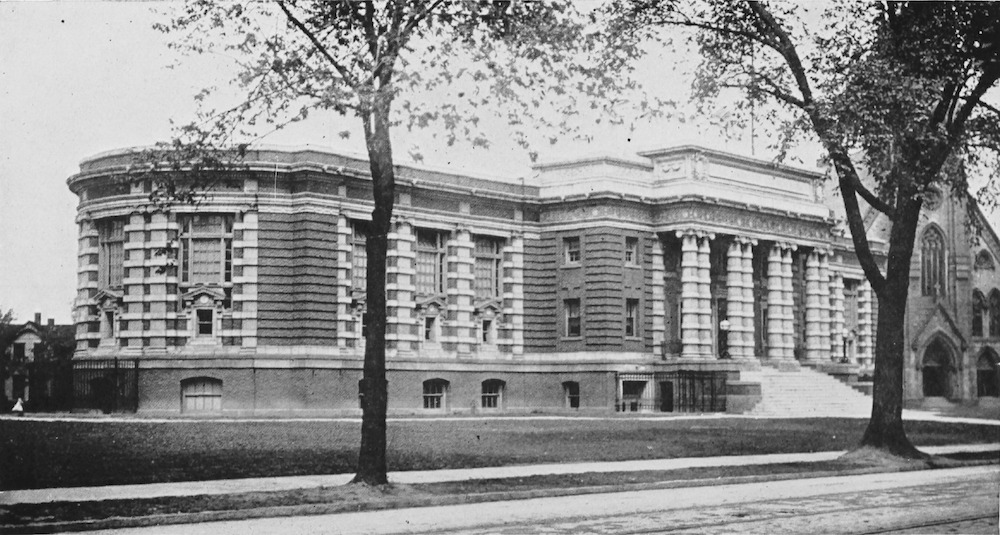
<span style="font-weight:400;">By 1907, the delay in planning and constructing the new West Side branch library was not the only problem facing the Library. It had exhausted nearly all of  Andrew Carnegie's 1903 donation in building the first five of the proposed seven new branches, and now, moreover, there were substantial additional expenses projected to be incurred by the City and Library in purchasing the land needed for the library park, building the Kentucky Street extension, creating the park in which the library would be located, and then actually building the new branch.  These expenses easily could have doomed the project. However, in a sign of how much he valued both the branch library project itself and Librarian Brett as a resource, Andrew Carnegie stepped in and made additional donations to ensure that the new West Side branch library would be built.  </p><p>After learning from Brett that building the first five branches had exhausted the original donation, Carnegie agreed to donate an additional $123,000 to construct the last two branches—the new West Side Branch library and new <a href="https://clevelandhistorical.org/items/show/862">South Branch library</a>. In 1908, in order to ensure that there were sufficient funds to enable the City to purchase the land for the park and the Kentucky Street extension, he donated an additional $110,000. Without these last two donations, it is questionable whether the West Side branch library would ever have been built, let alone in the grand form of the building that sits on Fulton Road today. James Bertram, Andrew Carnegie's personal secretary, noted how extraordinary the first of these two additional donations were in a letter he wrote to the Library on July 2, 1907:  "Mr. Carnegie congratulates Cleveland upon exceeding even Pittsburg in proportion to the amount of population, in Library appropriation, placing Cleveland first of all."  </p><p>With the all-important land acquired, construction of the new West Side branch library (appropriately renamed Carnegie West in a nod to Carnegie's 1908 donation) began in the fall of that year and was completed in the spring of 1910. </span><span style="font-weight:400;">Designed by New York architect Edward L. Tilton in a modified Renaissance style with classical elements, the new branch was built in a triangular shape, with a facade composed of red brick, limestone and terra cotta. It has banded and fluted columns and pilasters in the Ionic style. With an interior covering 25,000 square feet of space, Carnegie West was Cleveland's largest branch library building. It had weathered oak finish and walls adorned with carbon prints of famous pictures and noted buildings. A majority of the rooms also had plaster friezes. There were balconies in the children's and reference rooms. An auditorium in the basement seated 650 persons. The new library was dedicated and officially opened to the public in May. Several months later, library experts from the American Library Association visited Cleveland to see the new branch library. According to an article appearing in the <em>Plain Dealer</em> on July 29, 1910, they unanimously declared, "for general attractiveness, facilities for circulating books, up-to-date interior equipment, method of handling the books and the ability of those on the staff, the West Side institution, for a branch library, stood without a peer anywhere in the United States."</span>
<span style="font-weight:400;">In the course of its long history, one of the library's most endearing traditions has been its service to the segment of the neighborhood population with the greatest educational needs, viz., immigrants and other non-English speakers.  When the branch library opened in 1910, that group was largely composed of Hungarian immigrants who had been moving into the neighborhood since the late 19th century. Carnegie West staff welcomed them by providing books in their native language, sponsoring their cultural events at the library or in Library Park, and by offering classes in English. When World War I intervened and caused many Americans to question the loyalty of Hungarians and other recent immigrants from eastern and southern Europe, the Cleveland Public librarians, including those at Carnegie West, responded with their own version of "Americanization," which showed a respect for the culture, language and traditions of the newcomers and offered their services and materials to help them navigate their new life in this country. </span>
<span style="font-weight:400;">In the second half of the 20th century, Puerto Ricans and other Spanish speaking people began to move into the Ohio City neighborhood, gradually replacing the Hungarian-Americans as the largest ethnic group of non-English speakers. Just as it had for Hungarian residents, Carnegie West provided books in their native language and offered the library as a place to hold cultural events. In 1992, when Carnegie West celebrated the 100th anniversary of the opening of the first West Side branch library, the celebration included a demonstration of traditional Hispanic and Hungarian dances.</span>
<span style="font-weight:400;">As the library aged in the second half of the twentieth century and the population of the Ohio City neighborhood shrank, the Library Board of Trustees was forced to weigh whether to retain the large library building or tear it down and replace it with a smaller building "better sized" for the neighborhood.  When this was proposed in 1979, West Side residents turned out in opposition to the proposal just as they had some seven decades earlier. Cleveland Public Library listened and decided instead to renovate and remodel the historic building, reducing its interior space in half, even though the cost of doing so was greater than that of constructing a smaller replacement.  In the ensuing years, other major repairs and renovations have been made to the building, including the 2004 repainting of the interior walls to their original colors. Today, 113 years after it first opened to the public, Carnegie West remains an architectural jewel in the Lorain-Fulton area and an important civic and cultural center for the entire Ohio City neighborhood.</span></p><p><em><strong><a href="https://mail.clevelandhistorical.org/items/show/1002">For more (including 24 images) view the original article</a></strong></em></p>]]></summary>
    <published>2023-04-18T19:28:02+00:00</published>
    <updated>2026-04-17T19:17:43+00:00</updated>
    <link rel="alternate" type="text/html" href="https://mail.clevelandhistorical.org/items/show/1002"/>
    <id>https://mail.clevelandhistorical.org/items/show/1002</id>
    <author>
      <name>Jim Dubelko</name>
    </author>
  </entry>
  <entry>
    <title type="html"><![CDATA[Cinecraft Productions: The Historic Film Company Produced by a Love Story]]></title>
    <summary type="html"><![CDATA[<img src="https://mail.clevelandhistorical.org/files/fullsize/9356c399633956464b62b5acc6d1022b.jpg" alt="Ray and Betty Culley working together (circa 1940)" /><br/><p>When, as Americans, we look back at the decade of the 1930s, we often see only the Great Depression. It was a calamitous time for the country and it may be difficult for us to imagine that anything good actually occurred during it. People, we may think, didn't thrive during this decade. At best, they just survived.  But for the two people who are at the center of this story, the decade of the 1930s was the one in which events conspired to bring them together in Cleveland; to allow them to fall in love; and to finally inspire them, just as they started their life together, to take a huge risk and start their own industrial motion picture company. Today, more than 80 years later, that company—Cinecraft Productions, Inc.—is still in business and, according to the Hagley Museum and Library in Wilmington, Delaware, is now the oldest surviving industrial film company in the United States.</p><p>First, a few words about industrial films, otherwise known as sponsored or non-theatrical films. These were films produced for the benefit of, and paid for by, private sector companies, nonprofit organizations, educational institutions, the federal government, or state or local governments. In the first half of the twentieth century, the making of such films by motion picture companies  developed into a large industry in the United States. Thousands of such films were produced in this period, many more than the number of entertainment films produced in Hollywood during the same period. </p><p>Some industrial films were produced to promote the products of large industrial and utility companies like General Electric, Standard Oil of Ohio (Sohio), Ohio Bell and Westinghouse; others to train industrial workers at steel mills, auto factories and other production sites; others to train members of the United States military on how to perform their duties; and still others to alert the public to a health risk or other public emergency. In the years before televisions became available in the United States to the general public, many of these films were shown in movie theaters as a prelude to the main attraction.  </p><p>The story of the two people who founded Cinecraft Productions  is itself worthy of a film. One of the two was Elizabeth "Betty" Buehner. She was born in Bavaria, Germany, in 1914. Her father Albin was a soldier who fought in the Great War, as World War I was called at that time. After the war ended, he came home to his wife Franziska and five-year old daughter, and together they experienced the financial and psychological trauma that many German families experienced in the aftermath of that war.  Hoping for a better life, Betty's parents decided to immigrate to the United States. Her father traveled first, arriving in Cleveland in 1922, where, according to family lore, his brother found him work as a laborer on theTerminal Tower project. In 1923, the now nine-year old Betty and her mother joined him here. While the Buehner family may have been very optimistic in the first years after their arrival, things didn't turn out for them the way they hoped.  </p><p>The family struggled to make ends meet and then, in 1928, Betty's mother died suddenly. Her father found himself unable to care for a teenage daughter and sent her off to live with and work as a nanny, first for a family in Shaker Heights and then later for one in Lakewood. Betty survived it all and, in the process, learned to speak English so well that, according to her son, years later no one could detect even a hint of a German accent when she spoke.  She attended Lakewood High where she was active in a number of school organizations, graduating in 1934. Before long, the resourceful and hard-working young woman  found employment and was living on her own. And then, just a few years out of high school, she landed the job which would change her life. Through a connection she had made as a nanny in Shaker Heights, she was hired to work as a  film editor (then called a "cutter") for Tri-State Motion Picture Company, a pioneer industrial film production company whose offices were then located in the Rockefeller Building in downtown Cleveland. Betty Buehner was working there in 1938 when she met Ray Culley.</p><p>Raymond "Ray" Culley came from a very different world.  He was born in Norwalk, Ohio, in 1904, the oldest son of working-class parents whose families had lived in Norwalk for several generations.  Ray dropped out of school in his teens and  went to work as a watchmaker's apprentice.  In the 1920s, he worked in  jewelry stores in Norwalk, Columbus, and West Virginia. In this early work, he demonstrated creativity and a willingness to take risks to succeed. While working in West Virginia, he taught himself how to fly a plane so that he could perform aerial stunts that would not only impress potential customers but also demonstrate the durability of his product.   </p><p>In 1930, after the economy collapsed and the country lurched into the Great Depression, Ray found himself thinking that perhaps the only people who could now afford to buy his jewelry were Hollywood actors.  So, the 26-year-old bought a car and drove across the country to southern California. Once there, he didn't sell jewelry for very long, as he soon found more profitable work at some of Hollywood's early motion picture studios. He first worked as an actor, landing bit roles in Westerns which featured big-name actors like Gene Autry, Hoot Gibson and Hopalong Cassidy. But later, in the way that things sometimes go in Hollywood, he found himself on the other end of the camera, first as a production assistant and then an assistant director. He was working in that latter capacity in 1937 when Tri-State contacted Republic Pictures, where Ray was then working, looking for a director. Tri-State's director, Jack T. Flanagan, had died in October 1936 following a film-shooting accident and the company needed someone to direct an industrial film that the company had contracted to produce for General Electric. Republic dispatched Ray to Cleveland where he directed that film, titled "From Now On." Tri-State must have been impressed by the young director, because, before Ray could return to Hollywood, he was hired as Tri-State's new director. And it was there that Ray Culley met Betty Buehner.</p><p>Their sons don't know—and it's unlikely that anyone now still living knows—the complete story of how, when and why the two Tri-State employees fell in love. What we do know is this. Shortly after Ray's arrival at Tri-State, Betty left the company and moved to New York where she hoped to learn more about the film editing business. As part of his duties with Tri-State, Ray was required to make regular trips to New York to have new industrial films edited. Ray and Betty likely met  in New York during these trips, because, in the spring of 1939, Ray made a special trip to New York  and, on that trip, the two married. They then  returned to Cleveland where, after a very short period, they founded the company they called Cinecraft Productions.  </p><p>In 1999, some sixty years later, Ray's younger brother Paul stated in an interview that Ray and Betty started Cinecraft  Productions because Ray had had a "falling out" with Tri-State. It is not known whether this "falling out" preceded his marriage to Betty, but the two certainly were ready with a plan when they returned to Cleveland. Ray's father lent the newlyweds $1500—the equivalent of approximately $30,000 today—to purchase a camera and tripod. Betty persuaded Ray that he should shoot movies with 16mm film, instead of the traditional 35mm, as she believed it was the future for industrial films. And the two quickly went into business together, at first operating Cinecraft Productions out of their west side apartment, but later out of an office and studio in the Card Building, which then stood on St. Clair Avenue East, near Ontario Street, where the Cleveland Marriott Hotel at Key Tower stands today. </p><p>In the same year that Ray and Betty Culley started their business, they successfully produced their first film. Titled "You Bet Your Life," it was made  for the Cleveland Railway Company and designed to alert riders about the rules of safety while traveling on the company's streetcars. In time, other businesses came their way, some via advertising companies  impressed with the couple. Ray's artful script work, skillful directing and affable personality, coupled with Betty's knowledge of film editing, frugality and business management skills, made the two an early era power couple in Cleveland industrial filmmaking. It enabled them to survive the early years, as difficult as they may have been, and to then begin growing their business from the ground up.</p><p>In the 1940s, Betty Culley was presented with a new challenge as she gave birth to the couple's twin boys in 1944 and then to a third son several years later. She continued to work for Cinecraft Productions, the 1950 federal census listing  her as an "executive" with the company.  Her sons, looking back to when they were children, remember the nanny who came to their house in Rocky River to watch them, allowing  their mom to jump into her car to drive to the company's offices and attend to . . .  well, to whatever needed her attention. In 1947 that drive became a little shorter after the company purchased the historic building at 2515 Franklin Boulevard on the west side of Cleveland and moved all of its operations there. The Culleys remodeled the building—which was designed and built to house Cleveland Public Library's first branch library—creating a large studio and offices for the company's  art work, film editing, and other departments.</p><p>The Culleys operated Cinecraft Productions from this west side location for decades, creating hundreds of quality industrial films for entities like the City of Cleveland, the Cleveland Transit System, Cleveland Electric Illuminating Company, Republic Steel, Westinghouse, Sohio, General Electric, and many other business and government organizations. Along the way, the company became  one of the early pioneers in the film industry to use three cameras with teleprompters operating in synch with each other to shoot the same movie scene from three different angles. The industrial films that Cinecraft Productions produced often featured  local talent from the Cleveland Play House, but the company was also able to land some big names from Hollywood and other parts of the country. The list of actors and other notables who traveled to Cleveland to be in industrial films directed by Ray Culley included Basil Rathbone, Merv Griffin, Joe E. Brown, Don Ameche, Danny Kaye, Joel Grey, Tim Conway, Ernie Anderson (Ghoulardi), and future United States presidents Richard Nixon and Ronald Reagan.</p><p>In 1970, Ray and Betty Culley retired, selling Cinecraft Productions to Ray's younger brother Paul. In 1986, Paul, after 16 years of ownership in which he guided the company in its transition from 16mm films to video films, retired too. Cinecraft Productions was then purchased by a company employee, Neil McCormick, and his wife Maria Keckan.  McCormick and Keckan shepherded in another major change in the company's history by transitioning it from video to  digital media production, and positioning the company to become a local leader in the production of e-learning courses.</p><p>The love story of Ray and Betty Culley, which produced Cinecraft Productions, Inc., came to an end in 1983 when Ray died. Betty went on to live for almost three more decades before dying at the age of 102 in 2016. Today, as noted earlier, Cinecraft Productions is believed to be the longest surviving industrial film company in the United States. This suggests that not only does love conquer all, but sometimes it also survives all too.</p><p><em><strong><a href="https://mail.clevelandhistorical.org/items/show/999">For more (including 23 images&#32;&amp;&#32;4 videos) view the original article</a></strong></em></p>]]></summary>
    <published>2023-02-11T16:38:26+00:00</published>
    <updated>2026-04-17T19:17:42+00:00</updated>
    <link rel="alternate" type="text/html" href="https://mail.clevelandhistorical.org/items/show/999"/>
    <id>https://mail.clevelandhistorical.org/items/show/999</id>
    <author>
      <name>Jim Dubelko</name>
    </author>
  </entry>
  <entry>
    <title type="html"><![CDATA[Fridrich Bicycle: Once Cleveland&#039;s Oldest Bike Shop]]></title>
    <summary type="html"><![CDATA[<p><strong><em>Until it closed in 2024, Fridrich Bicycle was Cleveland's oldest retail bicycle shop and  one of the oldest in the United States.  The Fridrich family had been selling bicycles in Cleveland for well over 100 years.  The family's roots in the Lorain Avenue Commercial Historic District, however, extended even deeper than that.</em></strong></p><img src="https://mail.clevelandhistorical.org/files/fullsize/04db346c2bc5a56681c7300fc5141dbf.jpg" alt="Fridrich Bicycle Store - 1993" /><br/><p>As in many other American families, the Fridrich family story begins with an immigrant.  In 1847, 36 year-old Joseph Friedrich, the unmarried son of a restaurant owner in Pirkensee, Bavaria, emigrated from his homeland. At the time, revolution and war in central Europe were pushing large numbers of ethnic Germans out of their principalities which became parts of a unified German state in 1871. Many immigrated to the United States, and to Cleveland, then a young, but growing, industrial city in the Midwest.  Friedrich--who would later change his surname to "Fridrich"--may have traveled directly to Cleveland from Europe, but there is no record of his presence until May 1853 when County records reveal that he married Margarete Schaefer, also a German immigrant.  </p><p>Margarete Schaefer Friedrich was the mother of three young boys--John, Anton and August Schmidt--all under the age of eight.  When he married her, Joseph Friedrich became a father to all of them. Over the course of the next ten years, he worked as a laborer--for at least some of that time employed by the Cleveland and Erie Railroad.  Margarete gave birth to three more boys, Joseph W., George, and William Friedrich.  In 1863, the year their youngest son William was born, the Friedrich family was residing in a house near the intersection of Old River and Mulberry Streets on the West Bank of the Flats.  The surrounding neighborhood was fast developing into an Irish-American enclave which became known as the Triangle, later shortened to "the Angle," and today nostalgically referred to by the Cleveland Irish community as "the Old Angle."</p><p>In 1864, the Friedrichs moved from the Angle about a mile south to a growing and predominantly German-American neighborhood that was centered around Lorain Street (Avenue) and located primarily west of Pearl (West 25th) Street.   Joseph purchased a new house on Branch (later renamed China, then Elvira and finally West 37th), a street south of Lorain and just west of Willet (Fulton) Road.  It was one of several streets in a new residential subdivision platted in 1860 by real estate developers John H. Sargent and Thomas Dixon.   Sargent & Dixon's subdivision was just one of a number built north and south of Lorain Street in the 1850s and 1860s that together grew into a neighborhood that was centered around a commercial corridor on Lorain Street. </p><p>Growing up in this neighborhood, the Schmidt and Friedrich boys would have had ample opportunity to explore Lorain Street, located less than a quarter mile from their doorstep.  When the family first arrived, most buildings on Lorain were one or two stories and made of wood.  Later, by the 1880s, many of the earlier era buildings had been razed and replaced by taller, more ornate buildings often built of brick.  When the boys made their first trips up to the corner of Mechanic (West 38th) Street and Lorain, possibly the first building that would catch their eyes was the livery and stable of Andrew Steinmetz which was built circa 1871. It was located almost directly across Lorain from Mechanic Street, and it clearly stood out from other nearby buildings because of its unusual mansard roof and because of the constant stream of horses, wagons and carriages going into or out of the building.  </p><p>Over the years as they grew up in their house on Branch which was renamed China Street in 1873, the Schmidt and Friedrich boys likely made many trips up to the corner and then up or down Lorain Street.  By 1880, this corridor was lined with commercial buildings that stretched westward from near Columbus Road almost all the way to Gordon Avenue (West 65th Street)  near Cleveland's border with the suburb of West Cleveland.  Some of those trips likely took them to the Pearl Street Market on the northwest corner of Lorain and Pearl (West 25th) Street,  just a half mile east of Mechanic Street.  When the Friedrich family moved into the neighborhood in 1864, there was an open-air market on that corner that was known as the West Side Market.  Four years later, the City of Cleveland built a one-story wooden market house on the site which it named after nearby Pearl Street.  (Forty-four years later in 1912, the market house that we know today as the West Side Market would open across the street, and the Pearl Street Market would shortly afterwards be razed.)  </p><p>Walking or riding to the Market, the Schmidt and Friedrich boys would have passed a number of thriving shops in the second half of the nineteenth century that became well-known to them, like Julius Grothe's cabinet shop at 265 (today, 3704) Lorain, John Kraus's boots and shoe shop at 257 (3622) Lorain, the Koblenzer family's butcher shop at 246 (3613) Lorain, and Heidenger's Bakery at 234 (3601) Lorain, just to name a few.  As they crossed Fulton Road, they would also have noted the rest of the nearly two dozen saloons that dotted the corners of Lorain from Mechanic Street to the Market, some sharing space with early grocery stores, others located in boarding houses.  The boys would take in all the sights, sounds and smells of the commercial businesses of Lorain Street, including the pungent aromas from the Dahlheimer cigar and tobacco factory and retail shop at 199 (3228) Lorain. In 1875, it was purchased by new owner Charles Sauer who, some two decades later, would build a new and larger factory and retail shop on the premises, one still standing today and recently renovated and restored. As the boys neared the Pearl Street Market, they might have noticed the millinery shop of Matilda and Julia Chubb at 96 (2615) Lorain, diagonally across the street.  The two sisters operated their retail business on the southwest corner of McLean (West 26th) Street and Lorain for nearly 20 years in the second half of the nineteenth century before retiring and moving to Lakewood.  As the boys passed the store, they may have turned their heads to better admire a fashionably dressed young woman leaving the Chubb sisters' store with a new hat atop her head.</p><p>The Schmidt and Friedrich boys were undoubtedly influenced by interactions with the Lorain Street commercial corridor like those imagined above.  While the two oldest Schmidt boys worked in traditional trades (one becoming a stone cutter and the other a bookkeeper), the younger four, after they became old enough, by nineteenth-century standards, to work for a living, all started new retail businesses on Lorain Street. This development within the second generation of the Fridrich family living in America would lead not only to the 1909 establishment of Fridrich Bicycle, but also to Fridrich Moving and Storage Co., another Fridrich family business that was founded by youngest brother William in 1915 and which has, like the bicycle shop, now operated in the Cleveland area for more than a century.</p><p>Fridrich Bicycle grew out of an early business partnership between August Schmidt, the youngest of the Schmitt brothers, and Joseph W. Friedrich, the oldest of the Friedriches.  In 1884, 34 year-old Schmidt, who by this time was spelling his last name "Schmitt," and 26 year-old Friedrich (whose immigrant father, a short time before his death in 1888, would change the spelling of their family's last name to "Fridrich") started a retail coal business under the name of "Schmitt and Friedrich." Originally operating out of the family house at 19 China (2000 West 37th) Street, the two moved their business in 1885 into a storefront at 840 (3817) Lorain Street.  Why they decided to start a retail coal business is unknown, but it may have been prompted by contacts their father developed while working for the Cleveland and Erie Railroad.   Meanwhile, the two youngest Friedrich boys, William and George, had also pooled their resources together and, in 1891, started a retail flour and feed business up the street from their older brothers' retail coal store at 924 (4209) Lorain.)</p><p>After operating their retail coal store together for 15 years, August Schmitt and Joseph W. Fridrich closed it in 1900, with each starting new retail coal businesses in their individual names.  While it is unknown why they ended their partnership, it may have been related to their different family statuses.  Joseph W. Fridrich had married in 1881 and, by 1900, had two sons--one of whom, Joseph Aloysius Fridrich, was 17 years old and already working in the family coal business.  August Schmitt, on the other hand, though eight years older than his brother, had not married until 1891 and had children who in 1900 were just  3 and 7 years old.  Schmitt operated his new business out of a store at 750 (3207) Lorain, while Fridrich took over the storefront of their former partnership business at 840 Lorain.  </p><p>While August Schmitt's new business was apparently successful--he operated it until his retirement in 1915, Joseph W. Fridrich's appeared to have been less so, as he faced the challenge of bringing two sons into the business.  In 1902, he opened a flour and feed store at 842 (3821) Lorain, right next door to his retail coal store, but that business closed by 1904.   He then formed a new partnership in the retail coal business with August Schmitt and his younger brother William Fridrich, but both August and William appear to have withdrawn from this association by 1907.  Joseph might have attempted other changes to his business model had not a new business opportunity suddenly come his way in 1908.  After his flour and feed store at 842 Lorain had closed in 1904, that storefront had been rented to a Walter J. Meyers, who opened a retail bicycle store there that same year.  Sometime in late 1908 or early 1909, however, Meyers closed his shop.  It is likely that Joseph's younger son, Alphonse, who, probably more so than his father, was aware of the bicycle "craze" going on in the United States in the early twentieth century, successfully lobbied his father to take over Meyer's bicycle shop.  It was the beginning of Fridrich Bicycle and the end of Joseph Fridrich's retail coal shop, which closed the same year. </p><p>While Alphonse Fridrich was the first manager of Fridrich Bicycle, the business was later largely operated by Joseph W. Fridrich and his older son Joseph Aloysius.  The Fridrich family continued to lease space for their shop at 3821 Lorain until 1915 when they purchased the building. In 1919, they added a retail auto parts business to their store and changed the name of the business to Fridrich Bicycle and Auto Supply Co.  In 1925, as the result of the successful growth of these two businesses, the Fridrich family purchased a building across Lorain Avenue which had originally been  Andrew Steinmetz's livery and stable.  It must have given Joseph W. Fridrich some pause the day he vacated the storefront at 3821 Lorain and  moved the business across the street into the historic building which had likely captured his imagination as a child.  </p><p>Seven years later, in 1932, Joseph W. Fridrich died and a new era in the family began when his son Joseph Aloysius took over operation of the store.  He was helped by his son Joseph J.  who had dropped out of high school  to work in the family business.  Continuing to thrive on Lorain Avenue, even in the wake of the Great Depression, Fridrich Bicycle and Auto Supply expanded again in 1942, purchasing  the three-story Schenck Building at 3806-3808 Lorain.  The business's address for its combined retail operations in the two  buildings would soon be changed to simply 3800 Lorain.  In 1947, when he was just 64 years old, Joseph Aloysius Fridrich died  and this ushered in yet another new era for the family business.  </p><p>Joseph J. Fridrich, known in the family as "J.J.," took over the operations of the store.  He is remembered by members of the Fridrich family today for the "Cadillac" bicycles which he and staff built in the store's basement, and which he passionately promoted as the store's owner and manager.  J.J. Fridrich also built a new building on Lorain Avenue to the west and adjacent to the Schenck Building, which soon became known in the family as "Schwinn Hall," because its first floor was used  to display the company's inventory of Schwinn bicycles.  In the 1960s, he made the decision to close the retail auto parts business and to concentrate exclusively on selling bicycles of all types.  In 1966, the name of the company was accordingly changed to Fridrich Bicycle, Inc.</p><p>J. J. Fridrich owned and operated Fridrich Bicycle until his death in 1992.  According to an article appearing in the Plain Dealer on April 14, 1992, when the store closed for a day in his memory, it was the first time it had closed on a day other than Christmas in the memory of anyone then working at the store.  After J. J. Fridrich's death, the store was owned and the business operated by J.J's son, Charles "Chuck" Fridrich.  Day-to-day operations later were handled by Jane Alley, the store's general manager, and a staff of nine employees.  Cleveland's oldest retail bicycle store remained an important business in the Lorain Avenue Commercial Historic District, as well as a custodian of two of that District's most historic buildings, until it closed in 2024.</p><p><em><strong><a href="https://mail.clevelandhistorical.org/items/show/964">For more (including 14 images) view the original article</a></strong></em></p>]]></summary>
    <published>2022-08-22T03:31:47+00:00</published>
    <updated>2026-04-17T19:17:42+00:00</updated>
    <link rel="alternate" type="text/html" href="https://mail.clevelandhistorical.org/items/show/964"/>
    <id>https://mail.clevelandhistorical.org/items/show/964</id>
    <author>
      <name>Jim Dubelko</name>
    </author>
  </entry>
  <entry>
    <title type="html"><![CDATA[Market Square Park: A Public Space for Two Centuries]]></title>
    <summary type="html"><![CDATA[<p><strong><em><em>In or about 1822, pioneer real estate developers Josiah Barber and Richard Lord laid out a village west of the Cuyahoga River. Its public square was located on what is today the northwest corner of West 25th Street and Lorain Avenue—just across the street from the West Side Market. While the village, which was known as "Brooklyn," was short-lived, the public space that was created for its village square was not. Two hundred years later, it still exists and is home today to Cleveland's Market Square Park.</em></em></strong></p><img src="https://mail.clevelandhistorical.org/files/fullsize/59448363a29bf4146aa74ef21697e88b.jpg" alt="Market Square Park in 2017" /><br/><p>Market Square Park sits across West 25th Street from the West Side Market.  While the Market is one of the best-known--even beloved--places on the West Side of Cleveland, Market Square Park is not.  Likely for many, it appears to be merely a small and uninteresting park that you might walk through or walk past on your way from the West Side Market to Great Lakes Brewing Company's BrewPub on Market Avenue.  It might surprise you then to learn that, while the West Side Market has indeed stood on the northeast corner of West 25th and Lorain for a long time—more than a century now—the land upon which Market Square Park stands has been a public space for even longer than that—a full two centuries.</p><p>It was in about 1822 that Josiah Barber and Richard Lord, brothers-in-law and pioneer real estate developers, laid out a village west of the Cuyahoga River that they named Brooklyn.  This village extended from Detroit Avenue on the north to Walworth Run on the south, and from the Cuyahoga River as far west as today's West 44th Street.  On the northwest corner of the intersection of  Pearl (today, West 25th) and Lorain Streets, the two men directed their surveyor, Edwin Foote, to set aside a parcel of land, eight rods by eight rods (132 feet by 132 feet), which they made the village's public square.   </p><p>Little is known of this early Brooklyn Village which was absorbed into the City of Ohio ("Ohio City") when the latter was incorporated by the Ohio Legislature on March 3, 1836. Seven months later, developers Barber and Lord created a subdivision in Ohio City which platted most, if not all, of the territory of the former Brooklyn Village, including the land that had served as the village square.  On their subdivision plat, however, the two made no mention of that square. Instead, the focal point of their new subdivision was a circular piece of land a half mile to the north, from which several streets radiated.  Called "Franklin Place" originally, we know it today as Franklin Circle.</p><p>The creation of Franklin Place and the omission of any mention of a Brooklyn Village square in the Barber and Lord subdivision led to uncertainty, first within Ohio City, and later in Cleveland after the former was annexed by the latter in 1854, whether the village square was in fact still a public space.  As early as 1851, according to a news item appearing in the Plain Dealer in April of that year, Ohio City Council had directed its mayor to take steps to "gain possession" of the land.  It was not, however, until after the annexation of Ohio City to Cleveland that, as a result of several critical events, resolving the matter became a high priority for City officials. </p><p>The first of these events occurred in 1855, just a year after Ohio City's annexation, when prominent residents of Franklin Street (today, Boulevard), including future Cleveland Mayor Irvine U. Masters and future Common Pleas Judge  James M. Coffinberry, persuaded their new City government to build a public park at Franklin Place.  This necessitated finding a new location for the open-air market that had been held there for decades and which, after Ohio City's annexation to Cleveland, had become known as the "West Side Market."  Two years later, Cleveland officials were still examining potential sites for that public market's relocation when David Pollock, a West Side businessman, petitioned the City to remove a blacksmith shop that he claimed was unlawfully operating on the old Brooklyn Village square. When Cleveland's City Marshal went out to investigate the matter, he found, and reported to Cleveland City Council, that not only was the blacksmith shop trespassing on the old village square, but so were two commercial buildings owned by Pollock. </p><p>Before the City could take action against him, Pollock sued it in Cuyahoga County Common Pleas Court in February 1858, seeking an injunction and a declaration that the land upon which his buildings stood was not public land.  While little remains of the record of this lawsuit, an appearance docket and final judgment entry, along with a few newspaper articles, reveal that, on December 18, 1858, Judge Horace Foote (a first cousin of Barber and Lord's surveyor Edwin Foote) decided the case in Cleveland's favor, finding that the former village square was still public land. This decision cleared the way for the City to raze all of the buildings on the land, including Pollock's, and moreover, in the summer of 1859, move the West Side Market there.</p><p>At the time of the relocation of the West Side Market to it, the village square was still being referred to in county tax records as a "public square." However, in 1864, James Webster, a real estate developer who had acquired David Pollock's land located adjacent to the village square, re-platted that land and on his plat identified the village square as "Market Square." It has been known by that name ever since (except for a brief period in the second and third decades of the twentieth century when it was officially, but not popularly, called "United Market Square.")  </p><p>Market Square was home to this early West Side Market for nine years, from 1859 to 1868.  In the first several years of that period, it operated, as it had at Franklin Place, as an open-air market, but, in or about 1862, according to newspaper accounts, a market house—perhaps a very small wooden building of humble construction—was built on the site.  In 1868, that first market house was torn down and replaced by a new and larger market house, which the City of Cleveland named the Pearl Street Market.  The new market house occupied virtually all of Market Square and stood on the site from 1868 until 1915.</p><p>By the mid 1890s, Pearl Street Market was in a rundown condition and was too small to meet the needs of West Side vendors and customers. Plans were initially made and circulated around this time by a West Side businessmen's association to raze it and build in its place on Market Square a larger and grander market house. However, those plans changed in 1902 when Mayor Tom Johnson, who inherited the project from two of his predecessors, decided to build the new market house instead on the northeast corner of Pearl and Lorain due to land acquisition problems and renewed concerns over the validity of the City's title to Market Square. Construction of the new West Side Market began in 1907 and was completed 1912.  After the new West Side Market opened, the old Pearl Street Market House continued to stand on Market Square for several more years while the Produce Arcade for the new West Side Market was being constructed and while City officials debated other possible uses for the old market house. The Produce Arcade was completed in 1914 and, when City officials could not come to any agreement upon various proposed uses for the Pearl Street Market, it was razed in 1915.</p><p>After the old market house was razed, Market Square continued to serve the public for many years, during good weather, as an open-air market for vendors who did not have stalls across the street in the new Produce Arcade or at the West Side Market. It was also used for years as a gathering place for community events ranging from street carnivals to holiday celebrations to weddings to political speeches and protests. It was notably the site of a fiery speech given by Socialist Party candidate Charles Ruthenberg on October 28, 1917, in his bid to become mayor of Cleveland.  (He finished third in the race, but received more than 25 percent of the votes cast.)</p><p>In 1930, the City built a shelter house (also called a comfort station) on the eastern part of Market Square fronting West 25th Street, which resulted in vendor stall spaces being moved to the western portion of the Square.  It was used for these two purposes by the City until about 1950 when the shelter house was leased to a business that converted it into a popular bakery shop with the rest of Market Square serving as a parking lot for that shop.  Shortly after this occurred, a lawsuit was filed against the City of Cleveland by descendants of Josiah Barber, who for decades had been interacting with the City regarding its use of the land dedicated by their ancestor as a public square.  They alleged in their lawsuit that, by allowing Market Square to be used for "other than public purposes," the City had forfeited its right to the land and that title had by law reverted to Barber's heirs. This lawsuit remained pending in Cuyahoga County Common Pleas Court for a number of years before Judge Benjamin Nicola, having afforded the heirs numerous opportunities to amend their pleadings to state a legally cognizable cause of action, dismissed their lawsuit in 1957.</p><p>In the 1960s and 1970s, as the renaissance of the Ohio City neighborhood was underway, West Side businessmen urged the City to convert Market Square into a park.  Planning and funding for the project were started during the Perk Administration.  After initially opposing the park project on the grounds that the park would attract only "winos,"  the Kucinich Administration reluctantly undertook construction of it in 1978. The former shelter house, which in recent years had become a fast-food restaurant, was torn down. The cement parking lot behind it was removed and replaced with red brick pavers.   Brick planters were added; trees planted; and street lighting added.  Market Square Park opened to the public in 1979.  In 1984, during the Voinovich administration, a large stone, multipart sculpture called "Tempus Pons" (Time to Build a Bridge) was added to the park. The sculpture was a prominent feature of the park until around 2010-2012, when, during a park redesign, it was dismantled and somewhat unceremoniously carted away.  Market Square Park remains today (2022) a pleasant and open public space across the street from the West Side Market.  It has now occupied Market Square for more than forty years.  And to date, there have been no complaints about this use of Market Square by the descendants of Josiah Barber.</p><p><em><strong><a href="https://mail.clevelandhistorical.org/items/show/959">For more (including 20 images) view the original article</a></strong></em></p>]]></summary>
    <published>2022-05-11T18:33:02+00:00</published>
    <updated>2026-04-17T19:17:42+00:00</updated>
    <link rel="alternate" type="text/html" href="https://mail.clevelandhistorical.org/items/show/959"/>
    <id>https://mail.clevelandhistorical.org/items/show/959</id>
    <author>
      <name>Jim Dubelko</name>
    </author>
  </entry>
  <entry>
    <title type="html"><![CDATA[Thomas Axworthy House: Where a Popular West Side Gym Once Stood]]></title>
    <summary type="html"><![CDATA[<p><strong><em>Clement and Katherine Folkman, immigrants from Eastern Europe, probably didn't know much, if any, of the history of the house at 4206 Franklin when they purchased it in 1923. So they, and their son Clement Jr. proceeded to make their own history there.</em></strong></p><img src="https://mail.clevelandhistorical.org/files/fullsize/8487376c904adf13daff3b7ec1272cda.jpg" alt="4206 Franklin Boulevard" /><br/><p>The house at 4206 Franklin Boulevard is one of only a few Second Empire  style houses on Franklin Boulevard.  It has approximately 3,000 square feet of living area and is notable for its hexagonal mansard roof, decorative window hoods and wrap-around single-story covered front porch.  The house was built in 1866 and,  while the name of the contractor who actually built it is unknown, it may have been Ferdinand Dreier (Dryer), a German immigrant and house carpenter by trade.  Dreier built a number of houses on or near Franklin Boulevard in the late 1860s, including a somewhat similar Second Empire style house almost directly across the street at 4211 Franklin.   </p><p>According to National Register of Historic Places (NRHP) records of the Franklin Boulevard Historic District, the house at 4206 Franklin is named for Thomas Axworthy, a nineteenth century coal merchant, who purchased it in 1873.  Its original owner was Atherton Curtis, a liquor dealer, whose family only lived in the house for a year or so before moving to Huron County, Ohio.  The family then rented the house  out to tenants for several years before selling it to Axworthy, who lived in the house with his wife Rebecca and their three daughters for more than a decade.</p><p>Thomas Axworthy was an interesting figure who left his mark on Cleveland city government, although not in the way you might think.  An English immigrant, Axworthy became involved in Cleveland politics in the 1870s, serving in that decade as a city fire commissioner as well as president of the "West Side Democracy," a political club for Democrats living west of the Cuyahoga River.  In 1883, while his star was still rising, Axworthy was considered to be a likely candidate for city mayor, but he ran instead for city treasurer and was elected in a close race.  He  was re-elected to the office in 1885 and again in 1887.  By the time he was re-elected the second time, he had already sold the house at 4206 Franklin, moving, like many other Franklin Boulevard residents during this period, to the city's far west end.  There, he built a grand house on Lake Avenue, not far from where political kingmaker Marcus Hanna, also a Franklin Boulevard resident, would build his Lake Avenue mansion just a few years later.</p><p>In October 1888, Thomas Axworthy's political star crashed and burned when the Cleveland Leader broke the news that he had fled the city after embezzling some $440,000 from the city treasury.  (To appreciate the size of his embezzlement, that sum would be almost $13 million in 2022 dollars.)  The papers, not only in Cleveland, but across the country, were abuzz for months with stories of Axworthy's whereabouts, the efforts made by Cleveland to recover the funds he had stolen, and the inevitable litigation that followed.  The person who headed the effort to locate Axworthy was attorney Andrew Squire, who just two years later would co-found Squire, Sanders and Dempsey, for many years one of Cleveland's largest and  most prestigious law firms.  Squire also happened to be a former neighbor of Axworthy, having lived just three houses down the street  from Axworthy during the years that the latter  resided on Franklin.  Squire doggedly searched for Axworthy, located him in London, and traveled  all the way there to confront  the disgraced treasurer who was living in England's capital under an assumed name.  Squire successfully negotiated a settlement with Axworthy which required him to surrender all of the cash and bonds still in his possession, and  agree to sell properties that he still owned back in the States--which included Colorado and Tennessee as well as Ohio--to cover much of the rest of what he had stolen.  In the end, after bondsmen made up the difference, the City of Cleveland was fully reimbursed for its loss.</p><p>After the Axworthy family moved from the house at 4206 Franklin, it was next owned and occupied by the family of a district passenger agent for the Erie Railroad and after that by a treasurer of a trucking company.  In 1919, the house was purchased by a Hungarian immigrant  whose family lived in it for four years before selling it to Clement and Katherine Folkman in 1923.  Clement, a German immigrant who worked in Cleveland as an auto body builder, and his wife Katherine, a Hungarian immigrant, were among a large number of  German and Hungarian immigrants who settled on and around Franklin Boulevard in the second and third decades of the twentieth century.  A number of them, like the Folkmans, purchased grand houses on Franklin that had once been occupied by the West Side's  wealthiest families, and then converted them into multi-family dwellings or rooming houses.  The Folkmans created three suites in the house at 4206 Franklin, living in one themselves and renting out the other two.</p><p>Clement and Katherine Folkman's son Clement, Jr., who was sixteen years old when his parents bought the house at 4206 Franklin, initially entered the workplace as an auto body builder like his father.   In 1936, however, when he was 29 years old, he decided to become a different type of body builder.  "Clem," as he was referred to by his family, was an adherent of  the "physical culture" theories of Bernarr McFadden, an American entrepreneur who, in the late nineteenth and early twentieth centuries, advocated physical fitness through weight lifting regimens. McFadden later published  a series of popular magazines which may have caught young Clem's eyes.  With his father's help, Clem built a gymnasium in the two-story carriage house that stood in the rear yard of their property.  An avid weightlifter himself, Clem soon was training young men in the neighborhood at his Folkman's Athletic Club, which he later renamed Folkman's Physical Culture Studio. By October 17, 1938, when an  article about his gym appeared in the Plain Dealer, he was training 50 young men, ages 20 to 30, who came to the gym three times a week, some with Olympic medal aspirations.</p><p>For decades, Folkman's Physical Culture Studio was a popular gym and  rare commercial enterprise on historically residential Franklin Boulevard.  The Folkman family at some point in time built another two-story building on the property, the first story of which served as a garage, and connected the new building to the old carriage house, which itself was extensively remodeled to accommodate Clem's growing business.  The gym was located on the second floor of the remodeled carriage house, and a locker room, sauna, and massage room on the first.  A large round clock was also installed on a pole in the front yard that for years reminded passers by on Franklin that it was "Time To Exercise."  The gym was still thriving in 1967 when legendary Plain Dealer reporter Bill Hickey paid a visit to Folkman's gym.  By this time, Clem's son Ronald, a Cleveland firefighter, was also working part-time at the gym as a masseuse.  Bill Hickey referred to the two of them in an article that appeared in the Plain Dealer on March 30, 1967, as "the Squires of Franklin Boulevard."   When Hickey reminded Clem that he had been exercising at the gym for years, Clem, according to the article, took one look at Hickey's body and responded, "Please don't tell anybody that. It will ruin me."</p><p>In 1986, the Folkman Physical Culture Studio had been operating at 4206 Franklin Boulevard for 50 years.  Cleveland Plain Dealer reporter James Neff visited the property in August of that notable anniversary year to interview Clem Folkman.  When he arrived, he found an elderly man who was gravely ill and reliving past glories, and a gymnasium that was literally falling apart and papered with city building code violation notices.   Clem Folkman died just three months after this interview.  After the death of Clem Folkman, one of his grandsons attempted to revive the business, but was unsuccessful.  In 1991, the   house at 4206 Franklin Boulevard was sold to a new owner, and one year after that the buildings on the rear of the property, which had housed Folkman's Physical Culture Studio  for more than a half century, were unceremoniously torn down.</p><p>Today, no evidence remains of the Folkman Physical Culture Studio where Clem Folkman trained so many Clevelanders for so many years in the theories, methodologies and regimens of Bernarr McFadden.  The Thomas Axworthy House, however, now nicely renovated as a three-family dwelling, and celebrating its 156th birthday in 2022, still stands at 4206 Franklin Boulevard.</p><p><em><strong><a href="https://mail.clevelandhistorical.org/items/show/956">For more (including 16 images) view the original article</a></strong></em></p>]]></summary>
    <published>2022-01-18T01:10:47+00:00</published>
    <updated>2026-04-17T19:17:42+00:00</updated>
    <link rel="alternate" type="text/html" href="https://mail.clevelandhistorical.org/items/show/956"/>
    <id>https://mail.clevelandhistorical.org/items/show/956</id>
    <author>
      <name>Jim Dubelko</name>
    </author>
  </entry>
  <entry>
    <title type="html"><![CDATA[M. J. Lawrence House: When Is It Time to Rename a Historic House?]]></title>
    <summary type="html"><![CDATA[<p><strong><em>In February 1886, a reporter from the Cleveland Leader tracked down the estranged wife of wealthy newspaper editor and publisher Mortimer J. Lawrence. He found her staying at the Forest City House on the west side of Public Square, where the Renaissance Cleveland Hotel stands today. She was pale, he noted, except for discoloration beneath her eyes which she confirmed was from injuries suffered at the hands of her husband.</em></strong></p><img src="https://mail.clevelandhistorical.org/files/fullsize/f0f7a629cf9c69eb752b541235ba99b4.jpg" alt="M. J. Lawrence House Today" /><br/><p>Historic houses are often named after the person for whom they were built, especially when that person happens to have been a prominent member of the community.  While  this practice may give historic  houses  a certain cachet, it is not without risk.  With the passage of time and changing societal mores, information about that prominent citizen may come to light which tarnishes their image and that cachet.  Such is the case with naming the house at 4414 Franklin Boulevard after Mortimer J. Lawrence,  a man who in the late nineteenth century built a newspaper empire that was headquartered in Cleveland.   </p><p>Most, if not all,  contemporary biographers of Mortimer J. Lawrence lauded him as they related his rags-to-riches life story.  It is a format that was often used  by Cleveland biographers of the late nineteenth and early twentieth centuries when telling the stories of the men who they believed were responsible for building the city into an industrial powerhouse.  For M. J. Lawrence, the story  went something like this.  He grew up in Wakeman, Ohio, just south of Vermillion.  His father abandoned him when he was a little boy.  He went to work at a young age to help support the family.  When the War between the States broke out in 1861, he lied about his age in order to enlist on the side of the North.  He served  gallantly and, when the war ended, he moved to Cleveland.  He married a local girl, Helen Madison, and together they started a family,  living at first on Cleveland's east side where their three sons were born.  Mortimer worked as a reporter at the  Herald for a time and then at the Leader.  In 1872, when he was just 29 years old, he decided to take a big risk.  He borrowed money to purchase the Ohio Farmer, a struggling agricultural newspaper.  Working tirelessly, he saved the paper from bankruptcy.   It soon became  a successful and profitable paper.  He then proceeded to build around it a chain of agricultural newspapers in neighboring states which created a readership for his papers that eventually stretched from the Midwest all the way to the East Coast.  Within a decade, the long hours, the hard work, and the risk taken made Lawrence  a very wealthy man.  That was the rags-to-riches narrative for Mortimer J. Lawrence.  But there was more to his life and much of it was far from being praiseworthy.</p><p>In March 1882, M. J., as he was known after he became wealthy, purchased a parcel of land on the north side of Franklin Boulevard, just a few lots east of Taylor (West 45th) Street, and arranged for the construction of the house which stands  today at 4414 Franklin.  Designed in the Queen Anne style by up-and-coming young architect Nevins Charlot, it is two and one-half stories tall and today has more than 5,000 square feet of living area.  Once construction was completed in late 1882, M.J.,  Helen and their three sons, who ranged in age from four to fourteen years, moved into the house.  With such a young family, you might expect that the Lawrences would have lived happily in the house for many years to come.  However, less than four years later, M.J.  sold the house and  moved to Denver, Colorado.  Before he departed, he told his employees, according to an article that appeared in the Leader on October 17, 1886, that he was leaving Cleveland  "on account of his health."  This was hardly the true reason for his hasty departure.</p><p>Eight months earlier, in February 1886, a series of articles began to appear in Cleveland and other area newspapers regarding the state of the marriage of  M. J. Lawrence and his wife Helen.  The first reported that, on February 16, Helen Lawrence had filed a petition in the Cuyahoga County Court of Common Pleas  against M. J., seeking a divorce, alleging that the well-known editor and publisher had committed acts of extreme cruelty against her as well as adultery.  Reporters following up on the filing learned from Helen Lawrence's sister that on Saturday evening, February 13, Helen had come to her house on Liberty (West 48th) Street seeking shelter, claiming that M. J. had beaten her.  The sister observed that Helen's face was badly bruised.  She said that it was common knowledge in the family that M. J. had  physically and mentally abused Helen for years, including striking her, spitting on her and throwing hot water in her face.  Finally, Helen could take no more of it and had fled from her home.  Days after speaking with Helen's sister, a reporter from the Leader learned that Helen Lawrence was staying at the Forest City House on Public Square.  He went there and observed for himself the bruises on Helen's face.  The Leader also interviewed M. J. Lawrence who told them he would prove his innocence in court.</p><p>Helen Lawrence wasn't the only woman in Cleveland in the post-Civil War era who was filing for divorce against an abusive husband.  Prompted and pressured by leading feminist activists like Susan B. Anthony , Elizabeth Cady Stanton and others, legislatures and courts across the United States had liberalized the grounds which women could assert in order to obtain a divorce from such husbands.  Moreover, the laws regarding alimony had also been liberalized to better enable women to support themselves after they were divorced.   As a result, the number of divorces sought by and granted to women in the post-Civil War era skyrocketed, causing legislators and others more interested in preserving the family unit than protecting the rights of battered women to push back against further progressive changes.  This then would be the last era to see significant changes in divorce laws that benefited women until the dawn of a new civil rights era for women  in the 1960s.  </p><p>Helen Lawrence was awarded a divorce from M. J. Lawrence in late March 1886, just six weeks after she filed her petition.   It turned out that M. J. Lawrence did not prove his innocence in court as he had told newspaper reporters that he would.   Instead, he did not contest his wife's entitlement to a divorce  and agreed to the court awarding her what in that era would have been considered a substantial alimony settlement.   Helen used a portion of that alimony to buy a house on Franklin, just west of Waverly (West 58th) Street, where she raised her  youngest son and cared for her aged mother.  After he sold the house at 4414 Franklin and moved to Denver, M. J. married the woman--more than 20 years younger than he-- with whom he had been carrying on his extramarital affair.  Nearly a decade would pass  before he and his new wife would return to and once again live in Cleveland.</p><p>After the Lawrence family moved from 4414 Franklin, it became home to several other prominent Clevelanders.  One was Herman Baehr, the owner of a prominent local brewery.  Best known as the man who defeated Cleveland's legendary mayor Tom Johnson, Baehr resided in the house at 4414 Franklin for a decade, including the period of 1910-1911 when he served as Cleveland's mayor.   Another prominent owner was Jacob Laub, who founded  Laub Bakery in Cleveland in 1889.  Laub Bakery was well known to Clevelanders for nearly a century before it went out of business in 1974.  In the 1920s, the house was owned and occupied by a less prominent Clevelander, Gustav Lebozsa, a Hungarian immigrant tailor. After initially occupying it as a single family house, in 1928 he converted it into a rooming house, which it remained, according to Cleveland directory records until at least 1951.  In the 1940 census, nine families were listed as residing in the M. J. Lawrence House.</p><p>By the mid-twentieth century, the M. J. Lawrence House was in deplorable condition.  A photo taken in 1954 for the Cleveland Board of Zoning Appeals revealed that house's third story front dormer was gone; the windows and decorative woodwork on the two front gables had been covered with asphalt shingles; the eaves of the front gables had been removed; several of the house's original five chimneys were missing; and  the house's covered front porch was gone.   Much, if not all, of this damage was caused by the historic 1953 tornado, which damaged this house and many others on Franklin.  In the year following the historic tornado, repairs were completed and the M. J. Lawrence House was converted from a rooming house into a four-suite apartment with two suites on the first floor, and two on the second.  The house continued to be so used during the decades of the 1960s and 1970s.  In the early 1980s,  a new owner was in the process of adding a fifth suite to the third floor of the house, when he abandoned the work and left the house vacant.  As the end of 1980s approached, the City of Cleveland was threatening to condemn  the M. J. Lawrence House when it was saved by Duane and Michaella Drotar.</p><p>According to Duane Drotar, he and his wife were social workers living on West 28th Street in 1989 when they became involved in the controversy surrounding St. Herman's House of Hospitality's application to the City of Cleveland for a zoning variance to add a dining hall onto the house at 4410 Franklin.  St. Herman's, which has provided shelter for homeless men at that location on Cleveland's west side since 1977,  is located next door to the M. J. Lawrence House.  While some in the neighborhood opposed the variance, the Drotars did not.  They learned that, if they were to purchase the vacant M. J. Lawrence House and indicate their non-opposition to St. Herman's variance request, the City of Cleveland would likely approve it.  So, the Drotars sold their house on West 28th and, with the sales proceeds, purchased the M. J. Lawrence House.  They then began what turned out to be a long process to renovate and restore it.  (Meanwhile,  St. Herman's proposed building addition was approved by the City.)  </p><p>Duane and Michaella Drotar first renovated the interior of the M. J. Lawrence House during the 1990s, building first a suite for their family that consisted of the entire first floor of the house and part of the second.   They next built  a separate rental suite on the remaining part of the second floor.  Finally,  they developed the third floor into a temporary residence for, as Duane Drotar put it, "people in transition."  After the interior renovations were completed, the Drotars turned their attention to the exterior of the house.   They did not attempt to restore it to its original design primarily because the cost was prohibitive.  Instead they renovated the exterior to resemble a  "painted lady" Victorian house that one might see in San Francisco.  Their external renovations to the house were completed in 2003.</p><p>The Drotar family lived in the house at 4414 Franklin for nearly 30 years. During these years, Duane and Michaella's three children grew up in the house, and Duane and Michaella continued their social work of ministering to the needy on Cleveland's west side.   While the M. J. Lawrence House may have been built for and first occupied by a newspaper editor who abused his wife, the Drotar family, over the course of their long residency in the house, did much to improve both the appearance and the reputation of the house, if not stigma attaching to its name. The M. J. Lawrence House is now, as a result, known in the Franklin Boulevard neighborhood as a place where innumerable acts of kindness, compassion and charity for neighbors occurred over the course of the decades that the Drotar family lived there.</p><p><em><strong><a href="https://mail.clevelandhistorical.org/items/show/954">For more (including 15 images) view the original article</a></strong></em></p>]]></summary>
    <published>2021-11-21T21:11:56+00:00</published>
    <updated>2026-04-17T19:17:42+00:00</updated>
    <link rel="alternate" type="text/html" href="https://mail.clevelandhistorical.org/items/show/954"/>
    <id>https://mail.clevelandhistorical.org/items/show/954</id>
    <author>
      <name>Jim Dubelko</name>
    </author>
  </entry>
  <entry>
    <title type="html"><![CDATA[Kentucky Street Reservoir: Today, Cleveland&#039;s Fairview Park and Kentucky Gardens]]></title>
    <summary type="html"><![CDATA[<img src="https://mail.clevelandhistorical.org/files/fullsize/316d7b2f2105c42ac9f8734b0cfc76ac.jpg" alt="The Kentucky Street Reservoir" /><br/><p>The next time you find yourself driving down historic Franklin Boulevard between Franklin Circle and West 50th Street, take time to notice what is different about the stretch of the Boulevard between West 32nd and West 38th Streets.  It is entirely devoid of any grand houses--nineteenth century or otherwise.  Relevant to this story, on the south side of that stretch just west of the Fairview Gardens Apartments, you'll see a large community garden that extends all the way to West 38th Street. You might imagine that at one time grand mansions graced this section of Franklin Boulevard, too.  If you did, however, you'd be wrong, because this is instead where the now legendary Kentucky Street Reservoir once stood.</p><p>The Kentucky Street Reservoir was part of the City of Cleveland's first water works system.  In March 1850, Cleveland Mayor William Case, in his inaugural address, noted Cleveland's extraordinary population growth in the preceding decade--from 6,000 in 1840 to 17,000 in 1850, an increase of 180.6%--and challenged City Council to address, among other things, the issue of providing a sufficient supply of "pure water" for this growing population.  At the time, all of Cleveland's drinking water came from springs and wells.  Water for other purposes, such as cleaning, was hauled in barrels up Superior Hill from the Cuyahoga River.  Council took up the challenge and appointed a committee to study the matter.  Over the course of the next two years, the committee examined the City's water needs, talked with experts both in the United States and Europe, and observed the operations of the water works systems in a number of large cities, including Cincinnati, then the nation's sixth largest with a population of more than 115,000 residents.  </p><p>In a report delivered to the Mayor and Council in November 1852, the committee detailed its recommendations for the construction of a water works system that would provide, at least for the next decade, water for all of the city's needs, including sufficient pure drinking water for its burgeoning population, water for cleaning, water for "sprinkling" streets, and water for fighting fires. The committee also recommended that the Council hire Theodore Scowden, the engineer who had designed Cincinnati's water works system, to design Cleveland's new system. It appears Council quickly followed that recommendation, because, within a week, Scowden was, according to local news accounts, already at work as the Engineer for the City's Water Works Board. One year later in October 1853, after the State Legislature had in March authorized the project and the Cleveland electorate had in April approved its financing, Scowden submitted a report to  City Council with his recommendations for the various component parts of the new Cleveland water works system including a reservoir.  </p><p>While Council's committee in 1852 had recommended  that the reservoir for the new water works system be a masonry tower with an iron tank capable of holding one millions gallons of water, and that it be constructed on land near the intersection of Frontier (East 21st) Street and Euclid Avenue, Scowden instead recommended an earthen reservoir with a capacity of six million gallons, and that it be built not in Cleveland but across the Cuyahoga River in Ohio City.  The site he recommended was a six-acre parcel of land  located (north and south) between Franklin (Boulevard) and Woodbine (Avenue) Streets , and (east and west) between Duane (West 32nd) and Kentucky (West 38th) Streets.  Scowden's reservoir recommendation appears to have been based on advice the City had received from local engineer George W. Smith, who was familiar with Cleveland's unique topography.   According to newspaper accounts, Smith informed City officials that the higher elevation of the Ohio City site--it was 31 feet higher above the surface of Lake Erie than sites considered on the east side of the River--made it not only a safer engineering choice, but also a more cost effective one.  While some had reservations over building the reservoir for the new water works system in another city, Council--perhaps anticipating that Ohio City would soon be annexed by Cleveland--approved Scowden's recommendations in a 6-2 vote on October 12, 1853.</p><p>The Cleveland water works system designed by Theodore Scowden was constructed during the period 1854-1856.  Its main components were an aqueduct located out in Lake Erie, 300 feet from shore and 400 feet west of the western terminus of the Old River Bed; an engine house on Old River Street (Division Avenue) near Kentucky Street, which featured two massive engines for pumping; the Kentucky Street Reservoir; and some 70,150 feet (13 plus miles) of pipeline on the east and west sides of the City, which, effective June 5, 1854, included the territory of the now annexed Ohio City.  The total cost of the project was $500,000.  During the construction of the water works system and in anticipation of the Ohio State Fair to be held in Cleveland in September 1856, the City also constructed a large stone fountain, 40 feet in diameter, at the center of Public Square.  The fountain was fed water through a series of pipes that led from the Reservoir, down the hill to the Flats, then under the Cuyahoga River, and up Superior Avenue to the Square. The water works system was completed just before the Fair opened and the Public Square fountain, with its pure drinking water and its bursts of water some 30 to 50 feet into the air, became a big hit with visitors to the Fair.</p><p>The Kentucky Street Reservoir quickly became one of the most recognizable landmarks on the west side of Cleveland. It covered approximately four acres of the six-acre site upon which it was constructed and was built on a sloped 21-foot high, trapezoid-shaped embankment of sand and earth that at its base was 332 feet wide and 466 feet long.  Atop this embankment was a 25-foot-high retention basin which was 100 feet wide at its base and 15 feet wide at the top. The exterior of both the retention basin and the embankment was covered with sod.  At the top of the Reservoir--46 feet above the grade of nearby Franklin Street--was an eight-foot-wide gravel walk that encircled the basin and that was reached by ascending a flight of 70 steps on the Reservoir's north face.  On the inside of the gravel walk-- known as the Promenade Walk--there was a wooden fence which enclosed the basin. A fountain in the basin jetted water into the air.  The Reservoir's Promenade Walk, which at the time had the highest elevation of any man-made structure in the City, treated visitors to what people said was the best view of Cleveland and its surroundings. The Reservoir grounds themselves were beautifully landscaped with walks, shade trees and shrubbery.</p><p>The Kentucky Reservoir served as an important part of the Cleveland water works system for thirty years. It was abandoned as a reservoir in 1886 after completion of the new much larger Fairmount (80 million gallon) and the High Service (Kinsman - 20 million gallon) reservoirs on the City's east side.  For a decade, the fate of the Kentucky Street Reservoir, unused and, according to neighbors, an eyesore and nuisance in the Franklin Avenue neighborhood, was uncertain. Some officials wanted to dismantle it and sell the property to a residential developer, but City lawyers warned that this could cause the land to revert to the heirs of its previous owner, Benjamin F. Tyler, from whom it had been appropriated for public purposes in 1854. Others wanted to preserve it as a storage facility for the Water Works Department.  </p><p>Finally, in 1897, the City decided to convert the old Reservoir into a city park after receiving a petition from the Western Improvement Association (WIA), an organization of west and south side residents formed in 1894 to advocate for public improvements to their neighborhoods. (WIA member Horace Hannum who led the drive was  the owner of the Sarah Bousfield House which was located diagonally across Franklin from the Reservoir property.) Over the course of the next year, the Reservoir was razed, and dirt, sand and other materials from it were used to create a terraced park in its place.  The new city park, which opened in April 1898, was dubbed "Fairview," because from its terraced hills visitors could get a "fair view" of Lake Erie.  While the name stuck, its "fair views" were lost to park visitors after 1912 when the City flattened the hills and trucked away much of the dirt, sand and other materials for use in the construction of Edgewater Boulevard.  In 1917, when World War I was creating much anti-German sentiment in the city, German Hospital located next door to the park was renamed Fairview Park Hospital, the name it is still known by, even though in 1955 it moved to its present day location on Lorain Avenue in the Kamms Corner neighborhood of Cleveland.</p><p>In the 1930s,  Fairview Park was extensively redeveloped during the administration of Mayor Harold Burton.  A playground and wading pool for children--many undoubtedly students attending nearby Kentucky Elementary School--were added in 1938.  Walking paths and a baseball diamond were also added to the park during this period.  A section of the park was also set aside during this period as a vegetable garden which was tilled for decades by school children under a Cleveland public schools agricultural program.  In the 1980s, this school garden became a community garden for residents of the Ohio City neighborhood.  Today, the former site of the once famous Kentucky Street Reservoir is home to both the community garden known as Kentucky Gardens,  located on the northern part of the old Reservoir property, while what is left of the original Fairview Park now occupies only the southern part of the historic site.</p><p><em><strong><a href="https://mail.clevelandhistorical.org/items/show/945">For more (including 15 images) view the original article</a></strong></em></p>]]></summary>
    <published>2021-05-21T22:44:12+00:00</published>
    <updated>2026-04-17T19:17:42+00:00</updated>
    <link rel="alternate" type="text/html" href="https://mail.clevelandhistorical.org/items/show/945"/>
    <id>https://mail.clevelandhistorical.org/items/show/945</id>
    <author>
      <name>Jim Dubelko</name>
    </author>
  </entry>
  <entry>
    <title type="html"><![CDATA[Wallace Manor: Robert Wallace&#039;s Great Stone House]]></title>
    <summary type="html"><![CDATA[<img src="https://mail.clevelandhistorical.org/files/fullsize/7e617f347a46818e63e56bd6eafb0bde.jpg" alt="Wallace Manor" /><br/><p>If you spend a little bit of time studying the history of the houses that line both sides of Franklin Boulevard from the Circle to West 50th Street, you soon learn that they do not stand alone and apart from one another. They are related to one another – many of them intimately. Over time, these houses have shared owners and occupants; fraternal societies and charitable organizations; architects and architectural styles. They have often also shared ties to early Cleveland enterprises and industries. This is certainly the case with Wallace Manor, which has stood on the northeast corner of Franklin Boulevard and West 48th Street since 1883. </p><p>Wallace Manor was built for Robert Wallace, one of three individuals whom Cleveland journalists and historians have credited with the transformation and modernization of the Great Lakes commercial shipbuilding industry in the late nineteenth century. The other two? They also were residents of Franklin Boulevard. Wallace's long-time partner <a href="https://clevelandhistorical.org/items/show/940">Henry Coffinberry</a> lived in a Gothic Revival style house at 3910 Franklin Boulevard, which, like Wallace Manor, is still standing today. And Wallace's other early partner, John Pankhurst, lived in a beautiful Italianate-style house at 3117 Franklin Boulevard. John Pankhurst's house, like those of Robert Wallace and Henry Coffinberry, is still standing. On your next drive down Franklin Boulevard, you might want to take note of the houses at 3117, 3910, and 4724 Franklin Boulevard. They share a connection to each other and to Cleveland's once great shipbuilding industry. </p><p>Robert Wallace was born in 1834 in County Cavan, Northern Ireland. According to Elroy McKendree Avery, an early twentieth-century Cleveland historian, Wallace immigrated to the United States and arrived in Cleveland in 1854. In the eulogy he delivered at a memorial service for Wallace on May 28, 1911, Rev. Henry Tenney, a Congregationalist minister who had been Wallace's pastor, observed that, when Wallace came to Cleveland, he settled on the City's west side because that was where his uncle, Robert Sanderson lived and worked. (Sanderson was a machinist and later principal owner of Globe Iron Works, an historic iron foundry on the West Bank of the Flats.) A listing in the 1856 Cleveland directory is the first record of Wallace's presence here. It states that he was then living on Clinton Avenue and working as a machinist. His name, however, does not appear again in any Cleveland directory until 1865 when he is this time listed as an engineer. </p><p>It may be, as suggested in Rev. Tenney's eulogy, that Wallace spent some, if not all, of those intervening years as a sailor traveling the Great Lakes aboard commercial ships. By the time that the 1866 directory was published the following year, Wallace appears to have set down firm business roots in Cleveland as he and his partner John Pankhurst are listed as the owners of a small machine shop in <a href="https://clevelandhistorical.org/items/show/767">Cleveland Centre</a> at the corner of Center and Columbus Streets. A year after that, in 1867, according to historian Richard J. Wright in his book "Freshwater Whales: a History of the American Ship Building Company and its Predecessors," Wallace developed a portable steam engine for unloading cargo from commercial ships which dramatically improved the unloading process. It also proved extremely profitable for Wallace's machine shop. </p><p>Within two years of his development of the portable steam engine for unloading , Wallace, Pankhurst, and their new partner Henry Coffinberry had accumulated sufficient capital to acquire a controlling interest in Globe Iron Works, from which Robert Sanderson had recently retired. The company had for years been producing steam engines and other iron products for Great Lakes commercial ships. Now, under Robert Wallace's leadership, Globe Iron Works expanded its business. In 1876, it purchased an interest in a nearby dry dock and, under the name Globe Ship Building Company, began building ships. Up until this time, the process of building Great Lakes commercial ships had required the involvement and coordination of several different industries which manufactured different vessel parts at different locations. Robert Wallace, according to historian Wright, changed this industrial process in 1881 when Globe Ship Building built a commercial ship, from start to finish, entirely at its shipyard. Just one year later, in 1882, the company built and launched the Onoko, the first large iron commercial ship to sail the Great Lakes. This ship has been recognized by marine historians as the prototype for all the commercial freighters that sail the Great Lakes today. </p><p>By the time the Onoko was launched in 1882, Globe Iron Works and Globe Ship Building Company had become successful and profitable enterprises. It was at about this time that Robert Wallace and his second wife Fanny – his first wife Lydia had died in 1878 – decided to move from their modest house at 129 (today, 3405) Clinton Avenue onto Franklin Avenue (Boulevard), the West Side's version of nineteenth-century Euclid Avenue's <a href="https://clevelandhistorical.org/items/show/10">Millionaires' Row</a>. In early 1883, Wallace purchased a vacant lot on the northeast corner of Liberty (West 48th) Street and Franklin Avenue that was owned by and located next door to the house of Alanson and Harriet Hopkinson. Alanson, also known as A. G., was the retired first principal of Cleveland's <a href="https://clevelandhistorical.org/items/show/772">West High School</a>. He was well known to Wallace as both were members of the First Congregational Church, and both had served as trustees of the church. In the early 1880s both were also actively involved in the planning and building of a new church for their parish on the southeast corner of Taylor (West 45th) Street and Franklin Avenue. The new stone church for the First Congregational Church – West Side, designed by Coburn and Barnum and dedicated by Rev. Tenney on December 20, 1885, was located just a few blocks east of the Hopkinson property upon which Wallace built his new stone house in 1883. While both the First Congregational Church and A. G. Hopkinson's house are no longer standing, they present yet another example of the intimate historical relationships that the houses and other buildings on Franklin Boulevard, in this instance one still standing and the others not, often had with one another. </p><p>Wallace Manor is, according to local architectural historian Craig Bobby, built in the Queen Anne style. While the identity of the architect who, or architectural firm which, designed the house is unknown, it may have been the firm of Coburn and Barnum, which designed the <a href="https://clevelandhistorical.org/items/show/917">Spitzer-Dempsey House</a> at 2830 Franklin and the <a href="https://clevelandhistorical.org/items/show/938">Sarah Bousfield House</a> at 3804-06 Franklin. In the early 1880s, <a href="https://clevelandhistorical.org/items/show/755">Forrest Coburn</a> was living at 86 Root (1901 West 47th) Street, less than one-half mile from the future site of Wallace Manor. He was also, like Robert Wallace, a member of the First Congregational Church. As a principal of the architectural firm that designed the new First Congregational church, he likely would have interacted with Wallace who, as a trustee, was also deeply involved in planning and building that church. However, according to Bobby, in the absence of documentation that the house was designed by this firm, there is nothing in the design of the house itself which either proves or disproves that it was the work of Coburn and Barnum.  </p><p>Designed as a single family home, Wallace Manor is two and one-half stories tall and has an exterior facade built of sandstone. The expanse of sandstone on the front facade is broken up by at least one belt course of smoothed stones located just below the second floor windows, and the front facade, as well as the expanses of the other exterior walls of the house, are further broken up by stone lintels and hoods around the house's windows. The house has asymmetrical massing with the west side of the front facade extending out beyond the rest of the facade. The roof of the house is hipped and features a number of dormers and three tall stone chimneys. The front of the house has two notable arched windows on the first floor. Also notable is the house's one-story columned porch which extends along the entire length of the eastern part of the front facade.  Located at the rear of the property is another stone building that once likely served as a carriage house. Over its front door on West 48th Street are the initials "RW" carved in stone. The structure, which is depicted on the 1896 Sanborn map, was likely built at the same time as the main house. </p><p>The Robert Wallace family, including for a time his oldest son James, a future president of the American Ship Building Company, lived in Wallace Manor until 1895. In that year they moved, like other wealthy Franklin Boulevard families of that time period, to the Cleveland suburb of Lakewood, where they built a house on Detroit Avenue, west of Nicholson Avenue. That house, which is no longer standing, was located on what today is the campus of St. Edward Catholic High School. After the Wallace family departed from Wallace Manor, the house was home to several middle to upper economic class families, including a general manager of the Cleveland Railway, the president of Citizens Savings and Trust Company, and a physician, before it was sold and converted into a rooming house in about 1920. In 1923, the property was acquired by Hungarian immigrants Julius and Elizabeth Rak, who lived in the house and continued to operate it as a rooming house until their deaths in 1943. By 1930, the carriage house on the property had been converted into a dwelling with a street address of 1453 West 48th Street and was occupied by two families. By 1940, there were seven families (including the Rak family) with a total of 21 people living in Wallace Manor and five families with a total of 9 people living in the carriage house. </p><p>In the second half of the twentieth century, Wallace Manor, like many of the other once grand houses on Franklin Boulevard, was suffering from insufficient maintenance and repair. Photos reveal that, by the 1980s, it was in a deteriorated condition. Most notable was that its once grand front porch had at some time between 1961 and 1986 been razed and replaced with a simple entranceway porch. Like any number of the grand houses on Franklin Boulevard that needed a savior in the late twentieth century, Wallace Manor found one when it was purchased in 1997 by Scott Staley and David Castro. Staley, who is the sole owner of the house today (2021), spent the next 17 years slowly restoring and renovating Wallace Manor. Living in the owner's suite at Wallace Manor, he has also, for the last five years, operated a bed and breakfast in the house which has rooms for guest stays. The carriage house at the rear of the property has also been renovated and today functions as a two-family dwelling. In 2019, descendants of Robert Wallace paid a visit to Wallace Manor, touring the house, snapping pictures, and imagining their ancestors walking from room to room. They too, like their ancestors who once lived there, now share a special relationship with not only those ancestors, but also with Wallace Manor and with historic Franklin Boulevard.</p><p><em><strong><a href="https://mail.clevelandhistorical.org/items/show/943">For more (including 18 images) view the original article</a></strong></em></p>]]></summary>
    <published>2021-04-26T19:29:34+00:00</published>
    <updated>2026-04-17T19:17:42+00:00</updated>
    <link rel="alternate" type="text/html" href="https://mail.clevelandhistorical.org/items/show/943"/>
    <id>https://mail.clevelandhistorical.org/items/show/943</id>
    <author>
      <name>Jim Dubelko</name>
    </author>
  </entry>
  <entry>
    <title type="html"><![CDATA[Henry Coffinberry House: The House of a Cleveland Shipbuilding Magnate]]></title>
    <summary type="html"><![CDATA[<img src="https://mail.clevelandhistorical.org/files/fullsize/8f583943a7d15a1572fe55dc8a5bf36b.jpg" alt="Henry Coffinberry House" /><br/><p>The house at 3910 Franklin Boulevard, which today is largely hidden from view by its owner's lush and exotic landscaping, is known as the Henry Coffinberry House.  It was built for Henry Darling Coffinberry, one of Cleveland's shipbuilding industry giants of the late nineteenth century.  Along with partners Robert Wallace and John F. Pankhurst, he was instrumental in modernizing the Great Lakes shipbuilding industry and building both the first iron and the first steel large commercial freighters to sail on the Great Lakes.  His efforts made Cleveland, for a time,  the largest shipbuilding center in the United States.   Think of Henry Coffinberry the next time you see an ore carrier streaming across Lake Erie.</p><p>Henry Darling Coffinberry was born in Maumee, Ohio, on October 12, 1841.  In 1855, when he was 14 years old, his father James, a lawyer who later became a Common Pleas Court judge, moved the family to Cleveland, purchasing a house on Franklin Boulevard that was located on the present day site of the former West Side Masonic Temple building.  According to biographers, Henry attended classes at and graduated from West High School, although records from the school do not show him graduating.  In 1862, with the Civil War raging, Henry joined the United States Navy, reaching the rank of "Acting Master" and serving until shortly after the War's end in 1865.  Returning to Cleveland, he tried his hand at several jobs before buying an interest in a small machine shop owned by fellow west siders Robert Wallace, John Pankhurst and a third individual, Arthur Sawtell, who soon departed from the business.  In 1869, the three surviving partners purchased a controlling interest in Globe Iron Works, an iron foundry started in 1853 by a partnership that included Samuel Lord, the brother of Ohio City pioneer real estate developer and mayor Richard Lord. The original foundry was  located in the West Bank of the Flats  at the northwest corner of Elm Street and Spruce Avenue--no more than a mile or so away from where Henry lived on Franklin Boulevard.  After the foundry was destroyed in a fire in January 1872, Henry and his partners built a new foundry--still standing today--on the southwest corner of that intersection.</p><p>Henry Coffinberry was living at his parents house in 1869 when he and his partners acquired their interest in Globe Iron Works.  He continued to reside with his parents until 1875, the year he married Harriet Morgan, the daughter of Civil War General George W. Morgan.  In August 1874, just eight months before his wedding, Coffinberry purchased a house up the street on the north side of Franklin Avenue, several lots west of Kentucky (West 38th) Street. According to local architectural historian Craig Bobby, Coffinberry either razed or moved that house and, in 1875, built in its place the house that today stands at 3910 Franklin Boulevard. Designed in the Gothic Revival style with cross gables, the two-story house has a prominent central gable that has an extension at what had been the original center of the front facade, which incorporates a vestibule and a large, decorative gable above. Two second-floor windows have Gothic detailing and its gables have decorated vergeboards. There is a one story entry porch at its front door.  The house also has an addition that was constructed onto its east side in 1895. The addition has a front door which for many years also had an entry porch.  Local historian Bobby observed that the house was built in the later years of the Gothic Revival period here in the United States. As a result, it has some features that were influenced by the then more prevalent Italianate style, such as, for example, the elaborate hoods over some of its windows.</p><p>According to Cleveland directories, Henry and Harriet Coffinberry did not move into their new house until more than a year after their marriage--sometime in late 1876 or early 1877.  (This may have been because they lived with Henry parents during the first year of their marriage, possibly to help care for the latter who had suffered severe injuries in a collision between their carriage and a train near the Union Depot Station while returning home from their son's wedding.)  Henry and Harriet, along with their daughters Nadine and Maria, resided in the house at 3910 Franklin until 1891, when the family moved from the house.  The fifteen or so years during which Henry Coffinberry lived there corresponded with the most productive years of his business career.  In 1876, Globe Iron Works started a new business called Globe Ship Building Company and began producing wooden ships. Henry Coffinberry was tapped by the partners to serve as president of the new business. Five years later in 1881, under his direction, the company built the Onoko, which, when launched in February 1882, became the first large commercial ship built of iron to sail the Great Lakes.  By 1883, Globe had built a large shipyard on W. Old River Street (Division Avenue) near its intersection with St. Paul (West 49th) Street, not far from the west end of the Ship Canal. In 1886, the company built and launched at its shipyard the Spokane, the first steel freighter to sail the Great Lakes. Globe Iron's iron and steel ships were prototypes for all the modern freighters that sail the Great Lakes today. </p><p>Just a month after the launch of the Spokane in 1886, a dispute within the partnership led to Coffinberry and Wallace's departure from Globe Iron Works and, several months later, their formation of a new company – Cleveland Shipbuilding Co. – which was financially backed by a number of prominent east and west side industrialists, including J. H. Wade, Jr., William Chisolm, M. A. Bradley, Robert Russell Rhodes, and George Warmington. As he had at Globe Ship Building, Coffinberry headed the new company as its president.  Cleveland Shipbuilding successfully competed with Globe Ship Building, with both businesses contributing to make Cleveland the leading shipbuilding center in the United States by 1890. Coffinberry retired from the shipbuilding business in 1894.  Five years later in 1899, Cleveland Shipbuilding, Globe Iron Works, Ship Owners' Dry Dock Company, and several out-of-town businesses consolidated to form the American Shipbuilding Company, one of Cleveland's great industrial enterprises of the late nineteenth and early twentieth century, according to environmental historian David Stradling and his brother Richard Stradling in their book "Where the River Burned."  </p><p>After moving out of the house at 3910 Franklin Boulevard in 1891, the Coffinberry family continued to own it and leased it to renters.  As noted above, they constructed an addition onto the house in 1895 and converted it into a two-family residence, which, after 1905, had the addresses of 3910 and 3912 Franklin Boulevard. The house remained in the Coffinberry family until 1918 when it was sold by Henry Coffinberry's widow and daughters.  The Coffinberry House thereafter passed through the hands of several short-term owners before it was acquired by Ernest and Mary Toth in 1926.  Ernest, a carpenter by trade, and his wife Mary, were Hungarian immigrants, as were many residents of Franklin Boulevard during this period.  The Toths initially leased it to renters, but from the mid 1930s until the mid 1950s they lived in the east side of the house, renting out only the west side.  Photographs of the house taken while it was occupied by the Toth family show that it was well-maintained during this period.  The Toths moved to the suburbs in the mid-1950s, and thereafter leased both sides of the Coffinberry House to renters.  Mary Toth sold the house in 1963 shortly after the death of her husband.  In the several decades that followed, the condition of the house declined until 1982 when it was acquired by Mark Pokrandt who restored and renovated the house.  As of 2021, the Henry Coffinberry House is still owned by Pokrandt.</p><p><em><strong><a href="https://mail.clevelandhistorical.org/items/show/940">For more (including 15 images) view the original article</a></strong></em></p>]]></summary>
    <published>2021-03-09T21:16:40+00:00</published>
    <updated>2026-04-17T19:17:42+00:00</updated>
    <link rel="alternate" type="text/html" href="https://mail.clevelandhistorical.org/items/show/940"/>
    <id>https://mail.clevelandhistorical.org/items/show/940</id>
    <author>
      <name>Jim Dubelko</name>
    </author>
  </entry>
  <entry>
    <title type="html"><![CDATA[Sarah Bousfield House: Also known as &quot;Stone Gables&quot;]]></title>
    <summary type="html"><![CDATA[<p><strong><em>Wealth generated from John Bousfield's wooden ware business enabled the Bousfield family to move into their first house on Franklin Avenue in 1863.  After the business failed and they lost that house, the resilient Bousfields found a way to return to the west side's "Euclid Avenue" in 1883,  building the mammoth stone house that today still stands at Franklin Boulevard and West 38th Street.</em></strong></p><img src="https://mail.clevelandhistorical.org/files/fullsize/7e94cfc54af23bff938538bc0ad44092.jpg" alt="The Sarah Bousfield House" /><br/><p>The large stone house on the northwest corner of Franklin Boulevard and West 38th Street was built in 1883-1884 for John and Sarah Bousfield. It was designed by the prominent nineteenth century architectural firm of Coburn and Barnum, the same firm that designed the Spitzer-Dempsey House at 2830 Franklin Boulevard.  The house, which today has the address of 3804-3806 Franklin, was designed to be  a two-family home with the Bousfields occupying the larger east side, which was advertised as having 17 rooms, and a renter occupying the west side which was said to have 13 rooms.  The house is two and one half stories tall and has more than 12,000 square feet of living space.  It also has a full basement with ground level access from the back yard.  The house was designed in the Queen Anne style, with characteristic asymmetrical massing, half-timbered gables, and what local architectural historian Craig Bobby referred to as "robust" spindlework.  Bobby also opined that the design of the house is closer to the English example of this style of house and less "Americanized" than other Queen Anne style houses built in Cleveland in the late nineteenth century.  </p><p>John Bousfield and Sarah Featherstone, the house's original owners, were English immigrants who came to America  in the early 1840s.  They met in Kirtland, Ohio, and married there in 1845.  After having little success in trying his hand at farming, John purchased a small wooden ware business and began manufacturing  wooden pails, first in Kirtland and then in nearby Fairport (today, Fairport Harbor).  Looking for a better location for his business, he moved his family to Cleveland in 1855.  His early years working and residing in the city  were filled with a mixture of small successes and  several business reverses, the latter often caused by fires that appear to have been altogether too common in the nineteenth century wooden ware manufacturing industry.  However, by the early 1860s, he and his business partner J. B. Hervey had established a large and successful business, known as Cleveland Wooden Ware Manufacturing Company, in Cleveland Centre, near the intersection of Leonard and Voltaire Streets.   After Hervey retired from the business in 1866, Bousfield and his new partner John Poole had even greater success initially, growing the business into what several contemporary sources stated was the largest wooden ware business in the country.  By this time, the company was manufacturing not only wooden pails, but also many other wooden products used in that era, including churns, half-tubs, washboards, clothes pins, dressed lumber, shingles, mouldings, and matches.</p><p>Befitting John Bousfield's business success, the Bousfield family in 1863 moved from a house on Pearl (West 25th) Street into their first house on Franklin Avenue (Boulevard), a grand mansion built in the Italianate style and located on the southeast corner of Franklin and Duane (West 32nd) Street.  To their east lived William Castle, former mayor of Cleveland, and to the west their house was just a stone's throw away from the Kentucky Street Reservoir and its legendary promenade walk.  (Diagonally across Franklin on the corner of State Street they may have noticed the little girl who tended to her flower garden and often played with Mayor Castle's daughter.  She would grow up to become Ella Grant Wilson, one of Cleveland's pioneer feminists.)  Living on Franklin Avenue, the Bousfields interacted socially with many of the west side's wealthiest families, including those of Daniel Rhodes, John Sargent, Nelson Sanford, Belden Seymour, Thomas Axworthy,  Judge James Coffinberry and his son Henry, and George Warmington, just to name  a few.  One such interaction, which was described in an article that appeared in the Cleveland Plain Dealer on January 8, 1870, was the party the Bousfields threw for their 25th wedding anniversary, where their "spacious mansion . . .on Franklin Street . . . was thronged with guests."  Interactions like these were not only "social," but often also presented opportunities for neighbors on the west side's "Euclid Avenue" to form new or cement old business relationships with each other.   John Bousfield was involved in several such business relationships with his neighbors.  In 1866, he and neighbors Daniel Rhodes, Nelson Sanford, John Sargent, James Coffinberry, and others, had founded the People's Gas Light Company, which Bousfield later headed as president.  Three years later, in 1869, he participated in the formation of the People's Saving and Loan Association, serving for the next six years as one of the bank's two vice presidents under president Daniel Rhodes.  Despite all of his neighborhood social and business successes, however, the economic depression in the United States that followed the Panic of 1873 may have been too much to overcome. John Bousfield's  wooden ware business in Cleveland Centre collapsed in 1875 and he was left bankrupt, losing not only his business assets  to creditors but, in 1880, his grand house on Franklin Avenue too.</p><p>After his business failed in 1875 and he lost his house on Franklin Boulevard, John Bousfield started a new wooden ware manufacturing business at a different location on the west side with help from his adult children, including his daughter Charlotte who lived with him and Sarah, but it was plagued by fire, lawsuits and other problems.  By 1881 it had closed and its business operations had been transferred to his adult sons' wooden ware manufacturing facility in Bay City, Michigan.  Between 1880 and 1883, the Bousfields rented a house on nearby Clinton Avenue--literally within sight of their former mansion--while they strove to satisfy creditors and plan their return to Franklin Avenue.  While there, they purchased another house on the northwest corner of Franklin and Kentucky (West 38th) Street in 1881.  They rented that house out until 1883, when they either razed it or moved it to make room for the large stone mansion designed by Coburn and Barnum that was subsequently built on the corner.  In the same year that the stone house was completed, the Bousfields began renting out rooms in a second house on the property that fronted Kentucky Street.  (This house may have been all or part of the house that formerly sat on the corner of Franklin and Kentucky; it may have been new construction; or it may have been a house that was moved from another location.) With two houses on their lot, the Bousfields were not only able to generate rental income from the west side of the stone mansion, but also from the second house too.  While there exists little evidence of the financial status of John and Sarah Bousfield during this period, the rental income from these properties may well have been critical to their survival in what were the later years of their lives.  John Bousfield died at the house in 1888; his wife Sarah died there six years later in 1894.</p><p>Following their deaths, Horace Hannum who lived up the street and who married Charlotte Bousfield  just months after her mother's death, took over the management of the Sarah Bousfield House as well as the other house on the property.  Hannum maintained the west side of the Sarah Bousfield House as a single-family unit, moving into it with Charlotte in 1898 and living there until his death in 1908.  The larger east side of the house, however, was by 1900 operating as a rooming house.  Shortly after Horace's death, Charlotte and the other heirs of Sarah Bousfield sold the property in 1910 to Juno Robeson, a social worker who had moved to Cleveland ten years earlier from Paducah, Kentucky.  Robeson converted the entire stone mansion into a rooming house for businesswomen.  It may have been during her ownership (1910-1923) that physical alterations were made to the house to provide access from one side of the house to the other.  Robeson's Business Inn for Women does not appear to have survived for more than a couple of years.  Thereafter the stone mansion, as well as the other house on the property, like many other large houses on Franklin Boulevard in the twentieth century, became rooming houses, first managed during Robeson's ownership, and then later directly owned, by Frank and Clara Bennett.  By 1925, the stone mansion was being advertised for lease as a rooming house with 38 rooms.  Both houses on the property remained rooming houses for much of the rest of the twentieth century.  In 1945, the lot upon which the two houses sat was split and the houses were thereafter under different ownership.  While it is unclear exactly when, at some point in time after 1966 the other house was razed.  The resulting vacant lot afterwards became property of the city of Cleveland which, in 1983, sold it to the  Franklin Boulevard Nursing Home, located across West 38th Street from the Sarah Bousfield House.</p><p>And thus the stone mansion continued to sit on the corner of Franklin Boulevard and West 38th Street, continued to be used as a rooming house, and continued to deteriorate until 1994,  when  James Hauer and Richard Turnbull purchased it at a sheriff's sale. The two men had since 1988 owned and lived in a house up the street at 3901 Franklin Boulevard.  Turnbull, an art historian, wanted to restore and renovate the house, redividing it into its original two-family configuration, with four apartment suites on the east side of the house and a five-room bed-and-breakfast on the west side.  After hiring Cleveland architect John Rakauskas,  obtaining city approval for their plan, and providing financial incentive for their roomers to vacate the house, Hauer and Turnbull began restoring and renovating it in 1999.  (That same year, they also purchased the vacant lot owned by the nursing home in order to provide parking for tenants and guests.)  Turnbull conducted extensive research in the restoration effort.  He located a 1905 photo of the house to guide his restoration of its exterior.  Decades of paint were hand-scraped off the house to get down to the original colors.  The front porch was restored with its original columns carefully replicated.  In the interior of the house, walls that had been put up to create the rooming house were removed, and the original rooms, to the greatest extent possible, were restored, even down to moldings and picture rails.  (During the renovation, Turnbull was able to debunk a legend told to him by a former roomer that in the 1950s money from a bank robbery had been hidden somewhere in the house under a floorboard.  Roomers believing the legend had cut through many of the house's floorboards, sometimes even switching rooms to cut through more.  If the money had ever been in the house, it was long gone before Trumbull did his extensive renovation.)  The total cost of the renovations and restoration was $650,000. The majority of the work was completed in 2001, when Stone Gables, a bed-and-breakfast that was advertised as a safe place for gay visitors to stay in Cleveland, opened.  Remaining work on the house continued for two more years before the renovation and restoration was complete.  Hauer and Turnbull operated the bed-and-breakfast and rented out the apartments in the house until 2017, when they sold the house.  As of 2021, its new owners continue to operate the Sarah Bousfield House--still also known as Stone Gables--as Hauer and Trumbull had.</p><p><em><strong><a href="https://mail.clevelandhistorical.org/items/show/938">For more (including 18 images) view the original article</a></strong></em></p>]]></summary>
    <published>2021-02-06T15:26:30+00:00</published>
    <updated>2026-04-17T19:17:42+00:00</updated>
    <link rel="alternate" type="text/html" href="https://mail.clevelandhistorical.org/items/show/938"/>
    <id>https://mail.clevelandhistorical.org/items/show/938</id>
    <author>
      <name>Jim Dubelko</name>
    </author>
  </entry>
  <entry>
    <title type="html"><![CDATA[West Side Y.M.C.A. : A Cleveland Neighborhood Center for Over a Century]]></title>
    <summary type="html"><![CDATA[<p><strong><em>In 1895, the Board of Directors of Cleveland's Young Men's Christian Association decided the time was right to build the organization's first branch facility on the city's West Side.  It was a decision that not only produced several important "firsts" for the organization but, in the longer view, created a new community center on Franklin Boulevard that would serve the surrounding neighborhood for more than a century.</em></strong></p><img src="https://mail.clevelandhistorical.org/files/fullsize/e95030159fc082e7def69a9aaaf5408e.jpg" alt="The West Side YMCA" /><br/><p>The origins of the building at 3200 Franklin Boulevard, which today is home to a condominium development known as "Franklin Lofts,"  may be said to go back to May 7, 1898, and the sudden death of W. A. Ingham, a prominent Cleveland bookseller and publisher.  Ingham's business had sustained a severe and unexpected loss in 1889 from which neither it nor he fully recovered, and, when he died, Ingham left his widow in a precarious financial condition.  According to her late husband's will, she had two options.  She could continue to live in their grand Italianate style house on the northwest corner of Franklin Avenue and Duane (West 32nd) Street, or she could sell the house and receive a lump sum of money from the estate.  The widow in question was Mary B. Ingham (also known as Mary Bigelow Ingham), a Cleveland pioneer feminist, a charter member of the national Women's Christian Temperance Union, a co-founder of the Cleveland Institute of Art, and an author of numerous articles and books about the lives of nineteenth century women.  She decided to stay in the house for the next two years while her husband's estate was being probated, taking in roomers to help pay the bills.  As the estate proceedings drew to a close, she elected to have the house sold and, in the Fall of 1900, she moved out, taking up residence on the campus of Oberlin College.  There, she continued to write and publish and, undoubtedly, continued to influence yet another generation of American women.</p><p>W.A. Ingham's death in 1898, and the decision of Mary B. Ingham to move out of their house in 1900, paved the way for the Young Men's Christian Association (YMCA) to establish a branch facility on the west side of Cleveland.  Since 1895, the Cleveland YMCA had been looking for an opportunity to do so.  In 1897, it had mounted a campaign to establish a location, but, according to the March 18, 1900, edition of the Plain Dealer, it had failed for lack of support.  When, in 1900, it came to the attention of a young men's club at the Franklin Avenue Methodist-Episcopal Church, located on the southwest corner of Franklin Avenue and Duane Street that the Ingham House, just across the street, was for sale, they mounted their own campaign to have it become the new west side YMCA.  Prominent west side business men joined the effort. Robert Wallace, the recently retired  president of  the Cleveland Shipbuilding Company, and as well  a long-time resident of Franklin Boulevard,  purchased the Ingham house and donated it to the YMCA.  Others contributed the money necessary to construct a gymnasium addition onto the rear of the house.  On November 5, 1901, the new West Side YMCA, which was initially called the West Side Boys Club, opened.  Not only was it Cleveland's first YMCA branch located on the city's west side, but it was also, according to contemporary newspaper accounts, the first YMCA in the United States whose membership was restricted to boys between the ages of 12 and 18.</p><p>The person who was tapped to head the new West Side YMCA was Mathew D. Crackel, Secretary of the Junior Department of the Central YMCA since 1897.  Crackel, who had been living in downtown Cleveland, immediately moved to Franklin Boulevard, the street on which, except for a two-year stay in Jerusalem in the 1930s where he established a YMCA for Jewish and Palestinian boys, he would live for the rest of his life.  Crackel  was known for his moral compass, his motivational speeches and his extended hiking and camping trips. The most memorable of the latter were his annual "gypsy trips," which began in 1902.  Each year, Crackel led a group of YMCA boys on long hikes that often covered hundreds of miles, and involved camping outdoors for weeks, before returning to Cleveland.  Crackel also headed the first Boy Scout troop in Cleveland, which was formed at the West Side YMCA in 1910.  He served as Secretary of the West Side YMCA until his retirement in 1933.  </p><p>It was during Mathew Crackel's tenure as head of the West Side YMCA that the building which currently sits on the northwest corner of Franklin Boulevard and West 32nd Street was erected.  In 1909, the Cleveland YMCA had decided to expand its membership by constructing new and larger facilities for its Central YMCA on Prospect Avenue as well as for its East End and West Side branches.  The new West Side YMCA facility was to be built at the same general location as the existing facility.  The lot on Franklin immediately to the west of the Ingham House was purchased and the house on it razed.  The Ingham house was razed as well and the gymnasium, which had been attached to the rear of it, was moved to the rear of the lot to the west.  The new building was erected on and straddled both of the lots.  It was designed by architect Albert Skeel, an English immigrant who trained in Cleveland at the offices of the well-known architect Frank Barnum.  Four stories in height, including its basement which held the lobby and served as the building's "ground" floor, it had 120 feet of frontage on Franklin Boulevard and an equal amount on West 32nd Street.  It was equipped with a gymnasium (giving this branch two gymnasiums), a swimming pool, an indoor running track, a handball court, game rooms, reading rooms, club rooms, a dormitory with capacity for 100 occupants, and a large kitchen and dining room.  (Later, an addition with more handball courts was constructed onto the west side of the new building.) Construction was begun and completed in 1911 at a cost of $110,000.   The new West Side YMCA was dedicated by Cleveland Mayor Newton D. Baker on March 21, 1912. </p><p>In the years, and decades that followed, the West Side YMCA became more than just a place for young men to go and follow the tenets of what was then referred to as "muscular Christianity."  In addition to the athletics, the clubs, the reading rooms and the other programs designed for young men, the building also served as a place for neighborhood residents to gather and participate in community events.  There were open houses and receptions, meetings of a variety of local organizations, art and other exhibitions, political gatherings, concerts, workshops, fund-raising events, lectures, and even a circus, which were attended by residents of what was then called the Near West Side, but what eventually became known as the Ohio City neighborhood.  As Cleveland's west side changed demographically in the post World War II era, the West Side YMCA changed with it, converting dormitories that had been built for young men moving to Cleveland into transitional housing for Cleveland's  homeless, and hosting the Hispanic Culture Center in recognition of the growing Hispanic presence in the neighborhood.  It also became a favorite place for older neighborhood men, especially retirees, to go and play handball.  Change of a different type came to the West Side YMCA in 1953, when it was hit by the tornado that destroyed many buildings on the west side of Cleveland.  The original wooden gymnasium building on the property was totally destroyed and the main building suffered substantial damage.  The old complex roof built with Spanish tile on its sloped front was rebuilt as a flat roof, giving the building thereafter a very different look.  By the 1980s, the West Side YMCA, like many other inner city YMCAs, was facing yet another challenge, this time to stay financially afloat. Efforts by members of the community  helped to keep it open for another two decades, but, on September 1, 2004, the West Side YMCA closed its doors for good.  The building was later sold to a developer who, in 2010, converted it into the Franklin Lofts.</p><p><em><strong><a href="https://mail.clevelandhistorical.org/items/show/933">For more (including 15 images) view the original article</a></strong></em></p>]]></summary>
    <published>2020-12-22T03:40:17+00:00</published>
    <updated>2026-04-17T19:17:42+00:00</updated>
    <link rel="alternate" type="text/html" href="https://mail.clevelandhistorical.org/items/show/933"/>
    <id>https://mail.clevelandhistorical.org/items/show/933</id>
    <author>
      <name>Jim Dubelko</name>
    </author>
  </entry>
  <entry>
    <title type="html"><![CDATA[Ball-Wilson House: A Lake Captain&#039;s Residence]]></title>
    <summary type="html"><![CDATA[<p><strong><em>When a grief-stricken Captain John Ball moved out of the house at 2902 Franklin Boulevard in 1862, little did he know that it would soon become the childhood home of a little girl who grew up to be a pioneer feminist, a prolific writer, and one of Cleveland's most prominent florists.</em></strong></p><img src="https://mail.clevelandhistorical.org/files/fullsize/42f944ccf9020486646d422c175dea91.jpg" alt="The Ball-Wilson House" /><br/><p>In 1852, John Ball, a Lake Erie ship captain, his wife Harriet Blake Ball, and their eight children moved into a new, two-story brick house on the northwest corner of State (West 29th) Street and Franklin Avenue (Boulevard), in what was then the City of Ohio (also referred to as "Ohio City").  Two years later, that city would merge with the City of Cleveland, and Ohio City would become Cleveland's near west side.  The house, which today, some 170 years later, still stands on the corner of Franklin Boulevard and West 29th Street is, according to local architectural historian Craig Bobby, of the Greek Revival style, but, in his estimation, was also influenced by the emerging Italianate style.  The notable Greek Revival features of the house include the straightforward stone lintels and sills on almost all the windows and the front door, and the dentil course immediately under the roof eaves.  The hipped roof and the cupola are viewed by Bobby as suggesting the Italianate influence,</p><p>Captain Ball, who was 40 years old when he moved into the house at 2902  Franklin Boulevard, which then bore an address of 181 Franklin Avenue, may have envisioned living in this roomy house with his wife and children for the rest of his life.  However, his family's residence in it was cut short, possibly because of a series of personal tragedies that befell the Ball family between the years 1858 and 1861.  In 1858, Ball's wife Harriet died suddenly, and then two of the couple's children, Mary (17) and Eunice (21) died from illnesses within three months of each other in December 1860 and February 1861.  At some point in time after the death of Eunice, Captain Ball moved his remaining children out of the house on Franklin Avenue and leased it in 1862 to the Gilbert and Susan Grant family.</p><p>The house at 2902 Franklin Boulevard has for decades been commonly known  in Cleveland as the Ball-Wilson house, because Gilbert and Susan Grant's daughter Ella, who was about eight years old in 1862 when the family moved into the house, grew up to become Ella Grant Wilson, a feminist pioneer, and one of the first  women in Cleveland to successfully own and operate her own florist business.  Later, she became well-known as a garden editor and  columnist for the Plain Dealer, as well as the author of two books describing her interactions as a florist with the wealthy families who lived on Cleveland's grand Euclid Avenue in the late nineteenth and early twentieth centuries.  The Grant family only lived in the house on Franklin Boulevard for five years, but that was enough time for Ella to form friendships with children of some of the more prominent west side Clevelanders that would last  a lifetime.  Among her west side childhood friends was Julia Castle, her "desk mate" at the neighborhood's Kentucky Street School.  Julia was the youngest daughter of William Castle, mayor of Ohio City from 1853-1854 and, following the merger of Ohio City and Cleveland, the  first mayor of the combined cities.  The Castle family lived at 186 Franklin (which today would be 2913 Franklin), almost directly across the street from the Grants.  In addition to the life-long friendships she formed there as a child, Ella Grant Wilson also made her first sale of flowers on Franklin Avenue.  In her book Famous Old Euclid Avenue of Cleveland, Volume One, published in 1932, she recounted a story of a man walking by her house one day, noticing her flower garden and offering her two tickets to the circus in exchange for a bouquet of  flowers.</p><p>In 1868, the Grant family moved from the house on Franklin Avenue to University Heights (today, Tremont) where Ella Grant just a few years later would build her first greenhouse on Jennings Avenue (West 14th Street), near Rowley Avenue, and start her florist business.  After the Grant family's departure, the Ball family rented out the house at 2902 Franklin for several  more years before selling it, in 1873, to Captain William B. Guyles.  In that the Ball-Wilson House is named after both its relatively obscure first owner and a pioneer Cleveland woman who never actually owned it, an argument could  be made that it should have instead been named after Captain Guyles.  Like John Ball, Guyles was a lake captain, but a much more notable one.  One biographical article contended that, in the 20 years that he commanded ships on the Great Lakes, he never had an accident which resulted in the loss of life or "considerable" property loss.  After retiring as a lake captain, Guyles became a marine inspector for a commercial insurance company.  In the early 1850s, he was elected to a seat on Ohio City's council and served on a committee that facilitated the merger of Ohio City and the City of Cleveland in 1854.  In 1870, as a member of the city's Board of Trade, he proposed a design for the improvement of Cleveland's harbor that led to the construction of the city's first breakwater in 1885.  After moving into the house on the corner of Franklin Avenue and State Street, Guyles became, like several other prominent residents of Franklin Avenue, a director of the People's Savings Bank, the president of which was then Robert Russell Rhodes, who lived across the street from him.  </p><p>Captain Guyles lived in the house at 2902 Franklin Boulevard until his death in 1896.  In 1900, his widow sold the house  to the next door neighbor at 2908 Franklin, who   used it as rental property for the next decade.  The house became  owner-occupied once again in 1912 when it was sold to James and Catherine (Moan) Walsh.  The Walshes, who were second generation Irish Americans, lived in the house until their deaths, his in 1932 and hers in 1935.  After Catherine's death, the house was inherited by one of her nephews, James V. Moan, who used it as rental property for the next three plus decades.  In 1970, Moan sold the house to Thomas and Claire Farnsworth, early Ohio City pioneers, who lived in it for the next five years.  It was about at this time that the house underwent rehabilitation, which included the removal of the wrap-around porch which had likely been added to it in the first decade of the twentieth century.  In 1980, the house was featured as one of the improved historic houses on the sixth annual Ohio City House and Garden tour.  As of 2020, the house was no longer single-family occupied, but instead an Airbnb rental property.</p><p><em><strong><a href="https://mail.clevelandhistorical.org/items/show/919">For more (including 9 images) view the original article</a></strong></em></p>]]></summary>
    <published>2020-11-24T19:23:40+00:00</published>
    <updated>2026-04-17T19:17:42+00:00</updated>
    <link rel="alternate" type="text/html" href="https://mail.clevelandhistorical.org/items/show/919"/>
    <id>https://mail.clevelandhistorical.org/items/show/919</id>
    <author>
      <name>Jim Dubelko</name>
    </author>
  </entry>
  <entry>
    <title type="html"><![CDATA[Spitzer-Dempsey House: A Fitting Residence for a 19th-Century Banker]]></title>
    <summary type="html"><![CDATA[<p><strong><em>There is a myth circulating in Cleveland that the  house at 2830 Franklin Boulevard was built in 1872 for Frederick W. Pelton, Cleveland's 22nd mayor.  Like many myths, it is not true.  The house was neither built in 1872, nor was it built for Mayor Pelton.  When it was built, who it was built for, and what prominent family first resided in it is the subject of this story.</em></strong></p><img src="https://mail.clevelandhistorical.org/files/fullsize/80a03411fbd7cbb9745e280f4b056ae2.jpg" alt="The Spitzer-Dempsey House" /><br/><p>In the mid-afternoon hours of July 28, 1880, Col. John Dempsey, a banker from Shelby, Ohio, a small town in Richland County located  about 80 miles southwest of Cleveland, appeared at a sheriff's sale being held on the south steps of the Cuyahoga County Courthouse, in downtown Cleveland.  There, he made a successful bid to purchase an elegant house that  was designed by a reputable Cleveland architectural firm and located on the west side's grand Franklin Avenue.  The house had been built in 1879 for Ceilan Milo Spitzer, who, like Dempsey, was a banker.  However, before Spitzer could even move into his new house in early 1880, creditors of his German-American Bank, which had recently failed, forced its sale.</p><p>How and why John Dempsey came to Cleveland on July 28, 1880, to purchase the house that today has the address of  2830 Franklin Boulevard is lost to history.  However, the long path which eventually brought him to Cleveland is more easily discernible. Dempsey was born on May 27, 1829, in Mountrath, Queens County, Ireland to James and Catherine Key Dempsey.  In 1848, during the Great Famine in Ireland, his family immigrated to the United States, settling first in Sandusky, Ohio, where five members of the family, including his father and four of his siblings, died during a cholera outbreak.  By 1860, he had married Martha Davis and had moved to Richland County, where he was a merchant and Martha was raising their first child, one-year old son James.  Dempsey's business career was interrupted by the Civil War which broke out that year.  He joined a militia and gained military fame as one of the "Squirrel  Hunters" who defended Cincinnati from a threatened invasion by Southern troops in 1862.  Later, he served in the 48th Ohio Infantry and 163rd Ohio Voluntary Infantry, rising to the rank of Lieutenant-Colonel.  After the war's conclusion, Col. Dempsey returned to Richland County where in a short time he amassed a fortune in the  wholesale grocer and banking businesses and was reputed to be the wealthiest man in the county.  By 1871, he was semi-retired and breeding race horses on his farm called "Mohican" in nearby Plymouth Township.  Retirement--even semi-retirement--may not have suited John Dempsey and that may well have been why he  decided in 1880 to move to Cleveland, then the second largest city in Ohio, to find new opportunities and to grow his commercial empire.  In addition to purchasing the mansion on Franklin Avenue in July of that year, the following spring he erected a new commercial building on Bank (West 6th) Street and also became active in Cleveland's banking circles. In 1886, Dempsey became president of the newly chartered Euclid Avenue National Bank.</p><p>The house which John Dempsey purchased on Franklin Boulevard in 1880 had been designed by the architectural firm of Coburn and Barnum.  Two and one-half stories tall and with nearly 4,000 square feet of living space, its design mirrored almost exactly that of another house on Case Avenue (East 40th Street), south of Cedar Avenue, that Frank Barnum had designed just three years earlier.  The late 1870s was a period of transition for residential architecture in the United States, with interest in the Italianate style waning and enthusiasm for the new Queen Anne style not yet fully developed.  Barnum's design for the house at 2830 Franklin may therefore be called "eclectic," according to Cleveland architectural historian Craig Bobby, its elements drawing inspiration from several different architectural styles.  Its general massing, with its tower tucked into the "L" of the house, is borrowed from the  Italian Villa style, as is the shallow bay on the first floor, right side of the house.  The bracketing of the eves of the tower also suggests the Italianate style, but the tower's flat-topped cap reflects a Second Empire influence, and the house's gabled roof is not typical of Italianate houses.  The house's design also borrows from the Gothic Revival style, particularly the quatrefoils on the projection from the left side of the roof and the barge boards along the eves of the gabled roof on the right side of the house.  The current porch is not part of the original design.</p><p>Moving into the grand house on Franklin Avenue with John Dempsey and his wife Martha in 1880 were their daughters Mary Katherine (19), Nellie (12) and Florence (3).  Their son James, then a 21 year old college student, was living in Gambier, Ohio, where he was attending classes at Kenyon College.  During school breaks at Kenyon, and later during breaks at Columbia University where he attended law school, James resided with his parents in their house on Franklin Avenue.  According to biographers,  the first legal employment he found in Cleveland was in 1883 with the downtown law firm of Estep, Dickey and Squire.  Two of the named partners, Moses Dickey and Andrew Squire were, like John Dempsey,  Franklin Avenue residents.   Andrew Squire lived in a house--since razed--that sat on the lot of what today is the Lutheran Family Services building at 4100 Franklin Boulevard, and Moses Dickey lived just a stone's throw away up the street at what is today 4211 Franklin Boulevard.  It is no stretch of  imagination to believe that law student James H. Dempsey was first introduced by his father to neighbors Moses Dickey and Andrew Squire, and that John Dempsey's business reputation and his residency on Franklin Avenue were important factors in the law firm's decision to hire James.  In 1884, James H. Dempsey became a licensed attorney in Ohio, and, just six years later, he and Andrew Squire, along with Judge William B. Sanders, formed a new firm they called Squire, Sanders and Dempsey, which in the twentieth century became one of Cleveland's most prestigious law firms, specializing in corporate and municipal bond law.  Today, the firm is known as Squire Patton Boggs, and it has become an international law firm that employs thousands of lawyers and has offices in twenty different countries around the world.</p><p>In 1892, just two years after  his son co-founded Squire, Sanders and Dempsey, Col. John Dempsey again retired from business, this time for good.  In retirement, he spent winters living in the house on Franklin Avenue in Cleveland and summers at his beloved Mohican Farm down in Richland County, where he died in August 1904.  During this period, the Spitzer-Dempsey House became the year round residence of John Dempsey's oldest daughter, Mary Katherine, and her husband Ernest Cook, a prominent Cleveland lawyer and a close friend of James H. Dempsey.  After Mary Katherine's untimely death in 1898, Ernest and the couple's four children remained in the house on Franklin Avenue, which later was bequeathed to them out of the estate of John Dempsey.  Even after his children grew up and moved out, Ernest continued to live in the house until his death in 1929.  </p><p>By the time Ernest Cook died in 1929, Franklin Avenue, which had been renamed Franklin Boulevard in 1921, was well into its transformation from a grand avenue lined with the beautiful single family houses of Cleveland's west side elite to a much less grand avenue with many of its beautiful houses razed and others converted into retail establishments, apartments or crowded rooming houses.  After Cook's death, the Spitzer-Dempsey House too transformed. The 1930 federal census identified four families living at 2830 Franklin Boulevard in that year.  Ten years later, according to the 1940 census, nine families were now living in the house.  By 1945, according to an ad in the Plain Dealer, the house had 11 furnished suites.  Following its conversion into a multi-family dwelling, the the house slowly deteriorated over the years, especially during the second half of the twentieth century, reflecting the general decline in the condition of Cleveland's housing stock and the rapid decline of the city's population during this period.  By the 1980s, the Spitzer-Dempsey house was, like many other older houses on the near west side of Cleveland, vacant and in disrepair.  In 1981, it acquired local notoriety when the body of a murdered west side teenage girl was discovered in one of its upstairs rooms.  In the mid-1990s, the house experienced renewal, as many houses in Ohio City did, when it was rehabilitated by two lawyers who converted it into their law office.  One of the lawyers later also made it her residence.  Today, the Spitzer-Dempsey House is once again one of the grand and desirable residences on Franklin Boulevard in Ohio City.</p><p><em><strong><a href="https://mail.clevelandhistorical.org/items/show/917">For more (including 15 images) view the original article</a></strong></em></p>]]></summary>
    <published>2020-11-05T15:32:38+00:00</published>
    <updated>2026-04-17T19:17:42+00:00</updated>
    <link rel="alternate" type="text/html" href="https://mail.clevelandhistorical.org/items/show/917"/>
    <id>https://mail.clevelandhistorical.org/items/show/917</id>
    <author>
      <name>Jim Dubelko</name>
    </author>
  </entry>
  <entry>
    <title type="html"><![CDATA[Belden Seymour House: From 19th-Century Mansion to 20th-Century Tenement to 21st-Century Restoration]]></title>
    <summary type="html"><![CDATA[<p><strong><em>The CWA census-taker couldn't believe his ears when, in 1934, he knocked on the door of the old mansion at 3805 Franklin Avenue (today, Franklin Boulevard) and was told by the person who answered the door that there were 80 people living at this address.</em></strong></p><img src="https://mail.clevelandhistorical.org/files/fullsize/cbf0089cf04601d5f45643553fce60d6.jpg" alt="The Belden Seymour House" /><br/><p>In 1934, during the Great Depression, President Franklin Delano Roosevelt commissioned the Civil Works Administration (CWA) to conduct a special census of American cities in the hope of gathering information that would be helpful in aiding the ongoing national economic recovery.  According to an article that appeared in the Cleveland Press on August 22, 1934, when one of Roosevelt's census-takers arrived at the grand old mansion at 3805 Franklin Avenue here in Cleveland, he  was stunned to learn that, not only were there 80 people living in the mansion, but there were another 30 living in a converted carriage house in the backyard and yet another 30  living in the  house next door which was also part of the tenement complex. The owner of all three of those houses on that day when the CWA census-taker arrived was none other than 75-year-old Belden Seymour, head of a Cleveland real estate company and the son of the man with the same name who had built the mansion for his family, including his then teenage son Belden, 60 years earlier in 1874.</p><p>The first Belden Seymour was a native of Vermont who had migrated to northeast Ohio in 1848.  At that time, Cleveland, and its municipal neighbor across the Cuyahoga River, Ohio City, were boom towns as a result of the completion of the Ohio-Erie Canal a decade earlier, connecting Lake Erie to the Ohio River, followed by the beginning of the grand railroad era. Seymour shrewdly invested in real estate here, particularly in Ohio City, which, after annexation to Cleveland in 1854, became the latter city's west side. Soon, Belden Seymour was one of the west side's wealthy elites.  </p><p>Seymour and his family were living on Pearl Street (today, West 25th Street) in 1865, when his good friend and the former mayor of Cleveland, Irvine U. Masters, died, leaving a will that named Seymour as one of his executors.  Included in Masters' estate was his Greek Revival-style house which had been built on the southwest corner of Franklin Avenue and Kentucky (West 38th) Street in 1853.  Seymour purchased this house from the estate along with an adjacent vacant lot. In 1871, he moved the former mayor's house some 80 feet west to that adjacent vacant lot, and then began construction of a large Italianate-style house on the former site of the Masters house. Completed in 1874, the mansion, with more than 7500 square feet of living space, a three-story tower (visible in the 1877 Bird's Eye View of Cleveland map), ornate window work, a skylight--rare for this period, balconies and bay windows, an elegant double front door and a beautiful front porch and portico, became one of the grand homes on the west side's version of Millionaires' Row.</p><p>Belden Seymour lived in this grand house until his death in 1889.  In the decade that followed, pursuant to an 1896 design by architect John N. Richardson, Seymour's widow Eleanor  and son Belden converted the mansion into a four-family luxury dwelling and also converted the carriage house into a single family dwelling, moving the latter building easterly to its present day location on the lot.  After Eleanor died in 1910, ownership of the mansion and converted carriage house, and the former Masters House next door, passed to her two married adult children, Belden and Mary Eleanor, and then eventually to Belden alone. Under his ownership, the mansion (3805 Franklin), the converted carriage house (3801 Franklin), and the old Masters house (3811 Franklin) gradually began to house more and more tenants, even in  attic and basement areas, until by 1934, as President Roosevelt's census-taker found out, the three structures together constituted one of the largest tenement complexes in Cleveland.</p><p>Sometime in the 1920s, and no later than by 1926, Belden Seymour hired Elizabeth "Pearl" Hayne, one of his tenants at 3805 Franklin Avenue, to be his property manager.  It was a hiring decision which would have consequences for the future of the Belden Seymour house and the other two associated houses.  Hayne managed the properties for Seymour until shortly before his death in 1937, when he sold the houses to the A. M. McGregor House. Within two years of the transfer, the City of Cleveland, possibly following up on information gleaned from the 1934 CWA census, began citing all of the houses for multiple violations of the city's tenement code. It was in that same year--probably not coincidentally, that the A. M. McGregor House transferred ownership of the houses to another corporation, Cleveland Rentals, Inc, formed by property manager Hayne.  </p><p>For the next fifty years, the Belden Seymour House and the other two associated houses, were owned and managed by the Hayne family. At one point in time, the Belden Seymour House was even called "Pearl Hayne's Family Hotel." As had been the case since at least as early as 1939, the City of Cleveland continued to find multiple code violations at the Haynes' properties, and, on at least three occasions, the Belden Seymour house was substantially damaged by fire, possibly as a result of some of these code violations.  Continued code enforcement activity by city building and fire officials, however, eventually resulted in a reduction of the number of tenants living at the houses and the establishment of safer, healthier, and more sanitary living conditions.</p><p>In 1989, Alberta Therrien, the daughter of Pearl Haynes who with her husband had been managing the Belden Seymour house and the two other properties since her mother's death in 1961, transferred the properties to Franklin Estates, Inc., a corporation formed by Dr. James L.. Hauer and his partner Richard Turnbull.  Little work was done to the exteriors of either house during their ownership.  In 2016, Franklin Estates, Inc. transferred the properties to 3801 Franklin LLC, a corporation formed by Adam Hayoun.  Since acquiring the properties, Hayoun has undertaken efforts to renovate both the historic Seymour and Masters houses.  In 2017, renovation of the Masters House at 3811 Franklin, and its conversion to a two-family dwelling, was completed. In that same year, Hayoun  turned his attention to the Belden Seymour mansion at 3805 Franklin, tearing off layers of insulbrick and vinyl siding and revealing for the first time in decades the original wood siding and other wood architectural features of the house.  In late 2017, the Cleveland Landmarks Commission issued a certificate of appropriateness for Hayoun's proposed Belden Seymour house renovation. As of August 2018, that proposal remained pending before other city boards.  It appears likely that, in the near future, the Belden Seymour House will join the Irvine U. Masters House as the two of the most recently renovated, houses on historic Franklin Boulevard.</p><p><em><strong><a href="https://mail.clevelandhistorical.org/items/show/847">For more (including 13 images) view the original article</a></strong></em></p>]]></summary>
    <published>2018-08-04T18:57:34+00:00</published>
    <updated>2026-04-17T19:17:39+00:00</updated>
    <link rel="alternate" type="text/html" href="https://mail.clevelandhistorical.org/items/show/847"/>
    <id>https://mail.clevelandhistorical.org/items/show/847</id>
    <author>
      <name>Jim Dubelko</name>
    </author>
  </entry>
  <entry>
    <title type="html"><![CDATA[Stephen Buhrer House: Built for a Cleveland Mayor and  Close Friend of John D. Rockefeller]]></title>
    <summary type="html"><![CDATA[<img src="https://mail.clevelandhistorical.org/files/fullsize/097b7bd4c7a46e21570faa9d767335d4.jpg" alt="Stephen Buhrer House" /><br/><p>The Second Empire style house at 327 Franklin Avenue (today, 4606 Franklin Boulevard), designed by the notable architectural firm of Griese & Weile, was undoubtedly a place of refuge for Cleveland Mayor Stephen Buhrer, as the city struggled to sort itself out politically in the wake of the horrendous United States Civil War.  When Buhrer, a Democrat, was elected mayor on April 1, 1867 after three consecutive Republican administrations dating back to the beginning of that war, the Plain Dealer, then a partisian Democrat paper, couldn't resist.  In its next day edition, it not only celebrated the victory, but also mocked the local Republicans who had branded the Democrats as "traitors" and "disloyal."  A week later, on April 9, the Cleveland Leader, the partisan Republican paper, concluded that Buhrer had only been elected because of  "a fusion of the German beer-drinking vote and Democrats."  And the Leader was just getting started.  It spilled much ink during Buhrer's two terms (1867-1871), criticizing the mayor, who owned a distillery business,  often referring to him as  a "dictator" and claiming that his  police force was notoriously soft on liquor violations,  while hard on citizens when they publicly assembled to celebrate post-Civil War Republican achievements like the Civil Rights amendments to the Constitution.</p><p>Stephen Buhrer led a life that was a Horatio Alger rags-to-riches tale.  He was born in Zoar, Ohio in 1825.  When his father died in 1829, Buhrer was bound over to the Society of Separatists who operated a communal farm there.  He began working on the farm at a young age and learned the cooper trade.  He left the community when he turned 18 years old, eventually settling in Cleveland in 1844.  He initially worked as a cooper here,  but soon left the trade and founded Eagle Distillery, a wholesale and retail liquor business which made him wealthy.  It had offices and a warehouse  on Merwin Street in the fast-growing Cleveland Centre.  Working in a firm next door as a bookkeeper was young John D. Rockefeller,  who once asked Buhrer for a job.   The two later became life-long friends.</p><p>Buhrer married Eva Schneider, a German immigrant, in 1848, and the couple moved to a house in Ohio City.  In 1855, the year following that city's annexation to Cleveland, he entered local politics, winning the Ward 11 trustee (council) election at just 29 years of age.  Buhrer would go on to serve three terms as a ward councilman before being elected mayor in 1867.  As councilman, one of his universally acknowledged Civil War era achievements  was successfully satisfying the federal quota requirements for his ward,  thereby easing his constituents' fears of becoming subjected to what many then viewed as an oppressive federal draft.  Later, as Cleveland mayor, he was credited with building the city's first workhouse and for laying the groundwork for the construction of the first viaduct over the Cuyahoga River, subsequently completed in 1878.</p><p>In 1869, the same year in which he began his second term as mayor, Buhrer, and his wife and their three children, moved into the grand house on Franklin Avenue.  Buhrer lived in the house for almost 40 years, until his death in 1907 at the age of 82.  His second wife, Marguerite Paterson--Buhrer's first wife, Eva, had died in 1889-- continued to live there until her own death in 1914. It would be the last time that the large house with approximately 5,000 square feet of living space was used as a single family dwelling. </p><p>Upon the death of Stephen Buhrer's widow, the house at 4606 Franklin Avenue passed by will to her brother, Abraham Paterson. By the time Paterson inherited the property, Franklin Avenue was no longer the west side's answer to millionaires' row that it had been in the nineteenth century.  Like many other owners of large houses on Franklin Avenue, Paterson converted the Buhrer house into a multi-family dwelling.  According to the 1920 federal census, there were three families and a total of 13 persons, including Paterson and his wife, living there.  By 1930, Paterson had sold the house and, according to the census of that year, the new owner had increased the number of tenant families living there to eight, with 21 people sharing living space in the house.</p><p>Over the years that followed, which included the decade of the Great Depression, followed by several decades of general decline on Cleveland's near west side, the condition of the once grand Buhrer house also declined.  At some point in time between the 1930s and 1950s, the house lost its front porticos and its ornate window shutters.  By 1960, as a tax photo of the house taken in 1961 reveals,  it was a house which hardly resembled the structure designed by Carl Griese and Albert Weile.  By the end of the 1970s, the house appeared to be almost in shambles, with photos showing a board nailed across its front door.  But then in 1980, it was rescued by Charles and Alice Butts, who renovated the house along with a number of others in Ohio City during this period.  As a result of the Butts' efforts, the Buhrer house once again began to at least resemble its original design, although the porticos were not restored. Under the Butts family ownership, the Buhrer house has now for more than three decades served the Ohio City neighborhood as a multi-family dwelling with five suites.  In 2018, the house celebrated its 150th birthday on historic Franklin Boulevard.</p><p><em><strong><a href="https://mail.clevelandhistorical.org/items/show/805">For more (including 15 images) view the original article</a></strong></em></p>]]></summary>
    <published>2017-06-25T07:33:11+00:00</published>
    <updated>2026-04-17T19:17:41+00:00</updated>
    <link rel="alternate" type="text/html" href="https://mail.clevelandhistorical.org/items/show/805"/>
    <id>https://mail.clevelandhistorical.org/items/show/805</id>
    <author>
      <name>Jim Dubelko</name>
    </author>
  </entry>
  <entry>
    <title type="html"><![CDATA[Trinity Evangelical Lutheran Church: From Historic German Church to Inner-City Ministry]]></title>
    <summary type="html"><![CDATA[<p><strong><em>Although it was not officially designated as a city landmark until 1973, Trinity Evangelical Lutheran Church, with its grand steeple rising 175 feet into the air just south of the intersection of West 30th Street and Lorain Avenue, has been a neighborhood landmark on Cleveland's west side ever since it went up in 1873.  But this church is clearly more than just a landmark.</em></strong></p><img src="https://mail.clevelandhistorical.org/files/fullsize/bfd73751dd56b51e56d7b2f4c0c75bb0.jpg" alt="Trinity Evangelical Lutheran Church" /><br/><p>In 1864, the German immigrant parishioners at Trinity Evangelical Lutheran Church (known today as Trinity Ohio City Church) were facing the unhappy prospect of replacing their founding pastor, Rev. John Lindemann (also sometimes referred to historically as William Lindemann).  He had organized this second Lutheran parish in Cleveland in 1853 as a mission of Zion Evangelical Lutheran Church.  He was pastor in 1858 when the parish became officially independent of Zion, took the name Trinity, and built its first real church.  (The parish had previously conducted services in a house that doubled as church and school.)   A teacher by profession, who had become an ordained minister to fill his religious community's need, Lindemann had just accepted a position as president of a teacher's college in Chicago.  He would not be an easy man to replace.  So imagine the joy, and the relief, Trinity's parishioners experienced when they learned that Rev. Friedrich Wyneken was available for the position.  What they felt was perhaps not unlike what Ohio State football fans experienced in 2011 when they learned that Urban Meyer was available to replace departing  coach Jim Tressel.</p><p>The new pastor, Friedrich Konrad Dietrich Wyneken (1810-1876), was a German immigrant and Lutheran minister, who had arrived in the United States in 1838 and undertaken pioneer missionary work in the Midwest, eventually helping to organize in 1847 the German Evangelical Lutheran Synod of Missouri, Ohio and Other States (known today as The Lutheran Church - Missouri Synod).  From 1850 to 1864, Wyneken served as President of the Synod.  But the office of president had exhausted his health, and because he believed it might improve in Cleveland, where his nephew, Rev. Heinrich Schwan, was already serving as the pastor of Zion Evangelical, Wyneken decided to accept the invitation.  Being Trinity's pastor turned out to be more challenging than he expected.  As a result of political instability during this period in central Europe, there was a surge in German immigration to Cleveland in the late 1860s, requiring that Wyneken preside over new building projects for both the parish church and school.  In 1870, a new school was built--a red brick building that still stands today on West 29th Street behind the church, and two years later  constructioin was begun on the current church.  Designed by the  local architectural firm of Gries and Weile, the Victorian Gothic red brick church with its grand steeple had floor dimensions of 57 feet by 181 feet, providing the parish with nearly five times the interior space of the old church.  It had seating for 900 in the assembly room, and another 600 in the galleries above, and could easily accommodate the parish membership which had increased to more than 1,000 by 1870.  Upon completion of construction, the new church was dedicated on Sunday, July 27, 1873. </p><p>If you could snap your fingers and transport yourself back to that dedication ceremony in 1873, you would immediately be struck not only by the beauty of the new church, but also by the fact that everyone there was speaking German, and that all the services were held in German.  For Trinity, the German language has and will always be a part of its cultural heritage, but, just as importantly, language has been for this church, as for other churches in Cleveland, a barometer of change in the parish and change in the neighborhood.  From 1853 until 1919, Trinity was a German church and only German was spoken at services.  This began to change during the period 1919-1949, as English first became an additionally permitted language at services, and then, shortly after the end of World War II, the only permitted language as it replaced German  as the liturgical language for all services.   As elsewhere in Cleveland during this period, the parish and the neighborhood were changing as middle-class German-American residents were moving to the suburbs in large numbers, and were being replaced by new residents who were neither German nor middle class.  In 1956, Trinity had to confront this sea change head on when its parish was called upon to decide whether to leave the inner city and merge with Holy Cross Church, a Lutheran parish located on Cleveland's far west side, or stay.  Trinity's parish chose to stay.</p><p>And in reality, Trinity did a lot more than just stay.  During the 1958-1973 pastorship of Rev. Arthur Ziegler, who authored a history of the church in 1969, the parish undertook new community ministries that began providing food and needed services, such as legal and medical assistance, to the neighborhood poor.  These ministries continued, and were expanded, under succeeding pastors.  In 1976, a food cooperative was started.  In 1978, in recognition of the growing Hispanic community in the neighborhood, the church began conducting services in Spanish.  In the same year, Trinity became a voice for social justice in Cleveland when it began participating in annual "Marches for the Poor" each Palm Sunday.  In 1980, Trinity opened a Food Pantry in Trinity Hall, and in 1982 it began offering preschool services in its former elementary school building.  In 1992, a nursing program was started and, in 1994, the church began opening its historic doors to the public every Wednesday for free organ concerts performed on its world-famous Beckerath organ.  In 1995, the church established a program offering free community meals to the public twice each week.  And in the year 2000, Pastor Jeff Johnson founded a organization, which exists to this day, that he called "Building Hope in the City," designed to raise funds and provide a wide range of needed services to the most needy in the Ohio City neighborhood.</p><p>In 2018, Trinity Ohio City's historic church will celebrate its 145th anniversary as a landmark in the Ohio City neighborhood.  During the celebration, there will likely be services held in English and  Spanish, but they will also likely be held in the African language of Kirundi, because in recent years the church has begun to minister to a west side refugee community from Burundi.  Because of the choice that this historic church's parish made in 1956 to stay in the inner city and minister to all residents, whether German or not, whether middle class or not, and regardless of what language they spoke, the church remains today as relevant to its community--maybe even more so,  than it was in 1873 when it was first dedicated as a house of worship for German Lutheran immigrants.</p><p><em><strong><a href="https://mail.clevelandhistorical.org/items/show/804">For more (including 12 images) view the original article</a></strong></em></p>]]></summary>
    <published>2017-06-25T07:29:11+00:00</published>
    <updated>2026-04-17T19:17:41+00:00</updated>
    <link rel="alternate" type="text/html" href="https://mail.clevelandhistorical.org/items/show/804"/>
    <id>https://mail.clevelandhistorical.org/items/show/804</id>
    <author>
      <name>Jim Dubelko</name>
    </author>
  </entry>
  <entry>
    <title type="html"><![CDATA[West High: Cleveland Builds its First Public High School on the West Side]]></title>
    <summary type="html"><![CDATA[<p><strong><em>After Cleveland annexed Ohio City in 1854, educators on the city's new west side who wanted their own high school on their side of the Cuyahoga River struggled to find a way around a problematic state law that permitted only one public high school to exist in Cleveland.    A. G. Hopkinson, principal of a grade school for advanced students in the former Ohio City, found the solution.</em></strong></p><img src="https://mail.clevelandhistorical.org/files/fullsize/57d75f04be781d26a912bc49da9ae253.jpg" alt="West High School" /><br/><p>There was a time when there were no public high schools west of the Allegheny Mountains.  When children living in the Midwest could only obtain a college preparatory education by attending private academies, the tuition for which only wealthy parents could afford.  That all changed, however, in 1846 when Central High School, the first free public high school west of the Alleghenies, was founded in Cleveland.  At first located in the basement of a Universalist church on Prospect Street (Avenue), it was afterwards for many years located in its own building near the intersection of Euclid Avenue and Erie (East Ninth) Street, just west of Scofield's boarding house.  </p><p>While Central High School was accessible to all Cleveland children in its first few years of operation, it was not, after the annexation of Ohio City in 1854, very accessible to Cleveland children who lived west of the Cuyahoga River.  Especially in an era when there were no motor vehicles to transport children to school and the bridges that crossed the river were far and few between.  West siders petitioned Cleveland City Council for their own high school, but a state law restricted the city to only one public high school.  According to several newspaper accounts, including one that appeared in the Cleveland Leader on June 12, 1910, it was A. G. Hopkinson, formerly principal of an Ohio City grade school for advanced students, who came up with the idea that building a "branch" high school on the west side would not violate the state law.    City Council was apparently persuaded and, on April 7, 1855, it passed legislation creating east and west "divisions" of Central High School.  Hopkinson became the first principal of the new west side high school, serving in the office until 1870.</p><p>Branch High School, as the west side division of Central High School was initially called, held its first classes on the top floor of Kentucky School, located on Kentucky (West 38th) Street near Terrett Avenue.  In 1861, West High School-- by this time everyone had dispensed with the fiction that it was a branch of Cleveland's east side high school-- moved to a new building, constructed on a small parcel of land at the intersection of Clinton Avenue and what is today West 29th Street and Dexter Place, not far from Franklin Circle. It remained at this location for twenty-three years until a growing west side population created the need for a larger school, resulting in the purchase of land and the construction in 1884 of a large two-story red brick and stone school building at the intersection of Bridge and Randall Avenues.  The west side's school age population continued to grow rapidly in the last two decades of the nineteenth century, in large part as the result of the annexations to the city of West Cleveland and Brooklyn Village in 1894.  The City responded, first in 1900, by building a second west side public high school--Lincoln High School-- at the intersection of Scranton Road and Castle Avenue, and then in 1902, by relocating West High School further to the west, on a larger site and into a larger three-story brick and stone building on Franklin Boulevard near what is today West 68th Street.  (The school building at Bridge and Randall later became a commerce high school, then  a junior high school, and was finally home to Lourdes Academy, a girls Catholic high school, from 1944 until 1971, the year the building was razed.)</p><p>West High School remained at its Franklin Boulevard location for the next seven decades.  During these years its teachers and students preserved and continued many of the traditions and school organizations which had roots in the late nineteenth and early twentieth centuries.  Organizations like the Dorian Literary Society (1881), the Castilian Literary Society (1898), the Thespian Dramatic Society (1902) and the Clionian Historical Society (1902).  At the end of every school year, the outgoing Class president passed to the incoming Class president a small wooden box called "The Casket," which contained metal tablets listing the names of graduating students from classes dating back to 1881, when the high school was still located on Clinton Avenue near Franklin Circle.   </p><p>In addition to its peculiar traditions and organizations, West High was also notable as the alma mater of a number of locally and nationally prominent Clevelanders.  For example, Mary Quintrell (Class of 1858), the first woman to run for public office in Cleveland--School Council in 1895.   James Ford Rhodes (Class of 1865) and Albert Bushnell Hart (Class of 1870), both prominent historians and both honored with Cleveland schools named in their honor.  Linda A. Eastman (Class of 1885), who, when named Librarian of Cleveland Public Library in 1918, became the first woman in the United States to hold this position in a library of such size and significance.  Alwin C. Ernst (Class of 1899), founder of the accounting firm Ernst & Ernst, today Ernst & Young.  Rear Admiral Isaac C. Kidd (Class of 1902), the highest ranking military officer to die in the December 7, 1941 Japanese attack on Pearl Harbor.  Lillian M. Westropp (Class of 1903) and her sister Clara (Class of 1904), pioneer women bankers who founded Women's Federal Savings and Loan in 1922.   And New York Metropolitan Opera star Mildred Miller (January Class of 1943) and her husband University of Pittsburgh Chancellor and retired Air Force Brigadier General Wesley Posvar (June Class of 1943).  </p><p>In 1970,  West High merged with Lincoln High, creating Lincoln-West High School, a new high school with its campus on West 30th Street in the Clark-Fulton neighborhood. After the merger, the old West High school building on Franklin Boulevard continued to serve as home to West Junior High for an additional seven years until 1977, when it was torn down to make room for Joseph M. Gallagher Junior High, a new school named after a long-time member of the Cleveland Board of Education.  With the razing of the old school buildings at the Franklin Boulevard site, and the razing of all of the other buildings that once served as its home, there no longer exist any buildings in Cleveland that stand as a memorial to West High, the city's first west side public high school.</p><p><em><strong><a href="https://mail.clevelandhistorical.org/items/show/772">For more (including 15 images) view the original article</a></strong></em></p>]]></summary>
    <published>2016-10-29T21:39:07+00:00</published>
    <updated>2026-04-17T19:17:41+00:00</updated>
    <link rel="alternate" type="text/html" href="https://mail.clevelandhistorical.org/items/show/772"/>
    <id>https://mail.clevelandhistorical.org/items/show/772</id>
    <author>
      <name>Jim Dubelko</name>
    </author>
  </entry>
  <entry>
    <title type="html"><![CDATA[Ohio City (City of Ohio): Building the West Side&#039;s First Urban Community]]></title>
    <summary type="html"><![CDATA[<p><strong><em>While other early New England settlers in Brooklyn Township envisioned growing acres of corn and building a rural community, Josiah Barber, a Connecticut native who arrived there in 1818, saw an entirely different future for the township located on the west bank of the Cuyahoga River.  </em></strong></p><img src="https://mail.clevelandhistorical.org/files/fullsize/caf053b72e7b782e5758cb554344b381.jpg" alt="Charles Winslow House" /><br/><p>Josiah Barber might have never set foot in Ohio if his first wife, Abigail Gilbert, hadn't died in 1797, leaving him with a young daughter to raise. In 1802, he married Sophia Lord of East Haddam, Connecticut, and, in doing so, became a member of the prominent Lord family. Several years later, after his new father-in-law had purchased nearly all of the land in what would become Brooklyn Township, Josiah became a partner in the family business of selling land in the new township. </p><p>In 1818, he and his wife and four children moved to Brooklyn township, where he organized the first township government and then laid out the first village lot development. While the survey of this village, which included a public square probably not unlike that in the village of Cleveland, appears to no longer exist, county deed records suggest that the approximate village boundaries were Detroit Avenue on the north, West 28th Street on the west, the Cuyahoga River on the east, and Monroe Avenue on the south. </p><p>The first village lots were sold in 1820 and the village soon became known as Brooklyn. In the same year that village development on the west bank began, Barber and Noble Merwin, who owned land across the river, obtained a license from the Ohio Legislature to build a permanent bridge across the Cuyahoga River. However, the demand for village lots in the 1820s turned out to be not sufficient to justify the expense of building that bridge, and the two men, probably wisely, allowed their license to expire. In the decade that followed, that would all change. </p><p>As a result of the building of the Ohio-Erie Canal (1825-1834), land speculation fever hit northeast Ohio in the early 1830s. The first investors to seize the opportunity that presented itself on the west bank were two Cleveland merchant bankers, Charles Gidding and Norman C. Baldwin, who were capitalized by a group of investors from Buffalo led by <a href="https://clevelandhistorical.org/items/show/645">Benjamin F. Tyler</a>, son-in-law of a wealthy judge. </p><p>In 1833, this group--known as the Buffalo Company, purchased Lorenzo Carter's farm and laid out a village on the west side near the mouth of the Cuyahoga River with 52 blocks and 1,100 lots. The development was bounded on the east by the river, on the north by the old river bed, on the south by Detroit Avenue, and on the west by what is today West 28th Street. With its warehouses and docks located in the west flats and its houses and retail shops up on the hill, it soon became known as West Cleveland, or simply West Village. </p><p>Josiah Barber too capitalized on this speculation fever. In 1831, he and his brother-in-law Richard Lord, who had moved to Brooklyn Township in 1826, formed a real estate partnership, and in 1835, they began planning for a redesign and re-subdivision of Brooklyn Village. They replaced the original public square with a circle-- at first called Franklin Place but later Franklin Circle, which featured streets emanating from it like spokes of a wheel, and they greatly increased the number of lots in the subdivision. </p><p>The new village design and development was not altogether different from that of Cleveland Centre on the east side at Oxbow Bend, which had been laid out in 1833 by an investor group led by former county sheriff, James S. Clarke. This group decided to invest also on the west side, and in 1835 purchased land from Barber and Lord east of today's West 25th Street that extended south beyond Lorain Avenue. The group named their new development "Willeyville," after one of their investors, John Willey, who also happened to be the mayor of Cleveland. </p><p>As part of the land purchase, the Clarke group was assigned the new state bridge license that Barber had obtained and undertook an obligation to build a bridge across the Cuyahoga River connecting the nearby developments on both sides of the river. Within the year, the Columbus Street bridge--the first permanent bridge across the river, was built. As the decade continued to unfold, village development in the West Village area also expanded. </p><p>In 1835, Ezekiel Folsom, a partner of Josiah Barber and Richard Lord in the Cuyahoga Steam Furnace Company, purchased 100 acres of the Charles Taylor farm--located immediately to the west of both West Village and Brooklyn Village, and laid out streets and village lots on the north and south sides of Detroit Avenue, pushing the western boundary of village development all the way to Harbor (West 44th) Street. </p><p>In the same year that Folsom began converting Charles Taylor's farm into village lots, community leaders on both sides of the river began openly discussing the need for a city charter to effectively address all of the issues and problems that came with rapid urban growth. Many on the west side--undoubtedly led by Josiah Barber, supported forming a single city on both sides of the river. However, most Clevelanders disagreed, fearing that the new city would be controlled by investors from Buffalo, then a much larger city than Cleveland. </p><p>In the end, separate charters were sought for each side of the river. On March 3, 1836, Ohio City, officially known as the City of Ohio, came into existence. Notable in its charter was the new western boundary line set along the western line of original Brooklyn Township Lot No. 50, which today would be between West 58th and West 59th Streets. </p><p>Josiah Barber, who, more than anyone else, shaped the first urban community on the west bank of the Cuyahoga River, was elected the first mayor of Ohio City in 1836. He served only one one-year term and died just five years after that in 1842, more than a decade before the annexation of Ohio City to the City of Cleveland in 1854. </p><p>Josiah Barber also didn't live to seen one last territorial change for the historic first city on the west bank. In 1853, one year before the City of Ohio was annexed to Cleveland, its voters approved an annexation proposal that, among other things, extended the western territorial limits of the city all the way to Alger (West 67th) Street. Given the efforts that Josiah Barber had made to establish this west side urban community and to then literally build a bridge between it and Cleveland on the east bank of the river, both annexations would likely have been events that he would have celebrated heartily.</p><p><em><strong><a href="https://mail.clevelandhistorical.org/items/show/765">For more (including 15 images) view the original article</a></strong></em></p>]]></summary>
    <published>2016-05-15T21:27:25+00:00</published>
    <updated>2026-04-17T19:17:41+00:00</updated>
    <link rel="alternate" type="text/html" href="https://mail.clevelandhistorical.org/items/show/765"/>
    <id>https://mail.clevelandhistorical.org/items/show/765</id>
    <author>
      <name>Jim Dubelko</name>
    </author>
  </entry>
  <entry>
    <title type="html"><![CDATA[Masterson-Bivins Park: Twice Dedicated, Twice Forgotten, and Now Remembered]]></title>
    <summary type="html"><![CDATA[<p><strong><em>It is one of Cleveland's smallest parks.  Not much more than a patch  of grass and a lamp post on the northwest corner of West 25th Street and Detroit Avenue.  But it is an important public space-- dedicated twice, over the course of the last ninety years, as a memorial to two different legendary Clevelanders--Ward Eight political boss Bernard "Brick" Masterson and famed boxer James Louis "Jimmy" Bivins.</em></strong></p><img src="https://mail.clevelandhistorical.org/files/fullsize/33a01ceebda7a1f7819cba73d7f650f2.jpg" alt="A Very Small Park" /><br/><p>It  was, in the first place, road and bridge improvements that created the park — almost as an afterthought.  For much of the first two decades of the twentieth century, the city of Cleveland had planned and then constructed Bulkley Boulevard (today, the west Shoreway) and then the Detroit-Superior Bridge, thereby providing more direct access for Clevelanders living on the east side to travel to Edgewater Park on the west side.  To address anticipated congestion from traffic coming off the new bridge near West 25th Street, the city purchased, and in 1917 razed, several buildings on Detroit  and Vermont Avenues, immediately west of West 25th, using part of the  cleared land  to create a fan-shaped entrance way onto Bulkley Boulevard.  The land that was left over after the fan-shaped entrance way had been created?  Well, little thought was apparently given to it until west side Councilman Michael H. Gallagher came along and decided that the remnant land should be a park serving as a memorial to Bernard "Brick" Masterson.</p><p>In 1917, Gallagher, a Republican, had been elected Ward Eight Councilman — the ward that then encompassed much of the near west side — defeating three-term incumbent Democrat,  William J. Horrigan.   Gallagher owed much of his electoral success to Brick Masterson, the Republican ward leader.   Masterson, who also was owner of a popular saloon at 1313 West 25th Street, was known on the west side as  "Mayor of the Angle."  This was perhaps due to his success in turning out the Republican vote in 1909, which contributed significantly to the stunning defeat  of Cleveland's most famous mayor, Tom L. Johnson.  Nine years after Johnson's defeat, and just four months after he engineered Michael Gallagher's  victory  over incumbent Councilman Horrigan, the 44-year old Masterson died tragically from a fall he suffered on St. Patrick's Day.  </p><p>While other politicians likely forgot the colorful ward leader soon after his very public funeral, Councilman Gallagher did not.  In 1921,  several years after the entrance way to Boulkley Boulevard at West 25th and Detroit had been created, he successfully sponsored legislation to make that small leftover piece of land a park named "Masterson Square."  And while some may have poked fun at the little park, as the Plain Dealer did in an article published in 1926, for decades Masterson Square served as a gathering place for community events in the historically Irish Old Angle neighborhood.  As late as 1944, it  was the site of a gala fundraising event for the new memorial chapel at nearby St. Malachi Catholic Church.  And then, apparently, as time passed, and the ethnic composition of the neighborhood changed, the park lost its public identity as a memorial to Brick Masterson.  </p><p>In the year 2000, eight decades after the park had been first named as the result of one Cleveland councilman's efforts, another Cleveland councilman came along — Ward 14's Nelson Cintron, who decided that it would be a great idea to honor boxing great Jimmy Bivins by naming the park, which was by this time apparently only known to city officials as the "Detroit-West 25th Street park,"  after him.  </p><p>James Louis "Jimmy" Bivins, an African American whose family moved from Georgia to Cleveland in 1921 during the Great Migration, was one of the city's best boxers ever, fighting both as a light heavyweight and as a heavyweight.  His professional career lasted from 1940 to 1955, during which time he amassed a record of 86-25-1.  During the years of World War II, he won the "duration" championship — awarded when Joe Lewis and others were away in the service — in both the light heavyweight and heavyweight classes.  Bivins retired from boxing in 1955, but afterwards he became  a trainer at the Old Angle Gym, which for many years was located in the Campbell Block, a building catty-corner across the street from Masterson Square.  There, Bivins not only trained young men--many of whom came from impoverished areas of the near west side, but he also became a partner in the operation of the gym, contributing his money as well as his time to keeping the gym going, at a time when many Cleveland boxing gym owners were hanging up their gloves for good.  After the Campbell Block was torn down in 1975, Bivins moved the gym first to the West Side Community House at West 30th Street and Bridge Avenue, and then in 1978 to St. Malachi School, where he taught boxing to kids there until 1996 when old age and personal tragedy ended his career as a trainer.</p><p>On October 4, 2000, Cleveland City Council passed Councilman Cintron's sponsored legislation to name the little park at the corner of West 25th and Detroit Avenue  "Jimmy Bivins Park."  But no plaque or other signage was ever put up to identify the park.  And so it remained for fifteen years until 2015, when a redevelopment proposal came before the City that included the land upon which the park was located.  During the redevelopment review process, the City not only learned that the proposal included land that was a city park, but also that the park had been named on two different occasions in honor of two different legendary Clevelanders.  City officials are now considering  the possibility of upgrading the park, and, hopefully, once and for all, resolving its name.</p><p>2021 Update:  Apparently, the City has resolved the issue of the twice-named little park by reaffirming that it is Jimmy Bivins Park in honor of the late, great Cleveland boxer. Signage honoring Bivins has gone up in the park area on the northwest corner of Detroit Avenue and West 25th Street.</p><p><em><strong><a href="https://mail.clevelandhistorical.org/items/show/752">For more (including 12 images) view the original article</a></strong></em></p>]]></summary>
    <published>2015-12-16T07:42:43+00:00</published>
    <updated>2026-04-17T19:17:41+00:00</updated>
    <link rel="alternate" type="text/html" href="https://mail.clevelandhistorical.org/items/show/752"/>
    <id>https://mail.clevelandhistorical.org/items/show/752</id>
    <author>
      <name>Jim Dubelko</name>
    </author>
  </entry>
  <entry>
    <title type="html"><![CDATA[Boxing in the Old Angle Neighborhood: From Johnny Kilbane to Jimmy Bivins]]></title>
    <summary type="html"><![CDATA[<p><strong><em>Cleveland has a rich history of amateur and professional boxing.  Much of it derives from the establishment of a number of athletic clubs and gymnasiums that were started on the near west side in the the late nineteenth and early to mid-twentieth centuries.  St. Malachi's La Salle Literary and Athletic Club in 1894.  Jimmy Dunn's gymnasium at 2618 Detroit in 1910.  Danny Dunn's gymnasium at 2861 Detroit in 1927.  And, the Old Angle Gym in the Campbell Block on  West Superior Avenue in 1943.  These gyms--which over the years trained hundreds, if not thousands, of amateur and professional boxers, including featherweight champion Johnny Kilbane, top heavyweight contender Johnny Risko, and "duration" champion Jimmy Bivins, were all located at or near the intersection of West 25th Street and Detroit Avenue, making the area--just south of the Old Angle neighborhood, an historic epicenter of boxing in Cleveland.</em></strong></p><img src="https://mail.clevelandhistorical.org/files/fullsize/27a4ec60c18084f2f426ee321ca18f50.jpg" alt="The Epicenter of Boxing in Cleveland" /><br/><p>Boxing in the Old Angle, an historic Irish neighborhood located on Cleveland's near west side, has deep roots,  reaching back at least as far as the year 1894 when Brother Salpicious of the Christian Brothers of the La Salle Order founded the La Salle Literary and Athletic Club at St. Malachi school for boys on the corner of Pearl Street (West 25th) and Division Avenue.  The Club encouraged boys attending St. Malachi to engage in a number of sports, including boxing.  It achieved national attention in 1912 when it sponsored the St. Patrick's Day parade in Cleveland, featuring new featherweight boxing champion Johnny Kilbane, who had learned to box at the La Salle Club in the first decade of the twentieth century.</p><p>As young school boys who trained at the La Salle Club grew older, other, more professional places were needed to provide continued training in the sport of boxing.  Johnny Kilbane, and others like Tommy Kilbane (no relation), Tommy (later "Black Jack") McGinty, and "Young Brick" Masterson, at first often had to travel out of the  Old Angle neighborhood to places like Volk's Gymnasium downtown on Prospect Avenue to train.  But in 1910, that changed when Jimmy Dunn, legendary trainer of Johnny Kilbane and other early twentieth century fighters, opened his first professional gym in the Angle neighborhood at 2618 Detroit Avenue--just a block west of the intersection of West 25th Street and Detroit.  According to an article which appeared that year in the Plain Dealer, Dunn's new establishment was "fitted up as completely as any gym in the city."  Johnny Kilbane was training out of Dunn's Gym at 2618 Detroit when he won his featherweight boxing crown in 1912.</p><p>Other gyms sprouted up in the neighborhood, and elsewhere, as the sport of boxing--thanks in large part to Johnny Kilbane's fame, became more popular in Cleveland in the 1920s and was viewed as a way to climb out of poverty, despite official discouragement of the sport from City Hall.  Jimmy Dunn's Gym at 2618 Detroit saw a succession of new owners, including Tommy "Black Jack" McGinty, the Frisco Club and others, including former boxer Bryan Downey who, around 1930 closed the gym at this location and opened a new one downtown on Superior.  Danny Dunn (a cousin of Jimmy Dunn), who for a short time managed the gym his cousin had founded, opened his own gym just up the street at 2816 Detroit in 1926. It became a neighborhood fixture for over a decade, training many boxers, until it closed around 1941.  Its most well-known boxer was Johnny Risko, a Slovak immigrant and heavyweight boxer, who trained at the gym in the decades of the 1920s and 1930s when he was one of the top contenders in the United States for the heavyweight crown.</p><p>Shortly after Danny Dunn's gym closed, as well as Bryan Downey's downtown in the same year, a movement appears to have begun in 1943 to bring a boxing gymnasium back to the Old Angle.  Prominent among the people involved in the movement was John A. Keough, a third generation Irish-American born in the Angle neighborhood, whose son John M. "Jackie" Keough, a welterweight, was one of the top boxers in Cleveland in the 1940s.  In or about 1943, Keough and a partner opened a gym in two rooms and an allotted basement area of the Campbell Block, an historic building erected in 1891 by Alexander Campbell, the grandfather of another famed fighter--Admiral Isaac Campbell Kidd, who went down fighting on the USS Arizona at Pearl Harbor on December 7,  1941.  </p><p>Located near St. Malachi Church and just a block north of the intersection of West 25th and Detroit Avenue, the gym was named the "Old Angle" gym, according to one source, by former boxing champion Johnny Kilbane.  For much of the next three decades, the Old Angle Gym was THE place to train on the west side of Cleveland. It operated out of the Campbell Block from 1943 until 1949.   In 1950, Keough opened a new Old Angle Gym  in the Rhodes Building at 1699 West 25th Street. This Old Angle Gym—sometimes also called the Old Angle Athletic Center— remained at that location until 1959, when Keough moved it back to the Campbell Block.  </p><p>One of the boxers attracted to the Old Angle Gym was James Louis "Jimmy" Bivins, an African American, whose family moved to Cleveland from Georgia in 1921 when he was just two years old.  Bivins fought as both a light heavyweight and heavyweight, winning the "duration" title in both weight classes during World War II.  After retiring from boxing in 1955, Bivins returned to the Old Angle gym to become a trainer, introducing a whole new generation of  kids living in the neighborhood to the "sweet science," including bantamweight Gary Horvath, who won multiple Golden Gloves championships in the decade of the 1960s.  Later, after Keough and his partners retired from management of the gym, Bivins and Horvath took over, operating the Old Angle Gym out of the Campbell Block until that building was torn down in 1975.  Afterwards, the two operated a boxing gym for several years in the West Side Community Center at West 30th Street and Bridge Avenue, and then Bivins opened up a boxing gym at St. Malachi Church--where it all started, for neighborhood youths in 1979, running it until the mid 1990s. </p><p>In the year 2000, in recognition of the contributions which Jimmy Bivins made to the community both as a legendary boxer and as a trainer of young boxers on the near west side,  the City of Cleveland, figuratively speaking, returned to the historic intersection of West 25th Street and Detroit Avenue, passing legislation to name the little park on the northwest corner of  that intersection "Jimmy Bivins Park."  Unknown to city officials at the time, the same park had eighty years earlier been dedicated as a memorial to Bernard "Brick" Masterson, a popular near west side ward leader, who was also associated with the sport of boxing--as a member of the historic La Salle club and as the father of a promising young boxer who, in the early days, trained with Johnny Kilbane in Jimmy Dunn's gym on  Detroit Avenue.  No matter the inadvertent slight to "Brick."  Had he been alive to witness the renaming of his park,  he probably would have been honored to share it with a man like Bivins.  It would be  entirely in keeping with history and tradition at this epicenter of boxing in Cleveland.</p><p><em><strong><a href="https://mail.clevelandhistorical.org/items/show/750">For more (including 13 images) view the original article</a></strong></em></p>]]></summary>
    <published>2015-11-30T05:22:25+00:00</published>
    <updated>2026-04-17T19:17:41+00:00</updated>
    <link rel="alternate" type="text/html" href="https://mail.clevelandhistorical.org/items/show/750"/>
    <id>https://mail.clevelandhistorical.org/items/show/750</id>
    <author>
      <name>Jim Dubelko</name>
    </author>
  </entry>
</feed>