<?xml version="1.0" encoding="UTF-8"?>
<feed xmlns="http://www.w3.org/2005/Atom">
  <title type="text">Cleveland Historical</title>
  <updated>2026-04-18T02:29:37+00:00</updated>
  <generator uri="http://framework.zend.com" version="1.12.20">Zend_Feed_Writer</generator>
  <link rel="alternate" type="text/html" href="https://mail.clevelandhistorical.org/"/>
  <link rel="self" type="application/atom+xml" href="https://mail.clevelandhistorical.org/items/browse?output=rss2"/>
  <id>https://mail.clevelandhistorical.org/</id>
  <author>
    <name>Cleveland Historical</name>
    <uri>https://mail.clevelandhistorical.org</uri>
  </author>
  <link rel="hub" href="http://pubsubhubbub.appspot.com/"/>
  <entry>
    <title type="html"><![CDATA[Geauga County Courthouse: From Log Cabin to Landmark on the Chardon Square]]></title>
    <summary type="html"><![CDATA[<p><strong><em>Resilience, perseverance, and dedication to history drive Chardon residents to continue improving their beloved courthouse, which has served as the seat of governance for Geauga County since 1805.</em></strong></p><img src="https://mail.clevelandhistorical.org/files/fullsize/9ad50285c8e25a45f5fa52bd2fdf78b4.jpg" alt="The Fourth Geauga County Courthouse" /><br/><p>Chardon’s early planning began with Peter Chardon Brooks, a wealthy Boston merchant who acquired land from the Connecticut Land Company in 1798. He offered the land to settlers with the only stipulation being to name it Chardon. The commissioners accepted this proposal in 1808. Before Chardon could be settled, one matter of prerequisite importance had to be addressed – the establishment of a permanent seat of justice for the Geauga County. The commissioners of the county's Common Pleas Court then assigned Samuel W. Phelps to purchase and lay out land for this purpose. Reflecting New England ideals of structure and order, in 1808, the first building to be erected in Chardon was a courthouse.  </p><p>Reflecting the realities of frontier life, however, this first “courthouse” was little more than a repurposed log cabin, originally built by Abraham Skinner for Captain Edward Paine Jr. and his family. The one-room building was primitive, with a single door and window, a basic fireplace and chimney, and wide, rough boards for flooring. It also served as a temporary jail. It had a large, split log that functioned as a seat for the judges and a single large table providing a desk for the lawyers.  Realizing that the log cabin had served its temporary functions, the time came for a larger courthouse. </p><p>In 1813, Samuel King was contracted to build the second courthouse where the fire station currently stands on the square. It was built of rugged timber and had two floors. The first floor housed one cell as a temporary jail, and the second floor was the courtroom. The courthouse had multiple additional functions as Chardon was being built up. It also served as a meeting hall for political, religious, and social gatherings, as well as providing a school room for the few children who lived in Chardon. </p><p>By 1824, village leaders realized that Chardon needed better quarters for the county offices. The county allotted funds to build the southern half of the third courthouse, which also served as a jail. It was not until 1829 that the northern half of the courthouse was completed. Built of bricks in Greek Revival style, this two-story building featured large columns on the front portico. Its increased architectural sophistication mirrored the growing wealth of the county and its businesses. Unfortunately, this courthouse was not to last. </p><p>On July 25, 1868, the <em>Cleveland Plain Dealer </em>reported terrible news: “the whole business portion of Chardon, including the courthouse and jail, were burned last night.” The damage was not only material, estimated at the then-enormous sum of $100,000, but also functional; the loss of the official county buildings cast uncertainty of Chardon’s future as the county seat.  </p><p>After the fire, Chardon's citizens refused to give up. The county quickly issued a contract to Messrs, Herrick & Simmonds of Cleveland to rebuild the business district and courthouse. A newspaper article from December 4, 1868, reported on the rebuilding of Chardon: “When the improvements are completed, Chardon will become one of the handsomest villages in the State.” Another newspaper article from January 29, 1869, raved about “Chardon rising from her ashes. A disaster transformed into a blessing.” By this time, six months after the disaster, Chardon had already established a building committee, secured funding, and had built Union Block (now Main Street) on the former ruins, as well as the Randall Block (now South Hambden Street), a new section that expanded the business district around the square. The highlight of rebuilding was the courthouse, now located at the head of the public square. </p><p>Unlike its predecessors, the architecturally picturesque fourth Geauga County Courthouse, with its octagonal steeple and interestingly designed windows, endures. Faced with brick and stone trim, the North Italianate building cost $88,862. The courthouse and the two blocks of storefronts to its west form a historic district listed on the National Register of Historic Places. The square tower, detailed cupulas, and dome give this building its distinctive look. The dome roof with clock faces on four sides and its weathervane are the crowning features. Chardon had built a courthouse to match the prestige of the town and its importance in Geauga County.     </p><p>In 2020, city officials began to discuss the need to expand the courthouse. The county's judiciary had outgrown the building, which needed not only structural renovations but also technological upgrades, especially to security features. More than a century and a quarter after the current courthouse was built, Chardon residents remained protective of their historic buildings. Originally, when it was proposed for the courthouse to get an addition, residents and the Chardon Square Association sent letters opposing the expansion. County Commissioner Janet Novak acknowledged that the community had “strong feelings” about historic Chardon Square and that “any change to the square was a sensitive subject.” These concerns delayed the expansion project for years. </p><p>In 2023, city officials and Chardon residents finally reached an agreement on the expansion. As the project neared completion in 2025, Commissioner James Dvorak, a retired Chardon bricklayer and stonemason, applauded city leaders’ willingness to prioritize the historic preservation of a building whose “Italianate arches and towers have defined Chardon Square for more than 150 years,” which meant that the addition to the courthouse had to blend with the existing structure. Dvorak noted that. the county returned to the same Cleveland-area quarry used in the 19th century to source Berea sandstone to ensure that the expansion matched the original. The latest addition to the Geauga County courthouse shows how much history means to the residents of Chardon. </p><p>As Chardon grows, residents still treasure its historical atmosphere. A newspaper article from 1902 boasted of “Chardon, typical New England village. Ideal place to live. Good churches, good schools, good water, and good air.” This statement still holds true well over a century later. People move to Chardon because it is safe, beautiful, and a good place to settle with children. This is true of Chardon because of the resilience, perseverance, and good nature of the people that have lived here since its founding in 1805. Chardon has been strong for a couple hundred years, and at the pace it's going, it will remain strong into the future.</p><p><em><strong><a href="https://mail.clevelandhistorical.org/items/show/1066">For more (including 9 images) view the original article</a></strong></em></p>]]></summary>
    <published>2025-11-13T19:37:34+00:00</published>
    <updated>2026-04-17T19:17:43+00:00</updated>
    <link rel="alternate" type="text/html" href="https://mail.clevelandhistorical.org/items/show/1066"/>
    <id>https://mail.clevelandhistorical.org/items/show/1066</id>
    <author>
      <name>Jez Lambert</name>
    </author>
  </entry>
  <entry>
    <title type="html"><![CDATA[Hart &amp; Co. Building: How One Building Helped Save a Struggling District]]></title>
    <summary type="html"><![CDATA[<p><strong><em>By 1980, 40 percent of the structures in the Warehouse District were gone. John Cimperman, head of the Cleveland Landmarks Commission,  summed up the situation best when he stated, “We need luck, money, and cooperation, but saving and restoring this area is [a] must.” The Hart & Co. Building was a starting point for the restoration of the Warehouse District in a broader trend of adaptive reuse.</em></strong></p><img src="https://mail.clevelandhistorical.org/files/fullsize/36069c526aa18707bd0098b219f3c1fe.jpg" alt="Hart &amp; Co. Building in 1897" /><br/><p>The Hart & Co. Building is located at 1235 West 6th Street in the Warehouse District and currently contains the Hat Factory Lofts and Richardson Design. The Hart & Co. Building was commissioned in 1888 by Elbert Irving Baldwin, one of the city’s oldest dry goods merchants, who came to Cleveland in 1857. The building’s first tenant was E. L. and F. W. Hart & Co., which leased the building until 1900. Hart & Co. was one of the most prominent millineries in a millinery market that ranked third in the nation (behind New York and Chicago) by 1895. Hart & Co. made hats for women and imported hats and materials from Europe. Hart & Co. sold straw, felt goods, feathers, flowers, ostrich plumes, ribbons, silk, velvets, ornaments, and other goods for making hats; many of these items the company sold made their way to the “far west and extreme south.” Furthermore, in 1897 it was reported that thousands of milliners (most of whom were women) came to Cleveland each year from Ohio, Indiana, Kentucky, Michigan, and Pennsylvania to see the latest spring hat designs. </p><p>On April 15, 1899, catastrophe struck Hart & Co. At noon, a fire erupted in the building occupied by Comey & Johnson behind the Hart & Co. Building. The fire threatened the entire block bounded by West St. Clair Ave and West Lakeside Avenues and West 3rd and West 6th Streets. Eventually, the fire spread to the Hart & Co. Building; by 1:00 p.m. the building was “doomed.” The heaviest loss was suffered by Hart & Co. whose building was a wreck, with damage estimated at approximately $75,000. In 1899, the building was rebuilt and redesigned by F. S. Barnum and Co. and Hart & Co. moved and rented out the Brush Building. It is unclear whether the entire building was destroyed or if only parts of it were destroyed. What is certain is the building suffered significant damage from the fire.</p><p>In 1900, the building was sold to Adams & Ford, a wholesale dealer in rubber goods that primarily made boots and shoes. In 1941, White Tool & Supply Co. bought the building and used it as a warehouse until 1983. White Tool & Supply Co. seemed especially prosperous in the 1950s. In July 1951, it was reported that the company sold more than $3,000,000 of tools, equipment and machinery each year. Business likely declined from the 1960s to 1980s as many of the businesses in Cleveland (and elsewhere) saw a decline due to deindustrialization and urban decline. Additionally, other factors that led to the decline of the machine tools industry included the failure to modernize/innovate, the failure to sell internationally, bigger companies buying smaller companies in the industry, and the dismantling of the iron and steel industry, which was linked with the machine tool industry. Hence, many buildings in cities became vacant/abandoned and left to deteriorate. The solution many cities implemented due to the crisis of deteriorating structures was demolition. From the 1940s to 1970s, approximately one-third of the buildings in the Warehouse District were cleared and replaced with surface parking. By 1980, 40 percent of the structures in the Warehouse District were gone. </p><p>In 1971, in response to demolition in Cleveland, the Cleveland Landmarks Commission was formed. The Landmarks Commission’s mission was to find architecturally and historically significant buildings in Cleveland and label them as landmarks to prevent their demolition. In April 1977, John D. Cimperman, head of the Landmarks Commission and Cleveland City Council member, revealed a plan for the Warehouse District that focused on reusing buildings through renovations and creating urban housing. Cimperman was aware of the historic value of the Warehouse District: it contained early commercial skyscrapers and much of the early wealth acquired in Cleveland was earned in the district. Cimperman summed up the situation best when he stated, “We need luck money, and cooperation, but saving and restoring this area is [a] must.” In 1982, the Warehouse District gained further protection from destruction. That year, Cleveland City Council established the Warehouse Historic District and the National Park Service approved listing the Warehouse District in the National Register of Historic Places. However, in 1983, White Tool & Supply Co. left the Hart & Co. Building, leaving its fate in question. </p><p>Luckily, on January 8, 1984, the Cleveland City Planning Commission approved an Urban Development Action Grant proposal for the building and in March, the U.S. Department of Housing and Urban Development approved the application. This meant funds of $800,000 and a $2 million mortgage were approved to help restore and repurpose the building. The renovation was undertaken by the Old Cleveland Properties division of the Dalad Group and turned into an apartment building with thirty-three loft-style suites. The first floor was used as a commercial space where a restaurant and tavern were expected to be installed. Additionally, the developers tried to keep elements of the industrial history of the building but also made it look like a cozy residential space. In June 1985, the Hat Factory Lofts opened. Thus, the Hart & Co. Building began its life as the first legal housing unit in the Warehouse District. </p><p>The transformation of the Hart & Co. Building into the Hat Factory Lofts was the first step in the spread of adaptive reuse in the Warehouse District. The Hat Factory Lofts was one of twenty-one buildings the Dalad Group planned to develop in the Warehouse District. Additionally, there were plans to establish pedestrian walkways and courtyards in the district to make it pedestrian friendly and to transform it into a mixed-use neighborhood. In 1987, Old Cleveland Properties undertook a $3 million renovation of the Hoyt Block, a four-story Victorian building. This led to the creation of eighty thousand square feet of retail space at ground-level and upper-floor offices. In 1988, Old Cleveland Properties made fifty-six apartments out of upper-story space in the Hoyt Block. In 1990, only three buildings in the Warehouse District had apartments: the Bradley Building, Hat Factory Lofts, and the <a href="https://clevelandhistorical.org/items/show/1062">Hart Building</a>. Hence, the adaptive reuse of the Hart & Co. Building paved the way to revitalize the Warehouse District and served as part of the national trend to use adaptive reuse to save struggling cities like Baltimore, Minneapolis, and Pittsburgh. In the end, the Hat Factory Lofts tips its hat to the building’s first inhabitant, Hart & Co., through its name and architectural features, continuing to provide a sense of Cleveland’s past as the city continues to live on.</p><p><em><strong><a href="https://mail.clevelandhistorical.org/items/show/1064">For more (including 8 images) view the original article</a></strong></em></p>]]></summary>
    <published>2025-11-13T19:36:21+00:00</published>
    <updated>2026-04-17T19:17:43+00:00</updated>
    <link rel="alternate" type="text/html" href="https://mail.clevelandhistorical.org/items/show/1064"/>
    <id>https://mail.clevelandhistorical.org/items/show/1064</id>
    <author>
      <name>Casey Smith</name>
    </author>
  </entry>
  <entry>
    <title type="html"><![CDATA[The Jones Home and School for Friendless Children: A Story of Transformation ]]></title>
    <summary type="html"><![CDATA[<p><strong><em>On the opening day of the Jones Home and School for Friendless Children, the weather was “dark and stormy,” but even so, “a large number of interested visitors found the house at 1633 Pearl St.,” which was a “half day’s drive by carriage or wagon” from Cleveland. Since that day in 1887, the Home has endeavored to improve the lives of children and families while adapting to more than a century of change. </em></strong></p><img src="https://mail.clevelandhistorical.org/files/fullsize/1757ef1c1c3a34dde1248a7bd97f30f2.jpg" alt="The Jones Home" /><br/><p>The Jones Home was founded on December 15, 1887, by Carlos and Mary B. Jones, who intended for it to provide mainly short-term housing for children who still had one or two parents, but who were currently unable to care for them. The Joneses began a policy of accepting only white, Protestant children for foster care that lasted for several decades. The farmhouse was situated on six acres and, in November 1889, housed about twenty children between four and ten years old. In 1890 the Home was reportedly “in a prosperous condition,” with extensions made to the main house and a new $1,300 building that enabled the Home to take in an additional thirty children.</p><p>Whenever possible, the Jones Home’s administrators wanted families to be reunited. Orphanages understood that they could never hope to replicate traditional home life but did their best. The First Annual Report noted: “One little fellow was readmitted after an absence of several weeks, and ran about wild with delight, poking his curly head into all his beloved play-places. 'Oh, is my little bed here yet?' was the first thing he said when the door opened to readmit him.”</p><p>If after staying at the Home for a time the children were unable to return to their parents, they would be apprenticed to a family when “age and acquirements justify” and given a Bible. The families were required to be “regular attendants of some Protestant church.” This preoccupation with religion was not unusual for the time. </p><p>During the annual harvest day festival in October 1895, Mr. Jones shared his vision to build a new three-story brick building near the original farmhouse, “at the corner of Pearl street and Daisy avenue.” The cornerstone of the new building, designed by Sidney R. Badgley, was laid in late November 1902. Dedicated in October 1903, the building was a “buff brick, with red stone trimmings” and cost $33,703.24. The first  floor included an entrance hall, reception room, dining room, kitchen, girl’s cloakroom, reading room, library, and the matron’s private rooms. The second floor contained four dormitories, bedrooms for attendants, and bathrooms. The third floor held a meeting hall, sewing room, and five sleeping rooms with bathrooms that the executive director later lived in with his family. The basement had a receiving room and bathroom for newly admitted children, boy’s coat room, coal room, and storage space. </p><p>At the turn of the century, the Jones Home had a bright future ahead of it. In 1908, a two-story playhouse was built for $5,500, allowing the children to play in bad weather. In 1910, the third floor of the main building was converted into sick rooms and additional dormitories, creating space for twenty more children. In 1921, a vegetable garden was being “maintained bountifully.” Unfortunately, this prosperity would only continue for a few more years.</p><p>The Jones Home struggled during the Great Depression; while in the past it had usually received “hundreds of dollars a month” from donations, in 1933 “less than $50 a month comes in” because of extremely high unemployment in Cleveland. The closure of banks caused its endowment to become inaccessible. Despite these troubles, fifty-eight children were living at the Home – with space for ten more but but no means to support them – and was described as “old-fashioned but comfortable.” The Home scraped by, however, with what limited funding the community could provide, and in 1937 year it partnered with Community Chest – later renamed United Way Services – which brought in additional funding.</p><p>When the Home celebrated its seventy-fifth anniversary in 1962, the “long-ago stipulation” that the children be Protestant had been “abandoned.” In late 1966, the Jones Home merged with Children’s Services, allowing it to provide psychologists and case workers for the children for the first time. A $400,000 renovation in 1971 was largely funded by selling land to the state to build I-71. Despite the encroaching city, it was a “quiet oasis” for “neglected children of any race or religion,” surrounded by eighty-year-old sycamore trees planted by Mr. Jones. The goal of the Home was to house children for “a few months to a year or two” while they and their parents received counseling.</p><p>The Jones Home continued to adapt to the community’s needs by expanding its ability to help children with mental health–related issues. In 1990, the Home was kept running with a 10 percent allocation from United Way, an endowment and trust fund, government funds, and donations. By this time the Home had three programs for children according to their needs: “a residential treatment program for children who are victims of sexual, physical and psychological abuse” and who were wards of Cuyahoga County’s Department of Human Services; “two classrooms funded by the Cleveland Board of Education for severely, behaviorally handicapped children”; and “court-designated programs providing temporary shelter and short-term, intensive residential treatment.”  In 1997, the Jones Home merged with Guidance Centers, a psychiatric clinic founded seventy years before, to form Applewood Centers.</p><p>The Cleveland City Planning Commission named the Home a Cleveland landmark in 1984, and it was listed in the National Register of Historic Places in 2012 as part of the Jones Home Historic District. Flats Construction completed a three-year long restoration in 2021, ensuring the Home will continue to serve the needs of Greater Cleveland's youth for many years to come.</p><p><em><strong><a href="https://mail.clevelandhistorical.org/items/show/1044">For more (including 4 images) view the original article</a></strong></em></p>]]></summary>
    <published>2024-11-27T00:40:52+00:00</published>
    <updated>2026-04-17T19:17:43+00:00</updated>
    <link rel="alternate" type="text/html" href="https://mail.clevelandhistorical.org/items/show/1044"/>
    <id>https://mail.clevelandhistorical.org/items/show/1044</id>
    <author>
      <name>Aidan Sellman</name>
    </author>
  </entry>
  <entry>
    <title type="html"><![CDATA[Caxton Building: Cleveland’s Historic Printing and Publishing Hub]]></title>
    <summary type="html"><![CDATA[<p><strong><em>The Caxton Building, located in downtown Cleveland, is a historic landmark that embodies the city's industrial past. Constructed in 1898-1900, the eight-story structure was designed by the architect F. S. Barnum as one of the nation’s earliest fireproof office buildings, tailored for printing and publishing businesses. Today, the Caxton Building stands as a testament to Cleveland’s rich history, housing a variety of modern offices while maintaining its vintage character through preserved architectural details.</em></strong></p><img src="https://mail.clevelandhistorical.org/files/fullsize/1494a8988e3d83f1bc0ace442fef0381.jpg" alt="Caxton Building Entrance" /><br/><p><span>The Caxton Building is named after William Caxton, a 15th-century British printer who was the first person to introduce the printing press to England. Caxton was known for printing the earliest English-language version of the Bible, along with other classical works. The Caxton Building’s namesake reflected the original motivation for its construction. Stockholders of the Caxton Building Co., Worcester R. Warner, Ambrose Swasey, Samuel T. Wellman, Rollin C. White, Luther Allen, and Wilson M. Day were behind the building's planning and construction. (Warner and Swasey were already widely known as the principals of a major Cleveland machine-tool and telescope manufacturing company bearing their name; Allen was a founder of Cleveland's White Motor Corp.) Their leadership and vision helped the Caxton Building develop as an aggregated space for printing and publishing businesses by providing the necessary infrastructure to attract such firms. The creation of nodes or hubs of aligned businesses, including so-called "power block" buildings like the Caxton, was a common practice during the rise of American downtowns.</p><p>Designed by architect Frank Seymour Barnum, the Caxton Building is an outstanding example of Chicago School architecture, which was popular in the late 19th and early 20th centuries. Completed in 1900, the building stands eight stories tall and is noted for its steel-frame construction, one of the earliest uses of this Chicago-born technology in Cleveland. This architectural style allowed for larger windows, a lighter appearance, and more flexibility in interior space, and the building’s reinforced concrete floors were especially suited to support the heavy equipment used by printing, publishing, and graphic design firms.</p><p>The arrival of enterprise publishers establishing their quarters in the Caxton Building soon fulfilled its developers’ hopes for it to become the recognized center for printing and publishing in Cleveland. The movement of the Chautauqua Assembly’s headquarters and publication office from Buffalo, New York, to the Caxton Building was a major milestone in the building's history and it brought a unique book publishing and magazine business in the city. Among the famous products developed at the Caxton Building were the <em>Chautauquan </em>(magazine), <em>Engineers’ Magazine</em>, <em>Iron Trade Review</em>, and the <em>Jesuit Relations</em> book series. Other notable printing businesses located there were the Cleveland Printing and Publishing Company and Arthur H. Clark Company, which specialized in historical and geographical publications. Perhaps the most famous Caxton Building business was the World Publishing Company, a major publisher of Bibles, dictionaries, and children's books, which was begun in 1902 by Alfred H. Cahen.</p><p>The Caxton Building was listed in the National Register of Historic Places in 1973 and a Cleveland Landmark three years later, solidifying its reputation as a historic building. As many publishing and printing firms closed or moved away, however, the building became largely vacant by the early 1990s. When the Gateway sports and entertainment complex arrived soon afterward, it spurred new business interest in the surrounding blocks. A well-timed renovation in 1994 gave the Caxton Building many much-needed modern updates while preserving its historic architectural features and well-lit interiors. In the years since, the building’s adaptability has enabled it to attract and new tenants, including architectural firms, law offices, digital media firms, design studios, and civic organizations. The Caxton Building is an excellent but rare example of how a building constructed for a specialized purpose adapted to changing needs while remaining a commercial and civic hub.</p></p><p><em><strong><a href="https://mail.clevelandhistorical.org/items/show/1041">For more (including 5 images) view the original article</a></strong></em></p>]]></summary>
    <published>2024-11-26T07:51:18+00:00</published>
    <updated>2026-04-17T19:17:43+00:00</updated>
    <link rel="alternate" type="text/html" href="https://mail.clevelandhistorical.org/items/show/1041"/>
    <id>https://mail.clevelandhistorical.org/items/show/1041</id>
    <author>
      <name>Ansh Doshi</name>
    </author>
  </entry>
  <entry>
    <title type="html"><![CDATA[Western Reserve Building: Weathering the Shifting Winds of Downtown Property Markets]]></title>
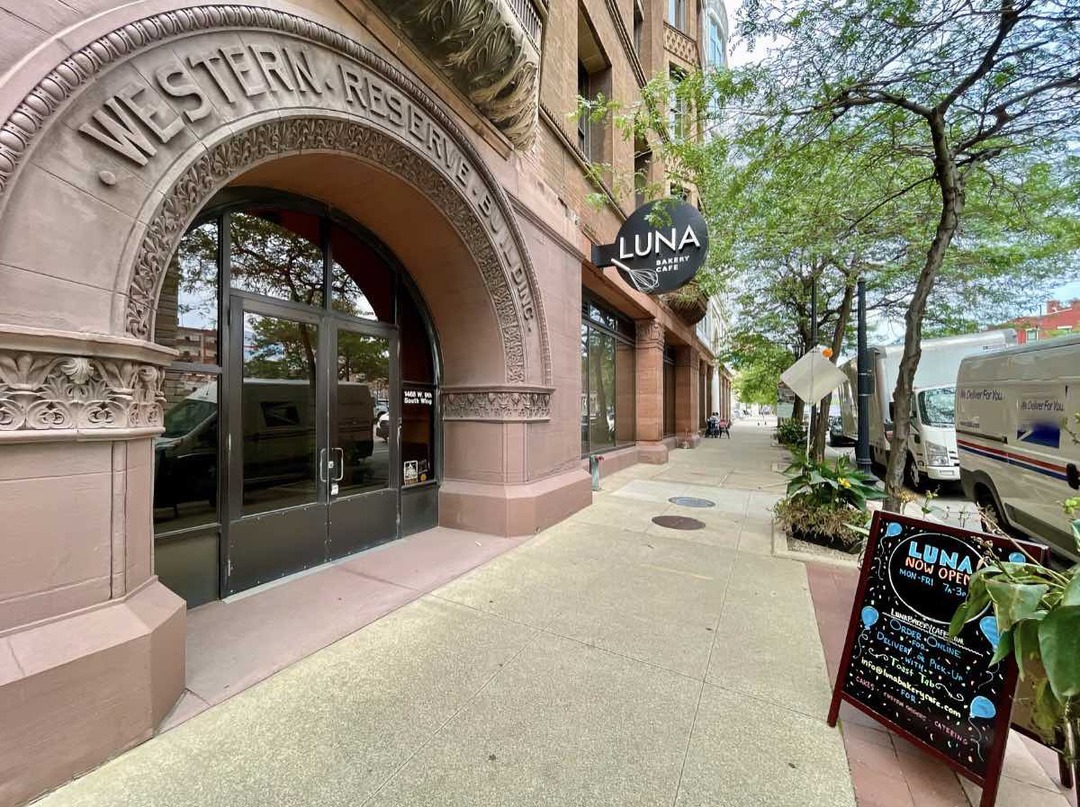
    <summary type="html"><![CDATA[<p><strong><em>Samuel L. Mather perched his offices in the Western Reserve Building above the river harbor where he plied his iron-mining and shipping business. At the time, he probably never imagined how the brick and stone edifice would fare as downtown and the city's economy evolved, but his onetime headquarters defied the odds, managing to retain its original function as an office building long after most other first-generation skyscrapers were demolished or converted to other uses.</em></strong></p><img src="https://mail.clevelandhistorical.org/files/fullsize/b24eb52bdd6ec25243308a1cd22ba2a4.jpg" alt="Romanesque Arch Entrance" /><br/><p>Samuel L. Mather, the grandson of one of the founding fathers of the Connecticut Land Company whose investment had led to the establishment of Cleveland, co-founded the iron-ore mining and shipping firm of Pickands, Mather & Co. in 1883, which helped him amass a new fortune on top of his already formidable wealth. Pickands Mather had kept offices for only a short time in the <a href="https://clevelandhistorical.org/items/show/1029">Perry-Payne Building</a> on Superior Avenue when Mather commissioned the Chicago architectural firm of Burnham & Root (already known locally for its <a href="https://clevelandhistorical.org/items/show/305">Society for Savings Building</a>) to design a headquarters office building on land that he and John Hay had purchased on the northwest corner of Superior and Water Street (now W. 9th).</p><p>The aptly named Western Reserve Building occupied a triangular parcel on the crest of a steep hill descending into the flats along the river. The land had once been home to the Carter Tavern, a hewn-log inn that early Western Reserve of Connecticut settler Lorenzo Carter had built in 1803. Following Carter's death in 1814, Phineas Shepard operated the inn for an unknown span of time, and it was the site of the meeting in 1816 that organized Trinity Parish, later <a href="https://clevelandhistorical.org/items/show/81">Trinity Episcopal Cathedral</a>. After it closed, deeds show that Carter's children Alonzo and Laura sold the land to the Oviatt family in two transactions in 1825 and 1830. By 1828, the Oviatts had replaced the old two-story inn with a three-story brick building that stood until Orson M. Oviatt razed it for a new four-story commercial block called the Franklin Buildings in 1835. The Franklin Buildings housed various dry-goods houses and professional offices, including the men's clothing store of George A. Davis, who owned the block from 1851 until his death ten years later. </p><p>The Franklin Buildings later housed Western Union Telegraph Company, which added "innumerable adornments of fencing and wires which surmount[ed] the electric ridden structure," according to an account in the <em>Plain Dealer</em> in 1886. Three years later, Hay and Mather, the executors of Amasa Stone's estate, purchased the property in the estate's name and set out to redevelop it. (Hay's and Mather's wives Clara and Flora were Stone's daughters.) Following on the heels of the Perry-Payne Building, the announcement of a new building to replace the Western Union block was a welcome news to those who feared Euclid Avenue's inroads. As the <em>Plain Dealer</em> pointed out in 1889, "Enough is now promised in the way of new buildings to save the street from becoming what it had at one time threatened to do—a street for banks and the wholesale trade plentifully mixed up with saloons."</p><p>Mather’s new eight-story pressed-brick and sandstone Western Reserve Building, which opened in 1892, is considered a transitional skyscraper. Like Burnham & Root’s Monadnock Building in Chicago and Cudell & Richardson's Perry-Payne Building, it had traditional load-bearing masonry exterior walls but also incorporated some interior steel framing, a recent innovation. On the ground floor, the Western Reserve Building featured pink sandstone piers capped by Romanesque capitals and a large Romanesque arch framing its Water Street entrance. Its upper floors had either rectangular, segment arch, or full arch windows, some of them in oriel bays. Samuel Mather had an elaborate cherry-paneled office inside. </p><p>In addition to Pickands Mather, the Western Reserve Building housed American Steel & Wire, Cleveland-Cliffs Iron, Island Creek Coal, and other shipping, mining, and manufacturing concerns. The building’s uses reflected business leaders’ desire to locate offices in the Wholesale District (later renamed the Warehouse District) close to Cleveland’s harbor. The riverside location was also attractive to the U.S. Weather Bureau. On May 1, 1892, Cleveland’s weather observatory and signal station opened there, 135 feet above the street, giving it a commanding view of the lake and river. From this lofty perch, signalman and weather observer W. B. Stockman hoisted flags to alert ship captains and downtown pedestrians to impending changes in the weather. The station had previously operated on top of the six-story Wilshire Block on Superior Avenue a block and a half west of Public Square. Now it was another beneficiary of Mather’s eagerness to be closer to the harbor. </p><p>In 1903, the Western Reserve Building was expanded northward along Water Street with an interior lightwell that may have drawn inspiration from Burnham & Root’s Rookery Building in Chicago or perhaps from a similar feature inside the Perry-Payne Building. The expansion increased the original building's size by about 40 percent. The building flourished into the 1920s, but like other buildings west of Public Square, it faced increasing competition from newer ones that rose to the east along Euclid Avenue. In 1924, Mather sold his interest in the Western Reserve Building to the Union Lennox Company, a firm named for the mammoth Union Trust Building that had recently replaced the Lennox Building on the northeast corner of Euclid and East 9th. Soon after, Pickands Mather moved its headquarters into the Union Trust Building. With the loss of its identity as a hub of the city's iron-ore business and the rise of newer, larger skyscrapers, the Western Reserve Building's future was in question.</p><p>The Western Reserve Building changed hands twice during World War II and, under Louis E. Goldman, it underwent a modernization in 1947 that covered its Romanesque arch entrance with a blocky granite façade. Despite this effort to renew its appeal, over the next three decades, the building stood sentinel over a part of downtown that was gradually decaying and receding in civic importance. Toward the end of that time, Goldman was no longer able to attract tenants, so the building sat mostly vacant. The exception to the rule was the opening in 1970 of the Cleveland Urban Learning Community, an experiment by St. Ignatius High School that took advantage of cheap rent to place its headquarters in the Western Reserve Building.</p><p>The Cuyahoga River’s east bank had been a natural place for Samuel Mather to envision an office building housing his iron mining and shipping business in the early 1890s. Although seemingly less natural, Herbert W. Strawbridge, chairman of the Higbee Company department store, felt a similar pull toward the western edge of the derelict Warehouse District nine decades later. Several years earlier, Strawbridge had visited San Francisco’s Ghirardelli Square, a shopping, dining, and entertainment complex filling the shell of its namesake chocolate manufacturer’s former factory. As Higbee’s downtown store sales slipped, Strawbridge recalled Ghirardelli Square. Then he hatched a daring plan to buy a swath of property overlooking the river and create a similar venue. Settlers’ Landing, as it would be named, would evoke Cleveland’s start along its river and, like Ghirardelli Square, reuse existing buildings as much as possible. More importantly, Strawbridge reasoned, Settlers’ Landing could draw large numbers of tourists and suburbanites back to a sagging downtown—and hopefully to Higbee’s.</p><p>Among the properties that the newly formed Higbee Development Corporation bought through agent John H. Bustamante was the Western Reserve Building, which Goldman was doubtless thrilled to unload in 1973. Strawbridge then hired Lawrence Halprin, the man behind Ghirardelli Square, to plan Settlers’ Landing. Higbee Development sank $4.5 million into a full renovation of the Western Reserve Building in 1974-76. The results drew a mixed response locally. Some decried the sandblasting that pitted the delicate sandstone facade. Others looked askance at the similarly insensitive treatment of the building’s interior. To avoid removing any leasable space, Higbee Development enclosed the historic lightwell to add an interior fire escape, heating and cooling ducts, and new restrooms on each floor. Halprin’s designer Angela Tzvetin created a modern lobby with “domed brick vaults” and spiderweb-like iron designs between their pillars, leading one architectural critic to dub the “corny” concept “early wine cellar.” The same critic went so far as to suggest that the Western Reserve Building was “second-rate Burnham and Root” that would have been better off bulldozed.</p><p>When the Western Reserve Building reopened in 1976, it seemed that the building had a new relevance as the Flats transitioned from maritime to leisure uses, but renewal was slow and difficult. Higbee’s operated a sandwich shop off the lobby while it searched (ultimately in vain) for a full-service restaurant to assume the space. At the time of the opening, only 1,220 of 53,840 square feet of office space was leased. Then Higbee’s plans for Settlers’ Landing collapsed after a major fire consumed some of the buildings the company had hoped to renovate. Despite efforts to promote the building, including hosting an exhibit and slideshow as part of the 1977 sesquicentennial of the opening of the Ohio Canal, the Western Reserve Building underperformed expectations. Coupled with Higbee’s expenses from opening new stores at Euclid Square and Randall Park malls, its renovation of Pickands Mather’s onetime headquarters building contributed to record quarterly losses that year. By 1981, the building was reportedly at 97 percent occupancy, but Higbee’s needed an infusion of cash, so it sold the building to another syndicate headed by developer John Ferchill.</p><p>Though Settlers’ Landing had flopped, the Flats and Warehouse District boomed in the 1980s. Nightspots, restaurants, and loft apartment conversions reinvigorated an area that earlier downtown planners had largely forsaken in their fixation on <a href="https://clevelandhistorical.org/items/show/909">Erieview</a>. It was too late for Higbee’s, which sold out to Youngstown developer Edward J. DeBartolo and the Little Rock-based Dillard’s chain in 1987 (though the Higbee’s name survived another five years). As for the Western Reserve Building, it flourished anew. Among the firms based there was Those Characters from Cleveland (now CloudCo Entertainment), a subsidiary of Cleveland-based American Greetings that formed in 1981 to develop and license characters developed by the card company such as Holly Hobbie and Strawberry Shortcake. That year saw Cleveland artist Elena Kucharik’s creation of the Care Bears, making the Western Reserve Building the birthplace of one of the 1980s’ popular culture icons. </p><p>Ferchill and his partners undertook yet another renovation in 1990 and built an eight-story addition to the north that doubled the size of the 1892/1903 building. The sandstone- and microcotta-faced addition featured a new arched entry, while the syndicate uncovered and restored the long-hidden one on the original building. After initial success, the enlarged building gradually languished again. By 2016, it was two-thirds vacant and in foreclosure, leading Ferchill to sell it the following year to WRB Partners (comprised of developer Fred Geis, real estate firm Cushman & Wakefield, and others). During the COVID-19 pandemic, the Western Reserve Building clung to its original function as an office building in a new era marked by the loss of downtown office-based work and a spate of office to residential conversions. In addition to attracting a global co-working company, WRB Partners added to its amenity-driven approach to combatting the loss of traditional dedicated office work by doing what Higbee’s had tried and failed to do fifty years earlier: entice a restaurant operator. In 2023, the popular Cleveland Heights-based Luna Bakery opened its third cafe on the building’s ground floor.</p><p><em><strong><a href="https://mail.clevelandhistorical.org/items/show/1030">For more (including 19 images) view the original article</a></strong></em></p>]]></summary>
    <published>2024-09-10T21:00:07+00:00</published>
    <updated>2026-04-17T19:17:43+00:00</updated>
    <link rel="alternate" type="text/html" href="https://mail.clevelandhistorical.org/items/show/1030"/>
    <id>https://mail.clevelandhistorical.org/items/show/1030</id>
    <author>
      <name>J. Mark Souther</name>
    </author>
  </entry>
  <entry>
    <title type="html"><![CDATA[Perry-Payne Building: Standing at a Place of Historic Memory]]></title>
    <summary type="html"><![CDATA[<p><strong><em>In the Spring of 1887, workmen tore down a number of three-story commercial buildings that had long stood on the north side of Superior Street between the National Bank Building on the northeast corner of Superior and Water (West 9th) Street and the Scovill Building (formerly the Franklin House), located midway up the block. The site was cleared to make room for the construction of the eight-story Perry-Payne Building. A little less than a year later, while the new Perry-Payne Building was going up, an article appeared in the <em>Plain Dealer</em> on April 15, 1888 recalling those earlier buildings and noting that "while the old must give way to the new," a number of Cleveland's most prominent pioneer merchants, including William Bingham and George Worthington, had started their businesses in the old buildings and that therefore "the place is of historic memory."</em></strong></p><img src="https://mail.clevelandhistorical.org/files/fullsize/cdb5ba97d0c460c22c2c6b53c94355bd.jpg" alt="Perry-Payne Building, 740 W. Superior Avenue" /><br/><p><span style="font-weight:400;">The historic land upon which the Perry-Payne Building at 740 W. Superior Avenue stands, and much of the land that surrounds it in Cleveland's Warehouse District, was first commercially developed by the Nathan Perry family. Nathan Perry Sr. (1760-1813) was an innkeeper in western New York's Genesee County when, in 1796, he was hired by Moses Cleaveland to provide food supplies to the surveying party that founded Cleveland. Almost a decade later, he, his wife Sophia, and their children moved here. In 1806, Perry purchased six acres of land northwest of the Public Square. On that land, which had frontage on Superior, St. Clair and Water (West 9th) Streets, Perry opened a trading post in a cabin that stood less than fifty feet from where the Perry-Payne Building stands today. </p><p>Nathan Perry, Sr. was one of Cleveland's first merchants. Less than a decade after arriving in Cleveland, however, he died unexpectedly. Four of his six acres, including the land upon which the Perry-Payne Building stands, passed to his son Nathan Perry Jr. (1786-1865), who transformed his father's trading post into a dry goods store and, in 1819, replaced the cabin with a two-story brick commercial building, one of Cleveland's first. Nathan Jr. operated his dry goods business in that building until 1826, when he sold the business but retained ownership of the building and the land upon which it stood. </p><p>In addition to running his dry goods business, Nathan Perry Jr., as early as 1814, had been making shrewd purchases of land in Cleveland, and, by 1830, he had become one of the city's wealthiest landowners. In that latter year, he moved his family from the simple frame house they had lived in on Water Street, just north of his dry goods store, into an early-era mansion on Euclid Avenue. It stood where Berkman Hall stands today on Cleveland State University's campus, just east of East 22nd Street.</p><p>In 1835, Perry decided to lease some of his land near the corner of Superior and Water to two hardware merchants, William Cleveland and Elisha Sterling. The terms of their two leases—drawn up by a young Cleveland lawyer named Henry B. Payne—required them to construct two three-story brick commercial buildings on the land they leased. Each of the two brick buildings they built had two storefronts. The buildings with their four storefronts became known as the "Central Buildings" because the corner of Superior and Water was then the center of Cleveland's commercial business district. It was in these buildings that William Bingham, George Worthington, and other prominent early Cleveland merchants, who were mentioned in the <em>Plain Dealer</em> article of April 15, 1888, got their business start.</p><p>As important as the Central Buildings were to the enlargement of Nathan Perry Jr.'s real estate portfolio, lawyer Henry B. Payne, who drafted the leases that required they be built, would soon become even more important. In 1833, Henry B. Payne was a law student in Hamilton, New York, when he was impelled to travel to Cleveland to help nurse his best friend, Stephen A. Douglas, who was suffering from a severe illness. Douglas, who later became the Illinois Senator whom Abraham Lincoln famously debated in 1858, left Cleveland after recovering. Henry Payne chose to stay. Payne completed his law studies here and, in 1836, when Cleveland officially became a city, Henry Payne became its first solicitor. In August 1836, Payne, who had in 1835, as noted above, served as Nathan Perry's lawyer, married Perry's only daughter, Mary, who thereafter became known to all in Cleveland as Mary Perry Payne. </p><p>Henry Payne practiced law in Cleveland for more than a decade before he decided to leave the practice. In 1849 he joined forces with Alfred Kelley and Richard Hilliard to build Cleveland's first railroad, the Cleveland, Columbus and Cincinnati ("CCC"). In the process, he became that railroad's first president. In 1855, Payne turned his attention to government service and was appointed to the City Waterworks Commission. It built Cleveland's first waterworks system. Then, in 1862, he took on the work of chairing a city sinking fund board which reportedly stabilized Cleveland's finances for years. Henry Payne also became active in local and state politics. He served in a number of Democrat party positions, before being elected in 1874 to the United States House of Representatives. A decade later, in 1885, he was elected Ohio's first United States Senator from Cleveland. </p><p>It was during the second year of Henry Payne's term as a United States Senator that local newspapers reported that Senator Payne was planning to build a new commercial building on Superior Avenue that would be named the Perry-Payne Building.  Different reporters and different historians writing in different eras have speculated differently as to the reason why Henry Payne named the Perry-Payne Building as he did. They all, however, may have been looking to the wrong person for an answer to their question. </p><p>When plans were made to build the Perry-Payne Building, the land upon which it was to be built was owned by Mary Perry Payne. The decade of the 1880s was one in which American women were beginning to acquire greater property rights, including the right to own, develop and dispose of real property in their own name. Henry B. Payne was uniformly said to be a progressive person of kind disposition who had a very loving marriage with Mary Perry Payne. Given all of the foregoing, there is no reason not to believe that Mary Perry Payne, probably with her husband's full support, was the person who chose the name of the building that was to be built upon her land. So perhaps the question that we should ask today, even if it was not asked by newsmen in 1887, or by historians thereafter, is: Why did Mary Perry Payne choose to so name her building? While we do not know the answer to that question with any degree of certainty, it might be as simple as that was where she first met Henry Payne.</p><p>In proceeding with their plans to build the Perry-Payne Building, Henry and Mary Perry Payne selected Cudell & Richardson, one of Cleveland's most prominent late nineteenth-century architectural firms, to design it. Cudell & Richardson, in additional to this historic building, also notably designed the following buildings still standing in Cleveland: St. Stephen Roman Catholic Church on West 54th Street; Franklin Circle Christian Church at 1688 Fulton Road; Belden Seymour Block at 2513-2525 Detroit Avenue; Franklin Castle at 4318 Franklin Boulevard; the George Worthington Company Building at 802-832 W. St. Clair Avenue; the Root and McBride Building at 1220 West 6th Street; and the Bradley Building at 1212-1224 West 6th Street. Additionally, Cleveland's Cudell Commons Park and the city's Cudell neighborhood are both named after Frank Cudell, one of the two named partners in that architectural firm.</p><p>The building Cudell & Richardson designed for Henry and Mary Perry Payne was described in a June 19, 1887 <em>Cleveland Leader</em> article. It was to be constructed "of brown stone and granite, in the Rennaissance style of architecture. The side and rear walls will be of brick. . . . The floor joists will be of iron and the floors fire clay tile. . . . [T]he stairs will be made of iron and cement or marble. Iron balconies will be provided on the fifth and seventh floors." The article stated that the building would be "eight stories high in the middle and seven on either side, with a basement. It will have a frontage of 138 feet, a depth of 100 feet, and will be 120 feet high." The article noted that the first floor of the building would be designed for the offices of banks, and the upper floors would have a total of 46 offices with an average size of 18 x 26 feet. </p><p>Other articles noted that the interior of the building would feature an eight-story interior court illuminated by a sky light. (The design of this light court, as well as the building's front facade, were reminiscent of Chicago's Rookery Building designed by Burhnam and Roots.) Other interior features of the Perry-Payne Building were its modern elevators and mail chutes that carried mail from all of the building's upper floors down to a first floor mail room. Designed with interior iron support columns, the Perry-Payne Building is notable architecturally as a transitional building between earlier buildings with masonry support walls and later buildings, including the Society for Savings Building erected just one year later, having interior steel support beams which enabled them to be built to great heights and led to them becoming known as "skyscrapers."</p><p>Construction of the Perry-Payne building commenced in the summer of 1887 after all of the old commercial buildings on the site had been razed. While construction was expected to be completed in 1888, financing difficulties encountered by Henry and Mary Perry Payne appear to have delayed completion of construction until the summer of 1889. The first tenants of the Perry-Payne Building included Bingham Hardware and National City Bank, who opened their offices in the new building on July 1, 1889.  When the Perry-Payne Building opened, it was the tallest and most grand commercial building in Cleveland, and it attracted many of the largest iron ore, coal, and shipping companies in Cleveland as tenants. It also attracted a number of Cleveland law firms, including a new firm named Squire, Sanders and Dempsey (today, Squire, Patton and Boggs), which has since become one of the city's largest and most historic law firms. </p><p>In the first two decades of its existence, even as larger and grander commercial building went up in downtown Cleveland, the Perry-Payne Building continued to attract more than its fair share of Cleveland's coal, iron, and shipping-related businesses, as well as a number of law firms and insurance companies. However, almost all of its core tenants departed after 1913 when Marcus Hanna's son Dan completed his construction of the enormous 15-story Leader Building on the corner of Superior Avenue and East 6th Street. Thereafter, for decades, the Perry-Payne Building survived with much less than full occupancy.</p><p>During its early years, ownership of the Perry-Payne Building remained with the Perry-Payne family and their descendants through the Perry-Payne Company formed in 1899, several years after the deaths of Henry and Mary Perry Payne. However, in 1945, that company sold the Perry-Payne Building to another corporation that was unrelated to the family. The building had many new owners in the years that followed and these new owners struggled to find and hold onto tenants. Then, in 1965, the State of Ohio leased the entire building for a number of its agencies with offices in Cleveland. This, however, only temporarily solved the building's occupancy problems for, in the summer of 1979, the State agencies departed when the new <span>Frank J. Lausche State Office Building, directly across the street, opened</span>.</p><p>In the 1980s and early 1990s, the owners of the Perry-Payne Building struggled anew with occupancy problems. In 1994, however, a new partnership purchased the building, hired an architectural firm known for its restoration work, and proceeded to restore the front facade of the Perry-Payne Building; renovate the remainder of it; and convert it into an apartment building with 91 apartments and 8,000 square feet of retail space. As of the writing of this story in 2024, the Perry-Payne Apartments remain a prestigious address in downtown Cleveland's Warehouse District.</p><p>If Mary Perry Payne were alive today and learned that her Perry-Payne Building had been converted into an apartment building, she might say that it really didn't matter, so long as Clevelanders today believe, as she and her husband and Clevelanders of her generation more than a century ago believed, that the Perry-Payne Building stands at a place of historic memory.</p><p> </p>
</p><p><em><strong><a href="https://mail.clevelandhistorical.org/items/show/1029">For more (including 19 images) view the original article</a></strong></em></p>]]></summary>
    <published>2024-08-06T01:52:23+00:00</published>
    <updated>2026-04-17T19:17:43+00:00</updated>
    <link rel="alternate" type="text/html" href="https://mail.clevelandhistorical.org/items/show/1029"/>
    <id>https://mail.clevelandhistorical.org/items/show/1029</id>
    <author>
      <name>Jim Dubelko</name>
    </author>
  </entry>
  <entry>
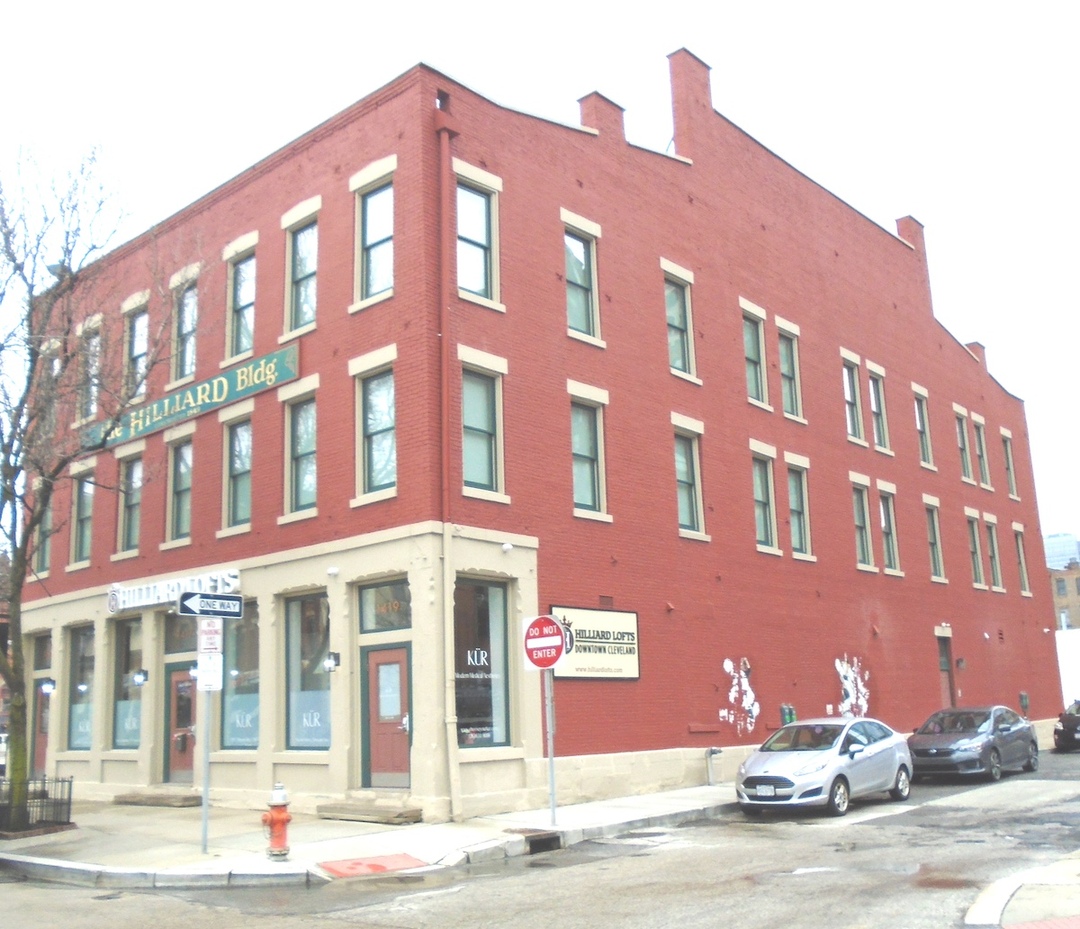
    <title type="html"><![CDATA[Hilliard Building: The Oldest Commercial Building in Downtown Cleveland]]></title>
    <summary type="html"><![CDATA[<p><strong><em>Richard Hilliard achieved much as a businessman and civic leader in the thirty years (1826-1856) that he lived in Cleveland.  Most of his achievements have long since faded from the public's memory.  However, the three story brick building that he erected in 1850 still stands today on West 9th Street as a reminder to Clevelanders of who he was.</p></strong></p><img src="https://mail.clevelandhistorical.org/files/fullsize/f6a53caee7076de0abc61048028a060b.jpg" alt="Hilliard Building" /><br/><p>In Cleveland's Warehouse District, northwest of Public Square, the historic Hilliard Building stands on the corner of West 9th Street and Frankfort Avenue. A visitor to the area can't help but notice how isolated it is from other buildings. In fact, it is entirely surrounded by parking lots. There is a parking lot to the west of it, directly across West 9th Street. There is another to the south of it between Frankfort and the Brotherhood of Railroad Trainmen Building on Superior Avenue. And finally there is a very large parking lot that extends north from the Hilliard Building all the way to St. Clair Avenue and also to the east behind the building all the way to West 6th Street. </p><p>Such parking lots, when covering large areas of a city's downtown, have become known as "parking craters," a term popularized by blogger Angie Schmitt who wrote that they render urban landscapes "inhospitable and unattractive." How and why the Hilliard Building came to occupy such an isolated location on West 9th Street, in the middle of a "parking crater," is an important part of the history of this building. </p><p>The Hilliard Building is named after Richard Hilliard, who was born in Chatham, New York in 1800. When he was a teenager, Hilliard began working in dry goods stores in western New York. One of those stores opened a branch in Cleveland in 1824, locating its new store at the southwest corner of Water (West 9th) and Superior, across Superior from where the Western Reserve Building stands today. Two years later, Hilliard who had by then become a partner in that business, moved to Cleveland. He soon bought out his partner and then formed a new partnership with William Hayes, a dry goods merchant in New York City. At about the same time that they formed their partnership, Hilliard married Sarah Katherine Hayes, a sister of his new partner, not an unusual way to cement a business relationship in the nineteenth century. </p><p>The dry goods business of Hilliard and Hayes, according to Hilliard's biographers, soon became very successful, and Richard Hilliard developed into an important figure in Cleveland's early history. In 1830, he was elected President of the Board of Trustees of Cleveland Village, and in 1836, when Cleveland became a city, he was elected one of its first aldermen. In the decade of the 1830s, he was one of the developers of Cleveland Centre in the Flats, a bold, but ill-fated, effort to make Cleveland the center of international trade in the Midwest. In the 1840s, Hilliard and Henry B. Payne, became more successfully involved in the incorporation of the Cleveland, Columbus and Cincinnati Railroad, Cleveland's first railroad, both of them becoming directors of that railroad. (Payne, an attorney, later built the Perry-Payne Building on Superior Avenue in downtown Cleveland.) In the early 1850s, Hilliard served as the first president of the Cleveland Water Works Commission, which led to the creation of Cleveland's first public water works system in 1856. </p><p>In 1850, Hilliard built the three story brick commercial building which is the subject of this story, moving his dry goods business into the building in the same year. According to an article appearing in the Plain Dealer on June 27, 1851, the building had 48 and 1/2 feet of frontage on Water Street and 100 feet on Centre (today, Frankfort) Street. The interior of the building was arranged as follows. There was a dry goods room measuring 25 by 100 feet on the Centre Street side of the building, and rooms on the two upper floors of the building that were also used in the dry goods business. The balance of the front of the building consisted of a room approximately 21 by 80 feet which served as a grocery store. The rear 20 feet of that part of the building was "furnished and used as a Counting-room." </p><p>Hilliard and Hayes, which then became Hilliard, Hayes and Co., was, according to newspaper sources, the largest dry goods wholesale business in the Midwest in the 1850s. It provided dry goods to retail stores in Ohio, Michigan, Indiana, Illinois and Wisconsin, and had sales that annually exceeded $500,000, equivalent to almost $20 million in 2024 dollars. However, shortly after returning from a business trip to New York, Richard Hilliard died on December 21, 1856 from typhoid fever. He was only 56 years old. His death had a profound effect upon his wholesale business operated out of the Hilliard Building, then known as the Hilliard Block. Several new partnerships were formed with combinations of Hilliard's son Richard Jr. and several of his father's former partners, but none lasted. On March 22, 1858, an advertisement appeared in the Plain Dealer, offering the "stock . . . business and good will" of the company for sale. By 1860, a new wholesale dry goods firm, S. Raymonds & Co., was operating its business out of the Hilliard Block. </p><p>S. Raymond and Co. occupied the Hilliard Block as a tenant for more than a decade under leases from the Hilliard family who still owned the building. Then, in 1875, the building took on new tenants when it was remodeled as an office building for merchants in Cleveland's coal and oil trade. Among those new tenants in the building now known as the Coal and Iron Exchange Building was Rhodes and Hanna, a business started by prominent early west side industrialist Daniel Rhodes, but, following his retirement in 1867, operated by a partnership that included his son Robert Russell Rhodes and son-in-law Marcus Hanna. (Known to history as "Cleveland's kingmaker," Hanna later directed the successful 1896 and 1900 presidential campaigns of William McKinley.) From 1875 to 1887, a number of Cleveland's most prominent coal and iron merchants had their offices in the building. </p><p>In the mid to late 1880s, as new and grander commercial buildings were erected in the Warehouse District like the Grand Arcade (1883) and the Perry-Payne Building (1889), coal and iron merchants left the Hilliard Block for these more prestigious addresses. For a time, the Hilliard building then served as home to the offices of several stocks, grains, provisions and oil brokers. In the early 1900s, several related wholesale fire equipment and marine supply companies operated out of the building. In 1914, Laura Hilliard, the youngest daughter of Richard Hilliard, who had owned the Hilliard Building since the 1880s, sold it to Koblitz Brothers Realty Company, who, under several different corporate names, owned and leased it to various tenants until 1950. </p><p>During the 1920s, when Koblitz Brothers owned the Hilliard Building, the Warehouse District, according to local historian and archivist Drew Rolik, reached its pinnacle of commercial development and then began a slow decline as some of its aging buildings were, beginning in the mid 1920s, demolished to make room for parking lots. At first these new lots were few and far between, but the pace of parking lot creation increased following the end of World War II and the building of the interstate highway system which facilitated a massive movement of urban dwellers to the suburbs in the post war era. </p><p>In the 1950s, government officials like County Engineer Albert Porter advocated for more parking lots in downtown Cleveland to encourage suburban residents to come downtown to work and shop. His sentiments were echoed by business leaders like Alfred Benesch who, in a letter published in the Plain Dealer on April 21, 1957, wrote that the Warehouse District (then known as the Wholesale District or as part of the Garment District) was an ideal location for such parking lots as it was filled with "buildings a hundred or more years old . . . which are not any asset to Cleveland . . [and] might be well condemned and razed in order to provide parking facilities . . " </p><p>With encouragement like this from government and private sector leaders, the pace of building demolition and parking lot creation in the Warehouse District increased in the 1960s and 1970s. However, in the latter decade the tide began to turn as preservationists made their voices heard. In 1977, aided by a report from architect William A. Gould, the Cleveland Landmarks Commission adopted a comprehensive preservation plan for the Warehouse District. Five years later, in 1982, with the Commission's urging, the City of Cleveland created the Warehouse Historic District, which was later accepted and added to the National Register of Historic Places. By 1988, the Landmarks Commission felt comfortable in proclaiming victory for the preservation of the District. </p><p>According to Stephanie Ryberg-Webster in her book <em>Preserving the Vanishing City</em>, by the time victory was declared, more than a third of the buildings that were standing in Cleveland's Warehouse District in its peak year of 1921 had been demolished.  The result was the creation of a number of "parking craters" in the District, including the earlier mentioned one within which the Hilliard Building still stands today.  That crater began to form in the 1930s when a number of buildings on Frankfort Avenue between West 9th and West 6th were torn down, as well as a part of the Payne Brothers Building on the southeast corner of West 9th and St. Clair. In circa 1950, the old W. Bingham building across Frankfort from the Hilliard Building was torn down for a parking lot, and, as that decade progressed, more buildings were torn down on Frankfort, as well as a number on the west side of West 9th across the street from the Hilliard Building.  </p><p>The decade of the 1960s and 1970s saw additional buildings demolished on the west side of the West 9th Street, many of them as the result of fires of unknown origin.  And then, perhaps most notably for the Hilliard Building, one by one the buildings that lined the east side of West 9th immediately north of the Hilliard Building and south of St. Clair Avenue were demolished for parking lots.  The remaining part of the Payne Brothers Building was the first to go in 1966; the Vincent Block next door to it then was torn down in the 1970s; and finally the Board of Trades Building, the last building standing on that side of the street between St. Clair and the Hilliard Building, in the 1980s. By the time the dust settled and the Cleveland Landmarks Commission declared victory in stemming the tide of demolition, the Hilliard Building was left in the middle of the parking crater that it still occupies today, almost 40 years after victory was declared.</p><p>The Hilliard Building avoided the fate of the other nineteenth century buildings that once surrounded it, most likely for two reasons. First, in 1950, the building was purchased by two brothers, Sidney E. and Albert E. Saltzman, who, during the peak years of demolition in the Warehouse District, operated a successful wholesale business called Drug Sundries Co. out of the building. And second, in 1983, after the tide had turned toward preservation rather than demolition in the district, attorneys Stanley Yulish and Mark Twohig purchased the building from the Saltzmans; renovated and restored it; and moved their law firm into the building. </p><p>Since 2000, the Hilliard Building has been owned by several different limited liability companies, and in 2020 it was further renovated and remodeled in order to convert the second and third floors of the building into apartments. Now, in 2024, almost 175 years old, the Hilliard Building is not just downtown Cleveland's oldest commercial building.  It is also a remarkable survivor of the second half of the twentieth century in this city when, for a time, parking in the Warehouse District was king.</p><p><em><strong><a href="https://mail.clevelandhistorical.org/items/show/1018">For more (including 14 images) view the original article</a></strong></em></p>]]></summary>
    <published>2024-03-05T20:17:12+00:00</published>
    <updated>2026-04-17T19:17:43+00:00</updated>
    <link rel="alternate" type="text/html" href="https://mail.clevelandhistorical.org/items/show/1018"/>
    <id>https://mail.clevelandhistorical.org/items/show/1018</id>
    <author>
      <name>Jim Dubelko</name>
    </author>
  </entry>
  <entry>
    <title type="html"><![CDATA[Mayfield Theater: Little Italy&#039;s Long-Dormant Movie House]]></title>
    <summary type="html"><![CDATA[<img src="https://mail.clevelandhistorical.org/files/fullsize/0784085f598a1d7fe35fba61477ae732.jpg" alt="New Mayfield Repertory Cinema" /><br/><p>Walking or driving through Little Italy, how many of us have wondered, “Why doesn't someone reopen or repurpose that old theater?” It’s a reasonable question despite the obvious challenges (cost, parking, safety, etc.). After all, the Mayfield Theater—a.k.a., the Mayfield Art Theatre, the Old Mayfield Theater, and the New Mayfield Repertory Cinema—has been shuttered for close to 40 years.</p><p>The “Old Mayfield” moniker is particularly resonant for those passersby of the Baby Boomer generation whose moviegoing journeys to 12300 Mayfield Road were in the late 1960s. That’s when this now-unassuming hole in the wall briefly became the go-to spot for silent films, silver screen classics, and revivals. For a time, “old was the new new.”</p><p>That incarnation (the theater's third) also may have struck a chord simply because the place exuded “old.” Original Arts and Crafts–style glass transoms. Crown molding. Time-worn terrazzo floors. Tickets were issued from a closet-like opening in the entryway, after which visitors would enter a gloomy and cramped low-ceilinged lobby. Directly above, a tiny projection booth could be accessed only via a metal ladder. By the late ’60s the theater’s original seats (some allegedly taken from the <a href="https://clevelandhistorical.org/items/show/460">Euclid Avenue Opera House</a>) were gone, but their rickety replacements were a perfect musty accompaniment to the showing of a 1920s or ’30s movie. </p><p>The first of the Mayfield Theater’s many lives began in 1923, when Michele Mastandrea, an Italian immigrant, built the two-story brick building with a theater on the first floor and a large apartment on the second. Mastandrea had previously operated a dry goods store on that same parcel. Before that he worked as a shoe salesman in a shop on the current site of Maxi’s Bistro. Mastandrea and his wife Christina lived in a small house behind the theater (fronting Fairview Court) until they moved to the new building’s second floor quarters in 1929. They operated the theater and remained in the spacious eight-room apartment until their deaths in 1955 and 1958, respectively. </p><p>The Mayfield wasn’t Little Italy’s first theater. The Venice, which opened around 1915, was a converted storefront at 12016 Mayfield Road, current site of the Little Italy Visitor Center at Random and Mayfield. The Roma Theater, a few years older than the Venice, staged live performances and possibly short films. It was located directly across Random Road from the Venice, where Tony Brush Park now stands. Both venues closed more-or-less concurrently with the opening of the Mayfield, which continued to be the only theater in Little Italy throughout its 32-year run. Mastandrea’s offerings included Italian-language and second-run Hollywood movies, as well as occasional live performances of Italian plays. As the neighborhood’s largest gathering space, the Mayfield also hosted community meetings and lectures, benefit performances (e.g., for Holy Rosary Church), <a href="https://clevelandhistorical.org/items/show/377">Feast of the Assumption</a> and Columbus Day celebrations, and political gatherings. In November 1930—the night before the national election—Ohio senate candidates debated at the Mayfield. </p><p>Michele Mastandrea died in August 1955 and the theater closed. In January 1959, it reopened as the Mayfield Art Theater, part of a national chain of art movie houses. Veteran managers Jack Silverthorne and Jack Lewis upgraded the marquee, interior, and projection equipment, and installed a new CinemaScope (super-wide) screen. The two Jacks showed first-run foreign films, as well as domestic comedies, dramas, and documentaries. Rod R. Mastandrea, a Cleveland attorney and son of Michele Mastandrea, assumed control in September 1959, a tenure that ended that December when the curtain came down again, save for a very brief attempt at live theater in 1961.</p><p>Amid the tumult of 1968, some Clevelanders may have been particularly primed for nostalgia. Thus emerged the space’s third reincarnation: the Old Mayfield, which the <em>Plain Dealer</em>’s George Barmann christened “Cleveland’s first silent movie house since the silent movie houses.” Blood and Sand with Rudolph Valentino kicked things off on October 3, 1968. Forthcoming attractions included <em>The Gold Rush</em> with Charlie Chaplin, <em>Way Down East</em> with Lillian Gish, <em>Arizona Wooing</em> with Tom Mix, The <em>Hunchback of Notre Dame</em> with Lon Chaney, and <em>The Mark of Zorro</em> with Douglas Fairbanks.</p><p>The Old Mayfield's emergence wasn't driven by movie men. Instead, the rescuers were Sam Guarino, owner of Guarino’s restaurant and Hank Schulie of the Golden Bowl. After forming the Itlo Development Corporation (Itlo stood for Italian Little Italy Organization), the two restaurateurs cleaned the place up, hired a pianist, and installed a beer and champagne bar in a corner of the lobby. Alas, their enthusiasm was not enough to overcome the area’s incessant parking problems as well as the race-related tensions that typified the time and the neighborhood, and the theater closed in October 1969. It reopened briefly in January 1970 with a spate of Marx Brothers and W.C. Fields movies, but lapsed back into sleep by late spring. </p><p>After four years, the theater was resurrected for the last time by an English and drama professor and cinephile named Sheldon Wigod. Dubbing his new movie house the New Mayfield Repertory Cinema, he stuck with classic movies but interspersed them with foreign films—from Flynn to Fellini. Wigod brought a personal—and personable—touch to the business, introducing each film prior to its showing. It was during Wigod’s tenure that the building was designated a Cleveland Landmark. </p><p>Wigod’s labor of love did better than most; the New Mayfield Repertory Cinema stayed awake until 1985 but has been vacant ever since. However, it did receive a spot on the National Register of Historic Places in 2013. And why hasn’t there been another reawakening? We periodically see vague hints—a cleanup here, a supply truck there—but specifics are few and barriers are many. Parking challenges are clearly a major hurdle. However, it seems likely that adhering to modern fire and safety codes might play a part, as could the high cost associated with converting to a digital film format or turning the space into something other than a theater.</p><p><em><strong><a href="https://mail.clevelandhistorical.org/items/show/1013">For more (including 7 images) view the original article</a></strong></em></p>]]></summary>
    <published>2024-02-07T20:21:13+00:00</published>
    <updated>2026-04-17T19:17:43+00:00</updated>
    <link rel="alternate" type="text/html" href="https://mail.clevelandhistorical.org/items/show/1013"/>
    <id>https://mail.clevelandhistorical.org/items/show/1013</id>
    <author>
      <name>Chris Roy</name>
    </author>
  </entry>
  <entry>
    <title type="html"><![CDATA[Rose Building: &quot;The New Center&quot;]]></title>
    <summary type="html"><![CDATA[<p><strong><em>In 1898-1900, Benjamin Rose financed the construction of the largest office building ever built in Ohio up to that time. At a time when conventional wisdom dictated a Euclid Avenue address, Rose did the unthinkable, selecting a spot at the corner of Prospect Avenue and Erie Street. Naysayers were convinced Rose's daring venture was doomed to fail, but they were wrong.</em></strong></p><img src="https://mail.clevelandhistorical.org/files/fullsize/1e18dd70994fd06dc46874a9b5534ab0.jpg" alt="Main Entrance" /><br/><p>The ten-story Rose Building took its name from its developer, an English immigrant and pioneer in the meatpacking industry. In 1854 Benjamin Rose and Chauncey Prentiss established Rose & Prentiss, later renamed Cleveland Provision Company, which embraced refrigeration and other innovations early and was the city’s largest packinghouse for more than a century. With the fortune he amassed selling cuts of meat, in 1898 Rose commissioned architect George Horatio Smith to design what would become Ohio’s largest office building.</p><p>When the Rose Building was constructed, Erie Street (now East 9th), was on the eastern fringe of downtown, but Rose cleverly dubbed the intersection “The New Center” and used this slogan to entice businesses that might otherwise have considered the location too distant. Indeed, the Rose Building stood out. Its first five stories were sixteen feet high, while floors six to ten were eleven feet high. The choice to make the ceiling height of the lower floors so much higher than usual was reportedly Rose’s wish. </p><p>Upon its opening in 1900, the building’s primary tenants on the lower floors included Lederer Furniture, Scott Dry Goods, and offices of the White Sewing Machine and Cleveland Gas & Electrical Fixture companies. The upper floors contained doctors’ and dentists’ offices, an artist’s studio, a correspondence school, and the offices of fifteen oil companies. In its early years the Rose Building also hosted many exhibitions, including the works of Cleveland artists, a Slavic craft fair, and even a mock Congressional session. </p><p>In 1908 Rose was poised to stake out the next speculative “new center” of downtown. He bought out the St. John’s African Methodist Episcopal Church on East 9th across from Erie Street Cemetery with plans to build a twelve-story office building, but before he could carry out the plan, he died during a trip to England. Instead of burnishing his reputation in life as a visionary developer, in death Rose seeded the legacy for which he is known today. In 1909, the Rose Building gained a new tenant. Tucked away in small, sparely furnished office on the tenth floor was the Benjamin Rose Institute. Funded by Rose’s $3 million bequest, it used the office to review applications for small pensions to enable elderly men and women to afford to remain in their own homes.</p><p>In 1984, the Institute sold the Rose Building to Medical Mutual of Ohio, which had located its headquarters there in 1947. Medical Mutual owned the building until 2000, when it sold it to California-based BentleyForbes and leased its space. When the owner fell into foreclosure, Medical Mutual bought the building back in 2017, but its future in downtown was anything but certain. After much deliberation, Medical Mutual vacated the Rose Building in 2023 and merged its operations in its Brooklyn, Ohio, offices in the former American Greetings headquarters. While pessimists might quip that Benjamin Rose's doubters were ultimately proven right, the Rose Building's now much more central location makes it a likely candidate for a new lease on life.</p><p><em><strong><a href="https://mail.clevelandhistorical.org/items/show/1012">For more (including 12 images) view the original article</a></strong></em></p>]]></summary>
    <published>2024-01-11T16:07:38+00:00</published>
    <updated>2026-04-17T19:17:43+00:00</updated>
    <link rel="alternate" type="text/html" href="https://mail.clevelandhistorical.org/items/show/1012"/>
    <id>https://mail.clevelandhistorical.org/items/show/1012</id>
    <author>
      <name>J. Mark Souther</name>
    </author>
  </entry>
  <entry>
    <title type="html"><![CDATA[Anthony J. Celebrezze Federal Building: Federal Modernism Comes to Cleveland]]></title>
    <summary type="html"><![CDATA[<p><strong><em>When the federal government began planning its new building as part of the Erieview Plan, it departed from I. M. Pei’s original vision and chose a stunning new design that drew from the latest in Modernist thought. Forty years later, that building was showing its age and required a dramatic intervention. The solution was an innovative facade overclad system that changed the building’s appearance but maintained its original purpose and function.</em></strong></p><img src="https://mail.clevelandhistorical.org/files/fullsize/08179223f0e96be7ec08765e524e5ec3.jpg" alt="The Anthony J. Celebrezze Federal Building" /><br/><p>The 1960s were a very active period for the construction of federal buildings in cities across the country, and Cleveland was no exception. As early as 1957, area members of Congress began pushing for the construction of a centrally located downtown federal office building that would consolidate federal services in the city. The site of the building was determined in 1960 as an integral part of the Erieview Urban Renewal Project in downtown Cleveland. This large scale, multi-phased urban planning project was led by renowned architecture firm I. M. Pei and Associates.</p><p>Pei’s 1960 master plan for the Erieview development included a mix of high- and low-rise commercial and residential buildings with more than fifty percent of the land left open for parks and malls. The plan was designed to be completed in two phases; a western area of 96 acres to be designated for primarily commercial use and an eastern area of 67 acres to be designated for residential buildings. The focal point, at the center of the development, was a forty-story office tower. Completed in 1964 and dubbed the Erieview Tower, this was the first part of the Erieview plan to be built. A new six-story federal building that was to occupy an entire city block was also a key part of Pei’s plan. In preparation for the Erieview redevelopment, more than 200 buildings were demolished, including the old Armory that was located on the site of the current Federal Building.</p><p>While I. M. Pei developed the master plan for the Erieview development, other architects were brought in to design the individual buildings, including the new federal building. The General Services Administration (GSA), established in 1949 to meet the needs of the growing federal government, selected three local architecture firms to work together on the design of the federal building: Outcalt, Guenther, Rode, Toguchi & Bonebrake; Schafer, Flynn & Associates; and Dalton & Dalton Associates. However, the GSA did not choose a lead designer for the project and left the three firms to resolve the issue. All three firms wanted to lead the project, so a compromise was reached that they would bring in an outside architect to be the lead designer. The firm principals originally thought about bringing in a famous architect to lead the project, but eventually decided to find an architect that worked for one of these significant architects. Peter van Dijk was working for Eero Saarinen and Associates in Bloomfield Hills, Michigan, at the time and was selected based on a suggestion by one of Calvin Dalton’s employees. Upon speaking with van Dijk, the principals at the three firms quickly decided he was the right person to lead the design of the Federal Building project.</p><p>The design process began in 1961 and continued through 1962. The architectural team was charged with designing a one million square foot federal office building with an “open, flexible, well-planned loft space for offices.” GSA also requested that a two-level parking garage, large cafeteria, and loading dock be included. According to van Dijk, the goal was “to produce a most elegant steel cage. A façade executed with strength and precision. A stressed skin smoothness with machine-like clarity. Good proportion, scale, detail and choice of appropriate materials and colors.”</p><p>After careful consideration and study of the site and GSA programmatic requirements, it was decided that the team would design a tall building, which was in direct contradiction to the concept design in Pei’s Erieview Master Plan. The designers’ decision to abandon the Pei design was based on their belief that a tall structure would relate to the existing Terminal Tower and the other buildings being designed in proximity at the time. In their opinion, the large donut-shaped plan did not conform with the “plans for open space and plazas.” They believed a tall building would provide for more space for outdoor plazas, as well as views of the downtown and lake from the upper floor offices. Following their conclusion, the team convinced Pei and GSA that “a tall, slim structure would be more in keeping” with the other high structures planned in the renewal area. </p><p>The building was designed as a simple rectangular shape and had the proportions of a golden rectangle. The design also contained a definite base, middle, and top and was intended to utilize simple materials (glass and stainless steel). Furthermore, according to van Dijk, the steel frame of the building became “the basis of the architectural expression of the façade.” The siting was also important to the designers. The building was purposely set back from East Ninth Street to provide room for a plaza at the main entrance and set back even farther on East Sixth Street to create a “garden plaza.”</p><p>The design was substantially completed by June 1962 when GSA issued an official press release regarding the new federal building in Cleveland. In the press release, GSA described the thirty-two story building as “an important element in the city’s Erieview Redevelopment Plan” that would “provide the lake-shore metropolis with an imposing landmark.” They also estimated that the building would cost $41.2 million to complete. </p><p>The Celebrezze Building was designed during a period of growing public acceptance of Modernist design. The Modernist movement in architecture, which had roots in Europe, began to flourish in the United States following World War II as architects like Walter Gropius and Mies van der Rohe expanded their influence. As the movement continued to thrive throughout the 1950s and into the 1960s, Modernism became the preferred style of architecture for office buildings across the country. Buildings such as the Seagram Building (1958) in New York City by Mies van der Rohe and Philip Johnson, as well as the Inland Steel Building (1957) in Chicago, Illinois by Bruce Graham and Walter Netsch of SOM, continued to push the envelope in Modernist design. Significant Modernist skyscrapers in Cleveland include the McDonald Investment Center (1968) by Charles Luckman; the Cleveland Trust Tower/Ameritrust Tower (1971) by Marcel Breuer; Earnest J. Bohn Housing Tower (1972) by William Dorsky Associates; the Diamond Building (1972) by SOM; the Holiday Inn Lakeside (1974) by William Bond; and the Sheraton City Centre Hotel (1975) – now the Crowne Plaza Hotel – by Bialosky and Manders.</p><p>The policies of the federal government also reflected the shift toward Modernist design. When John F. Kennedy assumed the presidency in 1961, he found many federal buildings to be lacking in efficient office space and inadequate for modern use. As a result, he requested that an Ad Hoc Committee on Federal Office Space be formed to develop solutions for short- and long-term space needs in federal buildings. In 1962 the committee issued its report, which included the “Guiding Principles for Federal Architecture.” In the “Guiding Principles” the committee recommended new mandates for “high quality architectural designs” for all new federal buildings across the country and developed a three-point system for federal architecture standards. They also encouraged modern principles of architecture through choice words within the standards, such as “contemporary,” “functional,” and “economical.” With the adoption of the new principles, the monotonous architecture of the previous decade gave way to new, innovative, quality design. Although the design of the Celebrezze Building was initiated before the Principles were published, it clearly exemplifies the Principles’ embrace of high-quality modern design.</p><p>The building’s expression of structure on the exterior façade follows the design principles of Mies van der Rohe, which can be seen in many of his works, including the Dirksen Federal Courthouse in Chicago completed in 1965. However, unlike Mies who used protruding mullions on his buildings, Peter van Dijk used only contrasting materials – stainless steel and glass – to emphasize the grid of columns and floor plates. According to van Dijk, the solid of the stainless steel and the void of the glass created a solid and void effect that clearly emphasized the building’s skeletal structure. The idea of an exterior skin with no protruding mullions was a concept van Dijk learned in the office of Eero Saarinen from projects such as the General Motors Technical Center in Warren, MI, and Bell Labs in Holmdel, NJ. It continued to be the subject of experimentation with other Saarinen followers, most notably Anthony Lumsden and Cesar Pelli. </p><p>In 1965, in the midst of the Civil Rights era, the construction of the new federal building in Cleveland became the subject of protests that received nationwide attention. Led by the National Association for the Advancement of Colored People (NAACP), picketers protested discriminatory hiring practices among the predominantly white trades unions involved in the construction of the building. The protest’s leadership also targeted the federal government “for its failure to enforce civil rights laws.” The Erieview plan, of which the federal building was a part, also appears to have strained community relations. Across the country at this time, many cities had undertaken similar projects that resulted in the displacement of their most vulnerable residents and the destruction of their homes, with disproportionate effects being felt by the African American population. In Cleveland, many poor Black residents perceived that the Erieview project, which was located in the heart of the downtown area and treated as a showpiece by politicians and government officials, was diverting badly needed resources from projects in critically underserved east side neighborhoods. This resentment, combined with myriad other factors, burst out into the open the following summer in the Hough Uprisings, an episode of violent unrest comparable to the riots that occurred in Harlem, Watts, and other urban areas during the 1960s. </p><p>The Cleveland Federal Building was substantially completed in the fall of 1966 at a cost of $31,968,000 (substantially less than the budgeted $41.2 million) and officially opened in early 1967. The new building housed more than fifty government agencies that had previously been spread out in buildings throughout the city. In 1973, the building was renamed in dedication of Anthony J. Celebrezze, former Mayor of Cleveland, Ohio Congressman, Secretary of Health, Education and Welfare in the Kennedy Administration, and U.S. Appeals Court Judge. As mayor, Celebrezze was an early proponent of the Erieview Urban Redevelopment Project and helped in the process of bringing the Federal Building project to realization. </p><p>Following its completion, the building underwent relatively few significant alterations until 2009, when GSA utilized funds available through the American Recovery and Reinvestment Act (ARRA) to begin a massive intervention addressing the condition of the curtain wall. Flaws in the original detailing and installation, water infiltration, the action of wind forces, and the harsh Cleveland winters had resulted in advanced deterioration on the façade’s various components. Additional assessments found the curtain wall to be strikingly deficient in terms of modern energy efficiency and security standards. Ultimately GSA decided to install a second skin on top of the existing façade, effectively overcladding the original building with an entirely new window wall system. </p><p>Pursuing this innovative approach allowed GSA to retain the existing building, thereby avoiding the expense and inefficiency of constructing an entirely new building and relocating the current building’s occupants. Additionally, it allowed the agency to preserve a historic asset. In 2011, the Celebrezze Building was determined eligible for listing in the National Register of Historic Places for its exceptional local historic and architectural significance. This determination rests on the Celebrezze Building’s distinguished modernist design and its role in the history of the Erieview plan and the development of the modern Cleveland skyline. It also recognizes Peter van Dijk as a master architect. Comparatively unknown at the time that he designed the Celebrezze Building, van Dijk went on to become one of the Cleveland area’s most celebrated designers. Following the Celebrezze Building, he designed the Blossom Music Center (1968) in Cuyahoga Falls. Subsequently, his firm developed a global reputation for expertise in the design of performance venues. A committed preservationist, van Dijk was also a driving force behind the plan to save Cleveland’s Playhouse Square theaters. Recognizing the need to address issues with the original design and construction of the Celebrezze Building, van Dijk supported and participated in the façade renewal project. Peter van Dijk passed away in 2019 at age 90.</p><p>Following the completion of the facade overcladding, the Celebrezze Building was identified as a contributor to the Erieview Historic District, which was listed in the National Register of Historic Places in 2021.</p><p><em><strong><a href="https://mail.clevelandhistorical.org/items/show/1004">For more (including 13 images) view the original article</a></strong></em></p>]]></summary>
    <published>2023-06-10T14:32:46+00:00</published>
    <updated>2026-04-17T19:17:43+00:00</updated>
    <link rel="alternate" type="text/html" href="https://mail.clevelandhistorical.org/items/show/1004"/>
    <id>https://mail.clevelandhistorical.org/items/show/1004</id>
    <author>
      <name>Jorgen Cleemann</name>
    </author>
  </entry>
  <entry>
    <title type="html"><![CDATA[Carnegie West : The West Side Branch Library built in a Park]]></title>
    <summary type="html"><![CDATA[<p><strong><em>Librarian William H. Brett established the open shelf system at Cleveland Public Library, the first metropolitan library in the United States to do so. Despite the main library then operating in cramped quarters, he found a way to create Cleveland Public Library's first children's room. And he fought back against local leaders who opposed the library's purchase of  fiction novels for the reading public. Brett's biggest challenge, however, may well have been building the Carnegie West branch library.</em></strong></p><img src="https://mail.clevelandhistorical.org/files/fullsize/b911596365bd0476511cebeb56ef42a5.jpg" alt="Carnegie West Branch Library -1910" /><br/><p><span style="font-weight:400;">In 1903, "Steel King" Andrew Carnegie pledged $250,000—today's equivalent of eight million dollars—for seven new branch library buildings in the City of Cleveland. One of the existing branches that was intended to benefit from the pledge was the West Side branch library. Opened in 1892, it was Cleveland's first branch library. Since 1898, it had occupied a building on Franklin Boulevard near Pearl (West 25th) Street. The building—still standing and known today as the "<a href="https://clevelandhistorical.org/items/show/999">Cinecraft Building</a>"—had been designed and built for the branch, but was owned by People's Savings Bank which leased it to Cleveland Public Library.</span>
<span style="font-weight:400;">Just two days after the newspapers reported Carnegie's pledge, a Cleveland Plain Dealer article pointed to the Cleveland Public Library Board of Trustees' plan to use part of the donation to relocate the West Side branch to the northwest corner of Pearl and Lorain Street (Avenue), where the old Pearl Street Market stood. The City of Cleveland was in the process of planning to construct a new <a href="https://clevelandhistorical.org/items/show/67">West Side Market</a> right across Pearl Street from old one, and the Library offered that, if the City would donate the old market property to it, the Library would expend $50,000 of the Carnegie funds to construct a new library building on the property that would feature a large auditorium for the public.</span>
<span style="font-weight:400;">The Library's proposal to site the new West Side branch library across the street from where the new West Side Market was to be built drew an immediate and negative public response. At least four different groups of residents and/or business owners protested the proposal and recommended various other locations for the new branch library. One of these groups felt so strongly that, on June 8, 1903, two hundred of its members traveled downtown to <a href="https://clevelandhistorical.org/items/show/788">Cleveland Public Library</a>'s main building, which then stood on the southeast corner of Wood (East 3rd) Street and Rockwell Street (Avenue). There they protested outside—while the Board held a meeting inside—each member wearing a silk badge that read: "Branch Library, Corner Clark Avenue and Lorain Street."</span>
<span style="font-weight:400;">As a result of the widespread public opposition, the Library abandoned its Pearl Street market site proposal and instead referred the matter to a committee for additional study and recommendations. Nearly two years passed before the Library's Board of Trustees, after reviewing its committee's recommendations, decided in 1905 to site the new West Side branch library on Fulton Road (then, Rhodes Avenue), just north of Lorain Avenue. This was then a central location in a fast growing area of the West Side that was centered upon the Lorain Avenue commercial corridor. In a few years, the intersection of Lorain and Fulton would become known as <a href="https://clevelandhistorical.org/items/show/966">Lorain-Fulton Square</a>. The Board purchased three lots on Fulton, no more than 100 feet from Lorain, and was prepared to begin the construction process when, once again, the West Side public intervened.</span>
<span style="font-weight:400;">In the same month that the Library completed the purchase of its lots on Fulton, the West Side Improvement Association (WSIA), an organization of business owners and other prominent West Side individuals, held a meeting at the Catholic Club, on Bridge Avenue just west of historic St. Patrick Catholic Church.  Some 400 people, including Librarian William H. Brett, reportedly attended. There, a proposal was made for the City to purchase additional land on Fulton north of the lots that the Library had purchased; use the Library's lots to extend Kentucky (West 38th) Street from Bridge to Fulton; and then create a park in the resulting triangular-shaped piece of land where the new West Side branch could then be sited. Ward 3 Councilman Thomas Croke, in whose ward the library and park would be located, agreed to introduce a City Council resolution to direct the City administration to explore the feasibility and cost of such a  plan.</span>
<span style="font-weight:400;">Cleveland City Council adopted the WSIA park proposal resolution, and ultimately, it resulted in an additional two and one-half years of delay in the siting and building of the new West Side branch library. During that period, City Park Engineer William Stinchcomb, who later became known as the "Father of the Cleveland Metroparks," floated an idea of making the proposed library park a "civic center" where statues of prominent literary figures could be placed. He suggested that the Schiller-Goethe monument, which stood in the way of the soon-to-be-built <a href="https://clevelandhistorical.org/items/show/29">Cleveland Museum of Art</a>, could be moved from Wade Park to the new library park to represent Germany's contributions to world literature. Stinchcomb's proposal, a forerunner to the Cleveland Cultural Gardens, was never acted upon and the Schiller-Goethe monument was destined to remain where it was until it was relocated to the <a href="https://clevelandhistorical.org/items/show/130">German Cultural Garden</a> in 1929. </span>
<span style="font-weight:400;">By 1907, the delay in planning and constructing the new West Side branch library was not the only problem facing the Library. It had exhausted nearly all of  Andrew Carnegie's 1903 donation in building the first five of the proposed seven new branches, and now, moreover, there were substantial additional expenses projected to be incurred by the City and Library in purchasing the land needed for the library park, building the Kentucky Street extension, creating the park in which the library would be located, and then actually building the new branch.  These expenses easily could have doomed the project. However, in a sign of how much he valued both the branch library project itself and Librarian Brett as a resource, Andrew Carnegie stepped in and made additional donations to ensure that the new West Side branch library would be built.  </p><p>After learning from Brett that building the first five branches had exhausted the original donation, Carnegie agreed to donate an additional $123,000 to construct the last two branches—the new West Side Branch library and new <a href="https://clevelandhistorical.org/items/show/862">South Branch library</a>. In 1908, in order to ensure that there were sufficient funds to enable the City to purchase the land for the park and the Kentucky Street extension, he donated an additional $110,000. Without these last two donations, it is questionable whether the West Side branch library would ever have been built, let alone in the grand form of the building that sits on Fulton Road today. James Bertram, Andrew Carnegie's personal secretary, noted how extraordinary the first of these two additional donations were in a letter he wrote to the Library on July 2, 1907:  "Mr. Carnegie congratulates Cleveland upon exceeding even Pittsburg in proportion to the amount of population, in Library appropriation, placing Cleveland first of all."  </p><p>With the all-important land acquired, construction of the new West Side branch library (appropriately renamed Carnegie West in a nod to Carnegie's 1908 donation) began in the fall of that year and was completed in the spring of 1910. </span><span style="font-weight:400;">Designed by New York architect Edward L. Tilton in a modified Renaissance style with classical elements, the new branch was built in a triangular shape, with a facade composed of red brick, limestone and terra cotta. It has banded and fluted columns and pilasters in the Ionic style. With an interior covering 25,000 square feet of space, Carnegie West was Cleveland's largest branch library building. It had weathered oak finish and walls adorned with carbon prints of famous pictures and noted buildings. A majority of the rooms also had plaster friezes. There were balconies in the children's and reference rooms. An auditorium in the basement seated 650 persons. The new library was dedicated and officially opened to the public in May. Several months later, library experts from the American Library Association visited Cleveland to see the new branch library. According to an article appearing in the <em>Plain Dealer</em> on July 29, 1910, they unanimously declared, "for general attractiveness, facilities for circulating books, up-to-date interior equipment, method of handling the books and the ability of those on the staff, the West Side institution, for a branch library, stood without a peer anywhere in the United States."</span>
<span style="font-weight:400;">In the course of its long history, one of the library's most endearing traditions has been its service to the segment of the neighborhood population with the greatest educational needs, viz., immigrants and other non-English speakers.  When the branch library opened in 1910, that group was largely composed of Hungarian immigrants who had been moving into the neighborhood since the late 19th century. Carnegie West staff welcomed them by providing books in their native language, sponsoring their cultural events at the library or in Library Park, and by offering classes in English. When World War I intervened and caused many Americans to question the loyalty of Hungarians and other recent immigrants from eastern and southern Europe, the Cleveland Public librarians, including those at Carnegie West, responded with their own version of "Americanization," which showed a respect for the culture, language and traditions of the newcomers and offered their services and materials to help them navigate their new life in this country. </span>
<span style="font-weight:400;">In the second half of the 20th century, Puerto Ricans and other Spanish speaking people began to move into the Ohio City neighborhood, gradually replacing the Hungarian-Americans as the largest ethnic group of non-English speakers. Just as it had for Hungarian residents, Carnegie West provided books in their native language and offered the library as a place to hold cultural events. In 1992, when Carnegie West celebrated the 100th anniversary of the opening of the first West Side branch library, the celebration included a demonstration of traditional Hispanic and Hungarian dances.</span>
<span style="font-weight:400;">As the library aged in the second half of the twentieth century and the population of the Ohio City neighborhood shrank, the Library Board of Trustees was forced to weigh whether to retain the large library building or tear it down and replace it with a smaller building "better sized" for the neighborhood.  When this was proposed in 1979, West Side residents turned out in opposition to the proposal just as they had some seven decades earlier. Cleveland Public Library listened and decided instead to renovate and remodel the historic building, reducing its interior space in half, even though the cost of doing so was greater than that of constructing a smaller replacement.  In the ensuing years, other major repairs and renovations have been made to the building, including the 2004 repainting of the interior walls to their original colors. Today, 113 years after it first opened to the public, Carnegie West remains an architectural jewel in the Lorain-Fulton area and an important civic and cultural center for the entire Ohio City neighborhood.</span></p><p><em><strong><a href="https://mail.clevelandhistorical.org/items/show/1002">For more (including 24 images) view the original article</a></strong></em></p>]]></summary>
    <published>2023-04-18T19:28:02+00:00</published>
    <updated>2026-04-17T19:17:43+00:00</updated>
    <link rel="alternate" type="text/html" href="https://mail.clevelandhistorical.org/items/show/1002"/>
    <id>https://mail.clevelandhistorical.org/items/show/1002</id>
    <author>
      <name>Jim Dubelko</name>
    </author>
  </entry>
  <entry>
    <title type="html"><![CDATA[Cinecraft Productions: The Historic Film Company Produced by a Love Story]]></title>
    <summary type="html"><![CDATA[<img src="https://mail.clevelandhistorical.org/files/fullsize/9356c399633956464b62b5acc6d1022b.jpg" alt="Ray and Betty Culley working together (circa 1940)" /><br/><p>When, as Americans, we look back at the decade of the 1930s, we often see only the Great Depression. It was a calamitous time for the country and it may be difficult for us to imagine that anything good actually occurred during it. People, we may think, didn't thrive during this decade. At best, they just survived.  But for the two people who are at the center of this story, the decade of the 1930s was the one in which events conspired to bring them together in Cleveland; to allow them to fall in love; and to finally inspire them, just as they started their life together, to take a huge risk and start their own industrial motion picture company. Today, more than 80 years later, that company—Cinecraft Productions, Inc.—is still in business and, according to the Hagley Museum and Library in Wilmington, Delaware, is now the oldest surviving industrial film company in the United States.</p><p>First, a few words about industrial films, otherwise known as sponsored or non-theatrical films. These were films produced for the benefit of, and paid for by, private sector companies, nonprofit organizations, educational institutions, the federal government, or state or local governments. In the first half of the twentieth century, the making of such films by motion picture companies  developed into a large industry in the United States. Thousands of such films were produced in this period, many more than the number of entertainment films produced in Hollywood during the same period. </p><p>Some industrial films were produced to promote the products of large industrial and utility companies like General Electric, Standard Oil of Ohio (Sohio), Ohio Bell and Westinghouse; others to train industrial workers at steel mills, auto factories and other production sites; others to train members of the United States military on how to perform their duties; and still others to alert the public to a health risk or other public emergency. In the years before televisions became available in the United States to the general public, many of these films were shown in movie theaters as a prelude to the main attraction.  </p><p>The story of the two people who founded Cinecraft Productions  is itself worthy of a film. One of the two was Elizabeth "Betty" Buehner. She was born in Bavaria, Germany, in 1914. Her father Albin was a soldier who fought in the Great War, as World War I was called at that time. After the war ended, he came home to his wife Franziska and five-year old daughter, and together they experienced the financial and psychological trauma that many German families experienced in the aftermath of that war.  Hoping for a better life, Betty's parents decided to immigrate to the United States. Her father traveled first, arriving in Cleveland in 1922, where, according to family lore, his brother found him work as a laborer on theTerminal Tower project. In 1923, the now nine-year old Betty and her mother joined him here. While the Buehner family may have been very optimistic in the first years after their arrival, things didn't turn out for them the way they hoped.  </p><p>The family struggled to make ends meet and then, in 1928, Betty's mother died suddenly. Her father found himself unable to care for a teenage daughter and sent her off to live with and work as a nanny, first for a family in Shaker Heights and then later for one in Lakewood. Betty survived it all and, in the process, learned to speak English so well that, according to her son, years later no one could detect even a hint of a German accent when she spoke.  She attended Lakewood High where she was active in a number of school organizations, graduating in 1934. Before long, the resourceful and hard-working young woman  found employment and was living on her own. And then, just a few years out of high school, she landed the job which would change her life. Through a connection she had made as a nanny in Shaker Heights, she was hired to work as a  film editor (then called a "cutter") for Tri-State Motion Picture Company, a pioneer industrial film production company whose offices were then located in the Rockefeller Building in downtown Cleveland. Betty Buehner was working there in 1938 when she met Ray Culley.</p><p>Raymond "Ray" Culley came from a very different world.  He was born in Norwalk, Ohio, in 1904, the oldest son of working-class parents whose families had lived in Norwalk for several generations.  Ray dropped out of school in his teens and  went to work as a watchmaker's apprentice.  In the 1920s, he worked in  jewelry stores in Norwalk, Columbus, and West Virginia. In this early work, he demonstrated creativity and a willingness to take risks to succeed. While working in West Virginia, he taught himself how to fly a plane so that he could perform aerial stunts that would not only impress potential customers but also demonstrate the durability of his product.   </p><p>In 1930, after the economy collapsed and the country lurched into the Great Depression, Ray found himself thinking that perhaps the only people who could now afford to buy his jewelry were Hollywood actors.  So, the 26-year-old bought a car and drove across the country to southern California. Once there, he didn't sell jewelry for very long, as he soon found more profitable work at some of Hollywood's early motion picture studios. He first worked as an actor, landing bit roles in Westerns which featured big-name actors like Gene Autry, Hoot Gibson and Hopalong Cassidy. But later, in the way that things sometimes go in Hollywood, he found himself on the other end of the camera, first as a production assistant and then an assistant director. He was working in that latter capacity in 1937 when Tri-State contacted Republic Pictures, where Ray was then working, looking for a director. Tri-State's director, Jack T. Flanagan, had died in October 1936 following a film-shooting accident and the company needed someone to direct an industrial film that the company had contracted to produce for General Electric. Republic dispatched Ray to Cleveland where he directed that film, titled "From Now On." Tri-State must have been impressed by the young director, because, before Ray could return to Hollywood, he was hired as Tri-State's new director. And it was there that Ray Culley met Betty Buehner.</p><p>Their sons don't know—and it's unlikely that anyone now still living knows—the complete story of how, when and why the two Tri-State employees fell in love. What we do know is this. Shortly after Ray's arrival at Tri-State, Betty left the company and moved to New York where she hoped to learn more about the film editing business. As part of his duties with Tri-State, Ray was required to make regular trips to New York to have new industrial films edited. Ray and Betty likely met  in New York during these trips, because, in the spring of 1939, Ray made a special trip to New York  and, on that trip, the two married. They then  returned to Cleveland where, after a very short period, they founded the company they called Cinecraft Productions.  </p><p>In 1999, some sixty years later, Ray's younger brother Paul stated in an interview that Ray and Betty started Cinecraft  Productions because Ray had had a "falling out" with Tri-State. It is not known whether this "falling out" preceded his marriage to Betty, but the two certainly were ready with a plan when they returned to Cleveland. Ray's father lent the newlyweds $1500—the equivalent of approximately $30,000 today—to purchase a camera and tripod. Betty persuaded Ray that he should shoot movies with 16mm film, instead of the traditional 35mm, as she believed it was the future for industrial films. And the two quickly went into business together, at first operating Cinecraft Productions out of their west side apartment, but later out of an office and studio in the Card Building, which then stood on St. Clair Avenue East, near Ontario Street, where the Cleveland Marriott Hotel at Key Tower stands today. </p><p>In the same year that Ray and Betty Culley started their business, they successfully produced their first film. Titled "You Bet Your Life," it was made  for the Cleveland Railway Company and designed to alert riders about the rules of safety while traveling on the company's streetcars. In time, other businesses came their way, some via advertising companies  impressed with the couple. Ray's artful script work, skillful directing and affable personality, coupled with Betty's knowledge of film editing, frugality and business management skills, made the two an early era power couple in Cleveland industrial filmmaking. It enabled them to survive the early years, as difficult as they may have been, and to then begin growing their business from the ground up.</p><p>In the 1940s, Betty Culley was presented with a new challenge as she gave birth to the couple's twin boys in 1944 and then to a third son several years later. She continued to work for Cinecraft Productions, the 1950 federal census listing  her as an "executive" with the company.  Her sons, looking back to when they were children, remember the nanny who came to their house in Rocky River to watch them, allowing  their mom to jump into her car to drive to the company's offices and attend to . . .  well, to whatever needed her attention. In 1947 that drive became a little shorter after the company purchased the historic building at 2515 Franklin Boulevard on the west side of Cleveland and moved all of its operations there. The Culleys remodeled the building—which was designed and built to house Cleveland Public Library's first branch library—creating a large studio and offices for the company's  art work, film editing, and other departments.</p><p>The Culleys operated Cinecraft Productions from this west side location for decades, creating hundreds of quality industrial films for entities like the City of Cleveland, the Cleveland Transit System, Cleveland Electric Illuminating Company, Republic Steel, Westinghouse, Sohio, General Electric, and many other business and government organizations. Along the way, the company became  one of the early pioneers in the film industry to use three cameras with teleprompters operating in synch with each other to shoot the same movie scene from three different angles. The industrial films that Cinecraft Productions produced often featured  local talent from the Cleveland Play House, but the company was also able to land some big names from Hollywood and other parts of the country. The list of actors and other notables who traveled to Cleveland to be in industrial films directed by Ray Culley included Basil Rathbone, Merv Griffin, Joe E. Brown, Don Ameche, Danny Kaye, Joel Grey, Tim Conway, Ernie Anderson (Ghoulardi), and future United States presidents Richard Nixon and Ronald Reagan.</p><p>In 1970, Ray and Betty Culley retired, selling Cinecraft Productions to Ray's younger brother Paul. In 1986, Paul, after 16 years of ownership in which he guided the company in its transition from 16mm films to video films, retired too. Cinecraft Productions was then purchased by a company employee, Neil McCormick, and his wife Maria Keckan.  McCormick and Keckan shepherded in another major change in the company's history by transitioning it from video to  digital media production, and positioning the company to become a local leader in the production of e-learning courses.</p><p>The love story of Ray and Betty Culley, which produced Cinecraft Productions, Inc., came to an end in 1983 when Ray died. Betty went on to live for almost three more decades before dying at the age of 102 in 2016. Today, as noted earlier, Cinecraft Productions is believed to be the longest surviving industrial film company in the United States. This suggests that not only does love conquer all, but sometimes it also survives all too.</p><p><em><strong><a href="https://mail.clevelandhistorical.org/items/show/999">For more (including 23 images&#32;&amp;&#32;4 videos) view the original article</a></strong></em></p>]]></summary>
    <published>2023-02-11T16:38:26+00:00</published>
    <updated>2026-04-17T19:17:42+00:00</updated>
    <link rel="alternate" type="text/html" href="https://mail.clevelandhistorical.org/items/show/999"/>
    <id>https://mail.clevelandhistorical.org/items/show/999</id>
    <author>
      <name>Jim Dubelko</name>
    </author>
  </entry>
  <entry>
    <title type="html"><![CDATA[Fairhill Road Village: A Unique Planned Community ]]></title>
    <summary type="html"><![CDATA[<p><strong><em>"It is seldom that an entire neighborhood packs its trunks and moves in a body," wrote <em>The Architectural Exhibitor</em> in April of 1929 about a group of neighbors living around Hessler Road. The enclave of creative professionals planned to move into a community of their design, giving way to a historic development that bridges Cleveland and Cleveland Heights and urban and suburban living.</em></strong></p><img src="https://mail.clevelandhistorical.org/files/fullsize/9caad50fe9b6e3d9b87b5fbdb316811b.jpg" alt="Fairhill Road Village" /><br/><p>Locally known as Belgian Village, Fairhill Road Village was listed on the National Register of Historic Places in 1990. Originally called Fairmount Place before the change of the development’s frontage road's name from Fairmount Road to Fairhill Road, the single-family homes combine detached and semi-detached dwellings. Today, thirteen homes comprise the Fairhill Road Village Historic District; five two-family semi-detached units built over the winter between 1929 and 1930 and three detached homes built intermittently in 1930, 1933, and 1971.
Fairhill recalls other planned communities built around the same time, notably Mayfair Lane in Buffalo, Sessions Village in Columbus, and the French Village in Philadelphia. All share the use of uniform architecture in a historic-revival style and semi-detached layout. Fairhill’s use of an unusually natural setting so close to an urban center allows it to be an exemplary model of this mode of building.</p><p>Standing on the abandoned debris created in the 1915 construction of the Fairmount Reservoir, Fairhill literally straddles the divide between urban and suburban by being built over the municipal boundary between Cleveland and Cleveland Heights. Architecturally Fairhill blends into its neighboring communities through historical revival architecture that evokes a common European heritage, a facet of suburban living. The development utilizes a style reflective of the Cotswold Hills District of England. The homes favor white varied stone and stucco with multiple gables and various recesses in the façade, creating the overall effect of an English hamlet appearing out of the forest.</p><p>The combination of shared and private space is central to Fairhill’s makeup. Originally planned as seventeen semi-detached homes by architect Antonio DiNardo, the eleven houses share a single drive with the dwellings facing a private park directly off Fairhill Road for shared use of the residents. The semi-detached units connect via their respective garages while service rooms above allow a more insular living space that looks onto private terraced gardens built at the edge of a ravine running through Ambler Park.</p><p>Landscape architect A. Donald Gray drove Fairhill’s development from conception to completion. Before moving to Cleveland, in 1920, Gray worked for The Olmsted Brothers landscape architecture firm under Frederick Law Olmsted Jr. Gray’s profession and his connections to the lauded firm show throughout Fairhill’s design.</p><p>The use of gardening to accentuate a site’s beauty and create natural boundaries was a key principle in Olmsted’s work and reflects in Fairhill’s balanced relationship between architecture and landscape. Each private terrace uses flower beds sparingly in order not to distract attention from the natural landscape. Decorative pools mirror the Doan Brook at the bottom of the ravine while simultaneously attracting birds into the garden. The additional planting of trees and shrubs at the front of the development creates a natural boundary between the homes and the roadway leading to the city.</p><p>The construction of Fairhill Road Village coincided with a culmination of development in suburban Cleveland before the Great Depression. By the end of the 1920s, Cleveland’s population had reached 900,000. The completion of the Union Terminal complex would mark Cleveland as a great American industrial center, with one of the tallest buildings in the country serving as a grand focal point for commuters going to and from their rapidly expanding suburban neighborhoods. Between 1919 and 1929 an average of 300 new homes were built annually in Shaker Heights. Literature and pamphlets were used like propaganda championing the single-family house on a large site and demonizing living close to vestiges of the city like factories, apartments, and minorities.</p><p>Nearby, John D. Rockefeller Jr. was developing the site of his family’s former country estate, <a href="https://clevelandhistorical.org/items/show/83">Forest Hill</a>, into another residential community. To promote his development, he mounted a large-scale advertising campaign in local papers that played on his bucolic childhood and promised to “revolutionize American standards of home construction” and ensure that “your neighbors are inevitably people of tastes in common with yours.”</p><p>In contrast to these commercial enterprises, Fairhill Road Village echoes the communal aspects of the Garden City Movement. Spearheaded by urban theorist Ebenezer Howard’s <em>Garden Cities of To-Morrow</em>, the Garden City attempted to alleviate the congestion of urban life by creating small, self-contained, and interconnected communities that would give residents access to the benefits of both urban and rural living while also making them stakeholders through communal ownership. Unlike Shaker Heights and Forest Hill, profit was not Fairhill’s concern. It started as a collaboration between creative professionals living on <a href="https://clevelandhistorical.org/items/show/829">Hessler Road</a> who wanted to move away from the frenzy of Cleveland towards the tranquility of Cleveland Heights while maintaining the cultural sophistication of urban life. Fairhill incorporated many of the ideas championed by the Garden City Movement through shared ownership, green space, and limited size.</p><p>The Fairmount Development Group, comprised of future residents of Fairhill, was formed to purchase and subdivide the property into individual lots. The company’s mission statement clearly outlined its objective “to get a group of interesting people to build semi-detached houses in the same style of architecture, to build these houses on small areas of land…” Through a co-op model, the residents of Fairhill pooled resources to procure the land on which to build their homes. This communal approach was unusual as shown by A. Donald Gray’s letter to architect H. O. Fullerton that showed the committee in charge of securing the loan at Cleveland Trust for the development of Fairhill was “skeptical” because the proposition “was a new idea to them.”</p><p>Inadequate finances and a lack of interested parties created an obstacle to the construction of Fairhill. To fill the appropriate number of building plots, the Fairmount Development Group members were enlisted to find interested people within their network. One Fairhill planner, J. T. Seavers, told Gray, “I’m putting it up to every family to get one more pronto, and we will not only be done but have a waiting list.”</p><p>A sense of urgency pervaded the building of Fairhill that correlated with the beginning of the Great Depression. <em>Cleveland Plain Dealer </em>business columnist, and original resident, John W. Love wrote on October 24, 1929, about his unease in Cleveland’s labor conditions amid a large building project. Love cited labor’s stable relationship with “the Vans” (<a href="https://clevelandhistorical.org/items/show/66">Van Sweringen brothers</a>) during the five-year construction of the Terminal complex as long as they didn’t “rock the canoe,” but that those agreements would end in the spring, and he urged the building to be completed before March 31 to avoid a potential strike. A week later, on Black Tuesday, he used the urgency of the telegram to communicate what must have been a growing sense of dread, writing, “Financial conditions [are] so extremely ominous that I doubt we ought to proceed with construction except with best possible guarantees of money and stability of contractor.” By April 1930, ten of the seventeen planned homes were completed in the spirit of DiNardo’s original plans if not in size.</p><p>The Great Depression crippled neighboring developments like Shaker Heights and Forest Hill. Donald Gray saw Fairhill’s innovative collaboration amongst its residents as a potential benefit in residential development during the Depression. In a letter to <em>The Ladies Home Journal, </em>Gray wrote of how the residents were able to lower the cost of building by sharing building materials because of Fairhill’s uniform style as well as sharing the expense of an architect. In a letter to <em>House Beautiful Magazine, </em>Gray stressed Fairhill’s merits, writing, “It seems to me that in these days of economy that the scheme has a great deal of interest to the general reader.” The letters show Gray’s belief in Fairhill’s social and economic benefits while demonstrating its adaptability to changing times.</p><p>The planned community allowed refuge for Cleveland’s white population to create enclaves amongst themselves. Fairhill’s co-op model and design reflected the intention to innovate in habitation, but not immune to the self-selective nativist sentiments prevalent in the 1920s. Fairhill’s formation of The Fairmount Road Association allowed members of the community to retain the social control that <em>The Architectural Exhibitor </em>alluded to in writing, “In every community, there are certain sections and sometimes individual streets to which people of kindred tastes and habits naturally gravitate.” To live, build, or sell in the development required the approval of three-fourths of the Association's trustees—a trustee was either the owner of a home or their spouse—allowing the residents to foster a social homogeneity in line with its times. Fairhill never fulfilled its objective as outlined in <em>The Architectural Exhibitor </em>of moving the original group of Hessler Road residents into a community of their design. Nevertheless, Fairhill proved to be the cross-section of creative, cultured, and professional people reflective of its origination on Hessler Road including Russell and Rowena Jelliffe, founders of Karamu House, retired movie star May Alison, and aforementioned John Love and A. Donald Gray.</p><p><em><strong><a href="https://mail.clevelandhistorical.org/items/show/987">For more (including 10 images) view the original article</a></strong></em></p>]]></summary>
    <published>2022-11-28T20:14:38+00:00</published>
    <updated>2026-04-17T19:17:42+00:00</updated>
    <link rel="alternate" type="text/html" href="https://mail.clevelandhistorical.org/items/show/987"/>
    <id>https://mail.clevelandhistorical.org/items/show/987</id>
    <author>
      <name>Robert Vroman</name>
    </author>
  </entry>
  <entry>
    <title type="html"><![CDATA[Lorain-Fulton Square: Once the &quot;Hub of the West Side&quot;]]></title>
    <summary type="html"><![CDATA[<img src="https://mail.clevelandhistorical.org/files/fullsize/2e69c04a06dba37e0b0aba310b4f2ca6.jpg" alt="&quot;Next Stop . . .  Lorain-Fulton Square!&quot;" /><br/><p>Fulton Road is one of seven streets that were originally designed to radiate from Franklin Circle in accordance with the 1836 subdivision plat created by Ohio City pioneer real estate developers Josiah Barber and Richard Lord.  Starting at the Circle, it runs for one-half mile in a southwesterly direction, intersecting several grid streets at sharp angles, before terminating--at least until 1905--at Lorain Avenue  (then, Lorain Street).  It is unknown whether Barber or Lord envisioned it, but the original terminus of Fulton Road was destined to become one of the most commercially important corners on the west side of Cleveland in the late nineteenth and early twentieth centuries.</p><p>Eighteen years after Barber and Lord recorded their 1836 subdivision plat, Ohio City was annexed to Cleveland, becoming that city's west side.  At about the same time, German immigrants began arriving in Cleveland in large numbers and moving  onto streets in the Barber and Lord  and other  residential subdivisions located on lands north and south of Lorain, and west of West 25th Street (then, Pearl Street).  As the immigrant population swelled in these subdivisions, a neighborhood emerged and Lorain  Street  transformed into its commercial corridor.  Retail merchants of German origin built and occupied store fronts along the street's north and south sides, and, before long, both sides of Lorain Street were lined  with retail stores all the way to Cleveland's western corporation line which, in the post Civil War period, was just west of West 59th Street (then, Purdy Street).  </p><p>A number of these early west side retail stores were built at or near corners of the intersection of Lorain with Fulton and nearby Willett Street, a north-south grid street which began on the south side of Lorain just across the street from Fulton Road's terminus. (In 1905, Willett Street would be renamed Fulton Road, creating the much longer version of the latter road that Clevelanders know today.)  These two intersections (hereinafter, simply referred to as the Lorain-Fulton intersection) were from the start likely viewed by merchants as favorable places to conduct retail business.  As noted above, the Lorain-Fulton intersection was just a half mile down Fulton from Franklin Circle, where the west side's elite were already beginning to build the mansions that would one day make Franklin Boulevard (then, "Franklin Street") the "West Side's Euclid Avenue."  Moreover, the intersection was also just one-half mile down Lorain from the West Side Market, which had become, since it relocated to the northwest corner of Lorain and Pearl in 1859, a popular place where west siders gathered and shopped for their meat and produce.  </p><p>The early retail merchants who located their businesses at or near the Lorain-Fulton intersection included grocers,  butchers, shoe makers, saloon keepers, tobacconists, bakers, confectioners, milliners and tailors, to name just a few.  A survey of period directories suggests that business failures among these merchants  were frequent and it wasn't unusual for a merchant to sell one type of product one year and then an entirely different one the next.  Two of the early merchants who located at or near the intersection, however, are noteworthy for establishing retail businesses that thrived for decades.  One was Henry Leopold, a German immigrant from Hanover, who, in 1859, opened up a store near the southeast corner of the  intersection where he initially manufactured and sold furniture and caskets.  Eventually, his company would leave the casket business and devote its full attention to making and selling furniture.  Leopold's store was a neighborhood fixture until the 1940s when it relocated to Cleveland's West Park neighborhood and, after that, to the suburb of Brecksville where it is still in business today.   The other notable early merchant at this intersection was George Tinnerman, a German immigrant from Bavaria, who opened a hardware and stove store on the northeast corner in 1868.  Tinnerman later developed a steel range stove which  became so popular that, after operating his retail business at the Lorain-Fulton intersection for almost four decades, he  finally closed it  in 1915 to focus exclusively on manufacturing steel range stoves at a factory he built on Fulton Road just south of the Lorain-Fulton intersection.</p><p>In 1879, the businesses of Henry Leopold, George Tinnerman and the other merchants engaged in the retail sale of products or services at or near the Lorain-Fulton intersection were boosted when the West Side Street Railway (WSSR), then controlled by Marcus Hanna, bested Tom Johnson's Brooklyn Street Railway and secured a license from Cleveland City Council to build and operate a new branch of the WSSR streetcar system on tracks which soon ran south on Fulton from Franklin Circle to Lorain and then west on Lorain Chestnut Ridge (today, West 73rd) Street. Later, that new branch was additionally connected to the WSSR main line by a separate track which ran from the Lorain-Fulton intersection to Pearl Street.  As more and more streetcar riders hopped on, got off or waited for a transfer at the Lorain-Fulton intersection, the businesses of nearby merchants grew as evidenced by the construction  of many larger and more grand commercial buildings at or near the intersection in the decades that followed.</p><p>In the early twentieth century, another change came to the Lorain-Fulton intersection that reflected its continued vitality and key location on Cleveland's west side.   Between 1903 and 1905, the Cleveland Public Library, armed with a promise of funding from Andrew Carnegie, conducted a search for a site for its new West Side branch library.  A number of sites at or near prominent West Side intersections were considered, including one at the intersection of Lorain and West 25th near the West Side Market and another at the junction of Lorain and Clark Avenues.  The Board, however, ultimately chose a site  on Fulton Road less than a tenth of a mile north of the Lorain-Fulton intersection.  The new Carnegie West branch library opened in 1910.  It was then, and still is today, the largest of Cleveland Public Library's branch libraries.  </p><p>In the same year that the new library opened, the City of Cleveland, spurred by the example of New York City, began naming a number of its more notable diagonal intersections "squares." (For example, the diagonal intersection of Huron Road and Euclid Avenue in downtown Cleveland was named "Euclid Square" in1910. It was later renamed "Playhouse Square" in 1921 when theaters began to locate there.)  While it is not known whether the City of Cleveland ever officially named it a square, the Lorain-Fulton intersection became popularly known on the West Side as "Lorain-Fulton Square" in this decade, likely as the result of a number of actions taken by merchants with stores located at or near the intersection.  In 1914, a number of these merchants, including George Tinnerman and Henry Leopold's son August, formed the Lorain-Fulton Square Business Association to further their mutual business interests and promote the area as a great place for west siders, including those on west side street cars, to shop for all of their family and other needs.  In 1915, the merchants sponsored a contest to create a slogan for their business area.  The winning slogan was "The Hub of the West Side." The merchants later used that slogan repeatedly in "Opportunity Ads" that promoted their stores and advertised their "bargain" sales.</p><p>The 1920s opened with another sign  of the continuing commercial vibrancy of  the Lorain-Fulton intersection. On December 25,1921, John and Bertha Urbansky opened their beautiful new Lorain-Fulton Theater at 3321-3409 Lorain Avenue, adjacent to Leopold's four-story furniture store on the intersection's southeast corner.  The theater seated 1,400 patrons; had a dance hall on the second floor; and had  storefronts for retail businesses.   In the years that followed, the intersection remained an active and busy commercial area, but as streetcars declined and automobile traffic increased, as upper- and middle-class residents (and the businesses that catered to them) moved to the suburbs, and as the city's deindustrialization began in the post World War II era, Lorain-Fulton Square began to lose many of its shoppers. By the 1950s, historic commercial buildings at or near the intersection were already beginning to show signs of  deterioration and neglected maintenance.   A number of them were torn down and replaced by parking lots, gas stations or fast-food restaurants which better served the needs of the more mobile--and more transient--population now frequenting  Lorain-Fulton Square.</p><p>At least since 1993, when the Cleveland Landmarks Commission cataloged historic buildings on Lorain Avenue between West 32nd and West 58th Streets during the process that created the Lorain Avenue Commercial Historic District, the City has been aware of the extent of the deterioration and loss of historic buildings at or near Lorain-Fulton Square.  Before Landmarks Commission intern Don Petit walked up and down Lorain Avenue in that year, snapping photos of the historic buildings, many historic buildings were already lost--burned down, torn down or perhaps blown down in the 1953 Tornado.  The photos he took were part of a City effort to save  the remaining historic buildings. Many of the buildings that were still standing at or near the intersection of Lorain and Fulton when Petit walked the area in 1993, no longer are.  Lorain Fulton Square has become a very different place than it was one hundred or even thirty years ago.  </p><p>While other prominent West Side intersections such as Detroit Avenue -West 25th Street and Lorain Avenue -West 25th Street have for decades  garnered  attention from redevelopers resulting in the preservation of a number of historic buildings in those areas being saved, Lorain-Fulton Square has not.  In 2022,  however, there is reason for hope as Lorain Avenue west of West 25th Street is beginning to get redevelopment attention.  While little of that attention has yet come to  Lorain-Fulton Square itself, it seems inevitable that it soon will.  It would be fitting to honor the rich commercial history of this historic intersection with redevelopment that recalls and reflects some of the height, massing and location of significant historic buildings.  This would seem to be good for business branding. It would also instill some pride in new business owners operating there, as well as new residents choosing to live there, as they came to learn that Lorain-Fulton Square was at one time, and for good reason, known as the "Hub of the West Side." </p><p><em><strong><a href="https://mail.clevelandhistorical.org/items/show/966">For more (including 21 images) view the original article</a></strong></em></p>]]></summary>
    <published>2022-09-30T14:36:48+00:00</published>
    <updated>2026-04-17T19:17:42+00:00</updated>
    <link rel="alternate" type="text/html" href="https://mail.clevelandhistorical.org/items/show/966"/>
    <id>https://mail.clevelandhistorical.org/items/show/966</id>
    <author>
      <name>Jim Dubelko</name>
    </author>
  </entry>
  <entry>
    <title type="html"><![CDATA[Fridrich Bicycle: Once Cleveland&#039;s Oldest Bike Shop]]></title>
    <summary type="html"><![CDATA[<p><strong><em>Until it closed in 2024, Fridrich Bicycle was Cleveland's oldest retail bicycle shop and  one of the oldest in the United States.  The Fridrich family had been selling bicycles in Cleveland for well over 100 years.  The family's roots in the Lorain Avenue Commercial Historic District, however, extended even deeper than that.</em></strong></p><img src="https://mail.clevelandhistorical.org/files/fullsize/04db346c2bc5a56681c7300fc5141dbf.jpg" alt="Fridrich Bicycle Store - 1993" /><br/><p>As in many other American families, the Fridrich family story begins with an immigrant.  In 1847, 36 year-old Joseph Friedrich, the unmarried son of a restaurant owner in Pirkensee, Bavaria, emigrated from his homeland. At the time, revolution and war in central Europe were pushing large numbers of ethnic Germans out of their principalities which became parts of a unified German state in 1871. Many immigrated to the United States, and to Cleveland, then a young, but growing, industrial city in the Midwest.  Friedrich--who would later change his surname to "Fridrich"--may have traveled directly to Cleveland from Europe, but there is no record of his presence until May 1853 when County records reveal that he married Margarete Schaefer, also a German immigrant.  </p><p>Margarete Schaefer Friedrich was the mother of three young boys--John, Anton and August Schmidt--all under the age of eight.  When he married her, Joseph Friedrich became a father to all of them. Over the course of the next ten years, he worked as a laborer--for at least some of that time employed by the Cleveland and Erie Railroad.  Margarete gave birth to three more boys, Joseph W., George, and William Friedrich.  In 1863, the year their youngest son William was born, the Friedrich family was residing in a house near the intersection of Old River and Mulberry Streets on the West Bank of the Flats.  The surrounding neighborhood was fast developing into an Irish-American enclave which became known as the Triangle, later shortened to "the Angle," and today nostalgically referred to by the Cleveland Irish community as "the Old Angle."</p><p>In 1864, the Friedrichs moved from the Angle about a mile south to a growing and predominantly German-American neighborhood that was centered around Lorain Street (Avenue) and located primarily west of Pearl (West 25th) Street.   Joseph purchased a new house on Branch (later renamed China, then Elvira and finally West 37th), a street south of Lorain and just west of Willet (Fulton) Road.  It was one of several streets in a new residential subdivision platted in 1860 by real estate developers John H. Sargent and Thomas Dixon.   Sargent & Dixon's subdivision was just one of a number built north and south of Lorain Street in the 1850s and 1860s that together grew into a neighborhood that was centered around a commercial corridor on Lorain Street. </p><p>Growing up in this neighborhood, the Schmidt and Friedrich boys would have had ample opportunity to explore Lorain Street, located less than a quarter mile from their doorstep.  When the family first arrived, most buildings on Lorain were one or two stories and made of wood.  Later, by the 1880s, many of the earlier era buildings had been razed and replaced by taller, more ornate buildings often built of brick.  When the boys made their first trips up to the corner of Mechanic (West 38th) Street and Lorain, possibly the first building that would catch their eyes was the livery and stable of Andrew Steinmetz which was built circa 1871. It was located almost directly across Lorain from Mechanic Street, and it clearly stood out from other nearby buildings because of its unusual mansard roof and because of the constant stream of horses, wagons and carriages going into or out of the building.  </p><p>Over the years as they grew up in their house on Branch which was renamed China Street in 1873, the Schmidt and Friedrich boys likely made many trips up to the corner and then up or down Lorain Street.  By 1880, this corridor was lined with commercial buildings that stretched westward from near Columbus Road almost all the way to Gordon Avenue (West 65th Street)  near Cleveland's border with the suburb of West Cleveland.  Some of those trips likely took them to the Pearl Street Market on the northwest corner of Lorain and Pearl (West 25th) Street,  just a half mile east of Mechanic Street.  When the Friedrich family moved into the neighborhood in 1864, there was an open-air market on that corner that was known as the West Side Market.  Four years later, the City of Cleveland built a one-story wooden market house on the site which it named after nearby Pearl Street.  (Forty-four years later in 1912, the market house that we know today as the West Side Market would open across the street, and the Pearl Street Market would shortly afterwards be razed.)  </p><p>Walking or riding to the Market, the Schmidt and Friedrich boys would have passed a number of thriving shops in the second half of the nineteenth century that became well-known to them, like Julius Grothe's cabinet shop at 265 (today, 3704) Lorain, John Kraus's boots and shoe shop at 257 (3622) Lorain, the Koblenzer family's butcher shop at 246 (3613) Lorain, and Heidenger's Bakery at 234 (3601) Lorain, just to name a few.  As they crossed Fulton Road, they would also have noted the rest of the nearly two dozen saloons that dotted the corners of Lorain from Mechanic Street to the Market, some sharing space with early grocery stores, others located in boarding houses.  The boys would take in all the sights, sounds and smells of the commercial businesses of Lorain Street, including the pungent aromas from the Dahlheimer cigar and tobacco factory and retail shop at 199 (3228) Lorain. In 1875, it was purchased by new owner Charles Sauer who, some two decades later, would build a new and larger factory and retail shop on the premises, one still standing today and recently renovated and restored. As the boys neared the Pearl Street Market, they might have noticed the millinery shop of Matilda and Julia Chubb at 96 (2615) Lorain, diagonally across the street.  The two sisters operated their retail business on the southwest corner of McLean (West 26th) Street and Lorain for nearly 20 years in the second half of the nineteenth century before retiring and moving to Lakewood.  As the boys passed the store, they may have turned their heads to better admire a fashionably dressed young woman leaving the Chubb sisters' store with a new hat atop her head.</p><p>The Schmidt and Friedrich boys were undoubtedly influenced by interactions with the Lorain Street commercial corridor like those imagined above.  While the two oldest Schmidt boys worked in traditional trades (one becoming a stone cutter and the other a bookkeeper), the younger four, after they became old enough, by nineteenth-century standards, to work for a living, all started new retail businesses on Lorain Street. This development within the second generation of the Fridrich family living in America would lead not only to the 1909 establishment of Fridrich Bicycle, but also to Fridrich Moving and Storage Co., another Fridrich family business that was founded by youngest brother William in 1915 and which has, like the bicycle shop, now operated in the Cleveland area for more than a century.</p><p>Fridrich Bicycle grew out of an early business partnership between August Schmidt, the youngest of the Schmitt brothers, and Joseph W. Friedrich, the oldest of the Friedriches.  In 1884, 34 year-old Schmidt, who by this time was spelling his last name "Schmitt," and 26 year-old Friedrich (whose immigrant father, a short time before his death in 1888, would change the spelling of their family's last name to "Fridrich") started a retail coal business under the name of "Schmitt and Friedrich." Originally operating out of the family house at 19 China (2000 West 37th) Street, the two moved their business in 1885 into a storefront at 840 (3817) Lorain Street.  Why they decided to start a retail coal business is unknown, but it may have been prompted by contacts their father developed while working for the Cleveland and Erie Railroad.   Meanwhile, the two youngest Friedrich boys, William and George, had also pooled their resources together and, in 1891, started a retail flour and feed business up the street from their older brothers' retail coal store at 924 (4209) Lorain.)</p><p>After operating their retail coal store together for 15 years, August Schmitt and Joseph W. Fridrich closed it in 1900, with each starting new retail coal businesses in their individual names.  While it is unknown why they ended their partnership, it may have been related to their different family statuses.  Joseph W. Fridrich had married in 1881 and, by 1900, had two sons--one of whom, Joseph Aloysius Fridrich, was 17 years old and already working in the family coal business.  August Schmitt, on the other hand, though eight years older than his brother, had not married until 1891 and had children who in 1900 were just  3 and 7 years old.  Schmitt operated his new business out of a store at 750 (3207) Lorain, while Fridrich took over the storefront of their former partnership business at 840 Lorain.  </p><p>While August Schmitt's new business was apparently successful--he operated it until his retirement in 1915, Joseph W. Fridrich's appeared to have been less so, as he faced the challenge of bringing two sons into the business.  In 1902, he opened a flour and feed store at 842 (3821) Lorain, right next door to his retail coal store, but that business closed by 1904.   He then formed a new partnership in the retail coal business with August Schmitt and his younger brother William Fridrich, but both August and William appear to have withdrawn from this association by 1907.  Joseph might have attempted other changes to his business model had not a new business opportunity suddenly come his way in 1908.  After his flour and feed store at 842 Lorain had closed in 1904, that storefront had been rented to a Walter J. Meyers, who opened a retail bicycle store there that same year.  Sometime in late 1908 or early 1909, however, Meyers closed his shop.  It is likely that Joseph's younger son, Alphonse, who, probably more so than his father, was aware of the bicycle "craze" going on in the United States in the early twentieth century, successfully lobbied his father to take over Meyer's bicycle shop.  It was the beginning of Fridrich Bicycle and the end of Joseph Fridrich's retail coal shop, which closed the same year. </p><p>While Alphonse Fridrich was the first manager of Fridrich Bicycle, the business was later largely operated by Joseph W. Fridrich and his older son Joseph Aloysius.  The Fridrich family continued to lease space for their shop at 3821 Lorain until 1915 when they purchased the building. In 1919, they added a retail auto parts business to their store and changed the name of the business to Fridrich Bicycle and Auto Supply Co.  In 1925, as the result of the successful growth of these two businesses, the Fridrich family purchased a building across Lorain Avenue which had originally been  Andrew Steinmetz's livery and stable.  It must have given Joseph W. Fridrich some pause the day he vacated the storefront at 3821 Lorain and  moved the business across the street into the historic building which had likely captured his imagination as a child.  </p><p>Seven years later, in 1932, Joseph W. Fridrich died and a new era in the family began when his son Joseph Aloysius took over operation of the store.  He was helped by his son Joseph J.  who had dropped out of high school  to work in the family business.  Continuing to thrive on Lorain Avenue, even in the wake of the Great Depression, Fridrich Bicycle and Auto Supply expanded again in 1942, purchasing  the three-story Schenck Building at 3806-3808 Lorain.  The business's address for its combined retail operations in the two  buildings would soon be changed to simply 3800 Lorain.  In 1947, when he was just 64 years old, Joseph Aloysius Fridrich died  and this ushered in yet another new era for the family business.  </p><p>Joseph J. Fridrich, known in the family as "J.J.," took over the operations of the store.  He is remembered by members of the Fridrich family today for the "Cadillac" bicycles which he and staff built in the store's basement, and which he passionately promoted as the store's owner and manager.  J.J. Fridrich also built a new building on Lorain Avenue to the west and adjacent to the Schenck Building, which soon became known in the family as "Schwinn Hall," because its first floor was used  to display the company's inventory of Schwinn bicycles.  In the 1960s, he made the decision to close the retail auto parts business and to concentrate exclusively on selling bicycles of all types.  In 1966, the name of the company was accordingly changed to Fridrich Bicycle, Inc.</p><p>J. J. Fridrich owned and operated Fridrich Bicycle until his death in 1992.  According to an article appearing in the Plain Dealer on April 14, 1992, when the store closed for a day in his memory, it was the first time it had closed on a day other than Christmas in the memory of anyone then working at the store.  After J. J. Fridrich's death, the store was owned and the business operated by J.J's son, Charles "Chuck" Fridrich.  Day-to-day operations later were handled by Jane Alley, the store's general manager, and a staff of nine employees.  Cleveland's oldest retail bicycle store remained an important business in the Lorain Avenue Commercial Historic District, as well as a custodian of two of that District's most historic buildings, until it closed in 2024.</p><p><em><strong><a href="https://mail.clevelandhistorical.org/items/show/964">For more (including 14 images) view the original article</a></strong></em></p>]]></summary>
    <published>2022-08-22T03:31:47+00:00</published>
    <updated>2026-04-17T19:17:42+00:00</updated>
    <link rel="alternate" type="text/html" href="https://mail.clevelandhistorical.org/items/show/964"/>
    <id>https://mail.clevelandhistorical.org/items/show/964</id>
    <author>
      <name>Jim Dubelko</name>
    </author>
  </entry>
  <entry>
    <title type="html"><![CDATA[The Union Club: Cleveland&#039;s Oldest Private Business Club]]></title>
    <summary type="html"><![CDATA[<img src="https://mail.clevelandhistorical.org/files/fullsize/aff2d346f93e317e2a4c018da3efcdeb.jpg" alt="The Union Club of Cleveland postcard" /><br/><p>In October 1989, <em>Cleveland Plain Dealer</em> business writer John Freeh wrote of the "downtown clubs of Cleveland." In an aside article he described his reception, as a journalist, when he requested an interview with the Union Club of Cleveland management. Club members declined his submitted questions in a "century-long tradition of confidentiality." Further attempts to individually interview executive and civic leader members were similarly denied. Nonetheless, Freeh assembled considerable information to profile Cleveland’s most prominent businessmen’s clubs that had been thriving for up to a century at that time, including the Commerce Club, the University Club, the Cleveland Athletic Club, the Hermit Club, the Tavern Club, and the Slovenian National Home. The clubs shared the common purpose of providing social settings for like-minded business leaders to gather, dine, entertain, and conduct business.</p><p>The Union Club of Cleveland is the grande dame of downtown clubs. Founded in 1872, it traces its roots back to the 1830s when the first Union Club in Cleveland was a troop of armed farmers protecting the village from horse and cattle thieves. Later, "Union League" clubs began to grow in several northern cities leading up to and during the Civil War. Clubs were committed to the Union cause and to promote loyalty and support to the causes of Abraham Lincoln. The League of clubs ultimately embraced the Republican Party, pro-Union Democrats, and the Union military and worked to alleviate miseries of the war experienced by local participants. </p><p>By 1870, the Cleveland Club, headquartered on the north block of Public Square, attracted patriotic and prominent citizens with common political, business, and academic/social interests. Shortly thereafter, dissatisfaction led to a mass exodus of about 70 members who organized and purchased the Senter residence at 48 Euclid Avenue (the future site of the <a href="https://clevelandhistorical.org/items/show/25">Hippodrome Theatre</a>) to become the clubhouse for the Union Club of Cleveland. Eighty-one men comprised the original membership including trustees led by Chairman William Bingham and Secretary Waldemer Otis. Trustees included Samuel Mather, William Boardman, H. B. Payne, and others. Marcus Hanna and Amasa Stone were also among the founding members. The Union Club of Cleveland charter declares "for the promotion of physical training and education." Members bought stock and paid dues to fund the club. The club boasts members from the US Senate and House of Representatives, Supreme Court Justices, U.S. Ambassadors, rail and auto executives, bishops (Episcopalian and Catholic), inventors, and an historian (James Ford Rhodes). Presidents Grant, Hayes, McKinley, Garfield, and Taft were honorary members who entertained at the club.</p><p>The club flourished with members (numbering 400) and civic influence during the ensuing 30 years of Cleveland’s industrial prosperity. By the turn of the century, the clubhouse would no longer adequately house the projected membership and a search began for a new headquarters site. After much study of available properties, finances, and member preferences, the Castle estate at East 12th and Euclid was purchased and Club members Charles Schweinfurth and David Norton were named architect and builder, respectively, for their new home, sized to accommodate 1,000 members.</p><p>December 6, 1905, marked the dedication of the new Union Club of Cleveland at 1211 Euclid Avenue, where it remains today. Decades of the 20th century brought a variety of challenges to the club now settled into its permanent home. In 1907 local politics divided the club. The club’s vast majority and leading Republican members supported Congressman Theodore Burton to unseat Mayor Tom Johnson. Liberty Holden, <em>Plain Dealer</em> publisher and Union Club president, supported Johnson, leading to internal debates and clashes among members about their nearly unanimous support and aid for Burton. Tom Johnson openly criticized the club and "sought its condemnation." Tom Johnson, a dues-paying absentee Union Club member, resigned shortly after his re-election that year. </p><p>The 1910s brought new challenges, including the club’s growing membership and operational and financial tensions. The advent of World War I and club members’ patriotic pride combined to influence Cleveland’s support of the impending war effort. Prohibition presented challenges to the tap room and refreshment aspects of the club—one manager served jail time for a Volstead Act conviction. Depression circumstances led to operational issues and fluctuating membership in the fourth decade and World War II brought growth and prosperity to the city and club for three more decades into the 1970s. The clubhouse interior was renovated often to accommodate functional and operational issues. </p><p>Club by-laws and social transformation evolved as well over time. Founding members instituted a 100-year tradition of all-male membership; women, wives and family of members were afforded full but separate member privileges in 1882 via separate entrances and room access in the clubhouse. Likewise, membership also excluded African American and Jewish men through the club’s first century. Change came gradually beginning about 1970 with Jewish members, and later in 1982, when the Union Club welcomed its first woman member with full privileges (Karen Horn, President of the Cleveland Federal Reserve Bank). Before its 150th birthday, the Union Club has seen its first woman president and first black president. While the "personality" of the club ebbed and flowed with its membership, it has remained a conservative social club of Cleveland’s elite business, civic, industry, and social leaders. True to its "ancestry" in the Union League, it remains an elite social club sharing characteristics of its fellow union clubs in Boston, New York, Philadelphia, Chicago, and Washington, D.C.</p><p><em><strong><a href="https://mail.clevelandhistorical.org/items/show/963">For more (including 7 images) view the original article</a></strong></em></p>]]></summary>
    <published>2022-08-21T21:07:46+00:00</published>
    <updated>2026-04-17T19:17:42+00:00</updated>
    <link rel="alternate" type="text/html" href="https://mail.clevelandhistorical.org/items/show/963"/>
    <id>https://mail.clevelandhistorical.org/items/show/963</id>
    <author>
      <name>Jim Lanese</name>
    </author>
  </entry>
  <entry>
    <title type="html"><![CDATA[Cleveland Trust Tower: Marcel Breuer&#039;s Only Skyscraper]]></title>
    <summary type="html"><![CDATA[<img src="https://mail.clevelandhistorical.org/files/fullsize/e8976666b8329c5668f39b5d0ae0874e.jpg" alt="Architect Rendering " /><br/><p>The 9, originally called Cleveland Trust Tower and then Ameritrust Tower, is the only skyscraper designed by one of the most eminent Modernist architects of the 20th century, Marcel Breuer. But like a number of projects Breuer designed in his career, this Brutalist tower did not win universal praise and was nearly destroyed in the early 2000s. </p><p>Marcel Breuer was a Bauhaus-trained architect and furniture designer. A native of Hungary and a protege of the eminent Modernist architect Walter Gropius, Breuer earned a reputation for designing furniture and tubular steel chairs such as the Model B3 or Wassily Chair in the 1920s. In 1938 he joined Gropius on the faculty at Harvard's Graduate School of Design. For the next three years, Breuer and Gropius collaborated on several residential designs, including Aluminum City Terrace, an International Style defense housing project near Pittsburgh in 1941. The 240-unit "ultra-utilitarian" compound of prefabricated multifamily and semi-detached dwellings immediately drew "intense antagonism from surrounding economically well-off private residential property owners" who decried the project's design. It would not be the last time Breuer's designs produced strong feelings.</p><p>In the 1950s, Breuer continued in domestic architecture but also moved into institutional building design, notably in his UNESCO headquarters and I.B.M. Research Center in France. He went on to design the Whitney Museum of American Art in New York in 1966, which earned him accolades, but when he produced a design for the proposed FDR Memorial that same year in Washington, D.C., the U.S. Commission of Fine Arts rejected his creation as a "disrespectful" "pop art sculpture." Breuer found a better reception with his design of the Department of HUD headquarters in the Southwest Washington, D.C. urban renewal project, and he enjoyed commissions for a number of laboratories, university and museum buildings, including the Education Wing at the Cleveland Museum of Art, completed in 1971.</p><p>The latter commission, received in 1967, led Cleveland Trust Company to turn to Breuer to steer the expansion of its downtown offices at Euclid and East 9th Street, where <a href="https://clevelandhistorical.org/items/show/761">George B. Post's early-1900s rotunda</a> was too small for the bank's needs. Breuer was no stranger to Modernist additions to historic buildings. He had recently designed a proposed pair of skyscrapers to rise above Manhattan's Grand Central Terminal, but the project foundered because it underestimated the groundswell of commitment to historic preservation among New Yorkers who were still reeling from the loss of the grand Penn Station. </p><p>In Cleveland, Breuer planned twin 29-story towers that together would frame the old rotunda with frontage on Euclid and East 9th. Elements of the building's design evoked Breuer's HUD headquarters. The first tower, clad in black granite with cast concrete window frames, was completed on the East 9th side in 1971. Bank president George Karch was quick to assert that it reflected Cleveland Trust's dissent from the prevailing "gloomy predictions" about downtown's future. However, by that time, the second tower's expected construction was not expected to start before 1975. Not only was the second tower ultimately not built, its twin and the rotunda were abandoned in 1996 after Ameritrust (as Cleveland Trust had renamed itself in 1971) merged in 1991 with Society for Savings, which had recently invested in expanding its footprint on Public Square, leading to the construction of the Society Center. Society and KeyCorp, which acquired it three years later, had no need for the old Cleveland Trust complex.</p><p>The tower sat empty for nearly a decade before Cuyahoga County purchased it in 2005. County commissioners tried to convince the public to support demolishing it for a new county administration center because it was purportedly beyond saving. The threat of demolition hung over the tower for several years, stimulating considerable efforts to highlight the building's many merits, including its build quality, the renown of its architect, the fact that this was Breuer's only skyscraper. </p><p>After the county commissioners' failure to assemble the needing financing for a new county complex and their becoming embroiled in scandal, the Geis Companies, a Northeast Ohio real estate development firm, stepped in and offered to purchase the skyscraper and rotunda and undertake their adaptive reuse. Completed in 2015, the rotunda opened as a distinctive Heinen's supermarket, while the tower became the 156-room Metropolitan Hotel and 105 apartments, and the adjacent Swetland Building contained part of Heinen's on the first floor and more apartments on upper floors. The project did much to reenliven a forlorn corner of downtown and ensured that Cleveland did not destroy what was possibly the boldest expression of one of the 20th century's greatest Modernist designers.</p><p><em><strong><a href="https://mail.clevelandhistorical.org/items/show/962">For more (including 12 images&#32;&amp;&#32;2 audio files) view the original article</a></strong></em></p>]]></summary>
    <published>2022-07-08T13:57:48+00:00</published>
    <updated>2026-04-17T19:17:42+00:00</updated>
    <link rel="alternate" type="text/html" href="https://mail.clevelandhistorical.org/items/show/962"/>
    <id>https://mail.clevelandhistorical.org/items/show/962</id>
    <author>
      <name>J. Mark Souther</name>
    </author>
  </entry>
  <entry>
    <title type="html"><![CDATA[Halle Building: Alfred Pope&#039;s Terra-Cotta Showcase for Downtown Shopping]]></title>
    <summary type="html"><![CDATA[<p><strong><em>In 1907 a New York industrialist acquired a rooming house on the south side of Euclid Avenue with rear frontage on Huron Road. At the time, downtown scarcely reached east of East Ninth Street, and this section of Millionaires' Row remained largely residential. Undeterred, the man imagined a tall building that might entice downtown development eastward. Appropriately enough, he selected an architect who was no stranger to big plans.</em></strong></p><img src="https://mail.clevelandhistorical.org/files/fullsize/0d988b9998d31b9ae3413f9581728ae0.jpg" alt="The Halle Building, Euclid Avenue Facade" /><br/><p>Alfred Atmore Pope had left his Millionaires' Row mansion in Cleveland in 1901 and moved to New York, but he remained keenly interested in the Forest City. After all, his parents had moved there from Maine on the eve of the Civil War, and it was there that he had struck out on his own as a young man, leaving his father's wool business to invest in the burgeoning iron industry. In only a decade he had risen to the helm of Cleveland Malleable Castings Company. Now he wanted to build a monument to his success. Even the Panic of 1907 did not deter Pope, who doubled down on his commitment, which he now also billed as a show of faith in Cleveland's future during an uncertain time.</p><p>Pope's "monument" would take the form of a skyscraper that he undertook on speculation. He turned to Henry Bacon to design this tribute to himself. The New York architect had prepared initial drawings for the Lincoln Memorial about a decade earlier, but the project's implementation still awaited congressional approval. Unlike in Washington, in Cleveland, backed by a "millionaire rolling mill master" on a mission, Bacon knew he wouldn't have to wait long to see the fruits of his labor.</p><p>Pope's monument began with a 42-foot-deep hole in the ground because he believed Euclid Avenue would eventually have a subway, and he wanted to have an underground entrance when that day came. To hold back the "quicksand" that reflected the site's nearness to Lake Erie, Pope's construction crews had to build a cofferdam and then pour thick reinforced concrete walls to keep the basement and subbasement dry. Above, they quickly assembled the building's steel superstructure and clad it with elaborately ornamented, white-glazed terra-cotta tile and enamel brick that would enable periodically washing off Cleveland's industrial soot.</p><p>Originally intending his monument to have two floors of retail space with eight floors of office space above, Pope instead found a single tenant to lease the entire $1 million Pope Building, a lessee that had a grand vision of its own that even a financial depression couldn't subdue. Who would make such a bold move during an economic depression and in a space so far east of Cleveland's business core? Samuel and <a href="https://clevelandhistorical.org/items/show/424">Salmon Halle</a>. The Halle Bros. Co. had started when its namesakes bought out a small furrier on Superior Avenue just west of Public Square in 1891. The Halles joined the shift of retailers eastward across Public Square to a Euclid Avenue storefront near the Arcade the next year, but with a growing mail-order and home-delivery business in addition to expanding into a full department store, they soon outgrew this space too. </p><p>With the lease of the 140,000-square-foot Pope Building in 1908, the Halles now had three times the space of their former location. Their move also influenced two other large stores to move eastward to upper Euclid Avenue. Within a year of Halle Bros.'s announcement, the Higbee Co. and Sterling & Welch Co. announced their own new stores on the sites of former Millionaires' Row homes across from the Pope Building. The Halle store's continued expansion led to the purchase of the building and plans to expand onto the adjacent lot following Pope's death in 1913. The Halles commissioned Bacon again, and he designed a mirror-image addition that was completed the following year. Close observers will note the vertical seam that marks where the newer building rose alongside the original one.</p><p>Halle's continued to grow in the 1920s, adding an identically styled terra-cotta clad Huron-Prospect Building (designed by Walker & Weeks) to the south of the main store that housed the Men's Store for the next three decades. Near the end of the '20s it also opened branches in Erie and New Castle, Pennsylvania, and Canton, Ohio. After weathering the Depression and War years, Halle's continued to grow, investing in its first suburban branch (at Shaker Square) and undertaking a modernization program that included the addition of escalators. </p><p>Downtown's fortunes began to turn in the second half of the 1950s, forcing Halle's to continue its aggressive planning to maintain its enormous downtown store's profitability. Walter M. Halle, Samuel Halle's son and by then the store's president, grew concerned about the impact of the CTS rapid transit line, which opened in 1954-55 and served downtown with a single station beneath the Terminal Tower (which incidentally benefitted Higbee's after its move to Public Square in 1930). Halle Bros. added its own free bus service from the Terminal on Public Square in 1956 and converted its Huron-Prospect annex into a parking garage in 1957, all while actively lobbying for a downtown subway to carry suburban shoppers closer to its store.  This hope — an echo of Mr. Pope's vision of a subway six decades earlier — collapsed once and for all after county commissioners twice rejected the plan in the late '50s. </p><p>Nevertheless, through ongoing effort, Halle's continued to hold its own into the late 1960s. In fact, for many Clevelanders born after midcentury, the 1950s and 1960s shaped their relationship with Halle's. The store introduced <a href="https://clevelandhistorical.org/items/show/828">Mr. Jingeling</a>, said to be Santa's keeper of the keys, as a popular Christmastime character who joined other child-friendly features such as the toy department, playground, and miniature golf course. Still, by the latter half of the 1960s, the convenience of suburban malls and inconvenience or even trepidation about trekking downtown led Halle's to press for new downtown apartments to create a captive market. </p><p>Although the Chesterfield Apartments opened in 1967 and Park Centre (Reserve Square) in 1969, the future of Halle's seemed shaky. Sterling Lindner, the successor to Sterling & Welch, closed in 1968 and the Allen, Ohio, State, and Palace Theaters fell dark the next year. In the decade after Chicago-based Marshall Field's scooped up Halle's in 1970, it made changes that irked some longtime tradition-minded customers—dropping the signature Halle Bros. logo in Old English font with a script font Halle's matching that of the Chicago store; ending the Mr. Jingeling tradition; and introducing cheaper lines of merchandise. </p><p>Ultimately, Field's dumped Halle's in 1981, and the store closed permanently the following year. Just as suddenly as Samuel and Salmon Halle had justified Alfred Pope's big gamble at a time when downtown had not yet "arrived," the building emptied. In the decades that followed, the Halle Building became what Pope had originally envisioned—an office building with a few small retailers (a food court and sundry services for office workers). It lived on as a department store only in public memory and, for a decade in the 1990s-2000s, as the fictional Winfred-Louder on ABC's <em>The Drew Carey Show</em>. Today it is an apartment building.</p><p><em><strong><a href="https://mail.clevelandhistorical.org/items/show/960">For more (including 17 images) view the original article</a></strong></em></p>]]></summary>
    <published>2022-07-07T01:24:38+00:00</published>
    <updated>2026-04-17T19:17:42+00:00</updated>
    <link rel="alternate" type="text/html" href="https://mail.clevelandhistorical.org/items/show/960"/>
    <id>https://mail.clevelandhistorical.org/items/show/960</id>
    <author>
      <name>J. Mark Souther</name>
    </author>
  </entry>
  <entry>
    <title type="html"><![CDATA[Kinney &amp; Levan: The Nation&#039;s Largest Housewares Emporium]]></title>
    <summary type="html"><![CDATA[<p><strong><em>At 79 years old, George W. Kinney had no time to stop to smell the roses—79 of them—that his employees had ordered for his birthday. He was too busy preparing for his store's biggest expansion in three decades.</em></strong></p><img src="https://mail.clevelandhistorical.org/files/fullsize/480768340f73d9aafed4925d15bfdb8d.jpg" alt="Early View of the Kinney &amp; Levan Building " /><br/><p>In the depths of the Great Depression, downtown merchant George W. Kinney pressed forward with an air of confidence. He expanded the Kinney & Levan store at 1365-85 Euclid Avenue from a housewares store to a full-fledged department store for the home in 1932. Kinney's radical reorganization enabled him to display wares in individual rooms to suggest how they might appear in a shopper's own home. Between the store's support columns on the street level, he arranged tall backlit cabinets and mirror-topped tables displaying various table settings. But it was the third floor that generated the most excitement. There Kinney created an experience akin to touring European and American history museum period rooms. Twenty-eight furnished rooms were filled with furniture manufactured by the Robert Irwin Furniture Co. of Grand Rapids, Michigan, and decorated in period and contemporary styles. At the expanded store's preview for reporters, Kinney recalled how skeptics had scoffed at his decision in 1913 to move "so far out," noting with satisfaction that Playhouse Square had followed him uptown.</p><p>In 1873, twenty-year-old George W. Kinney, the son of a longtime trustee of Oberlin College, had traveled from Oberlin to Cleveland to sell several empty oil barrels to William H. Doan, who co-owned several Cleveland refineries that produced carbon oil, naphtha, and gasoline. On Doan's advice, Kinney decided to try his luck selling kerosene lamps, first from a building on the north side of Public Square, and quickly expanded to china, glassware, and lamps. In 1883, he partnered with merchant Aaron B. Levan to buy out the Bowman Bros. & Levan housewares store at 120 West Superior Street across from where the Perry-Payne Building was built five years later. Then, in 1885, they moved to a much larger building at 219-221 Bank Street (later 1427-37 West 6th Street). The business soon served a four-state area with four traveling salesmen and fifteen store employees. </p><p>Outgrowing its store on West 6th, Kinney & Levan moved in 1913 to a new six-story building leased from Samuel, William G., and Katherine Mather on upper Euclid Avenue, becoming the easternmost of downtown's major retailers. The building replaced the home where Samuel Mather had lived before moving farther east on Euclid Avenue. In the new terra-cotta faced building designed by Walker & Weeks, the store staked its claim as the nation's largest housewares store—"The housewife's paradise," averred George Kinney. The space was immense, so large, Kinney liked to point out, that he had no need of golf because he got plenty of exercise pacing the 450 feet between Euclid Avenue to Dodge Court multiple times each day. The store occupied the first four floors and basement, as well as the rear half of the fifth floor. The Cleveland Public Library occupied the front half of the fifth and all of the sixth floor until its new Beaux-Arts edifice was completed on Superior in 1925. The store featured five model kitchens and literally acres of floor space with a "bewildering" assortment of china, glassware, silverware, crockery, cutlery, lamps, appliances, and more.</p><p>Following A. B. Levan's death soon after the move to Euclid Avenue, Kinney continued to update his store. He opened a portion of the space to the Likly & Rockett Trunk Co. in 1916, and two years after that he added the Oriental Studio, where costumed Chinese women served tea to customers. In 1928, Kinney bought the property he had originally leased. In addition to recasting his store's "interior frontier," which historian Alison Isenberg has identified as an approach to helping "Main Street" survive the Depression, four years later, Kinney took up interior decorator services for other businesses and even decorated the "<a href="https://clevelandhistorical.org/items/show/1028">Home in the Sky</a>" and "House of Tomorrow," two model "houses" in the Builders' Exchange Building, part of the Union Terminal Group. </p><p>The weight of economic conditions may explain why, in spite of having a payroll of 330 employees and a national reputation for its vast selection of merchandise, the Kinney & Levan Company leased out considerable space in its building starting in 1934. The lessees included the Intown Club, Foster Frocks, Guenther Art Galleries, and Poyner's Beauty Shop. The following year, Stouffer's restaurant moved into the former Likly & Rockett space. Finally, in 1936, months after George Kinney died, Kinney & Levan descended into bankruptcy and was sold at auction the following year. At the time of Kinney's passing, he and W. B. Davis of Lindner & Davis were the city's oldest downtown merchants. </p><p>After the Kinney & Levan Building's sale, its rear half was leased to Bailey Co. department store for its warehouse starting in 1937. The street-facing front half included a succession of various businesses. WJW radio station arrived in 1944, and in its studio five years later deejay Alan Freed coined the name "rock 'n' roll" for the music he played. While WJW departed to a location east of the Hanna Building in 1957, Stouffer's held on until 1972, when the reduction of foot traffic after the closing of the Playhouse Square theaters finally forced it to close. </p><p>Despite the gradual restoration of the theaters over the next two decades, the old Kinney & Levan building languished before being donated to the Playhouse Square Foundation in 1998. A decade later it found new life as the home of Cleveland's National Public Radio affiliate. Though he surely would have lamented the disappearance of retail, Kinney might also have appreciated the building's new name—Idea Center. After all, it had been his "idea center" too.</p><p><em><strong><a href="https://mail.clevelandhistorical.org/items/show/958">For more (including 18 images) view the original article</a></strong></em></p>]]></summary>
    <published>2022-04-23T20:03:43+00:00</published>
    <updated>2026-04-17T19:17:42+00:00</updated>
    <link rel="alternate" type="text/html" href="https://mail.clevelandhistorical.org/items/show/958"/>
    <id>https://mail.clevelandhistorical.org/items/show/958</id>
    <author>
      <name>J. Mark Souther</name>
    </author>
  </entry>
  <entry>
    <title type="html"><![CDATA[Thomas Axworthy House: Where a Popular West Side Gym Once Stood]]></title>
    <summary type="html"><![CDATA[<p><strong><em>Clement and Katherine Folkman, immigrants from Eastern Europe, probably didn't know much, if any, of the history of the house at 4206 Franklin when they purchased it in 1923. So they, and their son Clement Jr. proceeded to make their own history there.</em></strong></p><img src="https://mail.clevelandhistorical.org/files/fullsize/8487376c904adf13daff3b7ec1272cda.jpg" alt="4206 Franklin Boulevard" /><br/><p>The house at 4206 Franklin Boulevard is one of only a few Second Empire  style houses on Franklin Boulevard.  It has approximately 3,000 square feet of living area and is notable for its hexagonal mansard roof, decorative window hoods and wrap-around single-story covered front porch.  The house was built in 1866 and,  while the name of the contractor who actually built it is unknown, it may have been Ferdinand Dreier (Dryer), a German immigrant and house carpenter by trade.  Dreier built a number of houses on or near Franklin Boulevard in the late 1860s, including a somewhat similar Second Empire style house almost directly across the street at 4211 Franklin.   </p><p>According to National Register of Historic Places (NRHP) records of the Franklin Boulevard Historic District, the house at 4206 Franklin is named for Thomas Axworthy, a nineteenth century coal merchant, who purchased it in 1873.  Its original owner was Atherton Curtis, a liquor dealer, whose family only lived in the house for a year or so before moving to Huron County, Ohio.  The family then rented the house  out to tenants for several years before selling it to Axworthy, who lived in the house with his wife Rebecca and their three daughters for more than a decade.</p><p>Thomas Axworthy was an interesting figure who left his mark on Cleveland city government, although not in the way you might think.  An English immigrant, Axworthy became involved in Cleveland politics in the 1870s, serving in that decade as a city fire commissioner as well as president of the "West Side Democracy," a political club for Democrats living west of the Cuyahoga River.  In 1883, while his star was still rising, Axworthy was considered to be a likely candidate for city mayor, but he ran instead for city treasurer and was elected in a close race.  He  was re-elected to the office in 1885 and again in 1887.  By the time he was re-elected the second time, he had already sold the house at 4206 Franklin, moving, like many other Franklin Boulevard residents during this period, to the city's far west end.  There, he built a grand house on Lake Avenue, not far from where political kingmaker Marcus Hanna, also a Franklin Boulevard resident, would build his Lake Avenue mansion just a few years later.</p><p>In October 1888, Thomas Axworthy's political star crashed and burned when the Cleveland Leader broke the news that he had fled the city after embezzling some $440,000 from the city treasury.  (To appreciate the size of his embezzlement, that sum would be almost $13 million in 2022 dollars.)  The papers, not only in Cleveland, but across the country, were abuzz for months with stories of Axworthy's whereabouts, the efforts made by Cleveland to recover the funds he had stolen, and the inevitable litigation that followed.  The person who headed the effort to locate Axworthy was attorney Andrew Squire, who just two years later would co-found Squire, Sanders and Dempsey, for many years one of Cleveland's largest and  most prestigious law firms.  Squire also happened to be a former neighbor of Axworthy, having lived just three houses down the street  from Axworthy during the years that the latter  resided on Franklin.  Squire doggedly searched for Axworthy, located him in London, and traveled  all the way there to confront  the disgraced treasurer who was living in England's capital under an assumed name.  Squire successfully negotiated a settlement with Axworthy which required him to surrender all of the cash and bonds still in his possession, and  agree to sell properties that he still owned back in the States--which included Colorado and Tennessee as well as Ohio--to cover much of the rest of what he had stolen.  In the end, after bondsmen made up the difference, the City of Cleveland was fully reimbursed for its loss.</p><p>After the Axworthy family moved from the house at 4206 Franklin, it was next owned and occupied by the family of a district passenger agent for the Erie Railroad and after that by a treasurer of a trucking company.  In 1919, the house was purchased by a Hungarian immigrant  whose family lived in it for four years before selling it to Clement and Katherine Folkman in 1923.  Clement, a German immigrant who worked in Cleveland as an auto body builder, and his wife Katherine, a Hungarian immigrant, were among a large number of  German and Hungarian immigrants who settled on and around Franklin Boulevard in the second and third decades of the twentieth century.  A number of them, like the Folkmans, purchased grand houses on Franklin that had once been occupied by the West Side's  wealthiest families, and then converted them into multi-family dwellings or rooming houses.  The Folkmans created three suites in the house at 4206 Franklin, living in one themselves and renting out the other two.</p><p>Clement and Katherine Folkman's son Clement, Jr., who was sixteen years old when his parents bought the house at 4206 Franklin, initially entered the workplace as an auto body builder like his father.   In 1936, however, when he was 29 years old, he decided to become a different type of body builder.  "Clem," as he was referred to by his family, was an adherent of  the "physical culture" theories of Bernarr McFadden, an American entrepreneur who, in the late nineteenth and early twentieth centuries, advocated physical fitness through weight lifting regimens. McFadden later published  a series of popular magazines which may have caught young Clem's eyes.  With his father's help, Clem built a gymnasium in the two-story carriage house that stood in the rear yard of their property.  An avid weightlifter himself, Clem soon was training young men in the neighborhood at his Folkman's Athletic Club, which he later renamed Folkman's Physical Culture Studio. By October 17, 1938, when an  article about his gym appeared in the Plain Dealer, he was training 50 young men, ages 20 to 30, who came to the gym three times a week, some with Olympic medal aspirations.</p><p>For decades, Folkman's Physical Culture Studio was a popular gym and  rare commercial enterprise on historically residential Franklin Boulevard.  The Folkman family at some point in time built another two-story building on the property, the first story of which served as a garage, and connected the new building to the old carriage house, which itself was extensively remodeled to accommodate Clem's growing business.  The gym was located on the second floor of the remodeled carriage house, and a locker room, sauna, and massage room on the first.  A large round clock was also installed on a pole in the front yard that for years reminded passers by on Franklin that it was "Time To Exercise."  The gym was still thriving in 1967 when legendary Plain Dealer reporter Bill Hickey paid a visit to Folkman's gym.  By this time, Clem's son Ronald, a Cleveland firefighter, was also working part-time at the gym as a masseuse.  Bill Hickey referred to the two of them in an article that appeared in the Plain Dealer on March 30, 1967, as "the Squires of Franklin Boulevard."   When Hickey reminded Clem that he had been exercising at the gym for years, Clem, according to the article, took one look at Hickey's body and responded, "Please don't tell anybody that. It will ruin me."</p><p>In 1986, the Folkman Physical Culture Studio had been operating at 4206 Franklin Boulevard for 50 years.  Cleveland Plain Dealer reporter James Neff visited the property in August of that notable anniversary year to interview Clem Folkman.  When he arrived, he found an elderly man who was gravely ill and reliving past glories, and a gymnasium that was literally falling apart and papered with city building code violation notices.   Clem Folkman died just three months after this interview.  After the death of Clem Folkman, one of his grandsons attempted to revive the business, but was unsuccessful.  In 1991, the   house at 4206 Franklin Boulevard was sold to a new owner, and one year after that the buildings on the rear of the property, which had housed Folkman's Physical Culture Studio  for more than a half century, were unceremoniously torn down.</p><p>Today, no evidence remains of the Folkman Physical Culture Studio where Clem Folkman trained so many Clevelanders for so many years in the theories, methodologies and regimens of Bernarr McFadden.  The Thomas Axworthy House, however, now nicely renovated as a three-family dwelling, and celebrating its 156th birthday in 2022, still stands at 4206 Franklin Boulevard.</p><p><em><strong><a href="https://mail.clevelandhistorical.org/items/show/956">For more (including 16 images) view the original article</a></strong></em></p>]]></summary>
    <published>2022-01-18T01:10:47+00:00</published>
    <updated>2026-04-17T19:17:42+00:00</updated>
    <link rel="alternate" type="text/html" href="https://mail.clevelandhistorical.org/items/show/956"/>
    <id>https://mail.clevelandhistorical.org/items/show/956</id>
    <author>
      <name>Jim Dubelko</name>
    </author>
  </entry>
  <entry>
    <title type="html"><![CDATA[M. J. Lawrence House: When Is It Time to Rename a Historic House?]]></title>
    <summary type="html"><![CDATA[<p><strong><em>In February 1886, a reporter from the Cleveland Leader tracked down the estranged wife of wealthy newspaper editor and publisher Mortimer J. Lawrence. He found her staying at the Forest City House on the west side of Public Square, where the Renaissance Cleveland Hotel stands today. She was pale, he noted, except for discoloration beneath her eyes which she confirmed was from injuries suffered at the hands of her husband.</em></strong></p><img src="https://mail.clevelandhistorical.org/files/fullsize/f0f7a629cf9c69eb752b541235ba99b4.jpg" alt="M. J. Lawrence House Today" /><br/><p>Historic houses are often named after the person for whom they were built, especially when that person happens to have been a prominent member of the community.  While  this practice may give historic  houses  a certain cachet, it is not without risk.  With the passage of time and changing societal mores, information about that prominent citizen may come to light which tarnishes their image and that cachet.  Such is the case with naming the house at 4414 Franklin Boulevard after Mortimer J. Lawrence,  a man who in the late nineteenth century built a newspaper empire that was headquartered in Cleveland.   </p><p>Most, if not all,  contemporary biographers of Mortimer J. Lawrence lauded him as they related his rags-to-riches life story.  It is a format that was often used  by Cleveland biographers of the late nineteenth and early twentieth centuries when telling the stories of the men who they believed were responsible for building the city into an industrial powerhouse.  For M. J. Lawrence, the story  went something like this.  He grew up in Wakeman, Ohio, just south of Vermillion.  His father abandoned him when he was a little boy.  He went to work at a young age to help support the family.  When the War between the States broke out in 1861, he lied about his age in order to enlist on the side of the North.  He served  gallantly and, when the war ended, he moved to Cleveland.  He married a local girl, Helen Madison, and together they started a family,  living at first on Cleveland's east side where their three sons were born.  Mortimer worked as a reporter at the  Herald for a time and then at the Leader.  In 1872, when he was just 29 years old, he decided to take a big risk.  He borrowed money to purchase the Ohio Farmer, a struggling agricultural newspaper.  Working tirelessly, he saved the paper from bankruptcy.   It soon became  a successful and profitable paper.  He then proceeded to build around it a chain of agricultural newspapers in neighboring states which created a readership for his papers that eventually stretched from the Midwest all the way to the East Coast.  Within a decade, the long hours, the hard work, and the risk taken made Lawrence  a very wealthy man.  That was the rags-to-riches narrative for Mortimer J. Lawrence.  But there was more to his life and much of it was far from being praiseworthy.</p><p>In March 1882, M. J., as he was known after he became wealthy, purchased a parcel of land on the north side of Franklin Boulevard, just a few lots east of Taylor (West 45th) Street, and arranged for the construction of the house which stands  today at 4414 Franklin.  Designed in the Queen Anne style by up-and-coming young architect Nevins Charlot, it is two and one-half stories tall and today has more than 5,000 square feet of living area.  Once construction was completed in late 1882, M.J.,  Helen and their three sons, who ranged in age from four to fourteen years, moved into the house.  With such a young family, you might expect that the Lawrences would have lived happily in the house for many years to come.  However, less than four years later, M.J.  sold the house and  moved to Denver, Colorado.  Before he departed, he told his employees, according to an article that appeared in the Leader on October 17, 1886, that he was leaving Cleveland  "on account of his health."  This was hardly the true reason for his hasty departure.</p><p>Eight months earlier, in February 1886, a series of articles began to appear in Cleveland and other area newspapers regarding the state of the marriage of  M. J. Lawrence and his wife Helen.  The first reported that, on February 16, Helen Lawrence had filed a petition in the Cuyahoga County Court of Common Pleas  against M. J., seeking a divorce, alleging that the well-known editor and publisher had committed acts of extreme cruelty against her as well as adultery.  Reporters following up on the filing learned from Helen Lawrence's sister that on Saturday evening, February 13, Helen had come to her house on Liberty (West 48th) Street seeking shelter, claiming that M. J. had beaten her.  The sister observed that Helen's face was badly bruised.  She said that it was common knowledge in the family that M. J. had  physically and mentally abused Helen for years, including striking her, spitting on her and throwing hot water in her face.  Finally, Helen could take no more of it and had fled from her home.  Days after speaking with Helen's sister, a reporter from the Leader learned that Helen Lawrence was staying at the Forest City House on Public Square.  He went there and observed for himself the bruises on Helen's face.  The Leader also interviewed M. J. Lawrence who told them he would prove his innocence in court.</p><p>Helen Lawrence wasn't the only woman in Cleveland in the post-Civil War era who was filing for divorce against an abusive husband.  Prompted and pressured by leading feminist activists like Susan B. Anthony , Elizabeth Cady Stanton and others, legislatures and courts across the United States had liberalized the grounds which women could assert in order to obtain a divorce from such husbands.  Moreover, the laws regarding alimony had also been liberalized to better enable women to support themselves after they were divorced.   As a result, the number of divorces sought by and granted to women in the post-Civil War era skyrocketed, causing legislators and others more interested in preserving the family unit than protecting the rights of battered women to push back against further progressive changes.  This then would be the last era to see significant changes in divorce laws that benefited women until the dawn of a new civil rights era for women  in the 1960s.  </p><p>Helen Lawrence was awarded a divorce from M. J. Lawrence in late March 1886, just six weeks after she filed her petition.   It turned out that M. J. Lawrence did not prove his innocence in court as he had told newspaper reporters that he would.   Instead, he did not contest his wife's entitlement to a divorce  and agreed to the court awarding her what in that era would have been considered a substantial alimony settlement.   Helen used a portion of that alimony to buy a house on Franklin, just west of Waverly (West 58th) Street, where she raised her  youngest son and cared for her aged mother.  After he sold the house at 4414 Franklin and moved to Denver, M. J. married the woman--more than 20 years younger than he-- with whom he had been carrying on his extramarital affair.  Nearly a decade would pass  before he and his new wife would return to and once again live in Cleveland.</p><p>After the Lawrence family moved from 4414 Franklin, it became home to several other prominent Clevelanders.  One was Herman Baehr, the owner of a prominent local brewery.  Best known as the man who defeated Cleveland's legendary mayor Tom Johnson, Baehr resided in the house at 4414 Franklin for a decade, including the period of 1910-1911 when he served as Cleveland's mayor.   Another prominent owner was Jacob Laub, who founded  Laub Bakery in Cleveland in 1889.  Laub Bakery was well known to Clevelanders for nearly a century before it went out of business in 1974.  In the 1920s, the house was owned and occupied by a less prominent Clevelander, Gustav Lebozsa, a Hungarian immigrant tailor. After initially occupying it as a single family house, in 1928 he converted it into a rooming house, which it remained, according to Cleveland directory records until at least 1951.  In the 1940 census, nine families were listed as residing in the M. J. Lawrence House.</p><p>By the mid-twentieth century, the M. J. Lawrence House was in deplorable condition.  A photo taken in 1954 for the Cleveland Board of Zoning Appeals revealed that house's third story front dormer was gone; the windows and decorative woodwork on the two front gables had been covered with asphalt shingles; the eaves of the front gables had been removed; several of the house's original five chimneys were missing; and  the house's covered front porch was gone.   Much, if not all, of this damage was caused by the historic 1953 tornado, which damaged this house and many others on Franklin.  In the year following the historic tornado, repairs were completed and the M. J. Lawrence House was converted from a rooming house into a four-suite apartment with two suites on the first floor, and two on the second.  The house continued to be so used during the decades of the 1960s and 1970s.  In the early 1980s,  a new owner was in the process of adding a fifth suite to the third floor of the house, when he abandoned the work and left the house vacant.  As the end of 1980s approached, the City of Cleveland was threatening to condemn  the M. J. Lawrence House when it was saved by Duane and Michaella Drotar.</p><p>According to Duane Drotar, he and his wife were social workers living on West 28th Street in 1989 when they became involved in the controversy surrounding St. Herman's House of Hospitality's application to the City of Cleveland for a zoning variance to add a dining hall onto the house at 4410 Franklin.  St. Herman's, which has provided shelter for homeless men at that location on Cleveland's west side since 1977,  is located next door to the M. J. Lawrence House.  While some in the neighborhood opposed the variance, the Drotars did not.  They learned that, if they were to purchase the vacant M. J. Lawrence House and indicate their non-opposition to St. Herman's variance request, the City of Cleveland would likely approve it.  So, the Drotars sold their house on West 28th and, with the sales proceeds, purchased the M. J. Lawrence House.  They then began what turned out to be a long process to renovate and restore it.  (Meanwhile,  St. Herman's proposed building addition was approved by the City.)  </p><p>Duane and Michaella Drotar first renovated the interior of the M. J. Lawrence House during the 1990s, building first a suite for their family that consisted of the entire first floor of the house and part of the second.   They next built  a separate rental suite on the remaining part of the second floor.  Finally,  they developed the third floor into a temporary residence for, as Duane Drotar put it, "people in transition."  After the interior renovations were completed, the Drotars turned their attention to the exterior of the house.   They did not attempt to restore it to its original design primarily because the cost was prohibitive.  Instead they renovated the exterior to resemble a  "painted lady" Victorian house that one might see in San Francisco.  Their external renovations to the house were completed in 2003.</p><p>The Drotar family lived in the house at 4414 Franklin for nearly 30 years. During these years, Duane and Michaella's three children grew up in the house, and Duane and Michaella continued their social work of ministering to the needy on Cleveland's west side.   While the M. J. Lawrence House may have been built for and first occupied by a newspaper editor who abused his wife, the Drotar family, over the course of their long residency in the house, did much to improve both the appearance and the reputation of the house, if not stigma attaching to its name. The M. J. Lawrence House is now, as a result, known in the Franklin Boulevard neighborhood as a place where innumerable acts of kindness, compassion and charity for neighbors occurred over the course of the decades that the Drotar family lived there.</p><p><em><strong><a href="https://mail.clevelandhistorical.org/items/show/954">For more (including 15 images) view the original article</a></strong></em></p>]]></summary>
    <published>2021-11-21T21:11:56+00:00</published>
    <updated>2026-04-17T19:17:42+00:00</updated>
    <link rel="alternate" type="text/html" href="https://mail.clevelandhistorical.org/items/show/954"/>
    <id>https://mail.clevelandhistorical.org/items/show/954</id>
    <author>
      <name>Jim Dubelko</name>
    </author>
  </entry>
  <entry>
    <title type="html"><![CDATA[Wallace Manor: Robert Wallace&#039;s Great Stone House]]></title>
    <summary type="html"><![CDATA[<img src="https://mail.clevelandhistorical.org/files/fullsize/7e617f347a46818e63e56bd6eafb0bde.jpg" alt="Wallace Manor" /><br/><p>If you spend a little bit of time studying the history of the houses that line both sides of Franklin Boulevard from the Circle to West 50th Street, you soon learn that they do not stand alone and apart from one another. They are related to one another – many of them intimately. Over time, these houses have shared owners and occupants; fraternal societies and charitable organizations; architects and architectural styles. They have often also shared ties to early Cleveland enterprises and industries. This is certainly the case with Wallace Manor, which has stood on the northeast corner of Franklin Boulevard and West 48th Street since 1883. </p><p>Wallace Manor was built for Robert Wallace, one of three individuals whom Cleveland journalists and historians have credited with the transformation and modernization of the Great Lakes commercial shipbuilding industry in the late nineteenth century. The other two? They also were residents of Franklin Boulevard. Wallace's long-time partner <a href="https://clevelandhistorical.org/items/show/940">Henry Coffinberry</a> lived in a Gothic Revival style house at 3910 Franklin Boulevard, which, like Wallace Manor, is still standing today. And Wallace's other early partner, John Pankhurst, lived in a beautiful Italianate-style house at 3117 Franklin Boulevard. John Pankhurst's house, like those of Robert Wallace and Henry Coffinberry, is still standing. On your next drive down Franklin Boulevard, you might want to take note of the houses at 3117, 3910, and 4724 Franklin Boulevard. They share a connection to each other and to Cleveland's once great shipbuilding industry. </p><p>Robert Wallace was born in 1834 in County Cavan, Northern Ireland. According to Elroy McKendree Avery, an early twentieth-century Cleveland historian, Wallace immigrated to the United States and arrived in Cleveland in 1854. In the eulogy he delivered at a memorial service for Wallace on May 28, 1911, Rev. Henry Tenney, a Congregationalist minister who had been Wallace's pastor, observed that, when Wallace came to Cleveland, he settled on the City's west side because that was where his uncle, Robert Sanderson lived and worked. (Sanderson was a machinist and later principal owner of Globe Iron Works, an historic iron foundry on the West Bank of the Flats.) A listing in the 1856 Cleveland directory is the first record of Wallace's presence here. It states that he was then living on Clinton Avenue and working as a machinist. His name, however, does not appear again in any Cleveland directory until 1865 when he is this time listed as an engineer. </p><p>It may be, as suggested in Rev. Tenney's eulogy, that Wallace spent some, if not all, of those intervening years as a sailor traveling the Great Lakes aboard commercial ships. By the time that the 1866 directory was published the following year, Wallace appears to have set down firm business roots in Cleveland as he and his partner John Pankhurst are listed as the owners of a small machine shop in <a href="https://clevelandhistorical.org/items/show/767">Cleveland Centre</a> at the corner of Center and Columbus Streets. A year after that, in 1867, according to historian Richard J. Wright in his book "Freshwater Whales: a History of the American Ship Building Company and its Predecessors," Wallace developed a portable steam engine for unloading cargo from commercial ships which dramatically improved the unloading process. It also proved extremely profitable for Wallace's machine shop. </p><p>Within two years of his development of the portable steam engine for unloading , Wallace, Pankhurst, and their new partner Henry Coffinberry had accumulated sufficient capital to acquire a controlling interest in Globe Iron Works, from which Robert Sanderson had recently retired. The company had for years been producing steam engines and other iron products for Great Lakes commercial ships. Now, under Robert Wallace's leadership, Globe Iron Works expanded its business. In 1876, it purchased an interest in a nearby dry dock and, under the name Globe Ship Building Company, began building ships. Up until this time, the process of building Great Lakes commercial ships had required the involvement and coordination of several different industries which manufactured different vessel parts at different locations. Robert Wallace, according to historian Wright, changed this industrial process in 1881 when Globe Ship Building built a commercial ship, from start to finish, entirely at its shipyard. Just one year later, in 1882, the company built and launched the Onoko, the first large iron commercial ship to sail the Great Lakes. This ship has been recognized by marine historians as the prototype for all the commercial freighters that sail the Great Lakes today. </p><p>By the time the Onoko was launched in 1882, Globe Iron Works and Globe Ship Building Company had become successful and profitable enterprises. It was at about this time that Robert Wallace and his second wife Fanny – his first wife Lydia had died in 1878 – decided to move from their modest house at 129 (today, 3405) Clinton Avenue onto Franklin Avenue (Boulevard), the West Side's version of nineteenth-century Euclid Avenue's <a href="https://clevelandhistorical.org/items/show/10">Millionaires' Row</a>. In early 1883, Wallace purchased a vacant lot on the northeast corner of Liberty (West 48th) Street and Franklin Avenue that was owned by and located next door to the house of Alanson and Harriet Hopkinson. Alanson, also known as A. G., was the retired first principal of Cleveland's <a href="https://clevelandhistorical.org/items/show/772">West High School</a>. He was well known to Wallace as both were members of the First Congregational Church, and both had served as trustees of the church. In the early 1880s both were also actively involved in the planning and building of a new church for their parish on the southeast corner of Taylor (West 45th) Street and Franklin Avenue. The new stone church for the First Congregational Church – West Side, designed by Coburn and Barnum and dedicated by Rev. Tenney on December 20, 1885, was located just a few blocks east of the Hopkinson property upon which Wallace built his new stone house in 1883. While both the First Congregational Church and A. G. Hopkinson's house are no longer standing, they present yet another example of the intimate historical relationships that the houses and other buildings on Franklin Boulevard, in this instance one still standing and the others not, often had with one another. </p><p>Wallace Manor is, according to local architectural historian Craig Bobby, built in the Queen Anne style. While the identity of the architect who, or architectural firm which, designed the house is unknown, it may have been the firm of Coburn and Barnum, which designed the <a href="https://clevelandhistorical.org/items/show/917">Spitzer-Dempsey House</a> at 2830 Franklin and the <a href="https://clevelandhistorical.org/items/show/938">Sarah Bousfield House</a> at 3804-06 Franklin. In the early 1880s, <a href="https://clevelandhistorical.org/items/show/755">Forrest Coburn</a> was living at 86 Root (1901 West 47th) Street, less than one-half mile from the future site of Wallace Manor. He was also, like Robert Wallace, a member of the First Congregational Church. As a principal of the architectural firm that designed the new First Congregational church, he likely would have interacted with Wallace who, as a trustee, was also deeply involved in planning and building that church. However, according to Bobby, in the absence of documentation that the house was designed by this firm, there is nothing in the design of the house itself which either proves or disproves that it was the work of Coburn and Barnum.  </p><p>Designed as a single family home, Wallace Manor is two and one-half stories tall and has an exterior facade built of sandstone. The expanse of sandstone on the front facade is broken up by at least one belt course of smoothed stones located just below the second floor windows, and the front facade, as well as the expanses of the other exterior walls of the house, are further broken up by stone lintels and hoods around the house's windows. The house has asymmetrical massing with the west side of the front facade extending out beyond the rest of the facade. The roof of the house is hipped and features a number of dormers and three tall stone chimneys. The front of the house has two notable arched windows on the first floor. Also notable is the house's one-story columned porch which extends along the entire length of the eastern part of the front facade.  Located at the rear of the property is another stone building that once likely served as a carriage house. Over its front door on West 48th Street are the initials "RW" carved in stone. The structure, which is depicted on the 1896 Sanborn map, was likely built at the same time as the main house. </p><p>The Robert Wallace family, including for a time his oldest son James, a future president of the American Ship Building Company, lived in Wallace Manor until 1895. In that year they moved, like other wealthy Franklin Boulevard families of that time period, to the Cleveland suburb of Lakewood, where they built a house on Detroit Avenue, west of Nicholson Avenue. That house, which is no longer standing, was located on what today is the campus of St. Edward Catholic High School. After the Wallace family departed from Wallace Manor, the house was home to several middle to upper economic class families, including a general manager of the Cleveland Railway, the president of Citizens Savings and Trust Company, and a physician, before it was sold and converted into a rooming house in about 1920. In 1923, the property was acquired by Hungarian immigrants Julius and Elizabeth Rak, who lived in the house and continued to operate it as a rooming house until their deaths in 1943. By 1930, the carriage house on the property had been converted into a dwelling with a street address of 1453 West 48th Street and was occupied by two families. By 1940, there were seven families (including the Rak family) with a total of 21 people living in Wallace Manor and five families with a total of 9 people living in the carriage house. </p><p>In the second half of the twentieth century, Wallace Manor, like many of the other once grand houses on Franklin Boulevard, was suffering from insufficient maintenance and repair. Photos reveal that, by the 1980s, it was in a deteriorated condition. Most notable was that its once grand front porch had at some time between 1961 and 1986 been razed and replaced with a simple entranceway porch. Like any number of the grand houses on Franklin Boulevard that needed a savior in the late twentieth century, Wallace Manor found one when it was purchased in 1997 by Scott Staley and David Castro. Staley, who is the sole owner of the house today (2021), spent the next 17 years slowly restoring and renovating Wallace Manor. Living in the owner's suite at Wallace Manor, he has also, for the last five years, operated a bed and breakfast in the house which has rooms for guest stays. The carriage house at the rear of the property has also been renovated and today functions as a two-family dwelling. In 2019, descendants of Robert Wallace paid a visit to Wallace Manor, touring the house, snapping pictures, and imagining their ancestors walking from room to room. They too, like their ancestors who once lived there, now share a special relationship with not only those ancestors, but also with Wallace Manor and with historic Franklin Boulevard.</p><p><em><strong><a href="https://mail.clevelandhistorical.org/items/show/943">For more (including 18 images) view the original article</a></strong></em></p>]]></summary>
    <published>2021-04-26T19:29:34+00:00</published>
    <updated>2026-04-17T19:17:42+00:00</updated>
    <link rel="alternate" type="text/html" href="https://mail.clevelandhistorical.org/items/show/943"/>
    <id>https://mail.clevelandhistorical.org/items/show/943</id>
    <author>
      <name>Jim Dubelko</name>
    </author>
  </entry>
  <entry>
    <title type="html"><![CDATA[Henry Coffinberry House: The House of a Cleveland Shipbuilding Magnate]]></title>
    <summary type="html"><![CDATA[<img src="https://mail.clevelandhistorical.org/files/fullsize/8f583943a7d15a1572fe55dc8a5bf36b.jpg" alt="Henry Coffinberry House" /><br/><p>The house at 3910 Franklin Boulevard, which today is largely hidden from view by its owner's lush and exotic landscaping, is known as the Henry Coffinberry House.  It was built for Henry Darling Coffinberry, one of Cleveland's shipbuilding industry giants of the late nineteenth century.  Along with partners Robert Wallace and John F. Pankhurst, he was instrumental in modernizing the Great Lakes shipbuilding industry and building both the first iron and the first steel large commercial freighters to sail on the Great Lakes.  His efforts made Cleveland, for a time,  the largest shipbuilding center in the United States.   Think of Henry Coffinberry the next time you see an ore carrier streaming across Lake Erie.</p><p>Henry Darling Coffinberry was born in Maumee, Ohio, on October 12, 1841.  In 1855, when he was 14 years old, his father James, a lawyer who later became a Common Pleas Court judge, moved the family to Cleveland, purchasing a house on Franklin Boulevard that was located on the present day site of the former West Side Masonic Temple building.  According to biographers, Henry attended classes at and graduated from West High School, although records from the school do not show him graduating.  In 1862, with the Civil War raging, Henry joined the United States Navy, reaching the rank of "Acting Master" and serving until shortly after the War's end in 1865.  Returning to Cleveland, he tried his hand at several jobs before buying an interest in a small machine shop owned by fellow west siders Robert Wallace, John Pankhurst and a third individual, Arthur Sawtell, who soon departed from the business.  In 1869, the three surviving partners purchased a controlling interest in Globe Iron Works, an iron foundry started in 1853 by a partnership that included Samuel Lord, the brother of Ohio City pioneer real estate developer and mayor Richard Lord. The original foundry was  located in the West Bank of the Flats  at the northwest corner of Elm Street and Spruce Avenue--no more than a mile or so away from where Henry lived on Franklin Boulevard.  After the foundry was destroyed in a fire in January 1872, Henry and his partners built a new foundry--still standing today--on the southwest corner of that intersection.</p><p>Henry Coffinberry was living at his parents house in 1869 when he and his partners acquired their interest in Globe Iron Works.  He continued to reside with his parents until 1875, the year he married Harriet Morgan, the daughter of Civil War General George W. Morgan.  In August 1874, just eight months before his wedding, Coffinberry purchased a house up the street on the north side of Franklin Avenue, several lots west of Kentucky (West 38th) Street. According to local architectural historian Craig Bobby, Coffinberry either razed or moved that house and, in 1875, built in its place the house that today stands at 3910 Franklin Boulevard. Designed in the Gothic Revival style with cross gables, the two-story house has a prominent central gable that has an extension at what had been the original center of the front facade, which incorporates a vestibule and a large, decorative gable above. Two second-floor windows have Gothic detailing and its gables have decorated vergeboards. There is a one story entry porch at its front door.  The house also has an addition that was constructed onto its east side in 1895. The addition has a front door which for many years also had an entry porch.  Local historian Bobby observed that the house was built in the later years of the Gothic Revival period here in the United States. As a result, it has some features that were influenced by the then more prevalent Italianate style, such as, for example, the elaborate hoods over some of its windows.</p><p>According to Cleveland directories, Henry and Harriet Coffinberry did not move into their new house until more than a year after their marriage--sometime in late 1876 or early 1877.  (This may have been because they lived with Henry parents during the first year of their marriage, possibly to help care for the latter who had suffered severe injuries in a collision between their carriage and a train near the Union Depot Station while returning home from their son's wedding.)  Henry and Harriet, along with their daughters Nadine and Maria, resided in the house at 3910 Franklin until 1891, when the family moved from the house.  The fifteen or so years during which Henry Coffinberry lived there corresponded with the most productive years of his business career.  In 1876, Globe Iron Works started a new business called Globe Ship Building Company and began producing wooden ships. Henry Coffinberry was tapped by the partners to serve as president of the new business. Five years later in 1881, under his direction, the company built the Onoko, which, when launched in February 1882, became the first large commercial ship built of iron to sail the Great Lakes.  By 1883, Globe had built a large shipyard on W. Old River Street (Division Avenue) near its intersection with St. Paul (West 49th) Street, not far from the west end of the Ship Canal. In 1886, the company built and launched at its shipyard the Spokane, the first steel freighter to sail the Great Lakes. Globe Iron's iron and steel ships were prototypes for all the modern freighters that sail the Great Lakes today. </p><p>Just a month after the launch of the Spokane in 1886, a dispute within the partnership led to Coffinberry and Wallace's departure from Globe Iron Works and, several months later, their formation of a new company – Cleveland Shipbuilding Co. – which was financially backed by a number of prominent east and west side industrialists, including J. H. Wade, Jr., William Chisolm, M. A. Bradley, Robert Russell Rhodes, and George Warmington. As he had at Globe Ship Building, Coffinberry headed the new company as its president.  Cleveland Shipbuilding successfully competed with Globe Ship Building, with both businesses contributing to make Cleveland the leading shipbuilding center in the United States by 1890. Coffinberry retired from the shipbuilding business in 1894.  Five years later in 1899, Cleveland Shipbuilding, Globe Iron Works, Ship Owners' Dry Dock Company, and several out-of-town businesses consolidated to form the American Shipbuilding Company, one of Cleveland's great industrial enterprises of the late nineteenth and early twentieth century, according to environmental historian David Stradling and his brother Richard Stradling in their book "Where the River Burned."  </p><p>After moving out of the house at 3910 Franklin Boulevard in 1891, the Coffinberry family continued to own it and leased it to renters.  As noted above, they constructed an addition onto the house in 1895 and converted it into a two-family residence, which, after 1905, had the addresses of 3910 and 3912 Franklin Boulevard. The house remained in the Coffinberry family until 1918 when it was sold by Henry Coffinberry's widow and daughters.  The Coffinberry House thereafter passed through the hands of several short-term owners before it was acquired by Ernest and Mary Toth in 1926.  Ernest, a carpenter by trade, and his wife Mary, were Hungarian immigrants, as were many residents of Franklin Boulevard during this period.  The Toths initially leased it to renters, but from the mid 1930s until the mid 1950s they lived in the east side of the house, renting out only the west side.  Photographs of the house taken while it was occupied by the Toth family show that it was well-maintained during this period.  The Toths moved to the suburbs in the mid-1950s, and thereafter leased both sides of the Coffinberry House to renters.  Mary Toth sold the house in 1963 shortly after the death of her husband.  In the several decades that followed, the condition of the house declined until 1982 when it was acquired by Mark Pokrandt who restored and renovated the house.  As of 2021, the Henry Coffinberry House is still owned by Pokrandt.</p><p><em><strong><a href="https://mail.clevelandhistorical.org/items/show/940">For more (including 15 images) view the original article</a></strong></em></p>]]></summary>
    <published>2021-03-09T21:16:40+00:00</published>
    <updated>2026-04-17T19:17:42+00:00</updated>
    <link rel="alternate" type="text/html" href="https://mail.clevelandhistorical.org/items/show/940"/>
    <id>https://mail.clevelandhistorical.org/items/show/940</id>
    <author>
      <name>Jim Dubelko</name>
    </author>
  </entry>
  <entry>
    <title type="html"><![CDATA[Sarah Bousfield House: Also known as &quot;Stone Gables&quot;]]></title>
    <summary type="html"><![CDATA[<p><strong><em>Wealth generated from John Bousfield's wooden ware business enabled the Bousfield family to move into their first house on Franklin Avenue in 1863.  After the business failed and they lost that house, the resilient Bousfields found a way to return to the west side's "Euclid Avenue" in 1883,  building the mammoth stone house that today still stands at Franklin Boulevard and West 38th Street.</em></strong></p><img src="https://mail.clevelandhistorical.org/files/fullsize/7e94cfc54af23bff938538bc0ad44092.jpg" alt="The Sarah Bousfield House" /><br/><p>The large stone house on the northwest corner of Franklin Boulevard and West 38th Street was built in 1883-1884 for John and Sarah Bousfield. It was designed by the prominent nineteenth century architectural firm of Coburn and Barnum, the same firm that designed the Spitzer-Dempsey House at 2830 Franklin Boulevard.  The house, which today has the address of 3804-3806 Franklin, was designed to be  a two-family home with the Bousfields occupying the larger east side, which was advertised as having 17 rooms, and a renter occupying the west side which was said to have 13 rooms.  The house is two and one half stories tall and has more than 12,000 square feet of living space.  It also has a full basement with ground level access from the back yard.  The house was designed in the Queen Anne style, with characteristic asymmetrical massing, half-timbered gables, and what local architectural historian Craig Bobby referred to as "robust" spindlework.  Bobby also opined that the design of the house is closer to the English example of this style of house and less "Americanized" than other Queen Anne style houses built in Cleveland in the late nineteenth century.  </p><p>John Bousfield and Sarah Featherstone, the house's original owners, were English immigrants who came to America  in the early 1840s.  They met in Kirtland, Ohio, and married there in 1845.  After having little success in trying his hand at farming, John purchased a small wooden ware business and began manufacturing  wooden pails, first in Kirtland and then in nearby Fairport (today, Fairport Harbor).  Looking for a better location for his business, he moved his family to Cleveland in 1855.  His early years working and residing in the city  were filled with a mixture of small successes and  several business reverses, the latter often caused by fires that appear to have been altogether too common in the nineteenth century wooden ware manufacturing industry.  However, by the early 1860s, he and his business partner J. B. Hervey had established a large and successful business, known as Cleveland Wooden Ware Manufacturing Company, in Cleveland Centre, near the intersection of Leonard and Voltaire Streets.   After Hervey retired from the business in 1866, Bousfield and his new partner John Poole had even greater success initially, growing the business into what several contemporary sources stated was the largest wooden ware business in the country.  By this time, the company was manufacturing not only wooden pails, but also many other wooden products used in that era, including churns, half-tubs, washboards, clothes pins, dressed lumber, shingles, mouldings, and matches.</p><p>Befitting John Bousfield's business success, the Bousfield family in 1863 moved from a house on Pearl (West 25th) Street into their first house on Franklin Avenue (Boulevard), a grand mansion built in the Italianate style and located on the southeast corner of Franklin and Duane (West 32nd) Street.  To their east lived William Castle, former mayor of Cleveland, and to the west their house was just a stone's throw away from the Kentucky Street Reservoir and its legendary promenade walk.  (Diagonally across Franklin on the corner of State Street they may have noticed the little girl who tended to her flower garden and often played with Mayor Castle's daughter.  She would grow up to become Ella Grant Wilson, one of Cleveland's pioneer feminists.)  Living on Franklin Avenue, the Bousfields interacted socially with many of the west side's wealthiest families, including those of Daniel Rhodes, John Sargent, Nelson Sanford, Belden Seymour, Thomas Axworthy,  Judge James Coffinberry and his son Henry, and George Warmington, just to name  a few.  One such interaction, which was described in an article that appeared in the Cleveland Plain Dealer on January 8, 1870, was the party the Bousfields threw for their 25th wedding anniversary, where their "spacious mansion . . .on Franklin Street . . . was thronged with guests."  Interactions like these were not only "social," but often also presented opportunities for neighbors on the west side's "Euclid Avenue" to form new or cement old business relationships with each other.   John Bousfield was involved in several such business relationships with his neighbors.  In 1866, he and neighbors Daniel Rhodes, Nelson Sanford, John Sargent, James Coffinberry, and others, had founded the People's Gas Light Company, which Bousfield later headed as president.  Three years later, in 1869, he participated in the formation of the People's Saving and Loan Association, serving for the next six years as one of the bank's two vice presidents under president Daniel Rhodes.  Despite all of his neighborhood social and business successes, however, the economic depression in the United States that followed the Panic of 1873 may have been too much to overcome. John Bousfield's  wooden ware business in Cleveland Centre collapsed in 1875 and he was left bankrupt, losing not only his business assets  to creditors but, in 1880, his grand house on Franklin Avenue too.</p><p>After his business failed in 1875 and he lost his house on Franklin Boulevard, John Bousfield started a new wooden ware manufacturing business at a different location on the west side with help from his adult children, including his daughter Charlotte who lived with him and Sarah, but it was plagued by fire, lawsuits and other problems.  By 1881 it had closed and its business operations had been transferred to his adult sons' wooden ware manufacturing facility in Bay City, Michigan.  Between 1880 and 1883, the Bousfields rented a house on nearby Clinton Avenue--literally within sight of their former mansion--while they strove to satisfy creditors and plan their return to Franklin Avenue.  While there, they purchased another house on the northwest corner of Franklin and Kentucky (West 38th) Street in 1881.  They rented that house out until 1883, when they either razed it or moved it to make room for the large stone mansion designed by Coburn and Barnum that was subsequently built on the corner.  In the same year that the stone house was completed, the Bousfields began renting out rooms in a second house on the property that fronted Kentucky Street.  (This house may have been all or part of the house that formerly sat on the corner of Franklin and Kentucky; it may have been new construction; or it may have been a house that was moved from another location.) With two houses on their lot, the Bousfields were not only able to generate rental income from the west side of the stone mansion, but also from the second house too.  While there exists little evidence of the financial status of John and Sarah Bousfield during this period, the rental income from these properties may well have been critical to their survival in what were the later years of their lives.  John Bousfield died at the house in 1888; his wife Sarah died there six years later in 1894.</p><p>Following their deaths, Horace Hannum who lived up the street and who married Charlotte Bousfield  just months after her mother's death, took over the management of the Sarah Bousfield House as well as the other house on the property.  Hannum maintained the west side of the Sarah Bousfield House as a single-family unit, moving into it with Charlotte in 1898 and living there until his death in 1908.  The larger east side of the house, however, was by 1900 operating as a rooming house.  Shortly after Horace's death, Charlotte and the other heirs of Sarah Bousfield sold the property in 1910 to Juno Robeson, a social worker who had moved to Cleveland ten years earlier from Paducah, Kentucky.  Robeson converted the entire stone mansion into a rooming house for businesswomen.  It may have been during her ownership (1910-1923) that physical alterations were made to the house to provide access from one side of the house to the other.  Robeson's Business Inn for Women does not appear to have survived for more than a couple of years.  Thereafter the stone mansion, as well as the other house on the property, like many other large houses on Franklin Boulevard in the twentieth century, became rooming houses, first managed during Robeson's ownership, and then later directly owned, by Frank and Clara Bennett.  By 1925, the stone mansion was being advertised for lease as a rooming house with 38 rooms.  Both houses on the property remained rooming houses for much of the rest of the twentieth century.  In 1945, the lot upon which the two houses sat was split and the houses were thereafter under different ownership.  While it is unclear exactly when, at some point in time after 1966 the other house was razed.  The resulting vacant lot afterwards became property of the city of Cleveland which, in 1983, sold it to the  Franklin Boulevard Nursing Home, located across West 38th Street from the Sarah Bousfield House.</p><p>And thus the stone mansion continued to sit on the corner of Franklin Boulevard and West 38th Street, continued to be used as a rooming house, and continued to deteriorate until 1994,  when  James Hauer and Richard Turnbull purchased it at a sheriff's sale. The two men had since 1988 owned and lived in a house up the street at 3901 Franklin Boulevard.  Turnbull, an art historian, wanted to restore and renovate the house, redividing it into its original two-family configuration, with four apartment suites on the east side of the house and a five-room bed-and-breakfast on the west side.  After hiring Cleveland architect John Rakauskas,  obtaining city approval for their plan, and providing financial incentive for their roomers to vacate the house, Hauer and Turnbull began restoring and renovating it in 1999.  (That same year, they also purchased the vacant lot owned by the nursing home in order to provide parking for tenants and guests.)  Turnbull conducted extensive research in the restoration effort.  He located a 1905 photo of the house to guide his restoration of its exterior.  Decades of paint were hand-scraped off the house to get down to the original colors.  The front porch was restored with its original columns carefully replicated.  In the interior of the house, walls that had been put up to create the rooming house were removed, and the original rooms, to the greatest extent possible, were restored, even down to moldings and picture rails.  (During the renovation, Turnbull was able to debunk a legend told to him by a former roomer that in the 1950s money from a bank robbery had been hidden somewhere in the house under a floorboard.  Roomers believing the legend had cut through many of the house's floorboards, sometimes even switching rooms to cut through more.  If the money had ever been in the house, it was long gone before Trumbull did his extensive renovation.)  The total cost of the renovations and restoration was $650,000. The majority of the work was completed in 2001, when Stone Gables, a bed-and-breakfast that was advertised as a safe place for gay visitors to stay in Cleveland, opened.  Remaining work on the house continued for two more years before the renovation and restoration was complete.  Hauer and Turnbull operated the bed-and-breakfast and rented out the apartments in the house until 2017, when they sold the house.  As of 2021, its new owners continue to operate the Sarah Bousfield House--still also known as Stone Gables--as Hauer and Trumbull had.</p><p><em><strong><a href="https://mail.clevelandhistorical.org/items/show/938">For more (including 18 images) view the original article</a></strong></em></p>]]></summary>
    <published>2021-02-06T15:26:30+00:00</published>
    <updated>2026-04-17T19:17:42+00:00</updated>
    <link rel="alternate" type="text/html" href="https://mail.clevelandhistorical.org/items/show/938"/>
    <id>https://mail.clevelandhistorical.org/items/show/938</id>
    <author>
      <name>Jim Dubelko</name>
    </author>
  </entry>
</feed>