<?xml version="1.0" encoding="UTF-8"?>
<feed xmlns="http://www.w3.org/2005/Atom">
  <title type="text">Cleveland Historical</title>
  <updated>2026-04-18T02:28:17+00:00</updated>
  <generator uri="http://framework.zend.com" version="1.12.20">Zend_Feed_Writer</generator>
  <link rel="alternate" type="text/html" href="https://mail.clevelandhistorical.org/"/>
  <link rel="self" type="application/atom+xml" href="https://mail.clevelandhistorical.org/items/browse?output=rss2"/>
  <id>https://mail.clevelandhistorical.org/</id>
  <author>
    <name>Cleveland Historical</name>
    <uri>https://mail.clevelandhistorical.org</uri>
  </author>
  <link rel="hub" href="http://pubsubhubbub.appspot.com/"/>
  <entry>
    <title type="html"><![CDATA[Greek Town: Onetime Heart of Cleveland&#039;s Eastern Mediterranean Communities]]></title>
    <summary type="html"><![CDATA[<img src="https://mail.clevelandhistorical.org/files/fullsize/b075cf420e41bd644a4bd93b2effeaf3.jpg" alt="Acropolis Coffee House" /><br/><p>Cleveland’s Greek population, only 6 in 1890 and 42 ten years later, soared to near its peak of 5,000 before immigration restrictions in 1924 imposed low quotas for further newcomers from Greece and other eastern Mediterranean nations. A smaller but still sizable community of immigrants had also come from what are now Lebanon and Syria. So many Greeks settled in the Haymarket district around the Central Market that the enclave that some Clevelanders referred to this area as "Greek Town." Some Greeks worked as fruit and vegetable peddlers, others as day laborers or steelworkers. Over time, a number became storekeepers, bakers, and proprietors of coffee houses and wholesale import grocery houses selling everything from olives to dried devil fish. Bolivar Road emerged as the social center for Greeks, its numerous coffee houses serving as places where Greek men sipped coffee or tea, shared hookahs, gossiped, played cards, dominoes, or barbouth, and caught up on news from their homeland. Yet even as Greek Town lost more and more Greek residents to Tremont and neighborhoods along East 79th Street in the years after World War I, its businesses remained a magnet drawing them back both to buy goods and socialize.</p><p>By the early 1940s, <em>Plain Dealer</em> columnist S. J. Kelly lamented that he “found Bolivar Road sadly depleted of its Greek. It is, in fact, a modern business thoroughfare and most of its classic residents are scattered over the city.” In the postwar years, as so many Clevelanders departed for the suburbs, remnants of ethnic communities beckoned as “old and colorful” anomalies in a downtown increasingly dominated by office towers and parking garages. As Bolivar Road transitioned from a complete neighborhood to the central business district for Greek, Lebanese, Syrian, and Palestinian populations that were now spread across the metropolitan area, it also gained greater popularity beyond these communities. A succession of "Grecian-American" restaurant-clubs at 714 Bolivar — The Athenian, Grecian Nites, and Never On Sunday — enticed patrons with belly dancers and bouzouki music. Middle East Restaurant, opening in 1962, introduced many Clevelanders to Middle Eastern cuisine. The restaurant’s proprietor, Edward Khouri, a native of Aramoun, a village near Beirut, built a loyal clientele with inexpensive, authentic dishes prepared and served by Josephine Abraham, also Lebanese. As Abraham later recalled, pita and hummus were so exotic to many customers when she started at the restaurant that she had to instruct them on how to use pita to eat hummus; “It was like feeding babies,” she quipped. </p><p>In 1973, the Greek and Middle Eastern businesses on Bolivar Road, along with the L&K Hotel, a single-room-occupancy hotel for “down-on-their-luck men,” fell to the wrecking ball to make way for a parking lot, which was later replaced with a garage for Progressive Field and Rocket Mortgage FieldHouse. <em>Plain Dealer</em> columnist George Condon echoed S. J. Kelly’s lament of three decades before, complaining that “downtown is diminished again.” While the Middle East Restaurant and Shiekh Grocery were able to find space in and next to the Carter Manor (formerly the Hotel Carter), other businesses dispersed. Today there is no sign of the Greek, Lebanese, and Syrian enclave on Bolivar. Greek culture revolves more around churches such as Tremont’s <a href="https://clevelandhistorical.org/items/show/95">Annunciation Greek Orthodox Church</a>. However, on nearby Carnegie Avenue, <a href="https://clevelandhistorical.org/items/show/1032">St. Maron Church</a> and Aladdin’s Bakery and Market still offer visible reminders of where Cleveland’s Middle Eastern communities got their start.</p><p><em><strong><a href="https://mail.clevelandhistorical.org/items/show/1031">For more (including 6 images) view the original article</a></strong></em></p>]]></summary>
    <published>2024-10-13T00:40:24+00:00</published>
    <updated>2026-04-17T19:17:43+00:00</updated>
    <link rel="alternate" type="text/html" href="https://mail.clevelandhistorical.org/items/show/1031"/>
    <id>https://mail.clevelandhistorical.org/items/show/1031</id>
    <author>
      <name>J. Mark Souther</name>
    </author>
  </entry>
  <entry>
    <title type="html"><![CDATA[Vietnamese Cultural Garden]]></title>
    <summary type="html"><![CDATA[<img src="https://mail.clevelandhistorical.org/files/fullsize/e2ec76727c199ed7d0aa762aed25a6af.jpg" alt="First Entrance to the Vietnamese Garden " /><br/><p>The Vietnamese Cultural Garden in Cleveland features a 12-foot-tall marble statue of a woman standing atop a square pedestal. The statue wears traditional Vietnamese garments, including the nón dang conical hat and the áo dài dress, which hold significant historical and cultural meaning and are still worn in the community today. The statue of the woman remains composed despite the weather or season, with her hair and dress gently swaying as if moved by the wind. </p><p>The Garden, located at the northern end of Martin Luther King Jr. Drive in Rockefeller Park, was sponsored by the Friendship Foundation and dedicated in 2020. The Garden was designed by Char Crowley, who also participated in the renovation of the Irish Cultural Garden in 2009. The most direct footpath to the Vietnamese Cultural Garden's entrance is along the Harrison Dillard Bikeway. </p><p>As the Vietnam War came to a close, many refugees sought new homes abroad. By November 1975, over 500 refugees had made their way to the Greater Cleveland area in search of freedom. The Vietnamese Cultural Garden stands as a testament to their bravery and the vibrant culture they brought with them. After the fall of Saigon, various religious and social groups formed to prepare aid and shelter for the newcomers seeking sanctuary. </p><p>A formal group was established in December 1975 to assist refugee community organization. Until 1995, the primary organization in the area was the Cong-Dong Viet-Nam Tai Vietnamese Community in Greater Cleveland. Since then, additional organizations have emerged to sponsor friends and families seeking opportunities away from Vietnam. Through local and international programs, these organizations help those adjust by encouraging socio-economic independence, providing housing opportunities, and promoting autonomy within the community. </p><p>American veterans were among those interested in volunteering or creating affiliated organizations. After serving with the Special Forces during the Vietnam War, U.S. Army Captain, historian, and attorney Joseph Meissner dedicated his time to the resettlement effort in Cleveland. Along with his many lifetime accomplishments and endeavors, Meissner helped establish the Friendship Foundation, serving as its vice president. </p><p>The Friendship Foundation is an American-Vietnamese non-profit organization founded in 1993 by Vietnamese-American immigrant Luong Thi Gia Hoa Ryan. Discouraged by the inability to visit home to her native country due to the aftermath of the war, Ryan and other community members joined efforts to establish the Foundation, fostering peace, respect, and harmony. The Foundation's website offers a descriptive history of the project and how the history of the Vietnam War influenced the culture of the community they aim to serve and other humanitarian activities they continue to sponsor. </p><p>After multiple delays, the Vietnamese Cultural Garden finally installed the 12-foot-tall marble statue on November 15, 2023, three years after the Garden's dedication. The sculpture has repeatedly been recognized as the Vietnamese Mother, exhibiting features in line with the Foundation's objectives. The Cleveland Vietnamese Cultural Garden serves as a symbol of courage and resilience for all community members, whether they are veterans, immigrants, or just passing by.</p><p><em><strong><a href="https://mail.clevelandhistorical.org/items/show/1024">For more (including 5 images) view the original article</a></strong></em></p>]]></summary>
    <published>2024-05-01T23:22:22+00:00</published>
    <updated>2026-04-17T19:17:43+00:00</updated>
    <link rel="alternate" type="text/html" href="https://mail.clevelandhistorical.org/items/show/1024"/>
    <id>https://mail.clevelandhistorical.org/items/show/1024</id>
    <author>
      <name>Makialani Kanewa-Mariano</name>
    </author>
  </entry>
  <entry>
    <title type="html"><![CDATA[The Grand Arcade: W. C. Scofield&#039;s Enduring Building]]></title>
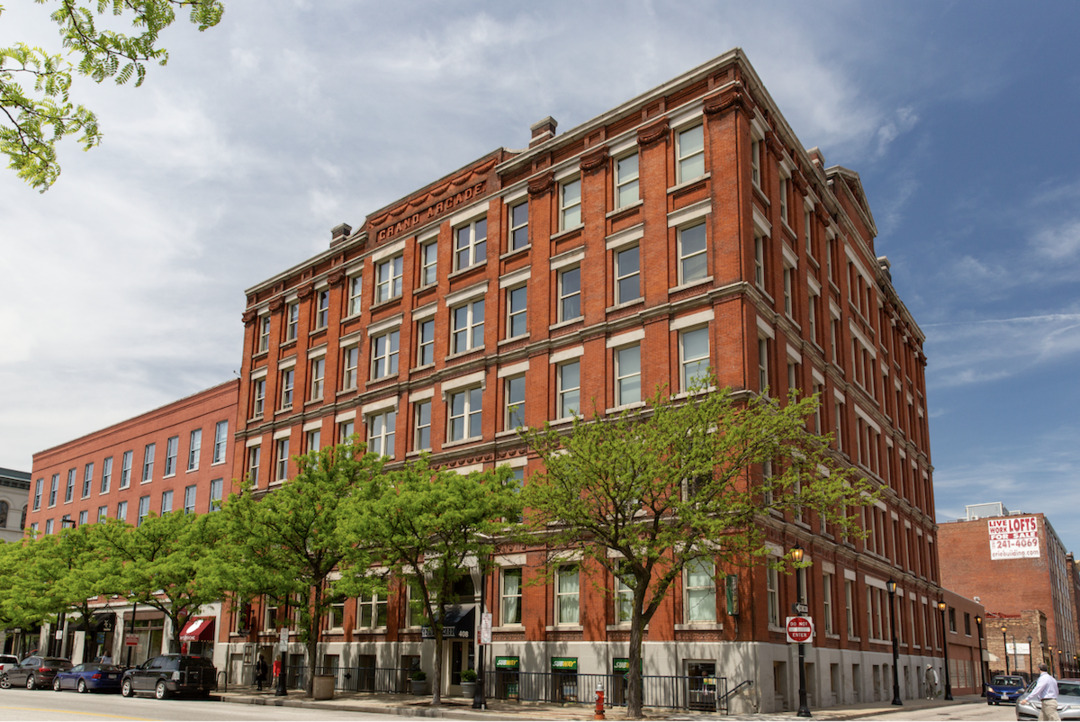
    <summary type="html"><![CDATA[<p><strong><em>When its construction was completed in 1883, the six-story Grand Arcade on the northwest corner of St. Clair and West 4th was the tallest commercial building and most prestigious business address in Cleveland.  Iron works, oil refineries and other industrial businesses rushed to lease offices in it.  However, when the even taller and more prestigious Perry-Payne Building opened on Superior Avenue  six years later, these businesses just as quickly left the Grand Arcade.  This wouldn't be the last occupancy challenge this historic building would face .</em></strong></p><img src="https://mail.clevelandhistorical.org/files/fullsize/d392fd4e40264971599e4ebad93b154c.jpg" alt="The Grand Arcade" /><br/><p>William Charles Scofield, the person for whom the Grand Arcade Building at 408 West St. Clair Avenue was built, was one of Cleveland's most prominent industrialists in the second half of the nineteenth century.  He and John Alexander, reputedly the first person to refine oil in Cleveland, co-founded the Great Western Oil  Works which, in the 1860s, was one of the chief competitors of John D. Rockefeller's Standard Oil  Company.  When, in 1872,  Standard Oil Company engaged in anti-competitive acts and forced virtually all of Cleveland's oil refiners, including John Alexander and William Scofield, to sell their refineries to it at discounted prices, Alexander retired from the refinery business and returned to England. Scofield, however, did not.  He not only survived the so-called "Cleveland Massacre," but thrived after it.</p><p>In 1872,  the same year that he was forced out of the oil refining industry by Rockefeller's Standard Oil Company, W. C., as Scofield was known, entered the iron manufacturing industry, purchasing the historic Otis Iron Works on Whiskey Island.  He renamed it Lake Erie Iron Company, expanded its operations to include a new facility for the manufacture of nuts and bolts on land located between East 63rd Street and Addison Avenue close to the tracks of the Lake Shore and Michigan Southern Railroad, and made it a very successful business.  In 1874, two years after the Cleveland Massacre, Scofield formed a new partnership, built a new oil refinery on Willson Avenue (East 55th Street), north of Broadway and near the tracks of the Atlantic and Great Western Railroad, and re-entered the oil refining business, operating once again as Great Western Oil. </p><p>In 1882, W. C. Scofield decided to construct the Grand Arcade.  Yet, it wasn't his first presence on St. Clair or even the first building he had erected on that street.  After immigrating from England and arriving in Cleveland in about 1844, he and his wife Ann had settled on St.  Clair Street, where their first two children were born. In 1850, they had moved  east to Hamilton Street as the neighborhood northwest of Public Square (today known as the Warehouse District) began its mid nineteenth century transformation into a commercial district. Despite moving his residence, Scofield retained a presence on St. Clair, starting up several small manufacturing businesses there in the 1850s and early 1860s.</p><p>In 1864, the same year in which he formed his partnership with John Alexander, William Scofield had  expanded his business presence on St. Clair by purchasing the former homestead of pioneer Cleveland grocer and wholesale liquor merchant Nelson Monroe, which was located nearly directly across the street from where the Grand Arcade would be built almost two decades later.  The offices of the Great Western Oil  Company were located on this property from 1864 to 1868. In 1878, Scofield had further solidified his presence on St Clair by building the four-story brick and stone Scofield Block on the property.  A number of industrial tenants, including Scofield's Lake Erie Iron Company, soon moved their offices into that building.</p><p>So why did W. C. Scofield decide in 1882 to build the Grand Arcade across the street from the Scofield Block built just four years earlier?   It is not clear from recorded sources why he did so, but it may have been to expand his influence in the industry in which he was most personally and financially invested—coal and iron.  Whatever the reason, in February 1882, Scofield purchased the lot on the northwest corner of St. Clair and Academy (West 4th) and hired Cleveland architect Levi T. Scofield to design an office building for that lot which had 100 feet of frontage on St. Clair and 97 feet of frontage on Academy. Levi Scofield, who does not appear to have been a relative of W. C. Scofield—at least not a close relative—is best known to Clevelanders today as the architect of both the Soldiers and Sailors Monument on Public Square and the Schofield Building on the southwest corner of East 9th Street and Euclid Avenue. </p><p>Like some of the  other buildings Levi Scofield designed, the Grand Arcade was designed to be grand and notable.  Years after it was built, it was referred to by at least one newspaper as Cleveland 's first "modern" office building.  Designed in the Neoclassical Revival style with elements of Neo-Grec, it is a brick and stone building that stands six stories tall (five floors above ground with a raised basement).  Its exterior walls fronting St. Clair Avenue and West 4th Street are decorated with  pilasters, capitals, belt courses, entablatures, ornamental swags and other details formed from cut sandstone and unglazed terra cotta. The construction cost of the building was $100,000 ($3 million+ in 2024 dollars).</p><p>One of the most notable features of the Grand Arcade's original design was its approximately 100 by 20 foot,  five-story-tall interior court which had an ornate triangular prism-shaped glass skylight above it.  All of the building's interior offices had direct access to this court from iron balconies and descending stairs.  Regrettably, that interior court no longer exists.  Although no record has been found that documents when it was removed, it likely occurred during one of the several renovations of the building that took place between 1902 and 1962.</p><p>Another mystery associated with the Grand Arcade is: Why did W. C. Scofield decide to call this building an "arcade?"  That term traditionally refers to a building with a covered passageway lined with retail shops on both sides.  An article in the Cleveland Leader, on December 7, 1912, noted that "the building actually is not an arcade and received its name from  the court and its many balconies opening from the inner office suites."  However, there is no indication that the newspaper had obtained that explanation from W. C. Scofield who was still living at the time the article was published, and there may have been a reason, other than the explanation offered by the Leader, why Scofield used the term.  There were, in fact, retail shops located on the first floor of the building  in the decades of the 1880s and 1890s and some of these could have had interior storefronts and entrance ways on the court.</p><p>When the Grand Arcade opened in 1883, it notably drew as its first tenants a large number of companies from the coal and iron industries, some of which had previously been tenants in the Hilliard Building on Water (West 9th) Street which had been known since 1875 as the Coal and Iron Exchange Building.  According to information gleaned from the 1884-1885 Cleveland Directory,  the Grand Arcade in its first full year leased office suites to 14  iron manufacturing  companies and five coal companies.  However, when the Perry-Payne building opened in 1889, all of the iron manufacturing tenants, except Scofield's Lake Erie Iron Company, and all but two of the coal tenants left the Grand Arcade. </p><p>It appears, again from a survey of tenant listings in Cleveland directories, that W. C. Scofield attempted to address the departure of coal and iron companies from his building by seeking, in the 1890s, to attract  oil and railroad companies.  For a time he was successful in that effort, helped by the fact that so many railroads and streetcar companies had located their offices in buildings on St. Clair between Seneca (West 3rd) and Water (West 9th) that that stretch of St. Clair was known as Railroaders' Row.  But just as the opening of the Perry-Payne Building in 1889 had impacted the Grand Arcade's efforts to attract and keep coal and iron companies as tenants, the opening of additional new downtown office buildings in the 1890s, including the Society for Savings Building and the Arcade in 1890, the Western Reserve Building in 1892, the Garfield Building in 1893 and the New England Building in 1896, similarly impacted the Grand Arcades's efforts to attract tenants from other industries.  By 1899, only one oil company and just three railroad companies remained as tenants in the Grand Arcade.  In that same year, W. C. Scofield, who was already in his late seventies—although he would live to be 95 years old—turned over ownership and control of the building to his sons Charles and Frank.  They, likely with their father's blessing, took a new approach to dealing with the building's growing occupancy problem.</p><p>In 1902, the Grand Arcade was remodeled and transformed from an office building into what was then called a "power block," i.e., a building occupied by a single tenant.  It was a good decision for the Scofield family which would continue to own the Grand Arcade and lease it to a series of single tenants until they sold the property in 1955.  From 1902 until 1912, the building was leased to North Electric Company,  a telephone manufacturing company.  Then, from 1913 until 1926, it was leased to Clawson and Wilson, a wholesale drug company headquartered in Buffalo, New York. Finally, from 1926 until 1961, the building was occupied by the Standard Drug Company, a Cleveland  retail and wholesale company, which used it as a warehouse and  purchased the building from the Scofield family in 1955.  Standard Drug sold the Grand Arcade in 1961  to a realty company.  The following year, the building was purchased by the non-profit City Mission which remodeled  and converted it into a homeless shelter.  </p><p>After occupying the building for almost three decades, the City Mission sold the Grand Arcade  in 1991 to a for-profit limited partnership which restored and renovated the building, converting it to a new  residential use, first as market-rate apartments and later as condominiums. In the second phase of the project, three other historic Warehouse District buildings were added to the Grand Arcade condominium development—the Waring Building, built in 1855 and located on St. Clair adjacent to the Grand Arcade;  the Klein-Marks Building, built in 1881 and located on West 6th Street just north of the Waring Building; and the Blair Building, built circa 1868 and located just north of the Klein-Marks Building.</p><p>From Cleveland's tallest office building and most prestigious address; to a "power block" for single commercial tenants; to a wholesale drug warehouse; to a shelter for Cleveland's homeless; to market-rate apartments; and finally to residential condominiums, the Grand Arcade has endured more use changes than most  of Cleveland's other historic buildings. Through it all, the Grand Arcade, much like the nineteenth century industrialist who built it, has not only survived, but has thrived.</p><p><em><strong><a href="https://mail.clevelandhistorical.org/items/show/1023">For more (including 17 images) view the original article</a></strong></em></p>]]></summary>
    <published>2024-04-16T16:33:30+00:00</published>
    <updated>2026-04-17T19:17:43+00:00</updated>
    <link rel="alternate" type="text/html" href="https://mail.clevelandhistorical.org/items/show/1023"/>
    <id>https://mail.clevelandhistorical.org/items/show/1023</id>
    <author>
      <name>Jim Dubelko</name>
    </author>
  </entry>
  <entry>
    <title type="html"><![CDATA[Rosenblum&#039;s: &quot;One Account Outfits the Family&quot;]]></title>
    <summary type="html"><![CDATA[<p><strong><em>When most people think about Cleveland’s downtown department stores, they think about Higbee’s or the May Company. There were, however, many other significant stores that contributed to the iconic image of downtown Cleveland, especially the many stores along Euclid Avenue. Among those stores was Rosenblum’s, a popular clothing store that was a shopping staple in Cleveland for close to a century. </em></strong></p><img src="https://mail.clevelandhistorical.org/files/fullsize/8d222439b3d92080b893c291a533d464.jpg" alt="Rosenblum&#039;s" /><br/><p>Max Rosenblum was born in Austria-Hungary on December 5, 1877, and at the age of six he and his family immigrated to the United States, arriving in Cleveland not long after. Rosenblum attended grammar school in Cleveland, but left school after the sixth grade. As a child, at 3:30 every morning he would grab as many Plain Dealers as he could, bringing them down to Union Station and selling them before serving regular customers and then going to school. After leaving school, Max Rosenblum continued to sell papers and shined shoes at Superior Avenue and West 3rd Street (then known as Seneca Street). At 17, Rosenblum was given a job at a clothing concern where he worked in every department and went on to work at other businesses as well. In 1910, at the age of 32, he decided to go into business for himself, and open up his own clothing store on Public Square with the motto “New ideas, new methods, new policies.”
Rosenblum’s first store was located at 2014 Ontario Street on the second floor of a building that predated the Terminal Tower and the Higbee building where JACK Casino now operates. Rosenblum poured all that he had into opening the store. In order to put up the sign for his new business, he even had to borrow a month of rent from an uncle. Rosenblum was an early adopter of ready-to-wear clothing, much like what is seen in today's clothing stores. Rosenblum’s sold clothes for men, women, and children, and in addition to the ready-to-wear clothing, Rosenblum’s also made tailored suits to order for both men and women. Rosenblum also believed in easy credit. Newspaper ads for Rosenblum’s carried the motto as advertised was “It’s easy to pay the Rosenblum way.” In 1910 just one dollar per week paid over a period of forty weeks would buy any article of clothing at the store. Rosenblum’s also offered Eagle or Merchants stamps with all sales. These stamps, which were redeemable for cash or merchandise, were introduced by the May Company in 1903.
With Rosenblum’s business thriving, in 1920 Max Rosenblum moved the store just down the street to 321 Euclid Avenue. The new Rosenblum’s was located on the second floor of the building, later above Mills Restaurant, with private elevator service to bring customers up to the store. Once a customer stepped off the elevator, they were greeted by a large, eleven thousand square-foot store filled with clothes for men, women, boys, and girls of all ages and sizes. By 1922 the Rosenblum’s department store employed over one hundred employees and had a reputation as one of Cleveland’s oldest and most reliable business institutions. Rosenblum’s was open from 8:00 to 5:30 most days and on Saturdays closed at 6:00. Advertisements, however, stressed that shopping in the morning had greater benefits than other times of the day. Salespeople were fuller of vigor and, with fewer customers in the store, they were able to provide better one-on-one service. Fewer customers in the store also meant there were no crowds to contend with, making shopping less stressful and more comfortable.
Rosenblum’s department store prided itself on many things: high-quality products, wide array of styles in all sizes, stellar customer service, low prices, and easy pay-as-you-go credit that allowed customers to pay the price of an item over a period of forty weeks. Payments could be made weekly, semi-monthly, or monthly without paying interest or carrying charges. While customers might not get the product right away, this style of charge account allowed for greater flexibility for the shopper to make purchases. While this form of payment, which is similar to layaway, has fallen out of favor for most retailers today, one hundred years ago it was a popular and convenient way to purchase products.
What sort of products could you expect to find at Rosenblum’s? Much like any clothing retailer, Rosenblum’s, had a wide array of varying products for all ages and in all sizes. In the 1920s Rosenblum’s primarily sold women’s dresses, suits and fur coats, and for men they sold suits, dress shirts, slacks, and overcoats. Rosenblum’s also offered free tailoring service on all clothing, and for both men’s and women’s clothing Rosenblum's offered tailor made clothing as well. Rosenblum’s also had an extensive children’s section, and every year, much like now, they would advertise for back-to-school shopping. Everything they sold came in a variety of styles and fabrics. Women’s fur coats were a popular product at Rosenblum’s and were made from materials such as raccoon, muskrat, marmot, mink and more, while dresses were made from various types of silk and twill.
Rosenblum’s downtown store was a success, but after World War II shopping gradually began moving from downtown to the suburbs. Although it was relatively late in embracing suburban expansion, Rosenblum’s eventually opened stores in Cleveland's growing southern suburbs. Rosenblum’s second store opened in December of 1967 in the Parmatown Mall in Parma, and a third location was opened in October of 1980 in the Southgate Shopping Center in Maple Heights. These new branches sold kitchen wares and household appliances in addition to clothing. Sadly, at the end of May 1981, less than 8 months after their most recent suburban expansion, the downtown Rosenblum’s closed its doors for the last time. Rosenblum’s Parmatown store continued successful operations into the latter half of the 1990s. Rosenblum’s final remaining location at Southgate closed in 2006.</p><p><em><strong><a href="https://mail.clevelandhistorical.org/items/show/1000">For more (including 6 images) view the original article</a></strong></em></p>]]></summary>
    <published>2023-04-07T21:12:27+00:00</published>
    <updated>2026-04-17T19:17:43+00:00</updated>
    <link rel="alternate" type="text/html" href="https://mail.clevelandhistorical.org/items/show/1000"/>
    <id>https://mail.clevelandhistorical.org/items/show/1000</id>
    <author>
      <name>Matthew Steenbergh</name>
    </author>
  </entry>
  <entry>
    <title type="html"><![CDATA[Chinatown: Immigration, Cultural Activities, and Racial Violence on Ontario Street and Rockwell Avenue]]></title>
    <summary type="html"><![CDATA[<img src="https://mail.clevelandhistorical.org/files/fullsize/40d59ee8867406948da7a0c697a61f2c.jpg" alt="Interior of On Leong Headquarters" /><br/><p>While Chinese people have been immigrating to the United States as far back as the 1848 California Gold Rush, they only moved to Cleveland in the late 1800s, numbering fewer than 100 until 1900. These settlements in Cleveland were spurred on by discrimination and acts of racial violence in the western United States. The most disturbing of these incidents was the 1871 Los Angeles Chinatown Massacre, which resulted in the lynching of 19 Chinese residents. Cleveland’s Chinatown became the theater for a wide array of historical events such as the 1911 visit by Dr. Sun Yat-sen and the Tong Wars. While the racial violence and discrimination did not cease upon entering Cleveland, the Chinese managed to build a strong community based on a love of Chinese culture, community aid, and a willingness to struggle for their democratic rights.</p><p>Chinese immigration to the United States sprang from a wide variety of factors that exposed the conditions of China itself. Corruption and opium consumption led to the disaster that was the First Opium War in 1840, which provided the foundation for the colonization of much of China. Additionally, a lack of economic opportunities in China led Chinese people to emigrate in search of gold, jobs, and education. Chinese immigrants worked in the gold mines of California and moved on to the Transcontinental Railroad. They moved east as racial discrimination grew, finding work as laundrymen and restaurant workers in cities across the United States. To protect their businesses, the Chinese formed merchant associations known as tongs, which functioned as both guilds and gangs. The feuds between tongs frequently got out of hand, leading to attacks from racist neighbors and police. Fearing the “Yellow Peril” associated with Chinese immigrants, the U.S. government passed the Chinese Exclusion Act in 1882, restricting immigration until World War II. Around the same time, a small population settled in Cleveland, creating what would become one of the nation's most notable Chinatowns.</p><p>Cleveland’s Chinese community started as a tiny enclave along Seneca Street (later West 3rd) but shifted two blocks east by the early 20th century to the block of Ontario Street immediately north of Public Square. Much like other Chinatowns across the United States, most Chinese businesses in Cleveland were restaurants or laundries. After moving to Cleveland from Chicago, Wong Kee opened the first Chinese restaurant in the city on Ontario Street and then opened a more prominent one called the Golden Dragon on the northwest side of Public Square. Businessmen formed tongs to protect their interests. Over the decades, the two main tongs that emerged were known as the Hip Sing Tong and the On Leong Tong. </p><p>While the Chinese faced a great deal of racism from surrounding communities, one notable exception was the congregation at Old Stone Church which was located on Public Square at the southern edge of the small Chinese settlement. Seeking to win converts and aid the local Chinese, the congregation sent missionaries, provided Chinese-language church services, and protected Chinese immigrants from racist policemen. Two notable members of the congregation, Mary and Marian Trapp, founded a Chinese Sunday School, and their efforts were rewarded with an embroidered depiction of Jesus Christ made by the students. With these successful efforts, the church would serve as both a school and community center. The founding of businesses and support from Old Stone Church established the Chinese as crucial contributors to the local economy and gave them local support.</p><p>With the establishment of a stable Chinese community came the concern for issues in China itself. Centuries of dissent against Manchu Qing authority in China crystalized into the Chinese Revolutionary Movement, which succeeded in 1911 after nearly two decades of trial and error. One leading figure of the movement was the exiled revolutionary and future president of the Republic of China Dr. Sun Yat-sen, who frequently visited communities in the Chinese Diaspora to raise funds for the revolution. Sun notably visited Cleveland in April 1911, raising money at Old Stone Church, and having his likeness depicted in the <em>Cleveland Press</em>. Months later, the Chinese Revolutionary Movement culminated in the Xinhai Revolution, ending Manchu rule and continuing the tradition of Cleveland’s Chinatown being involved in Chinese affairs.</p><p>The tongs of Cleveland had many feuds during their existence, but it was only in 1925 when what became known as the Tong Wars that they gained attention from the police. Wong Bao led the Hip Sing Tong while the brothers Wong Kee and Wong Xing swapped the responsibility of leading the On Leong Tong. The brothers’ leadership of the tong was also tied to the Golden Dragon restaurant, which they jointly managed for many years. This relationship to the tongs and the Golden Dragon restaurant also likely existed for Bennie Shea Lin, who was related to the Wong brothers and wrote a brief article on the Golden Dragon in 1964. Soon, the police arrested local Chinese residents in many raids, including many who were not in the tongs as well. Many Cleveland residents disputed these arrests, standing in solidarity with the Chinese community. One notable example was Reverend William Foulkes of Old Stone Church, who defended his Chinese neighbors over WHK radio. The raids and arrests ceased, but racial violence remained.</p><p>As the Tong Wars raged on, Chinatown moved to Rockwell Avenue. The On Leong tong had already purchased land along Rockwell Avenue and the purchase was apparently one of the causes of the Tong Wars. As the businesses on Ontario Street were torn down after the Tong Wars, many Chinese put their resources towards the new On Leong tong Headquarters on Rockwell. They donated ebony tables, chairs, drums, gongs, and other artifacts to the building. Various Chinese businesses soon moved to Rockwell and the area became the center for the Chinese community as the Great Depression began.</p><p>While the Chinese had found difficulty in settling in the United States, their love of Chinese culture and community aid gave them a sense of mission and made Cleveland’s Chinatown regionally and even nationally prominent. As in other cities, they created a strong business community that was organized via tongs. Their education at Old Stone Church attracted the attention of figures such as Sun Yat-sen. Their efforts to protect their democratic rights during the Tong Wars and support for the United States and China during World War II played a vital part in undoing the Chinese Exclusion Act in 1943. Cleveland celebrated by naturalizing one Zhu Yun On under the name Bennie Shea Lin, the first Chinese American to be naturalized since 1882. The Chinese faced many difficulties during their early years such as tong feuds, racial violence, and the police, but they overcame such challenges through strong community aid and a willingness to fight for their rights.</p><p><em><strong><a href="https://mail.clevelandhistorical.org/items/show/974">For more (including 9 images) view the original article</a></strong></em></p>]]></summary>
    <published>2022-11-21T21:52:26+00:00</published>
    <updated>2026-04-17T19:17:42+00:00</updated>
    <link rel="alternate" type="text/html" href="https://mail.clevelandhistorical.org/items/show/974"/>
    <id>https://mail.clevelandhistorical.org/items/show/974</id>
    <author>
      <name>Jan Jalics</name>
    </author>
  </entry>
  <entry>
    <title type="html"><![CDATA[Ethiopian Cultural Garden]]></title>
    <summary type="html"><![CDATA[<img src="https://mail.clevelandhistorical.org/files/fullsize/1a469ea4bc6380431c16e28e7eb02846.jpg" alt="Front of the Ethiopian Cultural Garden Mural" /><br/><p>The Ethiopian community in Cleveland is small but through the Menelik Hall Foundation it was able to establish a cultural garden. Ethiopia is the first country from Africa to be represented in Cleveland’s Cultural Gardens. Despite this achievement, many Clevelanders are unfamiliar with the Menelik Hall Foundation and the cultural garden. They are more likely to know the Empress Taytu.</p><p>The Empress Taytu is an Ethiopian restaurant that Carl and Senait Robinson founded in the St. Clair-Superior neighborhood in the mid-1990s. Carl Robinson is a doctor in Cleveland. Senait Robinson is a native Ethiopian nurse who moved to Cleveland after part of the Ethiopian army deposed Haile Selassie and set up a provisional military government in 1974.There were famines and political unrest, she sought refuge with friends in Cleveland. The Robinsons began by sponsoring Ethiopian students in Cleveland in the 1980s. The Robinsons and the students would often cook meals to thank those in the community that helped sponsor them. The community then in turn encouraged them to open a restaurant so more people could enjoy their food. While the Robinsons were originally opposed, Senait’s brother Mike agreed it was a good idea. Mike managed the restaurant, and it became a family business with their sons and daughters helping along the way.</p><p>Before opening the restaurant, the Robinsons had founded the Menelik Hall Foundation in 1987 to help Ethiopians in Ohio and abroad by providing support to students and refugees, sending health and medical supplies abroad, and promoting education and cultural understanding. The foundation also established a Sister City relationship between Bahir Dar, Ethiopia, and Cleveland in 2004. It hosts a variety of events throughout the year but the project that currently holds most of its attention is the creation of the Ethiopian cultural garden. </p><p>Menelik Hall completed the first of three phases in the Ethiopian Cultural Garden and hosted its dedication ceremony on August 24, 2019. It became the thirty-seventh cultural garden. The first phase included a twelve-foot-high wall with a five-panel ceramic mural on the front and a painting on the back. The five panel mosaic travels through different periods over Ethiopia’s 5,000-year history. The first panel begins with Lucy, one of the earliest human ancestors. The second panel represents the diversity of Ethiopia’s ethnicities. The third panel represents early civilization, the fourth represents the period of emperors, and the fifth and final panel represents the modern era of globalization. </p><p>On the back of the five panels is a reproduction of a painting by Yetmgeta, “When the Sun Gets the Moon.” Yetmgeta’s idea behind the painting is to bring attention to human impact on the environment. The plaque below the painting reads, “Despite modern technology, the Earth is being devastated.”</p><p>The garden’s second and third phases will involve the installation of two massive stone pieces. The first will be a silhouette of the Axum Stele, planned to be the centerpiece of the garden. The second will be a replica of a doorway from the Churches of Lalibela. Both the Axum Stele and the Churches of Lalibela are UNESCO World Heritage sites today. </p><p>Stelae are similar to obelisks but with rounded rather than pointed tops. Stelae were burial monuments built between the 3rd and 4th century C.E. by the Akumites. They were carved out of solid stone with ornate details to replicate the Aksumite buildings they were created in the image of. The sides of the stelae have carved windows and at the very bottom there are two false doors with carved handles and locks. While Aksumite buildings were only a few stories at most, the Axum Stele depicts thirteen floors and is the largest standing stelae in Ethiopia today. </p><p>The churches of Lalibela were constructed in the 12th century and attributed to the King Lalibela who wanted to create a “New Jerusalem” in Ethiopia due to Islamic control of the Holy Land. He hoped they would serve as an alternative pilgrimage site while the fighting continued between Christians and Muslims. There are eleven churches, each is carved out of a single block of stone. Each church is different from the next but many share design aspects. The replica doorway chosen for the Ethiopian cultural garden is one of these aspects.</p><p>Some Clevelanders’ only connection to Ethiopia is through Ethiopian restaurants like the Empress Taytu. The addition of the Ethiopian Cultural Garden not only reflects the widening scope of the Gardens’ original concept but the growing acknowledgement of diversity in Cleveland. The garden is one new place for Clevelanders to make connections to Ethiopia and the area’s local Ethiopian community members. </p><p><em><strong><a href="https://mail.clevelandhistorical.org/items/show/952">For more (including 5 images) view the original article</a></strong></em></p>]]></summary>
    <published>2021-10-06T12:58:33+00:00</published>
    <updated>2026-04-17T19:17:42+00:00</updated>
    <link rel="alternate" type="text/html" href="https://mail.clevelandhistorical.org/items/show/952"/>
    <id>https://mail.clevelandhistorical.org/items/show/952</id>
    <author>
      <name>Jasmine Prezenkowski</name>
    </author>
  </entry>
  <entry>
    <title type="html"><![CDATA[Wallace Manor: Robert Wallace&#039;s Great Stone House]]></title>
    <summary type="html"><![CDATA[<img src="https://mail.clevelandhistorical.org/files/fullsize/7e617f347a46818e63e56bd6eafb0bde.jpg" alt="Wallace Manor" /><br/><p>If you spend a little bit of time studying the history of the houses that line both sides of Franklin Boulevard from the Circle to West 50th Street, you soon learn that they do not stand alone and apart from one another. They are related to one another – many of them intimately. Over time, these houses have shared owners and occupants; fraternal societies and charitable organizations; architects and architectural styles. They have often also shared ties to early Cleveland enterprises and industries. This is certainly the case with Wallace Manor, which has stood on the northeast corner of Franklin Boulevard and West 48th Street since 1883. </p><p>Wallace Manor was built for Robert Wallace, one of three individuals whom Cleveland journalists and historians have credited with the transformation and modernization of the Great Lakes commercial shipbuilding industry in the late nineteenth century. The other two? They also were residents of Franklin Boulevard. Wallace's long-time partner <a href="https://clevelandhistorical.org/items/show/940">Henry Coffinberry</a> lived in a Gothic Revival style house at 3910 Franklin Boulevard, which, like Wallace Manor, is still standing today. And Wallace's other early partner, John Pankhurst, lived in a beautiful Italianate-style house at 3117 Franklin Boulevard. John Pankhurst's house, like those of Robert Wallace and Henry Coffinberry, is still standing. On your next drive down Franklin Boulevard, you might want to take note of the houses at 3117, 3910, and 4724 Franklin Boulevard. They share a connection to each other and to Cleveland's once great shipbuilding industry. </p><p>Robert Wallace was born in 1834 in County Cavan, Northern Ireland. According to Elroy McKendree Avery, an early twentieth-century Cleveland historian, Wallace immigrated to the United States and arrived in Cleveland in 1854. In the eulogy he delivered at a memorial service for Wallace on May 28, 1911, Rev. Henry Tenney, a Congregationalist minister who had been Wallace's pastor, observed that, when Wallace came to Cleveland, he settled on the City's west side because that was where his uncle, Robert Sanderson lived and worked. (Sanderson was a machinist and later principal owner of Globe Iron Works, an historic iron foundry on the West Bank of the Flats.) A listing in the 1856 Cleveland directory is the first record of Wallace's presence here. It states that he was then living on Clinton Avenue and working as a machinist. His name, however, does not appear again in any Cleveland directory until 1865 when he is this time listed as an engineer. </p><p>It may be, as suggested in Rev. Tenney's eulogy, that Wallace spent some, if not all, of those intervening years as a sailor traveling the Great Lakes aboard commercial ships. By the time that the 1866 directory was published the following year, Wallace appears to have set down firm business roots in Cleveland as he and his partner John Pankhurst are listed as the owners of a small machine shop in <a href="https://clevelandhistorical.org/items/show/767">Cleveland Centre</a> at the corner of Center and Columbus Streets. A year after that, in 1867, according to historian Richard J. Wright in his book "Freshwater Whales: a History of the American Ship Building Company and its Predecessors," Wallace developed a portable steam engine for unloading cargo from commercial ships which dramatically improved the unloading process. It also proved extremely profitable for Wallace's machine shop. </p><p>Within two years of his development of the portable steam engine for unloading , Wallace, Pankhurst, and their new partner Henry Coffinberry had accumulated sufficient capital to acquire a controlling interest in Globe Iron Works, from which Robert Sanderson had recently retired. The company had for years been producing steam engines and other iron products for Great Lakes commercial ships. Now, under Robert Wallace's leadership, Globe Iron Works expanded its business. In 1876, it purchased an interest in a nearby dry dock and, under the name Globe Ship Building Company, began building ships. Up until this time, the process of building Great Lakes commercial ships had required the involvement and coordination of several different industries which manufactured different vessel parts at different locations. Robert Wallace, according to historian Wright, changed this industrial process in 1881 when Globe Ship Building built a commercial ship, from start to finish, entirely at its shipyard. Just one year later, in 1882, the company built and launched the Onoko, the first large iron commercial ship to sail the Great Lakes. This ship has been recognized by marine historians as the prototype for all the commercial freighters that sail the Great Lakes today. </p><p>By the time the Onoko was launched in 1882, Globe Iron Works and Globe Ship Building Company had become successful and profitable enterprises. It was at about this time that Robert Wallace and his second wife Fanny – his first wife Lydia had died in 1878 – decided to move from their modest house at 129 (today, 3405) Clinton Avenue onto Franklin Avenue (Boulevard), the West Side's version of nineteenth-century Euclid Avenue's <a href="https://clevelandhistorical.org/items/show/10">Millionaires' Row</a>. In early 1883, Wallace purchased a vacant lot on the northeast corner of Liberty (West 48th) Street and Franklin Avenue that was owned by and located next door to the house of Alanson and Harriet Hopkinson. Alanson, also known as A. G., was the retired first principal of Cleveland's <a href="https://clevelandhistorical.org/items/show/772">West High School</a>. He was well known to Wallace as both were members of the First Congregational Church, and both had served as trustees of the church. In the early 1880s both were also actively involved in the planning and building of a new church for their parish on the southeast corner of Taylor (West 45th) Street and Franklin Avenue. The new stone church for the First Congregational Church – West Side, designed by Coburn and Barnum and dedicated by Rev. Tenney on December 20, 1885, was located just a few blocks east of the Hopkinson property upon which Wallace built his new stone house in 1883. While both the First Congregational Church and A. G. Hopkinson's house are no longer standing, they present yet another example of the intimate historical relationships that the houses and other buildings on Franklin Boulevard, in this instance one still standing and the others not, often had with one another. </p><p>Wallace Manor is, according to local architectural historian Craig Bobby, built in the Queen Anne style. While the identity of the architect who, or architectural firm which, designed the house is unknown, it may have been the firm of Coburn and Barnum, which designed the <a href="https://clevelandhistorical.org/items/show/917">Spitzer-Dempsey House</a> at 2830 Franklin and the <a href="https://clevelandhistorical.org/items/show/938">Sarah Bousfield House</a> at 3804-06 Franklin. In the early 1880s, <a href="https://clevelandhistorical.org/items/show/755">Forrest Coburn</a> was living at 86 Root (1901 West 47th) Street, less than one-half mile from the future site of Wallace Manor. He was also, like Robert Wallace, a member of the First Congregational Church. As a principal of the architectural firm that designed the new First Congregational church, he likely would have interacted with Wallace who, as a trustee, was also deeply involved in planning and building that church. However, according to Bobby, in the absence of documentation that the house was designed by this firm, there is nothing in the design of the house itself which either proves or disproves that it was the work of Coburn and Barnum.  </p><p>Designed as a single family home, Wallace Manor is two and one-half stories tall and has an exterior facade built of sandstone. The expanse of sandstone on the front facade is broken up by at least one belt course of smoothed stones located just below the second floor windows, and the front facade, as well as the expanses of the other exterior walls of the house, are further broken up by stone lintels and hoods around the house's windows. The house has asymmetrical massing with the west side of the front facade extending out beyond the rest of the facade. The roof of the house is hipped and features a number of dormers and three tall stone chimneys. The front of the house has two notable arched windows on the first floor. Also notable is the house's one-story columned porch which extends along the entire length of the eastern part of the front facade.  Located at the rear of the property is another stone building that once likely served as a carriage house. Over its front door on West 48th Street are the initials "RW" carved in stone. The structure, which is depicted on the 1896 Sanborn map, was likely built at the same time as the main house. </p><p>The Robert Wallace family, including for a time his oldest son James, a future president of the American Ship Building Company, lived in Wallace Manor until 1895. In that year they moved, like other wealthy Franklin Boulevard families of that time period, to the Cleveland suburb of Lakewood, where they built a house on Detroit Avenue, west of Nicholson Avenue. That house, which is no longer standing, was located on what today is the campus of St. Edward Catholic High School. After the Wallace family departed from Wallace Manor, the house was home to several middle to upper economic class families, including a general manager of the Cleveland Railway, the president of Citizens Savings and Trust Company, and a physician, before it was sold and converted into a rooming house in about 1920. In 1923, the property was acquired by Hungarian immigrants Julius and Elizabeth Rak, who lived in the house and continued to operate it as a rooming house until their deaths in 1943. By 1930, the carriage house on the property had been converted into a dwelling with a street address of 1453 West 48th Street and was occupied by two families. By 1940, there were seven families (including the Rak family) with a total of 21 people living in Wallace Manor and five families with a total of 9 people living in the carriage house. </p><p>In the second half of the twentieth century, Wallace Manor, like many of the other once grand houses on Franklin Boulevard, was suffering from insufficient maintenance and repair. Photos reveal that, by the 1980s, it was in a deteriorated condition. Most notable was that its once grand front porch had at some time between 1961 and 1986 been razed and replaced with a simple entranceway porch. Like any number of the grand houses on Franklin Boulevard that needed a savior in the late twentieth century, Wallace Manor found one when it was purchased in 1997 by Scott Staley and David Castro. Staley, who is the sole owner of the house today (2021), spent the next 17 years slowly restoring and renovating Wallace Manor. Living in the owner's suite at Wallace Manor, he has also, for the last five years, operated a bed and breakfast in the house which has rooms for guest stays. The carriage house at the rear of the property has also been renovated and today functions as a two-family dwelling. In 2019, descendants of Robert Wallace paid a visit to Wallace Manor, touring the house, snapping pictures, and imagining their ancestors walking from room to room. They too, like their ancestors who once lived there, now share a special relationship with not only those ancestors, but also with Wallace Manor and with historic Franklin Boulevard.</p><p><em><strong><a href="https://mail.clevelandhistorical.org/items/show/943">For more (including 18 images) view the original article</a></strong></em></p>]]></summary>
    <published>2021-04-26T19:29:34+00:00</published>
    <updated>2026-04-17T19:17:42+00:00</updated>
    <link rel="alternate" type="text/html" href="https://mail.clevelandhistorical.org/items/show/943"/>
    <id>https://mail.clevelandhistorical.org/items/show/943</id>
    <author>
      <name>Jim Dubelko</name>
    </author>
  </entry>
  <entry>
    <title type="html"><![CDATA[Donauschwaben German-American Cultural Center]]></title>
    <summary type="html"><![CDATA[<img src="https://mail.clevelandhistorical.org/files/fullsize/50b4a4f713ade34ff781cfb18a338e6a.jpg" alt="The German-American Cultural Center" /><br/><p>German-speaking immigrants have been settling in Cleveland for more than two centuries and remain one of the largest and most influential ethnic groups. Unbeknownst to many though, the end of World War II brought a wave of ethnic Germans from Eastern Europe to the city in the 1950s. These people are known as Danube Swabians, an homage to their early 18th-century Swabian ancestors who left Germany by invitation to colonize parts of the Danube River Valley in the Austro-Hungarian Empire in what is today mostly Hungary, Romania, Croatia, and Serbia. Having kept their language and culture alive through the centuries, Germany’s defeat in World War II, followed by Soviet occupation of that region, meant oppression, incarceration, and death for many of the nearly two million ethnic Germans caught behind the Iron Curtain. This subjugation led to the forced migration of several hundred thousand Danube Swabians who came to the United States in the largest numbers from 1950 to 1952, many settling in Cleveland, where they found work, raised families, and forged new, unbreakable ties to their new homeland. </p><p>Like so many immigrants, the Cleveland Danube Swabians unsurprisingly sought to preserve key aspects of their cultural identity, namely through associational life. That first began by mixing with the Banater Club, an existing German-speaking organization which had a small building (Banater Hall) on W. 140th Street near Lorain Avenue. There the Danube Swabians joined recreational groups, such as <em>Gesangvereine</em> (choirs) and folk dance troops, and introduced their own youth and sports initiatives as well as educational opportunities. In 1958 the Society of Danube Swabians was formerly recognized and elected its first president, Anton K. Rumpf. A year later a women’s group was formed with leadership from President Katharina Ritzmann. By 1960 the Society had formalized its bylaws and structure, elected a Board, and endeavored to grow the organization. This was done so successfully that it was soon clear they had outgrown the Banater Club. For the festive annual events like <em>Tag der Donauschwaben</em> (Day of the Danube Swabians), <em>Trachtenfest</em> (Folk Costume Festival), and <em>Weihnachtsfeier</em> (Christmas Celebration), they had to rent spaces to accommodate the large crowds. German language course offerings, known first as Weekend School, soon had to be held in classrooms in local churches. By 1970 the Weekend School was renamed the German Language School and offered classes for varying age levels as well as kindergarten in rooms at St. Stephen’s Catholic Church. That same year the Board approved the use of $97,000 in member donations to purchase Ritter Farm, a 17-acre parcel off Columbia Rd. in Olmsted Township, in the hope it would eventually accommodate the needs of the Cleveland Danube Swabian community. </p><p>Soon after closing the deal the land was cleared and leveled by member volunteers. In short order soccer fields, tennis courts, a pond, as well as a bar, picnic and restroom facilities were installed, but no large central building yet for its many indoor programs. The new property was renamed “Lenau Park,” after Nikolaus Lenau, a famed 19th-century German poet (from what is today Romania) who had settled in Ohio for a short time in the 1830s. Economically speaking, the 1970s were a terrible time to commence such a project as the United States soon entered its worst economic downturn since the Great Depression. Undaunted, the group proceeded with planning and fundraising for its main clubhouse under the tireless efforts of then President Josef (Sepp) Holzer. Construction eventually began in 1980 and culminated in the <em>Donauschwaben Deutsch-Amerikanishes Kulturzentrum</em> (Danube Swabian German-American Cultural Center), a 46,000 plus sq. ft. multi-level building that is today replete with sundry class, meeting, and dance rooms, a two-lane bowling alley, an indoor soccer field with locker and shower facilities, as well as a central ballroom. Named in honor of Josef Holzer (<em>Holzer Halle</em>), the ballroom has kitchen, bar, and restroom facilities to accommodate nearly 600 people. Dedication ceremonies were held on the 17th and 18th of May, 1986, the first day in English, the second in German. The keynote address on that first day was given by Cleveland State University President Walter B. Waetjen, himself of German descent. </p><p>A motto of sorts sits high above the stage in <em>Holzer Halle</em>. The Josef Linster quote reads “<em>Nur der ist seiner Ahnen wert, der ihre Sitten treu verehrt</em>.” This translates roughly to “Only those who honor the traditions of their ancestors are worthy to be their descendant.” Whether consciously or not, the newer generations of leadership have imbibed this sage message. Just as the founders had intended, the Cultural Center continues to be a conduit for German language and culture. Today, the German Language School offer eight levels of language instruction for children and six levels for adults as well as national and international proficiency exam testing. The strong tradition of associational life is alive and well too. For those interested in sports, the Concordia Soccer Club, the Blau-Weiss Tennis Group, the Edelweiss Ski Club, or the <em>Kegelverein</em> (bowling club) fit the bill. Dance groups for all ages, a choir group (<em>Banater Chor</em>), and the <em>Blaskapelle</em> (Brass Band) uphold musical traditions. The event calendar is packed all year round, from Lenten fish fries to the massive Oktoberfest celebration. And one certainly need not be of German heritage to join in the fun. Shaped by their history, from being guest immigrants in a foreign land in the 18th century to <em>Vertriebene</em> (expellees) in the 20th century, they value inclusivity and welcome their neighbors, thus personifying an American ideal that we still struggle with today.</p><p><em><strong><a href="https://mail.clevelandhistorical.org/items/show/872">For more (including 9 images) view the original article</a></strong></em></p>]]></summary>
    <published>2019-08-23T20:45:13+00:00</published>
    <updated>2026-04-17T19:17:39+00:00</updated>
    <link rel="alternate" type="text/html" href="https://mail.clevelandhistorical.org/items/show/872"/>
    <id>https://mail.clevelandhistorical.org/items/show/872</id>
    <author>
      <name>Mark B. Cole</name>
    </author>
  </entry>
  <entry>
    <title type="html"><![CDATA[Kol Israel Memorial]]></title>
    <summary type="html"><![CDATA[<img src="https://mail.clevelandhistorical.org/files/fullsize/553b678e91787a823956dcee9457d96a.jpg" alt="Dedication Ceremony" /><br/><p>At the young age of fourteen in the predominantly Jewish town of Pryztyk, near Radom, Morry Malcmacher witnessed first-hand a violent pogrom fueled by his Polish neighbors. Three years later when the Germans invaded in 1939, Malcmacher found himself fighting for survival in a series of slave labor, concentration, and death camps. Upon liberation in 1945, he spent four years in a displaced persons camp in Feldafing, Germany before immigrating to the United States, ultimately settling down in University Heights. The roughly 96,000 Jewish survivors of the Holocaust that came to the US had to adjust to a new country, a new culture, and learn to live again while coming to terms with the murder of immediate family members, distant relatives, and friends. In 1959 Malcmacher and a small group of forward-thinking survivors in Cleveland laid the groundwork for a new organization that could help survivor émigrés make that transition. </p><p>Inspired by Voice of Israel, the clandestine radio station of the underground paramilitary force (<em>Haganah</em>) in Mandatory Palestine, the group opted for the phonetically identical, if orthographically different, name (in Hebrew) <em>Kol Israel</em>, or “All of Israel.” The Foundation elected its first officers in February 1960 and was chartered by the State of Ohio the following year. In 1963 the Sisterhood of Kol Israel, a division, was created to raise funds for the Foundation’s many initiatives. A third division, called Second Generation (2G), was formed in 1978 by the children of survivors with a commitment to continuing the legacy of their elders. All three divisions merged in 2013 as membership numbers dwindled. Three years later witnessed the birth of 3G (mainly the grandchildren of survivors) which has refocused Kol Israel on Holocaust education as well as efforts to curb all forms of hate and bigotry. Noteworthy is its <em>Share Our Stories</em> program which brings the children or grandchildren of survivors into local junior- and high-school classrooms who show and discuss recorded survivor accounts of their loved ones. And Kol Israel’s 2019 acquisition of Shaarey Tikvah’s <em>Face to Face</em> Holocaust education initiative reaffirms the organization’s commitment to “Never Forget.” </p><p>If not so clearly articulated in the formalistic language of its first charter, from the very beginning the Kol Israel Foundation has had three distinct, but related goals. For those who found themselves in Cleveland with no support network, Kol Israel privately offered financial assistance, smoothed access to vocational and housing services, and provided much needed emotional and psychological support via social gatherings and organized events. Secondly, the foundation was committed to supporting the State of Israel. From planting forests there through the Jewish National Fund, to donating ambulances to Magen David Adom (national emergency services), to buying State bonds, and giving monies to the Israeli Defense Forces, Kol Israel has been steadfast in its advocacy. The third aim from the outset has been Holocaust memorialization, in the form of holding annual <em>Yom Hashoah</em> events (Holocaust Remembrance Day), participating in the Warsaw Ghetto Uprising Memorial Services, and most notably building one of the first Holocaust monuments of its kind in the United States. In 2009 the Jewish Federation bestowed its highest honor, the Charles Eisenman Award, on the Foundation for its exceptional civic engagement. </p><p>The brainchild of Kol Israel’s first treasurer, Morry Malcmacher, the <em>matzavah</em> (grave marker) to the memory of six million murdered Jews was originally planned for Mount Olive Cemetery, but because of space constraints, was built in Zion Memorial Cemetery in Bedford Heights. It was unveiled at a public ceremony in 1961 attended by some 600 people, including Cleveland Mayor Anthony Celebrezze, who, during a speech averred “the lesson we must learn from it [the Holocaust]…is that it must not happen again.” Israeli writer Zvi Kolitz, perhaps best known for his <em>Yosl Rakover Talks to God</em>, gave the keynote address. </p><p>Designed and installed by Kotecki Family Memorials of Cleveland, the hulking monument of French Creek granite consists of a Star of David-capped obelisk which stands 17 ft. tall sandwiched between two 14 ft. panels. Haunting engravings on those panels depict a mother with two children and a man clutching a Torah scroll, all preparing to be engulfed by flames. Inscriptions in Hebrew and English front and rear call attention to the Nazi genocide and offer solace. At the foot of the memorial lies a crypt which holds the remains of Jewish martyrs secured from Poland. </p><p>On that sunny spring day in 1961 Kol Israel President William Miller announced that the memorial service was to become an annual event, and the Foundation has more than made good on that promise. The non-profit’s Memorial Committee, along with its co-sponsor the Jewish Federation of Cleveland, continues to hold the memorial service at the site between the Jewish holidays of Rosh Hashana and Yom Kippur. The family and friends of victims attend this solemn event which features a candle-lighting ceremony and the <em>Kaddish</em>, or Mourner’s Prayer. Each spring, the co-sponsors also hold a Holocaust Remembrance Day Event, wherein local dignitaries, religious leaders, survivors, liberators, and the public gather to commemorate the <em>Shoah</em> (Destruction). A granite knee wall, which has surrounded the monument since 1996, lists the names of some 1,300 victims and survivors who have since died, a jarring reminder of not only the duty to bear witness, but also just how much the legacy of the Holocaust has impacted Cleveland and the community. The Ohio History Connection of Columbus recognized that impact in 2017 by installing an Ohio Historical Marker. </p><p>Several hundred Holocaust survivors still live in the Cleveland area and the Kol Israel Foundation continues to support this vulnerable, yet dwindling population. Even when the last survivor has passed on, their mission to keep memory alive and combat intolerance via educational initiatives means the Foundation is well-positioned to carry on that most important of Jewish values, <em>tikuun olaam</em> (mending the world) in the 21st century.</p><p><em><strong><a href="https://mail.clevelandhistorical.org/items/show/871">For more (including 12 images) view the original article</a></strong></em></p>]]></summary>
    <published>2019-08-15T16:58:19+00:00</published>
    <updated>2026-04-17T19:17:39+00:00</updated>
    <link rel="alternate" type="text/html" href="https://mail.clevelandhistorical.org/items/show/871"/>
    <id>https://mail.clevelandhistorical.org/items/show/871</id>
    <author>
      <name>Mark B. Cole</name>
    </author>
  </entry>
  <entry>
    <title type="html"><![CDATA[Saint Andrew Kim Korean Catholic Church]]></title>
    <summary type="html"><![CDATA[<p><strong><em>“Repurposed” churches are not uncommon in Tremont. Some structures have become businesses or residences. Others are now home to newer congregations with different religions and ethnicities</em></strong></p><img src="https://mail.clevelandhistorical.org/files/fullsize/c05368f5eb12bd6be99657d3a4a49e03.jpg" alt="St. Andrew Kim" /><br/><p>Throughout most of 19th and 20th Century, Tremont was a multi-ethnic stew. Settled in the 1840s by New England Puritans, the neighborhood soon became home to immigrant Germans, Greeks, Irish, Poles, Ruthenians, Slovaks and Syrians. Most of these groups built their own houses of worship, giving South Side (as Tremont was long referred to) one of the greatest concentrations of churches in America. Later in the century, some of these structures were repurposed to serve later-arriving populations such as African-Americans and Hispanics. And although Korean Catholics were never a significant part of Tremont’s residential mix, they too have a repurposed house of worship: Saint Andrew Kim Korean Catholic Church at 2310 West 14th Street. </p><p>“Korean Catholic” is actually a far larger faction than one might think—in Korea as well as America. Introduced by scholars who visited China and brought back Western books translated into Chinese, Roman Catholicism began to take root in the early to mid 18th century. The first Catholic missionaries arrived in Korea in 1836. St. Andrew Kim Taegon, the first Korean priest and Korea’s patron saint, was ordained in China in 1845. He returned to Korea at age 25 and almost immediately was arrested and beheaded by officials of the ruling Joseon dynasty which had banned Catholicism (the state-mandated religion was Confucianism). Religious freedom came to Korea in 1883. </p><p>The Cleveland congregation known as Saint Andrew Kim Korean Catholic Church was launched in 1978 in the basement chapel of St. Ann Church in Cleveland Heights. A year later, Father Francis Kwang Nam Kim, a priest from the Scranton, PA, Catholic Diocese, formally established the Cleveland Korean Catholic community. As the community grew, a larger space became necessary and an unused school building belonging to St. Augustine Parish in Tremont filled the bill. The structure’s classrooms were converted into a chapel. This arrangement lasted until 1988, when the community purchased its own church and rectory less than a quarter mile to the north. </p><p>The object of this particular repurposing was the former Polish National Church, Sacred Heart of Jesus. Congregants of this church first assembled in a long-gone hall at the corner of Fairfield Avenue and West 11th Street in 1913. Two years later, three buildings were acquired on the east side of West 14th but financial obligations associated with the site were too great. Finally, in November 1916, the congregation purchased another site on the west side of West 14th and built the church building that stands to this day. Polish congregants worshipped in the structure until the mid-1980s when the facility closed. On behalf of St. Andrew Kim, the Catholic Diocese took control of the church on October 1, 1987. The Cleveland area’s only remaining Polish National Churches are now Holy Trinity on Broadway Avenue and St. Mary’s on Broadview Road. </p><p>St. Andrew Kim Korean Catholic Church has become a spiritual epicenter for Korean Catholics throughout northeastern Ohio. The church offers mass in Korean and English, helps Korean immigrants adjust to life in the US and organizes religious lectures and retreats. In 1996, the Korean Catholic community received a relic of St. Tae Gon Kim. On August 24, 1997, the parish welcomed Bishop Anthony M. Pilla who celebrated Mass and formally unveiled a statue of the parish’s patron saint.</p><p><em><strong><a href="https://mail.clevelandhistorical.org/items/show/850">For more (including 4 images) view the original article</a></strong></em></p>]]></summary>
    <published>2018-10-08T15:20:48+00:00</published>
    <updated>2026-04-17T19:17:42+00:00</updated>
    <link rel="alternate" type="text/html" href="https://mail.clevelandhistorical.org/items/show/850"/>
    <id>https://mail.clevelandhistorical.org/items/show/850</id>
    <author>
      <name>Chris Roy&amp;#32;&amp;amp;&amp;#32;Eileen Sotek</name>
    </author>
  </entry>
  <entry>
    <title type="html"><![CDATA[Cleveland East Side Turners : The Complicated History of a Simple Social Club]]></title>
    <summary type="html"><![CDATA[<img src="https://mail.clevelandhistorical.org/files/fullsize/7ccdc88a4c4b0d561662117cadb6f9fb.jpg" alt="Cleveland East Side Turners Building" /><br/><p>The small, two and half story, red brick building lying in the shadow of the long-abandoned Richmond Bros. complex on East 55th Street is not exactly welcoming.  The building sits on a weed-filled lawn behind a small parking lot, surrounded by a barbed-wire-topped chain link fence.  The windows are covered and the small sign above the doorway can barely be made out from the street.  Security cameras are prominently placed and focused on the entrance of the building.  An unassuming passerby may well wonder what sort of nefarious deeds are occurring there that warrant such secrecy and security.  Well, none, actually—other than some rather aggressive digging, setting and spiking.  It happens to be the hall of the Cleveland East Side Turners, Northeast Ohio’s most popular volleyball club.</p><p>Like its building, the history behind the East Side Turners would surprise many unknowing passersby.  Turners is an Americanization of Turnverein, a gymnastics movement started in 1811 by Friedrich Ludwig Jahn in the Germanic lands of Central Europe. Jahn was a nationalist who wanted a united Germany, but, above all, he believed proper exercise would propel the Germanic people to preeminence in the region. Seen by some as an eccentric outcast with xenophobic, anti-Semitic, and militaristic tendencies bent on improving the Germanic race, it is not hard to understand why some historians have drawn parallels between Jahn and a later German with a similar worldview and mindset—Adolph Hitler. Jahn was exiled during Clemons von Metternich’s anti-liberalism crusade in 1819, becoming a mere figurehead as his Turnverein evolved into a more inclusive group. After the Germanic Revolutions of 1848 the organization was disbanded and its leaders arrested, which led many members to seek new lives with greater freedom and economic opportunity in the United States.</p><p>The Cleveland Turnverein was the fourth formed in the U.S. behind Cincinnati, Boston, and Philadelphia. Established in 1850, the members initially met at Welch & Frank’s—a local, German-run shop, while practicing their gymnastic exercises in Bellevue Garden on Central Avenue near what would later become the Gateway complex. Membership grew as Germans continued to flock to the Cleveland area in the mid-19th century, until the Civil War intervened. The Turnverein members tended to be staunch abolitionists and the entire Cleveland Turnverein joined the Union Army en masse in 1861. Their initial three-month enlistment created the 150-man, Company K of the 7th Ohio Volunteers—the first all-German unit from Cleveland. Most members immediately reenlisted in the same regiment after this first stint, and the unit fought bravely at Fredericksburg, Chancellorsville and Chattanooga. One Turnverein member from the original Company K, Dr. Charles Hartmann, instead joined the illustrious 107th Ohio Infantry as the regimental surgeon.  At Chancellorsville on May 2, 1863, he entered the fray in an attempt to rally the troops and prevent the regiment from being routed. However, he was gunned down by advancing Confederate troops, and became the only surgeon killed in battle during the war.  </p><p>As German-American soldiers made their way home after the war and attempted to reunite the Turnverein, difficulties arose and the social club splintered. In 1867, a west side group began meeting at the Free German School auditorium on Mechanic Street (now West 38th). Another faction stationed on the near east side of downtown started calling themselves the Germania Turnverein in 1876, initially meeting at a hall on Woodland Avenue before building Germania Hall on Erie Street (East 9th) a dozen years later. Yet another group, calling themselves the Turnverein Vonvaerts, formed in 1890, and in 1893 they built the red-brick hall on the corner of Willson Avenue (East 55th) and Harlem Street. The Germania Turnverein merged with the Vonvaerts in 1908 and the combined clubs have since remained at that location in the shadow of the Richmond Bros. building. </p><p>The athletic emphasis of the Cleveland Turnverein was reestablished after World War I and they regularly held large, public gymnastic displays. Men and women would engage in elaborate demonstrations that showcased their agility and strength at public venues in front of enormous crowds—a kind of forerunner to today’s Cirque du Soleil. One prominent member, Dr. Karl Zapp, was an early and loud advocate for instituting physical education classes in school curricula. It is through his early efforts that American children have enjoyed the benefits, or torments, of gym classes since the 1920s. The Turnverein was also instrumental in popularizing bowling throughout the United States as a form of recreational exercise.  </p><p>Aside from brave Civil War medics, various lithe gymnasts and physical education proponents, many illustrious Clevelanders have been members of the Cleveland Turnverein. Ernst Mueller was one of Cleveland’s most successful brewers, founding the very popular Cleveland Home Brewing Co, and serving as President of the enormous Cleveland-Sandusky Brewing Corp.  The architect Theodore Schmitt was responsible for many public structures throughout Cleveland, including the Cuyahoga County Courthouse, the Joseph & Feiss Building, and the Euclid Avenue Temple, among many others. His father Jacob was Chief of Police for the city, and when he died in 1893, his obituary in the Cleveland Plain Dealer claimed that he was “better known than any other one man in the city.” Although the Turnverein concentrated on athletics, and gymnastics in particular, it also served as a German social club for the city’s large and influential German population, and many of its members were prominent citizens.</p><p>The World Wars brought certain prejudices, and German-Americans during this time sought to distance themselves from purely Germanic associations and better assimilate into American life. To this end, the Turnverein began referring to itself simply as the more acceptably American sounding--American Turners. By 1941, the Turnverein Vonvaerts had become the Cleveland East Side Turners.  </p><p>As the enthusiasm waned for public displays of gymnastics, the East Side Turners eventually transformed into an organization running popular volleyball leagues and tournaments. The outlying structures of the property on East 55th Street, which once included a separate meeting hall and a large kitchen facility, eventually were lost until only the gymnasium remained. Although this lone building in a corner of the resurgent St. Clair-Superior neighborhood may look foreboding, volleyball enthusiasts of every nationality are warmly welcomed here. Like the convoluted history of its ancestral gymnastics club, the nondescript brick building that is home to today’s Cleveland East Side Turners is far more interesting, and less frightening, than it seems at first glance.</p><p><em><strong><a href="https://mail.clevelandhistorical.org/items/show/744">For more (including 12 images) view the original article</a></strong></em></p>]]></summary>
    <published>2015-11-04T15:03:18+00:00</published>
    <updated>2026-04-17T19:17:41+00:00</updated>
    <link rel="alternate" type="text/html" href="https://mail.clevelandhistorical.org/items/show/744"/>
    <id>https://mail.clevelandhistorical.org/items/show/744</id>
    <author>
      <name>Michael Barkacs</name>
    </author>
  </entry>
  <entry>
    <title type="html"><![CDATA[Third Federal Savings and Loan: The Nation&#039;s Largest Polish-American-Led Financial Institution]]></title>
    <summary type="html"><![CDATA[<img src="https://mail.clevelandhistorical.org/files/fullsize/dec3b7517a103b36e483f2fa50eb14ab.jpg" alt="Exterior of Third Federal" /><br/><p>In 1938, Ben Stefanski and his wife Gerome started Third Federal Savings and Loan, with the promise of helping those in the community achieve the dream of home ownership and financial security. In addition to offering mortgage loans, Third Federal has long been dedicated to educating their customers on the requirements of home ownership beyond the down payment. </p><p>Through the years, Third Federal expanded far beyond its home office at 7007 Broadway Avenue. In 1957, the company opened a second branch in Brecksville and by the end of the 1960s had an additional seven branches. By 1983, the savings and loan had 16 branch offices and $1.08 billion in assets. Today, Third Federal has 46 branch offices in Ohio and Florida, and lends in 21 states and the District of Columbia, making it the largest Polish American-led financial institution in the country. </p><p>While the company has always dedicated itself to helping members of the Slavic Village community afford homes, they have also earned a reputation as a company devoted to giving back to the community through philanthropy. Ben Stefanski was a strong supporter of the arts movement, most noted by the commissioning of a mural by Peter Paul Dubaniewicz. The mural was dedicated to the public and depicts the building of America by men of many cultures. </p><p>In addition to the arts, Stefanski was a great supporter of education in the community. In 1965, he gave $1 million to the Catholic Diocese High School Fund for the building of 11 new high schools and expansion of seven existing schools. It was this extreme charity that earned him the nickname “Benefactor” Stefanski. Today, Third Federal still follows the example of Mr. Stefanski in their dedication to the education and health of those in the community. In 2007, the company created the $55 million Third Federal Foundation when the company went public through its IPO. The purpose of the foundation is to bring partners together in collaboration of programs that promote education in the community. The foundation’s initiatives include the P-16 program and a Service Scholarship program at Cleveland Central Catholic High School. The P-16 program works closely with the Cleveland Metropolitan School District to improve educational experiences for those in the Slavic Village through the implementation of tutoring programs, after school programs, and scholarships. They have also collaborated with Metro Health to put a clinic in a local school. The program has proven so effective that a mobile health clinic was added to service additional schools, more school-based clinics are planned.</p><p>Most recently, Third Federal developed Trailside Slavic Village. A neighborhood of new construction, affordable housing, built on the site of former light industrial buildings. Beginning construction in 2013, Trailside is located along the Morgana Run Trail and is adjacent to the Third Federal headquarters. Currently in Phase 1, the development offers two different style homes, each with three bedrooms and open floor plans. All of the homes meet or exceed Cleveland’s Green Energy standard with down payment assistance and tax abatement. </p><p>Third Federal is committed to benefiting not only the surrounding community, but also the associates who make the company as successful as it has become. Third Federal has been featured on Forbes' list of the 100 Best Companies to Work For, and the company boasts that it has not had a single layoff in its history. Associates are cross-trained to assist in other areas as needed. Third Federal offers a number of training opportunities, tuition reimbursement, and throws annual appreciation events.</p><p>In its 77 years of operation, Third Federal has become a crucial piece of the Slavic Village neighborhood through its continued dedication to the betterment of the community as a whole. The company has long lived up to its mission of “helping people achieve the dream of home ownership and financial stability, while creating value for our communities, our customers, our associates, and our stockholders.”</p><p><em><strong><a href="https://mail.clevelandhistorical.org/items/show/741">For more (including 6 images) view the original article</a></strong></em></p>]]></summary>
    <published>2015-10-20T15:02:37+00:00</published>
    <updated>2026-04-17T19:17:41+00:00</updated>
    <link rel="alternate" type="text/html" href="https://mail.clevelandhistorical.org/items/show/741"/>
    <id>https://mail.clevelandhistorical.org/items/show/741</id>
    <author>
      <name>Danielle Rose</name>
    </author>
  </entry>
  <entry>
    <title type="html"><![CDATA[The 1916 Waterworks Tunnel Disaster: Twenty Clevelanders Die Four Miles Out in Lake Erie]]></title>
    <summary type="html"><![CDATA[<p><strong><em>This wasn't John Patton's first trip to America.  The Irish immigrant, who was born and raised in the village of Derreens on Achill Island in County Mayo, had come to America in 1907, staying on the west side of Cleveland with his sister Mary and her husband.  But for whatever the reason--possibly to tend to a wife who was ill at home, he soon returned to Ireland.  There, he resumed farming, helped to raise the couple's five children, and perhaps held hope that he could make a life for himself and his family there.  By 1914, however, those hopes had likely evaporated.  His wife had died.  He had remarried.  And now he was making plans for a second voyage to America and to Cleveland, this time to stay with his younger sister Celia.  She was engaged to be married to James Masterson, a work crew foreman for a massive waterworks tunnel project just underway in Cleveland.  It wouldn't be a stretch to believe that it was the promise of a job on this project which prompted Patton's second trip to America.  Regrettably, it was a job that two years later would cost him his life.</em></strong></p><img src="https://mail.clevelandhistorical.org/files/fullsize/dcc3f046429bb857edabf78b1f5e6cb8.jpg" alt="Rescuers Gasping for Air" /><br/><p>Long before John Patton, one of the victims in the 1916 waterworks tunnel disaster, had ever thought about coming to Cleveland, the city had been digging water intake tunnels under Lake Erie.  In the post-Civil War era, pollution of the Cuyahoga River and the lake into which it flowed had increased so rapidly as a result of an expanding industrial sector and urban population that, by the late 1860s, residents were already complaining of tainted water from the lake, which had been the city's primary source for drinking water since 1856, the year construction of the Kentucky Street Reservoir project had been completed.  Responding to these complaints, the city, in 1874, constructed its first waterworks tunnel.  Five-feet in diameter and located 40 feet below the lake bed, it extended from the shore near the old River Bed to a water intake crib in the lake a little over a mile away where, presumably, the water was untainted.  </p><p>By the mid-1890s, however, this tunnel, and a second, larger one later built to the same crib, became inadequate, as pollution of the river and lake had worsened considerably.  Therefore, in 1898, the city undertook to construct a new tunnel leading to a new water intake crib three miles out in the lake.  (Still visible from Cleveland's shoreline today, this crib eventually became known as the 5-mile crib, because, while located three miles from the shore, its tunnel stretches a distance of five miles to the east side Kirtland pumping station.)  The project was completed in 1904, but by 1910, with questions raised regarding the new tunnel's integrity and a rising typhoid fever rate in the city, plans were soon made to construct a fourth tunnel, larger in diameter and extending further out into the lake than any of the previous ones. The new tunnel would be constructed from the old west side crib, which was abandoned when construction of the new tunnel to the Kirtland station had been completed, to a new water intake crib nearly four miles out into the lake.  </p><p>Construction of this newest lake tunnel began in March 1914.  It was initially lauded for its safety record, especially when compared to that of the last tunnel's construction, which had taken the lives of a total of 33 workers in four separate accidents occurring between 1898-1901.  But the praise quickly ended on July 25, 1916, when Clevelanders woke up to learn that there had been a terrible accident the night before in the tunnel.  In the evening hours of July 24, Harry Vokes, a 27-year-old Case Institute graduate, who was serving as acting foreman, led a work crew of eight men, including John Patton, down into the tunnel from the new crib known as Crib No. 5.  Shortly thereafter, when natural gas vented up from the lake bed and somehow ignited, an explosion occurred, which buried Vokes and his entire work crew under hundreds of feet of mud and tunnel debris.</p><p>As often happens in the midst of tragedy, a number of men, including African American Garrett Morgan, inventor of a new type of gas mask, and later of other patented products including the first three-position traffic signal light, exhibited extreme courage and bravery in descending into the tunnel to search for survivors that night and the following morning.  The first two rescue attempts led by Crib superintendent John Johnston and Construction superintendent Gus Van Duzen rescued none of the work crew and resulted only in the deaths of ten of the rescuers who were overcome by the gas in the tunnel.  Several additional efforts in the early morning hours of September 25 by Van Duzen's stepson Tom Clancy resulted in the successful rescue of one or two members of the second rescue team lying unconscious on the tunnel floor, but it was not until Morgan, and his brother Frank, arrived with their gas masks that they, tunnel workers, firefighters and others at Crib No. 5, were able to descend into the tunnel relatively safely and bring out the remaining surviving rescuers, including Van Duzen, as well as the bodies of the rescuers who had not survived.</p><p>Once all of the rescuers, alive or dead, were removed from the tunnel, sandhogs began to dig through the mud, and sometimes patiently wait for gas in the tunnel to dissipate, in a renewed effort to reach and retrieve the bodies of the work crew.  As this was slowly progressing, Cleveland City Hall launched a probe to determine who was at fault for this disaster.  Fingers were initially pointed at Van Duzen, Johnston and Vokes, as well as at a city chemist who had failed to timely test an air sample from the tunnel. But, when witnesses began to fault city officials for safety shortcomings at Crib No. 5, including lack of resuscitation equipment, a telephone, and an attending physician, Mayor Harry L. Davis quickly ended the probe, concluding that no one was at fault and that "every man did what he thought best."  Meanwhile, digging for the work crew continued.  By August 21, all nine bodies were recovered, including that of John Patton.  His body was identified by his brother-in-law James Masterson.  During the recovery effort, another sandhog, Italian immigrant Luigi Bucciarelli, fell from Crib No. 5 into the lake and drowned, becoming the twentieth victim of the tragedy.</p><p>Work soon resumed on construction of the tunnel, which was finally completed in 1918.  Afterwards, the two west side cribs were submerged under Lake Erie's waters, leaving only the 5-Mile Crib still visible to Clevelanders today.  The west side tunnel was destined to be the last waterworks tunnel ever constructed under the lake bed.  When the city initiated its next water intake project in 1948, the project was constructed by digging a trench in the lake bed from a crane mounted on a barge, and then laying prefabricated pipe into the trench.  Certainly, this was a better and safer method of constructing a water intake system in Lake Erie, but it unfortunately was developed three decades too late for Irish immigrant John Patton and the other 19 men who died with him four miles out in Lake Erie.</p><p><em><strong><a href="https://mail.clevelandhistorical.org/items/show/736">For more (including 12 images) view the original article</a></strong></em></p>]]></summary>
    <published>2015-09-22T08:42:04+00:00</published>
    <updated>2026-04-17T19:17:41+00:00</updated>
    <link rel="alternate" type="text/html" href="https://mail.clevelandhistorical.org/items/show/736"/>
    <id>https://mail.clevelandhistorical.org/items/show/736</id>
    <author>
      <name>Jim Dubelko</name>
    </author>
  </entry>
  <entry>
    <title type="html"><![CDATA[Diemer Mansion: Cleveland&#039;s Hidden Home]]></title>
    <summary type="html"><![CDATA[<img src="https://mail.clevelandhistorical.org/files/fullsize/ff7de401c26ffc56b0a4b76a83896ce4.jpg" alt="The Diemer Mansion (Pre-1924)" /><br/><p>In a city with a history as rich as Cleveland, one would have no problem finding a building, landscape, or district recognized either nationally or locally for its historical significance. Places like the Terminal Tower, Rockefeller Park, or the West Side Market might quickly come to the minds of locals listing significant places in the area, or they may be found on the lists of tourists traveling to Cleveland. When driving down St. Clair Avenue on the city’s near-east side, these same individuals would undoubtedly notice the <a title="Slovenian National Home" href="https://clevelandhistorical.org/items/show/289">Slovenian National Home</a>, the largest such cultural center of its kind in the United States. However, locals and tourists alike may be unaware that lurking behind this iconic cultural center is a mansion that has stood on the property for over a century.
Built around 1870, the Diemer Mansion was constructed for Peter Diemer, a German immigrant who relocated to Cleveland with his parents in 1840. Peter Diemer’s personal wealth was amassed thanks to his entrepreneurial spirit and business savvy. He began Cleveland’s first artificial ice company capitalizing on a growing national industry that would eventually lead to the downfall of the global Ice Trade of the nineteenth century. As owner of the company, Diemer's success allowed him to become one of the first individuals to purchase and develop land east of East 55th Street where his family would live for almost fifty years.
Though not as grand as the sprawling homesteads that would have been found along Euclid Avenue on Millionaire’s Row in Cleveland around the same time, the Diemer Mansion had a dominating presence along the St. Clair corridor. Situated on a sprawling estate, the two story home boasted many unique features which included an access road running along side it, known as Diemer Street, that provided direct access to Lake Erie for the family, now renamed East 64th Street.
The exterior of the home is derivative of the Colonial style with Italianate influences. Constructed of red brick, the front facade is perfectly symmetrical around the main entryway with two windows flanking the front door on either side. Four ionic columns support a one story portico and each window on the first and second story are accented with terra cotta keystones. Along the roof line is an ornamental wooden cornice supported by modillions which wrap around the entire structure. The triangular pediment in the center of the facade above the second story windows is surpassed in height on the home only by the cupola in the center of the roof.
Immediately inside the front door is the grand foyer with a staircase opened to the second floor. On either side of the staircase stands the parlor and dining room with two matching carved marble fireplaces. Arguably the most unique feature of the interior, though, is the second floor ballroom. To accentuate its grandeur, the ceiling of the ballroom was raised into the attic to match the room heights of the spaces located downstairs.
Aside from its significance to the house, the ballroom is also a meaningful space in regards to the Diemer family’s history with the home. In 1918, the ballroom was host to the family’s last social event held there for the marriage of Alma Diemer. Shortly thereafter in the same year, the Diemer family sold the home to the Slovenian National Home Organization. After purchasing the site, the group converted the upstairs bedrooms into classrooms where English classes were offered to immigrants from Slovenia who settled in Cleveland. The organization also excavated the basement to be converted into a private bar for members of the organization.
Today, the mansion remains surprisingly unaltered for a structure of its age, both inside and out. The Slovenian National Home did little to the home aside from the reconfiguration of the basement and the shortening of the first floor windows on the front facade. The home was also originally built with wooden shutters which the Slovenian National Home removed but have kept stored in the attic. In 1924, rather than demolish the mansion to make way for a much-needed expansion of the center, the Slovenian National Home had a new structure erected around the house, simultaneously preserving and hiding it away from the streetscape.
Traces of the Diemer family near the site are most readily observed by the renaming of an alley behind the Slovenian National Home now recognized as Diemer Court. In 1974, the city of Cleveland designated the mansion a historic landmark with the Slovenian National Home being identified as such a decade late in 1984.</p><p><em><strong><a href="https://mail.clevelandhistorical.org/items/show/719">For more (including 7 images) view the original article</a></strong></em></p>]]></summary>
    <published>2015-07-09T15:44:15+00:00</published>
    <updated>2026-04-17T19:17:41+00:00</updated>
    <link rel="alternate" type="text/html" href="https://mail.clevelandhistorical.org/items/show/719"/>
    <id>https://mail.clevelandhistorical.org/items/show/719</id>
    <author>
      <name>Joe Dill</name>
    </author>
  </entry>
  <entry>
    <title type="html"><![CDATA[Ariel International Center: A Place American Dreams Are Made]]></title>
    <summary type="html"><![CDATA[<img src="https://mail.clevelandhistorical.org/files/fullsize/22da036e502abcb7d0a53767d94cb93a.jpg" alt="Ariel International Center" /><br/><p>Imagine leaving work in downtown Cleveland on a cold, early winter evening in 1887.  Though that winter would go on record as one of the warmest in Cleveland’s history, and it was in the upper 60s just days before, November 29th was a bitterly cold night with temperatures in the single digits and a coating of ice was beginning to form over the muddy streets.  The nights come early at that time of year, and it was already nearly dark as people rushed to the streetcars in the frigid conditions, but a strange orange glow just to the east caught the commuters’ attention, and many drifted in that direction to investigate.  Billings-Taylor, the illustrious paint manufacturer chock full of flammable and explosive materials, was spectacularly burning two miles away at the foot of what was then Case Avenue (now East 40th Street) along the Lakeshore Train line.</p><p>The horse-drawn fire trucks had broken through the thin crust of ice on the unpaved road and were mired in axle deep mud several blocks from the fire, waiting for additional horses to drag the equipment to the blaze.  Upon reaching the building, the firemen were dismayed to see only feeble streams of water dribbling no further than a few yards out of their hoses, due to the overburdened and inadequate supply pipes of the area.  After hours of confronting frustrating problems like these and the dangerous conditions, the conflagration was finally under control, but the building was a charred shell, and the once thriving business seemed to be in ruins.  A rash of horrific fires like these, soon led to the introduction of fire alarms and sprinkler systems in industrial buildings throughout the country.  But this hulking brick structure with the iconic water tower would rise phoenix-like from the ashes to continue as an incubator for businesses headed by enthusiastic recent immigrants in search of the American Dream.</p><p>Steven Taylor emigrated from England in 1852 and soon established himself in Cleveland as the premier innovator in dry pigment, and paint manufacturing.  Together with Frank Billings he formed Billings-Taylor and Company in 1879 and the firm quickly earned a reputation for quality paint and varnish products used  throughout the world on high-end residences, luxury hotels, and various industrial applications.  Viewing the fire as an opportunity rather than a calamity, the company quickly expanded using the insurance money.  In 1899 the aging Taylor stepped aside to make way for the younger Nathaniel D. Chapin, and it was reorganized as the Billings-Chapin Company.  It competed with other local firms to make Cleveland one of the preeminent producers of paint, varnish and dry pigment in the world.  The deaths of the founders and indifferent leadership from their heirs, caused the company to eventually lose its focus and the once dominant paint manufacturer was purchased by Glidden in the 1920s, leaving the building at the edge of East 40th Street momentarily vacant.</p><p>In 1939 the Canadian Elwood Dyment arrived from Canada and settled in the building with myriad plans for a diverse range of products that he would soon obtain patents for and produce at the Dyment Company, a mounter and finisher of printed material started by his brother in Toronto.  The Dyments were one of the wealthiest and most powerful families in Canada, and Elwood strove to stand out from his illustrious and successful band of brothers and cousins, by moving to Cleveland and making a name for himself.  From collapsible garbage bins, and ‘noiseless’ poker chips, to various advertising display stands, Dyment seemed to have a limitless capacity to imagine and produce unique products for a wide range of possible uses.  Although his products were moderately successful, none became the blockbuster hit he hoped for, and eventually he, too, moved from the large building on the edge of downtown, allowing in the next tenant who was already on the brink of enormous success.</p><p>The H. Leff Electric Company moved in by the summer of 1965 after several successful decades in smaller buildings throughout Cleveland.  Ironically, it was another disastrous winter fire on another frigid Cleveland evening on February 2, 1961, that caused over $1 million damage to the company’s headquarters on Payne Avenue that eventually prompted Leff’s move to East 40th Street.  Leff Electric was founded by Harry Leff, yet another immigrant to Cleveland, who arrived from Russia in 1904, and he and his sons Philip and Sanford grew the company into a hugely successful world-wide distributor of electronics.   Among many successful endeavors, Leff supplied Cedar Point with electronic components for its rides and buildings in the 1960s, and, more recently, Cleveland with equipment for its LED streetlight program in 2013.  Leff remained at the East 40th Street location until their 2007 move opened the way for the current incarnation of the building.</p><p>In 2010 Radhika Reddy, this time an immigrant from India who had originally come to Cleveland on a scholarship to Case Western Reserve University, purchased the building and has transformed it into a modern, dual-use facility that takes full advantage of its location near the lake.  Continuing the legacy of what the building has always been, she leases office space to a variety of international businesses seeking to establish a foothold in the United States, while the upper floors of the building utilize dramatic views of the lake and serve as a much sought after venue for events such as weddings, parties and corporate meetings.</p><p>Throughout its history at the bottom of East 40th Street, this building has been the home of businesses formed by new immigrants to Cleveland from a variety of nationalities seeking out the American Dream.  It is a glistening phoenix on an industrial edge of the St. Clair-Superior neighborhood that demonstrates the work ethic, ingenuity and diversity of the area, and hopes to serve as a cornerstone to an area posed for a rebirth.</p><p><em><strong><a href="https://mail.clevelandhistorical.org/items/show/714">For more (including 9 images) view the original article</a></strong></em></p>]]></summary>
    <published>2015-06-25T11:56:02+00:00</published>
    <updated>2026-04-17T19:17:40+00:00</updated>
    <link rel="alternate" type="text/html" href="https://mail.clevelandhistorical.org/items/show/714"/>
    <id>https://mail.clevelandhistorical.org/items/show/714</id>
    <author>
      <name>Michael Barkacs</name>
    </author>
  </entry>
  <entry>
    <title type="html"><![CDATA[Collinwood High School]]></title>
    <summary type="html"><![CDATA[<p><strong><em>In 1874, a single rail stop was constructed about ten miles east of downtown Cleveland, allowing incoming trains to switch engines before entering the city. The operation quickly grew to accommodate hundreds of trains,  with thousands of workers to form a thriving manufacturing and residential neighborhood. Today, Collinwood remains a blue collar community, with deep ties to the old railyard. Collinwood High School, home of the Railroaders, has served this working community since 1907.</em></strong></p><img src="https://mail.clevelandhistorical.org/files/fullsize/0f11c9b00df3a4c8dffcb28dbc4f0912.jpg" alt="Clark School" /><br/><p>Cleveland, Ohio's northeast corner grew from a railroad stop in the mid 1800's to a vibrant community by the turn of the century. Few people resided in the area until the Lake Shore and Michigan Southern Railroad developed a line to Painesville and Ashtabula and placed stop number 11 in "Frogsville," a swampy area about ten miles northeast of the mouth of the Cuyahoga River along the Lake Erie shoreline. By 1863 twenty families lived in the area bounded by Collamer Village to the south and Nottingham Village to the east. The railroad stop grew from a place to switch engines to enter the central city to a multi-purpose maintenance and railroad switching operation. The railroad expansion in the area brought more population and by 1876, the railroad’s well regarded chief engineer, John Collins gave his name to the settlement. By 1899 the Directory of Collinwood listed its population at 3,237 residents. 
At the turn of the twentieth century the community was responding to a growing need for schools. Originally a one room building on Collamer Avenue (now East 152 Street) and Waterloo Road served the neighborhood children. By 1864, a second red brick school was added serving all grades until 1889. That year, Clark School was built at Saint Clair Avenue and Clark Street (East 147 Street) to accommodate the growing student population. In 1892, Clark High School graduated its first class – one senior.  </p><p>Frank P. Whitney, a recent Oberlin College graduate, was hired as principal for 90 students at Clark. Frank grew up on a farm in Huron, Ohio, and spent two years teaching in the rural village of Wakeman. Following his first year at Collinwood, he rode his bicycle to New York City, boarded a steamer for England and explored English schools via bicycle for the summer. Upon his return he was appointed to lead Collinwood's schools as superintendent where he began to install programs inspired by his visit to English schools.
During this same period, Cleveland experienced its initial wave of central and southern European immigrants arriving to work, live, and settle in ethnic enclaves throughout the city. Collinwood also experienced this phenomenon. The railroad line bisected the village and provided a valuable resource for factory development and transportation access. Areas north and south of the tracks afforded plenty of land to develop residential housing for the immigrant workers. Manufacturers sought inexpensive land adjacent to the rail lines and attracted the needed human resources, first from Cleveland to the west, and later more European immigrants into the developing neighborhood. The abundant construction and factory-style work suited the people who populated the region. The neighborhood mix of residential and industrial space defined the community’s character, it blended the immigrant workforce with the manufacturing boom. Several large corporations established factories to support Cleveland’s manufacturing leadership that emerged during the end of the nineteenth century and the first half of the twentieth century. 
Meanwhile, more students required more space. In 1907, South High School was dedicated on the site where Collinwood High School now stands. During that year, a <a href="https://clevelandhistorical.org/items/show/394">tragic fire at Lakeview School</a> took the lives of 172 students and two teachers. Cleveland annexed Collinwood Village and its schools were added to the Cleveland Public Schools in 1910. Mr. Whitney joined the school district as principal (West Tech), supervisor, and assistant superintendent before returning to his Collinwood "home" in 1926 as principal of the newly built Collinwood High School. During its first year, enrollment reached 3,488 students, Ohio’s largest school at the time. In less than thirty years, the school enrollment alone exceeded the neighborhood's entire resident population.
The neighborhood reached its highest population census between 1930 and 1960. Whitney's influence continued with his leadership through 1941 as the high school thrived with high enrollments, dedicated faculty, and nationally recognized programs featuring health, citizenship, and character education and student guidance. "Railroader" football teams of the 1940s and Lady Railroader track teams of a more recent era, excelled on the track and in the classroom. Honors academics joined numerous extra curricular programs to provide students with Cleveland’s best educational opportunities throughout the new century.
Collinwood continued to reflect developments of the larger Cleveland community. By the 1960s and 1970s, <a href="https://clevelandhistorical.org/items/show/392">racial strife at the high school</a> reflected community tensions. Its mix of people, manufacturing employers, schools, and social climate reflected the rise and fall story of the rust belt urban center and its school challenges.</p><p><em><strong><a href="https://mail.clevelandhistorical.org/items/show/695">For more (including 8 images&#32;&amp;&#32;6 audio files) view the original article</a></strong></em></p>]]></summary>
    <published>2015-03-03T13:41:43+00:00</published>
    <updated>2026-04-17T19:17:40+00:00</updated>
    <link rel="alternate" type="text/html" href="https://mail.clevelandhistorical.org/items/show/695"/>
    <id>https://mail.clevelandhistorical.org/items/show/695</id>
    <author>
      <name>Jim Lanese</name>
    </author>
  </entry>
  <entry>
    <title type="html"><![CDATA[Mitchell&#039;s Fine Chocolates]]></title>
    <summary type="html"><![CDATA[<img src="https://mail.clevelandhistorical.org/files/fullsize/de6039f85291bba565fcd2b9d2766cd3.jpg" alt="The Original Mitchell Team" /><br/><p>Well into the 20th century, waves of immigrants swelled Cleveland's ranks. Among them was a Greek native by the name of Chris Mitchell. Rather than contenting himself with a factory job, however, Mitchell tried his hand in business. Unfortunately, it was during the Great Depression and Mitchell’s first three businesses failed. But then he made a particularly astute observation: One business that seemed to thrive despite hard economic times was cinema! For his fourth endeavor, Mitchell thus chose to open a candy shop next door to the Heights Theater in 1939. More than three quarters of a century later, the store is still a Cleveland Heights icon. </p><p>Originally located on Euclid Heights Boulevard, Mitchell's was not the only store selling popcorn and penny candy to moviegoers. At one point there were as many as sixteen others in the Cleveland area. However, when movie theaters started bringing concessions in house, businesses similar to Mitchell's began to die out. Rather than suffer the same fate, Chris Mitchell deemphasized popcorn and other inexpensive sweet treats and focused most heavily on chocolate. The store's chocolates and the methods by which they are made have remained the same for decades, with the exception of new molds, a few modern machines, and the introduction of more products.</p><p>Chris Mitchell's new wife, Penelope, joined the business in 1949, a year after they were married. Their son, Bill, who had worked for his father as a boy, eventually inherited the business. After fifty-two years in Coventry Village, Mitchell's relocated to Lee Road in May 1991. Chris Mitchell died in 2000 at the age of 102. Penelope Mitchell lived until her late nineties. She passed away in 2015, assisting in the shop until shortly before her death. In 2016, Bill Mitchell finally decided it was time for a change. The business is now owned by Jason Hallaman and his wife Emily, who are committed to maintaining the Mitchells’ impeccable legacy. </p><p>The view from the shop windows may have changed, as have the owners. However, the tastes and smells of fresh, hand-dipped chocolate remind loyal customers of the small candy store where they would spend their dimes as children. </p><p><em><strong><a href="https://mail.clevelandhistorical.org/items/show/545">For more (including 8 images&#32;&amp;&#32;8 audio files) view the original article</a></strong></em></p>]]></summary>
    <published>2012-08-30T18:18:39+00:00</published>
    <updated>2026-04-17T19:17:39+00:00</updated>
    <link rel="alternate" type="text/html" href="https://mail.clevelandhistorical.org/items/show/545"/>
    <id>https://mail.clevelandhistorical.org/items/show/545</id>
    <author>
      <name>Heidi Fearing</name>
    </author>
  </entry>
  <entry>
    <title type="html"><![CDATA[Shrine Church of Saint Stanislaus: The Heart of Polish Cleveland]]></title>
    <summary type="html"><![CDATA[<img src="https://mail.clevelandhistorical.org/files/fullsize/d5755e96417354d70492a27e3ba5c0c7.jpg" alt="St. Stanislaus Postcard" /><br/><p>The Shrine Church of Saint Stanislaus is dedicated to St. Stanislaus, the bishop, martyr, and patron of Poland. It represents the history of the Polish community in Cleveland, Ohio since the mid 1800s. Cleveland's Bishop asked the Pastor of St. Adalbert in Berea to 'gather and care' for the Poles in Cleveland and Newburg who were living in the Flats and worshiping at the abandoned St. Mary church. </p><p>By the 1870s, the community grew rapidly as Amasa Stone sought to solve a labor dispute by recruiting workers from Poland to staff his Newburg Rolling Mill. Community members soon built the first Saint Stanislaus church on its present site on East 65th Street in 1882. This structure was replaced in the 1890s with a large brick Gothic cruciform design with two magnificent spires. The spires were toppled in an April, 1909 tornado that killed seven people in the neighborhood. The interior of the church remained intact with nearly two dozen stained glass windows, several statues, frescoed walls, and plaster engravings. Forty rows of hand-rubbed red oak pews and a wood carved pulpit adorn the nave of the church.</p><p>The parish and schools grew to serve the Polish community with elementary and high school programs which included language and culture instruction. The high school program merged with three other Cleveland Catholic schools to form Cleveland Central Catholic in 1969. The school remains in operation today.</p><p>St. Stanislaus remains the center of the Polish community in greater Cleveland. It hosts many events celebrating new and old world Polish achievements. Most notably, Cardinal Karol Wojtyla, later to be Pope John Paul II, visited the church in 1969 to present relics of St. Stanislaus as a gift from Poland in thanks for Cleveland's consistent support. Solidarity leader Lech Walesa also visited in 2004. </p><p><em><strong><a href="https://mail.clevelandhistorical.org/items/show/421">For more (including 9 images&#32;&amp;&#32;4 audio files) view the original article</a></strong></em></p>]]></summary>
    <published>2012-03-16T15:42:04+00:00</published>
    <updated>2026-04-17T19:17:39+00:00</updated>
    <link rel="alternate" type="text/html" href="https://mail.clevelandhistorical.org/items/show/421"/>
    <id>https://mail.clevelandhistorical.org/items/show/421</id>
    <author>
      <name>Jim Lanese&amp;#32;&amp;amp;&amp;#32;Ken Valore</name>
    </author>
  </entry>
  <entry>
    <title type="html"><![CDATA[Friendly Inn]]></title>
    <summary type="html"><![CDATA[<img src="https://mail.clevelandhistorical.org/files/fullsize/e4a12c3ff937d2d08923daa54bf8d5d7.jpg" alt="Woodland Avenue Location, 1934" /><br/><p>The Friendly Inn Social Settlement was founded in 1874 to provide a liquor-free gathering place for the residents of poor neighborhoods. Originally called the "Temperance Coffee House and Lunchroom," it eventually evolved into one of the city's first settlement houses.  The charitable work of members of the Woman's Christian Temperance Union (WCTU) resulted in the establishment of multiple locations of the Friendly Inn within Cleveland at 634 St. Clair Street, 34 River (W. 11th) Street, and 71 Central Place.  These affluent women reportedly left their coachmen and drivers, setting out on their own to mingle with the poor, pass out food, and read passages from the Bible. Groups like the WCTU would eventually become the spokespersons for the Prohibition era.  </p><p>An article from the Cleveland Press states that the Friendly Inn was originally a place of boredom, but was transformed into a facility that was comfortable, well lit, and sanitary.  The settlement houses encouraged those who spent time there to read and learn other skills.   </p><p>Through donations from John D. Rockefeller and Stephen V. Harkness, one of the founders of Standard Oil Company, the Friendly Inn was able to consolidate its locations in 1888 into a three-story building called the Central Friendly Inn, located at 522 Central Avenue at the corner of Broadway.  However, in 1894 the organization was facing a financial crisis.  Administrators of the social settlement engineered a plan to raise the necessary funds to provide its services to the poor — the creation of the Woman's Edition of the Plain Dealer.  Through negotiations with the managing editor, 200 women contributed to the process of writing and distributing the first edition of the fundraising newspaper on January 24, 1895. </p><p>In contrast to many other settlement houses in Cleveland and the United States, the Friendly Inn refrained from practices of segregation and kept its doors open to African Americans.  The Friendly Inn was the first settlement house in Cleveland to operate with an interracial staff and by 1942 the organization was celebrating "Negro Health Week."  Between 1950 to 1970 the demographics of the neighborhood in which the Friendly Inn operated switched from a primarily European immigrant to a predominantly African American population.  In response to this change, the Friendly Inn created programs that specifically addressed issues faced by African Americans.  The Inn provided employment training, housing assistance and hosted G.E.D classes to combat the increased rates of high school dropouts.  </p><p>Currently, the Friendly Inn has included programs that focus on the role of the family  by providing family camping trips and promoting the benefits of living a healthy lifestyle.  In recent decades the Friendly Inn began to consolidate its branches, and in 2003 the organization moved into a 41,000-square-foot building located on 2386 Unwin Road.</p><p><em><strong><a href="https://mail.clevelandhistorical.org/items/show/399">For more (including 8 images) view the original article</a></strong></em></p>]]></summary>
    <published>2012-01-20T20:27:30+00:00</published>
    <updated>2026-04-17T19:17:38+00:00</updated>
    <link rel="alternate" type="text/html" href="https://mail.clevelandhistorical.org/items/show/399"/>
    <id>https://mail.clevelandhistorical.org/items/show/399</id>
    <author>
      <name>Sule Holder</name>
    </author>
  </entry>
  <entry>
    <title type="html"><![CDATA[Goodrich House: Flora Stone Mather&#039;s Tribute to Her Old Stone Church Pastor]]></title>
    <summary type="html"><![CDATA[<img src="https://mail.clevelandhistorical.org/files/fullsize/39eece9deaa94f50e267611122b647d2.jpg" alt="At the Loom" /><br/><p>The Goodrich House was erected in 1897 and was founded by Flora Stone Mather.  Mrs. Mather can be described as a pious woman who was influenced by the establishment of other settlement houses in Cleveland, most notably the Hiram House.  She named the organization out of loyalty to her pastor at Old Stone Church, William H. Goodrich. The first location of the Goodrich House was in downtown Cleveland on East 6th and St. Clair Avenue.  Within two years of its opening it had summer camps and education classes in a variety of subjects. The Goodrich House organized street clubs while also providing classes and workshops for cooking and sewing. One of the Goodrich House's most famous alumni is Newton D. Baker who became the 37th mayor of Cleveland from 1912 to 1915 and the U.S. Secretary of War from 1916 to 1921.  </p><p>As the reputation of the Goodrich House increased, it used programs to promote unity and break down barriers of mistrust between immigrants from countries such as Italy, Ireland and Poland.  For example, in 1918 it hosted an "All Nations Pageant" to ease tensions among immigrant ethnic groups who often wrestled over employment and housing privileges.  </p><p>The Goodrich House always emphasized its connection with the inhabitants of the community and developed programs to serve their needs. Like other settlement houses, it served a vital role in assisting Cleveland's poor during times of malcontent. For example, the Goodrich House formed soup kitchens for those whose families who were unable to cook during the flu epidemic of 1918-19. The settlement later created a newsletter for soldiers during World War II and offered a day nursery for children who resided in downtown hotels. In a 1950s pamphlet the Goodrich House defined itself as, "A social settlement, helping people in the neighborhood 'realize'" that what is good for one family is good for everyone."</p><p>In 1963, Goodrich House was renamed Goodrich-Gannett Neighborhood Center, honoring both Reverend Goodrich of the Old Stone Church and Alice Gannett, a long-time head worker at the settlement house. The name change of the organization coincided with the purchase of the old library building it was then occupying at 1368 East 55th Street. The Goodrich-Gannett Neighborhood Center later moved to a new facility just down the street at 1400 East 55th Street. Soon after the settlement closed in 2019, the facility became the new home of another social service agency, the Northern Ohio Recovery Association, which provides chemical dependency services.</p><p><em><strong><a href="https://mail.clevelandhistorical.org/items/show/386">For more (including 9 images) view the original article</a></strong></em></p>]]></summary>
    <published>2012-01-09T21:01:13+00:00</published>
    <updated>2026-04-17T19:17:38+00:00</updated>
    <link rel="alternate" type="text/html" href="https://mail.clevelandhistorical.org/items/show/386"/>
    <id>https://mail.clevelandhistorical.org/items/show/386</id>
    <author>
      <name>Sule Holder</name>
    </author>
  </entry>
  <entry>
    <title type="html"><![CDATA[Kingsbury Run]]></title>
    <summary type="html"><![CDATA[<img src="https://mail.clevelandhistorical.org/files/fullsize/896546489e8c64a172ad2a2fa4d1faef.jpg" alt="From a Shanty Town to a Landfill" /><br/><p>Kingsbury Run refers to an area along the east side of Cleveland near Shaker Heights that stretched westward through Kinsman Avenue and down to the Cuyahoga River.  It also included a natural watershed that runs through East 79th Street in Cleveland where natural creeks drain storm water into the Cuyahoga River from areas that are now known as Warrensville Heights and Maple Heights. The name Kingsbury Run comes from James Kingsbury, the first inhabitant of Newburgh (1797) and one of the earliest settlers of the Western Reserve area. In the late 1800s, the city commissioned a new sewer tunnel system project.  This was constructed to pass through the Kingsbury Run area under Kinsman Avenue. </p><p>The Kingsbury Run stretch of land separated Cleveland from Newburgh and became an area for railroad traffic. Industry boomed in this area, including the crude oil refinery belonging to John D, Rockefeller and the oil and naphtha works of William Halsey Doan. The boom years, however, were followed by a wave of poverty. During the Great Depression, the industry began to collapse and Cleveland's workforce suffered. Minorities and immigrants were among the hardest hit. The groups that were affected the worst included African Americans, particularly those from the Cedar-Central area; a Hungarian community in Kinsman to the east of Cedar-Central; Czech and Slovak neighborhoods east of downtown along the lakefront; and Polish, Czech and Irish neighborhoods along the banks of the Cuyahoga River. Many of these displaced and out of work people took up residence in abandoned plots of land and formed communities of their own that became known as shantytowns. One of these types of settlement formed in Kingsbury Run. </p><p>The impoverished population of the area continued to grow into the late 1930s. A large wave of new residents moved in from other lakefront shantytowns as these were being removed by the city. It was during this time that Kingsbury Run grew to notoriety by being thrust into the spotlight as a crime scene. Many of the victims of the still unidentified Kingsbury Run Butcher were discovered in the shantytown. Hinting at the gruesome nature of the killings, the case soon became known as the Cleveland Torso Murders.  </p><p>Beginning with the discovery of the first victim in September of 1934 thirteen people were brutally murdered over the course of four years. All of them were decapitated, some while they were still alive. The first victim was a woman determined to be in her mid-30s was never identified and was referred to as “The Lady of the Lake.” Though this killing was not first attributed to the serial killer at the time, it would be considered as the killer's first victim later in the investigation. In 1936 the recently appointed Cleveland Safety Director Eliot Ness was placed on the case.</p><p>In 1938, Cleveland safety director Eliot Ness ordered and conducted a raid of the area that resulted in the eviction of 300 squatters as well as the burning of at least 100 shanty homes.  The murders continued until the last victim was discovered in August 1938, after which the murders simply ceased. The Torso Murders case remains unsolved. Two decades later, the city set out to redevelop Kingsbury Run into a low-income housing area as part of the Garden Valley federal urban renewal project. Constructed on a slag dump donated by Republic Steel, Garden Valley was emblematic of a national tendency in the 1950s to relegate renewal housing to marginal inner-city lands. </p><p>Kingsbury Run is still remembered today, mostly for a violent period of time in Cleveland history. When city government makes reference to this area, it is mostly to note the vast sewer system that runs through it.</p><p><em><strong><a href="https://mail.clevelandhistorical.org/items/show/376">For more (including 5 images) view the original article</a></strong></em></p>]]></summary>
    <published>2011-12-21T21:23:48+00:00</published>
    <updated>2026-04-17T19:17:38+00:00</updated>
    <link rel="alternate" type="text/html" href="https://mail.clevelandhistorical.org/items/show/376"/>
    <id>https://mail.clevelandhistorical.org/items/show/376</id>
    <author>
      <name>Alea Lytle</name>
    </author>
  </entry>
  <entry>
    <title type="html"><![CDATA[East End Neighborhood House: A Social Settlement Born on a Hungarian Woman&#039;s Front Porch]]></title>
    <summary type="html"><![CDATA[<img src="https://mail.clevelandhistorical.org/files/fullsize/a74621dd903e473d462e320a7656204b.jpg" alt="East End Neighborhood House" /><br/><p>In 1907, Hedwig Kosbab, a Hungarian immigrant's daughter and social worker, began teaching English to children on the porch of her mother’s home. As Kosbab’s programs expanded, she moved them first to a storeroom at East 89th Street and Woodland Avenue. In 1910 Kosbab’s venture incorporated at East End Neighborhood House and over the next year held high-profile fundraisers that included a charity bridge party at the Colonial Club and a benefit performance of <em>The Three Lights</em> by May Robson at the Colonial Theater. In 1911 the organization moved into a former saloon at 9410 Holton Avenue to serve a growing immigrant population in the predominantly Hungarian, Slovak, and Italian Buckeye, Woodland, and Woodhill areas and also maintained a summer playground and training garden at Woodland and East 93rd Street. East End Neighborhood House was guided by influential board members such as Samuel Mather, Rollin White (founder of White Consolidated Industries, co-founder of American Ball Bearing Company, and founder of Baker Motor Vehicle Company), and O. P. Van Sweringen.</p><p>East End Neighborhood House moved to 2749 Woodhill Road in 1916. The house had previously served as the residence of J. T. and Catherine Wamelink. J. T. Wamelink was a Dutch immigrant, musician, composer, and music store proprietor who also invested in real estate on Cleveland’s east side in the latter half of the nineteenth century. On one of his parcels Wamelink created a triangular subdivision bounded by Woodland Avenue, Woodland Hills Avenue (later Woodhill Road), and Steinway Avenue, a new street whose name reflected his musical interest. The Wamelinks retained eight acres to the east, across Woodland Hills Avenue, as their homestead. There they built a large, two-and-a-half story, hipped-roof frame house in 1894. After Mr. Wamelink died in 1900, Catherine subdivided much of the homestead in 1907. These lots remained unbuilt, and in 1912 the Weybridge Land Company, a “straw corporation” for M. J. and O. P. Van Sweringen’s real estate interest, bought the entirety of the Wamelink property before transferring it to the Van Sweringen Company. Both entities stipulated in the transfer deeds a life interest for Mrs. Wamelink that enabled her to remain in her home, which she did until her death in 1915. The Van Sweringen Company continued to own the property until East End Neighborhood House acquired it in 1933. </p><p>In the years after Hedwig Kosbab died in 1922, East End Neighborhood House initiated other clubs, summer programs, and craft classes in addition to the ongoing English classes she had started. The organization directed more of its energies toward serving African Americans following the Buckeye neighborhood’s racial transition that began in the 1940s. A $100,000 addition designed by architect Philip L. Small was completed in 1950. The addition contained a large room with a stage, lounges with a kitchen, sewing rooms, woodworking and ceramic rooms, craft rooms, and a photographic dark room. East End Neighborhood House served more than 4,000 people at that time and had a daycare for children and older individuals, programs for children, transportation, a gardening center, music and art programs, and vocational training for high school dropouts. Two classes for adults entitled "Understanding Your Child" and "Home Nursing" were created in 1959. A new "Taking Off Pounds Sensibly" program began in 1961 that had group therapy discussions every week. East End Neighborhood House also collaborated with other organizations and groups to put on events such as Circus Day and the Soap Box Derby. </p><p>Today, East End Neighborhood House remains in its 2749 Woodhill Road location and is thriving. It still offers daycare and after-school programs for children and services to the elderly. The organization now offers home visits for children at risk and hosts Alcoholics Anonymous meetings.</p><p><em><strong><a href="https://mail.clevelandhistorical.org/items/show/372">For more (including 11 images) view the original article</a></strong></em></p>]]></summary>
    <published>2011-12-21T00:14:04+00:00</published>
    <updated>2026-04-17T19:17:38+00:00</updated>
    <link rel="alternate" type="text/html" href="https://mail.clevelandhistorical.org/items/show/372"/>
    <id>https://mail.clevelandhistorical.org/items/show/372</id>
    <author>
      <name>Jessica Poiner</name>
    </author>
  </entry>
  <entry>
    <title type="html"><![CDATA[Ukrainian Museum-Archives]]></title>
    <summary type="html"><![CDATA[<img src="https://mail.clevelandhistorical.org/files/fullsize/5d59fc64c3c821a21c9e030c25db70d4.jpg" alt="Ukrainian Museum-Archives" /><br/><p>While much of Tremont's Ukrainian population moved to the suburbs in the decades following World War II, the Ukrainian-Museum Archives remains a presence—drawing international recognition for its extensive collections. The museum started in 1952 when Leonid Bachynsky, a scholar-turned-machinist who left Ukraine to escape Communism after World War II, began collecting materials relating to Ukrainian immigration to America. He was later joined by Alexander Fedynsky, another post-World War II Ukrainian immigrant, and the museum's collection continued to grow. It now contains more than 20,000 books, thousands of newspapers and sound recordings, as well as documents, photographs, artwork, clothing, pysanky (Ukrainian Easter eggs), and other artifacts relating to Ukrainian culture. The facility is one of the largest Ukrainian archives in North America.</p><p>The museum officially opened to the public in 1977. The 3-story house across from Lincoln Park was once a convent for Ukrainian nuns and later served as home to a Ukrainian Boy Scouts organization. Alexander Fedynsky's son Andrew became the museum's director in 1986 and, with the help of volunteers, began organizing its collections and rehabilitating the old house. Today, the museum continues to grow. An annex recently opened behind the main building—providing additional archival space and a gallery for special exhibitions. The museum regularly hosts educational events and has collaborated with other institutions in Ohio and throughout the world to further the study of Ukrainian culture and history.</p><p><em><strong><a href="https://mail.clevelandhistorical.org/items/show/313">For more (including 6 images) view the original article</a></strong></em></p>]]></summary>
    <published>2011-08-01T16:46:18+00:00</published>
    <updated>2026-04-17T19:17:38+00:00</updated>
    <link rel="alternate" type="text/html" href="https://mail.clevelandhistorical.org/items/show/313"/>
    <id>https://mail.clevelandhistorical.org/items/show/313</id>
    <author>
      <name>Michael Rotman</name>
    </author>
  </entry>
  <entry>
    <title type="html"><![CDATA[Slovenian National Home]]></title>
    <summary type="html"><![CDATA[<img src="https://mail.clevelandhistorical.org/files/fullsize/b1aa7ae066cbb7af4b481d47332b7720.jpg" alt="Slovenian National Home" /><br/><p>Slovenian migrants have built National Homes at the center of their communities wherever they have moved throughout the world. Cleveland's Slovenian National Home is the cultural center for Cleveland's Slovenian community and the largest facility of its type in the United States.  Constructed around the old Diemer mansion, the Slovenian National Home has a 1,000-seat auditorium that has been used for educational, social, and recreational events. In conjunction with St. Vitus Catholic Church, it remains an anchor for the Slovenian community in the region, now serving as the Slovenian Museum & Archives.  Although the majority of Slovenians have moved to Cleveland's suburbs, the "old neighborhood" is still a destination for religious and cultural activities. </p><p>Cleveland is home to the largest population of Slovenians in the world outside of Slovenia. Slovenians began to settle in the city in the 1880s, with a large Slovenian community developing along St. Clair Avenue between E. 30th and E. 79th Streets. Cleveland originally attracted Slovenians because of its industrial base and its need for unskilled and semi-skilled laborers. The first wave of Slovenian immigrants to come to Cleveland therefore tended to be young, unmarried men seeking economic opportunities. The post-World War II Slovenian immigrants, on the other hand, were political refugees escaping the Communist regime of Josip Broz Tito and were often older and better educated than had been the first group of immigrants when they first arrived in Cleveland.  </p><p>St. Vitus, the first Cleveland Slovenian Catholic parish, began in 1893 when the city's Slovenians wanted to attend services in their native language. By 1932, the parish had constructed a church on E. 61st Street and Glass Avenue, and it is still an active Slovenian parish today.  In addition to religious activities, St. Vitus provided the community with social services and cultural events, and it continues, along with the Slovenian National Home, to serve as a central organization for Slovenians today.</p><p><em><strong><a href="https://mail.clevelandhistorical.org/items/show/289">For more (including 7 images) view the original article</a></strong></em></p>]]></summary>
    <published>2011-07-23T16:58:42+00:00</published>
    <updated>2026-04-17T19:17:38+00:00</updated>
    <link rel="alternate" type="text/html" href="https://mail.clevelandhistorical.org/items/show/289"/>
    <id>https://mail.clevelandhistorical.org/items/show/289</id>
    <author>
      <name>Silvia Sheppard, Amanda Ahrens, Brian Berger,&amp;#32;&amp;amp;&amp;#32;Andrew Glasier</name>
    </author>
  </entry>
</feed>
