<?xml version="1.0" encoding="UTF-8"?>
<feed xmlns="http://www.w3.org/2005/Atom">
  <title type="text">Cleveland Historical</title>
  <updated>2026-08-21T21:19:25+00:00</updated>
  <generator uri="http://framework.zend.com" version="1.12.20">Zend_Feed_Writer</generator>
  <link rel="alternate" type="text/html" href="https://mail.clevelandhistorical.org/"/>
  <link rel="self" type="application/atom+xml" href="https://mail.clevelandhistorical.org/items/browse?output=rss2"/>
  <id>https://mail.clevelandhistorical.org/</id>
  <author>
    <name>Cleveland Historical</name>
    <uri>https://mail.clevelandhistorical.org</uri>
  </author>
  <link rel="hub" href="http://pubsubhubbub.appspot.com/"/>
  <entry>
    <title type="html"><![CDATA[The Shaker Lakes Trolley: &quot;The Earlier &#039;Rapid&#039; Trip Downtown&quot;]]></title>
    <summary type="html"><![CDATA[<img src="https://mail.clevelandhistorical.org/files/fullsize/442cbffce36c0de58bfcc06452f7e02b.jpg" alt="Shaker Lakes Line" /><br/><p>Many residents of Shaker Heights know that the Van Sweringen brothers built the Shaker Rapid Transit in the early twentieth century to provide Shaker residents with quick and efficient public transportation service between their suburb and downtown Cleveland.  Probably considerably fewer, however, know that more than a decade before the Shaker Rapid ran its first trains from Shaker to downtown Cleveland on April 20, 1920, the Van Sweringens had already created a public transportation system for Shaker Heights.  That public transportation system, which also transported Shaker residents to and from downtown Cleveland, was the Shaker Lakes trolley line. </p><p>The story of the Shaker Lakes trolley line is the story of how the Van Sweringen brothers, unlike other Cleveland area developers of the early twentieth century, were able to successfully develop the 1300 acres of land in East Cleveland, Cleveland Heights, and Shaker Heights that was formerly the site of a colony of the United Society of Believers in Christ's Second Appearance, more commonly known as the Shakers.  In 1889, the Shakers dissolved this colony and the land was sold.  During the period 1892-1906, several local and out-of-state groups attempted to develop the land for single-family residential subdivisions.  All failed, except the Van Sweringen brothers who succeeded largely because they were able to build a transportation system along Fairmount Boulevard that persuaded wealthy Clevelanders to move from Cleveland to Shaker Heights.  </p><p>The story of the Van Sweringens' first transportation system begins In 1906, when the brothers, following the development model earlier employed by Patrick Calhoun in the latter's development of Euclid Heights, persuaded the Cleveland Electric Railway Company to extend its Euclid Heights trolley line along Fairmount Boulevard from Cedar Road to Lee Road, a distance of approximately two miles.  In this venture, the Van Sweringens also employed the F.A. Pease Engineering Company to design an extension of Fairmount Boulevard.  Three years earlier, in 1903, the Pease firm had designed the conversion of Fairmount Boulevard  in Euclid Heights from a single lane dirt road into a grassy divided highway, making it, according to several sources, the first such highway in the United States.  </p><p>By 1907, the Van Sweringens had completed construction of the Fairmount Boulevard extension and the Cleveland Electric Railway had laid trolley tracks on the Boulevard all the way to Lee Road. Just one year later, the Shaker Heights Land Improvement Company, which was controlled by the Van Sweringens, was already building and selling upper class housing on Fairmount Boulevard.</p><p>The Shaker Heights trolley line was the the fastest public transportation route from Shaker Heights to downtown Cleveland from 1907 until 1920. This was a critical period for the development of Shaker Heights.  During this time, the garden suburb grew from a population of less than 200 to one of approximately 1,500 residents--a more than 700 percent increase in population.  </p><p>For residents who boarded the trolley at its terminus at Fairmount Boulevard and Lee Road, the trolley trip to downtown Cleveland took an  average of 45 minutes. When the Shaker Rapid opened in 1920, the trip to downtown Cleveland was significantly reduced. When the line was completed, travel time was only about fifteen minutes. While the Shaker Rapid supplanted the Shaker Lakes Line as the quickest public transportation route to downtown Cleveland, Shaker Heights would not have developed when it did and as it did were it not the vision of the Van Sweringens and the Shaker Lakes trolley line.</p><p><em><strong><a href="https://mail.clevelandhistorical.org/items/show/418">For more (including 7 images&#32;&amp;&#32;4 audio files) view the original article</a></strong></em></p>]]></summary>
    <published>2012-03-05T21:54:38+00:00</published>
    <updated>2026-04-17T19:17:38+00:00</updated>
    <link rel="alternate" type="text/html" href="https://mail.clevelandhistorical.org/items/show/418"/>
    <id>https://mail.clevelandhistorical.org/items/show/418</id>
    <author>
      <name>Jim Dubelko</name>
    </author>
  </entry>
  <entry>
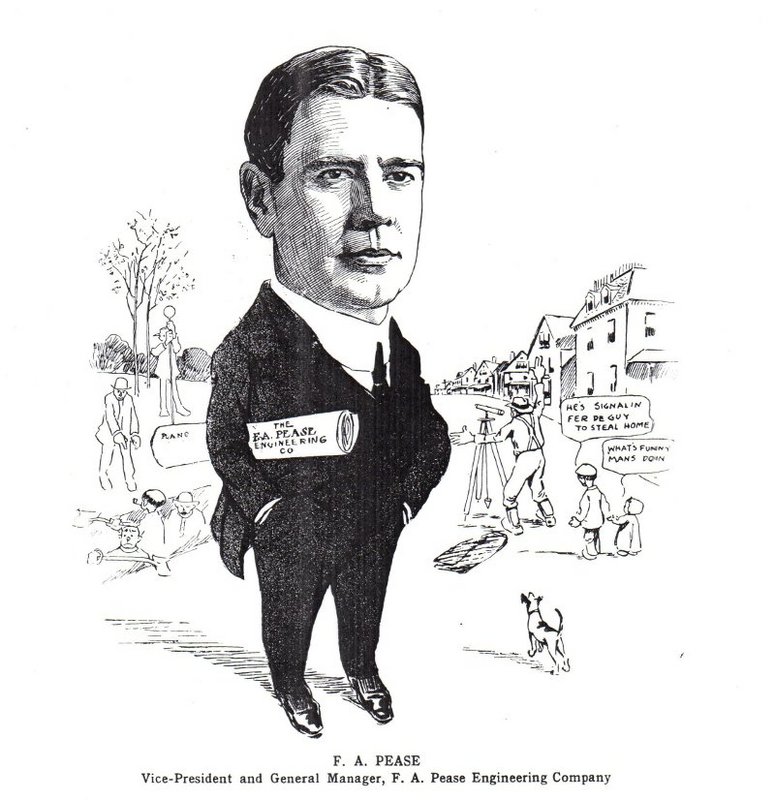
    <title type="html"><![CDATA[The Vans&#039; Engineers: F. A. Pease Engineering Co. and the Design of Shaker Heights]]></title>
    <summary type="html"><![CDATA[<p><strong><em>When Fred Alwood Pease, the founder of F. A. Pease Engineering Company, died in 1955, his obituary noted that his engineering firm had designed the roads and streets of approximately 30 square miles of Cleveland's eastern suburbs. Among those suburbs were Shaker Heights, Cleveland Heights and Gates Mills.  As almost all of the present day streets of Shaker Heights were designed by this engineering firm, it would be somewhat arbitrary to select any street as the marker for this story. So instead we've selected Shaker Lakes Park as the site for this story, because the parklands were the one constant in their engineering work which the firm could not change and around which the firm was compelled to exercise both its creativity and its engineering knowledge in designing for the Van Sweringens the first boulevards and avenues of Shaker Heights.    </em></strong></p><img src="https://mail.clevelandhistorical.org/files/fullsize/965a23c73b03d57294e22df291757181.jpg" alt="Engineering the Shaker Streets" /><br/><p>F. A. Pease was born in 1873 in Kingsville, Ohio, a small town in Ashtabula County. After graduating as valedictorian of his high school class, he came to Cleveland in 1891 looking for work.  He was employed in a number of private firms before landing a job as deputy county engineer for Cuyahoga County shortly before the turn of the century. In 1903, F. A. left his county job to found the F. A. Pease Engineering Company. The firm's design work for Fairmount Boulevard and other east side suburban streets soon caught the attention of a group of land investors that included O. P. Van Sweringen. The investors hired the firm in 1904 to begin laying out streets for the residential subdivisions which the group envisioned for the 1,300 acres of land former owned by the Shaker Colony. This land would within a decade become the original territory of a new garden suburb of Cleveland called Shaker Heights.</p><p>The streets of Shaker Heights as designed by F. A. Pease Engineering fit the model of early twentieth-century design for upper middle-class American suburbs. Rather than laying down a traditional square or rectangular grid of streets, the firm designed curvilinear streets for Shaker Heights which followed the natural topography of the land and attempted to retain as much of the natural beauty of the land as possible, including wooded areas and streams.</p><p>Harry C. Gallimore (1886-1958), who was hired by the F. A. Pease Engineering Company in 1908, and who later became a partner of F. A. Pease, was an especially important member of the street design team for Shaker Heights.  In addition to his skills as an engineer, Gallimore, who was an avid reader of English literature, drew upon that knowledge to name many of the streets of Shaker Heights. </p><p>Another prominent member of the firm was William E. Pease (1875-1943), a younger brother of F. A.  Arriving in Cleveland later than his older brother, William was formally trained as an engineer at the Case School of Applied Sciences.  After working for several years for his brother's firm, he was hired by the Van Sweringen Brothers to be the principal engineer for the rapid transit line and the Terminal Tower and Train Station.  In presenting his arguments to Cleveland City officials why the new train station in Cleveland should be located on Public Square rather than the Mall, Pease may have claimed, according to one newspaper account, that he was a descendant of Captain Seth Pease (1764-1819), the surveyor of Moses Cleveland who laid out Cleveland Public Square. While William Pease may have been distantly related to Seth Pease, research of his family history suggests that he was not a direct descendant.</p><p>The F. A. Pease Engineering Company brilliantly designed the streets and boulevards of Shaker. Their work significantly contributed to making Shaker Heights one of America's premier twentieth-century garden suburbs.  </p><p><em><strong><a href="https://mail.clevelandhistorical.org/items/show/409">For more (including 6 images) view the original article</a></strong></em></p>]]></summary>
    <published>2012-02-12T19:39:39+00:00</published>
    <updated>2026-04-17T19:17:38+00:00</updated>
    <link rel="alternate" type="text/html" href="https://mail.clevelandhistorical.org/items/show/409"/>
    <id>https://mail.clevelandhistorical.org/items/show/409</id>
    <author>
      <name>Jim Dubelko</name>
    </author>
  </entry>
</feed>
