<?xml version="1.0" encoding="UTF-8"?>
<feed xmlns="http://www.w3.org/2005/Atom">
  <title type="text">Cleveland Historical</title>
  <updated>2026-08-21T20:14:05+00:00</updated>
  <generator uri="http://framework.zend.com" version="1.12.20">Zend_Feed_Writer</generator>
  <link rel="alternate" type="text/html" href="https://mail.clevelandhistorical.org/"/>
  <link rel="self" type="application/atom+xml" href="https://mail.clevelandhistorical.org/items/browse?output=rss2"/>
  <id>https://mail.clevelandhistorical.org/</id>
  <author>
    <name>Cleveland Historical</name>
    <uri>https://mail.clevelandhistorical.org</uri>
  </author>
  <link rel="hub" href="http://pubsubhubbub.appspot.com/"/>
  <entry>
    <title type="html"><![CDATA[GEAR Foundation: For the Benefit of Cleveland&#039;s Gay and Lesbian Community]]></title>
    <summary type="html"><![CDATA[<img src="https://mail.clevelandhistorical.org/files/fullsize/c93bcbc747863196184c74365ad76b98.jpg" alt="Bernard Furniture Building, 1969" /><br/><p>In the summer of 1975, Art MacDonald was 25. He had been kicked out of the Navy a few years before for his orientation. He had since partnered, and founded and continued to lead a Metropolitan Community Church (MCC) congregation in spite of death threats aimed at him, serious harassment and assaults on his congregation, and his lack of theological education. He had also founded <em>High Gear</em> the year before and continued to write for it, and he co-founded the Gay Educational and Awareness Resources (GEAR) Foundation earlier that year and continued to lead it. </p><p>GEAR intended to provide activities and services in hopes of uniting the lesbian and gay community. One of GEAR’s main purposes was furnishing information, through <em>High Gear</em> and a hotline, and another was providing social space, through the Gay Community Center. <em>High Gear</em> covered a wide variety of topics but mainly focused on political news affecting the gay and lesbian community and on lesbian and gay events in northeast Ohio. The hotline was staffed by volunteers and answered evening and weekend calls. Some callers were simply going out of their way to harass the community, but the majority of calls were actually from gay and lesbian people with a variety of concerns: those considering suicide, individuals looking for nonjudgmental healthcare for STIs, folks wanting information about the bars and baths, and people who were just coming out. GEAR was concerned about gay and lesbian youth, but ambivalent or uncertain about how to interact with them or allow them space without reinforcing negative public perceptions of lesbian and gay people. In the early 1980s, the organization focused on helping youth through the hotline.</p><p>GEAR’s founders and board members were against gender and racial discrimination, at least in principle, but active inclusion was more difficult to achieve. The composition of GEAR’s board of trustees shifted from all men to nearly half women and back again from the late 1970s to the mid-1980s, while that of the foundation membership remained fairly steady at approximately one-third women. Bisexuals, transgender people, crossdressers, and people involved in the drag scene were seen as less a part of the community, and very few of these individuals were involved with GEAR. Participation by straight allies was also uncommon in the 1970s and 1980s, with most of the few around being parents in Parents of Gays (now PFLAG). GEAR did host groups for black and Asian gay men, but participation of people of color in GEAR was limited.</p><p>With the discriminatory social climate and limited financial resources, GEAR was frequently looking for suitable space to host Cleveland’s lesbian and gay community. Before opening the Gay Community Center, GEAR initially met at MacDonald’s home, but he moved to Chicago early in 1976 to attend seminary. Starting around November 1975, GEAR had its office and the hotline at 2999 W. 25th Street, in a shared space with the offices of the Cleveland Gay Federation and the Cleveland MCC congregation. On March 27, 1977, the Gay Community Center had its first open house in GEAR’s new location, a few rooms in the CoventrYard building, a mini-mall at the corner of Euclid Heights Boulevard and Coventry Road in Cleveland Heights. Eleven months later, CoventrYard was destroyed in a fire. GEAR moved into a basement room at New Dimensions, a club downtown at 1012 Sumner Court, across from Erie Street Cemetery. The room was cold and small, holding only fifteen to thirty people at most, and quite loud when the club was operating. GEAR began to look for another location but didn’t find a suitable place until 1980.</p><p>In February 1980, GEAR’s board made its initial decision to buy the former Bernard Furniture Building on the northeast corner of West 14th Street and Auburn Avenue in Tremont. The wooden building was approximately 80 years old and needed substantial work, but GEAR’s trustees assumed they could gain enough rental income from the upper floor to make the finances work, and moved forward with the purchase. After GEAR made the down payment early in March, a few neighborhood organizations got wind of the planned move and disapproved of it. GEAR became concerned over safety and attempted to back out of buying the building, but the organization couldn’t find a way to without losing its down payment. The board initially planned to resell, but renovations progressed slowly, and with no immediate incident of significant prejudice GEAR moved in to save money. However, the problems of owning a building – particularly issues with tenants and the physical state of the Bernard building – quickly exacerbated GEAR’s money woes. By September 1982, the building had failed a city inspection, almost all its utilities were past due, and some had been disconnected. The next month, all the trustees resigned and the mortgage was foreclosed. A meeting of the foundation membership was held in November, electing new trustees who began to turn the situation around, and GEAR continued to use the Bernard building into the fall of 1983 before moving to a board member’s home at 2100 Fulton Road by December 1983.</p><p>The Gay Community Center continued despite GEAR’s decline, and became the stable foundation of Cleveland’s LGBT community over the next thirty years. It moved only three additional times over that period, and with a few name changes continues to exist as the LGBT Center of Greater Cleveland.</p><p><em><strong><a href="https://mail.clevelandhistorical.org/items/show/880">For more (including 6 images) view the original article</a></strong></em></p>]]></summary>
    <published>2019-11-20T20:07:46+00:00</published>
    <updated>2026-04-17T19:17:38+00:00</updated>
    <link rel="alternate" type="text/html" href="https://mail.clevelandhistorical.org/items/show/880"/>
    <id>https://mail.clevelandhistorical.org/items/show/880</id>
    <author>
      <name>Katie Cummings</name>
    </author>
  </entry>
  <entry>
    <title type="html"><![CDATA[Mitchell&#039;s Fine Chocolates]]></title>
    <summary type="html"><![CDATA[<img src="https://mail.clevelandhistorical.org/files/fullsize/de6039f85291bba565fcd2b9d2766cd3.jpg" alt="The Original Mitchell Team" /><br/><p>Well into the 20th century, waves of immigrants swelled Cleveland's ranks. Among them was a Greek native by the name of Chris Mitchell. Rather than contenting himself with a factory job, however, Mitchell tried his hand in business. Unfortunately, it was during the Great Depression and Mitchell’s first three businesses failed. But then he made a particularly astute observation: One business that seemed to thrive despite hard economic times was cinema! For his fourth endeavor, Mitchell thus chose to open a candy shop next door to the Heights Theater in 1939. More than three quarters of a century later, the store is still a Cleveland Heights icon. </p><p>Originally located on Euclid Heights Boulevard, Mitchell's was not the only store selling popcorn and penny candy to moviegoers. At one point there were as many as sixteen others in the Cleveland area. However, when movie theaters started bringing concessions in house, businesses similar to Mitchell's began to die out. Rather than suffer the same fate, Chris Mitchell deemphasized popcorn and other inexpensive sweet treats and focused most heavily on chocolate. The store's chocolates and the methods by which they are made have remained the same for decades, with the exception of new molds, a few modern machines, and the introduction of more products.</p><p>Chris Mitchell's new wife, Penelope, joined the business in 1949, a year after they were married. Their son, Bill, who had worked for his father as a boy, eventually inherited the business. After fifty-two years in Coventry Village, Mitchell's relocated to Lee Road in May 1991. Chris Mitchell died in 2000 at the age of 102. Penelope Mitchell lived until her late nineties. She passed away in 2015, assisting in the shop until shortly before her death. In 2016, Bill Mitchell finally decided it was time for a change. The business is now owned by Jason Hallaman and his wife Emily, who are committed to maintaining the Mitchells’ impeccable legacy. </p><p>The view from the shop windows may have changed, as have the owners. However, the tastes and smells of fresh, hand-dipped chocolate remind loyal customers of the small candy store where they would spend their dimes as children. </p><p><em><strong><a href="https://mail.clevelandhistorical.org/items/show/545">For more (including 8 images&#32;&amp;&#32;8 audio files) view the original article</a></strong></em></p>]]></summary>
    <published>2012-08-30T18:18:39+00:00</published>
    <updated>2026-06-02T15:57:53+00:00</updated>
    <link rel="alternate" type="text/html" href="https://mail.clevelandhistorical.org/items/show/545"/>
    <id>https://mail.clevelandhistorical.org/items/show/545</id>
    <author>
      <name>Heidi Fearing</name>
    </author>
  </entry>
  <entry>
    <title type="html"><![CDATA[Mac&#039;s Backs-Books]]></title>
    <summary type="html"><![CDATA[<img src="https://mail.clevelandhistorical.org/files/fullsize/8919e2a89d054e64b3d0d9023ad31158.jpg" alt="Old Exterior, ca. 1985" /><br/><p>Technology has been changing the shape of entertainment on Coventry Road for quite some time. Bars on the street can now show virtually any sporting event from around the world live and in high-definition, while DJs tote laptops filled with hundreds of thousands of songs to make dance floors come alive. For the past thirty years, however, Mac's Backs-Books has held free monthly poetry readings that rely on nothing more than the human voice and creativity. With bookstores closing across the city, the continued success of Mac's Backs and its literary events are a testament to the store's close ties to the Coventry community, which has not entirely turned away from its "hippie" roots.</p><p>Jim McSherry and Suzanne DeGaetano opened Mac's Backs-Books above the old Dobama Theatre on Coventry Road in 1982. In 1984 the store moved to a larger spot at 1785 Coventry Road, on the north end of the street. Around this time, the store began holding poetry readings on the second Wednesday of each month. This tradition started when poets Daniel Thompson (the first poet laureate of Cuyahoga County) and Dennis McDonnell approached Macs Backs’ owners after a nearby coffee shop no longer wanted to host. The poetry readings at Mac's Backs have featured both professional authors and amateur poets, and other literary events such as book clubs and author talks are frequently held at the store.</p><p>In 1993, Mac's Backs moved to its present location at 1820 Coventry Road, right next to Tommy's, another long-standing Coventry business. The neighborhood actually has two bookstores; the other is Revolution Books, a mainstay at the corner of Coventry and Mayfield Roads since the 1970s. Many of us also remember Delphic Books, which recently gave way to a coffee shop, and Coventry Books, which resided on Coventry from 1972 until the early 1980s. Mac's Backs, however, has no plans to expand, close or move—preferring to remain the small, customer-focused shop that it has been since it opened.</p><p><em><strong><a href="https://mail.clevelandhistorical.org/items/show/541">For more (including 6 images&#32;&amp;&#32;4 audio files) view the original article</a></strong></em></p>]]></summary>
    <published>2012-08-22T16:37:14+00:00</published>
    <updated>2026-04-17T19:17:39+00:00</updated>
    <link rel="alternate" type="text/html" href="https://mail.clevelandhistorical.org/items/show/541"/>
    <id>https://mail.clevelandhistorical.org/items/show/541</id>
    <author>
      <name>Michael Rotman</name>
    </author>
  </entry>
  <entry>
    <title type="html"><![CDATA[Saint Ann Church: Building a Catholic Parish for Cleveland Heights]]></title>
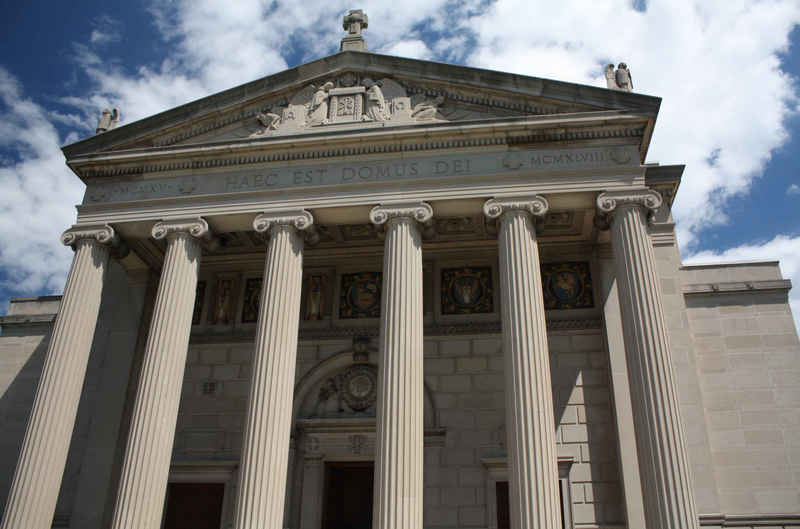
    <summary type="html"><![CDATA[<p><strong><em>Father John Mary Powers was nothing if not enterprising. When he was assigned to establish a new parish in 1915, he influenced local government and citizens to develop the neighborhood as well. For over half a century, he led the Saint Ann’s community with conviction, creativity, and an exceptional eye for secondhand bargains. </em></strong></p><img src="https://mail.clevelandhistorical.org/files/fullsize/ba1c3551db8a51a9f5da76803e41cf32.jpg" alt="Main Entrance to St. Ann Church" /><br/><p>In 1915, Father John Mary Powers was assisting at St. Thomas Aquinas parish in Cleveland when Bishop Farelly assigned him to create a parish for families residing in the village of Cleveland Heights. Fr. Powers walked up Cedar Glen from the eastern end of the streetcar line and continued roughly one-half mile beyond the top of Cedar Hill. There, at the southeast corner of Cedar and Coventry Roads he found a suitable site. He then set three goals: build a church that could serve about 40 families, construct a school, and extend the public transportation line into the neighborhood. Within four years, he had fulfilled the first mission: the new wood church would continue serving a growing Catholic community for 33 years.</p><p>Fr. Powers turned next to his school and transportation goals. An advocate of housing and residential space, he successfully argued that no commercial enterprises should border the church grounds. With this commitment from the municipal government, he then set about building his school. The three-story design technically defied city code, but Powers got around this issue by disguising the building as a two story structure. </p><p>On a trip downtown for a haircut in 1925, Fr. Powers stopped into the recently failed First National Bank on Euclid Avenue. According to Powers, he went into the bank to buy a desk. However, he left with myriad additional items: the rudiments of a collection that would ultimately furnish a new church. It would take 25 years to convince skeptical Cleveland bishops to approve plans for construction. </p><p>In 1948, ground was finally broken for the current St. Ann Church. Designed by Walker and Weeks, it incorporated an organ from Massachusetts Pilgrim Church; oak woodwork from one of the Hanna family mansions; marble from the Ritz-Carlton Hotel in Manhattan; and chandeliers, choir loft railing, columns, and brass and bronze doors from the First National Bank. </p><p>Fr. Powers remained in his leadership role for 51 years before retiring in 1966. He was a tireless promoter of fair housing, pursued interests with theater productions (The Powers Players), and guided an active greenhouse and floral enterprise for church events for many years. St. Ann Church is on the grounds of the Communion of Saints Parish in Cleveland Heights.</p><p><em><strong><a href="https://mail.clevelandhistorical.org/items/show/457">For more (including 8 images&#32;&amp;&#32;3 audio files) view the original article</a></strong></em></p>]]></summary>
    <published>2012-05-12T10:10:43+00:00</published>
    <updated>2026-04-17T19:17:39+00:00</updated>
    <link rel="alternate" type="text/html" href="https://mail.clevelandhistorical.org/items/show/457"/>
    <id>https://mail.clevelandhistorical.org/items/show/457</id>
    <author>
      <name>Jim Lanese</name>
    </author>
  </entry>
  <entry>
    <title type="html"><![CDATA[Heights Hardware]]></title>
    <summary type="html"><![CDATA[<img src="https://mail.clevelandhistorical.org/files/fullsize/32676f62699cb720d90f86162b736135.jpg" alt="Heights Hardware, 1982" /><br/><p>Near the northern edge of Coventry Village, surrounded by vintage, hip clothing stores, stands one of Cleveland Heights' oldest businesses. Operated by Tom and Andy Gathy, a father-son team, Heights Hardware is in some ways timeless: Oak cabinets, rolling ladders, pressed-tin ceiling, and friendly personalized service have endured. From three blocks south, the store's giant sign–blue-and-white paint on old brick–is readily visible: "Heights Hardware Since 1911." The date might puzzle those who know that Coventry Village emerged in 1919-22. How do we account for the difference?</p><p>In 1911, Alfred, Arthur, and Sidney Weiskopf opened Weiskopf Bros. Hardware and Plumbing Company at 1140 East 105th Street in Cleveland's Glenville neighborhood. At the time, the surrounding streets were the nucleus of the city's Jewish community. A decade later the brothers, sensing the new trend of Jews moving into the Heights, opened a second location called Weiskopf Bros. Heights Hardware in 1922. They sold their Glenville store three years later to concentrate on serving contractors and homeowners in the midst of the 1920s suburban population boom. A succession of owners continued to operate the original hardware store on East 105th through the 1970s, but the building suffered repeated challenges. It was bombed in 1935, caught fire in 1958, and was robbed at gunpoint by seven juveniles in 1967.</p><p>Oscar Elton, son of Hungarian immigrants to Cleveland, bought out the Weiskopfs in 1949, beginning a family connection to the business that remains to this day. Elton sold the business to his distant cousin Carl Weiss in 1969, but continued to work in the store for some 40 more years (into his nineties). Meanwhile, Elton's second cousin, current owner Tom Gathy, fled Europe during the 1956 Hungarian Revolution. After six years he arrived in Cleveland and, with some help from Elton, became active in the construction trades. Having become a regular customer at Heights Hardware, Gathy decided to buy the store in 1979.</p><p>Over the next two decades Gathy modernized the store, adding new plate-glass windows and neon signage, and affiliating with the Ace independent hardware cooperative in the early 1980s. When new big-box stores opened in the reconfigured Severance Town Center in 1998, Gathy responded decisively. He expanded the store's merchandise by building an extension to replace an old rear carriage house and hiring his son Andy to build for the future. Today Heights Hardware remains a strong presence on Coventry Road by continuing to offer a large product selection, fast service, know-how,  and the personal touch.</p><p><em><strong><a href="https://mail.clevelandhistorical.org/items/show/453">For more (including 12 images&#32;&amp;&#32;5 audio files) view the original article</a></strong></em></p>]]></summary>
    <published>2012-05-09T12:54:24+00:00</published>
    <updated>2026-04-17T19:17:39+00:00</updated>
    <link rel="alternate" type="text/html" href="https://mail.clevelandhistorical.org/items/show/453"/>
    <id>https://mail.clevelandhistorical.org/items/show/453</id>
    <author>
      <name>J. Mark Souther</name>
    </author>
  </entry>
  <entry>
    <title type="html"><![CDATA[Rock Court]]></title>
    <summary type="html"><![CDATA[<img src="https://mail.clevelandhistorical.org/files/fullsize/adad77bb30ff1b5e5e0fafe9cceed119.jpg" alt="The Condemned, 1979" /><br/><p>On August 16, 1979, bulldozers leveled three homes on Rock Court to make room for a parking lot and expansion of the Pick-N-Pay supermarket.  In what was probably a last act of defiance by those seeking to save the buildings, someone concealed the gas valves of each home under piles of stones.  </p><p>This wasn't Rock Court's first protestor uprising. The battle began earlier in the year when nine tenants ignored eviction notices from their landlord and hired a lawyer to block demolition of the three homes.  Their efforts to save the aging structures walked the line between community organizing and theater.  Tenants collected signatures, attended council meetings, filed court papers, and staged a rally complete with music, dancing, and a march.  Their efforts obviously failed, but the widespread support of the neighborhood reflected the friction that frequently existed between Coventry residents and "outsider" developers.  </p><p>From the start, it was unlikely that the tenants would win.  There was no disagreement that the homes had seen better days, nor was the property owner beyond his rights to demolish the buildings. Yet the homes' impending doom attracted public interest because Rock Court embodied both the history and contradictions of the Coventry area. </p><p>The houses that lined this narrow, unpaved street (which, at the time, linked Euclid Heights Boulevard with Hampshire Road) were likely constructed in the late 19th century for workers on the interurban lines and streetcars.  From the 1940s to the early 1970s, Rock Court was populated by Hungarian and Italian immigrants.  The three two-family homes on the west side of the street (backs facing the parking lot) were purchased and managed as apartments by A. Siegal, who had also built Pick-N-Pay.  The Rock Court neighborhood was overseen by self-proclaimed "street mayors," whose primary responsibility was to discourage non-residents from driving through their community. The road was (and continues to be) so hideously bumpy that the street mayors may well have saved many a car-owner's axle. </p><p>By the late 1960s, a wave of counterculture types had begun to settle in the houses and apartments along Hampshire and Lancashire roads.  The three homes on Rock Court bordering the lot--as well as several Rock Court homes to the north--were soon occupied by artists, musicians, writers, photographers and neo-dadaists.  One of the homes claimed by the Pick-N-Pay lot even housed a new-age church.</p><p>Coventry's metamorphosis in the late 1960s and early 1970s forged a new identity for the area: a sort of Midwest Greenwich Village or Haight-Ashbury. Local demand for unique goods and services was quickly met by mainly local entrepreneurs.  Stores that previously catered to the immigrant community were largely replaced by unique specialty shops geared to sightseers and the neighborhood's left-wing residents: places like Bill Jones Leather, Record Revolution, Rainblue, Green Tomato and the first Arabica.  </p><p>By the late 1970s, however, increased demand for housing and retail space pushed up rents, infuriating new and old residents who often railed against what they perceived as malevolent inflation instigated by greedy landlords and real estate speculators.  By the time Pick-N-Pay announced plans to expand its Coventry Road store, the tenants of Rock Court had no trouble finding sympathetic ears. Beyond commiseration, however, little could be done. Not only was the landlord on the right side of the law, but expansion of the supermarket and lot were needed to support the changing community. A handful of forested homes still stand near Rock Court's terminus at Hampshire Road. In fact, those who venture in from Hampshire may still encounter self-styled "mayors," as well as an abrupt and poorly marked end to the road high above what is now the Marc's parking lot.</p><p><em><strong><a href="https://mail.clevelandhistorical.org/items/show/452">For more (including 6 images) view the original article</a></strong></em></p>]]></summary>
    <published>2012-05-09T10:00:02+00:00</published>
    <updated>2026-04-17T19:17:39+00:00</updated>
    <link rel="alternate" type="text/html" href="https://mail.clevelandhistorical.org/items/show/452"/>
    <id>https://mail.clevelandhistorical.org/items/show/452</id>
    <author>
      <name>Richard Raponi</name>
    </author>
  </entry>
  <entry>
    <title type="html"><![CDATA[M. M. Brown&#039;s Mayfield Heights]]></title>
    <summary type="html"><![CDATA[<img src="https://mail.clevelandhistorical.org/files/fullsize/8904124554a7f3e3e09d2e75a5636c28.jpg" alt="M. M. Brown House, ca. 1905" /><br/><p>For over a century, the beautiful tree-shaded community once known as "Mayfield Heights" has stood as a fine example of an early 20th-century American suburban development. No, we're not speaking of the suburb that is located way out on Mayfield Road with the same name, but rather the original Mayfield Heights that is one of the oldest residential sections of Cleveland Heights. The neighborhood, initially part of East Cleveland Township, was envisioned by real estate attorney, developer, and philanthropist Marcus M. Brown (M. M. Brown).  Brown, a self-made man, had a successful real estate and legal career in Chicago, but in 1896 he and his wife moved to Cleveland to seek more leisure time for literary and philosophical pursuits.</p><p>Shortly after M. M. Brown's arrival, he constructed a home on a Mayfield Road bluff just east of Coventry Road.  Real estate development, it seemed, was still in his blood. From his new home, he started planning the development of a modern suburban community. The new community, bounded roughly by Mayfield Road, Superior Road, Euclid Heights Boulevard, and Coventry Road, was christened Mayfield Heights because it was situated above Mayfield Road's interurban and streetcar tracks. Unlike Patrick Calhoun's Euclid Heights to the immediate west, designed to attract a well-to-do constituency, Mayfield Heights was originally envisioned to appeal to the professional and managerial middle class. While Mr. Brown developed some rather imposing dwellings in the Mayfield Heights Allotment prior to 1900 (including a splendid new estate for himself and his family on Euclid Heights Boulevard at Wilton Road), later residences were relatively modest builder-designed homes nestled on smaller lots.</p><p>M. M. Brown created a network of fine brick streets for Mayfield Heights with such names as Center Avenue (Hampshire), Preyer Avenue (Somerton), Florence Avenue (Radnor), Hurst Avenue (Middlehurst), Monroe Avenue (Wilton), and Cadwell Avenue. Interestingly, Monroe was M. M. Brown's middle name and Cadwell was the maiden name of his wife, Jeanette. Unfortunately, after the turn of the century, sales began to wane and then the nationwide economic calamity known as the Panic of 1907 struck. Consumer interest in real estate all but dried up and in 1908, the Cleveland Trust Company foreclosed upon M. M. Brown and his Mayfield Heights Realty Company. The bank took ownership of the allotment at sheriff sale and began to aggressively market Mayfield Heights. Soon large newspaper ads proclaimed Mayfield Heights as "Country Life in Cleveland" and "Real Homes for Real People." In order to further advance the idea of "Country Life," Cleveland Trust changed the street names that M. M. Brown established to the English monikers we are familiar with today. Homes were sold for the advertised deal of "$500 down, the rest same as rent" until all the lots were gone.</p><p>The spirit of M. M. Brown's Mayfield Heights lives on to this day. The neighborhood's solid American Foursquare, Arts and Crafts, Craftsman, Bungalow, Colonial, and Queen Anne homes have been preserved and are mostly faithful to the styles in which they were originally built. The community prides itself as a traditional neighborhood of attractive homes and gardens in a pedestrian-friendly environment.</p><p><em><strong><a href="https://mail.clevelandhistorical.org/items/show/449">For more (including 12 images) view the original article</a></strong></em></p>]]></summary>
    <published>2012-05-07T22:13:23+00:00</published>
    <updated>2026-04-17T19:17:39+00:00</updated>
    <link rel="alternate" type="text/html" href="https://mail.clevelandhistorical.org/items/show/449"/>
    <id>https://mail.clevelandhistorical.org/items/show/449</id>
    <author>
      <name>Charles Owen &amp;#32;&amp;amp;&amp;#32;J. Mark Souther</name>
    </author>
  </entry>
  <entry>
    <title type="html"><![CDATA[Danny Greene Bombs Coventry?]]></title>
    <summary type="html"><![CDATA[<img src="https://mail.clevelandhistorical.org/files/fullsize/cfcf901957706403104e5c80be7b23d7.jpg" alt="Danny Greene, 1964" /><br/><p>Late on the evening of Halloween 1971, as the children of Cleveland Heights slept with bellies full of candy, a blast shook the Coventry neighborhood.  Police raced to Swan's Auto Service at the southwest corner of Mayfield and Coventry Roads (now the site of the Coventry Food Mart) to find 31 year-old Arthur Sneperger dead under a pile of debris.  Michael Frato, owner of both Swan's and a garbage collection business, was the clear target; his Cadillac had been parked at Swan's, and a garbage truck in the backyard of his Cleveland Heights home was destroyed by an arsonist the very same evening.  But the bomb went off too early, and Sneperger became the victim. Attention focused immediately on "The Irishman," Danny Greene.</p><p>Younger Clevelanders may be familiar with Danny Greene only after seeing the 2011 biopic "Kill the Irishman." But those who lived in the city during the 1970s surely remember him well. A mob war involving the Irish-American Greene and competing factions of the Italian Mafia led to more than 30 bombings in the city, most involving car bombs. The violence became so endemic that a local newspaper referred to Cleveland as "Bomb City, USA."  </p><p>Frato and Greene had once been friends, but tension between the two rose after Frato pulled his garbage collection firm out of the profitable trash hauler's union that Greene ran. Frato started his own trade group, the Cuyahoga County Refuse Haulers Association, whose offices were located near Swan's Auto Service on Coventry Road. Frato was playing cards in these offices on the night that Sneperger was killed. </p><p>Arthur Sneperger had a history with both Greene and Frato.  Sneperger and Frato grew up together in Cleveland near the intersection of Woodland Avenue and East 25th Street.  Sneperger and Greene, meanwhile, had worked together at the city's docks, and Sneperger eventually became "muscle" for Greene's gang.  The month before the bombing at Swan's, Sneperger backed out of an earlier plan of Greene's to bomb Frato's car, going as far as to inform Frato of Greene's intentions.  Soon after, Sneperger starting talking to a Cleveland Police officer about Greene's criminal activities.  After the Halloween bombing on Coventry, police speculated that Greene had found out about Sneperger's betrayals, and that Sneperger's death had not been unintentional.  Greene may have remotely detonated the bomb early on purpose, knocking off a traitor and sending a powerful message to Frato at the same time.</p><p>Less than a month after the Swan's bombing, Danny Greene shot and killed Michael Frato at White City Park Beach on Cleveland's lakefront.  Frato and an associate drove up to Greene as he walked his dogs at the park. When Frato fired a gun, Greene shot back, killing Frato with a single shot to head.  Greene was later acquitted of the murder after claiming he acted in self-defense.  </p><p>For several years in the 1970s, the Coventry neighborhood was also home to Shondor Birns, once known as "Cleveland's Public Enemy #1." A ruthless Jewish gangster who ran Cleveland's numbers and policy rackets, Birns first hired Danny Greene in the 1960s as an enforcer. As Greene's power grew, his ties to Birns deepened, but conflict over an unpaid debt soured their relationship.  On Saturday evening, March 29, 1975, Birns was killed by a car bomb as he left Christy's Lounge, a strip bar located on Detroit Avenue on Cleveland's near west side.  Greene was suspected in the murder, but never charged.</p><p>Danny Greene died in a car bombing in suburban Lyndhurst in 1977 after becoming ensnared in a fight surrounding competing claims for leadership of Cleveland's Italian mafia.  </p><p><em><strong><a href="https://mail.clevelandhistorical.org/items/show/448">For more (including 7 images) view the original article</a></strong></em></p>]]></summary>
    <published>2012-05-07T15:23:03+00:00</published>
    <updated>2026-04-17T19:17:39+00:00</updated>
    <link rel="alternate" type="text/html" href="https://mail.clevelandhistorical.org/items/show/448"/>
    <id>https://mail.clevelandhistorical.org/items/show/448</id>
    <author>
      <name>Michael Rotman</name>
    </author>
  </entry>
  <entry>
    <title type="html"><![CDATA[Grant Deming&#039;s Forest Hill]]></title>
    <summary type="html"><![CDATA[<img src="https://mail.clevelandhistorical.org/files/fullsize/18ef96626dad5aeb520aed27624372e4.jpg" alt="Eclectic 1911 House" /><br/><p>Grant Wilson Deming, born in Sarnia, Ontario, at the southern tip of Lake Huron, moved to Cleveland with his brothers in the 1890s and became swept up in real-estate development. The Demings built upper-middle-class residential districts in Cleveland's Glenville area to the north of University Circle in the 1900s. Grant's brother Barton set out on his own to redevelop Rockefeller's old Euclid Golf Club in the "Heights" to the east as a fashionable destination for Millionaires Row families seeking a more sylvan setting away from the city. Sensing the eastward push into the Heights, Grant Deming also shifted his focus to suburban speculation. In the early 1900s, he acquired almost 200 acres of land owned mainly by John D. Rockefeller Jr. and the heirs of James B. Haycox, a dairy farmer. There Deming imagined Forest Hill, "America's Richest Suburb."</p><p>Deming thought big. His promotional literature attempted to situate Forest Hill in the company of Boston's Brookline, New York's Llewellyn Park, and Washington's Chevy Chase. Like these other garden suburbs, Forest Hill would have gently curving streets, setback sidewalks, and a pastoral air. Deming characterized the streets, laid out by the same company that platted Shaker Heights, as "natural openings through the giants of the forest," but the landscape was more accurately a mosaic of woods and meadows. An exception was the western side of the tract, where two branches of the Dugway Brook meandered through thickly forested ravines on their descent to Lake Erie.</p><p>Almost completely built out by the time the Great Depression hit, Forest Hill gradually lost its identity as residents came to identify more with the Coventry or Cedar-Lee business districts that flanked it to the northwest and southeast. Some also turned inward. The Lincoln Boulevard Club, formed by women on the street to sew bandages for the Red Cross during World War I, is reputedly the oldest surviving block club in Greater Cleveland. Far from the well-to-do allotment promised by Deming, Forest Hill became a mishmash of varying sizes of homes and even a number of two-family houses. To some extent the neighborhood also looked to nearby religious institutions for identity. Forest Hill lay wholly within the St. Ann's Roman Catholic parish, and many Jews who moved to the Heights from Cleveland's Glenville neighborhood lived in Forest Hill and worshipped a half-mile to the northeast at the Temple on the Heights. The arrival of the first African American family in 1927 in a house at Washington Boulevard and Cottage Grove Avenue prompted a bombing before cooler heads prevailed. It would take another four decades for racial integration to make real progress.</p><p>Listed on the National Register of Historic Places in 2010, Forest Hill is beginning to reclaim its long-obscure name recognition apart from the places it is near. Like Cleveland Heights itself, Forest Hill today melds historic sense of place with a socially diverse population.</p><p><em><strong><a href="https://mail.clevelandhistorical.org/items/show/447">For more (including 9 images&#32;&amp;&#32;4 audio files) view the original article</a></strong></em></p>]]></summary>
    <published>2012-05-05T07:36:40+00:00</published>
    <updated>2026-06-11T01:22:17+00:00</updated>
    <link rel="alternate" type="text/html" href="https://mail.clevelandhistorical.org/items/show/447"/>
    <id>https://mail.clevelandhistorical.org/items/show/447</id>
    <author>
      <name>J. Mark Souther</name>
    </author>
  </entry>
  <entry>
    <title type="html"><![CDATA[Briggs Estate]]></title>
    <summary type="html"><![CDATA[<img src="https://mail.clevelandhistorical.org/files/fullsize/986a05065b08985d448b1e226d76d53b.jpg" alt="Briggs Estate" /><br/><p>The four residential buildings (16 total units) that occupy the block bounded by Mornington Lane and East Overlook, Coventry and Edgehill Roads are a significant departure from the architectural flavor most people associate with Cleveland Heights. Built in the mid-1960s, the condominiums are vaguely Usonian, with the low roofs, open living areas and integrated furnishings favored by Frank Lloyd Wright. The homes are clearly a departure from the city's stylistic essence, but they are attractive, well-accepted neighbors in a district populated mainly by grand, early 20th-century residences.</p><p>The area was not always so accommodating or so eclectic. From 1909 to 1965, the 5.5-acre plot where the condominiums now stand was home to the Briggs estate, a European-style "castle" designed by famed architect Charles Schweinfurth. Although badly neglected and largely vacant in its later years, the structure was still considered by many to be a treasure worth saving. In the 1960s, unfortunately, there simply was no market for such an opulent, over-the-top abode. As a result, the massive stone building fell victim to the wrecker's ball following a nasty legal fight. The only structures remaining from the original estate are the wall and fence surrounding the property, a playhouse, a beautiful swimming pool and bath house, and a building that borders Mornington Lane, inside of which is a magnificent 60-foot-long ballroom.</p><p>How lavish was the Briggs castle? Built between 1906 and 1909, the Tudor-style colossus had 30 rooms, 30-inch outer walls, ten bathrooms (with tile imported from Italy), 15 hand-carved marble fireplaces, mahogany paneling, hand-blown leaded glass windows, two greenhouses, and imported English slate and tile. The house even contained a Bible room characterized by mosaic marble panels depicting biblical stories from Genesis to Revelation.</p><p>Perhaps more amazing than its architectural specs is the fact that this magnificent structure stood for less than 60 years. Moreover, its only resident owners (the Briggs family) occupied the home for less than 30 years (1909 to 1937). The home then was under- or un-used until its demise in the mid 1960s. Simply put, Dr. Charles Briggs, a wealthy physician and businessman, had created a behemoth that suited only him and his family. Despite its amazing luxury, the place was simply too large and too maintenance-intensive to attract other residents after Dr. Briggs' death in 1937.</p><p>After 1937, the Briggs estate plodded on as a rooming house. It was also a popular musical venue for the many years that widely beloved piano teacher Frieda Schumacher lived in the ballroom (1941 to 1964). Unfortunately, Ms. Schumacher's presence was one of the home's only bright spots during that period. The other tenants were mostly short-term renters, transients and squatters. By 1957, following numerous legal squabbles, only Ms. Schumacher and a few other people - notably Elisabeth Andersen Seaver Ness, the widow of famed lawman Eliot Ness - were allowed to stay.</p><p>Sadly, the truncated life of such a majestic property was not that unusual in Cleveland Heights, or anywhere for that matter. The inescapable reality is that, more often than not, homes of such gargantuan proportions belong to another age. A small percentage are lovingly maintained by resident owners with deep pockets, and creative reuse (e.g., bed & breakfasts or offices for non-profit agencies) saved some others. But in Cleveland Heights, a great many ultra-grand homes fell well short of the multi-century lifespan intended for them.</p><p><em><strong><a href="https://mail.clevelandhistorical.org/items/show/446">For more (including 10 images) view the original article</a></strong></em></p>]]></summary>
    <published>2012-05-05T07:34:05+00:00</published>
    <updated>2026-04-17T19:17:39+00:00</updated>
    <link rel="alternate" type="text/html" href="https://mail.clevelandhistorical.org/items/show/446"/>
    <id>https://mail.clevelandhistorical.org/items/show/446</id>
    <author>
      <name>Chris Roy</name>
    </author>
  </entry>
  <entry>
    <title type="html"><![CDATA[Coventry School]]></title>
    <summary type="html"><![CDATA[<img src="https://mail.clevelandhistorical.org/files/fullsize/29a1a4c7f64c14af0a6b8d43c6370d22.jpg" alt="Coventry School Upper Playground, ca. 1958" /><br/><p>Stand just to the left of the PEACE Arch where Coventry Road intersects with Euclid Heights Boulevard. Then look east toward the slope with the playground on the left. That's where the "real" Coventry School stood for nearly 60 years. This 1919 building, either Tudor Gothic or Colonial Revival, depending on who you ask, was one of many Cleveland Heights schools torn down in the mid 1970s. Realistic concerns about condition and maintenance — combined with currently popular, new-age notions about open classrooms and community spaces — culminated in the sweeping demolition and new construction of many Cleveland Heights University Heights schools. Only two of the resulting "modern" buildings (Fairfax and Boulevard) are used today as public schools. The reconstructed Taylor Road School became a multi-use student facility, while the Board of Education leased the new Coventry School to a variety of civic, educational, and non-profit organizations until Heights Libraries acquired the property and decided to close the former school.</p><p>The original Coventry School was a wonderful and quite unusual building. Wonderful because of its great architecture and the memories retained by its thousands of alumni. Unusual because of how it nestled beautifully into the side of a hill. The structure consisted of three floors formed more or less like a Capital L. The top two floors of the L's center comprised the auditorium; directly below was a partly underground gymnasium-small, dark and somewhat creepy.</p><p>Looking at the accompanying floor-plan illustration, you can see that the longer side of the building bordered Euclid Heights Boulevard and the shorter side bordered Washington Boulevard. (At that time, Washington Boulevard ran all the way through to Coventry.) What you can't see is that the Euclid Heights side was a full story lower, and thus one entered the second floor from street level on the Washington side. There also was a main, center-hall entrance at the front, which students seldom used-perhaps because the doors bordered the principal's office. And what kid wants to go near a principal unless compelled?</p><p>Another of the building's unusual features was a mysterious tunnel that ran from the Euclid Heights side under the school and into a courtyard area on the lower playground. The tunnel was used primarily to house children's bicycles and provide janitors access to the bowels of the school. At the non-Euclid Heights end of the tunnel was a cement play area-perhaps 60 square feet-with three-story walls on three sides. Although it was quite reminiscent of a prison courtyard, it was a great environment for battle-ball which, for many decades, was played every morning before school and after school. Imagine a less liability-minded age when a sixth-grader wielding a lethal rubber playground ball could get away with "wiping out" a hapless and much smaller third grader. Trust us — it happened regularly.</p><p>Equally distinctive were the two playgrounds:  an upper playground bordering Washington Boulevard and a lower playground bordering Euclid Heights Boulevard. A long, curving ramp–perfect for dangerous, high-speed skateboarding–connected the two playgrounds. Of course, the playgrounds themselves were none too safe either, with hard asphalt surfaces everywhere and several high-rise "monkey bars." Such were the days before litigation ruled the world.</p><p>Another feature worth noting was that, in the school's early days, Cleveland Heights' rapid growth forced the Board of Education to create a number of free-standing quonset buildings for use as temporary classrooms. One of these short-lived structures is visible in a photo accompanying this article. In the same picture, you can see how Washington goes through all the way through to the intersection with Coventry and that there is no Heights Library. The library was built in 1926.</p><p>In one sense, Coventry may have been just another school. It also is true that a strong sense of enthusiasm, community and volunteerism existed throughout the replacement building's life as a public school (1976 to 2006). However, to the many teachers and children who passed through its halls — as well as those who appreciate fine architecture and local history–the original Coventry School truly was special.</p><p><em><strong><a href="https://mail.clevelandhistorical.org/items/show/445">For more (including 10 images&#32;&amp;&#32;1 audio file) view the original article</a></strong></em></p>]]></summary>
    <published>2012-05-05T07:32:18+00:00</published>
    <updated>2026-04-17T19:17:39+00:00</updated>
    <link rel="alternate" type="text/html" href="https://mail.clevelandhistorical.org/items/show/445"/>
    <id>https://mail.clevelandhistorical.org/items/show/445</id>
    <author>
      <name>Chris Roy&amp;#32;&amp;amp;&amp;#32;Eric Silverman</name>
    </author>
  </entry>
  <entry>
    <title type="html"><![CDATA[Diamond&#039;s Flowers]]></title>
    <summary type="html"><![CDATA[<img src="https://mail.clevelandhistorical.org/files/fullsize/884a05e9fe456501f1f4bd5a7e83b094.jpg" alt="Shop Window" /><br/><p>Now more than 90 years old, Diamond's Flowers is the second oldest business in Coventry Village, second only to Heights Hardware. Diamond’s is also the oldest business to originate on the street. Although many years have passed since the store opened, customers who visit the floral boutique today would see little difference between then and now. Not only has the store not moved from its original location, the way flowers are prepared and arranged has remained largely the same. Even the flower coolers are the same ones installed almost a century ago.</p><p>Mr. and Mrs. Diamond opened their flower boutique in 1934. After 35 years they sold Diamond's Flowers to Max R. Ferris and his wife Thelma Woods. The new owners continued to run the business the same way the Diamond family did. After Mrs. Ferris died in 1981, Mr. Ferris ran the store until a fall forced him to stop working.</p><p>In 1985, Roseana Bass came to work at Diamond's Flowers and prepared herself to take over the store. Because Diamond's Flowers was well known for its quality, Bass, like the Ferrises, learned the same methods of floral preparation that had been used at the small shop for more than 50 years. Bass continues to run the store, watching Coventry Village change around her. This old business stands as a reminder of the many boutique and mom-and-pop businesses that once adorned the street. </p><p><em><strong><a href="https://mail.clevelandhistorical.org/items/show/444">For more (including 5 images&#32;&amp;&#32;2 audio files) view the original article</a></strong></em></p>]]></summary>
    <published>2012-05-01T12:24:23+00:00</published>
    <updated>2026-04-17T19:17:39+00:00</updated>
    <link rel="alternate" type="text/html" href="https://mail.clevelandhistorical.org/items/show/444"/>
    <id>https://mail.clevelandhistorical.org/items/show/444</id>
    <author>
      <name>Heidi Fearing</name>
    </author>
  </entry>
  <entry>
    <title type="html"><![CDATA[Coventry Village Library]]></title>
    <summary type="html"><![CDATA[<img src="https://mail.clevelandhistorical.org/files/fullsize/2ef8ea0046e7f0d87832474735b353a1.jpg" alt="Open House, December 1981" /><br/><p>Harry Potter and his friends would feel right at home in the Coventry Village Library, a brick Tudor Revival and Jacobean-style building that sits on a gentle grassy slope near the intersection of Coventry Road and Euclid Heights Boulevard. The building features many historical details, including a large fireplace, Arts and Crafts tilework, and medieval light fixtures. </p><p>Designed by John H. Graham & Co., which also drew plans for Fairmount Presbyterian Church nearly a decade before, the Coventry Village Library opened as the main library for Cleveland Heights in 1926. Built on land originally platted as part of Grant W. Deming's Forest Hill residential allotment, the library, along with Coventry School, were the only non-residential structures in Deming's development. </p><p>In 1961, the Cleveland Heights-University Heights Libraries system boasted the country's second highest book circulation among comparably sized municipalities. The growth of these two suburbs strained the library's ability to serve public needs, so in 1968, the library board opened a large new main library on Lee Road, demoting Coventry to branch status. The library languished and fell into disrepair after the Lee Road facility opened. </p><p>A new chapter in the library's history began with the building's sale in 1974 to the Fairmount Center for Creative and Performing Arts, a non-profit arts organization formed four years earlier in Novelty, Ohio. The Fairmount Center hoped to extend its reach to a larger population and used the library to provide fine arts services to the CH-UH and East Cleveland school systems, and to run dance programs for Cuyahoga Community College and Lake Erie College. The Fairmount Center leased two main-floor rooms back to the library, so Coventry remained open.</p><p>Residents expressed growing dissatisfaction as hours and services were pared back. After failing to secure a long-term lease, concerned citizens, rallied by Shirley Hyatt, gathered more than 2,000 signatures on a petition in 1979 to get the library to buy back its building. The library board, however, saw the building as decrepit and hoped to obtain federal Community Development Block Grant (CDBG) funding through the city to open a larger library in developer Lewis Zipkin's CoventrYard mall development across Euclid Heights Boulevard. Two factors--city council's refusal to allocate CDBG monies to the library and the Fairmount Center's worsening financial woes--combined to persuade the board to repurchase Coventry Library in 1980.</p><p>After an extensive renovation in 1981, Coventry Village Library reopened. Its role as a center for fine arts, however, did not disappear. The Pottery Cooperative of the Heights Guild of Artists and Artisans (later renamed Cleveland Clay Works) purchased ceramic studio equipment, including a kiln, from the Fairmount Center and continued to serve as a pottery-making center. Coventry Village Library has retained its longtime role as a community center, offering musical and theatrical performances (including those for the deaf), poetry readings, and a forum for community meetings and public lectures. </p><p><em><strong><a href="https://mail.clevelandhistorical.org/items/show/443">For more (including 9 images&#32;&amp;&#32;1 audio file) view the original article</a></strong></em></p>]]></summary>
    <published>2012-04-25T13:16:05+00:00</published>
    <updated>2026-04-17T19:17:39+00:00</updated>
    <link rel="alternate" type="text/html" href="https://mail.clevelandhistorical.org/items/show/443"/>
    <id>https://mail.clevelandhistorical.org/items/show/443</id>
    <author>
      <name>J. Mark Souther</name>
    </author>
  </entry>
  <entry>
    <title type="html"><![CDATA[Grog Shop]]></title>
    <summary type="html"><![CDATA[<img src="https://mail.clevelandhistorical.org/files/fullsize/88895c13b274f4389d69e3651c5c7428.jpg" alt="Grog Shop Fliers" /><br/><p>After more than three decades, the Grog Shop remains a fixture of both the Coventry business district and the local independent music scene. The club is also a reminder of Coventry's rebirth in the 1990s. Some twenty years prior to the Grog Shop's opening, Coventry remained a slightly greying, midwestern stepchild of Haight-Ashbury or Greenwich Village. Music stores, headshops and boutiques still attracted shoppers, but the days of scary biker bars and droves of loitering youth had largely passed. By the late 1980s, however, as the vitality of the commercial district fluctuated in response to the demands of both consumers and the surrounding residential community, a changing of the guard took place. Merchants that had long operated in Coventry gave way to new entrepreneurs, even as public memory of the neighborhood as a haven for hippies, punks, and art students continued to mold the district’s identity. This was the environment into which the Grog Shop inserted itself in 1992. </p><p>The development of the Grog Shop would reflect and help define the character of the Coventry business district over the next decade. Opened by three co-workers from Club Isabella, a jazz venue in University Circle, the Grog Shop replaced a fledgling bar called the Jazz Saloon — itself a short-lived successor to The Saloon, a rowdy, quasi-biker bar that occupied the space on the south side of Coventry near Mayfield Road in the 1970s and 1980s. Under a one-year management agreement, the Grog Shop began to build a clientele and introduce live music to the bar. The agreement was extended soon after.</p><p>The organic transformation of the Grog Shop into an indie music venue can be attributed to the location and timing of the venture. Its inception in the early 1990s coincided with the popularization of indie music styles and the rebirth of the Coventry business district. Bands such as Nirvana and Soundgarden redefined and helped create a larger consumer base for alternative music, while Coventry’s new restaurants and shops energized a neighborhood struggling to subsist on memories of a rebellious heyday. While both the success of the neighborhood and the club were intertwined, the Grog Shop's development can also be attributed to the many successful relationships forged between its management/staff and concert promoters, local and regional artists, patrons, and booking agents. As many of Cleveland's other independent show spaces closed their doors or changed formats by the end of the millennium, the Grog Shop — now located in CoventrYard after being forced out of its previous location in 2002 — secured a place as one of Cleveland’s leading music venues.</p><p><em><strong><a href="https://mail.clevelandhistorical.org/items/show/442">For more (including 9 images&#32;&amp;&#32;1 audio file) view the original article</a></strong></em></p>]]></summary>
    <published>2012-04-25T12:36:21+00:00</published>
    <updated>2026-04-17T19:17:39+00:00</updated>
    <link rel="alternate" type="text/html" href="https://mail.clevelandhistorical.org/items/show/442"/>
    <id>https://mail.clevelandhistorical.org/items/show/442</id>
    <author>
      <name>Richard Raponi</name>
    </author>
  </entry>
  <entry>
    <title type="html"><![CDATA[CoventrYard ]]></title>
    <summary type="html"><![CDATA[<img src="https://mail.clevelandhistorical.org/files/fullsize/33a68c917dbd54e95bff2748fa3042d8.jpg" alt="Lewis Zipkin, 1977" /><br/><p>The opening of the CoventrYard Mall in 1977 signaled a new era for the Coventry business district in Cleveland Heights. Controversy over the actions and intentions of real estate developer Lewis A. Zipkin sparked a public discussion about the impact of gentrification along Coventry Road. For several years, entrepreneurs had leveraged the neighborhood's changes: using counterculture themes to market products and services to a broad audience. However, Zipkin's decision to fill his mall with upscale boutique-type shops clearly indicated a desire to reposition Coventry for outsiders. Adding fuel to the fire, a business dispute between Zipkin and resident/restaurateur Tom Fello raised questions about the manner in which the retail spaces were managed.</p><p>Five years prior to CoventrYard's opening, Zipkin had purchased two buildings at the corner of Euclid Heights Boulevard and Coventry Road. He removed the connecting wall and added a skylight. More than $300,000 in renovations were made in an effort to retain the architectural integrity of the structure, while converting it to a mini-mall. This was Zipkin's management style: invest heavily in redevelopment projects to create attractive, modern spaces that meet governmental codes. Rather than rely on tenants to build out their own spaces, Zipkin's 20-member staff completed or oversaw most renovation work. In return, he charged his tenants higher rents. His methods paid off. By the time CoventrYard was half full in 1978, commercial and private rents throughout the business district had skyrocketed. As leases expired, including Tommy Fello's, business owners had to decide whether to accept what they saw as exorbitant prices, or start from scratch at a new location.</p><p>Negotiations between Zipkin and Fello came to a standstill. For a brief time, the future of Tommy's seemed to be in jeopardy. Fello eventually found a new location (the former Coventry Cafe), but the dispute spoke to a larger concern: many members of the community believed that the character of the neighborhood was being threatened and that longtime residents would be driven from their homes and businesses. Community responses frequently included idyllic memories of Jewish immigrants sitting communally alongside bikers, hippies, and art students at a local greasy spoon. The community's core identity was being touted as economic and social diversity, grittiness, cheap rents, and pedestrian lifestyle—characteristics that seemed at odds with Zipkin's gentrified, homogenized vision. </p><p>But despite fond recollections, many structures in the area were deteriorating and did not meet building codes. Residents faced issues of crime and poverty. A healthy business district was essential. The CoventrYard debates reflected competing but not always realistic visions of what constituted progress for this eclectic community.</p><p>Similar debates over the pros and cons of gentrification are still being waged in the Coventry area—an ongoing balancing act between retaining local personality and affordability, and accommodating the wrenching and often expensive evolutions through which communities pass. Despite two devastating fires and an often-revolving door of lessees, some tenants, notably the Grog Shop and the Inn on Coventry, have been around long enough to be considered CoventrYard "fixtures."</p><p><em><strong><a href="https://mail.clevelandhistorical.org/items/show/441">For more (including 8 images&#32;&amp;&#32;1 audio file) view the original article</a></strong></em></p>]]></summary>
    <published>2012-04-25T12:35:53+00:00</published>
    <updated>2026-04-17T19:17:39+00:00</updated>
    <link rel="alternate" type="text/html" href="https://mail.clevelandhistorical.org/items/show/441"/>
    <id>https://mail.clevelandhistorical.org/items/show/441</id>
    <author>
      <name>Richard Raponi</name>
    </author>
  </entry>
  <entry>
    <title type="html"><![CDATA[Coventry Kosher Poultry]]></title>
    <summary type="html"><![CDATA[<img src="https://mail.clevelandhistorical.org/files/fullsize/b38d8671c298797deb154b94c6224f85.jpg" alt="Rabbi Kazen" /><br/><p>As the well-dressed young adults sit on the patio of Panini's Bar and Grill, sipping their drinks and watching the game on TV, few probably realize that their trendy warm-weather hangout was once the site of a slaughterhouse.  From 1946 until 1992, the Coventry Poultry Market sat on the eastern edge of what today is Panini's patio, providing freshly-killed kosher chickens to the neighborhood's Jewish residents.  </p><p>Jews began moving to the Coventry area in the 1920s, leaving neighborhoods on the east side of Cleveland for apartments and small homes in the suburbs. Their presence led to the opening of a number of kosher delis, bakeries, and meat markets (including a few poultry slaughterhouses) on Coventry Road.  </p><p>Benny Simon opened the Coventry Poultry Market in 1946.  Since it was a kosher market, a "shochet" (ritual slaughterer) handled the killing duties, using a special, sharp knife to quickly sever the chicken's neck arteries, sparing it (supposedly) from undue pain. Kosher chicken is also carefully drained of all blood, since the Old Testament states that "blood is the life; and thou shalt not eat the life with the flesh." The shochet must also rigorously inspect each chicken for disease or impurities and say specific prayers at the beginning and end of each day.  </p><p>In the 1960s, the "counter culture" came to Coventry, and many Jews left the neighborhood for suburban areas further east.  One by one, the Jewish businesses on Coventry Road closed up shop.  Younger Jews seemed less concerned with the strict Kosher practices of their elders, and it was more modern and convenient to buy frozen, pre-packaged chicken at the nearby Pick-N-Pay supermarket. The Coventry Kosher Market, however, remained -- the last remnant of a largely bygone generation set amidst "jazzy window displays, 10-speed bicycles, and patrician antique stores," as a 1982 Plain Dealer article described it. Nonetheless, the market still served a diverse clientele, including elderly Jews who had not moved away, new Russian immigrants, and Muslims. A number of Asians who used chicken blood in their cooking also frequented the market, as did some Case Western Reserve University students who picked up chicken heads for research. Therefore, even as the community changed, there still seemed to be a use for the Coventry Poultry Market.</p><p>In 1992, however, the city of Cleveland Heights had the market torn down. The market simply did not fit in with Coventry's new image as a family-friendly, middle-class shopping and dining destination. Demolition of the market cleared the way for a municipal parking garage.</p><p><em><strong><a href="https://mail.clevelandhistorical.org/items/show/440">For more (including 8 images&#32;&amp;&#32;4 audio files) view the original article</a></strong></em></p>]]></summary>
    <published>2012-04-25T12:35:16+00:00</published>
    <updated>2026-04-17T19:17:39+00:00</updated>
    <link rel="alternate" type="text/html" href="https://mail.clevelandhistorical.org/items/show/440"/>
    <id>https://mail.clevelandhistorical.org/items/show/440</id>
    <author>
      <name>Michael Rotman</name>
    </author>
  </entry>
  <entry>
    <title type="html"><![CDATA[Pee Wee&#039;s Bike Shop]]></title>
    <summary type="html"><![CDATA[<img src="https://mail.clevelandhistorical.org/files/fullsize/93cd5bdf4ea1e9796fa9ffd7563b7bb0.jpg" alt="Bicycles, 1955" /><br/><p>Among the many mom-and-pop businesses that graced Coventry Village during the 1960s and 1970s, Pee Wee's Bike Shop often stands out. Although it is a part of Coventry's history, the shop did not have its beginnings there. Pee Wee (real name Marvin Rosenberg), had lived in Cleveland Heights since the early 1940s. He first opened Pee Wee's Bike Shop at 894 Lakeview in the Glenville neighborhood of Cleveland in the mid 1950s. He stayed there until a series of robberies convinced him to move his business to Cleveland Heights in the 1960s.</p><p>A neighboring business owner followed and partnered with Pee Wee, starting a bike and variety shop called Pee Wee's Bike & Hobby Company at 2871 Mayfield Road. The joint business lasted about three years until Pee Wee's partner ventured out to start his own wholesale bike business. Changing the name of his store to Pee Wee's Cycle Shop, Rosenberg stayed on Mayfield Road for two more years until the building was sold.</p><p>Pee Wee moved to Coventry Village in the late 1960s. The name he chose for his relocated business was the Cycle & Import Company, but everyone continued to refer to it as Pee Wee's Bike Shop. Pee Wee ran his business at 1791 Coventry Road for seventeen years, during which time he became an almost legendary figure in the area.</p><p>In the 1980s, Pee Wee purchased a small building on Lee and Superior Roads near Cain Park. He again changed the name of his business, appropriately calling it Cain Park Bicycle. Unfortunately, not long after he moved he became ill and was no longer able to run the business. He did, however, make sure he left the shop good hands—someone who, according to Pee Wee, "knew bikes." Despite the frequent moves and name changes, Pee Wee's Bike Shop is remembered fondly as part of Coventry Village history. </p><p><em><strong><a href="https://mail.clevelandhistorical.org/items/show/439">For more (including 6 images&#32;&amp;&#32;4 audio files) view the original article</a></strong></em></p>]]></summary>
    <published>2012-04-25T12:34:28+00:00</published>
    <updated>2026-04-17T19:17:39+00:00</updated>
    <link rel="alternate" type="text/html" href="https://mail.clevelandhistorical.org/items/show/439"/>
    <id>https://mail.clevelandhistorical.org/items/show/439</id>
    <author>
      <name>Heidi Fearing</name>
    </author>
  </entry>
  <entry>
    <title type="html"><![CDATA[Irv&#039;s Deli]]></title>
    <summary type="html"><![CDATA[<img src="https://mail.clevelandhistorical.org/files/fullsize/b7a3dd530fcb7ee0a539ddbd5f58eb2a.jpg" alt="Irv&#039;s Deli, 1982" /><br/><p>For decades, Irv's Deli, on the corner of Coventry and Hampshire Roads, was the place to wallow in Coventry Village’s eclectic edginess. The delicatessen and adjoining bar opened in 1959, when the street was mainly a commercial district serving the area's heavily Jewish population. In the thirty years Irv's was in business, Coventry Village changed drastically: at various and often overlapping times a hangout for hippies, biker gangs, punks, wannabes, gawkers, drug seekers, university students, and even middle-class families. For many years, restaurant owner Irving Gulko’s business model and customers kept pace with Coventry's many transformations. However, as Coventry continued to evolve, Irv’s came more and more into conflict with the neighborhood. </p><p>When Gulko opened his deli and bar, he served everything from Chinese food and pizza to shots and beers. Although Gulko came from a family of restaurant owners (his father and grandfather both operated delicatessens in Cleveland), his establishment was often associated with unappetizing food and poor sanitation. Rumors accusing the enigmatic Gulko of running prostitution, drug, and bookmaking businesses were common. What is known for sure is that Irv's Deli was indeed a hangout for down-and-outers, counter culturists, and motorcycle gangs such as the Outlaws and Hell's Angels. But it also was popular with other types. At 2:00 AM, one might find Irv’s still crawling with bikers, late-night munchies sufferers, and Case Western Reserve University students cramming for exams. </p><p>Irv’s problems escalated in the early 1980s. The neighborhood was becoming more family-friendly, but Irv’s was the epicenter of more and more crimes and police reports. In 1982 Coventry Neighbors, Inc. (CNI), a civic betterment organization formed in 1969, took action. It introduced a (winning) referendum on the 1982 election ballot that stripped Gulko's right to serve wine and liquor by the glass. Gulko fought the election results with little success. Starting in 1983, he could only sell beer by the glass and take-out alcoholic beverages. The facility limped along for another six years and closed in 1989. </p><p>Ironically, for a business associated with alcohol, crime and drugs, Irv's was for a short time a popular venue for Cleveland's straight edge hardcore community. Musical performances were organized by local teens, featuring bands like Confront, Project X, Gorilla Biscuits, and other acts known for their steadfast sobriety and lyrics promoting the virtues of "clean living." A decade after its closing, Irv’s also received a fictive cinematic treatment: the epicenter of a movie called <em>The NightOwls of Coventry</em> starring “Marv” as the restaurant’s somewhat too sympathetic owner.</p><p><em><strong><a href="https://mail.clevelandhistorical.org/items/show/438">For more (including 7 images&#32;&amp;&#32;7 audio files) view the original article</a></strong></em></p>]]></summary>
    <published>2012-04-25T12:33:52+00:00</published>
    <updated>2026-04-17T19:17:39+00:00</updated>
    <link rel="alternate" type="text/html" href="https://mail.clevelandhistorical.org/items/show/438"/>
    <id>https://mail.clevelandhistorical.org/items/show/438</id>
    <author>
      <name>Heidi Fearing</name>
    </author>
  </entry>
  <entry>
    <title type="html"><![CDATA[PEACE Park: A True Coventry Yard]]></title>
    <summary type="html"><![CDATA[<img src="https://mail.clevelandhistorical.org/files/fullsize/008060f9799d0810e792b0d3eaf4bc1d.jpg" alt="Cardinal Climbing Structure" /><br/><p>PEACE Park carries on a piece of the tradition of the closed <a href="https://clevelandhistorical.org/items/show/445">Coventry School</a> next door. The park originated when neighborhood residents became concerned that the school's playground had seen better days. In 1991, the Coventry PTA formed a committee that got elementary school students to submit drawings of their "dream" playground.</p><p>The visioning group in the PTA incorporated as Coventry People Enhancing A Child's Environment, or Coventry PEACE, an acronym that evoked the school's peace theme. Through a series of T-shirt, candy, lemonade, and bake sales, and benefit performances and dinners, the non-profit organization raised the nearly $300,000 needed to create Coventry PEACE Park. The park's construction in October 1993 was in the "New England barnraising" style and proceeded despite torrential downpours. </p><p>In 2001, the newly formed nonprofit organization Heights Arts sponsored its first public art project in the park: Coventry Arch. Designed by Barry Gunderson, an art professor at Kenyon College, the 180-degree span of aluminum pipes includes four whimsical, abstract figures (two on each side) reaching across the path to form an arch-like entry to the park. Gunderson's creation, according to his original proposal, is "a symbol of greeting, accommodation, and celebration of differences."</p><p>After nearly thirty years, PEACE Park’s well-loved facilities were showing their age. In 2018, Heights Libraries purchased the six-acre PEACE campus. Collaborating with the Fund for the Future of Heights Libraries, it began collecting community input with the goal of renovating PEACE Park as an inclusive, accessible, and environmentally sustainable public space — one that might truly embody Gunderson's arch's symbolism. The project resulted in a completely transformed park that reopened in 2025 with amenities such as a red Cardinal climbing structure, rope swing, large slide, zipline, bandstand, storybook loop trail, educational signage, native plantings, an urban mini-forest, new seating, and brighter lighting.</p><p>Home to summer movie nights, winter sledding, after-school playing, and the occasional peace demonstration, PEACE Park remains a beloved green space and a symbol of the neighborhood that outlived the school from which it was born.</p><p><em><strong><a href="https://mail.clevelandhistorical.org/items/show/437">For more (including 10 images) view the original article</a></strong></em></p>]]></summary>
    <published>2012-04-25T12:33:25+00:00</published>
    <updated>2026-04-17T19:17:39+00:00</updated>
    <link rel="alternate" type="text/html" href="https://mail.clevelandhistorical.org/items/show/437"/>
    <id>https://mail.clevelandhistorical.org/items/show/437</id>
    <author>
      <name>J. Mark Souther</name>
    </author>
  </entry>
  <entry>
    <title type="html"><![CDATA[Heights Art Theater]]></title>
    <summary type="html"><![CDATA[<img src="https://mail.clevelandhistorical.org/files/fullsize/0f57e310816b162c9e33738825d94e01.jpg" alt="Heights Theater, 1941" /><br/><p>A dramatic police raid.  A community up in arms.  A man taking his fight for justice all the way to the Supreme Court.  These events sound like the plot of a Hollywood movie, but they actually in Cleveland Heights. Cleveland Heights police raided a screening of the French film "Les Amants" ("The Lovers") at the Heights Art Theater. The net effect was an obscenity conviction for theater manager Nico Jacobellis and a five-year legal battle. The movie's offenses: a risqué theme and one two-second shot of a female breast!  </p><p>Controversy over "Les Amants" (directed by the legendary Louis Malle) was not the first time the movie theater on Euclid Heights Boulevard was the center of a community-wide moral debate. Nor was it the first time the theater had been raided by police.  In 1922, just three years after it opened, the (originally named) Heights Theater got into trouble for showing a movie on a Sunday afternoon. In the middle of the film, Cleveland Heights police arrested two managers and the theater's projectionist, clearing the theater of 500 patrons to a chorus of boos and catcalls.  A month later, a jury convicted the three of breaking Ohio's "blue law" which prohibited "theatrical or dramatic performances," as well as all other forms of commercial entertainment, on the Sabbath. Cleveland Heights City Council voted to allow Sunday movies in 1931, on the same day that Ohio's statewide "blue law" was repealed.  More than 9,000 Cleveland Heights residents signed a petition demanding the change.</p><p>In 1954, the Heights Theater became the Heights Art Theater, dedicated to showing "Only distinguished motion pictures of international prestige." From a publicity perspective "Les Amants" was the theater's peak. The movie, which tells the story of a married woman's love triangle, had been highly acclaimed in Europe, though the Cleveland Plain Dealer's review called it "shockingly nasty." On November 13, 1959, Chief of Cleveland Heights Police Edward Gaffney, upon hearing a report from the city's law director and the Cuyahoga County prosecutor, who had attended a showing of "Les Amants," ordered police to clear the theater, confiscate the film, and arrest Nico Jacobellis. After a lengthy trial that featured dueling film critics, clergymen, and university professors, Jacobellis was found guilty of possessing and exhibiting an obscene film and fined $2,500.  Throughout the trial, Jacobellis, an Italian immigrant who studied and taught film at Western Reserve University, insisted that he was just following the orders of the theater's owners who had screened the film in other cities without incident.  </p><p>Jacobellis' attorneys appealed the case all the way to the U.S. Supreme Court.  In June 1964 the Supreme Court ruled on Jacobellis v. Ohio, reversing the conviction in a 6-2 decision.  The ruling suggested that national standards of decency–and not those of individual local communities–mattered most, though this principle would come into question in later Supreme Court decisions. One of the Supreme Court's most famous quotes also emerged from the decision, when justice Potter Stewart noted that "I know [pornography] when I see it, and the motion picture involved in this case is not that."</p><p>In the 1970s and 1980s, the Heights Art Theater went on to show movies considerably racier than "Les Amants" and "Behind the Green Door." However, no further legal action was ever taken against the theater.  In 1984, the Heights Art Theater changed its name to the Coventry Theater and later to the Centrum, neither of which showed X-rated films. Lacking proximate parking and unable to compete with large multiplexes, the theater screened its last film in 2003. Nearby parking, comfy seats, expensive projection systems, and dozens of screens accomplished what two police raids and a series of legal fights could not. Today, a church, a whiskey bar, and a taqueria share the main floor, while an upstairs section includes a hookah parlor.</p><p><em><strong><a href="https://mail.clevelandhistorical.org/items/show/436">For more (including 10 images&#32;&amp;&#32;3 audio files) view the original article</a></strong></em></p>]]></summary>
    <published>2012-04-25T12:32:45+00:00</published>
    <updated>2026-04-17T19:17:39+00:00</updated>
    <link rel="alternate" type="text/html" href="https://mail.clevelandhistorical.org/items/show/436"/>
    <id>https://mail.clevelandhistorical.org/items/show/436</id>
    <author>
      <name>Michael Rotman</name>
    </author>
  </entry>
  <entry>
    <title type="html"><![CDATA[Tommy&#039;s]]></title>
    <summary type="html"><![CDATA[<img src="https://mail.clevelandhistorical.org/files/fullsize/4df585504c2048c9c4942c4b8df2e8d4.jpg" alt="First Location" /><br/><p>Walk down Coventry in the mid-1970s and you’d probably see a large yellow sign — Tommy’s — on a wood-paneled storefront where Coventry Road intersects with Euclid Heights Boulevard. Inside this unique restaurant, all 27 seats would likely be filled. However, that would be a mere fraction of the myriad fans of Tommy Fello's milkshakes and Americanized Lebanese food. Three Coventry-area locations and forty years later, Tommy's has flourished. Its seats (now 125) are still filled and the same wonderful smells still waft out to greet passersby.</p><p>Tommy began working at his restaurant's predecessor: a drug store and soda fountain called The Fine Arts Confectionery (formerly Ace Drug and, before that, Merit Drug), located on the current site of the Inn on Coventry. As a soda jerk and stock boy, Tommy worked under three different owners. But it was the last, Fawze Saide, who inspired Tommy to become the owner of the most famous restaurant on Coventry. Tommy noticed that when Fawze brought his lunches to work, the customers who came to drink their milk shakes and eat their unappetizing heat-and-eat sandwiches at the drug store curiously sniffed the Lebanese owner's Middle Eastern cuisine. Tommy suggested they start selling the same food Fawze's wife brought him for lunch. The soon-to-be business owner took those pita bread sandwiches to sell during his short time at a computer school. After Fawze retired and moved back to Lebanon, Tommy purchased the facility. Part of the agreement was that Fawze would teach him how to make hummus, baba ghannouj and falafel. Nineteen-year-old Tommy was then in business, selling drug store merchandise, the same great milkshakes, and Lebanese sandwiches.</p><p>It wasn't until CoventrYard developer Lewis Zipkin pushed Tommy out of his store by threatening a 500 percent rent increase that Tommy fully realized the potential in the restaurant side of the business. "For me as a business move it was great because . . . it forced me to take a look at what I was doing . . . There wasn't a future in that drug store and that soda fountain; there was a future in the food part of it." He closed in March 1977 but reopened the next year in a new location where Mac's Backs-Books now is.</p><p>Tommy stayed for a decade until a fire that started in High Tide Rock Bottom's basement caused half the block, including Tommy's dining room, to go up in flames. He then moved to a third location — the former site of Coventry Café (a dingy “old man’s bar”) — combining the kitchen of his old store with a new dining room. Tommy's officially opened at its current location at 1824 Coventry Road in May 1993. He still makes milkshakes the same way he did when he was a soda jerk at The Fine Arts Confectionery. And most food offerings continue to be named after friends, longtime customers, and even celebrities who suggested the recipes. </p><p><em><strong><a href="https://mail.clevelandhistorical.org/items/show/435">For more (including 7 images&#32;&amp;&#32;3 audio files) view the original article</a></strong></em></p>]]></summary>
    <published>2012-04-25T12:32:12+00:00</published>
    <updated>2026-04-17T19:17:39+00:00</updated>
    <link rel="alternate" type="text/html" href="https://mail.clevelandhistorical.org/items/show/435"/>
    <id>https://mail.clevelandhistorical.org/items/show/435</id>
    <author>
      <name>Heidi Fearing</name>
    </author>
  </entry>
  <entry>
    <title type="html"><![CDATA[Coventry Street Fair]]></title>
    <summary type="html"><![CDATA[<img src="https://mail.clevelandhistorical.org/files/fullsize/5de7f526a074571d9875cda299326e18.jpg" alt="Crowds at the Street Fair, 1980" /><br/><p>Those who reminisce about the Coventry Street Fair often recall an uncountable crowd interspersed with local business owners and outside vendors selling unique merchandise, clowns, magicians, fire eaters, musicians, and, most of all, fun.  However, organizers of the fair have quite a different memory of the annual event. The Coventry Street Fair began in 1974 as an effort by Coventry merchants to draw new people to their shops. They were also eager to disprove rumors that the presence of the Hell's Angels, who frequented Coventry Village, made the area an unsafe place to visit. Unfortunately, it was not bikers but rather the fair's attendees that caused the summer events to be perceived as dangerous, both to people's safety and to the familial atmosphere the fair's organizers sought to promote. </p><p>The first decade of fairs were both run and enjoyed by the hippie generation. The City of Cleveland Heights gave permission for Coventry Street to be shut down between Euclid Boulevard and Mayfield Road, and what began as a sidewalk sale essentially turned into a carnival.  As the years progressed, so did the size and cost of the fairs. More food vendors, merchants, and entertainers delighted the crowds that became increasingly rowdy.  </p><p>Although the fairs became larger and more popular, the atmosphere of the fairs began to diverge from the original intent of its organizers and Coventry residents. According to the Coventry Village News, "Values of peace, love and tie-dye [had] been replaced with values of family, community pride, and homeownership."  Furthermore, outside vendors had been brought in to help pay the tens of thousands of dollars it cost to run the fair. This destroyed the main objective of the fair, which was to promote Coventry Village businesses.  </p><p>All of these issues coalesced in 1985 when Coventry Neighbors, Inc., (CNI), the group who organized the fairs, questioned whether to continue the eleven-year tradition. The street fairs continued for another year, until 1986, after which it was decided that the City of Cleveland Heights would no longer close down the street to accommodate the event. The fairs were revived eighteen years later and ran smoothly for several years. Then things changed. In 2011, a flash mob disrupted the fair, casting new doubt on the event's future.  Because of concerns that similar incidents would occur, organizers decided against subsequent fairs. </p><p>But the story did not end there. Indeed, the spirit of those years has reappeared in new forms, bringing together those with and without memory of the street fair. Prior to the COVID-19 pandemic, the Coventry Village Special Improvement District began sponsoring Final Fridays, a name that reflected these events' being on the last Friday of each month. Then in 2021 the street hosted its first Juneteenth celebration, whose popularity led to its return in 2022, along with what might become a new tradition: the Coventry Street Festival. While the Coventry Street Fair is no more, its legacy lives on in a new generation of gatherings that enliven this meeting place in the Heights.</p><p><em><strong><a href="https://mail.clevelandhistorical.org/items/show/434">For more (including 8 images&#32;&amp;&#32;3 audio files) view the original article</a></strong></em></p>]]></summary>
    <published>2012-04-25T12:31:32+00:00</published>
    <updated>2026-04-17T19:17:39+00:00</updated>
    <link rel="alternate" type="text/html" href="https://mail.clevelandhistorical.org/items/show/434"/>
    <id>https://mail.clevelandhistorical.org/items/show/434</id>
    <author>
      <name>Heidi Fearing</name>
    </author>
  </entry>
  <entry>
    <title type="html"><![CDATA[Big Fun Toys]]></title>
    <summary type="html"><![CDATA[<img src="https://mail.clevelandhistorical.org/files/fullsize/7c5ce9a0dd0272fd1d2c656b92a23e43.jpg" alt="Signs, Fixtures and Color Schemes  " /><br/><p>On April Fools Day 1991, people discovered Big Fun in Coventry Village. Awed by the colorful decorations, circus-like atmosphere, and thousands of vintage toys, those patrons surely thought that the store's owners, Marvin Presser and his son Steve, had brought something entirely new to the area. They were right. </p><p>The first home of Big Fun was located where Jimmy John's Gourmet Sandwiches now stands at 1827 Coventry Road. Empty and run down, Steve Presser deemed the former site of the C-Saw Café, a notorious biker bar, perfect for the new store. </p><p>The Pressers brought together many pieces of Cleveland's history to make Big Fun's first home. The floors in the front of the store were redone using wood from the lanes of the Kinsman-Lee Bowling Alley. Madison Five and Dime, which had operated in Lakewood, supplied Big Fun with its fixtures. To display some of their merchandise, the Pressers used 1910s jewelry cases from Taddeo's, a former Little Italy jewelry store. Illuminating the store were light fixtures from Higbee's, a department store that operated in Cleveland from the 1860s to the 1990s.</p><p>Big Fun made—and was filled with—history. Sixty to seventy percent of the store was filled with items Steve Presser has acquired from warehouses: "oodles and oodles of old merchandise," most of it in the original packaging. Presser also bought toys from people's childhoods. G.I. Joes, Star Wars Action Figures, Atari and other older gaming systems, Polly Pockets, and My Little Pony were just a few of the notable items that ensured patrons’ childhoods would never end. Moreover, Big Fun bought and sold toys from as far back as the 1930s. That’s a lot of childhoods. </p><p>After Marvin's death in 1998, Steve Presser's mother, Beverly, became his partner until she passed away in 2005. “I was so happy to be able to work with both of them,” Steve recalled. “It was a real 'mom and pop' shop.”</p><p>In 2005, Steve Presser moved Big Fun to a much larger location across the street: the former space of High Tide, Rock Bottom at 1814 Coventry Road. Along with his merchandise, Presser brought over the old store's light fixtures, photo booth, glass cases, signs, the circus-like awning, and an enormous refrigerator retrieved from a mansion in Shaker Heights. In 2018, after more than a quarter century, Big Fun pulled up stakes from Coventry Village and reopened in partnership with B. A. Sweetie Candy in a new "lifestyle center" in Orange Village. </p><p><em><strong><a href="https://mail.clevelandhistorical.org/items/show/427">For more (including 8 images&#32;&amp;&#32;4 audio files) view the original article</a></strong></em></p>]]></summary>
    <published>2012-04-03T12:18:41+00:00</published>
    <updated>2026-04-17T19:17:39+00:00</updated>
    <link rel="alternate" type="text/html" href="https://mail.clevelandhistorical.org/items/show/427"/>
    <id>https://mail.clevelandhistorical.org/items/show/427</id>
    <author>
      <name>Heidi Fearing</name>
    </author>
  </entry>
  <entry>
    <title type="html"><![CDATA[Coventry Village: Making the Haight-Ashbury of the Midwest]]></title>
    <summary type="html"><![CDATA[<img src="https://mail.clevelandhistorical.org/files/fullsize/coventry2_9a592bfef5.jpg" alt="Heights Theater, 1941" /><br/><p>Cleveland's industry and population grew rapidly during the last quarter of the 19th century. As a result, the city's affluent population began looking beyond the city limits for respite from the dirt and bustle of urban living. The area that is now known as Coventry Village was one of those destinations — originally developed as part of the upper-class planned community of Euclid Heights in the 1890s. In the 1910s, however, the bankruptcy of the Euclid Heights Realty Company forced the breakup of large properties for the elite, and led to the erection of several apartment buildings near Coventry Road. As a result, the neighborhood's population became more ethnically and economically mixed, bringing diversity and density to what originally was an exclusive enclave designed for a wealthy, Protestant, and native-born population.</p><p>The demise of the Euclid Heights Realty Company also spurred the development of a commercial district along Coventry Road in the 1920s. At the time, the intersection of Coventry and Mayfield Roads served as a key transfer point for streetcar commuters, making the stretch of Coventry between that juncture and Euclid Heights Boulevard a natural place for retail development. In 1919, The Heights Theatre, a 26,000-square-foot, 1,200-seat movie theater, opened at the corner of Euclid Heights Boulevard and Coventry Road. Food markets, drug stores, restaurants, professional offices, hardware stores, and banks also began opening in newly constructed commercial buildings along Coventry Road. The neighborhood's Jewish community, already present in the 1920s, continued to grow in the years after World War II, following the arrival of many Jews from Cleveland's Glenville and Hough neighborhoods. Their kosher meat markets, bakeries, delicatessens, and tailors shops occupied many of Coventry's retail spaces.</p><p>Coventry remained a largely Jewish community until the late 1960s, when the neighborhood became the epicenter of Cleveland's growing counterculture. University Circle redevelopment uprooted some of that population and Jews accelerated their migration eastward toward Beachwood and other suburbs. Coventry Village thus emerged as Cleveland's equivalent of Haight-Ashbury or Greenwich Village. Record stores, head shops, and restaurants catering to younger crowds soon replaced most of the Jewish-owned businesses. For a while, an uncomfortable relationship existed among new counterculture residents and visitors, remaining Jewish families residing primarily in the apartments along Hampshire, and several motorcycle gangs that staked out claims at bars such The Saloon and the C-Saw Café on the east side of Coventry. For the next three decades, Coventry sheltered both hippies-at-heart and adherents of the punk and progressive music movement before morphing yet again into the diverse district that it is today: one part offbeat destination, one part college-town hangout, and one part neighborhood meeting place.</p><p><em><strong><a href="https://mail.clevelandhistorical.org/items/show/36">For more (including 8 images, 4 audio files,&#32;&amp;&#32;1 video) view the original article</a></strong></em></p>]]></summary>
    <published>2010-09-18T13:44:25+00:00</published>
    <updated>2026-04-17T19:17:36+00:00</updated>
    <link rel="alternate" type="text/html" href="https://mail.clevelandhistorical.org/items/show/36"/>
    <id>https://mail.clevelandhistorical.org/items/show/36</id>
    <author>
      <name>CSU Center for Public History and Digital Humanities</name>
    </author>
  </entry>
</feed>