<?xml version="1.0" encoding="UTF-8"?>
<feed xmlns="http://www.w3.org/2005/Atom">
  <title type="text">Cleveland Historical</title>
  <updated>2026-04-18T02:18:38+00:00</updated>
  <generator uri="http://framework.zend.com" version="1.12.20">Zend_Feed_Writer</generator>
  <link rel="alternate" type="text/html" href="https://mail.clevelandhistorical.org/"/>
  <link rel="self" type="application/atom+xml" href="https://mail.clevelandhistorical.org/items/browse?output=rss2"/>
  <id>https://mail.clevelandhistorical.org/</id>
  <author>
    <name>Cleveland Historical</name>
    <uri>https://mail.clevelandhistorical.org</uri>
  </author>
  <link rel="hub" href="http://pubsubhubbub.appspot.com/"/>
  <entry>
    <title type="html"><![CDATA[The Jones Home and School for Friendless Children: A Story of Transformation ]]></title>
    <summary type="html"><![CDATA[<p><strong><em>On the opening day of the Jones Home and School for Friendless Children, the weather was “dark and stormy,” but even so, “a large number of interested visitors found the house at 1633 Pearl St.,” which was a “half day’s drive by carriage or wagon” from Cleveland. Since that day in 1887, the Home has endeavored to improve the lives of children and families while adapting to more than a century of change. </em></strong></p><img src="https://mail.clevelandhistorical.org/files/fullsize/1757ef1c1c3a34dde1248a7bd97f30f2.jpg" alt="The Jones Home" /><br/><p>The Jones Home was founded on December 15, 1887, by Carlos and Mary B. Jones, who intended for it to provide mainly short-term housing for children who still had one or two parents, but who were currently unable to care for them. The Joneses began a policy of accepting only white, Protestant children for foster care that lasted for several decades. The farmhouse was situated on six acres and, in November 1889, housed about twenty children between four and ten years old. In 1890 the Home was reportedly “in a prosperous condition,” with extensions made to the main house and a new $1,300 building that enabled the Home to take in an additional thirty children.</p><p>Whenever possible, the Jones Home’s administrators wanted families to be reunited. Orphanages understood that they could never hope to replicate traditional home life but did their best. The First Annual Report noted: “One little fellow was readmitted after an absence of several weeks, and ran about wild with delight, poking his curly head into all his beloved play-places. 'Oh, is my little bed here yet?' was the first thing he said when the door opened to readmit him.”</p><p>If after staying at the Home for a time the children were unable to return to their parents, they would be apprenticed to a family when “age and acquirements justify” and given a Bible. The families were required to be “regular attendants of some Protestant church.” This preoccupation with religion was not unusual for the time. </p><p>During the annual harvest day festival in October 1895, Mr. Jones shared his vision to build a new three-story brick building near the original farmhouse, “at the corner of Pearl street and Daisy avenue.” The cornerstone of the new building, designed by Sidney R. Badgley, was laid in late November 1902. Dedicated in October 1903, the building was a “buff brick, with red stone trimmings” and cost $33,703.24. The first  floor included an entrance hall, reception room, dining room, kitchen, girl’s cloakroom, reading room, library, and the matron’s private rooms. The second floor contained four dormitories, bedrooms for attendants, and bathrooms. The third floor held a meeting hall, sewing room, and five sleeping rooms with bathrooms that the executive director later lived in with his family. The basement had a receiving room and bathroom for newly admitted children, boy’s coat room, coal room, and storage space. </p><p>At the turn of the century, the Jones Home had a bright future ahead of it. In 1908, a two-story playhouse was built for $5,500, allowing the children to play in bad weather. In 1910, the third floor of the main building was converted into sick rooms and additional dormitories, creating space for twenty more children. In 1921, a vegetable garden was being “maintained bountifully.” Unfortunately, this prosperity would only continue for a few more years.</p><p>The Jones Home struggled during the Great Depression; while in the past it had usually received “hundreds of dollars a month” from donations, in 1933 “less than $50 a month comes in” because of extremely high unemployment in Cleveland. The closure of banks caused its endowment to become inaccessible. Despite these troubles, fifty-eight children were living at the Home – with space for ten more but but no means to support them – and was described as “old-fashioned but comfortable.” The Home scraped by, however, with what limited funding the community could provide, and in 1937 year it partnered with Community Chest – later renamed United Way Services – which brought in additional funding.</p><p>When the Home celebrated its seventy-fifth anniversary in 1962, the “long-ago stipulation” that the children be Protestant had been “abandoned.” In late 1966, the Jones Home merged with Children’s Services, allowing it to provide psychologists and case workers for the children for the first time. A $400,000 renovation in 1971 was largely funded by selling land to the state to build I-71. Despite the encroaching city, it was a “quiet oasis” for “neglected children of any race or religion,” surrounded by eighty-year-old sycamore trees planted by Mr. Jones. The goal of the Home was to house children for “a few months to a year or two” while they and their parents received counseling.</p><p>The Jones Home continued to adapt to the community’s needs by expanding its ability to help children with mental health–related issues. In 1990, the Home was kept running with a 10 percent allocation from United Way, an endowment and trust fund, government funds, and donations. By this time the Home had three programs for children according to their needs: “a residential treatment program for children who are victims of sexual, physical and psychological abuse” and who were wards of Cuyahoga County’s Department of Human Services; “two classrooms funded by the Cleveland Board of Education for severely, behaviorally handicapped children”; and “court-designated programs providing temporary shelter and short-term, intensive residential treatment.”  In 1997, the Jones Home merged with Guidance Centers, a psychiatric clinic founded seventy years before, to form Applewood Centers.</p><p>The Cleveland City Planning Commission named the Home a Cleveland landmark in 1984, and it was listed in the National Register of Historic Places in 2012 as part of the Jones Home Historic District. Flats Construction completed a three-year long restoration in 2021, ensuring the Home will continue to serve the needs of Greater Cleveland's youth for many years to come.</p><p><em><strong><a href="https://mail.clevelandhistorical.org/items/show/1044">For more (including 4 images) view the original article</a></strong></em></p>]]></summary>
    <published>2024-11-27T00:40:52+00:00</published>
    <updated>2026-04-17T19:17:43+00:00</updated>
    <link rel="alternate" type="text/html" href="https://mail.clevelandhistorical.org/items/show/1044"/>
    <id>https://mail.clevelandhistorical.org/items/show/1044</id>
    <author>
      <name>Aidan Sellman</name>
    </author>
  </entry>
  <entry>
    <title type="html"><![CDATA[Caxton Building: Cleveland’s Historic Printing and Publishing Hub]]></title>
    <summary type="html"><![CDATA[<p><strong><em>The Caxton Building, located in downtown Cleveland, is a historic landmark that embodies the city's industrial past. Constructed in 1898-1900, the eight-story structure was designed by the architect F. S. Barnum as one of the nation’s earliest fireproof office buildings, tailored for printing and publishing businesses. Today, the Caxton Building stands as a testament to Cleveland’s rich history, housing a variety of modern offices while maintaining its vintage character through preserved architectural details.</em></strong></p><img src="https://mail.clevelandhistorical.org/files/fullsize/1494a8988e3d83f1bc0ace442fef0381.jpg" alt="Caxton Building Entrance" /><br/><p><span>The Caxton Building is named after William Caxton, a 15th-century British printer who was the first person to introduce the printing press to England. Caxton was known for printing the earliest English-language version of the Bible, along with other classical works. The Caxton Building’s namesake reflected the original motivation for its construction. Stockholders of the Caxton Building Co., Worcester R. Warner, Ambrose Swasey, Samuel T. Wellman, Rollin C. White, Luther Allen, and Wilson M. Day were behind the building's planning and construction. (Warner and Swasey were already widely known as the principals of a major Cleveland machine-tool and telescope manufacturing company bearing their name; Allen was a founder of Cleveland's White Motor Corp.) Their leadership and vision helped the Caxton Building develop as an aggregated space for printing and publishing businesses by providing the necessary infrastructure to attract such firms. The creation of nodes or hubs of aligned businesses, including so-called "power block" buildings like the Caxton, was a common practice during the rise of American downtowns.</p><p>Designed by architect Frank Seymour Barnum, the Caxton Building is an outstanding example of Chicago School architecture, which was popular in the late 19th and early 20th centuries. Completed in 1900, the building stands eight stories tall and is noted for its steel-frame construction, one of the earliest uses of this Chicago-born technology in Cleveland. This architectural style allowed for larger windows, a lighter appearance, and more flexibility in interior space, and the building’s reinforced concrete floors were especially suited to support the heavy equipment used by printing, publishing, and graphic design firms.</p><p>The arrival of enterprise publishers establishing their quarters in the Caxton Building soon fulfilled its developers’ hopes for it to become the recognized center for printing and publishing in Cleveland. The movement of the Chautauqua Assembly’s headquarters and publication office from Buffalo, New York, to the Caxton Building was a major milestone in the building's history and it brought a unique book publishing and magazine business in the city. Among the famous products developed at the Caxton Building were the <em>Chautauquan </em>(magazine), <em>Engineers’ Magazine</em>, <em>Iron Trade Review</em>, and the <em>Jesuit Relations</em> book series. Other notable printing businesses located there were the Cleveland Printing and Publishing Company and Arthur H. Clark Company, which specialized in historical and geographical publications. Perhaps the most famous Caxton Building business was the World Publishing Company, a major publisher of Bibles, dictionaries, and children's books, which was begun in 1902 by Alfred H. Cahen.</p><p>The Caxton Building was listed in the National Register of Historic Places in 1973 and a Cleveland Landmark three years later, solidifying its reputation as a historic building. As many publishing and printing firms closed or moved away, however, the building became largely vacant by the early 1990s. When the Gateway sports and entertainment complex arrived soon afterward, it spurred new business interest in the surrounding blocks. A well-timed renovation in 1994 gave the Caxton Building many much-needed modern updates while preserving its historic architectural features and well-lit interiors. In the years since, the building’s adaptability has enabled it to attract and new tenants, including architectural firms, law offices, digital media firms, design studios, and civic organizations. The Caxton Building is an excellent but rare example of how a building constructed for a specialized purpose adapted to changing needs while remaining a commercial and civic hub.</p></p><p><em><strong><a href="https://mail.clevelandhistorical.org/items/show/1041">For more (including 5 images) view the original article</a></strong></em></p>]]></summary>
    <published>2024-11-26T07:51:18+00:00</published>
    <updated>2026-04-17T19:17:43+00:00</updated>
    <link rel="alternate" type="text/html" href="https://mail.clevelandhistorical.org/items/show/1041"/>
    <id>https://mail.clevelandhistorical.org/items/show/1041</id>
    <author>
      <name>Ansh Doshi</name>
    </author>
  </entry>
  <entry>
    <title type="html"><![CDATA[Western Reserve Building: Weathering the Shifting Winds of Downtown Property Markets]]></title>
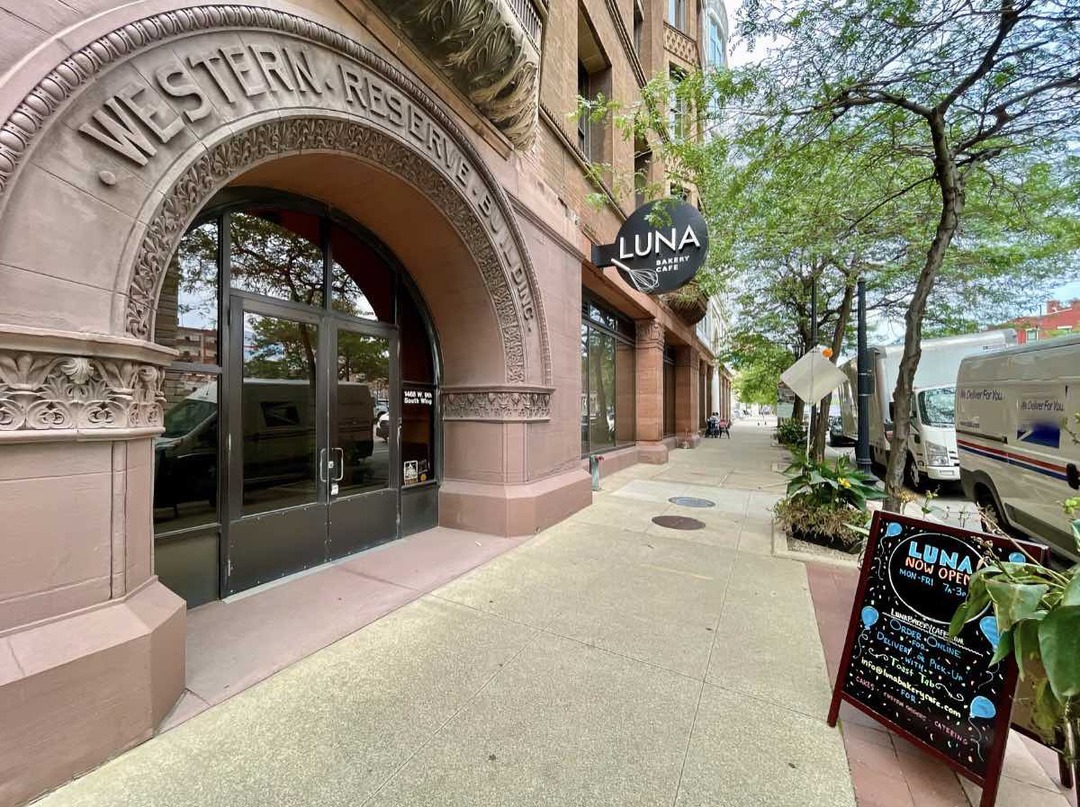
    <summary type="html"><![CDATA[<p><strong><em>Samuel L. Mather perched his offices in the Western Reserve Building above the river harbor where he plied his iron-mining and shipping business. At the time, he probably never imagined how the brick and stone edifice would fare as downtown and the city's economy evolved, but his onetime headquarters defied the odds, managing to retain its original function as an office building long after most other first-generation skyscrapers were demolished or converted to other uses.</em></strong></p><img src="https://mail.clevelandhistorical.org/files/fullsize/b24eb52bdd6ec25243308a1cd22ba2a4.jpg" alt="Romanesque Arch Entrance" /><br/><p>Samuel L. Mather, the grandson of one of the founding fathers of the Connecticut Land Company whose investment had led to the establishment of Cleveland, co-founded the iron-ore mining and shipping firm of Pickands, Mather & Co. in 1883, which helped him amass a new fortune on top of his already formidable wealth. Pickands Mather had kept offices for only a short time in the <a href="https://clevelandhistorical.org/items/show/1029">Perry-Payne Building</a> on Superior Avenue when Mather commissioned the Chicago architectural firm of Burnham & Root (already known locally for its <a href="https://clevelandhistorical.org/items/show/305">Society for Savings Building</a>) to design a headquarters office building on land that he and John Hay had purchased on the northwest corner of Superior and Water Street (now W. 9th).</p><p>The aptly named Western Reserve Building occupied a triangular parcel on the crest of a steep hill descending into the flats along the river. The land had once been home to the Carter Tavern, a hewn-log inn that early Western Reserve of Connecticut settler Lorenzo Carter had built in 1803. Following Carter's death in 1814, Phineas Shepard operated the inn for an unknown span of time, and it was the site of the meeting in 1816 that organized Trinity Parish, later <a href="https://clevelandhistorical.org/items/show/81">Trinity Episcopal Cathedral</a>. After it closed, deeds show that Carter's children Alonzo and Laura sold the land to the Oviatt family in two transactions in 1825 and 1830. By 1828, the Oviatts had replaced the old two-story inn with a three-story brick building that stood until Orson M. Oviatt razed it for a new four-story commercial block called the Franklin Buildings in 1835. The Franklin Buildings housed various dry-goods houses and professional offices, including the men's clothing store of George A. Davis, who owned the block from 1851 until his death ten years later. </p><p>The Franklin Buildings later housed Western Union Telegraph Company, which added "innumerable adornments of fencing and wires which surmount[ed] the electric ridden structure," according to an account in the <em>Plain Dealer</em> in 1886. Three years later, Hay and Mather, the executors of Amasa Stone's estate, purchased the property in the estate's name and set out to redevelop it. (Hay's and Mather's wives Clara and Flora were Stone's daughters.) Following on the heels of the Perry-Payne Building, the announcement of a new building to replace the Western Union block was a welcome news to those who feared Euclid Avenue's inroads. As the <em>Plain Dealer</em> pointed out in 1889, "Enough is now promised in the way of new buildings to save the street from becoming what it had at one time threatened to do—a street for banks and the wholesale trade plentifully mixed up with saloons."</p><p>Mather’s new eight-story pressed-brick and sandstone Western Reserve Building, which opened in 1892, is considered a transitional skyscraper. Like Burnham & Root’s Monadnock Building in Chicago and Cudell & Richardson's Perry-Payne Building, it had traditional load-bearing masonry exterior walls but also incorporated some interior steel framing, a recent innovation. On the ground floor, the Western Reserve Building featured pink sandstone piers capped by Romanesque capitals and a large Romanesque arch framing its Water Street entrance. Its upper floors had either rectangular, segment arch, or full arch windows, some of them in oriel bays. Samuel Mather had an elaborate cherry-paneled office inside. </p><p>In addition to Pickands Mather, the Western Reserve Building housed American Steel & Wire, Cleveland-Cliffs Iron, Island Creek Coal, and other shipping, mining, and manufacturing concerns. The building’s uses reflected business leaders’ desire to locate offices in the Wholesale District (later renamed the Warehouse District) close to Cleveland’s harbor. The riverside location was also attractive to the U.S. Weather Bureau. On May 1, 1892, Cleveland’s weather observatory and signal station opened there, 135 feet above the street, giving it a commanding view of the lake and river. From this lofty perch, signalman and weather observer W. B. Stockman hoisted flags to alert ship captains and downtown pedestrians to impending changes in the weather. The station had previously operated on top of the six-story Wilshire Block on Superior Avenue a block and a half west of Public Square. Now it was another beneficiary of Mather’s eagerness to be closer to the harbor. </p><p>In 1903, the Western Reserve Building was expanded northward along Water Street with an interior lightwell that may have drawn inspiration from Burnham & Root’s Rookery Building in Chicago or perhaps from a similar feature inside the Perry-Payne Building. The expansion increased the original building's size by about 40 percent. The building flourished into the 1920s, but like other buildings west of Public Square, it faced increasing competition from newer ones that rose to the east along Euclid Avenue. In 1924, Mather sold his interest in the Western Reserve Building to the Union Lennox Company, a firm named for the mammoth Union Trust Building that had recently replaced the Lennox Building on the northeast corner of Euclid and East 9th. Soon after, Pickands Mather moved its headquarters into the Union Trust Building. With the loss of its identity as a hub of the city's iron-ore business and the rise of newer, larger skyscrapers, the Western Reserve Building's future was in question.</p><p>The Western Reserve Building changed hands twice during World War II and, under Louis E. Goldman, it underwent a modernization in 1947 that covered its Romanesque arch entrance with a blocky granite façade. Despite this effort to renew its appeal, over the next three decades, the building stood sentinel over a part of downtown that was gradually decaying and receding in civic importance. Toward the end of that time, Goldman was no longer able to attract tenants, so the building sat mostly vacant. The exception to the rule was the opening in 1970 of the Cleveland Urban Learning Community, an experiment by St. Ignatius High School that took advantage of cheap rent to place its headquarters in the Western Reserve Building.</p><p>The Cuyahoga River’s east bank had been a natural place for Samuel Mather to envision an office building housing his iron mining and shipping business in the early 1890s. Although seemingly less natural, Herbert W. Strawbridge, chairman of the Higbee Company department store, felt a similar pull toward the western edge of the derelict Warehouse District nine decades later. Several years earlier, Strawbridge had visited San Francisco’s Ghirardelli Square, a shopping, dining, and entertainment complex filling the shell of its namesake chocolate manufacturer’s former factory. As Higbee’s downtown store sales slipped, Strawbridge recalled Ghirardelli Square. Then he hatched a daring plan to buy a swath of property overlooking the river and create a similar venue. Settlers’ Landing, as it would be named, would evoke Cleveland’s start along its river and, like Ghirardelli Square, reuse existing buildings as much as possible. More importantly, Strawbridge reasoned, Settlers’ Landing could draw large numbers of tourists and suburbanites back to a sagging downtown—and hopefully to Higbee’s.</p><p>Among the properties that the newly formed Higbee Development Corporation bought through agent John H. Bustamante was the Western Reserve Building, which Goldman was doubtless thrilled to unload in 1973. Strawbridge then hired Lawrence Halprin, the man behind Ghirardelli Square, to plan Settlers’ Landing. Higbee Development sank $4.5 million into a full renovation of the Western Reserve Building in 1974-76. The results drew a mixed response locally. Some decried the sandblasting that pitted the delicate sandstone facade. Others looked askance at the similarly insensitive treatment of the building’s interior. To avoid removing any leasable space, Higbee Development enclosed the historic lightwell to add an interior fire escape, heating and cooling ducts, and new restrooms on each floor. Halprin’s designer Angela Tzvetin created a modern lobby with “domed brick vaults” and spiderweb-like iron designs between their pillars, leading one architectural critic to dub the “corny” concept “early wine cellar.” The same critic went so far as to suggest that the Western Reserve Building was “second-rate Burnham and Root” that would have been better off bulldozed.</p><p>When the Western Reserve Building reopened in 1976, it seemed that the building had a new relevance as the Flats transitioned from maritime to leisure uses, but renewal was slow and difficult. Higbee’s operated a sandwich shop off the lobby while it searched (ultimately in vain) for a full-service restaurant to assume the space. At the time of the opening, only 1,220 of 53,840 square feet of office space was leased. Then Higbee’s plans for Settlers’ Landing collapsed after a major fire consumed some of the buildings the company had hoped to renovate. Despite efforts to promote the building, including hosting an exhibit and slideshow as part of the 1977 sesquicentennial of the opening of the Ohio Canal, the Western Reserve Building underperformed expectations. Coupled with Higbee’s expenses from opening new stores at Euclid Square and Randall Park malls, its renovation of Pickands Mather’s onetime headquarters building contributed to record quarterly losses that year. By 1981, the building was reportedly at 97 percent occupancy, but Higbee’s needed an infusion of cash, so it sold the building to another syndicate headed by developer John Ferchill.</p><p>Though Settlers’ Landing had flopped, the Flats and Warehouse District boomed in the 1980s. Nightspots, restaurants, and loft apartment conversions reinvigorated an area that earlier downtown planners had largely forsaken in their fixation on <a href="https://clevelandhistorical.org/items/show/909">Erieview</a>. It was too late for Higbee’s, which sold out to Youngstown developer Edward J. DeBartolo and the Little Rock-based Dillard’s chain in 1987 (though the Higbee’s name survived another five years). As for the Western Reserve Building, it flourished anew. Among the firms based there was Those Characters from Cleveland (now CloudCo Entertainment), a subsidiary of Cleveland-based American Greetings that formed in 1981 to develop and license characters developed by the card company such as Holly Hobbie and Strawberry Shortcake. That year saw Cleveland artist Elena Kucharik’s creation of the Care Bears, making the Western Reserve Building the birthplace of one of the 1980s’ popular culture icons. </p><p>Ferchill and his partners undertook yet another renovation in 1990 and built an eight-story addition to the north that doubled the size of the 1892/1903 building. The sandstone- and microcotta-faced addition featured a new arched entry, while the syndicate uncovered and restored the long-hidden one on the original building. After initial success, the enlarged building gradually languished again. By 2016, it was two-thirds vacant and in foreclosure, leading Ferchill to sell it the following year to WRB Partners (comprised of developer Fred Geis, real estate firm Cushman & Wakefield, and others). During the COVID-19 pandemic, the Western Reserve Building clung to its original function as an office building in a new era marked by the loss of downtown office-based work and a spate of office to residential conversions. In addition to attracting a global co-working company, WRB Partners added to its amenity-driven approach to combatting the loss of traditional dedicated office work by doing what Higbee’s had tried and failed to do fifty years earlier: entice a restaurant operator. In 2023, the popular Cleveland Heights-based Luna Bakery opened its third cafe on the building’s ground floor.</p><p><em><strong><a href="https://mail.clevelandhistorical.org/items/show/1030">For more (including 19 images) view the original article</a></strong></em></p>]]></summary>
    <published>2024-09-10T21:00:07+00:00</published>
    <updated>2026-04-17T19:17:43+00:00</updated>
    <link rel="alternate" type="text/html" href="https://mail.clevelandhistorical.org/items/show/1030"/>
    <id>https://mail.clevelandhistorical.org/items/show/1030</id>
    <author>
      <name>J. Mark Souther</name>
    </author>
  </entry>
  <entry>
    <title type="html"><![CDATA[Perry-Payne Building: Standing at a Place of Historic Memory]]></title>
    <summary type="html"><![CDATA[<p><strong><em>In the Spring of 1887, workmen tore down a number of three-story commercial buildings that had long stood on the north side of Superior Street between the National Bank Building on the northeast corner of Superior and Water (West 9th) Street and the Scovill Building (formerly the Franklin House), located midway up the block. The site was cleared to make room for the construction of the eight-story Perry-Payne Building. A little less than a year later, while the new Perry-Payne Building was going up, an article appeared in the <em>Plain Dealer</em> on April 15, 1888 recalling those earlier buildings and noting that "while the old must give way to the new," a number of Cleveland's most prominent pioneer merchants, including William Bingham and George Worthington, had started their businesses in the old buildings and that therefore "the place is of historic memory."</em></strong></p><img src="https://mail.clevelandhistorical.org/files/fullsize/cdb5ba97d0c460c22c2c6b53c94355bd.jpg" alt="Perry-Payne Building, 740 W. Superior Avenue" /><br/><p><span style="font-weight:400;">The historic land upon which the Perry-Payne Building at 740 W. Superior Avenue stands, and much of the land that surrounds it in Cleveland's Warehouse District, was first commercially developed by the Nathan Perry family. Nathan Perry Sr. (1760-1813) was an innkeeper in western New York's Genesee County when, in 1796, he was hired by Moses Cleaveland to provide food supplies to the surveying party that founded Cleveland. Almost a decade later, he, his wife Sophia, and their children moved here. In 1806, Perry purchased six acres of land northwest of the Public Square. On that land, which had frontage on Superior, St. Clair and Water (West 9th) Streets, Perry opened a trading post in a cabin that stood less than fifty feet from where the Perry-Payne Building stands today. </p><p>Nathan Perry, Sr. was one of Cleveland's first merchants. Less than a decade after arriving in Cleveland, however, he died unexpectedly. Four of his six acres, including the land upon which the Perry-Payne Building stands, passed to his son Nathan Perry Jr. (1786-1865), who transformed his father's trading post into a dry goods store and, in 1819, replaced the cabin with a two-story brick commercial building, one of Cleveland's first. Nathan Jr. operated his dry goods business in that building until 1826, when he sold the business but retained ownership of the building and the land upon which it stood. </p><p>In addition to running his dry goods business, Nathan Perry Jr., as early as 1814, had been making shrewd purchases of land in Cleveland, and, by 1830, he had become one of the city's wealthiest landowners. In that latter year, he moved his family from the simple frame house they had lived in on Water Street, just north of his dry goods store, into an early-era mansion on Euclid Avenue. It stood where Berkman Hall stands today on Cleveland State University's campus, just east of East 22nd Street.</p><p>In 1835, Perry decided to lease some of his land near the corner of Superior and Water to two hardware merchants, William Cleveland and Elisha Sterling. The terms of their two leases—drawn up by a young Cleveland lawyer named Henry B. Payne—required them to construct two three-story brick commercial buildings on the land they leased. Each of the two brick buildings they built had two storefronts. The buildings with their four storefronts became known as the "Central Buildings" because the corner of Superior and Water was then the center of Cleveland's commercial business district. It was in these buildings that William Bingham, George Worthington, and other prominent early Cleveland merchants, who were mentioned in the <em>Plain Dealer</em> article of April 15, 1888, got their business start.</p><p>As important as the Central Buildings were to the enlargement of Nathan Perry Jr.'s real estate portfolio, lawyer Henry B. Payne, who drafted the leases that required they be built, would soon become even more important. In 1833, Henry B. Payne was a law student in Hamilton, New York, when he was impelled to travel to Cleveland to help nurse his best friend, Stephen A. Douglas, who was suffering from a severe illness. Douglas, who later became the Illinois Senator whom Abraham Lincoln famously debated in 1858, left Cleveland after recovering. Henry Payne chose to stay. Payne completed his law studies here and, in 1836, when Cleveland officially became a city, Henry Payne became its first solicitor. In August 1836, Payne, who had in 1835, as noted above, served as Nathan Perry's lawyer, married Perry's only daughter, Mary, who thereafter became known to all in Cleveland as Mary Perry Payne. </p><p>Henry Payne practiced law in Cleveland for more than a decade before he decided to leave the practice. In 1849 he joined forces with Alfred Kelley and Richard Hilliard to build Cleveland's first railroad, the Cleveland, Columbus and Cincinnati ("CCC"). In the process, he became that railroad's first president. In 1855, Payne turned his attention to government service and was appointed to the City Waterworks Commission. It built Cleveland's first waterworks system. Then, in 1862, he took on the work of chairing a city sinking fund board which reportedly stabilized Cleveland's finances for years. Henry Payne also became active in local and state politics. He served in a number of Democrat party positions, before being elected in 1874 to the United States House of Representatives. A decade later, in 1885, he was elected Ohio's first United States Senator from Cleveland. </p><p>It was during the second year of Henry Payne's term as a United States Senator that local newspapers reported that Senator Payne was planning to build a new commercial building on Superior Avenue that would be named the Perry-Payne Building.  Different reporters and different historians writing in different eras have speculated differently as to the reason why Henry Payne named the Perry-Payne Building as he did. They all, however, may have been looking to the wrong person for an answer to their question. </p><p>When plans were made to build the Perry-Payne Building, the land upon which it was to be built was owned by Mary Perry Payne. The decade of the 1880s was one in which American women were beginning to acquire greater property rights, including the right to own, develop and dispose of real property in their own name. Henry B. Payne was uniformly said to be a progressive person of kind disposition who had a very loving marriage with Mary Perry Payne. Given all of the foregoing, there is no reason not to believe that Mary Perry Payne, probably with her husband's full support, was the person who chose the name of the building that was to be built upon her land. So perhaps the question that we should ask today, even if it was not asked by newsmen in 1887, or by historians thereafter, is: Why did Mary Perry Payne choose to so name her building? While we do not know the answer to that question with any degree of certainty, it might be as simple as that was where she first met Henry Payne.</p><p>In proceeding with their plans to build the Perry-Payne Building, Henry and Mary Perry Payne selected Cudell & Richardson, one of Cleveland's most prominent late nineteenth-century architectural firms, to design it. Cudell & Richardson, in additional to this historic building, also notably designed the following buildings still standing in Cleveland: St. Stephen Roman Catholic Church on West 54th Street; Franklin Circle Christian Church at 1688 Fulton Road; Belden Seymour Block at 2513-2525 Detroit Avenue; Franklin Castle at 4318 Franklin Boulevard; the George Worthington Company Building at 802-832 W. St. Clair Avenue; the Root and McBride Building at 1220 West 6th Street; and the Bradley Building at 1212-1224 West 6th Street. Additionally, Cleveland's Cudell Commons Park and the city's Cudell neighborhood are both named after Frank Cudell, one of the two named partners in that architectural firm.</p><p>The building Cudell & Richardson designed for Henry and Mary Perry Payne was described in a June 19, 1887 <em>Cleveland Leader</em> article. It was to be constructed "of brown stone and granite, in the Rennaissance style of architecture. The side and rear walls will be of brick. . . . The floor joists will be of iron and the floors fire clay tile. . . . [T]he stairs will be made of iron and cement or marble. Iron balconies will be provided on the fifth and seventh floors." The article stated that the building would be "eight stories high in the middle and seven on either side, with a basement. It will have a frontage of 138 feet, a depth of 100 feet, and will be 120 feet high." The article noted that the first floor of the building would be designed for the offices of banks, and the upper floors would have a total of 46 offices with an average size of 18 x 26 feet. </p><p>Other articles noted that the interior of the building would feature an eight-story interior court illuminated by a sky light. (The design of this light court, as well as the building's front facade, were reminiscent of Chicago's Rookery Building designed by Burhnam and Roots.) Other interior features of the Perry-Payne Building were its modern elevators and mail chutes that carried mail from all of the building's upper floors down to a first floor mail room. Designed with interior iron support columns, the Perry-Payne Building is notable architecturally as a transitional building between earlier buildings with masonry support walls and later buildings, including the Society for Savings Building erected just one year later, having interior steel support beams which enabled them to be built to great heights and led to them becoming known as "skyscrapers."</p><p>Construction of the Perry-Payne building commenced in the summer of 1887 after all of the old commercial buildings on the site had been razed. While construction was expected to be completed in 1888, financing difficulties encountered by Henry and Mary Perry Payne appear to have delayed completion of construction until the summer of 1889. The first tenants of the Perry-Payne Building included Bingham Hardware and National City Bank, who opened their offices in the new building on July 1, 1889.  When the Perry-Payne Building opened, it was the tallest and most grand commercial building in Cleveland, and it attracted many of the largest iron ore, coal, and shipping companies in Cleveland as tenants. It also attracted a number of Cleveland law firms, including a new firm named Squire, Sanders and Dempsey (today, Squire, Patton and Boggs), which has since become one of the city's largest and most historic law firms. </p><p>In the first two decades of its existence, even as larger and grander commercial building went up in downtown Cleveland, the Perry-Payne Building continued to attract more than its fair share of Cleveland's coal, iron, and shipping-related businesses, as well as a number of law firms and insurance companies. However, almost all of its core tenants departed after 1913 when Marcus Hanna's son Dan completed his construction of the enormous 15-story Leader Building on the corner of Superior Avenue and East 6th Street. Thereafter, for decades, the Perry-Payne Building survived with much less than full occupancy.</p><p>During its early years, ownership of the Perry-Payne Building remained with the Perry-Payne family and their descendants through the Perry-Payne Company formed in 1899, several years after the deaths of Henry and Mary Perry Payne. However, in 1945, that company sold the Perry-Payne Building to another corporation that was unrelated to the family. The building had many new owners in the years that followed and these new owners struggled to find and hold onto tenants. Then, in 1965, the State of Ohio leased the entire building for a number of its agencies with offices in Cleveland. This, however, only temporarily solved the building's occupancy problems for, in the summer of 1979, the State agencies departed when the new <span>Frank J. Lausche State Office Building, directly across the street, opened</span>.</p><p>In the 1980s and early 1990s, the owners of the Perry-Payne Building struggled anew with occupancy problems. In 1994, however, a new partnership purchased the building, hired an architectural firm known for its restoration work, and proceeded to restore the front facade of the Perry-Payne Building; renovate the remainder of it; and convert it into an apartment building with 91 apartments and 8,000 square feet of retail space. As of the writing of this story in 2024, the Perry-Payne Apartments remain a prestigious address in downtown Cleveland's Warehouse District.</p><p>If Mary Perry Payne were alive today and learned that her Perry-Payne Building had been converted into an apartment building, she might say that it really didn't matter, so long as Clevelanders today believe, as she and her husband and Clevelanders of her generation more than a century ago believed, that the Perry-Payne Building stands at a place of historic memory.</p><p> </p>
</p><p><em><strong><a href="https://mail.clevelandhistorical.org/items/show/1029">For more (including 19 images) view the original article</a></strong></em></p>]]></summary>
    <published>2024-08-06T01:52:23+00:00</published>
    <updated>2026-04-17T19:17:43+00:00</updated>
    <link rel="alternate" type="text/html" href="https://mail.clevelandhistorical.org/items/show/1029"/>
    <id>https://mail.clevelandhistorical.org/items/show/1029</id>
    <author>
      <name>Jim Dubelko</name>
    </author>
  </entry>
  <entry>
    <title type="html"><![CDATA[Mayfield Theater: Little Italy&#039;s Long-Dormant Movie House]]></title>
    <summary type="html"><![CDATA[<img src="https://mail.clevelandhistorical.org/files/fullsize/0784085f598a1d7fe35fba61477ae732.jpg" alt="New Mayfield Repertory Cinema" /><br/><p>Walking or driving through Little Italy, how many of us have wondered, “Why doesn't someone reopen or repurpose that old theater?” It’s a reasonable question despite the obvious challenges (cost, parking, safety, etc.). After all, the Mayfield Theater—a.k.a., the Mayfield Art Theatre, the Old Mayfield Theater, and the New Mayfield Repertory Cinema—has been shuttered for close to 40 years.</p><p>The “Old Mayfield” moniker is particularly resonant for those passersby of the Baby Boomer generation whose moviegoing journeys to 12300 Mayfield Road were in the late 1960s. That’s when this now-unassuming hole in the wall briefly became the go-to spot for silent films, silver screen classics, and revivals. For a time, “old was the new new.”</p><p>That incarnation (the theater's third) also may have struck a chord simply because the place exuded “old.” Original Arts and Crafts–style glass transoms. Crown molding. Time-worn terrazzo floors. Tickets were issued from a closet-like opening in the entryway, after which visitors would enter a gloomy and cramped low-ceilinged lobby. Directly above, a tiny projection booth could be accessed only via a metal ladder. By the late ’60s the theater’s original seats (some allegedly taken from the <a href="https://clevelandhistorical.org/items/show/460">Euclid Avenue Opera House</a>) were gone, but their rickety replacements were a perfect musty accompaniment to the showing of a 1920s or ’30s movie. </p><p>The first of the Mayfield Theater’s many lives began in 1923, when Michele Mastandrea, an Italian immigrant, built the two-story brick building with a theater on the first floor and a large apartment on the second. Mastandrea had previously operated a dry goods store on that same parcel. Before that he worked as a shoe salesman in a shop on the current site of Maxi’s Bistro. Mastandrea and his wife Christina lived in a small house behind the theater (fronting Fairview Court) until they moved to the new building’s second floor quarters in 1929. They operated the theater and remained in the spacious eight-room apartment until their deaths in 1955 and 1958, respectively. </p><p>The Mayfield wasn’t Little Italy’s first theater. The Venice, which opened around 1915, was a converted storefront at 12016 Mayfield Road, current site of the Little Italy Visitor Center at Random and Mayfield. The Roma Theater, a few years older than the Venice, staged live performances and possibly short films. It was located directly across Random Road from the Venice, where Tony Brush Park now stands. Both venues closed more-or-less concurrently with the opening of the Mayfield, which continued to be the only theater in Little Italy throughout its 32-year run. Mastandrea’s offerings included Italian-language and second-run Hollywood movies, as well as occasional live performances of Italian plays. As the neighborhood’s largest gathering space, the Mayfield also hosted community meetings and lectures, benefit performances (e.g., for Holy Rosary Church), <a href="https://clevelandhistorical.org/items/show/377">Feast of the Assumption</a> and Columbus Day celebrations, and political gatherings. In November 1930—the night before the national election—Ohio senate candidates debated at the Mayfield. </p><p>Michele Mastandrea died in August 1955 and the theater closed. In January 1959, it reopened as the Mayfield Art Theater, part of a national chain of art movie houses. Veteran managers Jack Silverthorne and Jack Lewis upgraded the marquee, interior, and projection equipment, and installed a new CinemaScope (super-wide) screen. The two Jacks showed first-run foreign films, as well as domestic comedies, dramas, and documentaries. Rod R. Mastandrea, a Cleveland attorney and son of Michele Mastandrea, assumed control in September 1959, a tenure that ended that December when the curtain came down again, save for a very brief attempt at live theater in 1961.</p><p>Amid the tumult of 1968, some Clevelanders may have been particularly primed for nostalgia. Thus emerged the space’s third reincarnation: the Old Mayfield, which the <em>Plain Dealer</em>’s George Barmann christened “Cleveland’s first silent movie house since the silent movie houses.” Blood and Sand with Rudolph Valentino kicked things off on October 3, 1968. Forthcoming attractions included <em>The Gold Rush</em> with Charlie Chaplin, <em>Way Down East</em> with Lillian Gish, <em>Arizona Wooing</em> with Tom Mix, The <em>Hunchback of Notre Dame</em> with Lon Chaney, and <em>The Mark of Zorro</em> with Douglas Fairbanks.</p><p>The Old Mayfield's emergence wasn't driven by movie men. Instead, the rescuers were Sam Guarino, owner of Guarino’s restaurant and Hank Schulie of the Golden Bowl. After forming the Itlo Development Corporation (Itlo stood for Italian Little Italy Organization), the two restaurateurs cleaned the place up, hired a pianist, and installed a beer and champagne bar in a corner of the lobby. Alas, their enthusiasm was not enough to overcome the area’s incessant parking problems as well as the race-related tensions that typified the time and the neighborhood, and the theater closed in October 1969. It reopened briefly in January 1970 with a spate of Marx Brothers and W.C. Fields movies, but lapsed back into sleep by late spring. </p><p>After four years, the theater was resurrected for the last time by an English and drama professor and cinephile named Sheldon Wigod. Dubbing his new movie house the New Mayfield Repertory Cinema, he stuck with classic movies but interspersed them with foreign films—from Flynn to Fellini. Wigod brought a personal—and personable—touch to the business, introducing each film prior to its showing. It was during Wigod’s tenure that the building was designated a Cleveland Landmark. </p><p>Wigod’s labor of love did better than most; the New Mayfield Repertory Cinema stayed awake until 1985 but has been vacant ever since. However, it did receive a spot on the National Register of Historic Places in 2013. And why hasn’t there been another reawakening? We periodically see vague hints—a cleanup here, a supply truck there—but specifics are few and barriers are many. Parking challenges are clearly a major hurdle. However, it seems likely that adhering to modern fire and safety codes might play a part, as could the high cost associated with converting to a digital film format or turning the space into something other than a theater.</p><p><em><strong><a href="https://mail.clevelandhistorical.org/items/show/1013">For more (including 7 images) view the original article</a></strong></em></p>]]></summary>
    <published>2024-02-07T20:21:13+00:00</published>
    <updated>2026-04-17T19:17:43+00:00</updated>
    <link rel="alternate" type="text/html" href="https://mail.clevelandhistorical.org/items/show/1013"/>
    <id>https://mail.clevelandhistorical.org/items/show/1013</id>
    <author>
      <name>Chris Roy</name>
    </author>
  </entry>
  <entry>
    <title type="html"><![CDATA[Rose Building: &quot;The New Center&quot;]]></title>
    <summary type="html"><![CDATA[<p><strong><em>In 1898-1900, Benjamin Rose financed the construction of the largest office building ever built in Ohio up to that time. At a time when conventional wisdom dictated a Euclid Avenue address, Rose did the unthinkable, selecting a spot at the corner of Prospect Avenue and Erie Street. Naysayers were convinced Rose's daring venture was doomed to fail, but they were wrong.</em></strong></p><img src="https://mail.clevelandhistorical.org/files/fullsize/1e18dd70994fd06dc46874a9b5534ab0.jpg" alt="Main Entrance" /><br/><p>The ten-story Rose Building took its name from its developer, an English immigrant and pioneer in the meatpacking industry. In 1854 Benjamin Rose and Chauncey Prentiss established Rose & Prentiss, later renamed Cleveland Provision Company, which embraced refrigeration and other innovations early and was the city’s largest packinghouse for more than a century. With the fortune he amassed selling cuts of meat, in 1898 Rose commissioned architect George Horatio Smith to design what would become Ohio’s largest office building.</p><p>When the Rose Building was constructed, Erie Street (now East 9th), was on the eastern fringe of downtown, but Rose cleverly dubbed the intersection “The New Center” and used this slogan to entice businesses that might otherwise have considered the location too distant. Indeed, the Rose Building stood out. Its first five stories were sixteen feet high, while floors six to ten were eleven feet high. The choice to make the ceiling height of the lower floors so much higher than usual was reportedly Rose’s wish. </p><p>Upon its opening in 1900, the building’s primary tenants on the lower floors included Lederer Furniture, Scott Dry Goods, and offices of the White Sewing Machine and Cleveland Gas & Electrical Fixture companies. The upper floors contained doctors’ and dentists’ offices, an artist’s studio, a correspondence school, and the offices of fifteen oil companies. In its early years the Rose Building also hosted many exhibitions, including the works of Cleveland artists, a Slavic craft fair, and even a mock Congressional session. </p><p>In 1908 Rose was poised to stake out the next speculative “new center” of downtown. He bought out the St. John’s African Methodist Episcopal Church on East 9th across from Erie Street Cemetery with plans to build a twelve-story office building, but before he could carry out the plan, he died during a trip to England. Instead of burnishing his reputation in life as a visionary developer, in death Rose seeded the legacy for which he is known today. In 1909, the Rose Building gained a new tenant. Tucked away in small, sparely furnished office on the tenth floor was the Benjamin Rose Institute. Funded by Rose’s $3 million bequest, it used the office to review applications for small pensions to enable elderly men and women to afford to remain in their own homes.</p><p>In 1984, the Institute sold the Rose Building to Medical Mutual of Ohio, which had located its headquarters there in 1947. Medical Mutual owned the building until 2000, when it sold it to California-based BentleyForbes and leased its space. When the owner fell into foreclosure, Medical Mutual bought the building back in 2017, but its future in downtown was anything but certain. After much deliberation, Medical Mutual vacated the Rose Building in 2023 and merged its operations in its Brooklyn, Ohio, offices in the former American Greetings headquarters. While pessimists might quip that Benjamin Rose's doubters were ultimately proven right, the Rose Building's now much more central location makes it a likely candidate for a new lease on life.</p><p><em><strong><a href="https://mail.clevelandhistorical.org/items/show/1012">For more (including 12 images) view the original article</a></strong></em></p>]]></summary>
    <published>2024-01-11T16:07:38+00:00</published>
    <updated>2026-04-17T19:17:43+00:00</updated>
    <link rel="alternate" type="text/html" href="https://mail.clevelandhistorical.org/items/show/1012"/>
    <id>https://mail.clevelandhistorical.org/items/show/1012</id>
    <author>
      <name>J. Mark Souther</name>
    </author>
  </entry>
  <entry>
    <title type="html"><![CDATA[Jesse Owens: The Cleveland Years]]></title>
    <summary type="html"><![CDATA[<p><strong><em>In the 1936 Olympics held in Berlin, Germany, African American Jesse Owens won 4 gold medals for the United States, sending a clear message to Adolf Hitler about his Nazi regime and theories of white supremacy. Owens' early years in Cleveland contributed in no small way to his ability to cope with racism at home and abroad while at the same time performing at the highest levels in athletic competitions.</em></strong></p><img src="https://mail.clevelandhistorical.org/files/fullsize/b06f252d1c7c1b369927bf03397a7f4e.jpg" alt="Setting an American Record in the Long Jump in 1935" /><br/><p>James Cleveland "Jesse" Owens, widely considered to be one of the greatest American athletes of the 20th century, was born in 1913 in Oakville, Alabama. His parents, Henry and Emma Owens, were sharecroppers who, like thousands of other African Americans living in the South in the post World War I era, decided to leave and migrate to one of the industrial cities of the North. By 1922, Henry and Emma and their eight children had moved to Cleveland and were renting a house on Hamilton Avenue near East 21st Street. The area was home to a small enclave of African Americans who lived within a larger ethnic neighborhood composed predominantly of immigrants from Poland, Lithuania, Russia, and Serbia. </p><p>Jesse, as he would later come to be called, was the family's youngest son. According to an interview he later gave in 1961, he made friends with the Polish boys in the neighborhood who were his age, saying that the color of his skin did not seem to matter to them. Like his father and older brothers who worked in the nearby steel mills, Jesse also worked in his new neighborhood, finding employment as a shoe shine boy at a nearby shoe repair shop on St. Clair Avenue.</p><p>In 1926, when he was 13 years old, his family moved to a house on East 90th Street, just south of Cedar Avenue. The move may have been prompted by his mother's discomfort in the Hamilton Avenue neighborhood. Years later, Owens remembered her keeping the window blinds closed all day and rarely venturing from the house unless accompanied by a member of her family. The family's new house was located in a part of the Cedar-Central neighborhood, east of East 55th Street, where many middle class and professional black families were settling in the 1920s. </p><p>The Owens family's relocation to East 90th Street would make all the difference to Jesse's future. He was enrolled in the sixth grade at nearby Bolton Elementary School and it was there that he acquired the name "Jesse" when his teacher asked him what his name was and he responded, with a Southern drawl, "J.C. . . Owens." Even more importantly, it was at Bolton where Owens was introduced to Charles Riley, a playground supervisor there. Riley was also the track coach at Fairmount Junior High on East 107th Street, the school where Owens would be attending the following year. Riley devoted himself to working with underprivileged youths and soon took Owens under his wing, training him every day before school started, often also bringing breakfast to the underweight boy. When Jesse started seventh grade at Fairmount the following year, Riley, seeing his potential, convinced him to try out for the track team.</p><p>It didn't take long before Cleveland began to take notice of track star Jesse Owens. Local papers reported in March 1928 that he took first place in the high jump at the annual Cleveland Athletic Club Indoor Meet held at Cleveland Public Hall. A year later, as an eighth grader competing at the same meet, he won three events--the high jump, the 40 yard low hurdles and the 40 yard dash--setting meet records in two of them. In March 1930, he returned to the Cleveland Athletic Club indoor meet at Public Hall for the final time as a junior high student, setting a new record in the high jump, besting the old record by more than two inches.</p><p>In the fall of 1930, Jesse Owens started high school at East Tech on East 55th Street. The joy of beginning high school may have been tempered, as it likely was for many other Cleveland students, by the deepening of the Great Depression which had struck America the year before. Just prior to its onset, Jesse's father was injured in a car accident and lost his job at the steel mill. Even after he recovered, he was not hired back. Jesse's older brothers also lost their jobs at the mill as the national economy slowed. To survive, Henry and Emma, along with the families of several of their adult children, moved in together into a two-family house at 2211 East 95th Street. Later, this extended family moved into a larger house at 2178 East 100th.</p><p>While his family struggled to just survive, Jesse thrived in high school, especially in sports. By this time, he was the only one of Henry and Emma Owens' eight children who had not dropped out of school to work and help support the family. Although he excelled in several sports in junior high, Owens was persuaded by East Tech's principal to now focus exclusively on his best sport, track and field. He also gave up the high jump--at the time arguably his best event--because East Tech already had a good jumper in future Olympic silver medalist Dave Albritton. Owens believed that he could best contribute to the success of his team at track meets by concentrating on the broad jump and several of the sprint events.</p><p>After a string of victories and record-setting performances at various track meets during his first two years at East Tech, Owens decided to try out for the 1932 Olympic team. At the tryouts held in June in Chicago, he found himself competing against older and more seasoned athletes and, despite performing well for a high schooler, he did not make that Olympic team. In his senior year, the high schooler bounced back, especially at the National Interscholastic Championships, where he won the long jump, as well as the 100 and 220 yard dashes, setting new national interscholastic records in all three events. The City of Cleveland honored Owens afterwards with a parade and a personal meeting with Mayor Ray T. Miller, who presented him with a laudatory city resolution.</p><p>As his high school years at East Tech came to a close, Jesse Owens publicly announced in August 1933 that he had decided to attend college at Ohio State University, where he planned to continue his amateur track and field career. It was a decision that angered leaders in the black community in Cleveland and elsewhere who referred to the university as "color-line Ohio State," because of its unfair treatment of black students at that time. According to Owens' principal biographer, however, Owens made his decision based solely upon which college he believed would best enable him to continue to contribute to his family's support. </p><p>Jesse Owens' support obligations had increased at the beginning of his senior year in high school when his girlfriend Ruth Solomon gave birth to their first child. From that point on, Owens added the obligation of supporting his child to what he felt was a continuing obligation to help support his parents. In the 1930s, colleges did not offer athletic scholarships in track and field. Therefore, for a track and field athlete like Owens, the only way to both attend college and meet family support obligations was to find a job that would enable him to do both. Ohio State offered him such a job, arranging for him to be hired as an elevator operator at the State House in Columbus while attending college. According to Owens, he made enough money at this job to not only pay his school tuition and personal living expenses, but to also send money home every week to both his mother and to Solomon, whom he married in Cleveland in 1935.</p><p>At Ohio State, Jesse Owens continued to win and set records in the long jump and sprint events. In May 1935, he achieved international fame and became a favorite for the 1936 Olympics to be held in Berlin, Germany, as a result of his performances at the Big Ten Championship Meet in Ann Arbor, Michigan. There, just days after being hospitalized for a back injury sustained in a fall down a flight of stairs on Ohio State's campus, he won the long jump, the 220 yard low hurdles, and the 100 yard dash, setting world records in all three events. One year later, at the Berlin Olympics, Owens won four gold medals--in the long jump, 100 and 200 meter dashes and as a member of the 400 meter relay team. He returned home to the United States to parades in New York City and in Cleveland. While some writers at the time contended that Hitler had snubbed Owens at the Olympics, historians have subsequently noted that the real snub he received was from President Franklin D. Roosevelt who, fearing to offend Southern Democrats, failed to even congratulate Owens, much less invite him to the White House.</p><p>Jesse Owens' Olympic victories signaled the beginning of the end of his days in Cleveland. After being honored with a parade in Cleveland for the second time, he looked for work in Cleveland but found very little that provided compensation commensurate with the level of success he had experienced at the Olympics. Since 1933, when not attending classes in Columbus, Owens had worked in Cleveland as a filling station attendant at <a href="https://greenbookcleveland.org/locations/wrights-service/" title="Wright’s Service @ Green Book Cleveland">Alonzo Wright's Sohio gas station</a> at East 93rd and Cedar. He now hoped that Cleveland would give him a better paying and more prestigious job, but the City instead offered him a position as a playground supervisor which paid an annual salary of only $1,600.00. He later referred to the combination of grand parades which honored him and the meager jobs which were offered him as "parades and poverty."</p><p>For several years following his Olympic experience, Owens explored businesses opportunities in Cleveland and elsewhere. One was the Jesse Owens Dry Cleaners store, which he and several business partners opened at the corner of East 100th and Cedar in 1938. Within a few years, however, the business failed, bankrupting Owens and causing a bank to foreclose on the house at 2187 East 87th Street which he had bought for his parents in 1936. According to a Call and Post news article, Owens was able to later buy a second house for them on Westchester Avenue in the Glenville neighborhood. However, just two weeks after moving into this house, Jesse's mother died. Two years later, his dad died, and, shortly after that, Jesse Owens departed Cleveland for good, accepting a management job in Detroit with the Ford Motor Company. Later, he moved to Chicago where he lived for most of the rest of his life. In 1980, Jesse Owens died at age 67. </p><p>In 1982, Cuyahoga County honored Jesse Owens by commissioning a statue of him which was placed in <a href="https://clevelandhistorical.org/items/show/518">Huntington Park</a>, just to the west of the Cuyahoga County Court House. More recently, in 2022, University Circle unveiled plans to honor Owens by constructing the Jesse Owens Olympic Oak Plaza at Wade Park. The plaza, located just north of the Rockefeller Lagoon, is (as of May 2023) partially constructed. Its centerpiece is an oak sapling which was cloned from the last of the surviving oak trees given to Owens by the German Olympic Committee in 1936 to commemorate his four Olympic gold medals. Were he alive today to witness these postmortem honors from the County and now University Circle, Inc., Jesse Owens might thank them but at the same time remind them that "parades" alone will not reduce "poverty" in underserved communities like the ones he lived in when he called Cleveland his home.</p><p><em><strong><a href="https://mail.clevelandhistorical.org/items/show/1003">For more (including 18 images) view the original article</a></strong></em></p>]]></summary>
    <published>2023-05-24T22:13:34+00:00</published>
    <updated>2026-04-17T19:17:43+00:00</updated>
    <link rel="alternate" type="text/html" href="https://mail.clevelandhistorical.org/items/show/1003"/>
    <id>https://mail.clevelandhistorical.org/items/show/1003</id>
    <author>
      <name>Jim Dubelko</name>
    </author>
  </entry>
  <entry>
    <title type="html"><![CDATA[Building the Cleveland Museum of Art: 1888 to 1916]]></title>
    <summary type="html"><![CDATA[<img src="https://mail.clevelandhistorical.org/files/fullsize/02b11a0c1507e3ced61e847e8b420725.jpg" alt="Cleveland Museum of Art Under Construction" /><br/><p>In the late 19th and early 20th centuries, the museum movement was sweeping the United States. Some cities had long-established art museums while others looked to form new ones. Cities without permanent exhibition spaces welcomed traveling exhibits for short periods of time. Cleveland was one of these cities that lacked a permanent art museum, so it hosted traveling exhibitions at Central High School. A spate of influential art museum openings in the 1880s helped ignite local interest in securing a museum for Cleveland. In 1880 President Rutherford B. Hayes dedicated the Metropolitan Museum of Art in New York City. With Cincinnati and Detroit founding art museums in 1881 and 1885, respectively, Clevelanders wanted a museum of their own. Some Cleveland artists were showing their work in the Met and made sure to note that they were unable to show their work in Cleveland due to the lack of a museum. </p><p>The first opportunity for a Cleveland art museum came with the death of Hinman Hurlburt. With the probating of his will in 1884 came the announcement that the majority of his estate and art collection should be put toward an art gallery. However, the part of his estate set for a museum would have to wait until his wife passed. The question, “Who will found for us a museum of art?” was posed at the Annual Patron Banquet for the Art School in 1888. This open call for creation of a museum in Cleveland continued to circulate and build momentum. These calls also brought whispers of potential donors. John Huntington contemplated creating a museum with the proposal of donating his personal art collection to Cleveland in 1889. The Art School also began to discuss plans for a combined museum and college. When Horace Kelley died late in the following year, he left most of his $500,000 estate for an art museum. </p><p>Two more years passed before the next big advance in museum plans. On December 25, 1892, Jeptha H. Wade II gifted a plot of land in Wade Park to the Kelley Art Trustees for the museum. The location in Wade Park was a little larger than four acres and sought after by Western Reserve University, the School of Art, and the Cleveland Park Commission. Wade originally expected the Kelley Art Trustees to pay for the parcel but chose to gift the land with newspaper announcements being made on Christmas Day. The acquisition of the land and the money from the Horace Kelley Trust led to increased pressure from Clevelanders asking for a museum to be built. Even with the land for the museum secured, seven more years passed before the Horace Kelley Trust set up a corporation for the museum. </p><p>Henry Clay Ranney was one of the trustees for both the Hurlburt and Kelley trusts, but he was also one of the executors of John Huntington’s estate. Huntington’s wishes for a museum were rumors until his death in 1893, when his will was released setting up a trust for a gallery and museum. Ranney, now trustee of all three estates, worked to unite all three to make one museum because he saw that they all had similar wishes. On March 16, 1899, Ranney sent off articles of incorporation to formally establish the <a href="https://clevelandhistorical.org/items/show/29">Cleveland Museum of Art</a>. He was elected as the first President of the museum that May. The newly formed Board of Trustees was composed of many notable men including J. H. Wade, George H. Worthington, Samuel Mather, William B. Sanders, Samuel Williamson, and Liberty Holden. John D. Rockefeller and Charles F. Brush were also elected but decided not to serve due to other engagements. </p><p>Despite the pressure to build immediately, preliminary steps toward the creation of the museum were being taken slowly. Another seven years passed before the architects Hubbell and Benes were chosen for the project in 1906. Preliminary plans were set in motion after the selection of the architects. In April 1907, a six-person committee discussed the first plans but called for revisions. The committee included Ranney, J. M. Jones, J. H. Wade, William Sanders, Liberty Holden, and Hermon Kelley. The committee traveled to Boston to talk to Edmund Wheelwright, the consulting architect for the Boston Museum of Fine Arts, and trekked across Europe taking notes, and its members continued to discuss and revise plans for another six years before building began. </p><p>During planning, battles erupted with the city over location disputes. The Museum Committee wanted to orient the museum east-west which would change the boundary of the land gifted by Wade, an action requiring city approval. The city rejected this proposal due to the cost to the city, but ultimately approved a new proposal in December 1908 with the building facing University Circle and Wade Lagoon to the south. The Committee and the city, particularly Mayor Tom Johnson, also disagreed on payment which was tied to when the museum would be open to the public. The Huntington will stipulated that the museum would offer admission-free days, but Mayor Johnson was trying to force the hand of when the free days would occur. The dispute ended with the conclusion of Johnson's five-term run in January 1910. Herman Baehr came into power and helped settle the dispute. Behind closed doors the Kelley Trust received a quitclaim deed from Wade to secure museum expansion in 20 to 30 years. More bad news came in March of that year. The Museum discovered that only $75,000 would come from the Hurlbut gift, not the original estimate of $500,000 that they had planned. The shortfall was resolved when the Huntington Trust agreed to pay two-thirds and the Kelley Trust one-third toward the cost of building, finally permitting the first steps to commence on building the museum. </p><p>The headline “First Stake Driven for Art Museum” introduced surveying action that occurred on the property in 1911 and Hubbell’s promise that the building would be completed in two years. Despite his claim of such a short build time, more challenges appeared. Even with the Huntington and Kelley Trusts taking on the cost, they were over their $1 million budget. The original plans centered around the three trusts were now questioned. The design committee went over a variety of new plans presented by Hubbell including new one-story options to help save money. Ultimately, they chose to go with a two-story option that gives the look of a single story from the north but presents a grander facade when viewed from across Wade Lagoon to the south. The design, rendered in white Georgian marble, reflected the Beaux-Arts influence that accompanied the pervasive City Beautiful movement of the time. In the fall of 1912, with little progress made, the Trustees blamed the architects for the delay of the museum. In the meantime, roads around the planned museum location were being constructed and by 1913 excavation was under way to move the Perry Monument from its spot in Wade Park to Gordon Park to make room for the museum. Excavation continued without pause until 1914 when police stopped construction due to missing permits. Along with missing permits, the plans for the building violated state building codes and Hubbell had to adjust the plans again to add more exits and reach code approval. After obtaining the proper permits, construction continued. </p><p>The museum committee announced the hiring of J. Arthur MacLean from the Boston Museum of Fine Arts to be the curator for the museum on September 6, 1914. Through the final phases of construction, the museum committee had calls for donations and searches for collections, but on June 7, 1916, it finally opened to the public. The accounts of opening night detailed it as marvelous and well attended. According to one, “the event marked the culmination of the dream and plans of thousands of Clevelanders to have a Cleveland art museum which would stand as a civic asset.” The museum was officially turned over to the people by the president of the museum association Judge William B. Sanders, who paid tribute to the founding donors John Huntington, Horace Kelley, and Jeptha Wade as well as the architects. The opening also welcomed new announcements for collection donations to help fill the museum’s galleries. </p><p>In addition to being known for its extraordinary collections, perhaps the Cleveland Museum of Art’s most singular attribute was its free days. From the start, the museum was open two days a week to the public at no charge. Not only was admission free but the museum was focused on education and provided free spaces for students to draw. This set the museum apart from art institutions in other cities. In keeping with its founding principles, the Cleveland Museum of Art later expanded this legacy, and its permanent collection is now always free to the public.</p><p><em><strong><a href="https://mail.clevelandhistorical.org/items/show/970">For more (including 10 images) view the original article</a></strong></em></p>]]></summary>
    <published>2022-11-07T03:15:53+00:00</published>
    <updated>2026-04-17T19:17:42+00:00</updated>
    <link rel="alternate" type="text/html" href="https://mail.clevelandhistorical.org/items/show/970"/>
    <id>https://mail.clevelandhistorical.org/items/show/970</id>
    <author>
      <name>Jasmine Prezenkowski</name>
    </author>
  </entry>
  <entry>
    <title type="html"><![CDATA[The Union Club: Cleveland&#039;s Oldest Private Business Club]]></title>
    <summary type="html"><![CDATA[<img src="https://mail.clevelandhistorical.org/files/fullsize/aff2d346f93e317e2a4c018da3efcdeb.jpg" alt="The Union Club of Cleveland postcard" /><br/><p>In October 1989, <em>Cleveland Plain Dealer</em> business writer John Freeh wrote of the "downtown clubs of Cleveland." In an aside article he described his reception, as a journalist, when he requested an interview with the Union Club of Cleveland management. Club members declined his submitted questions in a "century-long tradition of confidentiality." Further attempts to individually interview executive and civic leader members were similarly denied. Nonetheless, Freeh assembled considerable information to profile Cleveland’s most prominent businessmen’s clubs that had been thriving for up to a century at that time, including the Commerce Club, the University Club, the Cleveland Athletic Club, the Hermit Club, the Tavern Club, and the Slovenian National Home. The clubs shared the common purpose of providing social settings for like-minded business leaders to gather, dine, entertain, and conduct business.</p><p>The Union Club of Cleveland is the grande dame of downtown clubs. Founded in 1872, it traces its roots back to the 1830s when the first Union Club in Cleveland was a troop of armed farmers protecting the village from horse and cattle thieves. Later, "Union League" clubs began to grow in several northern cities leading up to and during the Civil War. Clubs were committed to the Union cause and to promote loyalty and support to the causes of Abraham Lincoln. The League of clubs ultimately embraced the Republican Party, pro-Union Democrats, and the Union military and worked to alleviate miseries of the war experienced by local participants. </p><p>By 1870, the Cleveland Club, headquartered on the north block of Public Square, attracted patriotic and prominent citizens with common political, business, and academic/social interests. Shortly thereafter, dissatisfaction led to a mass exodus of about 70 members who organized and purchased the Senter residence at 48 Euclid Avenue (the future site of the <a href="https://clevelandhistorical.org/items/show/25">Hippodrome Theatre</a>) to become the clubhouse for the Union Club of Cleveland. Eighty-one men comprised the original membership including trustees led by Chairman William Bingham and Secretary Waldemer Otis. Trustees included Samuel Mather, William Boardman, H. B. Payne, and others. Marcus Hanna and Amasa Stone were also among the founding members. The Union Club of Cleveland charter declares "for the promotion of physical training and education." Members bought stock and paid dues to fund the club. The club boasts members from the US Senate and House of Representatives, Supreme Court Justices, U.S. Ambassadors, rail and auto executives, bishops (Episcopalian and Catholic), inventors, and an historian (James Ford Rhodes). Presidents Grant, Hayes, McKinley, Garfield, and Taft were honorary members who entertained at the club.</p><p>The club flourished with members (numbering 400) and civic influence during the ensuing 30 years of Cleveland’s industrial prosperity. By the turn of the century, the clubhouse would no longer adequately house the projected membership and a search began for a new headquarters site. After much study of available properties, finances, and member preferences, the Castle estate at East 12th and Euclid was purchased and Club members Charles Schweinfurth and David Norton were named architect and builder, respectively, for their new home, sized to accommodate 1,000 members.</p><p>December 6, 1905, marked the dedication of the new Union Club of Cleveland at 1211 Euclid Avenue, where it remains today. Decades of the 20th century brought a variety of challenges to the club now settled into its permanent home. In 1907 local politics divided the club. The club’s vast majority and leading Republican members supported Congressman Theodore Burton to unseat Mayor Tom Johnson. Liberty Holden, <em>Plain Dealer</em> publisher and Union Club president, supported Johnson, leading to internal debates and clashes among members about their nearly unanimous support and aid for Burton. Tom Johnson openly criticized the club and "sought its condemnation." Tom Johnson, a dues-paying absentee Union Club member, resigned shortly after his re-election that year. </p><p>The 1910s brought new challenges, including the club’s growing membership and operational and financial tensions. The advent of World War I and club members’ patriotic pride combined to influence Cleveland’s support of the impending war effort. Prohibition presented challenges to the tap room and refreshment aspects of the club—one manager served jail time for a Volstead Act conviction. Depression circumstances led to operational issues and fluctuating membership in the fourth decade and World War II brought growth and prosperity to the city and club for three more decades into the 1970s. The clubhouse interior was renovated often to accommodate functional and operational issues. </p><p>Club by-laws and social transformation evolved as well over time. Founding members instituted a 100-year tradition of all-male membership; women, wives and family of members were afforded full but separate member privileges in 1882 via separate entrances and room access in the clubhouse. Likewise, membership also excluded African American and Jewish men through the club’s first century. Change came gradually beginning about 1970 with Jewish members, and later in 1982, when the Union Club welcomed its first woman member with full privileges (Karen Horn, President of the Cleveland Federal Reserve Bank). Before its 150th birthday, the Union Club has seen its first woman president and first black president. While the "personality" of the club ebbed and flowed with its membership, it has remained a conservative social club of Cleveland’s elite business, civic, industry, and social leaders. True to its "ancestry" in the Union League, it remains an elite social club sharing characteristics of its fellow union clubs in Boston, New York, Philadelphia, Chicago, and Washington, D.C.</p><p><em><strong><a href="https://mail.clevelandhistorical.org/items/show/963">For more (including 7 images) view the original article</a></strong></em></p>]]></summary>
    <published>2022-08-21T21:07:46+00:00</published>
    <updated>2026-04-17T19:17:42+00:00</updated>
    <link rel="alternate" type="text/html" href="https://mail.clevelandhistorical.org/items/show/963"/>
    <id>https://mail.clevelandhistorical.org/items/show/963</id>
    <author>
      <name>Jim Lanese</name>
    </author>
  </entry>
  <entry>
    <title type="html"><![CDATA[West Side Y.M.C.A. : A Cleveland Neighborhood Center for Over a Century]]></title>
    <summary type="html"><![CDATA[<p><strong><em>In 1895, the Board of Directors of Cleveland's Young Men's Christian Association decided the time was right to build the organization's first branch facility on the city's West Side.  It was a decision that not only produced several important "firsts" for the organization but, in the longer view, created a new community center on Franklin Boulevard that would serve the surrounding neighborhood for more than a century.</em></strong></p><img src="https://mail.clevelandhistorical.org/files/fullsize/e95030159fc082e7def69a9aaaf5408e.jpg" alt="The West Side YMCA" /><br/><p>The origins of the building at 3200 Franklin Boulevard, which today is home to a condominium development known as "Franklin Lofts,"  may be said to go back to May 7, 1898, and the sudden death of W. A. Ingham, a prominent Cleveland bookseller and publisher.  Ingham's business had sustained a severe and unexpected loss in 1889 from which neither it nor he fully recovered, and, when he died, Ingham left his widow in a precarious financial condition.  According to her late husband's will, she had two options.  She could continue to live in their grand Italianate style house on the northwest corner of Franklin Avenue and Duane (West 32nd) Street, or she could sell the house and receive a lump sum of money from the estate.  The widow in question was Mary B. Ingham (also known as Mary Bigelow Ingham), a Cleveland pioneer feminist, a charter member of the national Women's Christian Temperance Union, a co-founder of the Cleveland Institute of Art, and an author of numerous articles and books about the lives of nineteenth century women.  She decided to stay in the house for the next two years while her husband's estate was being probated, taking in roomers to help pay the bills.  As the estate proceedings drew to a close, she elected to have the house sold and, in the Fall of 1900, she moved out, taking up residence on the campus of Oberlin College.  There, she continued to write and publish and, undoubtedly, continued to influence yet another generation of American women.</p><p>W.A. Ingham's death in 1898, and the decision of Mary B. Ingham to move out of their house in 1900, paved the way for the Young Men's Christian Association (YMCA) to establish a branch facility on the west side of Cleveland.  Since 1895, the Cleveland YMCA had been looking for an opportunity to do so.  In 1897, it had mounted a campaign to establish a location, but, according to the March 18, 1900, edition of the Plain Dealer, it had failed for lack of support.  When, in 1900, it came to the attention of a young men's club at the Franklin Avenue Methodist-Episcopal Church, located on the southwest corner of Franklin Avenue and Duane Street that the Ingham House, just across the street, was for sale, they mounted their own campaign to have it become the new west side YMCA.  Prominent west side business men joined the effort. Robert Wallace, the recently retired  president of  the Cleveland Shipbuilding Company, and as well  a long-time resident of Franklin Boulevard,  purchased the Ingham house and donated it to the YMCA.  Others contributed the money necessary to construct a gymnasium addition onto the rear of the house.  On November 5, 1901, the new West Side YMCA, which was initially called the West Side Boys Club, opened.  Not only was it Cleveland's first YMCA branch located on the city's west side, but it was also, according to contemporary newspaper accounts, the first YMCA in the United States whose membership was restricted to boys between the ages of 12 and 18.</p><p>The person who was tapped to head the new West Side YMCA was Mathew D. Crackel, Secretary of the Junior Department of the Central YMCA since 1897.  Crackel, who had been living in downtown Cleveland, immediately moved to Franklin Boulevard, the street on which, except for a two-year stay in Jerusalem in the 1930s where he established a YMCA for Jewish and Palestinian boys, he would live for the rest of his life.  Crackel  was known for his moral compass, his motivational speeches and his extended hiking and camping trips. The most memorable of the latter were his annual "gypsy trips," which began in 1902.  Each year, Crackel led a group of YMCA boys on long hikes that often covered hundreds of miles, and involved camping outdoors for weeks, before returning to Cleveland.  Crackel also headed the first Boy Scout troop in Cleveland, which was formed at the West Side YMCA in 1910.  He served as Secretary of the West Side YMCA until his retirement in 1933.  </p><p>It was during Mathew Crackel's tenure as head of the West Side YMCA that the building which currently sits on the northwest corner of Franklin Boulevard and West 32nd Street was erected.  In 1909, the Cleveland YMCA had decided to expand its membership by constructing new and larger facilities for its Central YMCA on Prospect Avenue as well as for its East End and West Side branches.  The new West Side YMCA facility was to be built at the same general location as the existing facility.  The lot on Franklin immediately to the west of the Ingham House was purchased and the house on it razed.  The Ingham house was razed as well and the gymnasium, which had been attached to the rear of it, was moved to the rear of the lot to the west.  The new building was erected on and straddled both of the lots.  It was designed by architect Albert Skeel, an English immigrant who trained in Cleveland at the offices of the well-known architect Frank Barnum.  Four stories in height, including its basement which held the lobby and served as the building's "ground" floor, it had 120 feet of frontage on Franklin Boulevard and an equal amount on West 32nd Street.  It was equipped with a gymnasium (giving this branch two gymnasiums), a swimming pool, an indoor running track, a handball court, game rooms, reading rooms, club rooms, a dormitory with capacity for 100 occupants, and a large kitchen and dining room.  (Later, an addition with more handball courts was constructed onto the west side of the new building.) Construction was begun and completed in 1911 at a cost of $110,000.   The new West Side YMCA was dedicated by Cleveland Mayor Newton D. Baker on March 21, 1912. </p><p>In the years, and decades that followed, the West Side YMCA became more than just a place for young men to go and follow the tenets of what was then referred to as "muscular Christianity."  In addition to the athletics, the clubs, the reading rooms and the other programs designed for young men, the building also served as a place for neighborhood residents to gather and participate in community events.  There were open houses and receptions, meetings of a variety of local organizations, art and other exhibitions, political gatherings, concerts, workshops, fund-raising events, lectures, and even a circus, which were attended by residents of what was then called the Near West Side, but what eventually became known as the Ohio City neighborhood.  As Cleveland's west side changed demographically in the post World War II era, the West Side YMCA changed with it, converting dormitories that had been built for young men moving to Cleveland into transitional housing for Cleveland's  homeless, and hosting the Hispanic Culture Center in recognition of the growing Hispanic presence in the neighborhood.  It also became a favorite place for older neighborhood men, especially retirees, to go and play handball.  Change of a different type came to the West Side YMCA in 1953, when it was hit by the tornado that destroyed many buildings on the west side of Cleveland.  The original wooden gymnasium building on the property was totally destroyed and the main building suffered substantial damage.  The old complex roof built with Spanish tile on its sloped front was rebuilt as a flat roof, giving the building thereafter a very different look.  By the 1980s, the West Side YMCA, like many other inner city YMCAs, was facing yet another challenge, this time to stay financially afloat. Efforts by members of the community  helped to keep it open for another two decades, but, on September 1, 2004, the West Side YMCA closed its doors for good.  The building was later sold to a developer who, in 2010, converted it into the Franklin Lofts.</p><p><em><strong><a href="https://mail.clevelandhistorical.org/items/show/933">For more (including 15 images) view the original article</a></strong></em></p>]]></summary>
    <published>2020-12-22T03:40:17+00:00</published>
    <updated>2026-04-17T19:17:42+00:00</updated>
    <link rel="alternate" type="text/html" href="https://mail.clevelandhistorical.org/items/show/933"/>
    <id>https://mail.clevelandhistorical.org/items/show/933</id>
    <author>
      <name>Jim Dubelko</name>
    </author>
  </entry>
  <entry>
    <title type="html"><![CDATA[Wade Park Manor: Judson Manor]]></title>
    <summary type="html"><![CDATA[<img src="https://mail.clevelandhistorical.org/files/fullsize/fe96dd69dc4b643163530918f8b560d2.jpg" alt="Wade Park Manor Postcard" /><br/><p>On September 15, 1921, Martin Daly used a silver spade to break ground near East 107th Street signifying the start of construction on Wade Park Manor, a high-end residential hotel. The announcement of plans for the hotel were made a year earlier by Daly, George Schneider, and Edwin Henn. Projected to cost $4,000,000 and contain 150 suites and 500 rooms, the hotel, its promoters predicted, would be “the last word in family hotel construction, equipment and service.”   </p><p>Residential hotels were built to serve the same purpose as a home or apartment but with the addition of different amenities and a community. Unlike transient hotels they were meant for semi-permanent or permanent stays. The first floor had public spaces and included a dining area for residents and visitors. Residential hotels were occupied by singles, widows and widowers, or young couples more so than families due to room sizing. Wade Park Manor followed this same pattern, catering to the middle and upper classes. </p><p>Headed by Daly, Henn, and Schneider, the Wade Park Manor Company commissioned George B. Post & Sons to design the hotel and John Gill & Sons as building contractors. Post & Sons was a well-known architecture firm that had designed The New York Stock Exchange, College of the City of New York, and the Cleveland Trust Company. They had their hand in the creation of other Cleveland hotels including <a href="https://clevelandhistorical.org/items/show/923">Hotel Statler</a> and <a href="https://clevelandhistorical.org/items/show/918">Fenway Hall</a>. The lead architect, Sydney Wagner, designed the building in the Georgian Revival style. The exterior was built of red brick in a U-shape that helped maximize lighting through the building. The lobby, made of stone and marble, was in the small vestibule that projected from the curve of the U at the center of the building. Attached at the back of the hotel was a three-story garage. Wade Park Manor boasted a variety of public spaces including a ballroom, dining room, library lounge, sun parlor, porches, and an enclosed heated sunroom on the roof.  </p><p>The interior was as well thought out as the exterior with the winning contract for furnishing going to Albert Pick and Company at over $500,000. Albert Pick and Company, once the third-largest hotel chain in the United States, had since become a hotel equipment supplier. The furnishings for Wade Park Manor were designed in the English style best exemplified by the grand fireplace and paneled walls found in the first-floor library lounge. Some of the rooms were outfitted with small kitchenettes including a sink, storage space, an outlet for appliances, and an electrical cabinet. Residential hotels provided dining services so it was expected that most residents would eat food made by hotel staff, but Schneider recommended small kitchens for cases when the hotel food was insufficient.   </p><p>Wade Park Manor opened on January 4, 1923, welcoming residents and visitors alike. Not only was it home to many Clevelanders, but the first floor acted as a social gathering place accessible to the public. Wade Park Manor soon became the exclusive, luxury place to be. There were conventions, weddings, small group meetings, and women’s events hosted at the Manor over the years. The hotel hosted some well-known guests including former president Dwight D. Eisenhower, Walt Disney, and Jack Benny. With its proximity to Severance Hall, Wade Park Manor also often housed several Cleveland Orchestra musicians. Outside famous individuals and large events, many people from the surrounding area also came and enjoyed dining at Wade Park Manor. The Lincoln Room, which opened at Wade Park Manor in 1942, was marketed as “the ultimate in dining facilities” and often the go-to spot for wedding anniversaries and celebrations. Others recount visiting Wade Park Manor for Sunday breakfast. </p><p>Although seen as the go-to place, there were multiple controversies around racial discrimination when it came to events being held at Wade Park Manor in the late 1940s and early 1950s. In 1947 there were claims that the management at Wade Park Manor had asked the Jewish Children's Bureau not to hold events there after discovering that there were black teachers in attendance. A second incident occurred in 1951 when the Delta Sigma Theta sorority was asked to cancel a dance at Wade Park Manor; the Manor had belatedly discovered Delta Sigma Theta were a group of African American women. In 1952, facing years of public backlash, management finally changed course, approving an application for the Boule Affair, a black men’s fraternity meeting. <em>Cleveland Call and Post</em> was prompted to publish an article with the headline "Wade Pk. Manor Quits Jim-Crow for Boule Meet."</p><p>Wade Park Manor remained a residential hotel for the upper and upper-middle classes until June 1964 when it was purchased by the Christian Residence Foundation. After purchasing the Manor, the Christian Residence Foundation renovated and transformed the hotel into a “full-service apartment house for single and married retired persons.”  Wade Park Manor, having lost its residential hotel status, lost its name in 1984 when Judson took ownership in 1983 from the Christian Residence Foundation. Newly named Judson Manor, the building underwent $7.3 million in renovations that were completed in 1985.</p><p><em><strong><a href="https://mail.clevelandhistorical.org/items/show/932">For more (including 7 images) view the original article</a></strong></em></p>]]></summary>
    <published>2020-12-14T16:23:21+00:00</published>
    <updated>2026-04-17T19:17:42+00:00</updated>
    <link rel="alternate" type="text/html" href="https://mail.clevelandhistorical.org/items/show/932"/>
    <id>https://mail.clevelandhistorical.org/items/show/932</id>
    <author>
      <name>Jasmine Prezenkowski</name>
    </author>
  </entry>
  <entry>
    <title type="html"><![CDATA[Cedar-Central Apartments: Ernest Bohn&#039;s &quot;Housing Laboratory&quot; and the Legacy of Public Housing]]></title>
    <summary type="html"><![CDATA[<img src="https://mail.clevelandhistorical.org/files/fullsize/3b40278581516dacf274c16c3a4a16b5.jpg" alt="Aerial View of Cedar-Central Apartments" /><br/><p>In the depths of the Great Depression when urban housing conditions were desperate, Ernest J. Bohn, then in his early thirties, emerged as a champion of housing reform. Bohn, who had come to Cleveland from Hungary with his parents in 1911, was elected to the Ohio House of Representatives just as the stock market collapsed. Dismayed by the effects of poverty and substandard housing on urban social problems and impelled by his deep Catholic faith, Bohn resolved to bring change. By 1933, as a city councilman, he had written and shepherded to passage the first state public housing enabling legislation in the United States, resulting in the formation of the Cleveland (later Cuyahoga) Metropolitan Housing Authority (CMHA). He drew attention to the plight of the poor by supporting Father Robert B. Navin’s study of Cleveland’s Cedar-Central neighborhood, “The Analysis of a Slum Area in Cleveland,” which exposed the cost to the city of allowing such conditions and became influential in shaping national public housing policy. One of the fruits of his labor was Cedar-Central Apartments, one of the three earliest public housing projects in Cleveland to garner federal funding, and among the first nationwide.</p><p>The conditions that led to Cedar-Central Apartments as a first step toward remediating the conditions that Fr. Navins’s study exposed were a product of rampant urban growth and social inequality. Cleveland’s population had doubled to nearly 800,000 in the first twenty years of the 20th century. This increased the housing inequities in the city, with many people being forced to take residence in substandard housing that was technically unfit for human habitation. Nowhere were conditions worse than in Cedar-Central. Cleveland’s answer was to launch a landmark project. As Bohn put it, Cleveland would serve as the U.S.'s “housing laboratory.” </p><p>In 1933, the New Deal set aside $150 million for government subsidized housing. Thanks to Bohn’s efforts, the CMHA built the Cedar-Central Apartments on eighteen acres between East 22nd to East 30th streets over a two-year period. The new Cedar-Central apartments would be built after some 200 slum dwellings were razed for the new project. The complex was completed in 1937 at a cost of $10 million, and the apartments reflected that investment. The project opened up some 650 apartments for occupants to vie for. Each unit had a refrigerator, a gas range and steam heat. The complex also housed two playgrounds for children, and featured manicured lawns. The apartments themselves had ceramic tile and chrome fixtures, and they boasted the possibility of a cross breeze. </p><p>The reception for what became a massive and decades-long project was mixed and the outcome was much the same. While offering temporary relief to Clevelanders, the Cedar-Central Apartments housing project ultimately cemented a divide in access to and perception of public housing depending on race. Not yet a year into the public housing project, citizen action groups and newspapers were demanding justice for the racial segregation at the coveted Cedar-Central Apartments. Only eight Black families were selected for Cedar-Central versus 650 white families. Many Black families waited months without hearing of their selection or rejection, and when they went to make inquiries about status, it was either said the decision was still in process or that they should consider another of Cleveland’s housing projects, <a href="https://clevelandhistorical.org/items/show/11">Outhwaite</a>. </p><p>At the start, Cleveland offered a lifeline to some low-income families that most needed it in the form of affordable and comfortable housing. But by the start of the 1970s, the slum conditions that public housing was supposed to be ridding America of were now plaguing it, thereby worsening or perpetuating cycles of poverty and poor standards of living. Amid the drying up of federal funding in the Nixon years, new proposed housing projects were put on hold in 1973 and the government instead transitioned to using rent vouchers for low-income families. Those rent vouchers are commonly known today by the name of “Section 8.” Many of those buildings, seen as positive living opportunities in 1973, are still in use today in urban centers and suburbs, including in the City of Cleveland and the Cedar-Central Apartments.</p><p>Litigation over the Cedar-Central apartments continued. In 1972, a ruling originally brought forward by the NAACP and the ACLU and Legal Aid Society on behalf of “Negro and non-white tenants” that were denied equal opportunity for public housing in newer and integrated sites within and around Cleveland showcased the gap within Cleveland itself—the east side being predominantly Black and having limited job opportunity and the west side, which was largely white, having easier access to suburbs and jobs. Litigation over where the CMHA was allowed to have buildings continued. In 1982 a landmark ruling over where the CMHA was allowed to put public housing made integrating public housing into the community nearly impossible. Due to the conservative government at the time, funding for HUD and public housing was cut at the federal level, and little was done toward promoting integration of old and new housing, or of the ethnic/racial divide of its tenants. </p><p>The future of public housing is a far cry from its first iterations. The social and political climate today is inconducive for creating public housing projects as the carefully and thoughtfully designed spaces they were in the 1930s. When Cleveland built its first housing projects, they were located in neighborhoods that afforded people the opportunity to go easily to work and near opportunity-rich areas. This phenomenon is one possible explanation for the fallen glory for the Cedar-Central apartments and other housing projects in Cleveland. With limited economic opportunities in the city, it can be difficult to position the housing in places that foster economic prosperity for its residents, and ergo, economic growth for Cleveland.</p><p><em><strong><a href="https://mail.clevelandhistorical.org/items/show/931">For more (including 10 images) view the original article</a></strong></em></p>]]></summary>
    <published>2020-12-14T02:28:54+00:00</published>
    <updated>2026-04-17T19:17:42+00:00</updated>
    <link rel="alternate" type="text/html" href="https://mail.clevelandhistorical.org/items/show/931"/>
    <id>https://mail.clevelandhistorical.org/items/show/931</id>
    <author>
      <name>Shannon Trimble</name>
    </author>
  </entry>
  <entry>
    <title type="html"><![CDATA[Ball-Wilson House: A Lake Captain&#039;s Residence]]></title>
    <summary type="html"><![CDATA[<p><strong><em>When a grief-stricken Captain John Ball moved out of the house at 2902 Franklin Boulevard in 1862, little did he know that it would soon become the childhood home of a little girl who grew up to be a pioneer feminist, a prolific writer, and one of Cleveland's most prominent florists.</em></strong></p><img src="https://mail.clevelandhistorical.org/files/fullsize/42f944ccf9020486646d422c175dea91.jpg" alt="The Ball-Wilson House" /><br/><p>In 1852, John Ball, a Lake Erie ship captain, his wife Harriet Blake Ball, and their eight children moved into a new, two-story brick house on the northwest corner of State (West 29th) Street and Franklin Avenue (Boulevard), in what was then the City of Ohio (also referred to as "Ohio City").  Two years later, that city would merge with the City of Cleveland, and Ohio City would become Cleveland's near west side.  The house, which today, some 170 years later, still stands on the corner of Franklin Boulevard and West 29th Street is, according to local architectural historian Craig Bobby, of the Greek Revival style, but, in his estimation, was also influenced by the emerging Italianate style.  The notable Greek Revival features of the house include the straightforward stone lintels and sills on almost all the windows and the front door, and the dentil course immediately under the roof eaves.  The hipped roof and the cupola are viewed by Bobby as suggesting the Italianate influence,</p><p>Captain Ball, who was 40 years old when he moved into the house at 2902  Franklin Boulevard, which then bore an address of 181 Franklin Avenue, may have envisioned living in this roomy house with his wife and children for the rest of his life.  However, his family's residence in it was cut short, possibly because of a series of personal tragedies that befell the Ball family between the years 1858 and 1861.  In 1858, Ball's wife Harriet died suddenly, and then two of the couple's children, Mary (17) and Eunice (21) died from illnesses within three months of each other in December 1860 and February 1861.  At some point in time after the death of Eunice, Captain Ball moved his remaining children out of the house on Franklin Avenue and leased it in 1862 to the Gilbert and Susan Grant family.</p><p>The house at 2902 Franklin Boulevard has for decades been commonly known  in Cleveland as the Ball-Wilson house, because Gilbert and Susan Grant's daughter Ella, who was about eight years old in 1862 when the family moved into the house, grew up to become Ella Grant Wilson, a feminist pioneer, and one of the first  women in Cleveland to successfully own and operate her own florist business.  Later, she became well-known as a garden editor and  columnist for the Plain Dealer, as well as the author of two books describing her interactions as a florist with the wealthy families who lived on Cleveland's grand Euclid Avenue in the late nineteenth and early twentieth centuries.  The Grant family only lived in the house on Franklin Boulevard for five years, but that was enough time for Ella to form friendships with children of some of the more prominent west side Clevelanders that would last  a lifetime.  Among her west side childhood friends was Julia Castle, her "desk mate" at the neighborhood's Kentucky Street School.  Julia was the youngest daughter of William Castle, mayor of Ohio City from 1853-1854 and, following the merger of Ohio City and Cleveland, the  first mayor of the combined cities.  The Castle family lived at 186 Franklin (which today would be 2913 Franklin), almost directly across the street from the Grants.  In addition to the life-long friendships she formed there as a child, Ella Grant Wilson also made her first sale of flowers on Franklin Avenue.  In her book Famous Old Euclid Avenue of Cleveland, Volume One, published in 1932, she recounted a story of a man walking by her house one day, noticing her flower garden and offering her two tickets to the circus in exchange for a bouquet of  flowers.</p><p>In 1868, the Grant family moved from the house on Franklin Avenue to University Heights (today, Tremont) where Ella Grant just a few years later would build her first greenhouse on Jennings Avenue (West 14th Street), near Rowley Avenue, and start her florist business.  After the Grant family's departure, the Ball family rented out the house at 2902 Franklin for several  more years before selling it, in 1873, to Captain William B. Guyles.  In that the Ball-Wilson House is named after both its relatively obscure first owner and a pioneer Cleveland woman who never actually owned it, an argument could  be made that it should have instead been named after Captain Guyles.  Like John Ball, Guyles was a lake captain, but a much more notable one.  One biographical article contended that, in the 20 years that he commanded ships on the Great Lakes, he never had an accident which resulted in the loss of life or "considerable" property loss.  After retiring as a lake captain, Guyles became a marine inspector for a commercial insurance company.  In the early 1850s, he was elected to a seat on Ohio City's council and served on a committee that facilitated the merger of Ohio City and the City of Cleveland in 1854.  In 1870, as a member of the city's Board of Trade, he proposed a design for the improvement of Cleveland's harbor that led to the construction of the city's first breakwater in 1885.  After moving into the house on the corner of Franklin Avenue and State Street, Guyles became, like several other prominent residents of Franklin Avenue, a director of the People's Savings Bank, the president of which was then Robert Russell Rhodes, who lived across the street from him.  </p><p>Captain Guyles lived in the house at 2902 Franklin Boulevard until his death in 1896.  In 1900, his widow sold the house  to the next door neighbor at 2908 Franklin, who   used it as rental property for the next decade.  The house became  owner-occupied once again in 1912 when it was sold to James and Catherine (Moan) Walsh.  The Walshes, who were second generation Irish Americans, lived in the house until their deaths, his in 1932 and hers in 1935.  After Catherine's death, the house was inherited by one of her nephews, James V. Moan, who used it as rental property for the next three plus decades.  In 1970, Moan sold the house to Thomas and Claire Farnsworth, early Ohio City pioneers, who lived in it for the next five years.  It was about at this time that the house underwent rehabilitation, which included the removal of the wrap-around porch which had likely been added to it in the first decade of the twentieth century.  In 1980, the house was featured as one of the improved historic houses on the sixth annual Ohio City House and Garden tour.  As of 2020, the house was no longer single-family occupied, but instead an Airbnb rental property.</p><p><em><strong><a href="https://mail.clevelandhistorical.org/items/show/919">For more (including 9 images) view the original article</a></strong></em></p>]]></summary>
    <published>2020-11-24T19:23:40+00:00</published>
    <updated>2026-04-17T19:17:42+00:00</updated>
    <link rel="alternate" type="text/html" href="https://mail.clevelandhistorical.org/items/show/919"/>
    <id>https://mail.clevelandhistorical.org/items/show/919</id>
    <author>
      <name>Jim Dubelko</name>
    </author>
  </entry>
  <entry>
    <title type="html"><![CDATA[Fenway Hall Hotel: Hotel Living in University Circle]]></title>
    <summary type="html"><![CDATA[<img src="https://mail.clevelandhistorical.org/files/fullsize/74949a1564510026d75c58db09bee4ab.jpg" alt="Fenway Hall, East Facade" /><br/><p>On a chilly evening in November 1923, hundreds of Clevelanders gathered for a tour of Fenway Hall, “Cleveland’s New Exclusive Apartment Hotel.” The delegation “inspected everything from the Florentine furniture in the lobby to the nutmeg grater in the kitchen of an eleventh-floor suite” and “chatted in Peacock Alley,” a corridor offering interior access to a row of shops and services. Along with nearby Park Lane Villa and <a href="https://clevelandhistorical.org/items/show/932">Wade Park Manor</a>, Fenway Hall was one of three residential hotels that opened that year on the border between the Doan’s Corners business and entertainment district and the University Circle educational and cultural district. </p><p>Doan’s Corners had long been a focal point for development in what was East Cleveland Township. In 1799, Nathaniel Doan built a cabin with a pond for watering horses along the stage road between Cleveland and Buffalo, later named Euclid Avenue, just east of its intersection with Doan (later East 105th) Street. In 1817, Doan’s son Job replaced the structure with a larger tavern, later known as Jim Wright’s Tavern. In 1876, Liberty E. Holden and other investors erected the four-story, mansard-roofed Fairmount Court Hotel on the old tavern site. The hotel stood on the northwest corner of Euclid Avenue and the newly cut Fairmount (later East 107th) Street. </p><p>After World War I, dozens of storefronts, theaters, and apartment buildings sprouted along Euclid Avenue, turning Doan’s Corners into a veritable “<a href="https://clevelandhistorical.org/items/show/49">second downtown</a>.” In 1922 the Euclid-Fairmount Co. purchased the former Holden property (by that time owned by the nearby Case School of Applied Science) and commissioned George B. Post and Sons to design a new residential hotel. The New York-based firm had designed the Hotel Statler in downtown a decade before and was also designing Wade Park Manor just to the north. Post’s Georgian Revival design, prepared in collaboration with Reynold H. Hinsdale of Cleveland, guided construction of the thirteen-story, brick and limestone faced, steel-framed, “fireproof” Fenway Hall. </p><p>Like other residential hotels, Fenway Hall promised an elegant, convenient lifestyle, free of the burdens of housekeeping. Early ads contrasted its advantages with the headaches of owning a suburban home. “When you pay your rent at Fenway Hall,” one ad observed, “you have also paid the coal man, the ice man, the gas and electric light men, the plumber, the repair man and the electrician, as well as the maid, the flat laundry, etc.” Indeed, Fenway Hall offered all the services that defined hotel living. On its ground floor were a dining room, delicatessen, coffee shop, beauty and barber shops, haberdashery, and, by 1924, Fenway Hall Golf School, staffed by Canterbury Golf Club instructor Jack Way. What’s more, each of its 192 one- to three-bedroom “Bachelor and Light Housekeeping Suites” was amply furnished—right down to linen, silver, china, glassware, and kitchen utensils—by Albert Pick and Co. of Chicago, which did the same for Wade Park Manor. </p><p>More than an address for Clevelanders seeking an alternative to a home in suburban Shaker Heights, Fenway Hall was a part-time residence for some wealthy locals who summered in lakefront estates or wintered in Florida, as well as a fashionable destination for out-of-town guests. One hotel ad noted, “transient guests over the holidays are accepted,” adding, “their nearness to your home, while at Fenway, and the completeness of our facilities make this service of real value to those entertaining friends from out-of-town.” Hotel residents shared Fenway Hall’s dining spots with those from across Cleveland and afar. For its part, the dining room advertised Sunday dinners for $1.50 and, in one very detailed ad, highlighted its commitment to locally sourced foods: milk and cream from Maple Leaf Dairy, seafoods from Edward J. Metzger and fruits and vegetables from De Gaetano & Parrino (both in the nearby Euclid-East 105th Street Market), and meats and poultry from Brandt Co. in the Sheriff Street Market. </p><p>Within a few years, the dining room was remodeled as the Jade Room. Billed as a “metropolitan supper club,” the Jade Room, with its green walls, yellow tables and chairs, and blend of “Georgian style” and “Chinese ornament,” featured nightly dance band concerts broadcast on radio station WTAM. The Jade Room, later restyled the Coral Room and then the Conga Room, was a popular stop before or after vaudeville shows and movies at the nearby Alhambra, Keith’s 105th, and Circle Theaters. In addition, Fenway Hall welcomed conventions and numerous local club meetings and weddings, and it housed some of the players on the Cleveland Falcons hockey team, which played in the Elysium, a giant indoor ice rink across East 107th Street from the hotel. </p><p>In the hotel’s early years, ads had promised jobs for white bellboys, maids, and other staff positions, with the first apparent job open to African Americans—dishwasher—only appearing after three years. Although references to racial qualifications for hotel jobs disappeared by the 1930s, Fenway Hall continued to target the patronage of well-heeled whites. In 1942 the hotel manager grudgingly accepted eleven Black physicians and their wives from Philadelphia as guests while they were in town for a medical convention. But the hotel’s days of exclusivity and exclusionary practices were drawing to a close. The former Doan’s Corners, more commonly called the Euclid–East 105th area, stood on the northeastern fringe of Cedar-Central (later Fairfax), Cleveland’s largest African American neighborhood, and by the 1950s the business district was simultaneously becoming a rare nexus for interracial nightlife and facing the leading edge of disinvestment. </p><p>These changes added to the growing challenges residential hotels faced. Affluent Clevelanders’ preference for suburban homes meant that University Circle would not see its Wade Park become Cleveland’s answer to Central Park West. After having been operated by the same company for its first quarter century, Fenway Hall changed hands repeatedly in the two decades after World War II. Despite the modernizations made by each new operator, the hotel was no longer a fashionable address but it remained an anchor for an evolving district. In 1960, E. L. Koenemann, president of Carnegie College at 4707 Euclid Avenue (a training school for medical technologists, assistants, and secretaries), bought the Fenway with the vision of relocating the college to University Circle and housing its students in the old hotel. Instead, under the name Fenway Motor Inn, the property became an economy accommodation for overnight and transient residents. </p><p>In November 1966, Marjorie Winbigler, a Cleveland Orchestra chorister who lived in Shaker Heights, disembarked at the bus stop outside Fenway Hall. Before she could reach Severance Hall on foot, she was assaulted and murdered in Wade Park. Combining with white racial fears elevated by the Hough rebellion earlier that year, the crime alarmed University Circle leaders. Case Institute of Technology and Western Reserve University purchased Fenway Hall and the nearby Tudor Arms Hotel months before the schools merged in 1967. They sought these buildings to provide graduate student housing but also to remake the western fringe of University Circle. However, following a subsequent decision to build new dormitories on Cedar Hill, Case Western Reserve University divested itself of Fenway Hall in 1975. The City of Cleveland paid CWRU $840,000 for the hotel and then resold it to University Circle Inc. (UCI), for $710,000, thereby letting the university avoid a loss. UCI hired the Orlean Co. to turn the building into a federally subsidized elderly housing development named Fenway Manor, which reopened in 1978. </p><p>Today Fenway Hall sits in a very different context. The Euclid–East 105th district yielded to the transformation wrought by the Cleveland Clinic’s relentless expansion, leaving the old hotel as the lone survivor from the district’s heyday, although recent and planned high-rise apartment developments promise to create the apartment row that never fully materialized along Cleveland’s Doan Brook park belt a century before.</p><p><em><strong><a href="https://mail.clevelandhistorical.org/items/show/918">For more (including 15 images) view the original article</a></strong></em></p>]]></summary>
    <published>2020-11-13T21:52:04+00:00</published>
    <updated>2026-04-17T19:17:42+00:00</updated>
    <link rel="alternate" type="text/html" href="https://mail.clevelandhistorical.org/items/show/918"/>
    <id>https://mail.clevelandhistorical.org/items/show/918</id>
    <author>
      <name>J. Mark Souther</name>
    </author>
  </entry>
  <entry>
    <title type="html"><![CDATA[African American Museum of Cleveland: Icabod Flewellen&#039;s Dream ]]></title>
    <summary type="html"><![CDATA[<img src="https://mail.clevelandhistorical.org/files/fullsize/d78d197a863c1fd79cd03fa1e5eb65d8.jpg" alt="The African American Museum" /><br/><p>Icabod Flewellen founded the first independent African American museum in the United States. In his home at 8716 Harkness Avenue, Flewellen chartered the Afro-American Historical and Cultural Society in 1953. His vision was the preservation and dissemination of information regarding the contributions of individuals of African descent. He hoped to educate young people about the positive contributions of African Americans to the cultures of the world, and to eliminate distorted portrayals and images of African Americans. </p><p>At age 13, Icabod Flewellen began collecting newspaper clippings about African American history. He drew inspiration from the writings of the Jamaican author J. A. Rogers, a self-trained historian, novelist, and journalist who spent most of his life debunking pseudo-scientific and racist depictions of people of African ancestry while popularizing the history of persons of black people around the world. Flewellen’s passion was also inspired by the lack of African American history in American classrooms. As he told the <em>Cleveland Plain Dealer</em>, “My daddy, who was a railroad brakeman, used to tell me of the great black inventors on the railroad. Every now and then we found a self-motivated teacher who would throw in a few things that weren’t in the textbooks, but still, we got very little Black history.” </p><p>Flewellen graduated from high school in the mid-1930s and began working for the Civilian Conservation Corps (CCC), a New Deal program created in 1933. At the age of 23, Flewellen went to West Virginia State University and enrolled in the National Youth Administration (NYA), another New Deal program, but ended up switching to the Civil Pilot Training Program. In 1942 Flewellen was drafted into the U.S. Army and served in North Africa in the quartermaster's service. </p><p>His first collection, located in his West Virginia home was, he said, “exceedingly rich with historical material.” While Flewellen served in the military, he asked his neighbor Mr. Pryor to store his collection in his garage. Unfortunately, most of the collection was lost when a firebomb thrown by white supremacists destroyed the garage. Flewellen was honorably discharged from the Army in 1945 and he moved to Cleveland. After his return from the military, Flewellen stated, “They were people who did not like what I was doing.” Undeterred, within a few years after moving to Cleveland, Flewellen had essentially transformed his home into a museum. It was so stuffed with portraits, letters, documents, books, busts and sheet music that he barely had room to sleep and eat. Seeking to institutionalize his activity, Flewellen helped organize and became president of the Afro-American Cultural and History Society, the first such organization in the U.S. With the help of the AACHS and his neighbors, Flewellen’s collection continued to grow. </p><p>In 1964, Flewellen’s and the AACHS’s accomplishments were recognized by the “Parade of Progress,” a national exhibition held at Cleveland’s Public Hall. A portion of Flewellen’s collection was on display as one of fifty displays set up by the National Service Center. Flewellen never tired of his role in bringing African American accomplishments to the public’s attention, including Garrett Morgan’s invention of the traffic light, Charles Drew’s work in perfecting blood plasma, and John Green’s role as the father of Labor Day. As Flewellen observed, “The Negro child doesn’t realize how great is his heritage. My goal is to let the Negro child know his ancestors were something besides just slaves.” Flewellen hoped his exhibition at the “Parade of Progress” would help create interest in the museum he wanted to build. </p><p>Flewellen opened his first museum outside of his home in a tiny classroom in the old school building behind St. Marian Catholic Church at 2212 Petrarca Avenue near Cedar Avenue and Fairhill Road in 1968. The next location was briefly located at the old Bell building at 1839 East 81st Street. Finally, in February 1983 it moved to the Cleveland Public Library’s decommissioned Treasure House building at 1765 Crawford Road in Hough.</p><p>By the 1970s, African Americans were being heard. Yet in spite of the fact that Black culture and history were increasing in popularity, the Afro-American Cultural and Historical Society faced extinction in a month’s time unless support and a benefactor could be found. The AACHS became a victim of the Black movement’s success. “It’s a really big thing these days,” said Flewellen. “There’s so many people jumping on the bandwagon with Black movements at universities, colleges, and other things who have much more funds and facilities than we do, we don’t find it easy to get support like that.” After seventeen years of struggling to keep his organization going, Flewellen's fortunes still appeared dim.</p><p>By 1985, a rift between founder and museum board over managerial and financial concerns forced Flewellen out. The group disbanded, which broke his heart. He saw his life’s work wasted. When his dream could not be a reality, he arranged for his entire collection to be donated to the East Cleveland Public Library upon his death, which came in 2001. Much of his life’s work lies in a wing of the library called The Flewellen Collection. </p><p>The African American Museum has provided cultural awareness, education about Black history, and community events, in addition to a collection of artifacts that represent a holistic view of the African Diaspora experience. Because of the vision and sacrifices made by Icabod Flewellen and countless others to document and display the accomplishment of African Americans and people of African descent, the National Museum of African American History and Culture was born. President Barack Obama spoke at the groundbreaking ceremony February 22, 2012, and on September 24, 2016, the museum opened – a long-imagined dream come true that would have made Flewellen proud.</p><p><em><strong><a href="https://mail.clevelandhistorical.org/items/show/897">For more (including 10 images) view the original article</a></strong></em></p>]]></summary>
    <published>2019-12-06T19:11:43+00:00</published>
    <updated>2026-04-17T19:17:42+00:00</updated>
    <link rel="alternate" type="text/html" href="https://mail.clevelandhistorical.org/items/show/897"/>
    <id>https://mail.clevelandhistorical.org/items/show/897</id>
    <author>
      <name>Linda Mack</name>
    </author>
  </entry>
  <entry>
    <title type="html"><![CDATA[Baldwin Reservoir: A Hidden Treasure]]></title>
    <summary type="html"><![CDATA[<img src="https://mail.clevelandhistorical.org/files/fullsize/c33c5f8aed44552686af21982568ab4c.jpg" alt="Interior View of Baldwin Reservoir&#039;s Massive Columns" /><br/><p>It is May 4, 1925. A great crowd of men, women, and children huddle together around the lanterns of their guides as they walk through a dark, stone hall beneath the earth.  Somewhere under the arches, music begins to play as young men test their banjos and mandolins in the hallowed space.  However, despite the arches and columns supporting the great stone roof, the place that they tour is no cathedral.  It is not a cave, either.  It is a reservoir, built underground and covered by 14 acres of concrete and dirt.  The 4,000 people that will be ushered through the darkness this day will be some of the last to see the inside of this place.  On July 1st of this same year, the plant and reservoir will be officially opened, and the reservoir will be filled with over a hundred million gallons of fresh, clear water.  That water will then flow from the reservoir to the people that need it, all over Cuyahoga County.  But, until June 7th, young and old alike will be able to stalk through what some have called a “temple”, and a modern marvel of engineering.</p><p>Part of the reason that the reservoir was such an attraction was its sheer size and the amount of material that went into its construction.  The Baldwin Reservoir measures roughly 1,035 feet long by 551 feet wide by 39 feet high.  Each half of the reservoir’s roof is 500 square feet and is held up by 1,104 arched panels.  Each of these panels is about 20 square feet. The panels are themselves supported 1,196 concrete columns that are about 35 feet high and 30 inches in diameter.  The reason that the roof is divided in half is because the reservoir itself is also divided.  A wall splits the reservoir into two basins, which are fed water from the plant by flumes set 21 feet above the reservoir floor.  The attached filtration plant covers an area of 268,000 square feet and was constructed in a Palladian style, according to the designs of architect Herman Kregelius.  The front entrance is covered by bronze doors that are 8 feet tall, with a 27-foot-tall glass arch surrounding the doors.  This arch, combined with the windows set a few feet apart close to the ceiling, allow in plenty of natural light to brighten up the plant during the day.  The plant and reservoir were completed in 1925 at the cost of $5 million, the equivalent of several tens of millions of dollars today.</p><p>However, the reservoir and filtration plant have been more than just an attraction to see or a big cost to the city.  They have also been a source of safe drinking water for thousands of people.  Prior to the construction of the reservoir, three quarters of Cuyahoga County’s population lived in a low-service zone.  For most of Cleveland, and the surrounding county, water was something that had to be rationed, and something that oozed out of the tap.  It was often filthy and filled with random bits of debris and waste that had coated the pipes over the years.  However, when the plant and reservoir were finished, and hooked up to a nearby pumping station, all of those people suddenly had fresh, clear water bursting out from their pipes whenever they turned on the tap.  People could drink their fill, water their lawns, and bathe regularly, without fear of contracting any diseases or being poisoned by industrial runoff.  And they could get this from their hookups at home, with no more need to go to contaminated neighborhood wells and pumps.</p><p>The true value of safe drinking water cannot be overstated.  In the year 1900, more than twenty years before the reservoir was completed, 54 out of every 100,000 people in Cleveland died from typhoid fever.  In 1915, four years after the city began disinfecting its water, that rate had dropped to 8 out every 100,000.  By 1920, the total rate was less than 4 per 100,000.  Most of those cases that still occurred were centered in low-service districts, where water quality and availability were lower.  When the reservoir was completed, and its attached filtration plant was put into action, the rate of typhoid-related deaths went down to near zero.</p><p>Today, the Baldwin Reservoir and Baldwin Filtration plant are practically invisible and tend to stay out of the news.  All that one can see, looking from beyond the fence along Woodhill Road, is a long stretch of lawn that extends to a line of hedges and trees, and some walkways leading up to the filtration plant and administration building.  However, beneath that lawn is one of the world’s largest covered reservoirs, and one of the biggest water supplies in the city of Cleveland.  Despite its invisibility, the Baldwin Reservoir has left a large impact on the city, its people, and its history.  One that is still felt today, every time that someone fills a glass from their tap.</p><p><em><strong><a href="https://mail.clevelandhistorical.org/items/show/890">For more (including 12 images) view the original article</a></strong></em></p>]]></summary>
    <published>2019-11-26T22:32:02+00:00</published>
    <updated>2026-04-17T19:17:42+00:00</updated>
    <link rel="alternate" type="text/html" href="https://mail.clevelandhistorical.org/items/show/890"/>
    <id>https://mail.clevelandhistorical.org/items/show/890</id>
    <author>
      <name>Madison Matuszak</name>
    </author>
  </entry>
  <entry>
    <title type="html"><![CDATA[Rainey Institute: Building on Anna Edwards&#039; Dream]]></title>
    <summary type="html"><![CDATA[<p><strong><em><span style="font-weight:400;">If Anna M. Edwards, the first Director (then called "Superintendent") of the Eleanor B. Rainey Memorial Institute could attend an El Sistema concert today, she would probably at first be surprised that the Institute was involved in such a thing. But once she came to understand what music, and other visual and performing arts, programs at Rainey were doing for the children of Cleveland's Hough neighborhood, she would, while perhaps personally noting the irony of it all, be very pleased.</span></em></strong></p><img src="https://mail.clevelandhistorical.org/files/fullsize/360e45df2b1005232b7d844e311585b0.jpg" alt="Willson Avenue Industrial Institute" /><br/><p>Anna M. Edwards dreamed of a career in music. Born in the Dayton, Ohio, area in 1849, she was the daughter of a Presbyterian minister who had moved his family to Cleveland near the end of the Civil War. Here, she attended local schools and then studied music at the Oberlin Conservatory of Music. By 1870, she was teaching music at the Lake Erie Seminary (today, Lake Erie College). However, when she was just 25 years old, her music career came to an end as a result of her involvement in the Women's Crusade (1873-1874), a national protest movement by women against America's saloon keepers. Edwards, according to her friend Edith Stivers, was persuaded by Frances Willard, legendary temperance reformer and women's suffragist, to give up her music career and go to work for the Woman's Christian Temperance Union (WCTU), a national organization led entirely by women that grew out of the Crusade and which was formally organized here in Cleveland in 1874.  </p><p>Edwards became the WCTU's Superintendent of Scientific Temperance Instruction for Ohio. This position required her to travel around the state, and later around the country, giving temperance lectures wherever she went. After a decade or so of this exhausting work, she began spending more of her time working at the non-partisan WCTU mission on St. Clair Street (St. Clair Avenue) near Willson Avenue (East 55th Street). The mission was located in a neighborhood that was brimming with saloons and home to many Eastern European immigrants, especially Slovenians. One day, according to accounts by several of her contemporaries, Edwards saw several young boys making a delivery of beer to a local saloon. They were drinking the "dregs" of the beer they were delivering and appeared to be intoxicated. Witnessing this was an epiphany for her. She decided then and there to devote the rest of her life to keeping boys like these away from saloons.</p><p>In 1888, Edwards took over the chairmanship of a WCTU reading room located on Willson Avenue, re-energized the neighborhood "Band of Hope" (a temperance pledge youth group), and opened the Flag Coffee House (so-called because of the flags she placed in its windows). The coffee house openly and actively competed with nearby saloons by offering boys a full dinner and a cup of coffee for just ten cents. Her work with the boys of this neighborhood eventually caught the attention of Eleanor B. Rainey, the widow of a wealthy Cleveland industrialist, who offered to provide Edwards with a larger and better facility for her work.  Rainey purchased a lot on the northeast corner of Willson and Dibble Avenues and built on it a three-story, 9,000-square-foot building, designed in the Tudor style by architects Badgley and Nicklas to resemble a large house. Officially called the Willson Avenue Industrial Institute, it opened in 1904. It had offices, and reading and game rooms, on the first floor; classrooms and a gymnasium on the second floor; and a custodian's apartment on the third floor. (Walfred and Anna Danielson, immigrants from Sweden and Canada respectively, and their son Harold, lived in that apartment and worked for the Institute for much of the period 1904-1940.)  </p><p>Just one year after the Institute opened, it was faced with a crisis that threatened its continued existence. Eleanor Rainey, its benefactor, suddenly died. The crisis was resolved when her heirs stepped in and agreed to continue their mother's support of the Institute's work, and the non-partisan WCTU (later known as the Women's Philanthropic Union) agreed to rename the Institute the "Eleanor B. Rainey Memorial Institute."  For the next half-century, the operations of Rainey as a settlement house were funded by Eleanor Rainey's heirs, particularly by her daughter Grace Rainey Rogers, who became sole owner of the building on East 55th Street and Dibble Avenues in 1931 and the sole surviving child of Eleanor Rainey in 1938. During this period, Rainey Institute functioned as a traditional settlement house, offering instruction in industrial trades for boys, home economics instruction (and also stenography and bookkeeping) for girls, and youth recreational activities. One of the young Slovenian boys who benefitted from these programs was Frank Lausche. He grew up to become Cleveland mayor (1942-1944), Ohio governor (1949-1957), and one of Ohio's United States Senators (1957-1969).</p><p>Anna Edwards served as superintendent of Rainey Institute until her death in 1923. She was succeeded by her younger sister, Flora, who served until her death in 1949. Upon her death, Flora Edwards was succeeded by Jessie Peloubet, whose mother was a close friend and associate of the Edwards sisters. Already 67 years old when she became superintendent, Peloubet faced many challenges during the decade of the 1950s. In 1957, the Goodrich settlement house moved from E. 31st Street to a location on E. 55th Street just up the street from Rainey Institute. The new Goodrich-Gannett neighborhood center, and several local organizations that provided funding to Cleveland settlement houses, put pressure on Rainey to either close, merge with Goodrich-Gannett, or move elsewhere. </p><p>Additionally, the decade of the 1950s saw the Hough neighborhood in which Rainey was located undergo racial transition, changing from primarily white and middle or working class in 1950 to primarily African American and working or lower class by 1960. Finally, the estate of Grace Rainey Rogers, Rainey's benefactor, who died in 1943, remained in administration well into the 1950s, forcing Peloubet to deal with estate executors and trustees in New York for the Institute's operational expenses. In 1955, pursuant to the terms of Rogers' will, the Rainey Institute land and building were finally conveyed from the estate to a newly formed non-profit corporation and a board of trustees was appointed that was charged with the financial management of an endowment left by Rogers for the continuing operating expenses of Rainey. </p><p>The record is silent as to how well Peloubet addressed these challenges, but by the end of 1959 she was no longer Rainey's superintendent, and, for a six-month period, Rainey was administered by League Park Center, Inc., a social services agency that was located, like Rainey, in the Hough neighborhood. According to an article which appeared later in the Cleveland Press on May 19, 1964, Rainey almost closed during this period. Shirley Lautenschlager, a social worker with a degree from Western Reserve University's School of Applied Social Sciences, was hired by the board of trustees in June 1960 to become the new director, of Rainey--the title of "superintendent" apparently having been discarded. Lautenschlager, who noted that, when she arrived, Rainey was functioning as little more than a recreation center, instituted a number of new social programs at Rainey that were intended to serve Hough's current population, including after school care for seven to twelve year olds; activities for teenagers including game rooms, clubs, and dances; and gardening, cake decorating and sewing classes. Several years later, in 1964, following the taking of a survey in the Hough neighborhood, Rainey also began offering piano lessons to the children of Hough. These and other music classes proved so popular with the neighborhood's parents and children that two years later Rainey Institute decided to concentrate its efforts solely in the field of music, becoming an affiliate of Cleveland Music Settlement in 1966. The institute also appointed a new Director that year who had a background in both music and social work.</p><p>For Rainey Institute, Zandra Richardson, the new Director hired in 1966, was like the second coming of founder Anna Edwards. Like Edwards, Richardson came to Cleveland from the Dayton area, and like Edwards, Richardson's first love was music. Both Edwards and Richardson became involved in social services because of their desire to help children in need and both ultimately worked for more than four decades helping children in what is today Cleveland's Hough neighborhood. Zandra Richardson, who served as Director from 1966 until 2008, left a deep imprint on the history and evolution of Rainey Institute as an arts center for underprivileged children. During her tenure, many new music and other arts programs were introduced at Rainey. One of the earliest new programs was a summer camp program promoted by Cleveland Music Settlement and Karamu House in 1967, the first summer following the 1966 Hough Riots. At summer camp, African American children were introduced to art, drama, African drumming, vocal music and dance. Several years later, Rainey expanded the summer camp program to include drama, art and music, and dance. Kids attending also received instruction in reading, math, and creative writing, and participated in recreational activities.</p><p>As time passed, Rainey's focus as a music and arts center gradually changed as theater and dance became more popular than music instruction. As a result, in 1997 Rainey severed its affiliate status with Cleveland Music Settlement. During first half of Richardson's directorship, she and Rainey's Board of Trustees, anchored by long-time trustee Theodore Horvath who worked tirelessly to preserve Rainey Institute's endowment, also initiated a long-term plan to build a new and larger facility so that more children in Hough and other nearby neighborhoods could be introduced to the visual and performing arts. In 2011, just three years after Richardson retired as Director, and with the guidance of new Director, Lee Lazar, many Cleveland businesses and charitable organizations, and Cleveland Councilwoman Fannie Lewis, Rainey Institute opened its new 27,500-square-foot Arts Center, just down the street from the old Rainey Institute building. In the same year as the new Arts Center opened, Isabel Trautwein, a violinist with the Cleveland Orchestra, established an El Sistema string orchestra program at Rainey. El Sistema, one of the most notable programs at Rainey today, promotes peaceful social change through music.</p><p>Under the directorship of Richardson and her successors, there have been many success stories at Rainey, of students who went on to have fulfilling careers in many different fields of endeavor ranging from music to government service to teaching to the business world. One of those former Rainey students is Stephanie D. Howse, an African American woman who had a successful career as an environmental engineer, before turning to public service and becoming State Representative from Ohio's 11th District. Today, Rainey Institute is a thriving art center, each year serving more than 2,500 children like Howse who hail from the Hough and other nearby neighborhoods of the City of Cleveland. </p><p>And the old Rainey Institute Building? It has not been forgotten by the City of Cleveland, which made it a Cleveland Landmark in 2018. From an early twentieth-century settlement house founded by a woman who gave up a career in music to help immigrant children threatened by saloons to a twenty-first century arts center, which uses music and other visual and performing arts to cultivate self-expression and promote social emotional growth in a new demographic of disadvantaged children in the neighborhood, Rainey Institute has come full circle, a statement with which Anna M. Edwards would certainly agree, even if she did find it ironic.</p><p><em><strong><a href="https://mail.clevelandhistorical.org/items/show/869">For more (including 17 images) view the original article</a></strong></em></p>]]></summary>
    <published>2019-05-02T21:58:59+00:00</published>
    <updated>2026-04-17T19:17:38+00:00</updated>
    <link rel="alternate" type="text/html" href="https://mail.clevelandhistorical.org/items/show/869"/>
    <id>https://mail.clevelandhistorical.org/items/show/869</id>
    <author>
      <name>Jim Dubelko</name>
    </author>
  </entry>
  <entry>
    <title type="html"><![CDATA[Riverside Cemetery]]></title>
    <summary type="html"><![CDATA[<img src="https://mail.clevelandhistorical.org/files/fullsize/22d81014dfc914eab7bbf5ed98b99547.jpg" alt="View Across Sections 10 and 11" /><br/><p>Riverside Cemetery, located at 3607 Pearl Road, has maintained its founding promise of a tranquil resting place for Cleveland's West Side citizens, despite the urban sprawl that has grown up around it. Conceived in 1875, and opened in 1876, Riverside Cemetery gave the West Side its first garden-style, "major sized, non-sectarian, Burial Park established west of the Cuyahoga River." Integral to the nineteenth-century ideal that cemeteries were public spaces, a garden-style cemetery (also known as a rural cemetery) was marked by its planned park-like landscape. Much like the East Side's prominent Lake View Cemetery, which opened in 1869, Riverside Cemetery once boasted of over 100 acres of lakes and well-tended paths, all of which helped to foster the sense of rest and ease that the citizenry wished for their community.  </p><p>Until the formation of the Riverside Cemetery Association in 1875, Cleveland's West Side had no municipal cemetery of its own apart from the much smaller municipal Monroe St. Cemetery. The acreage that would become Riverside was purchased from a well-known farmer, Titus N. Brainard, who would later have a street (Titus Ave.) named for him in old Brooklyn Village. The Riverside Cemetery Association asked landscape architect and engineer, E.O. Schwaegerl, who would later be named Superintendent of Parks (1884), to help design the cemetery. Auspiciously, within the first year of operations, Riverside hosted a centennial memorial service to commemorate America's independence. The occasion was marked by the planting of elms in remembrance of community members, with one tree planted by Ohio Governor and future president, Rutherford B. Hayes.  </p><p>Prominent community members buried there include the families of Titus N. Brainard and historian James Ford Rhodes, but by the turn of the twentieth century the cemetery's trustees had already established the cemetery as one that was to benefit the whole community, a legacy that continues today. Sections such as Babyland, where children from the community can be interred alongside their playmates, as well as clusters of different ethnic groups who made Cleveland's West Side their home, showcase the diversity that marks Riverside's accommodation of the larger needs of the community.  </p><p>However, urban growth in the area has impacted Riverside. For around fifty years after its inception, Riverside Cemetery remained largely untouched by urban expansion. By the late 1960's, however, Interstate 71 and State Route 176, (better known as the Jennings Freeway), had cut off Riverside from its namesake, the Cuyahoga River, and the steady push westward by Cleveland's population- and encroachment of heavy industry had replaced the neighboring farms that once lent a more pastoral air to the sprawling cemetery. Despite this loss in acreage and change in setting, Riverside continues to provide the community with a peaceful place to lay their loved ones and neighbors to rest. Ongoing projects that restored the 1876 chapel to operational status after a nearly fifty-year hiatus, complete with pews from Trinity Episcopal Cathedral's renovations, serve to remind the community that Riverside Cemetery remains open to the tastes and needs of the communities that surround it.  </p><p><em><strong><a href="https://mail.clevelandhistorical.org/items/show/866">For more (including 9 images) view the original article</a></strong></em></p>]]></summary>
    <published>2019-02-26T23:51:07+00:00</published>
    <updated>2026-04-17T19:17:42+00:00</updated>
    <link rel="alternate" type="text/html" href="https://mail.clevelandhistorical.org/items/show/866"/>
    <id>https://mail.clevelandhistorical.org/items/show/866</id>
    <author>
      <name>Toni Berry</name>
    </author>
  </entry>
  <entry>
    <title type="html"><![CDATA[Sidney Hillman Memorial Building: &quot;In Union There is Strength&quot;]]></title>
    <summary type="html"><![CDATA[<img src="https://mail.clevelandhistorical.org/files/fullsize/abe9cefa03be09821627e5a6182ba9d7.jpg" alt="The historic exterior of the Hillman Building" /><br/><p>Standing at 2227 Payne Avenue just east of downtown Cleveland is a building whose exterior is unlike any other in the city. Its two-story façade is deeply concave and dominated by five vertical panels of block glass windows beneath high-relief, Art Deco-style letters, perhaps ten feet high, reading “In Union There Is Strength”. In 1949, when the building was completed and the labor movement in America was approaching its postwar zenith, probably most people would have recognized the words as a rallying cry to join and support labor unions. Today, after decades of decline suffered by organized labor, probably most passersby are merely puzzled by these words.</p><p>In fact, the union which built this impressive headquarters, designed by local architect Milo Holdstein, was the Amalgamated Clothing Workers of America, once a pillar of the local and national labor movements. It was named the Sidney Hillman Memorial Building in honor of the founder and long-time president of the union, who had died in 1946 at the age of 59. However, the “Amalgamated,” or ACWA, which organized workers in the men’s clothing industry, began declining in membership and resources soon after this building opened, and, in 1999, fifty years later, the union, a mere shadow of its former self, abandoned the building, which has been, since 2004, the Norma Herr Women’s Center, an emergency shelter for homeless women.</p><p>Sidney Hillman and his colleagues founded the Amalgamated in 1914, following a revolt of more socialist-minded locals against the conservative leadership of the United Garment Workers, and by the next year, 1915, the new union was active in Cleveland. Apparently the first years here were difficult ones for the union; it made some headway among the smaller “shops,” or production units, but a Cleveland delegate to the 1918 national convention pleaded that a Bohemian and an Italian organizer be sent to Cleveland to help with the organizing (he claimed that 75% of the workers here were Bohemian).</p><p>A 1919 “general,” or industry-wide, strike resulted in a 44-hour work week, increased wages, and union security in many of the Cleveland shops, and a seven-week strike in 1921 against the Douglas Tailoring Co., which had shops in Akron and Canton as well as Cleveland, resulted in the union’s greatest organizing victory during its early years here. A young shop steward from the Douglas Co., Beryl Peppercorn, the son of a Jewish tailor from Austria whose family immigrated to Cleveland around 1900, was to emerge as the head of the local union; Peppercorn was not only the Manager of the Cleveland Joint Board of the Amalgamated from 1922 to 1958, but he was also instrumental in forming the first CIO (Congress of Industrial Organizations) unions in Cleveland during the 1930s and in fighting Communist domination of these unions during the early 1940s.</p><p>Regardless of its successes in the smaller shops, the union’s welfare depended critically on its ability to organize the city’s three largest garment manufacturers, Kaynee, Joseph and Feiss, and Richman Brothers. Interestingly, all three were owned by Jewish entrepreneurs and developed national reputations for their progressive labor policies. <a href="https://clevelandhistorical.org/items/show/723">Kaynee</a>, which employed around 700 workers at its main plant on Aetna Avenue in the Slavic Village neighborhood, produced mainly boys’ clothing. Its factory contained, remarkably, a day care center, recreation room, dance hall, and movie theater, as well as medical and dental clinics, and an outdoor playground.</p><p>Likewise, the <a href="https://clevelandhistorical.org/items/show/653">Joseph and Feiss Co.</a>, which employed some 2,000 workers at its West 53rd Street plant, combined scientific management and progressive welfare policies, resulting in well-lit and well-ventilated work spaces, work chairs and tables redesigned to maximize comfort and minimize injury, plus company-sponsored dances, choruses, athletic clubs, and more; in addition, Joseph and Feiss introduced the five-day, forty-hour work week in 1917, before Henry Ford did so in Detroit. <a href="https://clevelandhistorical.org/items/show/708">Richman Bros.,</a> operating out of a 65,000 sq. ft. factory on East 55th Street, offered its thousands of employees two weeks (later three) of paid annual leave, paid maternity leave, interest-free loans in times of need, and many other benefits.</p><p>The union had made concerted efforts to organize both Joseph and Feiss and Richman Brothers since 1926, but it was not until 1934 that they could claim success at Joseph and Feiss. The firing of a worker for union activity resulted in a walkout, picketing by as many as a thousand employees, and finally, after intervention by Hillman, a vote inside the factory on whether the workers preferred the Amalgamated or the pre-existing company union – a vote won overwhelmingly by the ACWA. Later that year, the union called a strike at Kaynee, and after a two-month strike marred by violence and the company’s temporary closing of the factory, the company agreed in January 1935 to a contract providing union recognition, wage increases, and other benefits.</p><p>The one firm which the Amalgamated could never organize, despite thirty years of trying, was Richman Brothers. Management of this firm had always tried to achieve a work environment suitable for its big “family” of employees, and toward the end of the union’s efforts, in the early fifties, it complained that “the union plan has been one to crush our business. We think this is wrong…to put this kind of pressure on our family.” Beryl Peppercorn reported to the 1950 convention that Richman Brothers remained unorganized, but he was hopeful the new union label program would lead to falling sales for the firm and an eventual union victory. The union also shifted its organizing efforts to the company’s 64 retail outlets, which employed 800 workers, compared with 2,500 at the East 55th factory, and began picketing around half the stores in 1951.</p><p>This picketing prompted an amusing response from the Plain Dealer, whose editors wrote in June 1951 that “the ACWA organizers are by no means stupid. They realize that the Richman Brothers Co. would be a big, fat, juicy plum…The Richman Brothers Co. is not having labor troubles with its employees and never has had troubles with them. The union, its mouth watering for the juicy plum, is simply trying to gobble up a good thing.”</p><p>With the defeat of the union efforts at Richman Bros. in the early fifties, the Amalgamated began a process of slow decline not long after the Sidney Hillman Building was opened. New plant technology, changing markets, and much cheaper labor, first in the American South and then overseas, spelled the death knell of the local industry. In 1952 Aetna International bought a large share of Kaynee Co. stock and then sold it to Piedmont Shirt Co. of Greenville, S.C., which closed the Cleveland factory in 1958 (the building no longer stands). In 1969 Richman Brothers merged with F.W. Woolworth, which liquidated the Cleveland firm and closed the massive factory in 1992 (the factory still stands empty after many failed proposals for redevelopment). Finally, in 1995, Joseph and Feiss closed its doors after 150 years in Cleveland, and the main factory building was razed in 2003, though the office building was spared and redeveloped in 2017 as Menlo Park Academy, a charter school.</p><p>And as the industry declined locally, so did the union. It first merged with the Textile Workers Union in 1976 to form ACTWU, the Amalgamated Clothing and Textile Workers Union, which then merged with the International Ladies’ Garment Workers Union in 1995 to form UNITE, the United Needle Trades, Industrial, and Textile Employees, and then, in 2004 merged with the Hotel and Restaurant Employees (HERE) to form UNITE HERE. A dissident group broke from UNITE HERE in 2009 to form Workers United, a union which represented around 150 workers in Brooklyn, Ohio, producing expensive men’s suits under the Hugo Boss label until that facility, too, was closed in 2019.</p><p><em><strong><a href="https://mail.clevelandhistorical.org/items/show/861">For more (including 10 images) view the original article</a></strong></em></p>]]></summary>
    <published>2018-12-03T02:04:44+00:00</published>
    <updated>2026-04-17T19:17:42+00:00</updated>
    <link rel="alternate" type="text/html" href="https://mail.clevelandhistorical.org/items/show/861"/>
    <id>https://mail.clevelandhistorical.org/items/show/861</id>
    <author>
      <name>David Nicolai</name>
    </author>
  </entry>
  <entry>
    <title type="html"><![CDATA[Luther Moses House: A Cleveland Landmark that did not find  its Savior]]></title>
    <summary type="html"><![CDATA[<p><strong><em>The house was one of the oldest and most historic residences in Cleveland's  Hough neighborhood.  And that's saying a lot, because Dunham Tavern Museum, just a mile or so away, is located in the same neighborhood.</em></strong></p><img src="https://mail.clevelandhistorical.org/files/fullsize/97ebaaee58bed93ec97998bb4bf90f73.jpg" alt="The Luther Moses House " /><br/><p>It was widely believed that the house which once stood at 5611 Lexington  Avenue was built in 1854 by pioneer Cleveland shipbuilder,  Luther Moses.  However, the house, which was originally designed in a vernacular style exhibiting  elements of Gothic, Greek Revival and Federal architecture, may have been nearly a decade older than that.  County tax and deed records suggest that Luther and his wife Arvilla, who in the 1840s had been living in Ohio City near his shipyard, moved in 1848 to East Cleveland Township, onto a 100-acre lot southeast of the intersection of Superior Street (Avenue) and Willson Avenue (East 55th Street).  The tax records further suggest that they took possession under a land contract and that, when they arrived, there was already a house on the property, one which was likely built in 1845 by early Cleveland merchant, real estate developer, and renowned house builder, Philo Scovill.  Finally, the tax records note that, in 1852, Luther was taxed for an "addition to house"--which was perhaps a one-story addition on the east side of the house observable for many decades--an improvement to the property that Luther may have delayed constructing until he acquired legal title, which occurred in 1851.  </p><p>So, was the house built in 1845 the same house that until recently sat at 5611 Lexington, or was the house at 5611 Lexington a newer house built on the property in 1854? That mystery may not be easily solved, but it is clear that Luther and Arvilla Moses lived in the house, which originally had a front entrance facing west toward Willson Avenue, until the early 1870s. Before that decade arrived,  Luther retired from the shipbuilding business and focused for a time on farming the 30 acres he had retained from his original 1851 land purchase. His farming days came to an end in the 1870s when East Cleveland Village--East Cleveland Township had become a village in 1866--was annexed to its fast-growing neighbor to the west, Cleveland. Anticipating (or perhaps even promoting) this annexation, Luther and Arvilla  Moses submitted a plat to East Cleveland village in 1871, proposing to create a  residential subdivision with 68 lots, most of them fronting new Moses Avenue. The subdivision was approved in 1872, the same year that East Cleveland was  annexed to Cleveland, and also, sadly for Luther, the same year that Arvilla Moses died. </p><p>As a result of the development of the new subdivision, the Luther Moses House acquired a street address of 1220 Moses Avenue (and likely also a new front entrance facing the new street). That street address became 1220 Lexington Avenue a few years later, when, in anticipation of the centennial of the Declaration of Independence, Moses Avenue was renamed Lexington Avenue.  In 1906 the house acquired its current address when Cleveland enacted legislation, among other things, renaming many of the city's north-south streets as numbered streets, and at the same time renumbering houses and other buildings on east-west streets with numbers indicative of their approximate location from a particular numbered street.</p><p>Within a month of his wife's death, Luther Moses moved from the house and put it up for sale.  It remained unsold for seven years--though it was rented out for several of those years--until it was purchased by Rosetta Scowden, the wife of renowned Cleveland engineer, Theodore Ransom Scowden. In 1852, Scowden, who had designed a water works system for the City of Cincinnati, came to Cleveland and designed this city's first system.  Because of the effects of Cleveland's early industrialization and population growth on the Cuyahoga River and Lake Erie, drinking water was becoming dangerously contaminated, leading to cholera and other disease epidemics. To combat this contamination and disease, Scowden designed a waterworks that included  an intake pipe that went well out into the Lake where the water was cleaner, an engine house near the shoreline that pumped the clean water uphill from the Lake, and a reservoir that held and distributed this water to Cleveland residents.</p><p>The Scowdens had become wealthy as a result of Theodore's engineering work here and elsewhere. They lived in a grand house on Euclid Avenue for years before retiring to their "cottage" in 1879, as Rosetta Scowden referred in her will to the Moses House. The Scowdens unfortunately did not live to enjoy many years of retirement in the house. Theodore died  in 1881, just two years after the house was purchased, and Rosetta the following spring in 1882. Upon her death, the house passed to their daughter Josephine, who had married Charles Gaylord, a Civil War veteran whose maternal grandfather was General Erastus Cleaveland, a hero in the War of 1812 and a cousin of Cleveland's legendary founder.</p><p>The Gaylords, who owned the house from 1882 until 1910, were the last family to occupy it as a single family residence for an extended period of time. When Josephine Gaylord died in 1910, her husband moved from the house and it was sold to Arnold and Pauline Roth who purchased it with the intention to convert it to a multifamily dwelling. The Roths made extensive changes to the exterior, as well as to the interior of the house, including replacing the front porch which extended along the entire south side of the house with a shortened two-story porch, adding a second floor to the addition on the east side of the house, and constructing an exterior two-story stairwell for tenant access on the north side of the house. In 1913, shortly after the reconstruction was completed, the Roths sold the house to local physician Dr. John H. Belt.</p><p>The Belt family owned and managed 5611 Lexington Avenue as absentee landlords for the next thirty years. As housing conditions in the Hough neighborhood declined, the condition of the Luther Moses House slowly did too.  The last owners of the house--Steve Matt Skrita, a Croatian immigrant, who owned the house from 1948 to 1963, and the African American Beatrice Landon family, who purchased it from Skrita in 1963--lived on site in one of the suites while renting out the others. However, after the death of Beatrice Landon in 1991, the Landon family struggled unsuccessfully to maintain it, and the condition of the house declined precipitously until the last owner, Herbert Landon, was compelled because of its condition to sell it to the County Land Bank in 2017.</p><p>Since at least 1987, when it was landmarked by the City of Cleveland, the Luther Moses House had been recognized in the community as one of the historic jewels of the Hough neighborhood. In recent years, that neighborhood has begun to rebound from its long decline, with new businesses opening up, new housing going up, and the renovation of historic League Park (just down the street from the Luther Moses House). During this period, continuing efforts were made by the City, the County, and even the Landon family, to save the house. It was the subject of well-researched articles, including one that appeared in the Cleveland Plain Dealer in 1995, and three that appeared in Christopher Busta-Peck's locally famous "Cleveland Area History" blog in 2009 and 2011.  In 2019, final efforts were made by the Cleveland Restoration Society to save the historic house. It was not an easy task, as efforts to save a similar historic house on the City's west side--the William Burton House on West 41st Street--have demonstrated.  While the William Burton House was eventually saved and restored, unfortunately, despite the efforts of many organizations, the Luther Moses House was not.  In September 2020, the 175-year old landmark was razed.</p><p><em><strong><a href="https://mail.clevelandhistorical.org/items/show/849">For more (including 12 images) view the original article</a></strong></em></p>]]></summary>
    <published>2018-10-04T21:18:38+00:00</published>
    <updated>2026-04-17T19:17:42+00:00</updated>
    <link rel="alternate" type="text/html" href="https://mail.clevelandhistorical.org/items/show/849"/>
    <id>https://mail.clevelandhistorical.org/items/show/849</id>
    <author>
      <name>Jim Dubelko</name>
    </author>
  </entry>
  <entry>
    <title type="html"><![CDATA[Baker Electric Building: An Auto Showroom for the &quot;Showplace of America&quot;]]></title>
    <summary type="html"><![CDATA[<p><strong><em>In the Great Depression, used-car lots began to replace the sweeping front lawns of some of the deteriorating mansions that were once the pride of Cleveland's famed Millionaires' Row. By the 1950s, Euclid Avenue was a veritable "Motorists' Row" with as many car lots, filling stations, garages, and motels as mansions. Yet, long before this turn, the "Showplace of America," as <em>Baedeker's Travel Guide</em> had recently dubbed Euclid Avenue, was a fitting place for a showroom for innovative—and expensive—new cars made in Cleveland.</em></strong></p><img src="https://mail.clevelandhistorical.org/files/fullsize/7071c4ab7e003ce4b8bab9e8c0df038e.jpg" alt="The Baker Electric Showroom in 1911" /><br/><p>More than a century before Elon Musk's Tesla Roadster was launched into space, the first crude electric carriage was produced by the Scottish inventor Robert Anderson in 1832. In 1891, William Morrison built the first successful electric automobile in the United States. Tesla's electric cars are a luxury item by today's standards, but electric cars have always been items of wealth. The Baker Motor Vehicle Company was founded in 1898 by the engineer Walter Baker to produce electric automobiles. Prior to this, Walter Baker helped found the American Ball Bearing Co. in 1895, which began to develop and produce automobile parts.</p><p>The vehicles at this time were extremely heavy and operated on large batteries that were very expensive. Baker built an electric automobile for his private use but wished to create a lighter machine with a smaller battery for mass consumption. The battery Baker invented used twelve cells, whereas other batteries during that time contained forty to forty-eight cells. By 1905, the success of Baker's lighter, simpler, and lower-maintenance electric automobile had created a demand for other styles including runabouts, stanhopes, four-passenger surreys, depot carriages, and broughams.</p><p>The Baker Motor Vehicle Company continued to adopt advanced technology for its vehicles. In 1909 the company implemented the bevel gear shaft drive as a more efficient transmission over the chain drive. The bevel gear shaft was both light and strong, suitable for small vehicles. The batteries used by the Baker Motor Vehicle Company were praised by their creator Thomas Edison. On July 29th, 1907 a Baker Electric car was driven for 106.8 miles on one charge on a standard lead battery. The record-setting car was shown in the sales room of the Baker Electric Motor Car Building.</p><p>The Baker Electric Motor Car Building was built in 1910. The Arts & Crafts-styled brick building served as Baker's first car showroom. It was designed by the prominent Cleveland architect Frank B. Meade and decorated by Rohrheimer-Brooks. Because only the wealthy could afford automobiles at the time, the showroom was built on Millionaires' Row at Euclid Avenue and East 71st Street (7100 Euclid Avenue). The Baker garages were well-regarded for their electric car services, and the building became a national model for automobile dealerships.</p><p>In 1912, Baker invented a new transmission, which proved to be the greatest revolution in the auto industry since the automobile itself. The new electric transmission was powered by a gasoline motor and eliminated many of the complicated processes in running automobiles such as the gear-driven transmission, clutch, flywheel, heavy self-starter, and the generator to charge the battery. Baker drove a car with this new transmission daily.</p><p>Of the three different models displayed in the Baker Electric Motor Car Building showroom in 1913, the most affordable model was the two-passenger Victoria model, which cost $2,000. The four-passenger coupe cost $2,800. The five-passenger brougham's cost came to $3,100. Adjusted for inflation, these vehicles would cost between $100,00 to $200,000 today.</p><p>In 1915 another Cleveland automaker, Rauch & Lange Carriage Company, merged with the Baker Motor Vehicle Company to form Baker Rauch & Lange Co. By 1915, the light Baker electric coupe launched into increased production. In doing so, they were able to lower the price of the both the couple, the double drive brougham, and the roadster. By the 1920s, Baker R. & L. Co. sold its electric car division to focus on industrial vehicles and equipment. The Otis Elevator Company bought Baker in 1954, and Otis merged with United Technologies in 1975. The latter company sold the Baker Division to German multinational company Linde-Akiengesellschaft in 1977. Baker Materials Handling, the Baker division under Linde-AG, became Linde Lift Truck Corporation in 1999.</p><p>Though the company itself has long ceased to exist, the Baker Electric Motor Car Building still stands on Euclid Avenue today. The building has been occupied over the years by a grinding and finishing shop and various printing companies, and the large picture windows were filled in by bricks to better accommodate the changing needs of the occupants. Ivy covered the building, concealing the aesthetic details of the architecture, when Cumberland Development LLC and Aril Ventures partnered together the buy the building in 2006. The Baker Electric Motor Car Building underwent a $7.1 million restoration project to convert the building into bio-tech labs and medical business offices to take advantage of its location on the newly christened "Health-Tech Corridor" near the Cleveland Clinic. Meade's Early Commercial/Mission Revival mixed-style Baker building was added to the National Register of Historic Places in 2007, which enabled historic tax credits for the restoration project.</p><p>Dick Pace, the real estate developer from Shaker Heights, led the project. Interestingly, Pace is an architect and former partner of Van Dijk Pace Westlake Architects of Cleveland, which was founded by Abram Garfield in 1905. Garfield had often partnered with Baker Electric Building designer Frank Meade on other projects.</p><p>The 50,000-square-foot Baker Electric Building's restoration revealed much of the original showroom. The large windows were recovered. Oak panel walls and showroom lamps were uncovered from drywall and drop ceilings. The showroom's original ceramic tile floor lay underneath asphalt floor tiles and concrete. The original, century-old ceramic tiles were laid out in a checked pattern with an intricate border design.</p><p>The building had room for a dozen tenants, and Pace was getting interest from international companies. In the hopes of being granted a Leadership in Energy and Environmental Design Silver Certificate, or LEED, the renovation implemented green and sustainable practices. There is an electric charging station on the outside of the building and energy companies occupy the building in search of new environmentally safe ways to harness energy. The Baker Electric building is a site of sustainable innovation which has promoted neighborhood growth along Euclid Avenue. </p><p><em><strong><a href="https://mail.clevelandhistorical.org/items/show/826">For more (including 10 images) view the original article</a></strong></em></p>]]></summary>
    <published>2017-12-06T09:56:45+00:00</published>
    <updated>2026-04-17T19:17:41+00:00</updated>
    <link rel="alternate" type="text/html" href="https://mail.clevelandhistorical.org/items/show/826"/>
    <id>https://mail.clevelandhistorical.org/items/show/826</id>
    <author>
      <name>Natalie Neale</name>
    </author>
  </entry>
  <entry>
    <title type="html"><![CDATA[Charles F. Schweinfurth Residence: The Unostentatious Home of the Man that Molded Beauty  ]]></title>
    <summary type="html"><![CDATA[<p><strong><em>"So you may know my life has been a happy and busy one, if at times, architecturally lonesome." – Charles F. Schweinfurth</em></strong></p><img src="https://mail.clevelandhistorical.org/files/fullsize/3c1c1eb54472a74b8b786aba07c8bbc1.jpg" alt="Front of Schweinfurth Residence" /><br/><p>As you look around Cleveland – attuned to the city's built landscape – you may not know it, but you are looking at many structures designed by the renowned architect Charles Frederick Schweinfurth. He envisioned the most expensive private residence, Mather Mansion, built on the acclaimed Millionaires' Row and erected his masterpiece Trinity Episcopal Cathedral. Schweinfurth's "sound mentality and intellectual discipline of a high order, supplemented by a thorough mastery of technical knowledge" sounded through in the design of the Union Club, and the stone bridges that accent the Cultural Gardens. Not only did Schweinfurth design these beautiful architectural works of art, he lived and thrived in the urban landscape that he was charged with making so aesthetically pleasing. During his successful tenure as one of Cleveland's master architects, Schweinfurth also conceived his own private residence on East 75th Street, formerly known as Ingleside Avenue. </p><p>What became the Schweinfurth residence was originally proposed for one of his clients W.K. Vanderbilt. In his book <em>Cleveland Architecture 1876-1976</em>, Eric Johannesen notes that "Vanderbilt was chairman of the Lake Shore & Michigan Southern Railroad" and a member of the famed robber baron family. Nevertheless, these plans fell through for unknown reasons and Schweinfurth took control of the property and set forth to design a home that truly expressed his own stylistic flare. In 1894, Schweinfurth's Romanesque Revival unostentatious home was completed. Schweinfurth occupied the home from 1894 until his death in 1919. In 1915 he "enlarged the original house … to provide [for an] additional dining area and space for servants and guests, as well as [a]…small conservatory." Over time, the lots down E. 75th Street were procured and the wealth of Euclid Avenue flowed off of the main artery onto the side streets. But then the area took an unimagined turn. </p><p>White flight to the suburbs changed the character of the neighborhood. The mansions and other grand homes were either boarded up, torn down, or chopped up by slum landlords eager to make a quick buck at the expense of the new predominantly African American clientele. The Schweinfurth home, no longer a private residence, continued after 1930 as the William L. Wagner & Son Funeral Home. The City of Cleveland turned away from the Midtown Corridor, leaving the people and structures to splinter into vermin riddled streets. A resident of E. 75th recalled looking out his "'window at the neighbor's house and watch[ing] the ground under the garbage cans writhe with rats.'" The Hough Riots of 1966, which were in no small way a response to the lack of investment in the area, did not propel the City of Cleveland or private investors to revive the area that "when Cleveland was a boom town… was the neighborhood in which to live." Banks only perpetuated the problem. Local banks redlined the neighborhood because it was overwhelmingly "occupied by persons at the bottom of the economic heap." It was not until 1970—when R. Van Petten and his partner Dale H. Smith purchased the former Schweinfurth property after convincing an African American bank to sign a loan agreement—that a twinkling of resurgence gleamed on the horizon. </p><p>Van Petten and Smith labored away, restoring the residence to its original simple elegance, while the rest of the street continued to suffer from urban decay. The new owners hoped that their personal investment in the area would encourage others to follow, but the home for decades remained an "oasis-in-the-desert." In the 1970s, Van Petten and Smith started a preservation movement in the Midtown Corridor that never quite caught. Once investment and economic recovery acts were implemented in the Midtown Corridor, new construction became the answer. Today the winding roads of infrastructure and the expanding Cleveland Clinic campus has architecturally sterilized much of the neighborhood. The former Schweinfurth residence remains an "architecturally lonesome" part of the Ingleside Historic District.</p><p><em><strong><a href="https://mail.clevelandhistorical.org/items/show/810">For more (including 8 images) view the original article</a></strong></em></p>]]></summary>
    <published>2017-08-23T18:02:06+00:00</published>
    <updated>2026-04-17T19:17:41+00:00</updated>
    <link rel="alternate" type="text/html" href="https://mail.clevelandhistorical.org/items/show/810"/>
    <id>https://mail.clevelandhistorical.org/items/show/810</id>
    <author>
      <name>Sarah Nemeth</name>
    </author>
  </entry>
  <entry>
    <title type="html"><![CDATA[Cuyahoga County Courthouse]]></title>
    <summary type="html"><![CDATA[<img src="https://mail.clevelandhistorical.org/files/fullsize/43beba243d36a5c4550ed15eae0d1a02.jpg" alt="Courthouse from Lake View Park" /><br/><p>Cuyahoga County was established in 1807—eleven years after “Cleaveland” became a city and four years after Ohio became a state. For the next century, multiple structures provided judicial services for the county. Initially, court was held in various taverns and inns around town. The first actual courthouse was completed in 1813. It contained jail cells, a living room for the sheriff, and a 2nd floor courtroom. Three other facilities—all located on or near Public Square—were built and deployed throughout the 1800s. </p><p>The current building on Lakeside Avenue near Cleveland City Hall was completed in 1911 at a cost of more than $4 million. Designed by the architectural firm of Lehman & Schmitt, with Charles Morris (an École des Beaux-Arts alumnus) as chief designer, the building is constructed of Milford pink granite from Massachusetts. It is one of seven buildings composing the <a href="https://clevelandhistorical.org/items/show/56">Group Plan</a>—a landmark 1903 initiative to redefine downtown Cleveland with open park space and grand, dignified buildings. The Group Plan structures are representative of the Beaux-Arts school, which emphasizes symmetry; arched and pedimented windows and doors; largely flat roofs; and myriad statuary. </p><p>The Courthouse is a prominent salute both to the Beaux-Arts tradition and to some of history’s most important figures. Posted at the entrance are bronze statues of Thomas Jefferson and Alexander Hamilton. Above the front cornice are representatives of the four kinds of law: Moses (moral law), Byzantine Emperor Justinian (civil law), King Alfred the Great (common law), and Pope Gregory IX (canon law). Various other statuary includes Simon de Montfort (founder of the English House of Commons), English King Edward I (who gave the English people the right to determine taxation), and US Chief Justice John Marshal. </p><p>Directly above the front entry doors are three large arched windows between fluted Ionic columns. These south-facing windows allow copious amounts of daylight into the courtroom—a convenience, an aesthetic bonus and even a metaphor. The frieze of the cornice includes the inscription “Cuyahoga County Courthouse.” The rear (northward) elevation facing Lake Erie is composed similarly but with the inscription “Liberty is Obedience to Law.” </p><p>The interior, created under the direction of noted Cleveland architect Charles Schweinfurth, features a grand three-story central court with vaulted ceilings, marble Ionic columns, and a balustraded (railing supported by spindles or stair sticks) mezzanine. An elegant curving marble staircase rises past a large stained-glass window representing Law & Justice.</p><p>Along with the Mall district, the Cuyahoga County Courthouse was listed on the National Register of Historic Places in 1975.</p><p><em><strong><a href="https://mail.clevelandhistorical.org/items/show/791">For more (including 9 images) view the original article</a></strong></em></p>]]></summary>
    <published>2017-05-11T09:46:43+00:00</published>
    <updated>2026-04-17T19:17:37+00:00</updated>
    <link rel="alternate" type="text/html" href="https://mail.clevelandhistorical.org/items/show/791"/>
    <id>https://mail.clevelandhistorical.org/items/show/791</id>
    <author>
      <name>Chris Roy</name>
    </author>
  </entry>
  <entry>
    <title type="html"><![CDATA[Standard Building: Warren S. Stone&#039;s Crowning Achievement]]></title>
    <summary type="html"><![CDATA[<p><strong><em>The Brotherhood of Locomotive Engineers had never before had a leader quite like Warren Sanford Stone.  In 1910, with Stone at the helm as their Grand Chief, the Brotherhood built the 14-story Engineers Building on the southeast corner of Ontario Street and St. Clair Avenue in downtown Cleveland.  It was the first skyscraper in the country built by a union.  That might have been achievement enough for most men, but Stone was just getting started.</em></strong></p><img src="https://mail.clevelandhistorical.org/files/fullsize/a6e8224f8218548bc297cde3527eca53.jpg" alt="Standard Building, ca. 1921" /><br/><p>On July 20, 1925, its formal opening was held.  The Brotherhood of Locomotive Engineers (BLE) Bank Building--known to us today as the Standard Building.  That beautiful 21-story pale cream terra cotta building located on the southwest corner of Ontario Street and St. Clair Avenue, in downtown Cleveland.  Built by the union whose name it originally bore and designed by the well-regarded architectural firm of Knox and Elliot, whose other works included the Rockefeller Building (1905), the Hippodrome Theater (1908), and the Engineers Building (1910) downtown, and the Breakers Hotel (1905) at Cedar Point.   At 282 feet, it was taller than any other in Cleveland to that date, except for the Union Trust Building (in 2022, the Centennial Building), at the corner of Euclid Avenue and East Ninth Street.  And even that building--also with 21 stories-- was only 7 feet taller.</p><p>The opening of such a building should have been a festive event for the BLE, which had been headquartered in Cleveland since 1870.  The union claimed the distinction of being the oldest in the country and, with 80,000 members, it was also one of the largest.  And, since 1903, it had been led by one of the most capitalist--yes, capitalist--union leaders ever, Warren Sanford Stone.   In 1910, under his leadership, the union had constructed the 14-story tall Engineers Building just across Ontario Street from where the BLE Bank Building would go up 15 years later.  It was the first skyscraper in the country built by an employee organization.  Ten years later, in 1920, the BLE, again, with Stone at its helm, founded the country's first labor bank.  Officially incorporated as the Brotherhood of Locomotive Engineers National Cooperative Bank, it was from the start known to all simply as the Engineers Bank.  And then, in the first five years following the founding of that bank, Stone, who also served as its president, opened 15 branch offices in cities all across the country, including New York, Philadelphia, Boston, Minneapolis and Portland, Oregon. By 1925, the BLE was invested in banks, real estate, businesses and other holdings with a total value in excess of $150 million, a huge figure in that era.  When asked why he had led his union into so many capital ventures, Stone responded, "When there is trouble the owners have been inaccessible to us.  They were to be found on Wall Street, no matter where the [rail]road in question was located.  So we decided to buy into 'Wall Street.'  Now we can sit at the same table with these men and talk things over."</p><p>And now Stone's growing labor bank was preparing to move into its new headquarters in the second tallest building in downtown Cleveland.  And so, by all accounts, July 20, 1925 should have been a festive day.  But the mood that day was  not, because Warren Sanford Stone, Grand Chief of the Brotherhood of Locomotive Engineers since 1903 and the driving force behind all of these capitalist projects, had one month earlier, after returning from a business trip to New York, died suddenly on June 12 from kidney disease.  His death had been mourned not just by union members, and not just in Cleveland, but, according to newspaper accounts, all across the country.  So tragic a loss it was that the opening of the union's new bank building, which had been scheduled to open in June, was delayed to July 20.  The crowd that turned out for the rescheduled event was still a large one as originally expected, but, as one reporter noted, many who attended first stood for a moment in the bank lobby of the building, gazing up reverently at the large portrait of Warren S. Stone, before moving on to see the rest of the building.</p><p>In the early years of the Engineers Bank Building's history, the bank itself occupied the two-story skylighted lobby and mezzanine in the center of the U-shaped building, as well as the basement.  The next 18 floors held a variety of government and private sector tenants.  The federal Treasury Department had offices on the sixth floor, and for several years Elliot Ness, who was investigator in charge of the Alcohol Tax Unit in Cleveland, had an office in the building before Mayor Harold Burton hired him to become the city's Safety Director in 1935.  Other prominent tenants in the building over the years included Dyke College, Sherwin Williams, and the U.S. Army Induction Center.  From the start, many lawyers also had offices in the building because of its proximity to the County Court House and City Hall, both located on Lakeside Avenue.  (The number of lawyers in the building later grew even more when, in 1976, the massive Justice Center complex opened just across the street on the northwest corner of St. Clair Avenue and Ontario Street.) The 20th floor of the building originally featured a glass-enclosed garden and promenade, as well as a "sky-top" restaurant, ballroom and health club.  Ness was known, even as Safety Director, to return to the health club from time to time to play a very competitive game of badminton.</p><p>It was in the 1930s that the building acquired the name by which it is known today.  When the Engineers Bank merged with several other small banks in 1930 to form the Standard Trust bank, the building was renamed the Standard Trust Building.  However, as so many other banks did during the Great Depression, the Standard Trust Bank soon failed, and the building then became known simply as the Standard Building.  It was so known until 1974 when it was renamed the Northern Ohio Bank Building after the bank that opened offices there.  However, that bank went out of business in 1975, and, on January 1, 1976, the building reverted to the name, Standard Building. It has been known as that ever since.</p><p>In 1989, the Standard Building became the headquarters of the Brotherhood of Locomotive Engineers and Trainmen (BLE-T), the successor organization to the BLE, the original owner of the building.  The union had been headquartered in the Engineers Building across Ontario Street since 1910, but had been forced to move from that building in 1989 when the building was razed in order to make room for the Key Center complex.  The BLE-T kept its headquarters in the Standard Building until 2014, when it moved to its new headquarters in Independence, Ohio, and sold the Standard Building to a subsidiary of Weston Inc., a local real estate development firm owned by the Asher family.  Weston soon announced that it planned to convert the Standard Building, which was designated a Cleveland Landmark in 1979, into a luxury apartment building to be known as "The Standard."  </p><p><em><strong><a href="https://mail.clevelandhistorical.org/items/show/789">For more (including 15 images) view the original article</a></strong></em></p>]]></summary>
    <published>2017-04-27T16:23:11+00:00</published>
    <updated>2026-04-17T19:17:41+00:00</updated>
    <link rel="alternate" type="text/html" href="https://mail.clevelandhistorical.org/items/show/789"/>
    <id>https://mail.clevelandhistorical.org/items/show/789</id>
    <author>
      <name>Jim Dubelko</name>
    </author>
  </entry>
</feed>